




Abstract
In his latest shock-fest, director Quentin Tarantino cloaks a revenge fantasy in a redemptive slave story and leaves a bad taste in one sociologist’s mouth.
In a paradigmatic moment of black on black violence, constructed by and for the white fetishistic gaze, Django Freeman (Jamie Foxx) enters the opulent Candyland (the home of Calvin Candie, played by Leonardo DiCaprio), where he witnesses a forced, fatal wrestling match between two enslaved black men. Arriving with his white, German counterpart and fellow bounty hunter, Dr. King Schultz (played by Christoph Waltz), Django moves through the room, repressing anxiety and disgust at the all-too-familiar sight of black bodies brutally used for white entertainment. But his disgust and anxiety are passive. He is resigned to the inevitability of black death.
Quentin Tarantino’s Django Unchained has been acclaimed by fans and condemned by critics, condemned by fans and acclaimed by critics. Some charge Tarantino with misrepresenting history, romanticizing violence as a form of redemption in a sensitive historical moment in the U.S. (post-Newtown massacre). Other critics point out that his Academy Award-winning film dismisses black women’s role in overturning the colonial script. Some simply express direct discomfort with the film, calling it incendiary. Kam Evans of SlyFox wrote that Django turns slavery into “a messy splatterfest where Massa gets exactly what he deserves,” and Gregg Evans (writing for Bloomberg News) says Django is “gruesome even for Tarantino, with whippings, shootings and a vicious ‘Mandingo fight’ (think human pit bulls).”
Django hit the theatres three years after Tarantino’s worldwide blockbuster Inglorious Basterds, an extravagant World War II revenge fantasy following the violent resistance of a band of Jewish American soldiers in Nazi-occupied France. Both films freely manipulate history. Whether Nazis or opulent American slave owners, for Tarantino they are merely available movie tropes—articulate monsters with a talent for sadism. This leaves both films with a central flaw: they lack ethics. In his take on Inglorious Basterds, film critic Jonathan Richards said ethics “might seem a stodgy thing to bring up in the context of a Quentin Tarantino movie, but it takes such center stage that it needs to be examined.”
©2012 The Weinstein Company
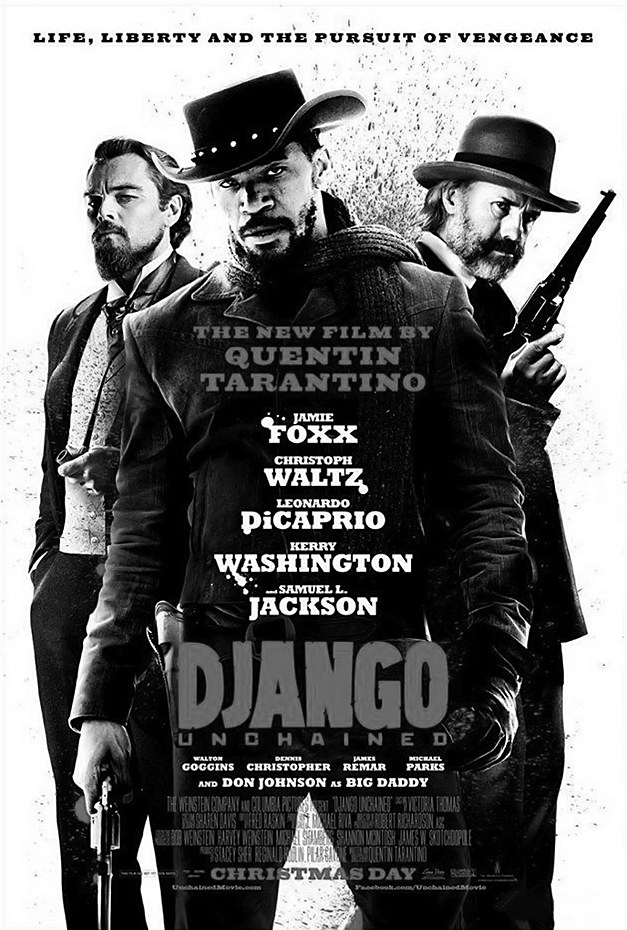
Similarly, given that Tarantino is known for his audacious fusion of gratuitous violence, clever pop culture, and independent art-house cinema (rather than, say, historical accuracy or ethical polemics), perhaps Django Unchained shouldn’t be enlisted in public sociological conversations. But regardless of Django Unchained’s ethical or cinematic value—whether pornographic replication or avenging restitution—the portability of this slavery spectacle for the delineation of post-racial citizenship needs to be interrogated now. As a sociologist interested in the visual construction of both freedom and oppression, I think the triumphant formation of black heroism against white brutality deserves critical scrutiny. At the very least, we sociologists should ask, can slavery and human depravity ever be objects of humor, of entertainment?
By opening with just one of Tarantino’s obscene displays of black-on-black violence, I want to position Django Unchained in the contemporary transnational context of the global war. In this context, black-on-black and brown-on-brown violence is presented to the white fetishistic gaze at the nexus of power, politics and pleasure. I find myself puzzled: Why are we so entertained by the racialized violence in this bloody slave-revenge western? What racial fetishes are enacted through this largely safe medium of witnessing racialized violence? What forms of pleasure are exposed through the humorous trope of black passivity, played so brilliantly by Samuel L. Jackson in the role of Candie’s enslaved right-hand man, Stephen?
Black passivity as a racialized ethos and black-on-black violence as U.S. spectacle carries over into the contemporary transnational landscape. The film’s “human cockfight” scene can be read as a site of extreme racist dehumanization, but it also functions as something deeply familiar—indeed, palatable—to the contemporary imagination. This scene addresses a U.S. viewing public that is literate in a set of referenced codes: the hyper-embodied (often, naked) black slave, the egoistic and opulent white supremacist, the Anglicized black jezebel, the uncomfortable (even socially awkward) white liberal, and the complicit black rebel, among others. Thus, this scene annexes the whole décor of the white colonial state into nothing more than a trompe l’oeil visual universe in which all the particularities of race, gender, class, and power can become parodies of themselves. Somehow, we know it’s grotesque, but it’s okay—it’s just setting the stage for colonial racism. Right?
Quentin Tarantino’s depiction of slavery and racial violence raised questions about Django’s fetishizing gaze.
©2012 The Weinstein Company
©2012 The Weinstein Company
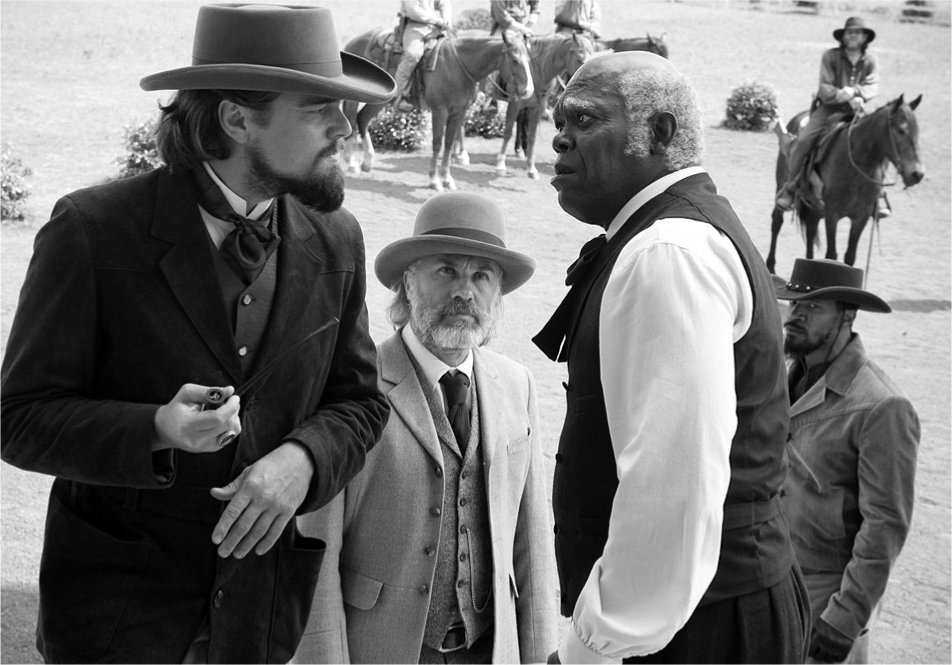
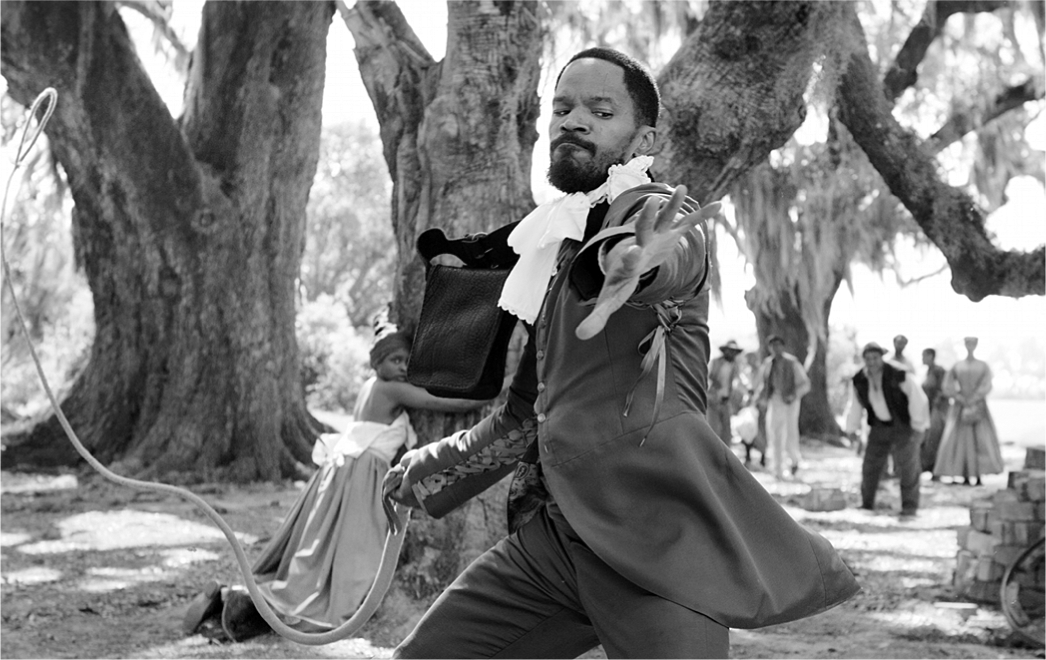
Like the proliferation of the 2003 Abu Ghraib photographs of the sexualized torture of brown, Muslim men, wherein political torture was manifested as erotic through visible, recorded, nonconsensual acts of S&M, hooding, sodomy, and public sex, Django’s first volley into Candyland testifies to the entertainment value of racialized violence. The power to see the other (in both cases, naked and sexed) has became equated with the power to know and to dominate. Any rage stemming out of race in the contemporary context needs to be regulated, disciplined, manipulated, and, if all else fails, incarcerated. As history has long shown us, building arsenals around race (and, now, the racialization of religion) is the pet hobby of a paranoid elite in a white racial state. It’s hard to see how this scene will lead to anything worthwhile.
But Django comes to show redemptive violence: black against white instead of the reverse, though it’s neatly framed within the context of white-on-black violence in Colonial America. So while the former narrative is largely unthinkable in American life, much less in big-budget pop culture productions, its location at the threshold of black emancipation allows black-on-white violence to be not just palatable, but enjoyable and even humorous. The film’s self-congratulatory tone is palpable throughout—a quiet winking that it has collapsed white colonial supremacy, usurped racist ideas, and allowed black men agency and resistance. For Django and for his audiences, each moment of white death operates as a step toward black emancipation, inciting applause and triumphant laughter in darkened movie theatres. This laughter is undoubtedly spiked with shame, as severe violence of racism in the U.S. becomes both visible and entertaining. An awareness of the depravity of slavery as the (main) human cost of a past colonialism ensures that the film is not cheap racist propaganda: the psychological complexity of say, Django or Dr. Schultz, is depicted so that liberals can enjoy the film without guilt.
Hence, the cinematic (re)production of the devastation of slavery by a white writer, producer, and director seems almost like satire. But Tarantino’s film is not satire. It is fiction disguised as redemptive history. Django, following the Maoist slogans, “dares to win.” His victory is seen as taking power and perhaps planting the seeds for a new socio-political reality. Tarantino’s juxtaposition between the noble black struggling on behalf of love and equality against the corrupt bourgeois, miserable human animals striving for profit and pleasure, produces the sine qua non of political history: a grand narrative that reverses an account of the corruptive force of capitalism. But Django is no radical hero. His subjecthood is centered on romantic love, his victory on his individual freedom, his curiosity on nothing but his own potential. Even his sympathy for his enslaved counterparts is laced with a disgust for the black passivity he works rigorously to shake off (it ties him, in his mind, to the white masters). In this regard, Tarantino, his creation Django, and their enamored audiences are, well… All-American.
This brings me to another key contemporary discursive fascination: racialized passivity. For Tarantino, this means black passivity, but in the transnational present, it’s Muslim passivity. Images of such passivity are ubiquitous tropes, not only for cinema, but also within other kinds of visual culture (e.g., mainstream news magazines that feature passive, downtrodden Muslim women, such as the covers of Time in August 2010 and National Geographic in August 2008). In Django Unchained, Candie’s trusted but duplicitous house slave, Stephen, functions as the evil sidekick to his master’s nefariousness; both characters have access to capital and exercise obscene forms of power. But unlike DiCaprio’s Candie, Jackson’s character is comic: he is the passive, stupid, older black male figure who functions seamlessly within his own subordination. Black passivity, in the film, is funny and repellant. Or as Frantz Fanon, in his polemic Black Skin, White Masks, tells us, “For not only must the black man be black; he must black in relation to the white man.” At the very least, Tarantino’s depiction of a passive black population slanders the enslaved and misunderstands history. At the Sesquicentennial of Emancipation, we might productively remember that the enslaved walked away and became “contraband.” Their status as soldiers (that is, men with guns) came far, far later.
Tarantino’s depiction of the Ku Klux Klan as a group of ill-equipped buffoons challenged dominant notions of white supremacy and masculinity.
©2012 The Weinstein Company
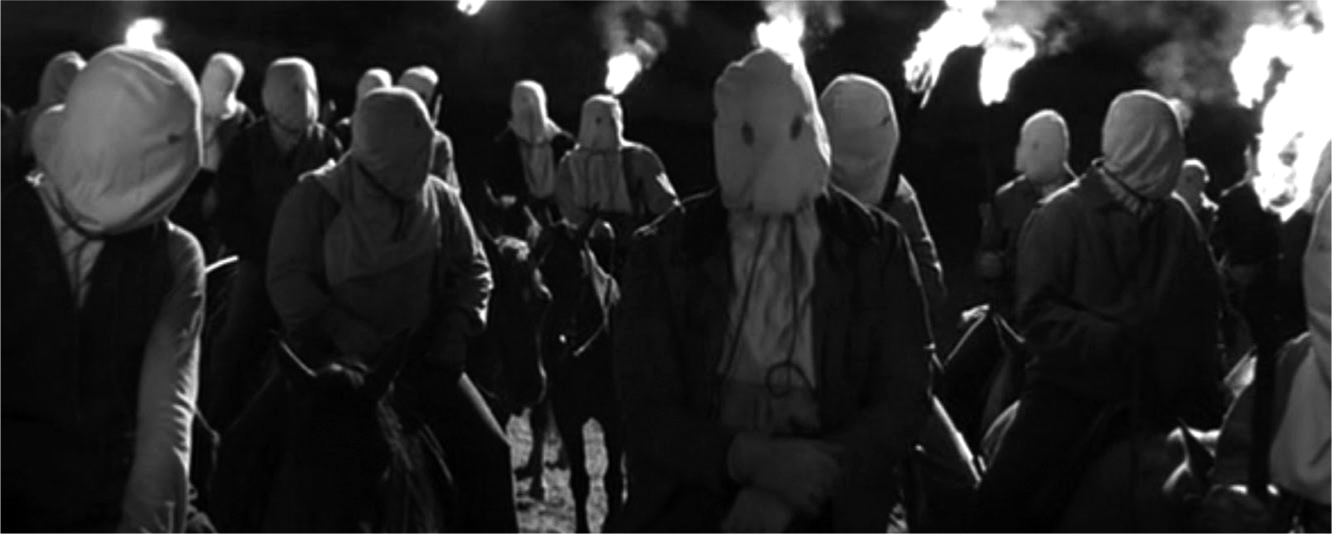
On the contrary, white masculinity is the identity most associated with mastery, wisdom, and grand narrative. It is anything but passive. We see this in Tarantino’s cinematic attempt to spoof the KKK: in Django, this group of white men are buffoons, complaining that the eyeholes in their hoods are not sewn in the right place and it’s blocking their view of the black people they are trying to kill. The comedic scene displaying white masculinity as stupid, racist, and violent is, perhaps, meant to undercut or justify all of the violence yet to come. Or, maybe it is meant to lighten the mood, nothing more than a moment of irony? As we know, KKK costumes are symbolic of white power, and yet this scene turns them into clothes sown by women (who is the Betsy Ross behind the KKK?). In any case, the scene domesticates the violence of white men, rendering it dumb and ineffective, less repellant than its racialized counterpart.
In the end, both colonial slavery and the contemporary context of the global war have economic roots, so maybe a high-budget, high grossing film is just the way to take them on. The former used dehumanized bodies as capital, the latter engages systematic brutality for politico-economic ends. The global war and the global prison complex rely on celling black and brown bodies, a process that emerges from the ideological sustenance of both black passivity and racialized violence. Can we even imagine a film that depicts Muslims successfully killing (white) Americans in a passionate, rageful way as a redemptive-glorified operation that reveals the white imperial state and nationalized racism? I suspect such a film will never be made. Historical and contemporary patterns of racialized punishment reveal Django’s absurdity rather easily. This film is not only a transparent attempt at moral elevation, but an act of bad conscience: a way to lick the wounds of the past by disarming contemporary black and brown rage through fictional vindication.