




Abstract
In 2012, an Asian American, Ivy-League educated basketball player captured the country's attention: what was it that made Jeremy Lin so exceptional, from his race to his physical and mental prowess to his athletic masculinity. In short: what led to the rise and fall of Linsanity? Will it have a legacy?
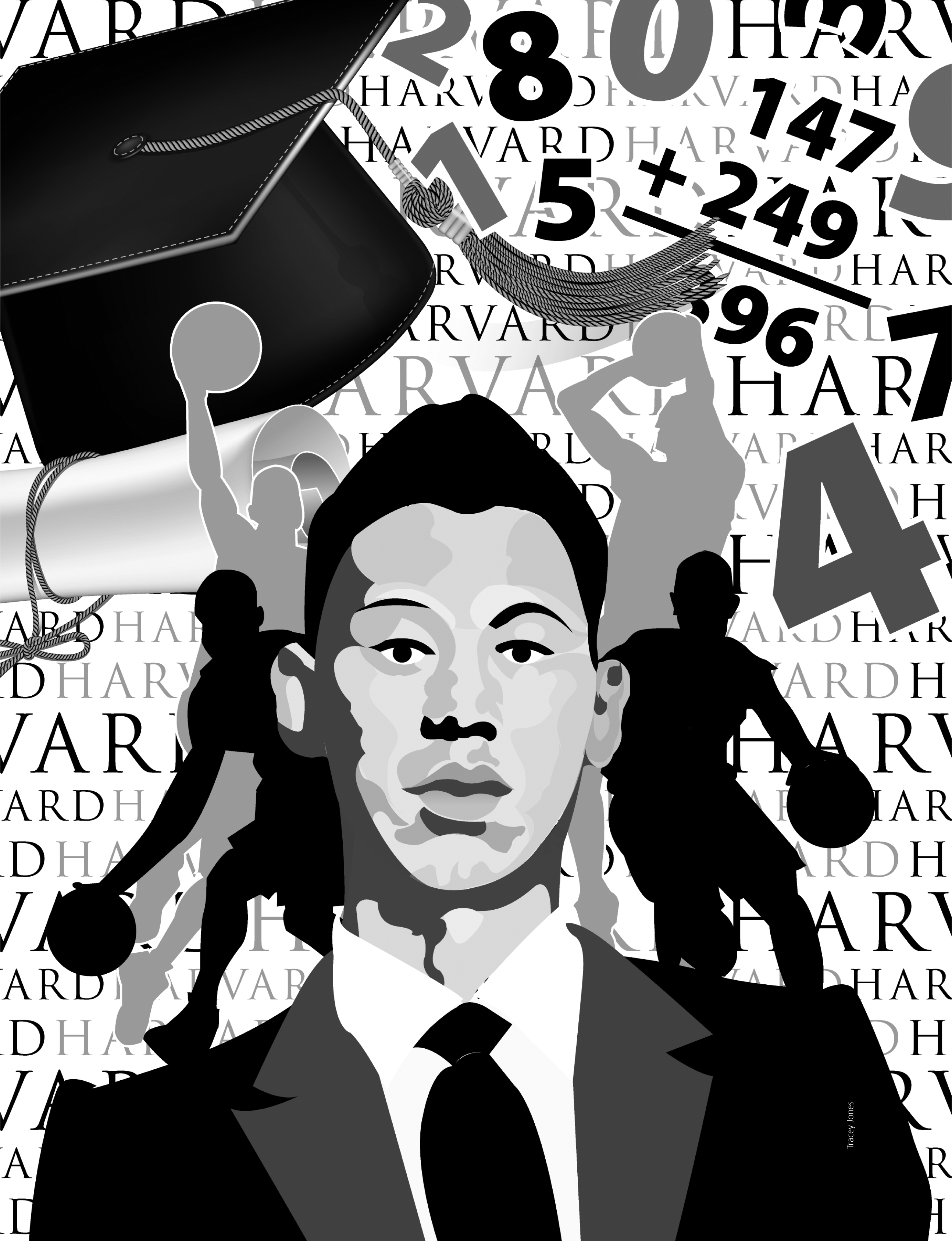
For a brief moment, NBA star Jeremy Lin offered Asian Americans a different way to imagine themselves—while affirming many longstanding myths about immigrant success.
By the time the New York Knicks and Los Angeles Lakers faced off in New York last February, breakout star Jeremy Lin had led the Knicks to a phenomenal three-game winning streak. Less than four minutes into the first quarter, the Knicks were leading 7-4, and Lin threw a perfect half-court pass to Tyson Chandler for an easy two-point slam. As fans in Madison Square Garden cheered the offensive attack, Lin mouthed the words “Come on!” The Knicks pressed their defensive attack, and a player from the Lakers dropped the ball.
The crowd sensed another quick score. Lin scooped up the ball and drove in for an easy lay-up. The Lakers called a time out and the fans erupted. Less than five minutes in, the Knicks had an uncontested 10-point run. Lin already had 9 points and 2 assists.
That night, a thousand miles away at Grinnell College in Iowa, I joined students from the Asian and Asian American Alliance to cheer on Jeremy Lin. Although we were unaware of it at the time, the game against the Lakers was one of the high points of what came to be known as “Linsanity”—the global cultural phenomenon that accompanied Lin’s meteoric rise from an unknown player to an international star.
The excitement began with Lin’s first game as a Knick in February 2012 and ended with the announcement of a season-ending knee injury only a month later. Since, Lin has left the Knicks to join the Houston Rockets and has struggled as a player. The national adulation that surrounded his breakout performance has largely faded.
The story of how Jeremy Lin became an NBA star is one of denied opportunities, enduring racism, and barrier-breaking in professional sports. Although his star has dimmed, Lin’s story is worth our attention.
The Model Minority—Again
Jeremy Lin’s success in the face of daunting obstacles both challenges the prevailing racial narrative of basketball and reinforces it, offering Asian Americans the chance to see themselves as something other than doctors, engineers, or accountants, while also affirming the belief that they are high achievers. In effect, Linsanity affirmed the myth of Asian Americans as the “model minority.” Through hard work and perseverance, Asian Americans supposedly show how any minority can overcome institutionalized inequality. At the same time, Lin’s achievements alone could do little to undo understandings of Asian men, exemplified by the docile honor student, that are at odds with male achievement in sports.
The model minority trope is taken for granted in U.S. media. In June 2012 the Pew Research Center released a report titled “The Rise of Asian Americans,” and it was big news. The report should have given Asian Americans—who comprise nearly six percent of the national population—a reason to celebrate. Sampling more than 3,500 people from six of the largest Asian ethnic groups (Chinese-, Filipino-, Indian-, Vietnamese-, Korean-, and Japanese-Americans), Pew’s report portrayed Asian Americans as an immigrant group that has successfully broken many social, political, and economic barriers. On the whole, Pew found, Asian Americans are highly educated, possess an admirable work ethic, and earn higher-than-average incomes.
The report goes on to describe Asian Americans’ strong family ties and high levels of happiness: “Most Asian Americans feel good about their lives in the U.S. They see themselves as having achieved economic prosperity on the strength of hard work, a character trait they say is much more prevalent among Asian Americans than among the rest of the U.S. population. Most say they are better off than their parents were at a comparable age. And among the foreign born, very few say that if they had to do it all over again, they would stay in their home country rather than emigrate to the U.S.”
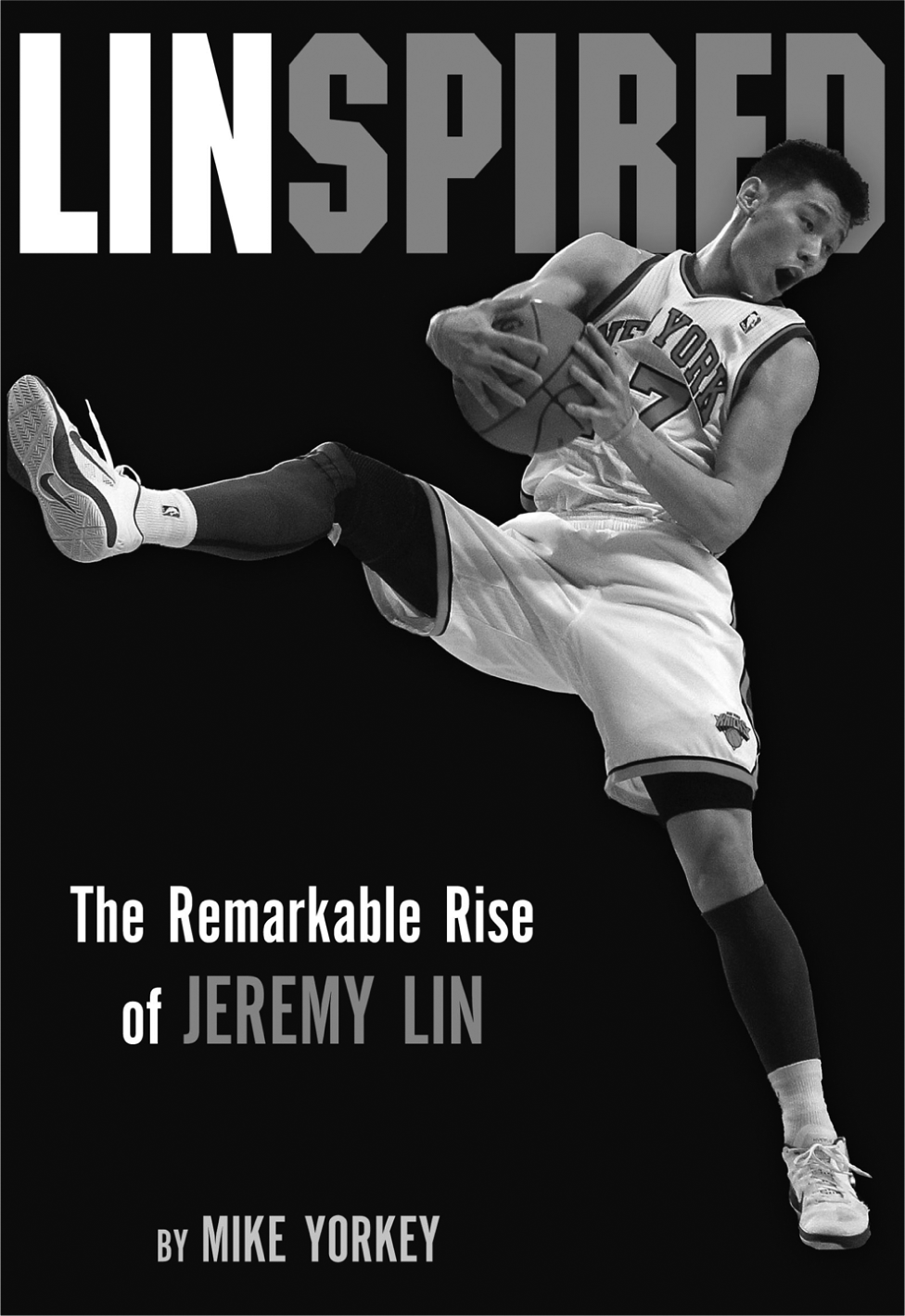
Just one of the many books written about Lin in 2012 and 2013.
Scholars, Asian American organizations, and advocacy groups—from the Japanese American Citizens League to the National Council of Asian Pacific Americans—criticized the report as “one-dimensional,” “exclusionary,” and full of “overgeneralizations” that portrayed Asian Americans as the torchbearers of American exceptionalism. California Congresswoman Judy Chu, who chairs the Congressional Asian Pacific American Caucus stated, “I would strongly caution against using the data [in the report] to validate the ‘model minority’ myth.” As she pointed out, “Our community is one of stark contrasts, with significant disparities within and between various subgroups.”
For example, another recent report, this time from the Asian American Center for Advancing Justice, showed that while Asian Americans are successful in terms of educational achievement compared to whites, specific ethnic groups (such as Hmong, Cambodian, Laotian, and Vietnamese Americans) have high school graduation rates as low as 61 percent and even lower rates of college graduation—numbers comparable to Latinos and African Americans. The Pew Report had lumped all these groups together as “Asian American,” ignoring some of the most distressed communities and the economic, health, and other challenges they face.
When research and portraits of Asian Americans are consistently framed this way, Asian Americans are almost always seen as superior to other minority groups in terms of educational achievement, economic stability, and social acceptance. Supposed exemplary Asian cultural values—hard work, perseverance, strong family traditions, a reverence for education, self-reliance, even self-sacrifice—are portrayed as unique among ethnic groups. As this story goes, even when Asian Americans face cultural and linguistic barriers, institutional racism, and other dramatically unequal treatment, they will not only overcome the obstacles, but do so without protest or complaint.
Popular culture has long portrayed Asian American men as geniuses, overachievers, computer geeks, or nerds. They’re shy and docile, humble and passive. If Asian American women are presented as exotic and hypersexualized, men are rendered effete, weak, and physically and sexually inferior. Examples range from the insufferable Long Duk Dong in the 1984 film Sixteen Candles to William Hung, famous for his cringeworthy rendition of “She Bangs” on American Idol in 2004. The character Raj on the hugely popular sitcom The Big Bang Theory is the most recent example of an image of a socially dysfunctional Asian American man. Such representations leave Asian Americans to struggle against broad stereotypes that are as inaccurate as they are negative—especially in a culture that prizes traditional masculinity.
Jeremy Lin’s breakout success gave Asian American men a striking respite from these oppressive images. Lin is tall, strong, aggressive, and physically gifted. Far from shy or quiet, he’s a powerful player in a physically demanding sport, displaying style and swagger on a huge media stage. The Linsanity phenomenon marked more than just the international embrace of a spectacular new Asian American sports star—it posed a challenge to emasculating stereotypes.
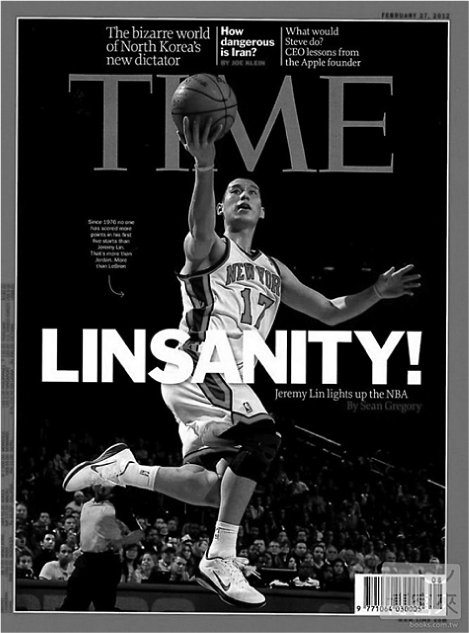
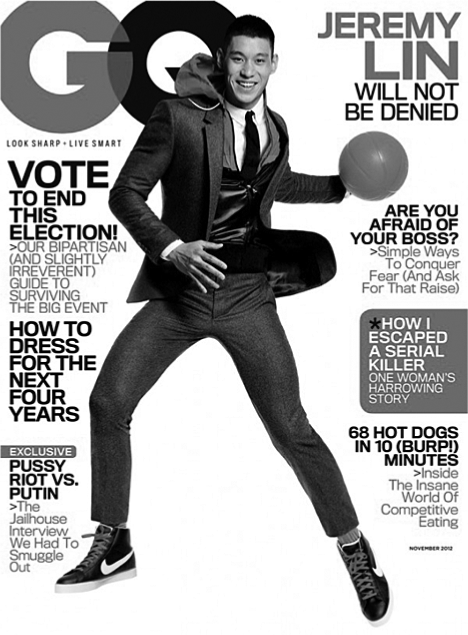
Jeremy Lin graced the cover of countless periodicals during the few short weeks of Linsanity, challenging stereotypes of Asian men.
©2012 Source Interlink Magazines, LLC
©2012 Time, Inc. A Time Warner Company
©2013 Condé Nast
©2012 Time, Inc. A Time Warner Company

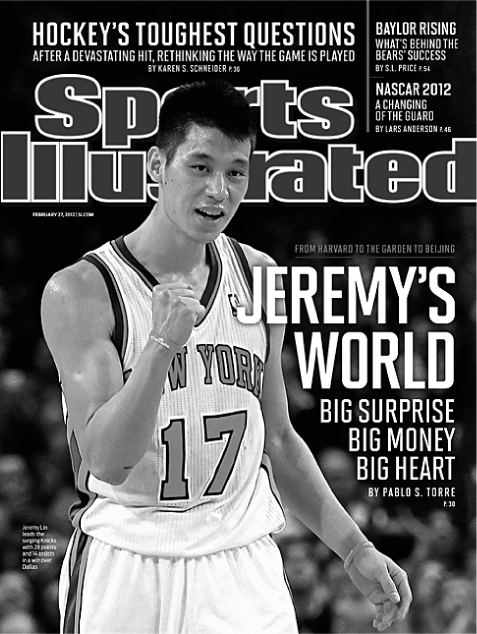
At the same time, Lin could be the poster child for the Pew Report. He was smart and driven, but overlooked by college recruiters and the NBA draft, and he bounced from team to team. His hard work and focus—model behavior—paid off in the form of a phenomenal ascent to the upper echelons of a multi-billion dollar sport.
Invisible Man?
The myth of the model minority is central to understanding the story of Jeremy Lin’s encounter with discrimination and his subsequent success as a professional basketball player. Likely because he did not fit expectations about what an elite basketball player looks like, Lin was a talented player but flew under the radar. The fact that many college coaches and recruiters later admitted that they’d failed to recognize Lin’s talents suggests they couldn’t see “past” his Asian features.
As Lin himself said in an interview with EPSN in 2012, “I was very disappointed, discouraged. I’m undrafted, I’m out of Harvard. ‘Asian American.’ That was kind of the perception everyone had of me and that was kind of the perception I had of myself. And when everyone thinks that, then it’s hard to break that.”
Yet Asians and Asian Americans who play basketball are not a wholly new phenomenon. There have been Asian players in the NBA—most notably Yao Ming of the Houston Rockets and Wataru Misaka, the first Japanese American to play professional basketball with the New York Knicks in 1947. There have also been standout Asian American college players such as Raymond Townsend, part-Filipino, who played for UCLA in the 1970s; Corey Gaines, part-Japanese, who played for Loyola Marymount University in the ‘80s and Rex Walters, part-Japanese, who played for Kansas in the early ‘90s.
As Lin’s remarks on ESPN and in a more recent television interview suggest, he is the first professional basketball player to deliberately and comfortably claim his Asian American heritage and be acknowledged as such by his fans. He has directly confronted the experience of social invisibility he experienced on his way up. And yet Lin’s success as a Knick is still couched in the default language of the model minority: he worked very hard to get to the top. He’s got intelligence—not just talent. If African American point guards are the norm in basketball, then Jeremy Lin is an anomaly whose existence almost demands explanation.
In his second career appearance against the Houston Rockets, Lin had an impressive showing, even though his Knicks trailed throughout the game and eventually lost. Late in the third quarter, one of the television sports show hosts commented about Lin’s overall performance: “He’s a hustler; he runs the show. Very intelligent player. Does the fact that he went to Harvard help that? Absolutely!”
Lin offers Asian Americans the chance to see themselves as something other than doctors, engineers, or accountants, while also affirming the belief that they are high achievers.
But what does Lin’s intelligence or Harvard degree have to do with his basketball skills? One could say that all professional athletes need intelligence to perform exceptionally. One might also observe that playing point guard requires especially intelligent play—a successful player in this role must read defenses, make plays, and provide assists. But in relation to race, “intelligence” is a loaded word.
According to sociologist Douglas Hartmann, “because of sport’s de facto association with bodies and the mind/body dualisms …African American athletic excellence serves to reinforce racial stereotypes by grounding them in essentialized, biological terms.” He continues: “Athletic prowess is believed to be inversely associated with intellectual and/or moral excellence.” Reporting and commentary about black basketball players, for example, often refers not to their formal education, but to an “urban experience” of playing basketball in the streets.
In contrast, Lin’s “intelligence” on the court was tied explicitly to his Ivy League education, even though Lin began playing the game at his local YMCA and on neighborhood playgrounds in Palo Alto, California. It’s the model minority discourse at work: educational achievements are primary, and the physical experience of playing ball is less central.
©2012 NYP Holdings, ©2012 Daily News

In the Lin narrative, basketball is a meritocracy based on skill, and those who rise to the top earn their rewards. This reaffirms the classic American story that those “who work hard and possess the right stuff will always prevail”—and deserve to, according to sociologist of sport Susan Birrell. Conversely, those who try and fail? They didn’t work hard enough.
Trying to Flip the Script
Despite the Asian American basketball players who came before Jeremy Lin, his stunning performance on the national stage confirmed something Asian Americans know, but had rarely witnessed: We can jump, drive, and shoot the ball. According to sociologist Oliver Wang, Linsanity made Asian Americans playing professional basketball “a national concept.” Lin’s triumph resonated with Asian Americans and many others, and it led some to believe Lin could present a real challenge to longstanding stereotypes.
The Linsanity phenomenon posed a challenge to emasculating stereotypes.
Not only do Asian Americans hope that Lin is the real deal, a truly talented basketball player of NBA caliber, we also want to see the devotion he has generated translate into real changes in perceptions of Asian Americans. For us, it is hard to overestimate the pure euphoria of seeing this man lead on the court, outmaneuver defenders, and make clutch plays—all with confidence, bravado, and off-court dignity.
This year, the documentary Linsanity, directed by Evan Jackson Leong, premiered at the Sundance Film Festival and opened San Francisco’s Center for Asian American Media’s annual film festival. Audiences cheered, giving it a standing ovation. An inspirational basketball story told through Jeremy Lin’s eyes, the film documents his rise to stardom.
Although Linsanity lasted just three glorious weeks, Jeremy Lin still offers a powerful new image of Asian American male sport prowess that both challenges and reaffirms the model minority myth. His success offers a critical commentary on how we understand the contradictory and often frustrating place of Asian Americans in American culture.
In March 2013, Wall Street Journal columnist Jeff Yang, discussing the Leong documentary, told eager readers: “Keep your eyes peeled, sports fans. Linsanity may well end up having a sequel.” Although Jeremy Lin has faded from basketball stardom, his story, by reaffirming some stereotypes while calling others into question, gives us a way to understand Asian Americans’ complicated relationship to American cultural values.