




Abstract
Longitudinal data suggests that the single adult homeless population is going through a demographic transition, where the overall population is aging but there are indications that a younger cohort may be emerging. Scholars Dennis P. Culhane, Stephen Metraux, Thomas Byrne, Magdi Stino, and Jay Bainbridge argue that interventions at both ends of this transition: housing the aging and increasingly infirm elements of this population while diverting at-risk younger populations from homelessness, have the potential to make a lasting reduction in this population.
Keywords
Chronic homelessness is at a demographic crossroad. In the 30 years since homelessness in its contemporary form first manifested in U.S. cities, it has ascended to one of the most prominent American social problems. Despite the current push by advocacy organizations to end homelessness, many expect it will always be with us. However, a closer examination of age and aging in chronically homeless populations offers an opportunity to intervene.
Homelessness looked very different four decades ago: Images of skid row scenes populated with old, alcoholic men were vestiges of the depression-era and reflected the many who remained down and out through the decades of prosperity that followed World War II. As the individuals represented by this urban archetype grew older and died, researchers noted significant demographic shifts among those who were experiencing housing challenges in the early 1980s. This “new” homelessness stood at odds with skid row stereotypes. The predominant demographic groups in the new homeless population were able-bodied young men, mostly black, and young women with their children. A new generation of destitute poverty had burst forth, comprised of people primarily born between 1954 and 1967, who had the misfortune of coming of age during the double-dip recessions of the late ‘70s and early ‘80s.
Age Distribution of Single Adults in NYC shelters
Source: New York City Department of Homeless Services
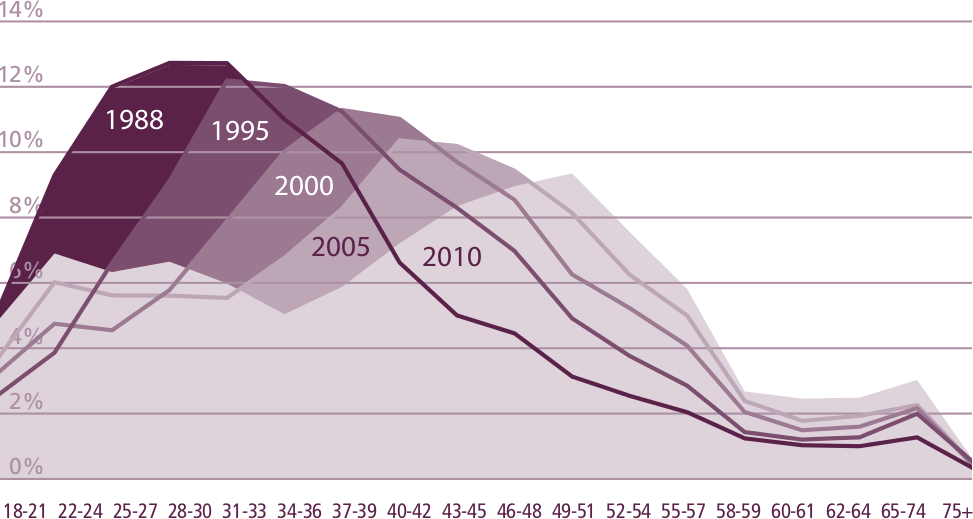
Data from 22 years of New York City shelter records and from the last three decennial census enumerations show a distinct cohort effect among the single adult homeless population. The age distribution of all single adults who stayed in New York City shelters has shifted to the right over time (see chart below, left). In other words, this population is aging. The peak age frequencies, which ranged from 28 through 33 in 1988, have progressed to ages 46 through 51 in 2010. The single adult homeless population here consists primarily of a male, mostly minority cohort born between 1959 and 1964, the last years of the baby boom generation.
This chart does not include adults in families that are homeless. In contrast to their unaccompanied counterparts, the ages of heads of NYC families that are homeless have remained unchanged over time with a modal age in the early 20s. This suggests that heads of families experience homelessness in conjunction with the difficulties of raising young children in poverty, and that they are able to advance economically as children get older. These dynamics deserve their own assessment, however, and the focus here is on adults who are without children and chronically homeless.
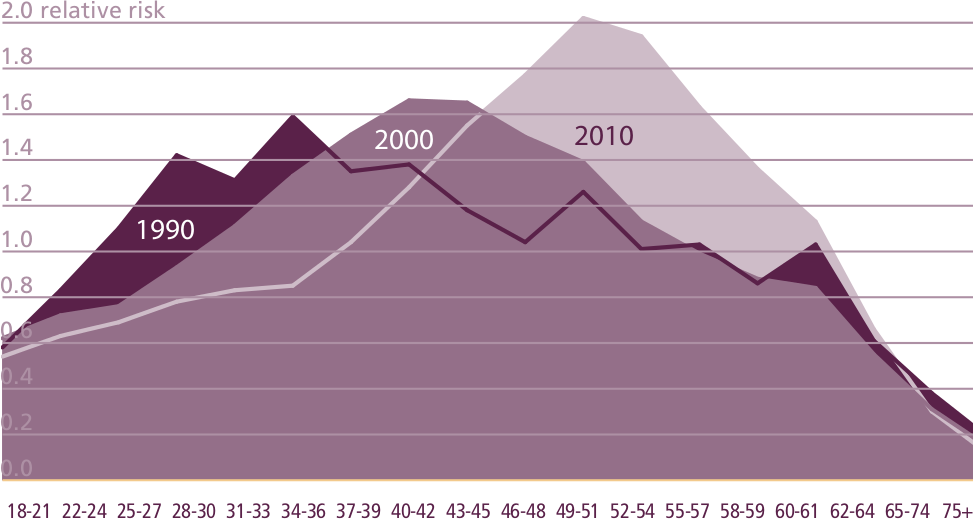
The age distributions of the homeless population are also available from the last three decennial census enumerations, and gauging the proportions of homelessness among age groups in the overall U.S. population provides the “relative risk” for each age group. Relative risk shows the degree to which a particular subgroup is at risk for experiencing an event as compared to the risk for the remaining population. Because the U.S. Census Bureau does not differentiate between a person being homeless as an individual or with a family, we look here only at males, who, when they experience homelessness, overwhelmingly do so as individuals. The chart to the right on the previous page shows a moving bulge, or aging trend, in the ages with peak relative risk. In the 1990 census enumeration, those aged between 34 and 36 had over one and a half times the relative risk for homelessness as the rest of the U.S. population (RR=1.6). In subsequent enumerations, the age groups with the highest relative risks for homelessness shifted to 40 to 42 (RR=1.7) in 2000, and then to 49 to 51 (RR=2.0) in 2010.
Relative Risk For Shelter Use Among Adult Males in US
Source: U.S. Census
Aging, Increasing Risk, and Decreasing Services
A confluence of factors potentially explains this trend. This late baby boom cohort faced tightened housing and labor market conditions as they came of age in the late 1970s and early 1980s. Depressed wages for unskilled workers, higher rates of youth and young adult unemployment, and rising rental housing costs raised the risk of housing and labor market problems for the most disadvantaged members of this cohort. Back-to-back recessions in the late 1970s and early 1980s exacerbated the problem. Among the most disadvantaged—disproportionately low-income, minority, urban youth—many never found employment in the formal labor market and instead spent much of their adult lives cycling between unemployment, working in the informal economy, and occasional stints in menial, low-paying jobs. Many of these men also spent time in drug treatment programs and/or were incarcerated which diminished their connections to the labor market and their families further. This pool of poor young adults was also expanding at a time when cutbacks to social welfare systems were weakening the safety net. Anti-poverty, child welfare, and homeless services systems were already overwhelmed and increased demands represented by this expanding population went unanswered. Instead, the corrections system rose to meet the demand.
Today, most of the men in this cohort are in their early 50s. Given a life expectancy of 64 for single men who are chronically homeless, this cohort is now approaching premature old age. The cohort that has been the bulwark of the single adult homeless population since the1980s likely will fade into history soon. But not before issues related to the medical frailty of aging ensure that they will have one last, profound impact on the social welfare system.
The Next Generation
Predictions of an overall decline in the single adult homeless population as these men age may be premature. Data from New York indicates that a new, young single adult cohort is emerging among the homeless population. Starting in 2000, and becoming more visible in subsequent years, is a bump among the groups in the 22 to 30 age range that suggests a new generation of homelessness. The many youth who grew up under the jurisdiction of the foster care and the juvenile justice systems are particularly at risk for chronic challenges in finding employment and housing. New veterans returning to civilian life after tours of duty in Iraq and Afghanistan have also been a substantial source of young adult homelessness, with recent data indicating that as many as 13,000 young veterans became homeless in 2011. States are increasingly adopting alternatives to incarceration that have led to decreases in the nation’s prison population over the past two years, the first such decline since the 1970s. If this decline continues, large numbers of incarcerated persons will filter back into a society for which they are poorly prepared; similar to the deinstitutionalization of persons with mental illness in the latter part of the twentieth century. All these trends play against a backdrop of sustained unemployment rates of nearly 30 percent among young black and Latino adults, a level not seen since the mid-1980s.
©iStockphoto/HelpingHandPhotos
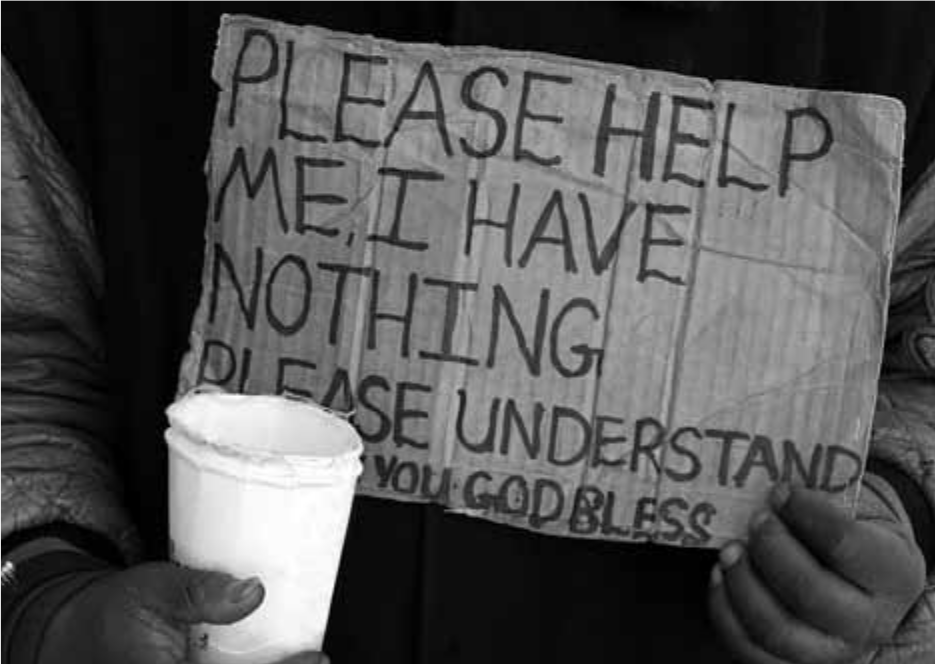
Today, the predominant age of the men in this cohort is early 50s. Given a life expectancy of 64 for single men who are chronically homeless, this cohort is now approaching premature old age.
If we wish to end homelessness among single adults, each end of this age distribution calls for different policy responses. At the older end, the needs of an aging homeless population fit well with the current policy emphasis on ending homelessness through the greater availability of permanent supportive housing. This approach combines affordable housing with support services (while bypassing the traditional shelter system) to place people who are homeless directly from the streets into their own homes. Supportive housing has been successful in housing the most chronic and recalcitrant among the homeless population (with one-year tenant retention rates typically exceeding 85 percent), and has been a key reason why, despite the worst recession in decades, the number of chronically homeless people in the United States has declined by a third since 2005 to 110,000.
Key to countering the budding trend of homelessness among younger men is the development of a range of prevention initiatives that target at-risk populations. Researchers and service providers are becoming more adept at identifying those most likely to become homeless and targeting prevention services to them. Such approaches include the Homebase program in New York City, which provides enough short-term emergency assistance to permit families on the verge of homelessness to weather their housing crises. Other approaches are broader and more “upstream”: seeking to reach households before they are at the shelter door. These include initiatives that provide ongoing housing, financial, and educational support for young adults who age-out of foster care placements; and veterans programs that provide a range of supports for veterans and their families in their transition from military life. But more broadly based and systematic programs that target issues such as youth unemployment and prison reentry on a large scale need to be put into place if we are to effectively prevent another generation of homeless.