




Abstract
Sociologists John Foran and Richard Widick explore the nature of the current global impasse on climate change negotiations, and argue that an emerging alliance among progressive nations and climate justice movements, and especially youth, offers grounds for cautious optimism.
Keywords
<< At the 2011 U.N. climate talks in Durban, South Africa, Oxfam dramatizes the devastating impact of climate change on the world’s poor.
Ainhoa Goma/Oxfam
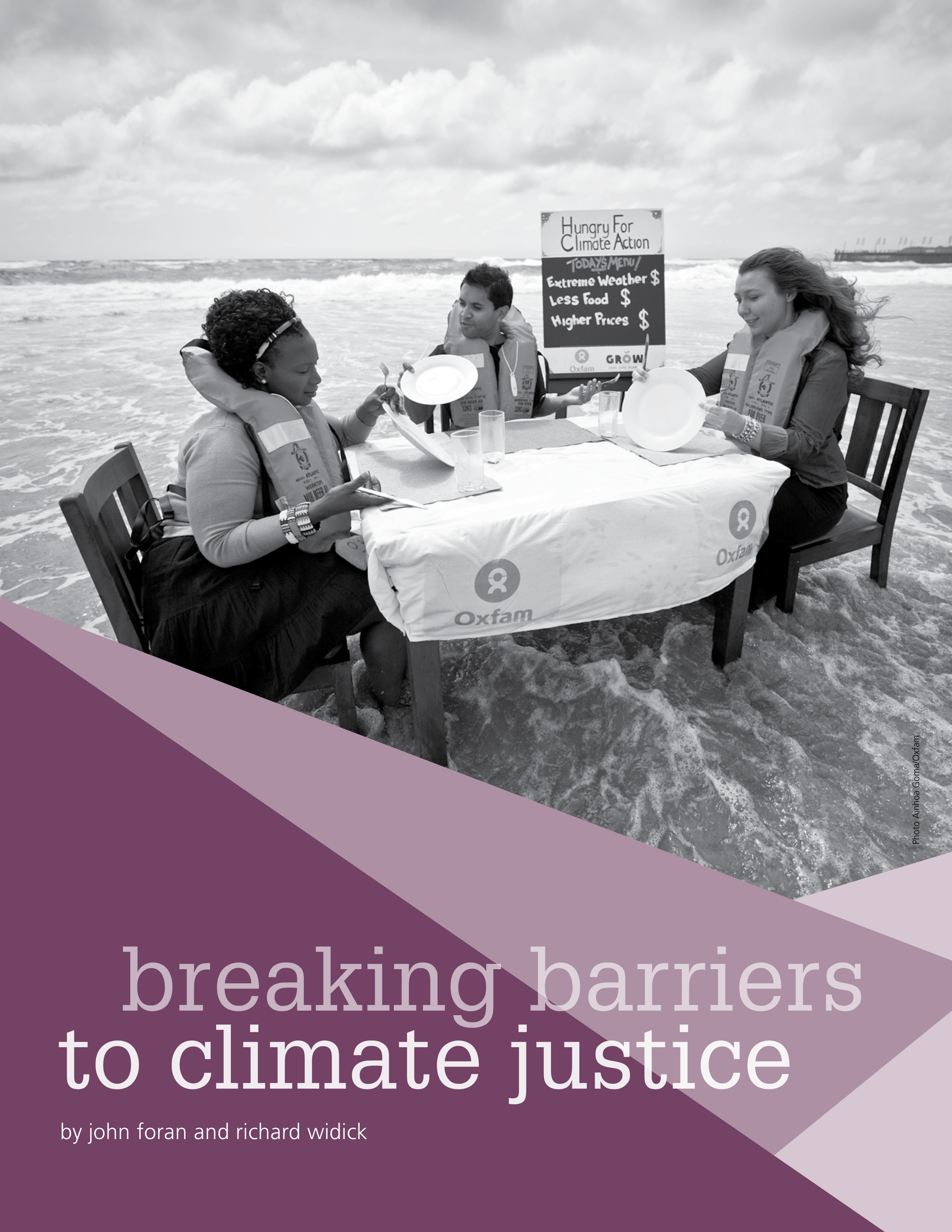
At the end of last year, the United Nations convened its annual climate talks in Doha, Qatar, attempting to negotiate binding international agreements on climate change. By limiting future temperature rise to two degrees Celsius, it hopes to stave off the worst effects of irreversible, possibly catastrophic changes in the climate system.
These negotiations have been ongoing for the past 18 years and now appear locked in a long-term stalemate. At the previous summit, in Durban, South Africa, we observed on one side, a shifting line-up of wealthy oil-producing countries and developed industrial economies, and on the other, the European Union and some emerging and still developing nations, largely of the global south. While the first group—led by the United States, Japan, India, Canada, Russia, and South Africa—drags its feet on moving toward a low-carbon future, the second struggles for sharper, more equitable emissions cuts by developed and emerging nations and financial transfers to help their countries replace fossil fuels with renewable energy.
Meanwhile, China, the world’s biggest emitter, plays a complex role in these negotiations—sometimes inside, and sometimes outside both groups. And to complicate things further, carbon dioxide emissions are up nearly 50 percent since the negotiations began, leaving many wondering whether the U.N. process is part of the problem rather than the solution.
We attend these annual climate talks—formally known as the Conferences of Parties (COP) to the U.N. Framework Convention on Climate Change (UNFCCC)—intent on discovering who and what is obstructing progress, and how the stalemate might be broken. As public sociologists, we want to contribute by joining the global climate justice movement in demanding equity in all climate governance, and by helping underrepresented voices be heard at the annual summits. At the Durban talks we interviewed activists and scholars, sat with delegates and listened to their speeches, collected documents, and attended sessions both inside and outside the negotiations.
On the final day of the proceedings, we saw frustrated activists and even official members of some national delegations raucously engage in civil disobedience, occupying the conference corridors. And we witnessed an emerging alignment among progressive nations, youth movements, and global civil society organizations around demands for “climate justice”—a coalition that may represent a way out of the stalemate.
Making a Better Treaty
The scientific consensus on climate change is by now well established, and in dispute only in the United States, where powerful fossil fuel corporations spend millions of dollars on media designed to shape the political debate and sow confusion. For climate scientists, the two-degree limit, and a return to no more than 350 parts per million of carbon dioxide in the Earth’s atmosphere—currently we are at 394—is the maximum allowable threshold. If these limits are exceeded, scientists predict a centuries-long epoch of extreme weather, sea level rise, extinction of species, and untold social unrest due to mass human migrations, famines, and wars.
At face value, the Durban decisions appear to confront the problem of climate change directly and ambitiously. The COP sustained the faltering Kyoto Protocol and mandated the negotiation of a new global climate treaty. It also advanced the Green Climate Fund, primarily market-based initiatives and financial mechanisms that seek to mitigate climate change. Chief U.S. climate negotiator Todd Stern, corporate business leaders, and other powerful actors declared their satisfaction with these decisions, echoing the words of the conference’s South African president, Maite Nkoana-Mashabane: “What we have achieved in Durban will play a central role in saving tomorrow, today.”
Against these optimistic pronouncements, leaders of the global climate justice movements declared that the Durban decisions are disastrous for the planet. They argued that in order to keep the Earth from heating up beyond the two-degree mark in the twenty-first century, more rapid action is necessary. Shannon Biggs, part of the Climate Justice Now! network, lamented that “the UNFCCC stunned even seasoned observers with a plan tantamount to genocide.” Emissions targets were dropped, loopholes for the worst offenders were permitted, and most critically, key decisions were put off until 2020.
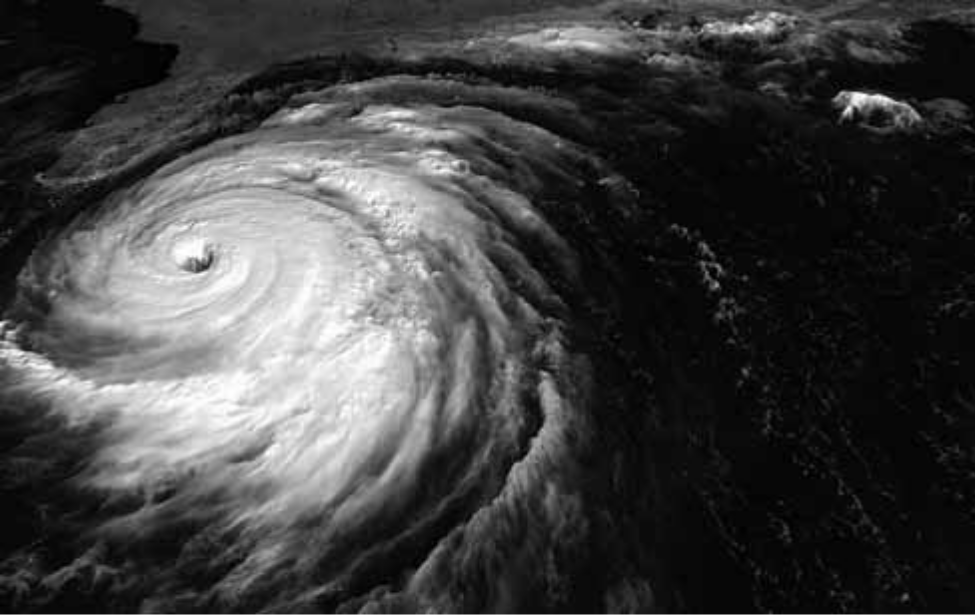
Scientists predict climate change will bring more frequent and severe storms.
Hal Pierce, NASA Goddard Space Flight Center
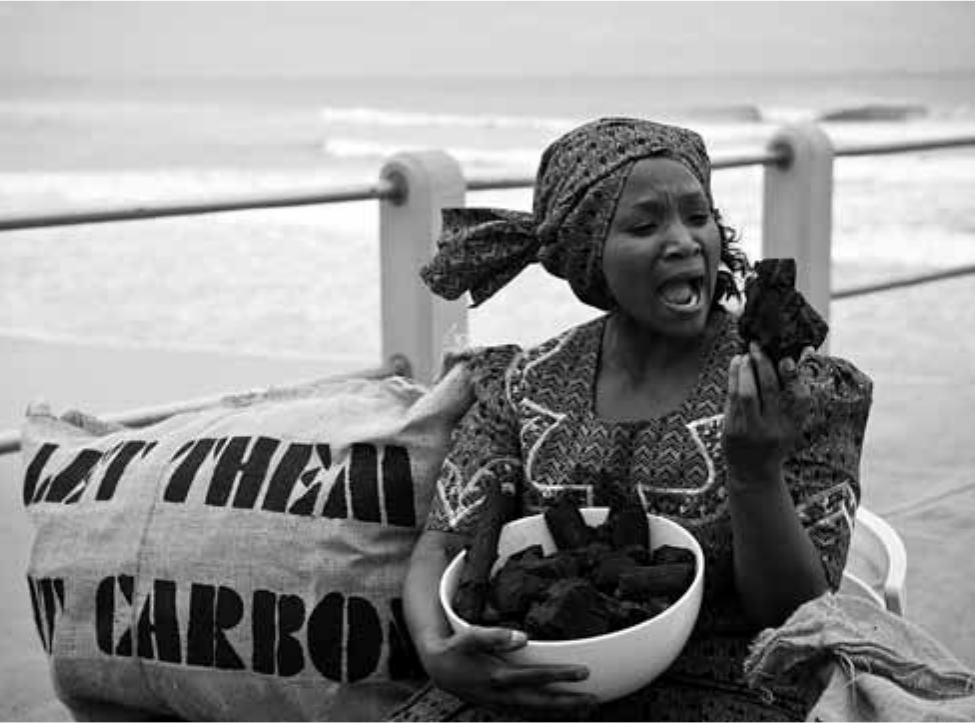
Coal emissions create climate changes that place our global food supply at risk.
Ainhoa Goma/Oxfam
Suggesting that delaying action until 2020 is a “crime of global proportions,” Nnimmo Bassey, the charismatic Friends of the Earth International spokesperson, observed that the likely “business as usual” increase in global temperatures of four degrees Celsius is “a death sentence for Africa, small island states, and the poor and vulnerable worldwide.” Invoking the Occupy movements, he argued that the summit was enacting a kind of “climate apartheid,” whereby the richest one percent of the world have decided that “it is acceptable to sacrifice the 99 percent.”
An emerging alignment among progressive nations, youth movements, and global civil society organizations may represent a way out of the stalemate.
Activists felt they had made little progress in compelling the U.N. and their home states and industries to take decisive steps to meet the real needs of the planet. Many saw their work as NGO delegates representing civil society, and their movement-building work outside of the negotiations, as ineffective. Asad Rehman, the London-based head of the International Climate Committee of Friends of the Earth, told us: “We have to ask ourselves, and for me the most fundamental question is: why are we so weak? Why is the political climate justice movement ineffectual, divided, weak and unable to exercise political power?”
Yet an emerging alignment among progressive nations, along with the rise of youth and global civil society activists, suggests there are reasons to remain cautiously optimistic about the U.N. process, and hopeful that the climate change stalemate can be broken.
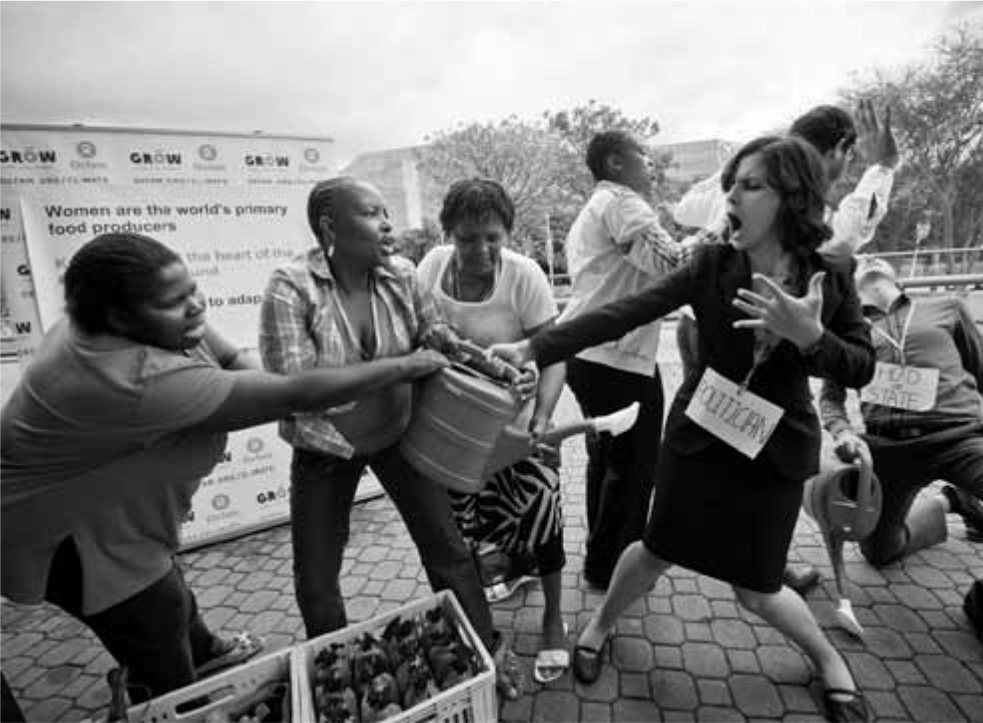
Women farmers “negotiate” with politicians who hold power over water and other necessary resources.
Ainhoa Goma/Oxfam
New Alignments
The two-week negotiations saw a large, loose coalition of countries committed to a just and binding treaty form stronger alliances. The 39-member Alliance of Small Island States (AOSIS), on the front lines of ocean waters that are already rising, demanded that global emissions be cut deep and fast enough to limit warming within a range of 1-1.5 degrees Celsius. An equally wide-sweeping set of demands came from the progressive Latin American Bolivarian Alliance (ALBA) nations, including Venezuela, Ecuador, Nicaragua, and Cuba, led by Bolivia and its indigenous president, Evo Morales, a staunch defender of measures to reduce global warming.
The majority of the Group of 77, a coalition of 132 African, Asian, and Latin American nations, also tried to move toward a serious treaty. These three groups exerted pressure on the 27-member European Union (EU) to affirm a long-standing position that mandates deep emissions cuts by the global North, and the payment of a substantial climate debt to the countries of the global South.
Perhaps three-quarters of the world’s countries demanded far more ambitious measures to avert the worst impacts of climate change. They argued that since the wealthy industrial nations have placed most of the humanly-created carbon dioxide into the atmosphere, they have an historical responsibility to make the deepest cuts. They also argued that the wealthy should subsidize the transition to low-carbon economies in the rest of the world. If these countries maintain their stance, there’s a chance the stalemate might break in the direction dictated by scientific necessity and demanded by social justice.
Meanwhile, as states were jockeying for position in the high-level meetings, youth activists came to Durban from everywhere to present their demands. Even before the U. N. conference started, activists gathered for three days of workshops and movement building. Heather Bruer of the Australian Youth Climate Coalition described their agenda: communicating the gravity of climate change, and building “strong, effective, strategic, positive, cool, engaging, and effective movements” in their countries. Young people, she said, are the “biggest stakeholders in this debate and absolutely the people who need to be most into this because it is our future that is at stake.”
Youth Step Up
Everywhere we turned, the global youth movements presented delegates with unflagging urgency, conveying the feeling that something unexpected might occur. Aaron Packard, a young New Zealander helping build climate movements among the Pacific island nations, described his strategy of “being the most joyful person in the room—that can change the energy of what’s happening in the room. And I guess the other thing is just believing in the people you work with.”
In the second week of the conference, at a press briefing by Canadian Minister of the Environment Peter Kent, six young citizens of that country stood up, turned around, and displayed t-shirts proclaiming “Turn your backs on Canada!” On the eve of the conference, their country had announced that it would pull out of the Kyoto Protocol, and that it would facilitate the massive financial and political investments in the hugely destructive tar sand oil fields of Alberta. Leading climate scientist James Hansen has warned that if the dirty tar sands oil is extracted and burned, it is essentially “game over” for the environment.
Working with U.S. activists, these Canadian youth had helped to successfully block the TransCanada Corporation’s Keystone pipeline, designed to bring synthetic tar and crude oil from Canada to U.S. ports on the Gulf of Mexico, and helped force the White House to withhold approval until a careful study of the pipeline’s environmental impact has been conducted. Empowered by success at home, they brought their symbolic protest to Durban, keeping the media spotlight on the pipeline controversy.
Middlebury College student Abigail Borah shouted down chief U.S. negotiator Todd Stern as he prepared to address the press. “2020 is too late to wait!” Borah implored the audience. “We need an urgent path to a fair, ambitious, and legally binding treaty!” Continuing, she demanded: “You must take responsibility to act now, or you will threaten the lives of the youth and the world’s most vulnerable. You must set aside partisan politics and let science dictate decisions. You must pledge ambitious targets to lower emissions, not expectations. 2020 is too late to wait!”
On the last day, civil society spokespeople were allowed to address the closing plenary, and Anjali Appadurai, from Maine’s College of the Atlantic, delivered a passionate plea for delegates to heed the voices of the world’s youth: “I speak for more than half the world’s population,” she said. “You’ve been negotiating all my life. In that time, you’ve failed to meet pledges, you’ve missed targets, and you’ve broken promises.“ According to the International Energy Agency, we have five years to avoid irreversible climate change, she said. “The science tells us that we have five years maximum. You’re saying, ‘Give us 10.’”
Droughts, like this one in southwest China, destroy crops and leave hundreds of thousands of people without drinking water.
ChinaFotoPress/Getty Images
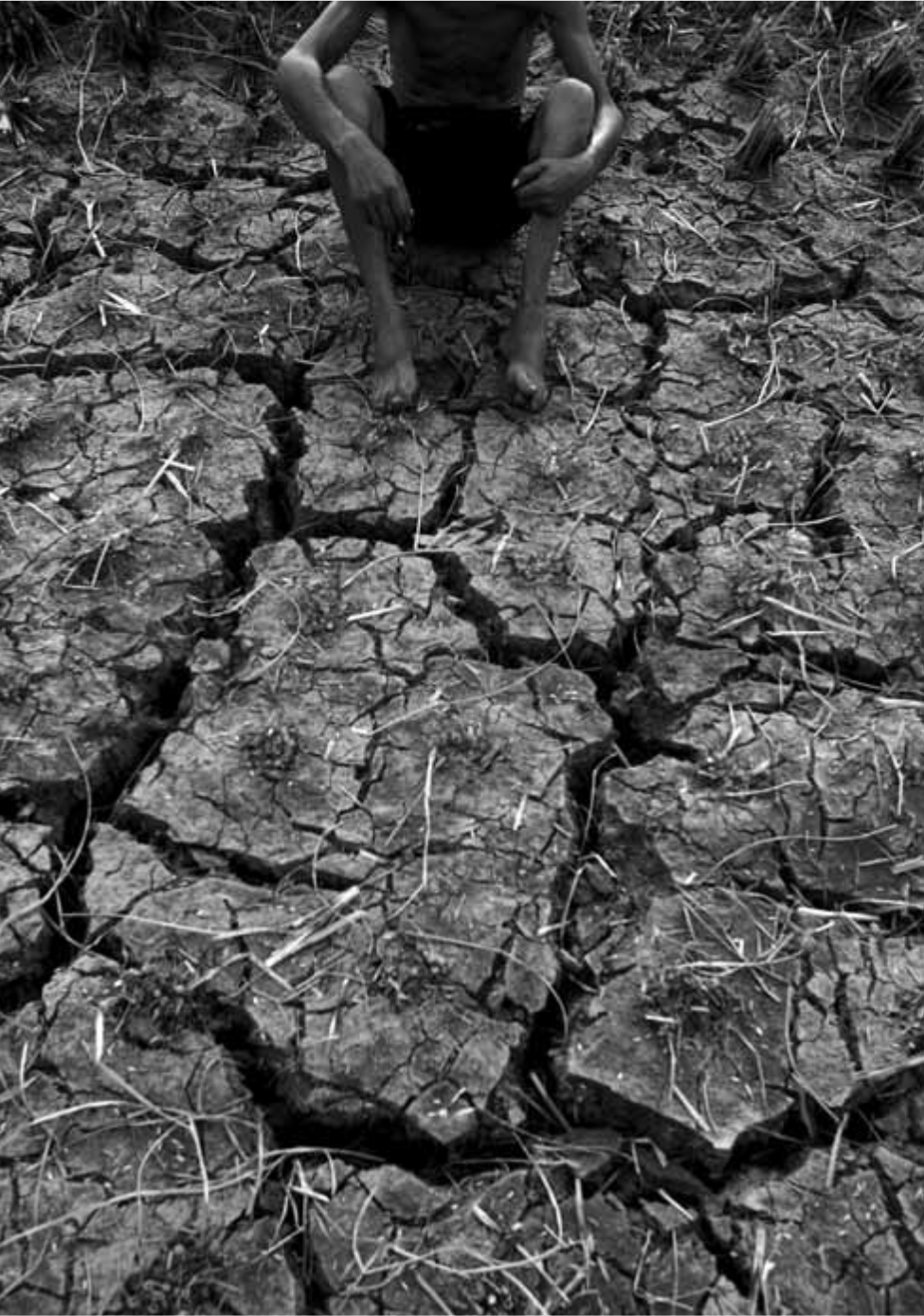
The scientific consensus on climate change is by now well established, and in dispute only in the United States.
She spoke of the “stark betrayal of your generation’s responsibility to ours,” asking: “Where is the courage in these rooms? Now is not the time for incremental action,” she said, telling the crowd this will be seen as “the defining moments of an era in which narrow self-interest prevailed over science, reason and common compassion.” There is real ambition in this room, she added, “but it’s been dismissed as radical, and deemed not politically possible.”
But long-term thinking is not radical. “What’s radical,” she said, “is completely altering the planet’s climate, betraying the future of my generation, and condemning millions to death by climate change”—words that brought down the house.
Estimates suggest that as little as 10 percent of climate change money designed to aid developing countries is channeled towards climate adaptation.
Ainhoa Goma/Oxfam
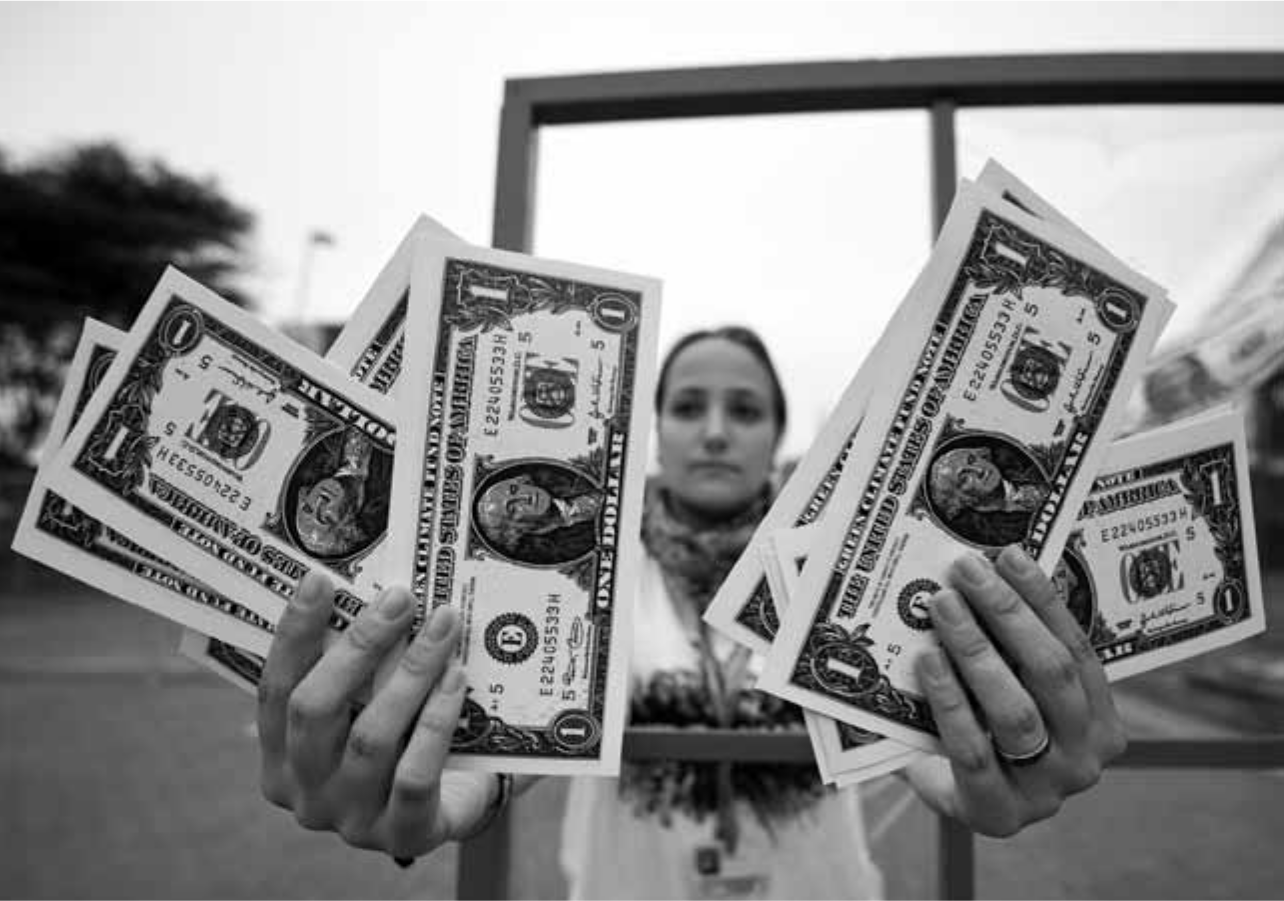
Occupy the COP
The Occupy movement lent its form and strategy to the local and international activists on hand. Young and old, officially delegated or not, met daily for general assemblies at the People’s Corner—a designated protest zone set up by authorities outside the militarized perimeter of the meeting—and staged a dramatic occupation inside the convention center.
Several hundred people gathered around the outspoken Maldives representative and tried to escort him into the central meeting room for the final plenary. When confronted by police, they refused to stop chanting “Occupy the COP” and singing “Shosholoza,” a South African folk song (“move on and create space for the next person”)—explaining to global media representatives why the time had come for civil disobedience.
They came, they said, to support the island nations, to stand with Africa, to say no to the World Bank, to demand “not just a climate treaty—a just climate treaty,” and to protest what seemed to be a conference that had made little progress. The direct action continued for nearly two hours until the U.N. police threatened everyone with expulsion, and several people sat down and refused to leave. Those who sat were placed in the hands of the South African police, who dropped them off at a designated protest zone across the street. Their acts of civil disobedience introduced a new sense of urgency into international climate negotiations.
In Durban, the growing majority of nations who insisted on science-based solutions, the rise of youth activism, and the occupation by representatives of civil society injected a new dynamic in the movement for climate justice. These efforts pushed the conference toward a target of 350 ppm and less than two degrees—and to seek non-market solutions, as well as more financing for adaptation measures in the least developed and most vulnerable countries.
This new dynamic mobilizes a large part of the global South, most of the European Union, the youth movements, and the NGOs who are seeking a fair and binding treaty. Its success will depend on their ability to further and more effectively penetrate the official boundaries of the COP and bring in otherwise marginalized voices, such as indigenous groups that come bearing advance warning of incipient climate chaos in their homelands.
As Friends of the Earth’s Asad Rehman observed, “it’s the tiny little countries and the individual negotiators who hold out under incredible pressure.” If people on the inside felt they have more support from the outside, he said, many more would feel empowered “to say no to the bullying.”
As movement elder Lidy Nacpil said, “We do have to combine outside and inside…to fight on many fronts at the same time, including local, national, and so on…. I think people have to understand it is going to be a long struggle.” And Pablo Solon, former climate negotiator for Bolivia, told us: “In order to have climate justice it’s necessary that the key thing is not inside the COP. It’s not going to come through diplomatic negotiations; there will only be climate justice if there is a strong organization from social movements and civil society around the whole world.”
Climate justice, he said, is like civil rights—you have to fight for it. But the problem, he said, is that the clock is running out. “We need to build this movement as fast as we can.”
Eyes on 2020
The world can no longer afford the global stalemate in climate negotiations. Emissions rose 2.5 percent in 2011, exceeding all previous years, and the World Bank is now predicting a world utterly wrecked by a planetary average of four or more degrees Celsius if the current growth rate of emissions is not dramatically reversed. Hurricane Sandy was but the latest warning.
Given that climate change is largely created in the wealthy North, and perpetuated by the one percent who hold global power, the climate problem will not be resolved without transforming the social system. That is the ultimate aim of the climate justice movement, expressed in the demand for “System Change, not Climate Change!” To be successful, this movement will need to be active both inside and outside the negotiations, in every locale and also in the international arena, fighting the sources of carbon pollution inside national borders, but also returning to future climate conferences.
Civil society, organized labor, faith-based organizations, artists and musicians rally in a peaceful march through Durban.
Ainhoa Goma/Oxfam
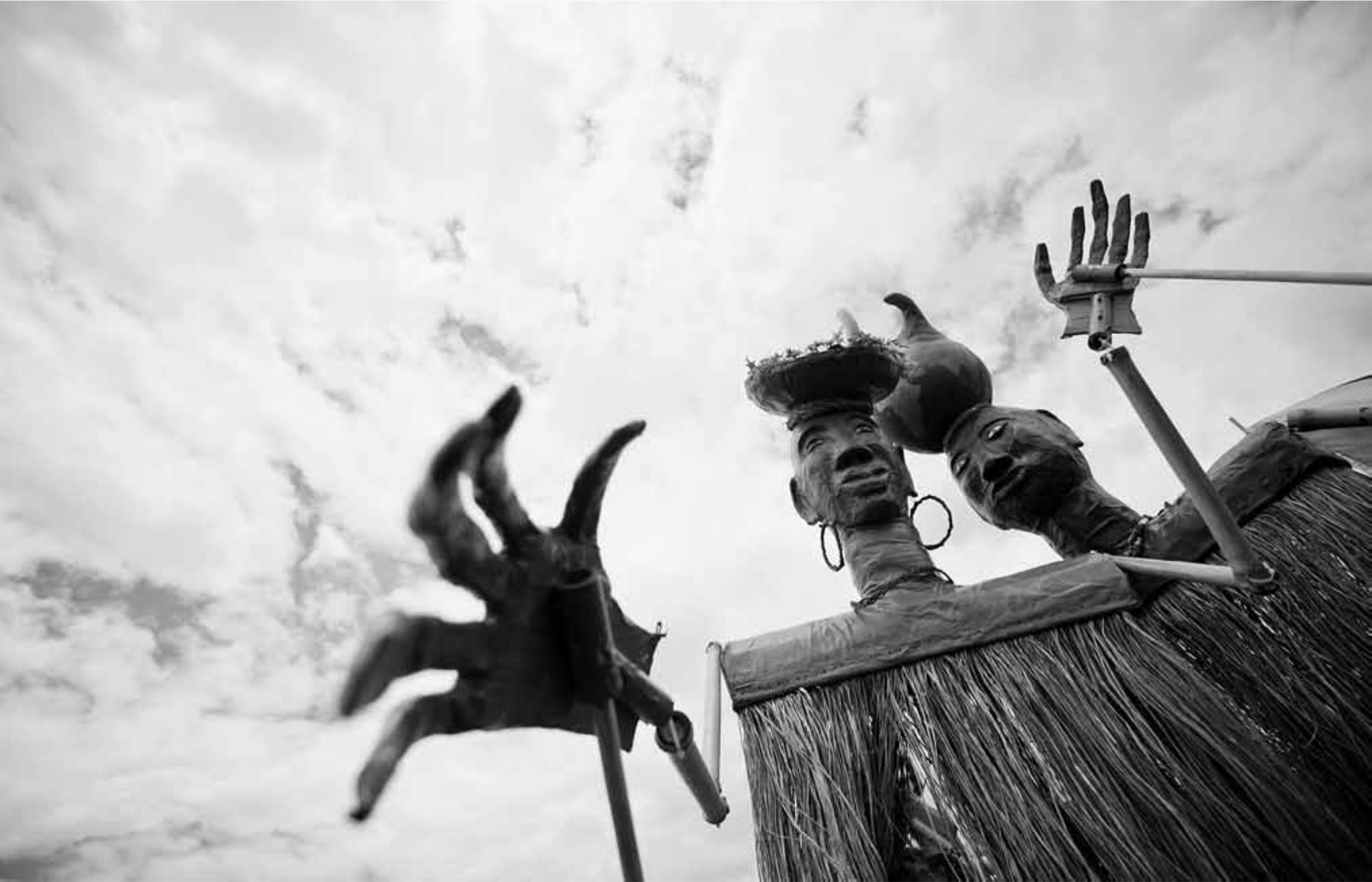
At the talks in Doha late last year, despite the fact that the physical distance and expense kept participation at a minimum, this progressive agenda advanced. The Kyoto Protocol was renewed for another eight years, and the Durban treaty for 2020 moved forward incrementally. In the halls, all eyes turned toward Poland, where the next climate conference will convene this year.
Our best hope is that global civil society organizations, and the movements of youth, indigenous people, labor, and environmentalists, will continue to converge at these talks, supporting those countries whose positions best address the magnitude of the crisis, and challenging those which do not. Under these conditions, there is a cautious basis for optimism.