




Abstract
The term Anthropocene (Age of Human) implies that the reduction of carbon emissions is a matter of changing human behaviour. This risks depoliticising the climate emergency. Everyone is not equally responsible for climate change, and the consequences of climate change are not distributed equally. Climate change is overwhelmingly the result of extractive and exploitative capitalist production. It is thus more useful to understand the climate crisis in terms of the Capitalocene (Age of Capital), with climate justice being a terrain of anti-capitalist struggle. Mainstream responses to climate change have largely neglected the Capitalocene, focusing instead on consumer behaviour. This individualistic approach has been taken up by several ecologically oriented psychological professions, where the emphasis has been on ‘responsible consumer behaviour’ and/or the psychological effects of climate uncertainty. There is, however, a growing critical tradition within the psychological professions that seeks to advance climate justice by taking seriously the capitalist political economy. Indeed, psychological practitioners are equipped with skills that may be useful for activists involved in psychopolitical efforts to consolidate climate justice movements and build political power. We posit three key areas for psychological practitioners working for climate justice movements: solidarity-making, affective mediation, and resource mobilisation.
Climate Change: From the Anthropocene to the Capitalocene
There is overwhelming empirical evidence that climate change is a product of the capitalist mode of production (Betts, 2021; Griffin, 2017). Mainstream responses to the climate crisis have done little to acknowledge its capitalist origins (Walk, 2010). While this is certainly the case at the state level, it is also the case among most of the psychological professions. 1 There are, however, several psychological practitioners who take capitalism seriously when addressing climate catastrophe. In this article, we seek to clarify how it is that those in the critical psychological professions can assist anti-capitalist activists in consolidating a climate justice programme, a task which – although fundamentally collective and political – involves different subjects working together through disagreements, tensions, setbacks, and a host of other psychological phenomena that play out in the process of social movement building.
Direct observations made on and above the Earth’s surface indicate that the planet’s climate is changing significantly (IPCC, 2021a). This has manifested in different ways. In recent years, wildfires throughout the Middle East, Australia, the Central African Republic, and Greece, rising sea levels in Bangladesh, droughts throughout the Horn of Africa, as well as hurricanes and flooding in the United States and Nicaragua have claimed lives and devastated ecosystems (Abdelhafez et al., 2021; Huber, 2022b; Thompson et al., 2021). Although the Earth’s climate has been in a state of flux throughout history (Hausfather et al., 2020; Hornsey & Fielding, 2020), the changes witnessed in the last seven decades, as demonstrated by the graph below (see Figure 1), have been enormous. Indeed, 800 000 years ago carbon emissions were less than 300 parts per million (PPM). Since the 1950s, though, industrial activity has steadily inclined, with carbon emissions having increased to 420 PPM (Betts, 2021). Reconstruction from ice cores. Credit: NOAA.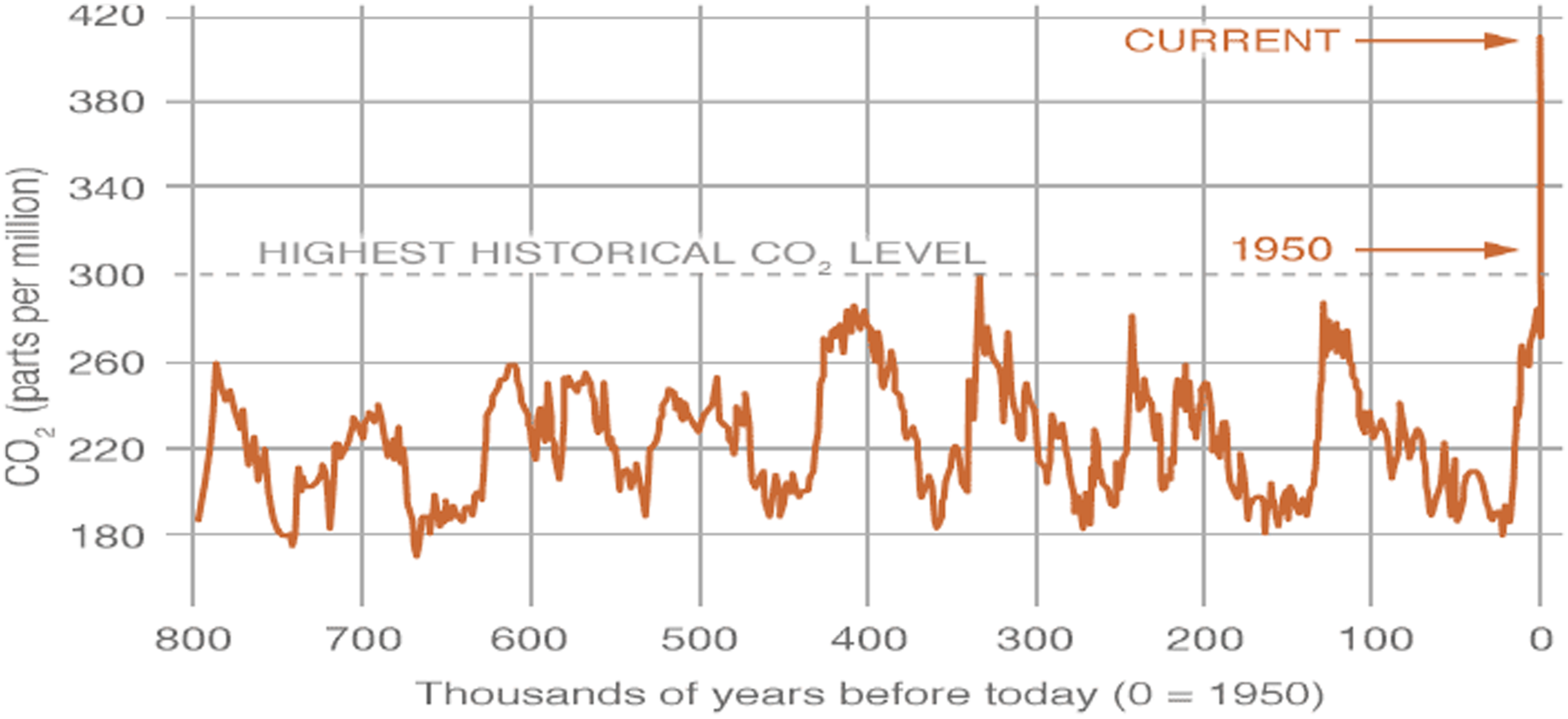
Globally, there is an increased atmospheric temperature because of greenhouse gases trapping more heat in the atmosphere (Dong et al., 2019; Maria et al., 2020). As atmospheric temperature increases, it worsens the severity of tropical storms due to warmer ocean water temperatures (Pandey et al., 2019; Philander, 1990; Vikas & Dwarakish, 2015). The increased atmospheric temperature also accounts for why there is less snowpack in mountain ranges and polar areas as well as an increase in the melting of glaciers and methane-releasing permafrost (Li et al., 2020; Randers & Goluke, 2020; Neumann et al., 2019). Moreover, all over the world, sea levels are rising, threatening coastal communities and estuarine ecosystems (Garner et al., 2017; Griggs et al., 2017; Trombley et al., 2017). There is also a noted increase in extended droughts; periods of abnormally hot weather that can last days and even weeks; the length of the frost-free season (and corresponding food security challenges); and the intensity, frequency, and duration of hurricanes (IPCC, 2021a; Lindsey, 2019; Marsooli et al., 2019; Nerem et al., 2018).
The health-related, social, and economic costs of climate change are well documented. In 2009, over 238 000 deaths were recorded as a result of natural disasters and over 200 million individuals were affected by climate change events, with existing vulnerabilities worsened by harvests disrupted by extreme weather conditions (UN General Assembly, 2010). There is growing recognition and acceptance among policymakers and in the national security spheres that the propensity of climate change and extreme weather conditions constitutes a significant threat to social cohesion and stability (NATO Parliamentary Assembly, 2015). Climate variability is believed to have the capacity to precipitate armed conflict, although the nature of the relationship between climate change and armed conflict requires further examination (Von Uexkull et al., 2016). For instance, at the 2018 United Nations General Assembly, Nigeria’s President, Muhammadu Buhari advocated for the recharging of the Lake Chad Basin. He claimed that violent conflicts in the Sahel and the Lake Chad Basin axis, especially Nigeria, have been fuelled in part by socio-environmental factors and dynamics, such as water scarcity. He indicated the Lake as foundational to the livelihood of more than 45 million inhabitants in the region. In addition to health outcomes, the consequences of the Lake’s shrinking include loss of jobs, increased poverty, and an uptick in recorded instances of violence (UN News, 2018).
The globalised nature of a climate crisis is another important dimension of the climate emergency. Climate events in one region affect or spiral into others. For instance, the Turkish fires that occurred in 2021 were fuelled by a southern European heatwave fed by hot air from North Africa (Al Jazeera, 2021). Similarly, even though El Niño 2 originates in the tropical Pacific, it has very serious global effects on seasonal weather as well as ecological, social, and environmental sectors (Jiang, J., & Fortenbery, T. R., 2019; Vikas & Dwarakish, 2015). Importantly, the globalised character of the climate crisis is not experienced evenly. The dangers of climate change fall differently upon different bodies. Indeed, nature is finite and for most people it is experienced as such (Wark, 2015). Low-income communities and poorer nations, when affected by climate-related disasters, are not prioritised by disaster relief efforts in the same way that wealthier countries and communities are. The rich are able to buy their way out of rising hunger, climate disasters, hurricanes, crop failure, wildfires, air pollution, and rising sea levels. Moreover, wealthier populations and individuals are not subject to the kinds of forced displacement, material destruction, and cultural degradation to which climate change subjects poorer communities (Barnwell & Wood, 2022; Ingle, 2020). The climate crisis thus exacerbates low-income populations’ already dire material conditions.
There is considerable evidence that it is human activities that have been the primary drivers of climate change (Huang et al., 2020; Omer et al., 2020; Wang et al., 2020; Zhang et al., 2020). This has led many scholars and popular commentators to dub our present geological age 'the Anthropocene', or the Age of Human. Those who understand our present-day geological epoch in terms of the Anthropocene speak of climate change as the problem and responsibility of human beings and thus of human behaviour more generally. Proponents of this view argue that a great acceleration in technology, production, and environmental devastation has occurred since around 1800, which saw the beginning of the Industrial Revolution and the use of steam power and coal production (Moore, 2015). There are convincing data confirming the Anthropocene. The Intergovernmental Panel on Climate Change 3 (IPCC), for instance, concluded in its Fifth Assessment Report that there is more than a 95% probability that human activities over the past 50 years have warmed our planet (IPCC, 2021b). The IPCC’s Report brings to light how human activity has raised carbon dioxide levels from 280 parts per million to about 417 parts per million in the last 151 years. The Report concludes that human-produced greenhouse gases – namely, carbon dioxide, methane, and nitrous oxide – have led to an increase in the Earth’s temperatures over the last half-century. Human life, it would appear, faces an existential crisis that seems to be of our own doing (Oladejo & Erondu, 2020).
It is, however, disingenuous to proclaim that all of humanity is equally responsible for the climate crisis. The evidence overwhelmingly indicates that almost all carbon emissions are a result of industry (see Griffin, 2017), that is, the capitalist mode of production that relies on the ceaseless extraction from and exploitation of the earth and the majority of human beings (Moore, 2021). Looking at the enormous inequalities engendered by capitalism, it is clear that the vast majority of poor and working people emit far less carbon than the wealthy minority (Maitland et al., 2022). As such, Moore (2017) considers the Anthropocene argument to be somewhat narrow in that it emphasises the individual agent at the cost of naming the global systemic arrangement (i.e. capitalism) most responsible for climate change. He has, instead, argued for what he calls the Capitalocene (or, Age of Capital) whereby exploitative capitalist relations of production are understood as the fundamental determinants of today’s climate change catastrophe. Capitalism, he argues, does not just organise our political economy, it also organises the relations between people and the environment. We can, therefore, understand capitalism in a dialectical fashion, wherein it degrades its principal sources of wealth: labour and nature (Amin, 2014). Climate change is part and parcel of capitalism (i.e. the extraction of surplus value), and we cannot consider human beings separately from nature. Humans are always encountered within and are part of the environment (Wark, 2015), and while climate change is certainly an issue of emissions, it is also an issue of carbon-heavy extraction and production industrial processes (Huber, 2022a). We can, therefore, trace the emergence of climate change to before the Industrial Revolution, which is to say, to the period of 1450–1640 when capitalist production began (Moore, 2015).
Understanding climate change in terms of the Capitalocene, rather than the Anthropocene, is important because it makes clear that although climate change is a problem that faces all of humanity, it is not one for which all of humanity is equally responsible or indeed one that is experienced in the same way by all human beings. It is the capitalist class and its ethos of infinite expropriation (its drive to cheapen labour and the environment for purposes of profit-making) who are most responsible for climate change (Moore, 2015). It is not only through unrestricted access to natural resources, but also via finance, imperial war-making, the global media, and rent extraction that capital has monopolised the world economy and produced the Capitalocene (Amin, 2014). This conception of climate change is important, as we will see, not only because it historicises our present geohistorical epoch in a power-sensitive and structurally attuned manner but also because it points towards how making connections between different struggles against capitalism is a crucial part of climate justice.
What then is the use – if any – of the psychological professions in resisting the Capitalocene? For the most part, as we will demonstrate, these professions have had a very minimal impact here. Most have, in fact, aligned with capitalist ideology by stressing adaptation to and individual responsibility for climate change, thereby obscuring the origins of climate change in the capitalist mode of production (Fernandes-Jesus et al., 2020). However, because all struggles always entail struggling psychologies as well as oppositional politics (Malherbe, 2022), we believe that there is a political role for psychological practitioners involved in social movements committed to climate justice. We situate this article within the small but growing body of critical and socially situated psychological work that takes seriously the capitalist origins of climate change. We argue that psychological practitioners can play a political role in the psychological (or perhaps rather psychopolitical) processes inherent to and required for climate justice movement building, namely, solidarity-making, affective mediation, and the availing of resources.
In what follows, we describe in further detail the entwinement of capitalism and climate change, after which we examine some of the most prominent government responses to the climate crisis and how these tend to obscure or ignore the capitalogenic roots of this crisis. We then consider some of the responses to the climate crisis within the mainstream psychological professions, most of which mirror the individualistic, elitist responses that have taken place at the government level. We then situate our contribution by describing the critical psychological traditions that have taken seriously the Capitalocene, after which we consider some of the roles that critical psychological practitioners can play in consolidating grassroots climate justice movements. Lastly, we conclude by reflecting on the future directions for critical psychological work concerned with climate justice.
Capitalism and Climate Change
Although several inventions are oftentimes credited as ushering in the transformations in economic activity associated with the Industrial Revolution (e.g. the spinning jenny, water looms, locomotives, and the steam engine), colonial expropriation was fundamental to changing these activities, with the destruction of land and its resources in the colonial peripheries serving as fundamental to the accumulation of wealth in the colonial centres (Amin, 2014). This was especially so with the introduction of the cotton gin, which relied on the unpaid slave labour, dispossession, and death of indigenous populations in the colonies (Moore, 2015; 2021). A carbon-fuelled colonial capitalism has, therefore, been central to the accumulation of wealth in the Global North and the disenfranchisement of the Global South (see Barnwell & Wood, 2022), and this predates the Industrial Revolution. These processes of capitalist extraction were then accelerated during the Industrial Revolution (Bastola & Sapkota, 2015; Yao et al., 2019). Indeed, it has been recorded that atmospheric CO2 concentration has increased by 48% since the Industrial Revolution (Wuebbles et al., 2017).
Today, the overconsumption of nature’s finite resources accounts for the unparalleled destabilisation of Earth’s life-support system, heightened pressure on human survivability, and problems consequent upon climate change, biodiversity loss, conflict, and resource scarcity (Arrow et al., 2004; Gaffney, 2014; IISD, 2019). In a landmark report, it was found that 100 of the world’s largest corporations are responsible for 71% of industrial greenhouse gases in the Earth’s atmosphere (Griffin, 2017). Another report found that a single billionaire emits one million times more carbon annually than anyone else outside of the richest 10% of the world’s population (Maitland et al., 2022). The effects of these emissions are always more acute in the Global South and in poorer communities (Barnwell & Wood, 2022), and in this sense they signify the devastating effects of an imperial capitalism that seeks to expand into and control territories (Değirmencioğlu, 2022). Whether air pollution, drought, desertification, hurricanes, food shortages, or rising sea levels – the impacts of climate change disproportionately affect the poor (Fernandes-Jesus et al., 2020; Ingle, 2020).
Capitalism contains within it what Marx called contradictions, or competing interests, that impact the climate negatively (Malherbe, 2022). Here, historian Ellen Meiksins Wood’s words remain prescient. She writes that capitalism may be able to accommodate some degree of ecological care, especially when the technology of environmental protection is itself profitably marketable. But the essential irrationality of the drive for capital accumulation, which subordinates everything to the requirements of the self-expansion of capital and so-called growth, is unavoidably hostile to ecological balance (Wood, 1988, p. 5).
The idea of limited government interference puts the owner of capital in a vantage position to relentlessly exploit nature (Anderson & Bows, 2012; Puaschunder, 2017). Even when governments do ‘interfere’ in market relations, it is usually in the service of capital, with very little separation noted between the interests of the capitalist state and big business. For example, several Big Tech companies were named in a case brought by the families of children killed or injured while mining cobalt in the Democratic Republic of Congo (Kelly, 2019). The extraction of cobalt has been linked to human rights abuses, corruption, child labour, and environmental destruction (Kelly, 2019). A study on the lifecycle assessment of cobalt extraction processes carried out by Farjana et al. (2019) shows that carbon dioxide and nitrogen dioxide emissions are highest from cobalt mining (Kelly, 2019). Colonial capitalism depends on the destruction of land and lives.
The drive towards economic growth has had an impact not only on the Earth’s finite resources but also on the people who interact with these resources either through their labour or in their daily lives (Poffenberger, 1990). Understanding climate change in terms of the Capitalocene makes clear that capitalism has always relied on unpaid work. Indeed, it is by labelling the environment – along with colonial and feminised subjects – ‘Nature’ that capitalist ideology seeks to justify the violence and the expropriation of free labour from women, colonised subjects, and the environment (Moore, 2015; 2021); effectively cheapening all life and labour in the process (Amin, 2014). Moore characterises this process of domination as the climate class divide, climate apartheid, and climate patriarchy which, together, form the 'capitalogenic trinity that now drives us full throttle towards the planetary inferno' (Moore, 2021, p. 752).
State Responses to Climate Change
There have been several landmark commitments to addressing the climate catastrophe. The United Nations organised the first conference on the environment in Stockholm in 1972 and the participants adopted a series of principles of sound management of the environment (Dorn, 2020; United Nations, 2021). At the conference, far-reaching resolutions were arrived at and there was consensus about how the protection and improvement of the environment affects the wellbeing of all peoples, making this a pertinent concern for all governments (United Nations, 2021). Thirteen years later, in 1985, the Vienna Convention took place. The focus of the Convention was on the protection of the ozone layer (Handrlica & Novotná, 2018; Yoshida, 2018). The Convention became necessary after systematic observations of the Earth’s atmosphere and scientific discoveries in the 1970s and 1980s highlighted disturbances in ozone levels in the stratosphere, discovering the ‘ozone hole’ (Barnes et al., 2019; Department of Agriculture, Water and Environment [Australia], 2021; United Nations, 2021). Ozone depletion increases the biologically harmful solar ultraviolet radiation reaching the surface of the Earth, which could, inter alia, lead to such adverse health outcomes like skin cancer, eye damage, and altered immune responses (Slaper et al., 1996; World Health Organization, 1994).
As a follow-up to the Vienna Convention, in 1987, the Montreal Protocol on Substances that Deplete the Ozone Layer was signed. This agreement was designed to stop the production and import of Ozone-depleting substances. It set phase-out obligations for all countries for at least 96 Ozone-depleting substances (Department of Agriculture, Water and Environment Australia, 2021), and it has, over the years, been amended six times. The ratification of the Montreal Protocol in 2012 by South Sudan makes it the first state-directed environmental treaty to achieve complete ratification (Department of Agriculture, Water and Environment Australia, 2021). The Montreal Protocol has been adjudged the most successful of all environmental treaties (Birmpili, 2018; McKenzie et al., 2019).
In 1992, The United Nations Conference on Environment and Development (UNCED), popularly referred to as The Rio Earth Summit, took place. It was, at the time, the largest environmental conference ever held, with over 30 000 attendees, including over 100 Heads of state (Wealth, 2019). The precursor to this Conference was the Brundtland Report of 1987 – Our Common Future: Report of the World Commission on Environment and Development. The Report foregrounded the imperative of sustainable development, highlighting environmental protection. Thus, the Rio Earth Summit focused on the need to reconcile worldwide economic development with environmental protection. The treaties and documents signed at the Summit meant that most of the world’s governments nominally committed themselves to the pursuit of economic development in ways that would protect the Earth’s environment and non-renewable resources (Encyclopaedia Britannica, 2021).
In September 2000, 189 countries agreed to eight goals – the Millennium Development Goals (MDGs) – which should be achieved by 2015. One of the goals was to promote environmental sustainability. The MDGs were later converted to Sustainable Development Goals (SDGs) in 2015. Out of the 17 SDGs, four have significant implications for environmental sustainability. These are: affordable and clean energy, sustainable cities and communities, responsible consumption and production, and climate action. Governments are expected to be circumspect in their use of the Earth’s resources and are to ensure that productive activities do not endanger the ecosystem.
Another major climate agreement is the Paris Climate Agreement. This represents a legally binding governmental treaty on climate change which was entered into on 4 November 2016 after the initial adoption by 196 parties at Conference of Parties 21 (COP21) in Paris, on 12 December 2015 (UNFCC, 2021). This was the first legally binding environmental treaty. Its goal is to limit global warming to below 2 degrees Celsius (Christoff, 2016; Glanemann et al., 2020; UNFCC, 2021). COP26 took place between 31 October and 12 November 2021. It brought parties together to accelerate action towards the goals of the Paris Agreement and the UN Framework Convention on Climate Change (United Nations Framework Convention on Climate Change UNFCCC, 2021). Perhaps what made COP26 so imperative was the Intergovernmental Panel on Climate Change (IPCC) 2021 Report. The IPCC’s mandate is to provide governments with scientific information that they can use to develop climate policies (IPCC, 2021b). The 2021 Report is the work of more than 200 scientists (Roston & Rathi, 2021). Drawing on thousands of studies, some of the key findings of the Report include: the past decade was most likely hotter than any period in the last 125,000 years, when sea levels were as much as 10 m higher; combustion and deforestation have raised carbon dioxide in the atmosphere higher than it has been in two million years; and agriculture and fossil fuels have contributed to methane and nitrous oxide concentration that is higher than any point in at least 800,000 years (Roston & Rathi, 2021). The Report warned that time is fast running out to stop global warming from exceeding 1.5 degrees Celsius, the lower end of the temperature targets agreed to in the 2015 Paris Agreement (Bloomberg, 2021a; 2021b). Based on the Report, the United Nations Secretary-General António Guterres warned that it is now Code Red for global heating (United Nations, 2021).
How have these different government responses fared in terms of environmental sustainability and climate control? Although it has been argued that some, especially the Montreal Protocol, have had reasonable impacts in controlling climate change (Brack, 2017; Velders et al., 2007), overwhelming evidence suggests otherwise (Clémençon, 2016; Nordhaus, 2020). The various treaties and conventions, which do not differ considerably from one another, appear to indicate a global trend, namely, the recognition that climate change is, indeed, occurring and that something must be done. At the same time, these treaties and conventions imply that the capitalist political economy must remain, by and large, intact, and reformed minimally if it is to be reformed – let alone transformed – at all. There is, in other words, a refusal to break from capitalist practice when climate change is dealt with in the top-down, elite-driven manner of the most prominent and well-resourced climate responses (Walk, 2010). As Neil Faulkner, referring specifically to COP, puts it: COP is only a spectacle. The accelerating gravity of the [climate] crisis, and the measures necessary to resolve it, are explained. Then targets are set and pledges made that bear no relation to the measures necessary. Then these targets and pledges are forgotten anyway. COP turns out to have been nothing more than political showbiz. The world has been getting hotter, and faster, for 25 years. Since the first COP conference, increases in carbon emissions, atmospheric loading, global temperatures, and sea-levels have continued to accelerate. COP has made no difference (Faulkner, 2021, p. 48).
There is a trend of signing but not ratifying climate agreements, particularly among rich and powerful countries (Bang et al., 2012). Even more severe than this, under the Trump Administration, the United States pulled out of the Paris Climate Agreement in 2020, the reason being that the Paris Climate Agreement disadvantages the United States. More recently, China, Russia and Saudi Arabia absented themselves from the G20 summit, skipping COP26 altogether (Bloomberg, 2021a; 2021b). The so-called Inflation Reduction Act recently passed by the present-day Biden Administration in the United States has made major concessions to the fossil fuel industry, with coal and gas continuing to produce some of the best-performing stocks of 2022 (Huber, 2022b). One of the key pledges in the Paris Climate Accord is that high-income nations would funnel $100 billion a year from 2020 to 2025 to low-income countries to help them transition to green energy and adapt to the effects of climate change (Colchester & Dalton, 2021). However, according to climate negotiators, this pledge – which says nothing about capital production or colonial expropriation in the Global South – has been shifted to 2023 (Colchester & Dalton, 2021).
The capital-friendly nature of state responses to climate change has been exemplified in various ways. For example, in September 2021, then-British Prime Minister and leader of the Conservative Party, Boris Johnson, urged G20 nations to recommit to tackling climate change (John & Daigle, 2021). Britain’s King Charles also told world leaders at the G20 Summit that 'the last chance saloon' was to save the world from runaway climate change (Walter, 2021). The fact that these two men who are utterly devoted to imperial expropriation and capitalist austerity measures can make proclamations on the climate emergency points towards the fundamental problem of denying the Capitalocene.
There are, of course, also world leaders who have been critical of the pseudo-actions taken by leaders in the imperial centres. Mexican President Andres Manuel Lopez Obrador, for instance, slammed the participants at COP26 for their hypocrisy, accusing them of failing to address the root causes of the crisis, namely, global capitalism (AFP, 2021). Below is an excerpt from his speech at the COP26. The world's most powerful countries increase their fuel production, at the same time that they hold summits for the protection of the environment. And then they arrive in private planes. Enough hypocrisy and fad. We must fight the massive monstrous inequality that exists in the world, that's what I will tell the UN (AFP, 2021, 1).
Aligning with the profit-making dictates of the Capitalocene prevents meaningful engagement with the climate emergency, and the failure of most governments to respond adequately to the climate crisis is tied in with their devotion to capitalism. We see a similar wilful ignoring of capitalist production and expropriation in other responses to the climate crisis, including within the psychological professions.
Climate Change and the Psychological Professions
With many government responses to climate change explicitly mentioning the health effects of climate change, the climate emergency has become increasingly prominent among psychological practitioners. The literature on climate change and psychological wellbeing is vast and expansive and cannot be satisfactorily recounted here (see e.g. Patz et al., 2014; Watts et al., 2015). The response of most psychological practitioners to climate change is, however, pertinent because it reflects the same problems as the state responses recounted above, namely, a denial of the Capitalocene and a refusal to engage the 'capitalogenic trinity' (i.e. climate class divide, climate apartheid, and climate patriarchy) which has been so central in driving today’s climate catastrophe.
Although the majority of the psychological professions have – as a product of their supposed commitment to political neutrality – had little engagement with climate change, there is a noted uptick in psychological practitioners who are drawing from their disciplinary backgrounds to address the climate crisis (Barnes et al., 2022). There have been several special issues published on psychological wellbeing and climate change, and climate change features prominently in the British Psychological Society’s 2018 Code of Ethics as well as the 2019 election manifesto published by Psychologists for Social Change (Knight, 2020). Added to this, the American Psychological Association’s task force on the Interface Between Psychology and Global Climate Change has made climate change central to its psychologically oriented interventions (Değirmencioğlu, 2022).
Most psychological work has engaged with climate change in two ways. First, such work has focused on traditional psychological functioning – such as attitudes and behaviours – in an effort to promote ‘pro-climate behaviour’ and to reduce both ‘unsustainable behaviour’ and ‘barriers to action’ (Adams, 2021; Fernandes-Jesus et al., 2020). The goal here is to assist people to better understand climate change and to overcome any psychic mechanisms that prevent them from acting to reduce carbon emissions (Stern, 2011), that is, to develop people’s self-efficacy or belief in their ability to reduce carbon emissions (Knight, 2020). Here, different psychological disciplines have been drawn on to alter consumer behaviour, oftentimes by concentrating on people’s emotions and feelings (Nielsen et al., 2021). This work coheres with capitalist ideology that places blame for structural issues on individual subjects, concentrating solely on the individual subject’s consumption patterns rather than capitalist modes of production, dispossession, and expropriation (Brown, 2007).
The second way by which psychological practitioners have engaged with climate change is by examining how climate change affects people’s psychological wellbeing or, indeed, exacerbates existing psychological challenges (Barnwell & Wood, 2022), with the goal of mitigating these effects through various coping strategies (Değirmencioğlu, 2022). Doherty and Clayton (2011) note that such work is typically concerned with three classes of climate change on psychological wellbeing: direct (i.e. the psychological effects of being involved in a climate disaster event), indirect (i.e. the psychological effects of observing the impact of climate change and living with so-called eco-anxiety), and psychosocial (i.e. the psychological effects of climate change on community, migration, livelihood, and cultural identity). There is little in this approach that seeks to slow down carbon emissions or intervene in the climate crisis. Instead, it endeavours to assist people in developing the resilience required to endure this crisis.
While these two approaches to addressing climate change from within the psychological professions are in some ways useful, they drain from climate justice its political constitution (see Barnes et al., 2022), that is, in proposing solutions to the climate crisis, this kind of psychological work turns its attention away from the Capitalocene and instead embraces individualistic consumption patterns, coping mechanisms, and lifestyle choices (Fernandes-Jesus et al., 2020). Psychological practitioners have, in other words, sought to develop knowledge about the climate crisis (Doherty & Clayton, 2011), rather than build the political power needed to fight against the mechanisms of capital that have created this crisis (Huber, 2022a). There is, however, a more critical variant within the psychological professions that seeks to put these professions to work for an anti-capitalist climate justice politics; using psychology to create coalitions and establish solidarity between different struggles. Although such critical, anti-capitalist climate justice work remains relatively marginal within the psychological professions, it has gained traction in recent years (see e.g. Adams, 2021; Barnes et al., 2022; Fernandes-Jesus et al., 2020; Fisher, 2013).
Critical psychological work on climate change has focused on activist (rather than consumer) behaviour; the role of emotion and power in resisting the structural forces of capital; coloniality and climate change; the centrality of youth-led movements in fighting for climate justice; and the role of language and representation in collectively combatting climate change at the systemic level (Adams, 2021; Barnwell & Wood, 2022; Trott et al., 2020). Such critical psychological work rejects the individualistic, top-down, adaptation, and/or mitigation strategies favoured by the mainstream psychological professions, and instead privileges the voices and needs of those most affected by climate change and who are working to challenge the capitalist roots of climate change (Fernandes-Jesus et al., 2020). Barnwell and Wood (2022) indicate that this work centres the participation and the desires of populations that have been marginalised by capitalist expropriation, and in so doing it strives to move psychological knowledge from the private sphere into the demos. In short, critical psychological work is attuned to the behaviours as well as the psychological and material requirements that promote the kinds of mobilisation against and collective resistance to capitalism that climate justice demands, while also remaining attentive to those voices that, despite being most affected by climate change, are continually silenced within policy decisions around climate change (Adams, 2021).
Critical psychological practitioners can and should assume an activist role when it comes to advancing climate justice. However, it may be argued that because of the institutional affiliations and cultural capital of many psychological practitioners, such practitioner-activists should work with business leaders, investors, the finance sector, and Big Tech to hold capital accountable. Yet, as we hope to have made clear, because capital depends on the destruction of the environment, it is capital that must be directly confronted when seeking to advance climate justice. It is certainly true that psychological practitioners can join the climate justice movement as activist-citizens, but we wish to argue that these practitioners also possess the skills and resources that can be useful in assisting those involved in consolidating and creating solidarity between anti-capitalist movements fighting against climate patriarchy, climate apartheid and the climate class divide. As such, there is a political role that psychological practitioners can play in the fight for climate justice.
The Political Role of Psychological Practitioners in Fighting for Climate Justice
In speaking to a socially just sustainability for all life and labour, Moore (2021) has called for solidarity and action with the planetary proletariat, that is, the people and nature who have been exploited and put to work for capital accumulation. The work of consolidating the planetary proletariat is not simple. For many, this work entails considerable stress, trauma, and a sense of failure that exacerbates any existing eco-anxieties. It is this difficult psychopolitical work to which we believe critical psychological practitioners can be of use.
There is a justifiable reluctance from some climate justice activists to work with psychological practitioners. This reluctance relates to the history of the psychological professions depoliticising and pathologising progressive social change-making efforts, as well as the ideological alignment of many of these professions with capitalism (Malherbe, 2022; Teo, 2018). Therefore, the psychological practitioner’s involvement in climate justice activism must be determined by social movement actors themselves, rather than disciplinary dictates. Practitioners, in short, must be willing to transform their disciplines through struggles for climate justice.
What, then, might the political role of the psychological practitioner be in climate justice movements? Although there are undoubtedly many roles that practitioners can play here, we wish to highlight three: 1) solidarity-making; 2) affective mediation; and 3) availing resources. In what follows, we flesh out the conceptual nature of these roles, considering how each can contribute to the consolidation of anti-capitalist climate justice politics.
Solidarity-Making
Solidarity speaks to the relational bonds forged in the context of struggle (Featherstone, 2012). Solidarity, we might say, is exercised in the fight for autonomy in the context of systemic injustices (Chatterton et al., 2013). Climate justice requires solidarity from many different actors to build the requisite political commitment among collectives (Huber, 2022; Moore, 2015). There is a need to create solidarity not only between climate justice movements, but between all anti-capitalist struggles that are made separate by capitalist ideological apparatuses (e.g. climate justice, gender justice, and racial justice). There is also a need to build political coalitions with, and to recognise the insurgent agency of, the many exemplary youth-led climate justice movements (e.g. Youth for Climate and The Child Movement), as well as the various children and youth-led engagements with the Capitalocene (see e.g. Sloan Morgan, 2020), most of which are routinely dismissed or ignored by adult-centric responses to climate change (Han & Ahn, 2020). Establishing common ground between these different struggles can alter how we perceive liberation from capitalism (Chatterton et al., 2013; Featherstone, 2012).
Solidarity-making is a psychologically fraught process precisely because individuals, united in their political commitments, may not take to one another on a personal level. We do not always like the comrades with whom we struggle (Malherbe, 2022). Additionally, we see a range of priorities, tactics and strategies across – and even within – different climate justice movements, which can cause rifts among those committed to the same political goals. Moreover, racial, nationalised, classed, developmental, and gendered power inequalities that mark the capitalogenic trinity can make building the solidarity relation challenging, especially when such different – but interlinked – axes of oppression go unchecked within and between movements. In light of all of this, solidarity-building for climate justice requires not only political commitment but also sensitivity towards the psychological processes that take place within social movement spaces. This is to say that building solidarity requires compromise, deep listening, and communication, all of which can be difficult to undertake effectively or without political fracturing. If invited into climate justice movements, psychological practitioners can assist activists in creating spaces for navigating the difficult, introspective reflection and honest engagement required to articulate the criteria for entering into solidarity. As Barnwell and Wood (2022) note, these spaces can serve not only to politicise psychological work, but they can also democratise this work by putting the psychological professions in the service of the emancipatory needs of the planetary proletariat.
An example of the psychopolitical nature of solidarity-building for climate justice was observed in 2012 when youth organisers across the southwestern metropolitan regions of the United States sought to link climate change resistance with immigrant justice, undertaking an ongoing process – rather than a momentary instance – of solidarity-building to do so (see Chatterton et al., 2013). Although there was an attempt to engage climate justice and immigrant justice on equal terms, activists from the Global North oftentimes exemplified paternalistic attitudes towards activists from the Global South. It was noted that Global North activists set the terms of debate and engagement and – despite acknowledging their relative privileges – spoke of Global South activists and their political demands in unitary and essentialising terms (Chatterton et al., 2013).
It seems clear, then, that in this instance, the solidarity relation was not built in accordance with the purported political commitments and values of the activists. The solidarity relation must, therefore, be renegotiated. However, the agonistic modes of engagement that are required to address imbalances of power within solidarity-building are likely to be met with resistance from those activists wielding disproportionate power (who are facing a direct challenge to their identity as activists), thereby creating tensions within climate justice movements. This may seem risky within already fragile movements. However, it need not be. Psychological practitioners can work with activists to hold such tension and engage continually with it in an effort to ensure that climate justice solidarity is driven by internal tensions (learning from, reflecting on, and changing with such tension), rather than become stifled, immobilised or fractured (Malherbe, 2022). It is with tension that climate justice activists, working with psychological practitioners, can ensure that the solidarity relation is not predetermined or imposed, but rather democratically negotiated in response to the demands of liberation from the capitalogenic trinity.
Confronting how solidarity is practiced – and the differential flows of power therein – must take place if all movement activists are to invest – psychologically and politically – in solidarity as an ongoing and collectively constituted process. Such work is unlikely to be comfortable, but psychological practitioners may be of use to activists seeking to establish spaces for articulating dissatisfaction over how the solidarity relation is being built, and what the re-articulation of solidarity – in accordance with different, seemingly disparate political commitments – might mean.
Affective Mediation
Affect refers to how people feel bodily and thus also socially, rather than how they feel cognitively or individually (Ahmed, 2015). Affect plays an important part in climate justice movements. Although affect can enable individuals to feel together in their shared political commitments, it can also have debilitating effects, fracturing movements through individualisation or creating feelings of despondency and disappointment when negative affect is encountered (Teo, 2018). This is not to say that climate justice movements can be reduced to mere feeling, but rather that if these movements are to strengthen themselves from within, the affective nature of movement building must be taken seriously. At the same time, because these movements face continued onslaught from capitalist state apparatuses, the affective dimensions of movement politics may, for some activists, seem less imperative than immediate or pragmatic concerns.
Embracing the affective dimension of climate justice movements while, at the same time, ensuring that these movements do not become overly psychologised or individualised is a psychopolitical task. In actioning this task, psychological practitioners can work with movement activists to build ‘affective communities’ in which people can discuss their feelings in relation to their commitments to climate justice (see Zink, 2019), which is to say, what an individual’s feelings mean in relation to their activity within movement spaces. It is within affective communities that psychological practitioners can work with climate justice activists to better understand the politically situated, feeling self, and to connect this self to other politicised selves. What, for example, do people’s individual feelings of eco-anxiety tell us about how to combat climate change collectively, and how can we ensure that such anxiety is not triggered within climate justice collectives? This is important for fostering the psychological connections that sustain political commitments, and for dealing with the affect that accompanies political failure. Put differently, acknowledging and articulating affect in these ways can bind people psychically to their political commitments rather than to political failure or setbacks.
Like all political affect, affect among climate justice activists remains under-examined. Martiskainen et al. (2020) have, however, undertaken important research in this area. These authors found that climate strikers across six different cities experienced a 'shockingly large' (p. 16) array of affects, ranging from hope, concern, and strength, to fear, despair, anger, and anxiety. The affects experienced by strikers influenced how they approached their activism and the reasons they had for striking (e.g. striking out of fear was related to winning climate justice for future generations). Notably, it was found that only 7% of strikers were motivated by anti-capitalism.
Affect within climate justice movements need not only be recorded and analysed, and different affects need not be understood as operating separately from one another. Affect can also serve as a point of intervention for psychological practitioners working with climate activists. The multiple ways of feeling within a single climate justice movement, or indeed across several movements, can give rise to multiple ways of connecting with the politics of these movements as well as with one’s comrades. Indeed, climate justice movements can mean different things to different groups of people (e.g. young people and adults might well engage with and relate to climate justice activism differently). Attention to affect offers a way into understanding the different emotional and bodily connections that people might have to climate justice activism. Therefore, although climate justice activism is very often localised (Chatterton et al., 2013), and has seen much political failure over the years, building solidarity through affect can allow activists to connect viscerally with others who share similar political commitments, thereby feeling into the capitalist totality (i.e. the capitalogenic trinity) as well as the urgency of addressing climate change in relation to this totality. To connect with feeling to others and the political commitments shared with others can, therefore, be useful for activating (or reactivating) the kinds of radical hope required to advance climate justice in what oftentimes seems like hopeless circumstances. It is thus within an anti-capitalist affective community that psychological practitioners and activists can work together to articulate different ways of feeling collectively in relation to climate activism and climate change itself. Climate justice movements may then, themselves, become spaces of psychopolitical healing.
Availing Resources
Resources are important for building climate justice movements, especially in low-income areas that are most effected by climate change. Transportation, communications, venues for meetings, chairs, and sound equipment are, for instance, all essential parts of organising climate justice politics. Such resources are not distributed evenly and those organisations most aligned with capitalism tend to be the most well-resourced (Walk, 2010). COP, for instance, is among the best-resourced climate change initiatives today because it has the buy-in and support from different capitalist entities, whereas grassroots anti-capitalist climate justice movements are severely underfunded and poorly resourced. Yet, even among these grassroots movements, access to resources differs considerably (Chatterton et al., 2013).
The professionalisation and institutionalisation of the psychological professions have availed resources to psychological practitioners. Critical psychological practitioners who are concerned with climate justice thus have a duty to work with activists to use and distribute resources for the purpose of advancing climate justice from below. In this, the psychological professions can be drawn upon to strike back against the very capitalist institutions in which they are embedded.
In resourcing climate justice efforts, psychological practitioners must reject liberal philanthropic frameworks as well as the capital-friendly conditions that oftentimes accompany the availing of resources. Resource mobilisation, in other words, must be held to the principles and political commitments of anti-capitalist climate justice movements, rather than the requirements of capitalism. This is challenging – but certainly not impossible – because psychological practitioners will very likely need to report to institutional bodies or funders on how resources are being used or allocated.
Han and Barnett-Loro (2018) warn that although resources are crucial for climate justice movements, merely having access to resources does not in every instance translate into action or large-scale change. Walk (2010), for instance, draws attention to the anarchist-inspired climate action camps that have, since 2006, sought to take direct action against carbon emitters while raising public consciousness around these emitters. Climate action camps have thus achieved a great deal with very few resources. However, the fact remains that these camps could achieve more with more resources. Psychological practitioners can work with groups like these to negotiate what resources are needed and in what ways resources could be used to advance a climate justice agenda. In these instances, practitioners can collaborate with activists to work around particular funding requirements. As such, psychological practitioners can work with climate justice activists in a manner determined by the political requirements of these activists, rather than a psychological or institutional agenda.
Conclusion
Today’s climate crisis marks a moment of existential urgency. The increasing frequency and intensity of global warming, extreme and extended drought, tropical storms, and rising sea levels, to name just a few, are outcomes of global economic systems based on fossil fuel consumption and carbon emissions. Climate change is a direct result of capitalist production, rather than human behaviour generally, and thus – with scholars like Moore (2015) – we believe that it is not only conceptually fruitful, but also politically useful, to understand our present-day geohistorical epoch as the Capitalocene. Psychological practitioners, like international leaders more broadly, have by and large ignored or downplayed the capitalist origins of the climate crisis, seeking instead to focus on individual consumer behaviour and/or learning to adapt to or live with this crisis. Those concerned with climate justice cannot ignore capitalism. In this article, we have sought to bring considerations of the Capitalocene into the tradition of critical psychological work that is concerned with climate justice, contrasting this work with the individualising tendencies of mainstream psychological work on climate change. As such, we argue for the political role of psychological practitioners in working with activists to consolidate anti-capitalist climate justice collectives.
There are many directions that work of this kind can take. Moreover, the extent of how useful, politically, psychological work is to climate justice movements remains debatable. It is our hope that future work will engage critically with the provocations that we provide in this article, adding to them, contesting them and, ultimately, assisting with developing sustainable possibilities for a kind of critical psychology that understands and engages climate change as a fundamentally political issue.
Footnotes
Acknowledgments
The authors thank the University of South Africa Institute for Social and Health Sciences and the South African Medical Research Council-University of South Africa Masculinity and Health Research Unit for their institutional support.
Declaration of Conflicting Interests
The author(s) declared no potential conflicts of interest with respect to the research, authorship, and/or publication of this article.
Funding
The author(s) received no financial support for the research, authorship, and/or publication of this article.
Compliance with Ethical Standards
The authors of this manuscript have complied with APA ethical principles in their treatment of individuals participating in the research, program, or policy described in the manuscript.
