




Abstract
Two recent books on marriage—Is Marriage for White People? by Ralph Richard Banks and Unhitched by Judith Stacey—are considered in this review essay by sociologist Micki McGee. Banks argues that the decline of marriage among African American women constitutes a social problem that could be remedied if more women from this group opted for interracial marriages. Stacey’s cross-cultural study contends that marriage is an institution that attempts the near impossible task of reconciling the goals of domesticity with those of erotic life, and that in the process an extraordinary range of marital arrangements have emerged. Taken together these arguments ask us to consider who marriage serves.
Keywords
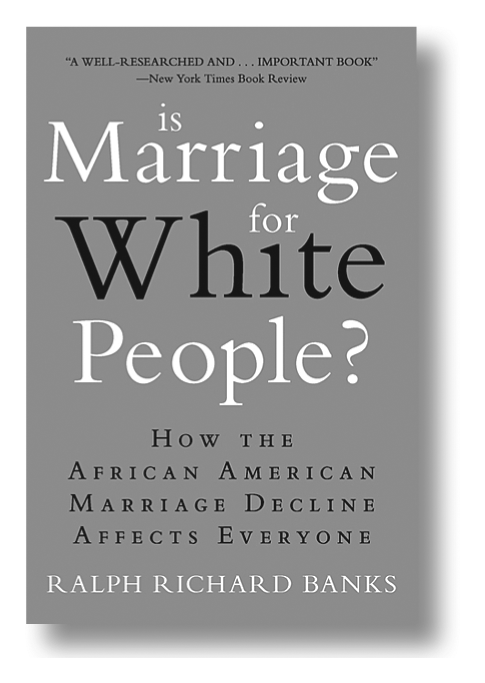
Is Marriage for White People? How the African American Marriage Decline Affects Everyone by Ralph Richard Banks Dutton, 2011 304 pages
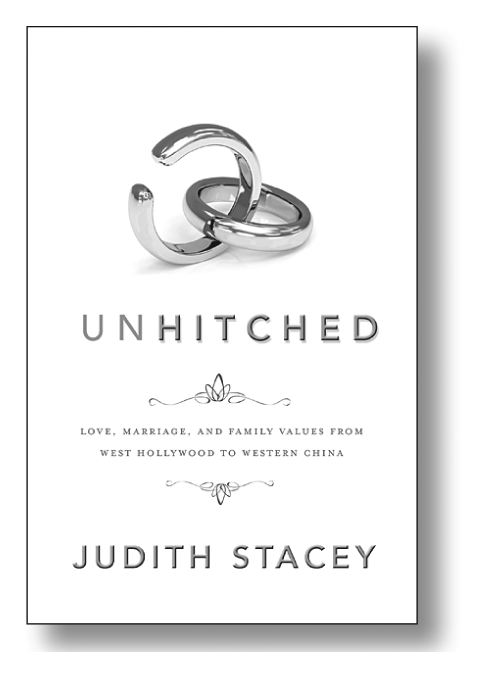
Unhitched: Love, Marriage, and Family Values from West Hollywood to Western China by Judith Stacey New York University Press, 2011 304 pages
Writers of all kinds have long understood that marriage, the ’til-death-do-us-part union of two members of the opposite sex, is the stuff of comedy, melodrama, and the occasional tragedy. The dubious project of hitching erotic desire to domesticity and property relations has a long history of unraveling in ways that are, at turns, hilarious, fraught, and, sometimes, heartbreaking. Sociologists, philosophers, and public policy experts, on the other hand, have a rather different way of untangling the assumptions and implications of modern marriages. Like writers of speculative fiction, their work engages what ought to be rather than simply what is.
With the provocative title Is Marriage for White People?, Stanford University legal scholar Ralph Richard Banks’s book draws a stark portrait of educational, economic, and social conditions that have made African American women of the middle classes the least likely (heterosexual) group in America to marry. Citing demographic data from the Pew and Russell Sage Foundations, Banks foregrounds the remarkable statistic that 7 out of every 10 African American women are unmarried, and 3 out of 10 may never marry. Black men are also less likely to marry than their white counterparts; Banks notes that fewer than half are wed.
To what does he attribute these stunning statistics? Banks notes that expectations of the role of marriage have shifted: from building a stable life and raising children, to the broader (and more elusive) aspirational goals of self-fulfillment and personal happiness. This change has affected marriages irrespective of race. Three distinctive factors have led to the decline of African American marriages—a veritable trifecta of social forces, he argues. First, there is the shortage of desirable, marriageable African American men (due to mass incarceration, the failure of our educational system to meet the needs of this group, and the decline of living-wage industrial jobs). Second, African American women are disinclined to marry outside their race (“out marry”) or to marry African American men who are not their economic and educational peers. (African American women have excelled as college graduates while their male counterparts have not.) And finally, African American men are more inclined to marry outside their race, which further reduces the pool of same-race marriage partners for African American women. (African American popular culture—from Terry Macmillan’s novels to Spike Lee’s films—have documented the knotty problem of interracial marriage from the inside out.)
Banks casts the decline of marriage among African Americans as a significant social problem. Of course there is a long history of blaming the decline of the African American family for the troubles of America’s urban poor, most notably in politician and sociologist Daniel Patrick Moynihan’s The Negro Family: The Case for National Action. But while Moynihan’s influential 1965 report focused on the so-called black “underclass” (and shaped decades of misguided public policy), Banks looks at the black middle class and asks why accomplished, economically self-sufficient middle-class African American women remain unmarried, are willing to put up with “man-sharing” arrangements (that he links to increased sexually-transmitted disease), and are both more likely to be single mothers, and terminate pregnancies, than their white counterparts. Banks sees the preponderance of unmarried African American women as a problem. The solution he proposes, with unfaltering market logic, is that African American women should shake off their commitment to same-race marriage and out-marry to level their odds in the marriage market. By expanding their options they would also, he argues, pressure their male counterparts into marriage.
Sociologist and New York University professor Judith Stacey would doubtlessly suggest a different framing and solution to the problem. While Banks takes a close-up look at the lives of single African American women in a series of case studies, Stacey’s wide-angle, cross-cultural study, Unhitched: Love, Marriage, and Family Values from West Hollywood to Western China, took her across the globe in search of models of intimacy and domesticity that might offer new possibilities for, and insights into, the troubled institution of marriage.
From the newlywed (and newly marriageable) gay couples of West Hollywood to the legal polygamy of customary marriages in South Africa, to China’s traditional Mosuo group, whose matrilineal system of family life has never linked the two ends of domestic care and erotic possibilities, Stacey unravels the marriage knot. In its place, she weaves a persuasive argument: the two-person, monogamous model of romantic marriage, however idealized, has failed to reconcile opposing human desires for erotic engagement and domestic care.
“Love and marriage” do not, Stacey asserts, go together as the popular 1950s tune would have it, “like a horse and carriage.” Unhitching this horse and carriage is the conceptual goal of this far-reaching study, which explores the contradictions of gay marriage (wasn’t gay liberation about being free to explore all sorts of sexual possibilities?) and even the possibilities for polygamy (perhaps fellow feminists might consider the real benefits of domestic relationships with multiple women engaged in the work of care). Polygamy, she contends, is no more or less shaped by patriarchal objectives than are traditional, two-partner marriages.
Arguing for social invention and expansive personal freedom, Stacey asserts: “Under social conditions that enable genuine consent, women and men should be free to opt for polygyny, polyandry, or monogamy, for arranged or love-match unions, for celibacy or polyamory, or for whatever domestic arrangements sustain them and those they love.” Of course the real hitch here is not marriage, but the utopian condition of locating a context “where social conditions enable genuine consent.” Stacey envisions a world where economic and social equality, rather than market forces and legal strictures, allow for consensual relationships and diverse families of all types.
Paradoxically, Stacey concludes her otherwise well-reasoned analysis with the assertion that this world yet-to-be-made already exists. She suggests that the polite fiction of the “normal family” needs to make way for diverse forms of intimate life and familial relationships that are already the norm. She contends that we need only get our laws, and our sensibilities, to catch up to this reality. But in the process, she elides the differentials of power and wealth among women and men.
Stacey suggests that the polite fiction of the “normal family” needs to make way for diverse forms of intimate life and familial relationships that are already the norm.
Although Stacey argues for a multiplicity of family and relationship types, her model of unhitched erotic flexibility and stable domesticity comes from a pre-modern Western Chinese ethnic group. Among the traditional Mosuo, who live in the Yunnan and Sichuan provinces, marriage as we know it simply doesn’t exist. Property relations and domestic responsibilities are organized in stable daytime matrilineal groupings, while erotic adventures are voluntary and mutable nocturnal meetings. Women who have come of age are granted private rooms where they may enjoy the company of as many, or as few, heterosexual partners as they wish. Men come and go, but by morning they return to their maternal homes. Although one wonders how homosexuals fare in this traditional context, the Mosuo surely offer a model of erotic pleasure insulated from domestic responsibilities.
Fatherhood (along with the neoliberal public policy whipping boy of fatherlessness) is inconceivable to the Mosuo, who are raised among dense maternal kinship networks. Their language, Stacey observes, does not differentiate between mother and maternal aunt: both are called emi. This group seems none the worse for their lack of fatherly attention; their children are raised unmarred by the lack of a male head of household. The case of the Mosuo suggests that the social problems that the modernized Western world’s policy experts have attributed to broken families and absent fathers are more aptly attributed to the lack of economic and social resources that an economically advantaged male partner traditionally brings to a heterosexual family.
Untethering property and domestic relationships from the erotic, as the Mosuo have done for at least two millennia, holds real possibilities for human flourishing (as anarchists and free love advocates have argued since the middle of the nineteenth century). But such flourishing also requires conditions of economic and social equality that do not yet exist, and which have grown increasingly elusive. Even though modern marriage and intimate life has recently been recast as a means to personal fulfillment (as in sociologist Anthony Giddens’s vision of the “democratization of intimate life”), in most settings marriage continues to operate as a social mechanism for the distribution of resources—of property, prestige, power, and personal attention.
Against the backdrop of staggering inequalities, Banks looks for a solution to the African American “man shortage” to shore-up traditional marriage and revalue African American women in a marriage market skewed by racial and gendered inequalities. He wants to see his accomplished black sisters garnering the attention and devotion they surely deserve. Stacey, on the other hand, envisions another world altogether. She argues simultaneously for a domestic and erotic pluralism comprising all manner of relationships (marriage included), and holds up the model of a world without marriage. Together these two important studies ask: Is marriage for anyone, and if so, for whom?