




Abstract
Eduardo Mendieta reviews the book Religion in Human Evolution. He reflects on Robert Bellah’s massive book on the role of religion in human evolution up to the Axial Period, and the emergence of second order cognitive and moral reflexivity.
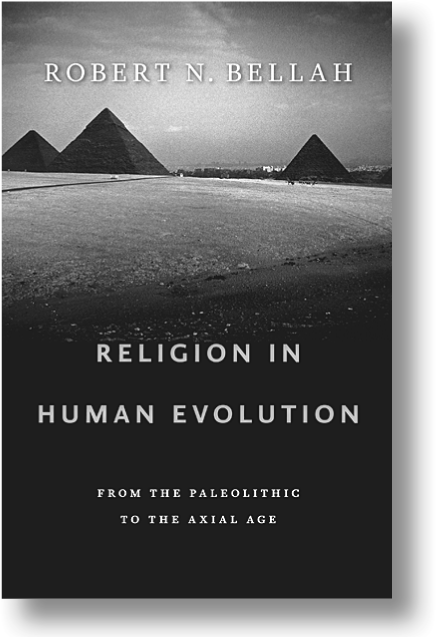
Religion in Human Evolution: From the Paleolithic to the Axial Age By Robert N. Bellah Belknap Press of Harvard University Press, 2011 784 pages
Books such as this one invite hyperbole. The book is massive, monumental, and majestic. It is the product of over a decade of intensive research, and comes after a long, paradigm-shaping career in the sociology of religion. It is the fruit of a scholar’s life spent assimilating, digesting, and synthesizing the latest developments in the cognitive sciences, anthropology, and the sociology of religion. In this case, the hyperbole is merited.
As humans, we must play if we are to be socialized.
Yet the book is also guided by a profound sense of humility and ecumenism. One is tempted to say that it brings Durkheim and Weber into the twenty-first century, with its evolutionary genetics and developmental neurobiology. The book does not even get around to discussing Christianity and Islam. It covers, as the subtitle indicates, the period from the earliest stages of humanoid evolution until the “axial age”—that period of time (named by German psychiatrist and philosopher Karl Jaspers) when there was an institutional/cognitive/ cultural/religious transformation which gave rise to the great monotheistic religions and the major ethical and metaphysical systems of thought that endure to our day. Bellah views this stretch of time (compared with the last 2500 years since) through the lens of religion and its transformation.
The book moves from the tribal through the archaic, to the axial period. Interestingly, though, Bellah, like Durkheim, Weber and all the major scholars of religion, begins with the premise that religion itself evolved. Therefore, the book’s title is not “The Evolution of Religion” but “Religion in Human Evolution,” suggesting that religion intervened, catalyzed, accelerated, and directed, in one way or another, human evolution.
Chapter two, along with the conclusion, offers us what I take to be one of Bellah’s most original theses: religion, as ritual, is rooted in the evolutionary adaptation of animals to engage in play. It is through play that animals are socialized into their specific communities, and into their specific skills of survival. Through play, animals “learn” to mime, imitate, and eventually, to develop skills. It is through play that animals learn to relate to shared objects of attention. Playing is learning to share a world, a world in which some things are the same for beings motivated by intention and not by instinct alone. Hunting by pack predators, or evading predators by herds of herbivores, requires tremendous feats of coordination.
Playing is, however, at the same time a practice that distances the activity from the rest of life. We can’t play if it is serious, if the game is in earnest; then, it is not play, it is real life—when everything is at stake. Playing takes leisure, time, and resources. It is a luxury. It is a luxury because parents, the pack, or the familial network, must provide for offspring who come into the world as helpless infants. Bellah’s point is that as humans, we go through a period in which we must play if we are to be socialized. Ritual, for Bellah, is play transformed into a collective process of teaching and learning. All learning is rooted in play, because it is in play that we learn to focus our attention on objects of “shared intentionality.”
In ritual, we learn to take ourselves as members of a collectivity, who are also simultaneously individualized. Beginning with ritual, we move to myth, and then to narrative. Then comes theology, and eventually “second order” reflexivity, or critical thinking. The latter is the hallmark of the axial age. This is an evolutionary story in which religion itself is a key aspect of the evolutionary process. One could say that there is no human evolution without the evolution of religion, and that the evolution of religion catalyzed social evolution in general.
One could say that there is no human evolution without the evolution of religion, and that the evolution of religion catalyzed social evolution in general.
Among the many important theses in this amazing book is that we ought to understand the axial age as a cognitive breakthrough in the history of human societies. This is true in two senses. The first sense, which has been the customary way of thinking since Jaspers, is that it signaled the emergence of conceptual, critical, self-reflexive thinking. The second sense is that the cognitive breakthrough was also a moral breakthrough. For reflexivity can and must also be applied to one’s ethical beliefs. What is distinctive about the figures of the axial period is, as Bellah beautifully illustrates, their questioning about their respective ethical practices and norms. A perfect illustration is Plato’s Euthryphro, where Socrates asks his moralistic interlocutor whether the pious is pious because the gods chose it, or whether the gods chose it because it is pious. This is another way of asking whether justice is what the gods will, or whether the gods chose justice.
Bellah goes further and argues that the axial age established self-reflexivity, or second order thinking, as both a theoretical or contemplative practice and as a moral or ethical practice. Here, play enters again. For the practice of conceptual and ethical self-reflexivity is a form of play, a bracketing and taking distance, which in Bellah’s view, manifests itself in the formulation of utopias.
Even if one does not agree with its premises or finds them implausible, one must agree that this is a great book. In particular, the chapters covering ancient Israel, Greece, China and India are superlative. Still, there are a couple of questions that Bellah’s book invites.
Religion intervened, catalyzed, accelerated, and directed, in one way or another, human evolution.
First, when does religion, as play, cease to be an evolutionary adaptation and become a cultural practice, open to learning but also to critical refraction? In fact, Bellah asks: “…can we say that society creates ritual, or do we have to say that the ritual creates society?” And he answers: “Mimetic ritual seem to be constitutive of the very society it makes possible.” This question is similar to the one that the philosopher Jean-Jacques Rousseau asked, about whether it was possible to separate language from society, and to ask which came first. Similarly we might ask: can we in fact separate religion from society, and locate one as prior to the other?
Ritual, as collective playing, enables “shared intentionality” and a shared world of meanings. Bellah would argue that there is no learning without playing, no ritual without playing, no myth without ritual, no narrativity without myth, no society without narrativity, and no possibility of critical self-reflection without narrativity. Still, I’m led to wonder: when did religion cease to be an evolutionary adaptation, and become a cultural practice? When did culture take over human evolution? Can we continue to talk about evolution when culture is in the grip of a different logic than that of evolutionary adaptation? Following social theorist Jürgen Habermas, we could say that cultures, or societies, do not evolve: they learn. And here we have entered the space of reflexive judgment rather than biological evolution.
Bellah’s book is not simply a masterful synthesis of the latest research on the evolution of religion, and the role religion played in human evolution. It is also a major meditation on religion as a mirror. We must continue to look at this mirror lest we forget how we became human. Although there is no gene for religion, just as there is no gene for freedom, we could not have become human without it.