




Abstract
Sociologist Dana M. Britton examines barriers to advancement in the academy, focusing on long-term associate professors. In particular, she draws attention to the role of “institutional reproduction”—teaching, advising, and service—as a barrier to advancement.
The term “glass ceiling” has long been used to describe the barriers faced by women seeking to advance in corporate America. Women can get close enough to see the top of the hierarchy, but few can break through the seemingly invisible barrier that excludes them. Though women have moved into academic positions in universities in increasing numbers over the past few decades, they too face a glass ceiling: they are still underrepresented at the highest academic rank, that of full professor. The rank of full professor confers status and is a gateway to further advancement. Full professors serve on important committees, fill the highest administrative positions, and are eligible for endowed and distinguished chairs. Ascending to this rank is a prerequisite for integrating the even more sex-segregated levels beyond.
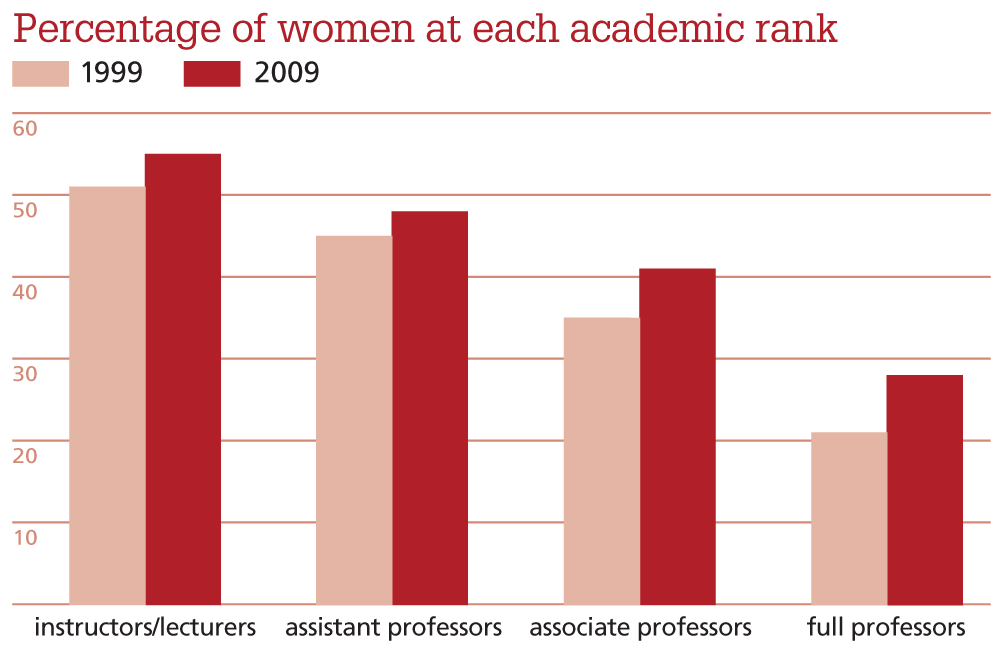
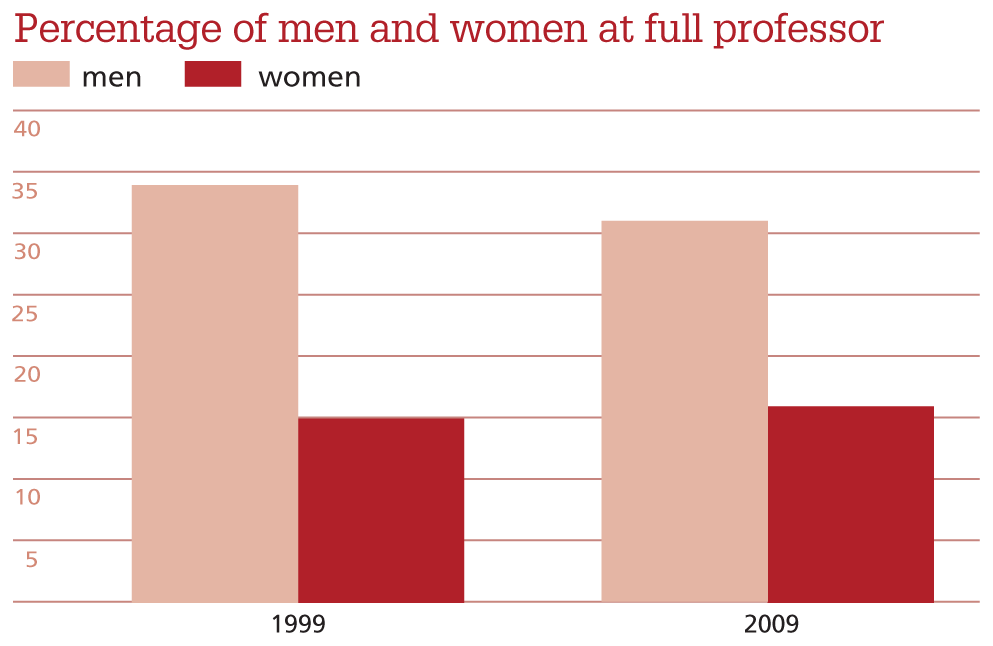
In 2009, women made up 43 percent of all full-time instructional faculty in degree-granting institutions in the United States, but only 28 percent of full professors. Men are about twice as likely as women to occupy this rank. In 2009, 31 percent of all men faculty but only 16 percent of women faculty were full professors—a situation that has not changed much over the last 10 years. (In 1999, 34 percent of all men faculty were full professors, but only 15 percent of women were.)
In 2009, women made up 43 percent of all full-time instructional faculty in degree-granting institutions in the United States, but only 28 percent of full professors.
But why do women face barriers at this level? With funding from the National Science Foundation’s ADVANCE program, I have been studying the process of promotion to full professor. I have conducted 178 interviews with faculty on 13 campuses across the United States, about 90 percent of whom are in Science, Technology, Engineering and Math (STEM) fields. All of the universities I visited are research intensive; 11 are land-grant institutions. Here I will focus on 39 faculty I interviewed (23 women and 16 men) who were long-term associate professors, having held this rank for seven years or more.
One of the central themes that came up in my interviews concerns the effects of what I call “institutional reproduction”—the teaching, advising, and service that must be done if students are to be educated and the university is to function. Though it is crucial work, those who do it—disproportionately women—find that they are rarely rewarded for it. In fact, young faculty members who wish to be successful (at least in conventional terms) at a research university learn very quickly to avoid teaching and service. This is perhaps even truer for mid-career faculty, for whom service demands increase precipitously.
Ken Bruzenak

Among the long-term associate professors I interviewed, high service loads and a high level of involvement with teaching were common. Women were especially likely to be doing student service. In the STEM fields, this often took the form of advising one or more groups of women students. But women also found themselves in demand as token representatives on search committees and in other mid-level administrative roles. Because service is rarely tracked or distributed systematically, their colleagues usually had little awareness of the service they did. One woman said that in evaluating her performance, the department chair consistently failed to mention her service—service that he had in fact asked her to do. As she observed: “To tell you the truth, this [service] doesn’t count for anything. Many times even in my evaluation the department head forgets to mention that I’m an advisor for this and that. So it has very little value for anything.”
Percentage of women at each academic rank
Source: National Center for Education Statistics, 2002
Percentage of men and women at full professor
Source: National Center for Education Statistics, 2002
A high level of involvement with teaching was also common among long-term associate professors. In some cases this took the form of heavy teaching loads, but for others this involved shifting their research focus to pedagogy (math or science education). No matter how successful they were in the classroom—one quarter told me they had received teaching awards—or in securing funding for pedagogical research, this group of faculty understood that they were likely to remain associate professors until they retired. As one woman put it: “I confess. I got to a point where I thought, I can spend my time writing a peer-reviewed journal article that three people are going to read, or I can spend my time putting together learning materials that will get used by [students] all over the U.S. and professionals in the field. I understand what the academic game is supposed to be, and I shifted from that—which is probably why I will never be a full professor.”
I focus here on the negative effects of performing institutional reproduction because I believe this captures important changes in the way public universities now operate. Those associate professors I interviewed who had very long careers (most of whom were men), all perceived a shift over time in the activities their institutions valued. They described this as a move toward a “cookie cutter” faculty ideal, where the only model for success is that of a successful researcher. Those who do not fit this model generally pay a price in terms of career advancement. In fact, almost all the campuses I visited have some version of a strategic plan to raise their profile, plans that invariably prioritize increasing research dollars, particularly from private sources. This is in part an outcome of shifting funding profiles for public universities, which must now rely less and less on state support. Research funding, and the overhead that comes with it, helps fill this gap.
Teaching, advising, and service are crucial work. But those who do it—disproportionately women—are rarely rewarded for it.
Because women disproportionately do the work of institutional reproduction, they are especially affected by its lower status. But anyone who does this work suffers the consequences. Many paradoxes result. Universities want to position themselves to the public, to legislators, and to parents as “student centered.” They also generate literally thousands of service positions that must be filled in order for them to operate. Yet the activity universities value and reward most highly is research and the funding that comes from it. Telling mid-career faculty to “just say no,” may work for some individuals, but does not solve the underlying problem.
The work of institutional reproduction has to be done. In failing to question the prevailing system, administrators privilege some groups over others, and at the same time help to reinforce the glass ceiling for women in the academy. Under the reward structure now in place at research-intensive universities, those most able to live up to the career model of the ideal academic researcher will be most successful. Those with families (a particularly important theme in my interviews with women), or who pursue research on pedagogy, or who spend time mentoring student groups, all pay a price. The problem of promotion to full professor raises hard questions about who does this work of reproduction, and why that work is so rarely rewarded.