




Abstract
Our main goal in this article is to discuss the structural and persistent problems experienced by women academics, especially with respect to the gendered divisions of academic tasks and unequal divisions of care obligations in the domestic sphere. The analysis is based on reflexive thematic analysis of the open-ended questions of an online questionnaire on the academic work environment, work satisfaction, stress, academic duties and allocation of tasks, and thoughts on gender equality. Academics from different countries voice their lived experiences, frustrations as well as worries about their future. We aim to highlight how these issues are embedded in the structures of academic capitalism and argue against the tendency to individualise these issues in a bid to inspire an informed collective resistance.
Keywords
Academic institutions worldwide are experiencing wide-ranging transformations and are increasingly managed according to a neoliberal market logic, emphasising profitability, commercialization and competition. Current international feminist scholarship continues to document gendered patterns that reproduce old hierarchies, as well as create new obstacles, as a result of this increased managerialism and dominance of market principles (e.g. Ivancheva et al., 2019; Morley, 2018; Murgia and Poggio, 2018; O’Hagan et al., 2019; O’Keefe and Courtois, 2019; Steinthorsdóttir et al., 2018; Sümer et al., 2020). A key persistent issue is women’s lower representation at the top of the academic hierarchy, that is, in professorial positions across regions. Despite the passage of time, the ratio of women in senior academic and decision-making positions in European Union (EU) countries are much lower than would be expected – if the selection and promotion processes were more equitable – given the growing numbers of women achieving PhDs and completing postdoctoral studies in the last two decades (European Commission, 2019). Our main goal in this article is to discuss common and persistent problems experienced in diverse national contexts, namely gendered divisions of tasks in the academic sphere and gendered divisions of care obligations in the domestic sphere, which hamper academic women’s career trajectories.
Our analysis is primarily a thematic analysis of the open-ended questions in an online questionnaire on women academics’ most pressing problems. The reflections of women academics from different countries enable us to give voice to and show the similarities in their lived experiences, their frustrations as well as worries about the future. As underlined by Savigny (2014), ‘giving voice to experience is a key mechanism through which feminist and critical theories seek to challenge existing power structures’ (p. 798). Our overall aim is to argue against an individualisation of these problems by highlighting how they are embedded in the structures of academic capitalism and thus can inspire an informed collective resistance.
To do this, we first introduce our theoretical perspective in light of selected recent literature and provide information on our research methods. We then present and discuss findings pertaining to gendered divisions of academic work and gendered divisions of care responsibilities. Based on our participants’ experiences and narratives, we discuss how organisational cultures within universities reflect and reproduce hegemonic structures implying power imbalances and male dominance at senior levels and leadership positions. We conclude by discussing the prospect of feminist solidarity and collective resistance in this regard.
Theorising systemic gender inequalities in academia
Universities have historically been gendered organisations, where men dominated the senior academic positions, received higher salaries and promotions (e.g. Britton, 2017; Nielsen, 2016; O’Connor et al., 2017; Thornton, 2013). Our focus is on the ways higher education and research organisations are characterised by gender inequalities: that is, systematic disparities between women and men in having control over resources, in opportunities for promotion and interesting work, in pay and other (material and non-material) rewards (Acker, 2009: 202). Gender is a ‘structuring structure’ that works through organisations and influences ‘what gets privileged and side-lined’ (Blackmore, 2014: 86). Gender inequalities in academia are created and sustained by a complex interaction of organisational, cultural, and individual factors operating within the overall context of ‘academic capitalism’. In this article, we understand academic capitalism as ‘market-like behaviours’ that include the processes of commercialisation, internationalisation and bolstered competition for external funding within higher education (Collyer, 2015; Slaughter and Leslie, 2001). Academic institutions worldwide are increasingly being run according to market principles that foster and intensify competition over limited external funding for research and permanent positions (Ivancheva et al., 2019; Morley, 2018). The research fields, methods and approaches that are prioritised in this context are often defined by funding bodies governed by ‘neoliberal policy doxas’ (Blackmore, 2014) with significant gendered patterns. Researchers from different countries report on both persistent and developing obstacles faced by women seeking academic careers as a result of this increased managerialism and dominance of market principles (e.g. Bozzon et al., 2019, based on the EU project GARCIA, which collected data in six European countries; Carvalho and Santiago, 2010, based on data from Portugal; O’Keefe and Courtois, 2019, based on data from Ireland).
‘Academic excellence’ is the dominant and ambiguous criteria underpinning academic evaluation processes in Europe. The ‘myth of meritocratic impartiality’ (Van den Brink and Benschop, 2011: 509) supposedly renders gender irrelevant, yet research continues to document that academia is not a ‘pure meritocracy’ and that the criteria for academic success are still highly coded in hegemonic masculine terms, resulting in disadvantages for women (e.g. Nielsen, 2016; O’Connor and O’Hagan, 2016; O’Connor et al., 2017). The unfavourable effects of gender stereotypes on evaluations of women’s academic work have been widely documented (e.g. Brandser and Sümer, 2017; Correll, 2017; Dubois-Shaik and Fusulier, 2017). Gendered stereotypes depress ratings of women, subjecting them to a ‘higher bar’ and a ‘double bind’ in which ‘judgements of competence and likability are negatively correlated for women, but not for men’ (Correll, 2017: 730). Women’s academic work can be devalued through both overt discrimination (including sexual harassment) and ‘subtle institutional and cultural forms of discrimination’ (Monroe et al., 2008: 230).
Due to the increasing demands on externally funded research, project-based temporary positions (such as PhDs and postdocs) are rapidly growing. In this context of increased insecurity, academics work under pressure to fundraise for their research, in addition to teaching, supervision and administration (Bozzon et al., 2019; Lynch and Ivancheva, 2015).
It is widely documented that mothers face specific disadvantages in the labour market, referred to as the ‘motherhood penalty’ with respect to wages and performance evaluations (e.g. Correll et al., 2007). Research on academic positions similarly document that motherhood and child-raising ‘result in truncated, broken or non-linear career paths for women (Maxwell et al., 2019: 142)’. A recent study from Germany documents that parenthood lowers the publication output of mothers, but not fathers (Lutter and Schröder, 2020).
Glorification of long work hours and devaluation of care work are key features of academic capitalism (cf. Cardozo, 2017). Research from different country contexts has shown that there is a ‘care ceiling’ derived from women’s caring work in the home, ‘built from the strong moral imperative on women to be primary carers’ (Grummell et al., 2009: 204). As workload intensifies, boundaries between work and non-work blur ‘posing additional difficulties for academics with caring responsibilities’ (Acker and Wagner, 2019: 64). We conceptualise work and care as two key pillars of society and the difficulties faced in combining them as both a public issue and a private matter that concerns families, communities, as well as policy makers, employers and managers (Sümer, 2016). Unpaid care and paid work are ‘overlapping sites of an interconnected gendered system’ and operate interdependently ‘through the materiality and relationality of the bodies and minds that occupy these shared spaces’ (Ivancheva et al., 2019: 450). Thus, effective gender equality policy needs to ‘develop an environment favouring more equal shares between men and women in paid work, care work, income, time, and voice, between individuals within households and in paid work and politics’ (Pascall and Lewis, 2004: 380).
As this brief review of selected literature shows, the highly individualised entrepreneurialism that is at the heart of the new academy has gendered implications that demand further inquiry. Against this background, we focus on two related issues that women academics working in different national contexts report, as similar and recurring problems, namely unequal gendered divisions of academic work and of domestic care work.
An online questionnaire on gender in academia
Based on previous research findings and a comprehensive review of current literature, we designed a questionnaire on gendered experiences and inequalities in academia and circulated this through social media (Twitter and Facebook) and by email (sent to mail groups and academic contacts) in two rounds. We received 191 responses to the open-ended questions from a total of 212 participants.
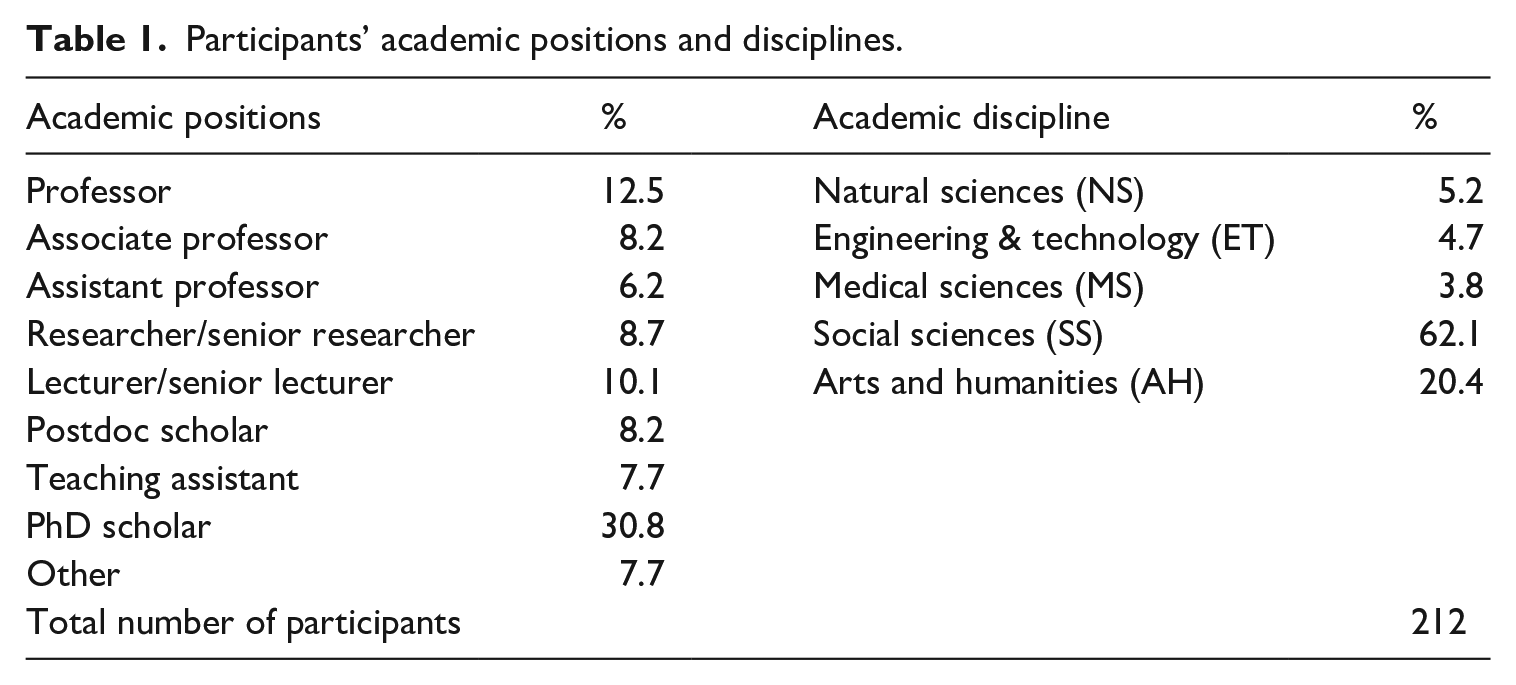
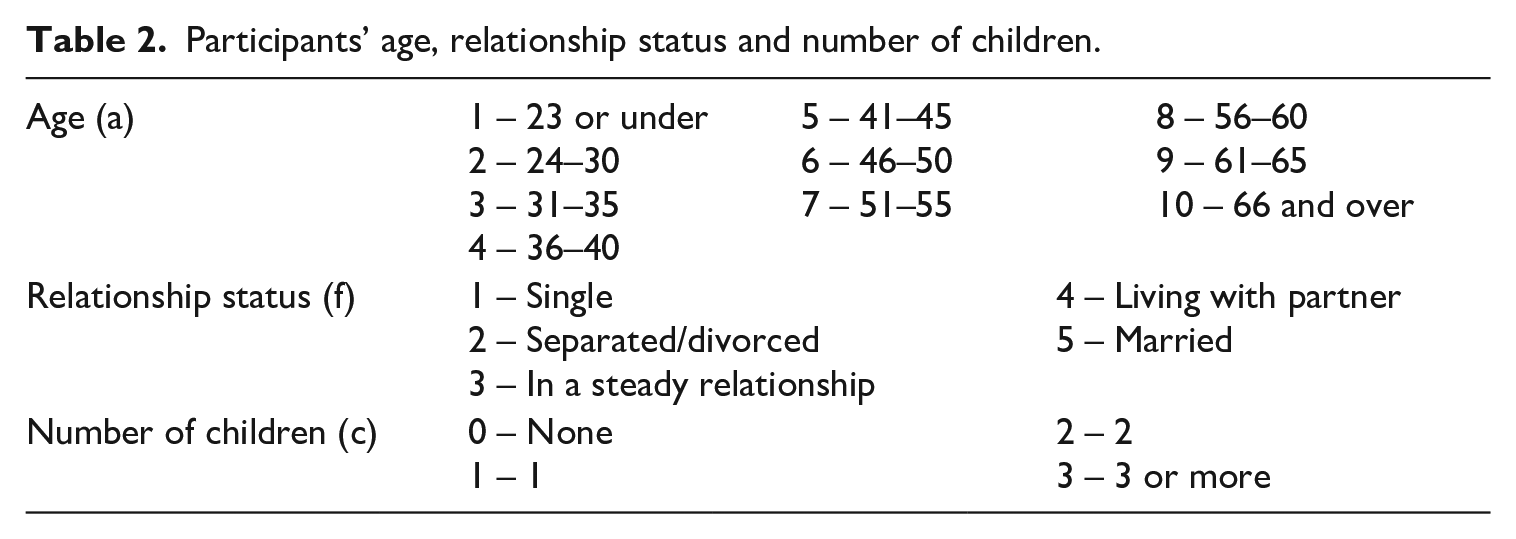
We targeted women academics working at geographically diverse universities, at different levels (including PhD fellows) and from different disciplines (see Table 1 for distribution of academic positions and fields and Table 2 for participants’ age group, relationship status and number of children). Around one-third of the respondents were PhD scholars and two-thirds worked in Social Sciences. A total of 146 of our respondents were employed in European countries (including Turkey), and we also had respondents from other continents: 24 from Mexico, 16 from the United States, 6 from Canada and 6 from Australia. The highest number of participants from one country was 39 from the United Kingdom, followed by Mexico (24); Spain (21); Germany, Austria and Norway (11 from each country). Many of our participants did not work in their country of origin. This is mostly due to internationalisation and mobility becoming central to policy discourse in higher education today (Morley et al., 2018). The highest number of academic ‘migrants’ were from Turkey (15%) followed by Mexico (11%) and Spain (8%).
Participants’ academic positions and disciplines.
Participants’ age, relationship status and number of children.
Due to the special distribution channels of our questionnaire (we especially targeted academic women’s support networks), our sample includes more critical and feminist voices than would be possible in a random sample. Although obviously not representative, we believe that our sample offers a rich mixture of academics at different career phases and in a range of academic disciplines, united by an interest in gender inequalities in academia. Our goal in this article is to identify shared problems and connect these experiences to the broader organisational context using a critical feminist theoretical approach.
The questionnaire was created with the use of SurveyXact. This enabled efficient collection, display and analyses of data through the automatic creation and export of data sets. The open-ended questions received detailed answers (generating over 70 pages of text) and provided us with the main data analysed and presented in this article. The open-ended questions – as they did not have a set of response options – required respondents to formulate a reply in their own words. This allowed for the views of the respondents to be collected without steering them into a particular direction by predefined response categories.
Our questionnaire combined Likert-type scale and open-ended questions on the work environment, work satisfaction, stress, academic duties and allocation of tasks and resources, and thoughts on gender equality. The questionnaire opened with questions on participants’ key demographics (age; family status; number of children and country of origin) followed by specific academic field and position. It then focused on perceptions of gender equality at work, asking, for instance, whether respondents think women have bigger challenges in combining parenthood and academic work than men and what these challenges are. The survey also had a question on measures that the participants thought could help to increase the number of women in top academic and leadership positions. The questionnaire ended with the question, ‘Looking back at your academic career path, what have been the major obstacles that you have faced?’ We provided a good amount of space for the answers to a total of 12 open-ended questions, and most of the participants provided lengthy accounts and reflections. These quotes were exported to Excel and coded. The first phase of coding was done to provide more descriptive codes for women academics’ perceptions and experiences, close to the participants’ narratives. Following the guidelines for reflexive thematic analysis (Braun and Clarke, 2019), we collated the codes to generate initial themes. The main themes that we identified from the data were
Unfair allocation of tasks,
Work-family issues (care work),
Gendered stereotypes and gender bias, and
Insecurity/precarity.
We mainly limit our discussion to the first two of these themes (gendered division of academic labour and gendered division of care) but also touch upon the other themes, since they are all related. Our data are rich and full of nuances but to accomplish our aim of identifying shared problems and to show their embeddedness in academic structures, we necessarily focus on similar accounts related to these overall themes. We employ thematic analysis with the aim of connecting these themes to the broader organisational and social context, through an ‘interpretative reflexive process’ that implies refining the themes and contextualising the analysis in relation to existing literature (Braun and Clarke, 2021).
Gendered divisions of academic work: Women doing more of the invisible work
Our questionnaire started with a very general open-ended question, ‘What is gender equality in academia to you?’ The comprehensive answers provided were based on both the lived experiences and the idealised expectations of our participants. While some respondents reported a more general understanding of equality (e.g. ‘having the same opportunities’), a great majority approached the concept of gender equality via their lived experiences of gender inequalities within academia. A key factor that was mentioned frequently was the unfair allocation of workloads and opportunities for research, contributing to men’s advantage. Former research on time-use in academia document that women dedicate more time to teaching and mentoring students than their male counterparts, leaving men with more hours on research and publications, which is the primary determinant of promotion (e.g. Angervall and Beach, 2018; Weisshaar, 2017). One respondent referred to these tasks as ‘invisible work’ and as a main disadvantage for women academics: Carrying more workload because of ‘invisible work’ (pastoral care, admin) and men who focus on themselves rather than the collective. (Lecturer, UK, Humanities, a:4, f:5, c:0)
1
As voiced by one of our experienced participants, women are being socialised into ‘servicing roles’ from the start and tend to internalise these expectations: . . . having experienced inequality from the beginning in academia, women are so much less likely to put themselves forward because they are already exhausted and fed-up by the time they get to that point. They have been thoroughly socialised into servicing roles and tend to take on those. Depressing, really! (Professor, Sweden, Gender Studies, a:8, f:5, c:1)
A postdoctoral fellow in France labelled the undesirable administrative tasks as ‘dirty work’, pointing at major gendered divisions: . . . and not always doing the ‘dirty work’, i.e., booking train tickets for invited researchers at seminars, or booking the restaurant, all of these administrative chores that are generally done only by women researchers, even when they have the same position as their male colleagues who are working on the same project. (Postdoc, France, SS, a:3, f:4, c:0)
Former research in the field similarly find that women are more frequently involved in what is labelled as “academic housework” defined as all the important but largely invisible and undervalued academic activities, which bear resemblances to the ‘second shift’, of which the extent and components are contingent with the employees’ gender, academic rank, the work culture of the subject field, as well as the level of intervention of more senior gatekeepers. (Heijstra et al., 2017: 211)
Pastoral care and emotional support for students were reported as undervalued but important activities that women do more of: to do more of the emotional labour with students, roles that have no credit, but students appreciate. (Lecturer, UK, SS, a:3, f:5 c:0)
As women take on servicing roles, they are nonetheless expected to perform the essential duties of academia – getting research funds and writing academic articles, leading to an overload: I have at least 4 different classes each semester while I have to do research, publish, and write my thesis while also holding 3 different administrating positions at my department and mentoring students. (PhD scholar, Turkey, NS, a:3, f:4, c:0)
Our findings indicate that being assigned more servicing roles slow down women’s progression in the increasingly competitive academic labour market. The ‘self-marketisation’ required of academics in the context of academic capitalism is apparently contingent on being able to be mobile in time and space and to be able to ‘delegate essential care work to others’ (Lynch and Ivancheva, 2015: 79). Veijola and Jokinen (2018) argue that gender still plays a significant role in academia coding non-tenure women as ‘mother-teachers’, meaning that they are depicted as having the ‘hostessing skills’ that operate with ‘affective, caring and aesthetic performances of femininity’ (p. 529). Women academics who are also mothers have the double-burden of providing the necessary care both at the workplace and in their homes.
Gendered care responsibilities: Constructions of the care-free ‘ideal academic’
A great majority (96%) of our participants stated that women have bigger challenges in combining parenthood and academic work than men. When we asked them to state what these challenges were, most of our early-career participants mentioned unequal division of care work, combined with an institutional disregard for the centrality of childcare for women academics: Academia is organized for people who have somebody at home who does all the care work. We should not have to cook, to clean, to have family obligations etc. It is as if we would still be in the 50s when researchers were all men and had a wife/servant at home. The administrative staff of my laboratory is composed almost only of women (there is one man). They all did a PhD. Most of them have children. The Professors are mostly men. Most of them have children too. I concluded that I should never accept an administrative job and never get pregnant. (Postdoc, France, SS, a:2, f:3, c:0)
The younger participants, who are PhD scholars, thought that it would be harder for them in the academia simply because they wanted to have children. A recurring factor listed as an expected obstacle was motherhood: ‘I intend to be a mother someday’; ‘I hope to have children’; ‘I want children’ and many similar expressions. We received numerous accounts from academics based in different countries on stereotypical expectations regarding motherhood and academic careers: Before I got married, I would go to a (male) colleague (who I considered to be a good friend) saying ‘I have some excellent news’, he would always assume my news was related to grants and publications. Since I got married, every time I’ve told him I had some news, he asks if I am pregnant. (PhD Scholar, Slovakia, SS, a:2, f:5, c:0)
Problems in combining work and care obligations were found to be a stressor interfering not only with our participants’ job-performances but also with their overall well-being and mental health. Academic capitalism creates the basis for the ‘long hours culture’ where the academics can only take part in the competition if they work extremely long hours (O’Hagan et al., 2019). This was particularly prominent among UK-based academics, which appears to be a national context characterised by a highly unregulated and insecure academic life: [There is an] expectation that our working hours are 24/7. (Senior Lecturer, UK, SS, a:3, f:5, c:1) Nothing is ever good enough. We have to be excellent teachers, administrators (more and more) and researchers. It never stops and the time for thinking is squeezed more each year. (Lecturer, UK, SS, a:2, f:4, c:0)
Heavy workloads and long working hours lead to stress and exhaustion, as indicated in the comments of one participant (which is the quote used in the title of this article). She depicted ‘dropping’ as her way of coping with stress caused by the workload: Working till I drop . . . Then dropping. (Senior Lecturer, UK, NS, a:8, f:5, c:1)
Due to the unequal gendered division of domestic work, the dominant long hours culture puts stronger constraints on women’s time (Bozzon et al., 2019: 37). Conflicting demands of work and family obligations were repeatedly mentioned as one of the biggest problems experienced at work, as in the words of a researcher from Sweden: Work-life balance is poor in academia. If you spend enough time with your children and have leisure time, then it is hard to get promoted due to low paper numbers. Most of the male colleagues seem to care less about spending less time with their children. (Senior Research Fellow, Sweden, Engineering, a:5, f;5, c:1)
Note that even academics working in the Nordic countries, which have well-developed parental leave and public childcare policies, experience combining academic work with motherhood as challenging. These problems are intensified in countries which do not have established work-family policies, such as Mexico, the United States and the United Kingdom: Universities in Mexico don’t have day-cares or other facilities for postdoctoral fellows/PhD students’ children. It is also difficult to publish with a new-born and the system is not flexible for women who are pregnant or have children under 5. (Postdoctoral scholar, Mexico, NS, a:4, f:4, c:1)
Our participants stated that they needed ‘flexible working hours’; ‘good maternity provisions’ and ‘good childcare places’ to reach gender equality at the workplace, but many evidently lacked these basic support mechanisms. As the quote below from an early-career researcher working in the United States illustrates, child rearing and parenting responsibilities, causing ‘gaps’ in their Curriculum Vitae (CV), continue to form one of the chief bases for gendered inequalities in academic promotions: Women are expected to fulfil more care giving roles than male faculty while simultaneously expected to continue the same level of academic output. For example, even if a female faculty takes maternity leave, and they are technically not supposed to be judged or rated unfairly because of it, there is often a still unspoken rule or fear that other faculty may judge their lack of output during that time of maternity leave. For example, multiple female mentors in my department have taken maternity leave . . . but have continued to work during those leaves out of fear of having a gap in their CVs when going up for tenure. Although the explicit idea behind being able to take leave for pregnancy is that you are excused, there is this implicit idea that exists that it is still ‘bad’. (Research Assistant, US, SS, a:4, f:5, c:1)
The negative impact of maternity leave leading to non-linear trajectories and ‘gaps in CVs’ is well documented (e.g.Gonzales Ramos et al., 2015; Maxwell et al., 2018). Although some countries have regulations to take parental leave periods in consideration while assessing academic productivity, this is often difficult to realise in practice.
Another often mentioned obstacle was the increasing demands for international mobility for early-career researchers. The requirement for researchers to be geographically mobile during their PhDs and postdoctoral phases poses additional challenges for women, since these often coincide with childbearing and rearing periods. The logic behind the demands for international mobility clearly run up against the logic of care: Hypermobility implies that there is fairly no possibility to combine family and academic work – you don’t even need to have kids for this conclusion since any kind of relationship suffers from the academic occupation. (PhD Scholar, Austria, SS, a:2, f:1, c:0)
Previous research also shows that women are especially vulnerable to insecurity and drop out of academic careers in greater numbers (Nielsen, 2017), notably due to the requirements of geographic mobility, which often coincides with family building (Lynch and Ivancheva, 2015). The accounts of our participants reveal that the ‘ideal academic’ is still an abstract character who is unencumbered by family and care obligations, and who ‘displays all the hallmarks of Benchmark Man’ (Thornton, 2013: 127). As formulated by a postdoctoral scholar, Academia was set up under the assumption that an ‘academic’ is an upper- or middle-class white man who is either unmarried or has a wife who takes care of all household and childrearing assignments for him. He is able to drop everything and move countries at the drop of a hat, go on extensive fieldwork, attend events at all hours of the day. . . . (Postdoctoral scholar, Israel, Arts and Humanities, a:4, f:5, c:1)
The ‘moral imperative’ on women to care has more negative consequences for the career development of women as the ‘ideal academic’ is constructed by the ‘masculinist care-free norms of hypermobility and 24/7 availability’ (Ivancheva et al., 2019: 459).
As the former quote underlines, the ‘ideal academic’ is not only masculine: he is also a white, middle-class man belonging to the ethnic majority. Our focus in this article is on gender, but it is vital to acknowledge that other elements (especially race, ethnicity, class and disabilities) intersect to form and reinforce disadvantages in academia. An intersectional approach is important to avoid ‘attributing fixed identity groupings to the dynamic processes of positionality and location on the one hand and the contested and shifting political construction of categorical boundaries on the other’ (Yuval-Davis, 2006: 200).
The importance of intersectionality was also underlined by some of our participants, who mentioned facing additional problems due to their class or ethnic backgrounds: For me, gender equality (also on a more general level, beyond academia) means much more than women being equal to men, as I don’t aim for the same neoliberal precarious positions many men are in – thus it is more than ‘simply’ a gender struggle, it is intersectional! (PhD scholar, UK, SS, a:3, f:5, c:0)
Although our participants reflected on problems they face ‘as women’, some provided critical comments, underlining the need for a more intersectional focus. Recurring statements like ‘I have experienced gendered racism’ in our data disclose the need for follow-up studies with a clearer intersectional approach where gender, ethnicity and class inequalities that cut across the distribution of opportunities and experiences within the academia can be further explored.
A PhD scholar, who had also researched gender equality in higher education, argued that the main challenge is how to articulate an intersectional understanding of gender in academia as a way to avoid “gender being used as a shield-varnish-management-device”, implying that “gender mainstreaming” policies can be used superficially by the leaders without looking deeper into the reasons of complex inequalities.
Another intriguing finding was the frequent report of difficulties related to doing feminist research or being involved in gender studies.
Being a feminist and gender studies academic
As mentioned above, our sample includes a high number of researchers either specialising in gender issues (both in STEM fields and social sciences) or with a clear interest in gender inequalities. Some of our participants stated that the feminist approach in their research or being a scholar in gender studies caused specific problems. A young PhD scholar mentioned this while describing her perception of gender equality in academia: Of course, there is what immediately comes into mind –– discrimination in salary, harassment, exclusion from research projects (here we could go on). But I also experience a different kind of discrimination as a gender studies scholar – I am viewed as ‘that feminist’, which sometimes distances me from other colleagues and research programmes. (PhD Scholar, Slovakia, SS, a:2, f:1, c:0)
A general resistance to gender perspectives and disparaging attitudes towards feminist scholars is documented in earlier literature (e.g. Taylor and Lahad, 2018; Verge et al., 2018). Gender scholars from different countries voiced that their fields of research and perspectives were devalued. Having a feminist perspective and doing gender research were mentioned among the ‘major obstacles’ faced at the academic career path: That my field of research (Gender Studies for STEM) is not really appreciated and established in the STEM-field. (Professor, Germany, STEM, a:6, f:3, c:0) To include feminist perspective on my doctoral thesis, due to the resistance of my directors. (PhD Scholar, Spain, SS, a:2 f:4, c:0) Doing research about feminism! (PhD Scholar, Italy, SS, a:2, f:4, c:0)
Studies focusing on the explicit relationship between ‘New Academic Governance’ and gender underline that ‘neo-liberalism is not essentially male, but it has reinforced asymmetrical power relations and male dominance of the research economy by valuing and rewarding the areas and activities in which certain men traditionally succeed’ (Morley, 2018: 34). Academic work is categorised as ‘valuable vs not valuable’, narrowing the range of ‘acceptable’ (and thus, fundable) research (Acker and Wagner, 2019). Academic merit is increasingly defined with quantified metrics of productivity (Ferree and Zippel, 2015) where the type of job men do more (research and journal publications) are valued more than what women do (teaching, supervising, administrative work and specifically gender research).
Hence, our findings add to growing concerns about the ways that neoliberal managerialist practices threaten academic freedom in general and feminist academics in particular (Taylor and Lahad, 2018). Our analysis shows that gendered divisions of academic and non-academic tasks disadvantage women as they clearly do more of the un-rewarded, invisible ‘academic housework’ as well as the essential domestic care work. These disadvantages cumulate along academic career paths and influence women’s work status and access to positions of power. We discussed these recurrent disadvantages in light of our participants’ own critical accounts. Ironically, some women felt they ended up replicating the ‘masculinised professional behaviour’ to survive in the academic world: My senior female colleagues all end up – as do I – replicating the masculinized professional behaviours – especially regarding ridiculously long working hours that we fought so hard against some time ago. (Professor, Sweden, SS, a:8, f:5, c:1)
This internalisation of the demands of academic capitalism and engaging in career practices that perpetuate gender differences is also documented by other recent studies in the field (Bozzon et al., 2019; O’Hagan et al., 2019). Academic capitalism effectively works through the languages of ‘love, flexibility and productivity’ (Mannevuo, 2016: 86). As we designate academic jobs as highly flexible and thus ‘lovable’, we risk becoming ‘blind’ to the elements of academic capitalism and seek individual solutions to structural problems (Mannevuo, 2016: 71).
While we were finalising this article, the world was hit by the COVID-19 pandemic. With very short notice, universities and research institutions were closed, and academics were asked to work from home, and in many cases, to combine this with the home-schooling of children. The gendered consequences of academic lock-down attracted rapid media and research attention (e.g. Al-Ali, 2020; Craig, 2020; Minello, 2020; Utoft, 2020). We, thus, conclude with a brief reflection on the gendered consequences of the pandemic for academics and discuss possibilities for change.
Concluding discussion: Backlash or new possibilities for collective resistance?
In extraordinary situations like the current COVID-19 pandemic, which led to lockdowns and working from home, the clashing demands of the family and work become even more visible. Although working from home is a rather common practice among academics, combining this with home-schooling of children, securing care arrangements for elderly parents and/or vulnerable relatives, and adapting to the mass digitalisation of teaching and research activities create new gendered divisions. Reflecting on her experiences of mothering and being an academic during the lockdown, Minello (2020) argues that the COVID-19 pandemic will exacerbate gender inequalities since: ‘Academic work – in which career advancement is based on the number and quality of a person’s scientific publications, and their ability to obtain funding for research projects – is basically incompatible with tending to children’. Early analyses of available data and initial reports from journal editors indeed show a rapid decline in the number and share of journal articles submitted by women since the pandemic hit (Murdie, 2020; Viglione, 2020). Especially early-career women’s research productivity is being affected more than men’s and thus will have long-term gendered consequences (Andersen et al., 2020). Initial quantitative analyses also show that COVID-19 pandemic is having a profound effect on women academics with younger children (Yildirim and Eslen-Ziya, 2021).
On a more optimistic note, the pandemic can also open new possibilities: COVID-19 measures have shown efficiently that the jobs that are considered ‘essential’ involve care and many of them are female-dominated. As Lyn Craig (2020) aptly puts it, COVID-19 has laid bare how much we value women’s work, and how little we pay for it: ‘The coronavirus crisis has made brutally clear that care work, both paid and unpaid, is fundamental to our economic and social survival (Craig, 2020)’. This might lead to an overall movement of valuing care work, both within the domestic sphere and beyond. Al-Ali (2020) also points to the possibility, and the necessity, of developing a transnational feminist solidarity, for a wider recognition of social reproduction and care giving.
One overall purpose of this article has been to draw attention to the similar problems that women academics are facing in different national contexts, to highlight the gendered elements of academic capitalism and argue against the tendencies of individualising these problems as being due women’s own choices. Changing the ‘solidly masculinized’ (Leatherwood and Read, 2009) organisational cultures and prevailing gender stereotypes in academic institutions and beyond is not an easy task. It demands a multi-dimensional consideration of factors operating at different levels. Most of our participants were aware of this complexity and underlined the need for supportive policies and awareness at different levels: More transparency in terms of criteria, gender equity in composition of boards, attaching more prestige to quality of teaching and student support. Family-friendly university structures, equal opportunities officers, neutral recruitment systems with trained staff. Raising gender awareness on all levels of the university. (Associate Professor, Germany, AH, a:8, f:5, c:2)
The recognition of this complexity in our data echoes the depiction of gender-inequality as the “unbeatable seven-headed dragon” with a multitude of faces (Van den Brink and Benschop, 2012). One first step towards beating the dragon could be better rewarding (both financially and symbolically) of academic tasks that fall disproportionately on women’s shoulders (such as teaching, supervision and pastoral care). Based on their study from South Africa, and pointing to similar international studies, Subbaye and Vithal (2017) argue that ‘recognising a broader range of activities in promotions policies and processes, beyond a focus on research, produces better and fairer outcomes for women’ (p. 948). Another key step is an acknowledgement that gendered divisions of academic work and care work are intertwined and women face an invisible but strong “care ceiling”, which is exacerbated by the performativity demands of academic capitalism (Grummell et al., 2009: 204).
Our data display a general awareness that the increasingly competitive work culture and the ‘publish and perish’ mentality are detrimental for establishing egalitarian workplace practices. Our final ‘voice’ stresses the need to change the system by cultivating feminist ethics: Also, the point is not to recruit more women in order to have them work for a system that reproduces gender, racial and class inequality. The point is to cultivate feminist or if you prefer social justice ethics within academia in order to change the power imbalance that privileges white middle-class men. (Postdoc, UK, SS, a:3, f:1, c:0)
The further marketization of the academy is neither good for gender and racial equality nor for academic freedom. It is time for a renewed reflexivity, through ‘naming the racialized, gendered, care-less and classed hierarchies of universities and how these undermine freedom’ (Lynch and Ivancheva, 2015: 82). We hope that by highlighting the persistent gendered hierarchies and the mechanisms behind them across different national contexts, this article will contribute to a collective criticism of the growing competitive individualism, which devalues ethics of care and turns academic careers into a race of individualistic self-promotion.
Footnotes
Acknowledgements
Special thanks to the members and administrators of the Women in Academia Support Network Group (#WIASN).
Declaration of Conflicting Interests
The author(s) declared no potential conflicts of interest with respect to the research, authorship, and/or publication of this article.
Funding
The author(s) received no financial support for the research, authorship, and/or publication of this article apart from the research time provided by their universities.
