




Abstract
Soicologist Ann Mullen explores what it means that women now earn the majority of bachelor’s degrees. Rather than seeing this as a sign of a “male crisis” in higher education, this article concludes that the gender integration of higher education is far from complete.
Keywords
Since 1982, women in the United States have been graduating from college at higher rates than men; they currently earn 57 percent of all bachelor’s degrees. Some view this trend as a triumphant indicator of gender egalitarianism, while others sound the alarm about the supposed “male crisis” in higher education and the problem of increasingly “feminized” universities.
Gigi Rose Gray
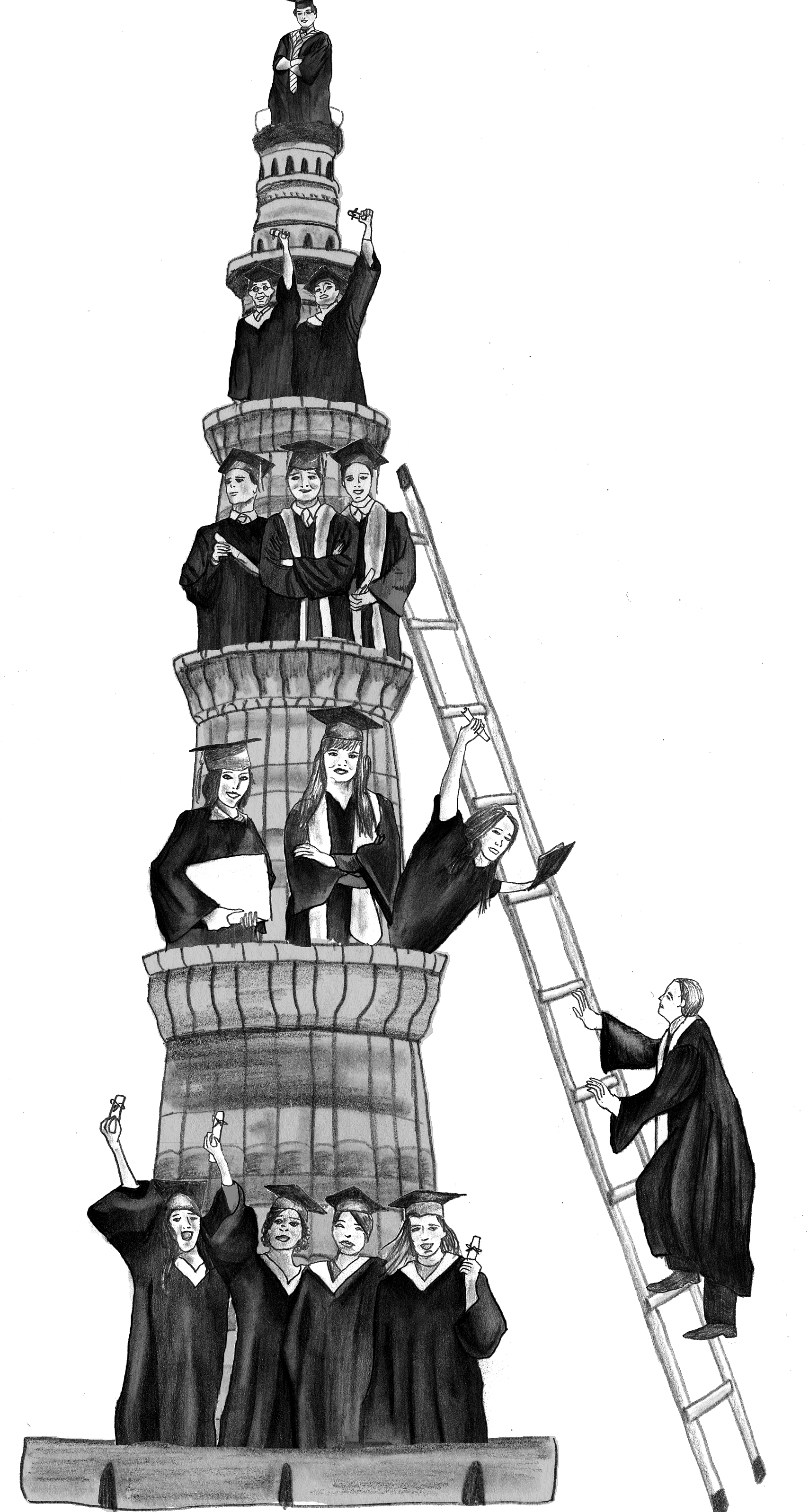
Recently, the New York Times reported that when it comes to college, “women are leaving men in the dust,” the Minneapolis Star Tribune announced that women’s “takeover is complete,” and the Weekly Standard described colleges as “where the boys aren’t.” Some have even predicted that sorority sisters will face increasing difficulty finding dates for formals, or eligible men to marry. Thomas Mortenson, a senior scholar at the Pell Institute for the Study of Opportunity in Higher Education, warned that if current trends continue, “the graduation line in 2068 will be all female.”
But is higher education really feminizing? Have women’s advances come at the cost of men? In 50 years, when they look around their classrooms, will undergraduate students be hard-pressed to see a male face? In other words, has the trend towards gender equality in higher education gone too far? To answer these questions, we need to look beyond the single statistic of the gender distribution of bachelor’s degrees, and take a broader approach to understanding the contours of gender in higher education.
Who’s Getting Degrees
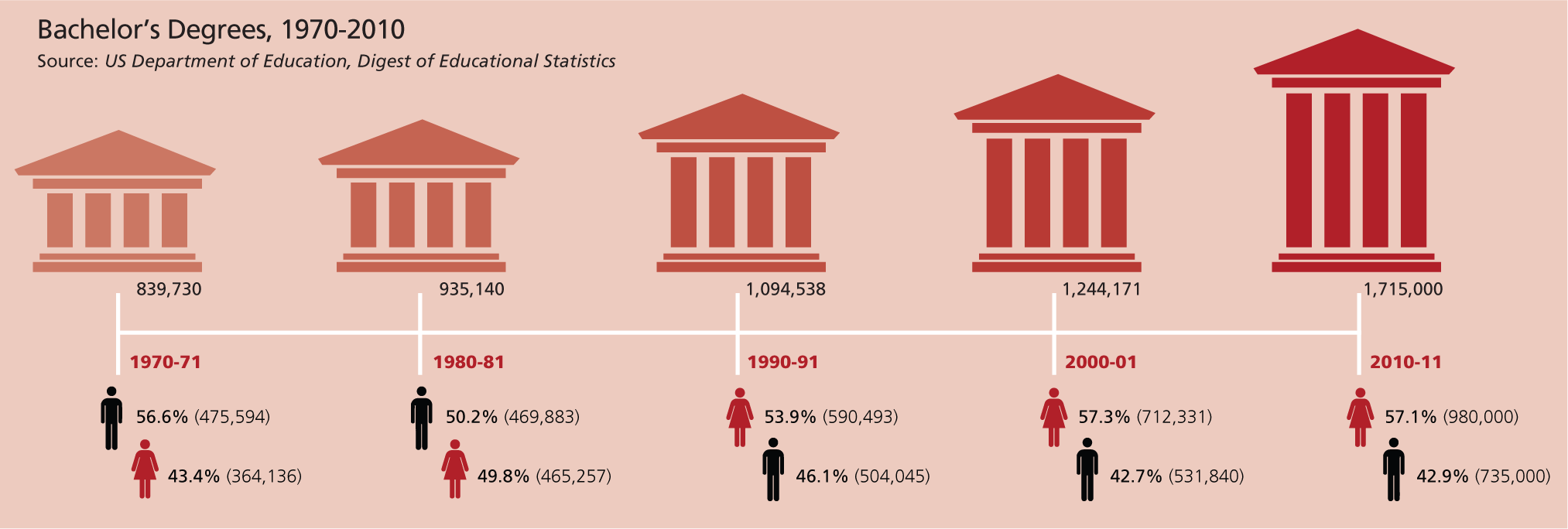
During the past 40 years, the gender distribution of bachelor’s degrees reversed. In 1970, men earned 57 percent of all degrees; today, women do. This trend leads some to conclude that women are squeezing men out of higher education, and that women’s success has led to men’s decline. In fact, this zero-sum scenario is incorrect: the college-going rates for both men and women have increased substantially. Both genders are far more likely to graduate from college now than at any previous point in time. Women’s increasing graduation rate isn’t due to a decrease in the number of graduating male students, but to the fact that women’s increases occurred faster than men’s. Particularly between 1970 and 1990, as employment opportunities for women expanded, their college graduation rates grew more rapidly than did those of men.
The rates of growth for men and women have now equalized. Over the past decade, the number of degrees earned by both men and women actually increased by the identical rate of 38 percent. The U.S. Department of Education predicts that over the course of the next decade women’s share of bachelor’s degrees will rise by only one percentage point, to 58 percent of all degrees. In looking at these figures over time, we see that women’s successes did not come at the expense of men, and that the gender gap is not growing uncontrollably. It has in fact stabilized, and has held steady for more than 10 years.
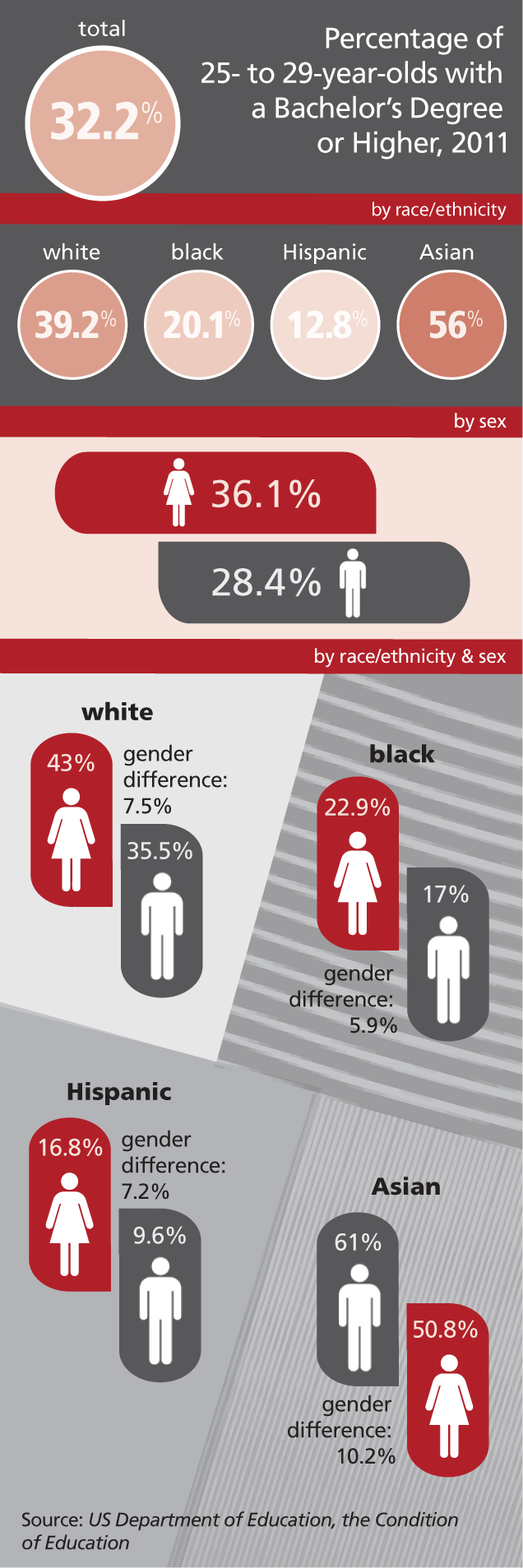
To fully assess the gender distribution of bachelor’s degrees, we also need to look at what kinds of men and women graduate from college, and whether men and women of different racial, ethnic and class backgrounds have the same chances of graduating. Among 25- to 29-year-olds, across all racial and ethnic groups, more women than men hold bachelor’s degrees. The gap is just over 7 percent among whites and Hispanics, 6 percent among blacks, and about 10 percent for Asians.
Women’s increasing graduation rate isn’t due to a decrease in the number of graduating male students, but to the fact that women’s increases occurred faster than men’s.
But in terms of race and ethnicity, the gaps in college completion far exceed that of gender: 56 percent of Asians between 25 and 29 years old hold bachelor’s degrees, compared to only 39 percent of whites, 20 percent of blacks, and nearly 13 percent of Hispanics. Both white and Asian men are far more likely than black or Hispanic students of either gender to earn a bachelor’s degree. These racial gaps are actually larger now than they were in the 1960s: while students from all backgrounds are now more likely to graduate from college, the rates have increased more quickly for whites and Asians.
Kimmy Holtz
Social class continues to be the strongest predictor of who will attend and graduate from college—one that far outweighs the effects of either gender, or race and ethnicity. Surveys by the U.S. Department of Education show that 70 percent of high school students from wealthy families will enter four-year colleges, compared to only 21 percent of their peers from low-income families. Gender differences also vary by social class background. According to education policy analyst Jackie King, for the wealthiest students, the gender gap actually favors men. (For families in the highest income quartile, men comprise 52 percent of college students, compared to 44 percent in the lowest income quartile, and 47 percent in the middle two quartiles). Age also plays a role: among adults 25 years and older, women are far more likely than men to return to college for a bachelor’s degree. But among those 24 and under, women make up only 55 percent of all students, and the gender difference among enrollment rates for recent high school graduates is small (41 percent of men and 44 percent of women).
Gigi Rose Gray
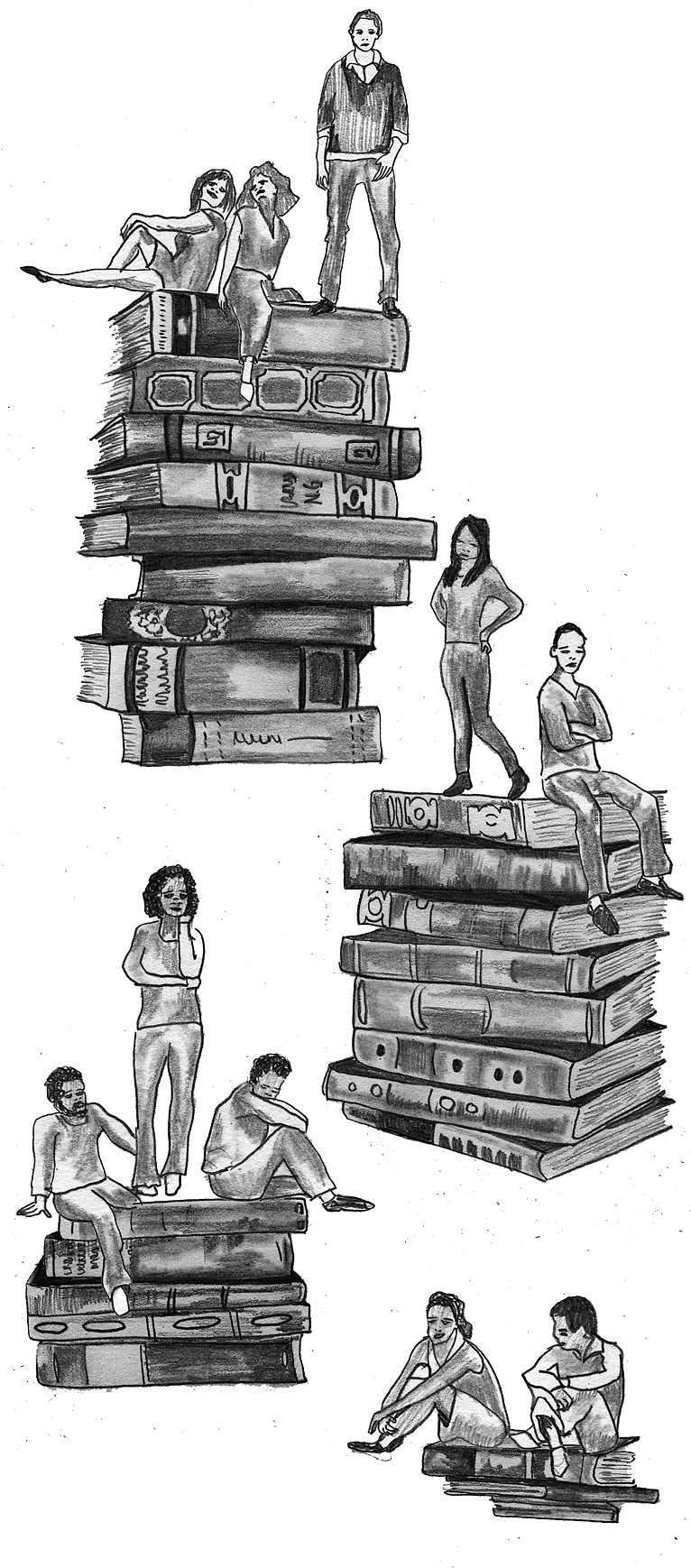
Social class continues to be the strongest predictor of who will attend and graduate from college—one that far outweighs the effects of either gender, or race and ethnicity.
In other words, women’s overall advantage in earning college degrees is not shared equally among all women. White women, Asian women, and wealthy women outpace women from other backgrounds. Gender differences are largest among students 25 years and up, Asians, and low-income students. But differences in relation to class, race and ethnicity greatly overshadow gender gaps in degree attainment.
Not at Caltech
In assessing gender equity in higher education, it’s also necessary to take into account where men and women earn their degrees. While more women than men tend to graduate from college, women are disproportionately represented in less competitive institutions.
Sociologist Jayne Baker and I found that women earned more than 60 percent of degrees in the least selective institutions, but only slightly more than half in the most selective institutions. Women’s gains have been greatest at institutions with lower standardized test scores and higher acceptance rates, while men and women are roughly on par with each other at elite institutions. Women are also underrepresented at the top science and engineering institutions, like Caltech and MIT. So, while women may be in the majority overall, their integration into higher education has been uneven, and they are more likely to attend lower status institutions.
Perhaps the most striking disparities are in the choice of college majors. In spite of their overall minority status, men still earn 83 percent of all degrees in engineering, 82 percent in computer and information sciences, 70 percent in philosophy, and 69 percent in economics. Women, on the other hand, continue to earn the lion’s share of degrees in traditionally female-dominated fields: 77 percent in psychology, 80 percent in education, and 85 percent in nursing and other health professions. About a third of all men (or women) would have to change majors in order to achieve gender parity across majors today. This hasn’t changed much in the last 25 years. (Through the 1970s and early 1980s, fields moved steadily toward becoming more integrated, but in the mid-1980s, this trend slowed and then stalled, shifting very little since then.)
Sociologists Paula England and Su Li found that most of the decrease in segregation came from the growth of gender-integrated fields, like business, and from the flow of women into previously male-dominated fields. Men are much less likely to move into female-dominated fields. They also found that women’s entrance into predominantly male fields discourages later cohorts of men from choosing those fields. Women gain status and pay by entering predominantly male fields, while men lose out when they enter devalued, predominantly female fields of study.
Women and men are ostensibly free to select any field they wish, and they no longer face the blatant kinds of barriers to entry that have historically existed. But, other factors influence students’ choices subtly, but powerfully. Sociologist Shelly Correll has done innovative experiments with undergraduate students that demonstrate how cultural beliefs about gender shape individuals’ career aspirations. When exposed to the idea that men are better at certain tasks, male participants in the study rated their own abilities higher than the women, even though they were all given the same scores. These subjective assessments of their own competencies then influenced students’ interest in related careers. Correll argues that widely shared cultural beliefs about gender and different kinds of competencies (like math and science) bias men’s and women’s perceptions of their own abilities, and their interest in pursuing these fields. She finds that men assess their own capabilities in math more generously than do women, which then encourages them to go into math and science fields.
Education researcher Maria Ong has studied the challenges young women of color majoring in physics face. Because their bodies do not conform to prevalent images of “ordinary” white, male scientists, their belonging and competence are questioned. To persevere in physics, these women confront the necessity of developing strategies for managing their physical appearance. In my own work, I found that students at an elite liberal arts institution choose majors in order to both carve out intellectual identities and settle on a career path. Students identify with the qualities of knowledge of different fields of study, which they often interpret in gendered ways. Men tend to reject female-dominated fields because of their perceived lack of rigor and objectivity.
Kimmy Holtz
Men and women also experience college differently. Education scholar Linda Sax uses 40 years of data about college freshmen, along with research from the 1990s that tracked individual students over time. She found some gender differences that have persisted over the past four decades, such as women’s lower levels of academic self-confidence. Among first-year college students, according to Sax, women rate themselves lower than men on three out of four indicators of confidence, in spite of their significantly higher high school grades. In terms of overall intellectual self-confidence, only about half of women consider themselves above average or in the highest 10 percent compared to over two-thirds of men. This gender gap widens even further during the college years.
Because more women than men come from low-income families, women also come to college with greater concerns about financing their education. Women study harder than men during college, spend more time talking with their professors, and get better grades, while men are more likely to miss classes and not complete homework. By focusing only on the relative numbers of men and women at college, we overlook the ways their college experiences diverge, and the different obstacles and challenges they encounter along the way.
After College
Paradoxically, women’s success in closing the gender gap in higher education has not closed the gender gaps in the labor market. Men and women still generally work in different kinds of jobs, and women still earn considerably less than men (even with the same levels of education). Occupational segregation remains high and the trend toward narrowing the gender gap in pay has slowed. Currently, young, college-educated, full time working women can expect to earn only 80 percent of the salaries of men ($40,000 annually compared to $49,800), a ratio identical to that of 1995. In fact, women with bachelor’s degrees earn the same as men with associate degrees. Some of this pay gap can be attributed to students’ undergraduate fields of study. Engineering graduates, for example, earn about $55,000 annually in their first year after graduation, while education majors bring home only $30,500. However, even after taking into account fields of study, women still earn less than men.
These pay disparities suggest an economic rationale for women’s vigorous pursuit of higher education. Not only do women need to acquire more education in order to earn the same salaries as men, they also receive higher returns on their educational investments. Education scholar Laura Perna has found that even though women’s salaries are lower than men’s, women enjoy a greater pay-off in graduating from college than men do. In the early years after graduating, a woman with a college degree will earn 55 percent more than a woman with a high school degree. For men, that difference is only 17 percent. What’s more, men with only a high school education earn a third more than women do, and are more likely to find work in traditionally male blue-collar jobs that offer health care and other benefits—which are not available in the sales and service jobs typically held by women.
Though men with high school educations enjoy higher salaries and better benefits than do women, they are also more vulnerable to unemployment. In general, the rates of unemployment are twice as high for high school graduates as they are for college graduates. They are also slightly higher for men than for women at all educational levels below the bachelor’s degree. According to data from a 2010 U.S. Census survey, the unemployment rate for high school graduates was 11.3 percent for men versus 9 percent for women (compared to 4.8 percent and 4.7 percent, respectively, for those with at least a bachelor’s degree), due in part to the effects of the recent recession on the manufacturing sector.
Women earn more degrees than men, but men and women still diverge in the fields of study they choose, their experiences during college, and the kinds of jobs they get after graduating.
In addition to offering access to better jobs, higher salaries, and less risk of unemployment, going to college offers a host of other advantages. College graduates live longer, healthier lives. They are less likely to smoke, drink too much, or suffer from anxiety, depression, obesity, and a variety of illnesses. They are more likely to vote, to volunteer, and to be civically engaged. Because of this broad array of social and economic benefits, we should be concerned about patterns of underrepresentation for any group.
Incomplete Integration
To some, the fact that women earn 57 percent of all degrees to men’s 43 percent suggests the gender pendulum has swung too far. They claim that if the ratio still favored men, there would be widespread protest. But such claims fail to see the full picture: though women earn more degrees than men, the gender integration of higher education is far from complete. Men and women still diverge in the fields of study they choose, their experiences during college, and the kinds of jobs they get after graduating.
In the early 1970s, when men earned 57 percent of college degrees, women faced exclusion and discrimination in the labor market and earned less than two-thirds of what men earned. Many professions, and most positions of power and authority, were almost completely closed to women. While the ratio of college graduates now favors women, women are not benefiting from more education in ways that men did 40 years ago. In terms of the economic rewards of completing college, women are far from matching men, let alone outpacing them.
By paying exclusive attention to the gender ratio, we tend to overlook much more serious and enduring disparities of social class, race and ethnicity. This lessens our ability to understand how gender advantages vary across groups. If there is a crisis of access to higher education, it is not so much a gender crisis, as one of race and class. Young black and Hispanic men and men from low-income families are among the most disadvantaged, but women from these groups also lag behind their white, Asian and middle-class counterparts. Addressing the formidable racial and economic gaps in college access will improve low-income and minority men’s chances far more than closing the gender gap would.
The higher proportion of degrees earned by women does not mean that higher education is feminizing, or that men are getting crowded out. It seems that if women hold an advantage in any area, even a relatively slim one, we jump to the conclusion that it indicates a catastrophe for men. In the case of access to college degrees, that’s simply not true.