




Abstract
Despite gender parity in earned bachelor’s degrees, large gender gaps persist across fields of study. The dominant explanatory framework in this area of research assesses how gender differences in individual-level attributes predict gaps in major choice. The authors argue that individualistic accounts cannot provide a complete explanation because they fail to consider the powerful effects of the gendered institutional environments that inform and shape young men’s and women’s choices. The authors propose a cultural-organizational approach that considers how institutional characteristics and cultural contexts on college campuses may influence gendered choices and thus be associated with patterns of gender segregation across fields of study. The results of an analysis of institutional data on all U.S. degree-granting colleges and universities reveal substantial interinstitutional variation in gender segregation. Furthermore, structural and contextual institutional features related to peer culture, curricular focus, institutional commitment to gender equity, and the gender proportionality of the student body correlate with heightened or diminished levels of segregation.
Since the 1960s, higher education systems worldwide have experienced two remarkably divergent trends toward gender integration. First, in almost all developed countries and half of developing countries, more women than men now attend and complete tertiary education (UNESCO 2008). In the United States, women have earned a higher share of bachelor’s degrees than men since 1982 and currently earn 57 percent of all these degrees (Snyder, de Brey, and Dillow 2016; Snyder and Hoffman 2002). This robust upward trend toward gender parity in earned degrees sharply contrasts with the second trend, that of the distribution of men and women across undergraduate fields of study, or horizontal segregation. Unlike the former trend, this one can be characterized by stagnation. In the United States, for example, the gender integration of fields of study increased through the 1970s and then stalled by the mid-1980s and has improved little since then (England and Li 2006; Jacobs 1995; Mullen and Baker 2015). Despite women’s entry into some previously male-dominated fields, such as business and the life sciences (England and Li 2006; Jacobs 1995), men still earn a disproportionate share of degrees in fields such as engineering, computer and information sciences, economics, and philosophy, while women continue to earn the lion’s share of degrees in traditionally female-dominated fields such as psychology, education, and nursing and other health professions (Snyder et al. 2016). About a third of all men (or women) would have to change majors in order to achieve gender parity across majors (Mullen and Baker 2015). This trend is common globally, with persistent and substantial levels of gender segregation of fields of study found across large samples of countries (Charles and Bradley 2002, 2009).
These long-standing patterns of gender segregation of fields of study are linked to entrenched levels of occupational segregation and gender disparities in earnings. In the United States, in the first year after college graduation, women earn only 80 percent of what men do, a figure that drops to 69 percent 10 years after graduation (Dey and Hill 2007), and gendered patterns of occupational segregation remain strong (Charles and Grusky 2004). Closing the gender gap in postsecondary enrollments has not had the anticipated effect of closing the gender gap in occupational segregation, in part because of the segregation of major fields of study (Bradley 2000; Brown and Corcoran 1997; Jacobs 1996; Shauman 2006; Smyth and Steinmetz 2008).
The reigning model toward explaining gender differences in fields of study relies on individual-level analyses, assessing the influence of students’ demographic characteristics, academic preparation, aspirations, and work attitudes on choice of major (Davies and Guppy 1997; Eide and Waehrer 1998; Legewie and DiPrete 2014; Ma 2009; Mann and DiPrete 2013; Riegle-Crumb et al. 2012). We argue that individualistic accounts of major choice cannot provide a complete explanation because they fail to consider the powerful effects of the gendered institutional environments that inform and shape young men’s and women’s choices. A large body of research documents the cognitive and psychosocial changes students experience during college as a result of the effects of institutions’ structural characteristics and distinct cultural contexts. These changes extend to shifts in liberal social values, gender role attitudes, and gendered career orientations (Ethington, Smart, and Pascarella 1988; Sax 2008; Sax and Bryant 2006). Furthermore, nearly half of college students change their major at least once before graduation (Sklar 2014), suggesting the possibility that students’ experiences in specific college environments may influence their choice of major.
In this article, we propose a new direction for the study of gender and the choice of college major. Drawing on research on college effects and theoretical insights from the gendered organizations literature, we argue that college cultural contexts are gendered and that these contexts support and promote gender-differentiated identities and aspirations in ways salient to the choice of major. In a departure from the prevailing individual-level explanations, we develop a cultural-organizational approach to explore how the institutional characteristics and cultural contexts of college campuses may shape gendered choices and thus be associated with patterns of gender segregation across fields of study. We consider the fruitfulness of this approach by examining institutional variation in the gender segregation of bachelor’s degrees across all U.S. degree-granting colleges and universities. Using institutional-level data on nearly 1.3 million bachelor’s degree completions collected from all U.S. degree-granting institutions, along with data on institutional characteristics, we first assess interinstitutional variation in gender segregation and then analyze the associations between four specific institutional characteristics and increased or decreased levels of segregation. Our results show that institutions vary significantly in the degree of gender segregation across undergraduate fields of study. Furthermore, structural and contextual institutional features related to peer culture, curricular focus, institutional commitment to gender equity, and the gender proportionality of the student body correlate with heightened or diminished levels of segregation.
Explaining Gender Differences in Undergraduate Fields of Study
The persistence of deep patterns of horizontal segregation alongside the full attainment of gender integration along the vertical dimension of higher education continues to puzzle social scientists. A large body of literature has sought to explain gender gaps in major choice by examining women’s decision to enter the majors in which they are underrepresented relative to men, such as science, technology, engineering, and mathematics fields (Legewie and DiPrete 2014; Leslie and Oaxaca 1997; Mann and DiPrete 2013; Riegle-Crumb et al. 2012) and majors leading to high-paying fields (Davies and Guppy 1997; Eide and Waehrer 1998; Ma 2009). These studies conceptualize major choice as an individual decision explained by students’ attitudes, values, academic aptitudes, and demographic characteristics. Although many scholars acknowledge the probable role of widespread cultural expectations and gendered beliefs, nonetheless empirical analyses are largely premised on socialization models, whereby gendered characteristics are inculcated in boys and girls through early childhood family and educational socialization, and students arrive at college with well-developed gendered occupational preferences that predict major choices. 1
Gender scholars, however, increasingly recognize gender not as primarily a role or identity at the individual level but rather as an organizing principle operating as an institutionalized system of social practices at the individual, interactional, and institutional levels (Ferree, Lorber, and Hess 1999; Martin 2004; Ridgeway and Correll 2004; Risman 2004, 2017). Adopting the perspective of gender as a multilevel system, in this study we develop a model that departs from individual-level explanations and uses a cultural-organizational approach that focuses on how gendered cultural contexts on university campuses may shape students’ gendered choices. To do this, we bring together theoretical frameworks and empirical findings from college effects studies and gendered organizations.
An extensive set of studies on the effects of attending college establishes that institutions influence students’ growth and development in myriad ways, including their academic and intellectual skills, identity and self-concept, attitudes and values, and moral development (see Mayhew et al. 2016 for a comprehensive review). Effects are associated with institutions’ structural characteristics, such as size and selectivity, as well as institutions’ organizational context characteristics, such as programs, administrative policies, curricular and cocurricular structures, and faculty culture. The effects of this latter set of institutional characteristics operate indirectly, through shaping the kinds of experiences students have (net of students’ precollege characteristics), which in turn shape student outcomes (Ro, Terenzini, and Yin 2013).
These organizational context characteristics are also related to distinct campus cultures. Universities cultivate unique institutional characters (Clark 1992; Stevens 2007) that arise not as much from structural features of the institutions but from contextual features, such as historical institutional sagas, the physical landscape of the campus, the frequency and quality of faculty-student interactions, and the promotion of particular types of student career aspirations (Binder and Wood 2012). In this way, institutional characteristics matter through a contextual dimension that influences the college experiences of students. For example, Binder and Wood (2012) found that although students arrive at college with understandings of a wider political culture, it is each campus’s “unique, local repertoires of conservative styles and ideas” that shape students’ understandings of what is “appropriate to say and do politically” (pp. 8–9). Universities shape college students’ political development in significant ways depending on the campus culture of each institution.
Belying the assumption that students arrive at college with solidified gendered identities, students’ gender role attitudes and career orientations continue to shift during college, in response to characteristics of college environments. Comparing changes in support for traditional gender roles and in sex-atypical career aspirations from the first to last year of college, research (Sax 2008; Sax and Bryant 2006) shows that features of institutional environments (such as selectivity, student-to-faculty ratio, and characteristics of the peer group), as well as college experiences (such as interactions with faculty members, curriculum, and volunteering), contribute to statistically significant shifts in attitudes and career plans. Sax and Bryant (2006) attribute these changes to the intentional and unintentional messages transmitted to students through faculty, peer groups, and the curriculum that shape students’ perceptions of career opportunities.
While studies of college effects find that structural features of institutions as well as distinctive campus cultures contribute to cognitive and psychosocial changes in students independent of their precollege characteristics, a second line of research applies insights from theoretical work on gender and organizations to examine how features of schooling environments shape gendered outcomes. Organizations are inherently gendered in their divisions, the symbols and images of those divisions (such as workplace culture), interactions, components of individual identity within the organization, and conceptualizations of jobs and workers (Acker 1990; Britton 2000). Within gendered organizations, “advantage and disadvantage, exploitation and control, action and emotion, meaning and identity, are patterned through and in terms of a distinction between male and female, masculine and feminine” (Acker 1990:146). Research in this area explores the practices by which organizations are gendered, such as evaluation procedures (Acker 1990; Creese 1999; Williams, Muller, and Kilanski 2012) and glass ceilings and escalators (Morgan 1998; Williams 1995), as well as the ways the gendering of an environment and one’s location within that environment shape experiences and behavior (Irvine and Vermilya 2010; Kanter 1977).
Insights from the gendered organizations literature have informed research investigating how the school practices and organizational features of schooling environments reinforce patterns of gender segregation and gendered behaviors (Holland and Eisenhart 1990; Martin 1998; Thorne 1993). At one midwestern university, for example, aspects of the university structure (including Greek life, the organization of the residence hall system, and the provision of “easy” majors) coalesce with a peer culture to support gender-traditional notions of masculinity and femininity (Armstrong and Hamilton 2013). The structural supports for these kinds of gendered notions allow women arriving at college with gendered interests to continue to cultivate traditional feminine tastes, appearance, personality styles, and skills and encourage those without such interests to begin to develop them. For many women, the social and academic environments effect deep transformations in their gender dispositions, as over time they internalize elements of a highly rewarded traditional femininity and shift into “easy” majors corresponding to the embodiment of a particular feminine self (Hamilton 2014). In contrast, institutional and interactional supports enable men to construct a complementary hegemonic masculinity based on sexual dominance over women. In these ways, institutional features help support the cultivation of gendered dispositions and contribute to facilitating particular gendered pathways on college campuses in ways that may influence major and career choice for women.
Institutional contexts may also frame the gendered meanings around college majors that inform students’ choices. An explicit liberal arts mission encourages students to understand their education as a project of self-development, and within that framework, the choice of a major becomes, in part, the choice of an intellectual identity (Mullen 2014). In this context, gendered associations with bodies of knowledge achieve salience in students’ decision making; women pursue their intellectual passions while men tend to construct their identities in opposition to femininity, avoiding those fields traditionally associated with feminine qualities even when they might find them intrinsically interesting. In this way, the gendering of the college major selection process may happen differently across institutions, varying with specific institutional contexts and the collective meanings around choice of major.
These streams of research show that university environments influence students in significant ways, independent of their precollege attributes, and that these effects operate through particular institutional characteristics as well as the influence of distinctive campus cultures. Furthermore, consistent with the idea that gender is a constitutive element of the underlying assumptions and practices of organizations (Acker 1990), campus cultural contexts are gendered in specific and varying ways in terms of peer cultures, gender-traditional notions of masculinity and femininity, gendered pathways, and gendered understandings of fields of study. Although men and women arrive on campus with gendered predispositions (Sax 2008), the structural and contextual features of institutions afford opportunities for experiences and interactions that may serve to further shape students’ gendered identities, gender role attitudes, and gendered conceptions of fields of study in ways salient to the choice of college major.
These insights point to significant theoretical and empirical limitations of current approaches to studies of gender and major. By seeking to explain major choice solely through analyses of individual-level attributes, the prevailing model presumes early childhood gender socialization as a sole or key determinant of later life choices, fails to consider ongoing influences to the development of gendered identities, and overlooks the potentially powerful effects of the institutional environments in which men and women study. As a corrective to the limitations of these models, we propose a new direction for studies of gender and major choice, one that attends to how the structural and contextual characteristics of institutions may influence students’ choices. We illustrate and explore the fruitfulness of this approach by first examining whether gender segregation varies across institutions and then analyzing the associations between four potentially salient university characteristics and levels of segregation. If college campuses constitute gendered environments that inform and shape students’ choice of major, we would expect interinstitutional variation in gender segregation along with patterned associations with specific institutional characteristics. In the discussion, we review the potential mechanisms through which campus characteristics may work to shape students’ choices and outline a set of research studies that may illuminate these processes.
A Cultural-organizational Approach to Studying Gender Gaps in Majors
A cultural-organization approach holds that college and university campuses constitute organizational sites that are generative systems of meaning and action (Binder 2018). Through the mechanism of interaction, the prevailing systems of meaning carry the capacity to shape actors’ orientations toward the world. Each institution’s unique organizational features structure chances for particular kinds of interactions and simultaneously provide meaning frameworks that inform students’ work in constructing their developing identities. To the extent that these meaning frameworks relate to notions about gendered identities, we would expect them to inform students’ choice of field of study, by endorsing or supporting some choices while subtly or overtly discouraging others. In a set of exploratory analyses, we consider four structural and contextual institutional features that relate to peer culture, curricular focus, institutional commitment to gender equity, and the gender proportionality of the student body. We speculate that these structural and cocurricular characteristics may reflect particular gendered institutional contexts related to context-specific ideals of masculinity and femininity.
Intercollegiate Football Programs
Intercollegiate football programs are deeply institutionalized features of many institutions (Clotfelter 2011; Grigsby 2009; Shulman and Bowen 2001). Football games, along with the tailgate parties that precede them, provide one of the largest and most visible cultural events at which distinct college cultures can be enacted (Clark and Trow 1966; Grigsby 2009). The ritualistic Saturday afternoon games are linked to the creation of a particular kind of campus ethos (Shulman and Bowen 2001). Although not all students participate in the college football culture, the significant influence of football on campus life can be seen in behavioral measures of students. At one institution, less than 10 percent of the student body reported not watching any of the games of their football team either on TV or in person, while upward of 40 percent of women and 50 percent of men watched more than 80 percent of the regular season games (Lindo, Swensen, and Waddell 2012). Football is also connected to a party culture (Sperber 2001), with the success of an institution’s football team linked to measurable increases in drinking, reduction in studying, and the lowering of grade point averages (Clotfelter 2011; Lindo et al. 2012; Neil and Fromme 2007). Of relevance here is the way campus party cultures deepen gendered values and behavior. Partying increases the likelihood of developing gender traditional career aspirations among men (Sax and Bryant 2006), while encouraging women to cultivate traditional feminine tastes, skills, and styles (Armstrong and Hamilton 2013).
Of any college sport, football is by far the largest (Cheslock 2007) and arguably the most deeply gendered. Although sports participation in general functions as a central site for the construction of masculinity (Messner and Connell 2007), sports that emphasize body contact, physical domination, aggression, and power, such as boxing, hockey, and football, are considered the most masculine of sports, exhibiting and exalting perceived “natural” differences between men and women (Brake 2001; Buzuvis 2007). Among all sports, football is most strongly equated with hegemonic masculinity (Buzuvis 2007). It has resisted the incorporation of women more than any other sport and is indeed the sole sport on college campuses that remains almost entirely exclusive to men (Buzuvis 2007; Cheslock 2007). Football celebrates and reinforces gender differences, through the masculine violence and aggression in the game, as well as through the sidelined position allocated for women in the highly sexualized role of cheerleaders (Brake 2001; Buzuvis 2007). These practices help foster a privileged masculinity that embraces traditional manhood and emphasizes sexual and physical dominance over women (Brake 2001). It is perhaps for these reasons that football players are among the students most commonly implicated in sexual assault and gang rape (Brake 2001). Football games also incite sharp increases in rapes on campus (Lindo, Siminski, and Swensen 2015). Among schools participating in Division IA football, reports of rape increase by 41 percent on days when an institution’s home football team plays at home and by 15 percent during away games.
Taken together, these findings suggest that institutions with prominent football programs may be associated with cultural contexts that reinforce and reward a more dominant style of masculinity and more gender traditional types of femininity that may encourage gender traditional field of study choices resulting in increased levels of gender segregation. To identify the kinds of institutions at which football programs may exert the greatest effect on campus cultures, we draw on Shulman and Bowen’s (2001) comprehensive study of the influence of athletics on campus ethos. They find that although Division IA schools are known for their powerful athletics programs, in fact sports programs exert a much greater influence on the campus ethos at the smaller, Division III institutions, at which the relatively larger proportion of athletes contributes to a distinct athletic culture, one not always consistent with an emphasis on academic achievement or the overall missions of the institutions. To put this in perspective, only 4 percent of the student body participates in sports at Division IA institutions (such as the University of Michigan, The Ohio State University, and the University of Texas at Austin), in contrast to 26 percent at Division III institutions (e.g., Williams College, Amherst College, and Franklin & Marshall College). We evaluate whether National Collegiate Athletic Association (NCAA) Division III football institutions show stronger patterns of gender segregation in fields of study than institutions with athletic programs in Division I or II.
Curricular Focus
Institutions vary in the types of undergraduate programs they offer. More selective colleges and universities tend to offer primarily liberal arts fields, while less selective institutions generally offer higher proportions of applied or preprofessional fields (Brint et al. 2005). Although gender divides run across both liberal arts and preprofessional fields (Goyette and Mullen 2006; Mullen 2014), we posit that the mix of fields an institution offers may not only attract particular kinds of students but also influence the gender dynamics of choosing fields in the following ways. Compared with other types of institutions, liberal arts colleges offer a distinctive quality of education (Astin 1999), one that fosters higher levels of student engagement in educational activities (Pascarella et al. 2005) and leads to significant increases in intellectual and personal growth, even after accounting for the precollege differences among students (Pascarella et al. 2005; Seifert et al. 2008). In addition, while students choosing liberal arts institutions enter college with more liberal political views, attending a liberal arts college strengthens these views during the four years of college (Hanson et al. 2012). This effect on students’ political views can be attributed in part to structural characteristics of these institutions: they offer fields of study that attract the most liberal faculty members, the student body on average holds more liberal views, and their relatively smaller size increases the chances for social and intellectual interaction with faculty members and students. We speculate that increased liberalism may be associated with the development of more progressive gender role attitudes. Beyond the effects of these structural characteristics, research suggests that these kinds of institutions convey a strong and cohesive institutional ethos that also exerts an influence on students’ development. Because these institutions are more committed to liberal arts ideals of education, which prioritize learning for the sake of knowledge, independent thinking, and critical thought, these institutions may support a culture that encourages students to question traditional and essentialist notions of gender, resulting in increased gender integration across fields of study. In this way, both the structural features as well as the broader cultural contexts of institutions offering higher proportions of liberal arts fields may be associated with decreased levels of segregation.
Incorporation of Women in the Faculty Hierarchy
Strong patterns of gender segregation can be found within the ranks of university faculties. There are fewer women than men, particularly at the tenured level; whereas women now make up 45 percent of all faculty members, only 31 percent of tenured faculty members are women (Snyder et al. 2016). In contrast, women are overrepresented among non-tenure-track instructor and lecturer positions. Women also work at less prestigious institutions, earn less, and are much less likely than men to hold leadership and administrative positions, particularly at the top levels (Kim and Cook 2013; Santovec 2005; Snyder et al. 2016). These gendered inequalities are attributed to patterns of discrimination and a “chilly climate” for female faculty members, comprising biases in hiring processes, imbalanced allocations of work responsibilities, policies that penalize women’s role in managing family responsibilities, and uninviting department and classroom climates (Britton 2017).
Prior research on the gender composition of the faculty as well as women’s representation in leadership positions within organizations suggests several ways that higher proportions of women in tenured positions may exert an influence on students. First, in a direct way, female faculty members may serve as role models, provide mentoring opportunities, and encourage and support young women in their pursuit of less gender traditional fields of study (Canes and Rosen 1995; Robst et al. 1998; Stearns et al. 2016). Second, when a critical mass of women hold positions of power in an organization, it serves to reduce gender-linked stereotypes about women’s competencies and abilities throughout an organization (Ely 1995; Stainback, Kleiner, and Skaggs 2016). In turn, the reduction in gender stereotypes may positively influence policy making. The effect on stereotype reduction has also been identified at the individual level. Dasgupta and Asgari (2004) found that attending a college with a higher proportion of female faculty members and taking more classes with female faculty members significantly reduced gender stereotypic beliefs among women. We speculate that the lessening of gender-stereotyped beliefs may predict an increased integration across fields of study. Finally, larger numbers of women in leadership positions serve to increase women’s relative power with regard to claims on organizational resources, decision making, and policy setting (Gorman 2005; Hultin and Szulkin 1999, 2003; Stainback et al. 2016). In organizations, this may result in greater gender equity with regard to hiring, promotion, and salary distribution. For these reasons, we posit that universities at which women make up a larger proportion of tenured faculty members may be more committed to gender egalitarian ideals and policies in ways that may also be associated with other aspects of the campus cultural context. In turn, students’ ideals of masculinity and femininity may be informed by the degree to which they observe women represented in positions of status and authority (tenured vs. non-tenure-track) as well as through a cultural context reflecting egalitarian institutional priorities. We examine the association between the gender division of authority in a university (as represented by the gender proportions at each level of the faculty hierarchy) and levels of segregation among undergraduate fields of study. Specifically, we expect that universities with higher proportions of women at upper levels in the faculty hierarchy may be associated with lower levels of segregation of undergraduate fields of study, while universities with higher proportions of women in non-tenure-track positions will be more segregated.
Gender Proportionality of Undergraduate Students
In her seminal study, Kanter (1977) found that the gender proportionality within an organization shapes gendered behavior, through its effect on gender relationships and peer culture. Women’s negative experiences and inability to achieve success can be attributed in part to their token status in organizations with low proportions of women. We apply this insight to the process of choosing majors. Institutions that maintain a strong majority of male or female undergraduates may perpetuate different gendered dynamics in the process of selecting fields of study. For example, if an institution has similar proportions of men and women, even heavily female-dominated fields such as elementary education will include at least a small contingent of men; however, at institutions where men make up only 25 percent of undergraduate students, their relative presence in female-dominated fields will significantly decrease, perhaps increasing the stigma associated with entering female-dominated fields (England and Li 2006) and further serving to discourage other men from entering those fields. We evaluate the association between institutions with very low proportions of either male or female students and levels of segregation.
Data and Methods
To asses interinstitutional variation in gender segregation and the possibility of patterned associations with the four structural and contextual institutional characteristics described earlier, we use institutional data collected from all U.S. degree-granting colleges and universities by the National Center for Education Statistics (NCES) at the U.S. Department of Education in 2004–2005. In additional to institutional characteristics, the data include the almost 1.3 million bachelor’s degrees earned at more than 1,400 institutions. We eliminate institutions that graduated fewer than 100 students and single-gender institutions (those with more than 90 percent men or women). The final number of institutions in our sample is 1,428.
The first part of our analysis presents the variation in levels of gender segregation of fields of study at each institution in our sample. To measure gender segregation across fields of study, we use the index of dissimilarity, calculated with six-digit Classification of Instructional Program codes. If students reported more than one major, we use their first major choice to avoid duplicates in the number of students in each field of study category. Values of the index range between 0 and 1 and represent the proportion of men (or women) who would have to change majors in order for the distribution of men and women across majors to be equal.
Although the index of dissimilarity is helpful for indicating variation in the gendered segregation of fields of study across campuses, it is sensitive to the gender typing of the majors offered at each institution. An institution offering degrees in only engineering and education, for example, will be more segregated than an institution offering primarily degrees in gender-integrated fields, such as business. To provide an accurate indication of gender segregation independent of the gender typing of the fields at each institution, we construct a new measure that indicates the disparity between each institution’s actual level of gender segregation and what we would predict the institution’s gender segregation to be on the basis of nationwide degree-earning statistics. Using national data on bachelor’s degree completions from the NCES Digest of Education Statistics, we derive a predicted index of dissimilarity for each institution on the basis of the fields offered by each institution in our sample and the gender distribution across those fields nationwide. The predicted index of dissimilarity indicates the expected degree of segregation at each institution if the gender distribution in each field offered by that institution matched that of the gender distribution in those fields nationwide. Our new measure captures the disparity between the actual and predicted index of dissimilarity values for each institution. A negative value indicates that an institution’s level of gender segregation is lower than expected on the basis of degrees earned at the national level; a positive value indicates a level of gender segregation in excess of that predicted.
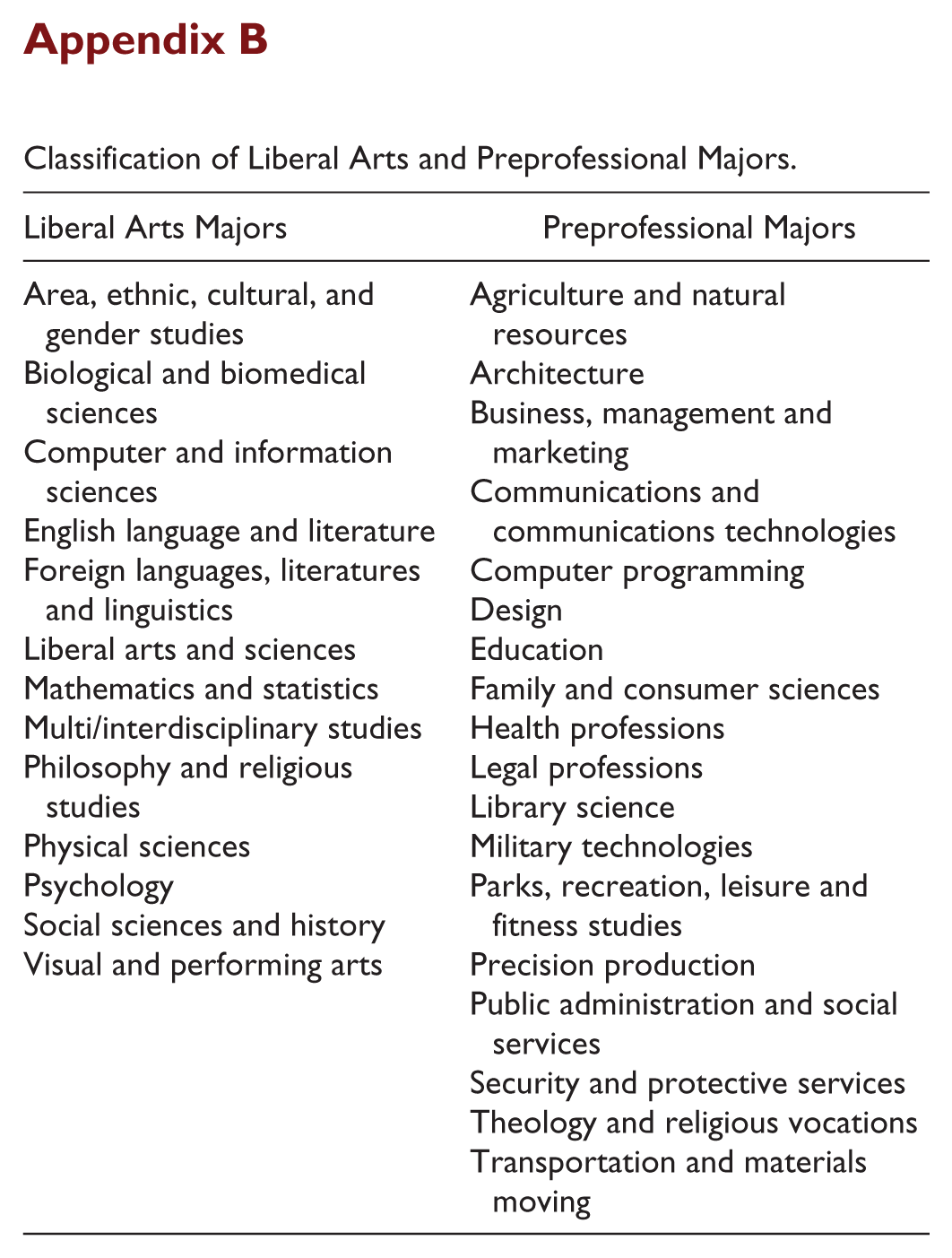
In the second part of our analysis, we use this variable in regression models exploring the association between institutional characteristics and gendered patterns of choosing major fields of study. Our dependent variable is the actual level of segregation minus the predicted level of segregation for each institution. To assess the impact of an institution’s commitment to male-dominated, intercollegiate sports, we include dummy variables for NCAA Division III football as well as NCAA Division III other sports, NCAA Division II football, and NCAA Division I (IA and IAA) football. Our second independent variable is the proportion of liberal arts degrees out of all degrees conferred at that institution. Liberal arts majors include the humanities, arts, math, and social and natural sciences (see Appendix B for a list of all liberal arts and preprofessional fields). We also add three variables indicating women’s presence in the faculty hierarchy: the percentages of women in non-tenure-track positions, tenure-track positions, and tenured positions. Finally, we consider the proportion of male and female students at each institution by including two dummy variables that indicate institutions with fewer than 25 percent male or female undergraduate students. Ideally, we would have included additional variables indicative of potentially salient cultural-organizational features of universities, such as the predominance of Greek life on campus, the percentage of students who live in on-campus residence halls, and the average class size. Unfortunately, these variables are not available in our data set.
Our models include controls for geographic region, institution size, and institutional selectivity. Because liberal arts–focused schools are generally more selective, we control for selectivity to isolate the effect of a liberal arts curriculum. Following the standard practice of using university admissions test scores to create a selectivity score for each institution (Davies and Guppy 1997; Jacobs 1999), we include the average SAT score (verbal and math combined) of incoming students at each institution. For those institutions that did not report SAT scores but did report ACT composite scores, we use the ACT/SAT concordance table to convert ACT composite scores to SAT scores. Our models also control for students’ demographic characteristics. For each institution, we add controls for the percentages of white, Asian, black, and Hispanic students. Major choices vary by race and ethnicity (Goyette and Mullen 2006; Ma 2009), though these differences are significantly smaller than gender gaps and are largely explained by differences in academic achievement (Riegle-Crumb et al. 2012). Additionally, gender divides vary within race and ethnic groups. Ma (2009) found the most severe levels of gender segregation among white students, slightly lower levels among black and Asian students, and the lowest levels among Hispanics. To control for socioeconomic background, we use a measure of the proportion of students receiving Pell grants at each institution. Our data come from Steinberg, Piraino, and Haveman’s (2009) study and include a number of state-level and institution-level controls that others have noted can affect the proportions of students eligible to receive a Pell grant (Tebbs and Turner 2005). Using Pell grants as a proxy for socioeconomic status is helpful but not perfect, because there are missing data for all non–financial aid applicants, many of whom may be poor. Although these demographic control variables increase our confidence that any interinstitutional variation in segregation cannot be attributed to variation in students’ race, ethnicity, and social background, a limitation of our study is the lack of more detailed data on individual students. Without having a more complete set of measures of student characteristics, including their intended major before beginning university, we cannot fully control for self-selection effects.
Findings
Table 1 provides the average index of dissimilarity across the 1,428 institutions in our sample. The index of dissimilarity across all institutions is .39, consistent with previous findings, and meaning that more than a third of either men or women would have to change majors in order to reach gender parity across all majors. 2
Average Index of Dissimilarity.

Note: N = 1,428 institutions.
Figure 1 shows the range of segregation across institutions, revealing significant interinstitutional variation. Just over a third (38 percent) of institutions cluster in the 0.30-to-0.39 range. However, many campuses are considerably more segregated. About a third of institutions (35 percent) have segregation levels ranging from 0.40 to 0.49, and another 13 percent of institutions have segregation levels of 0.50 or higher. At the far end of the range is an institution with a 0.72 index score. At the other end, some campuses are considerably less segregated; 13 percent of all institutions have segregation levels of 0.29 or lower (to almost zero). These findings show that incoming students arrive on campuses with sharply diverging patterns of gender segregation.
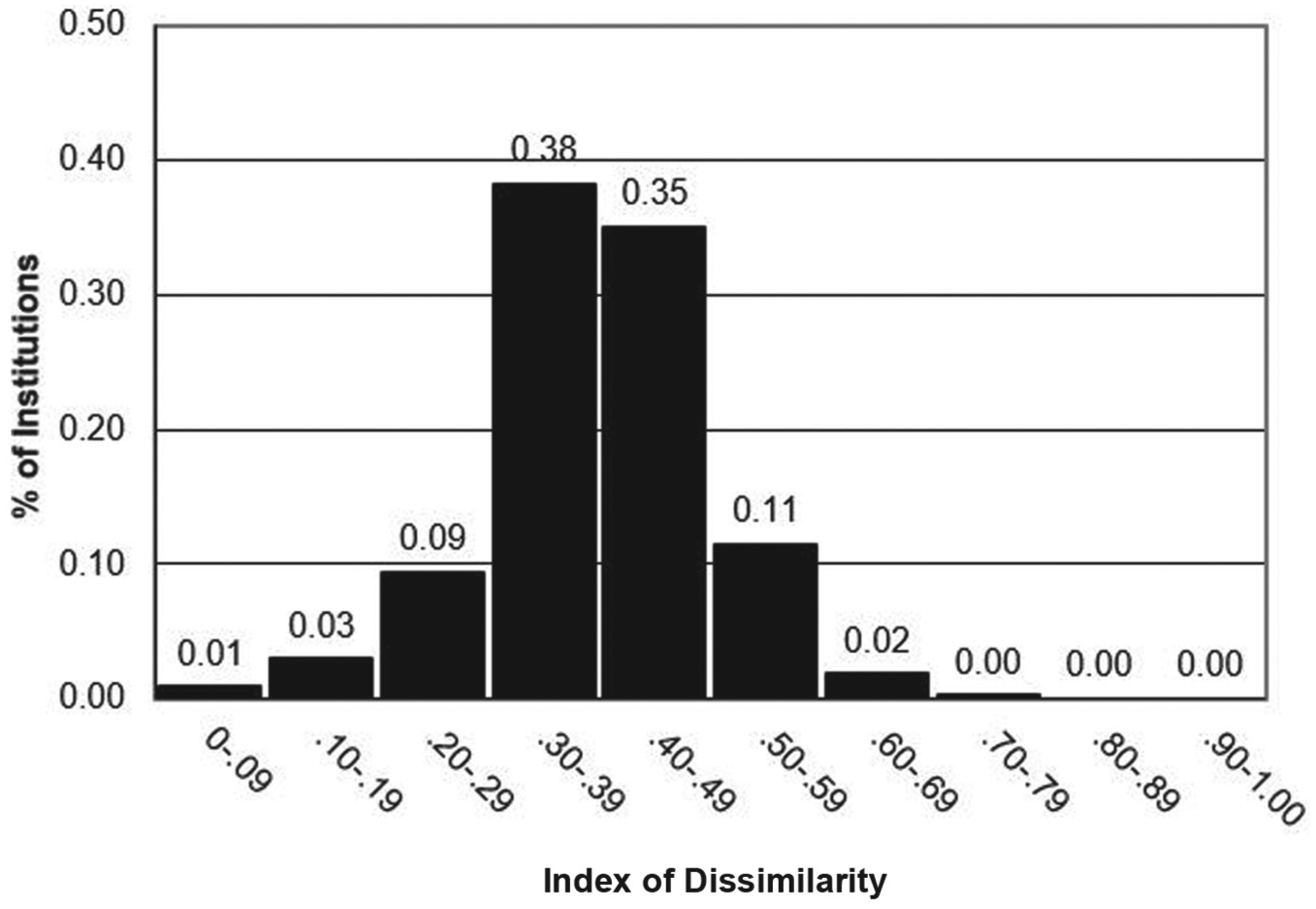
Variation in gender segregation of undergraduate fields of study across 1,428 institutions.
Table 2 presents the results of our regression analyses. The independent variable is the difference between an institution’s actual and predicted levels of segregation. Negative coefficients indicate variables associated with lower levels of segregation than predicted. Model 1 includes our key independent variables as well as controls for size, selectivity, and geographic region (we do not report the region coefficients). To see whether the associations with institutional characteristics may be influenced by students’ demographic characteristics, model 2 adds students’ race and ethnicity and the proportion of students holding Pell grants.
Linear Regression Results Predicting Gender Segregation.
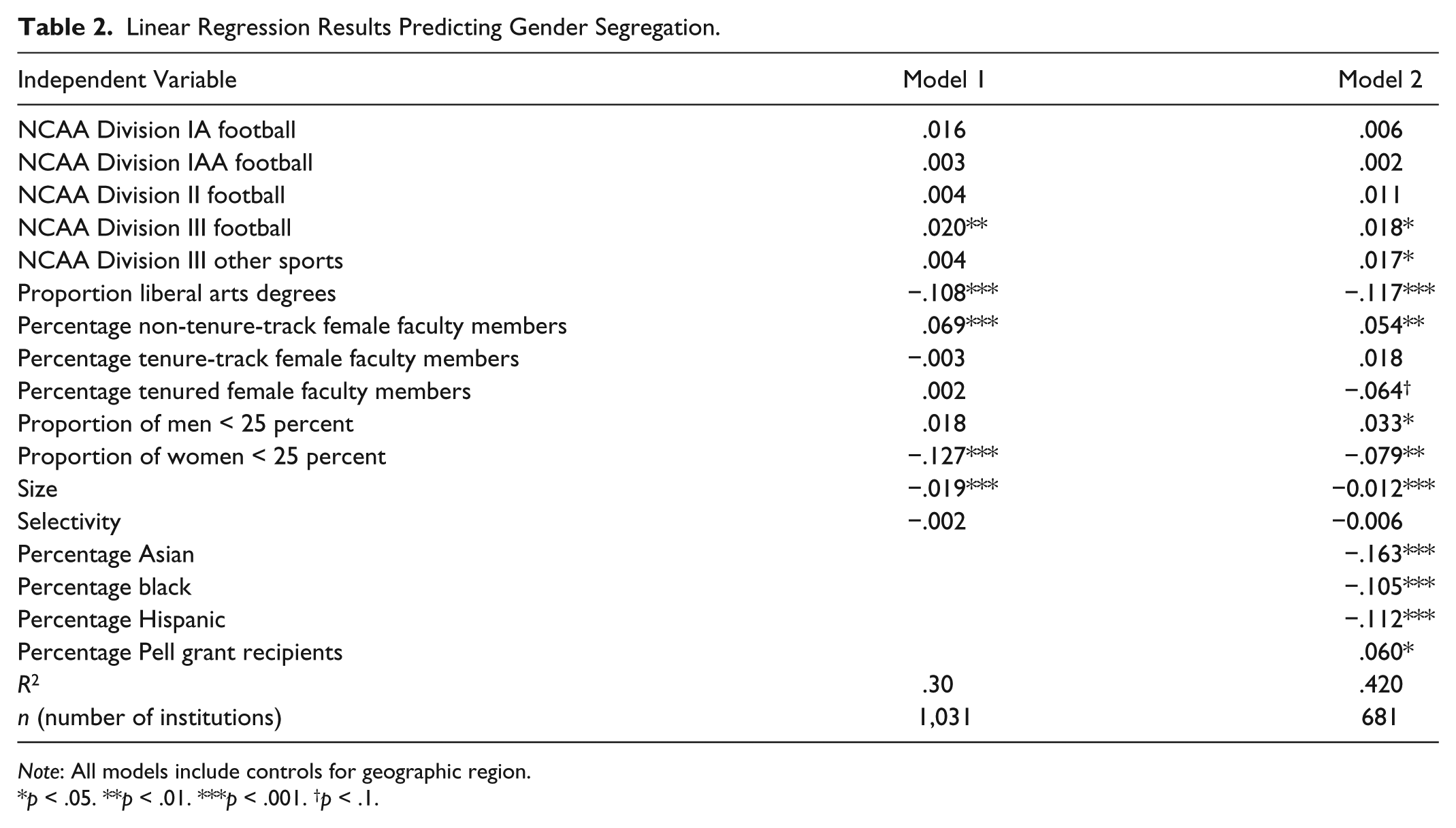
Note: All models include controls for geographic region.
p < .05. **p < .01. ***p < .001. †p < .1.
The first section of model 1 lists the coefficients indicating an institution’s participation in NCAA football divisions. With the exception of NCAA Division III football, none of the coefficients are significant. The coefficient for NCAA Division III football is positive and significant. Institutions participating in the football division of this athletic association are more highly segregated than would be predicted on the basis of the fields of study they offer. The results also show that institutions that offer a higher proportion of liberal arts degrees are less segregated than predicted. The next three variables indicate the proportion of women among the faculty. Institutions that have higher proportions of women working in non-tenure-track positions are significantly more segregated than predicted. Having higher proportions of women in tenure-track and tenure roles does not appear to influence segregation. The next two variables indicate the gender proportions of undergraduate students. The variable indicating a low presence of men (<25 percent) is not significant. However, institutions at which women make up less than 25 percent of the students are significantly less segregated than predicted. Finally, our control variable indicating size is negative and significant. This model explains .30 of the total variance.
The addition of control variables for student population characteristics in model 2 results in few changes in the effects of the main independent variables. The coefficient for NCAA Division III football remains positive and significant. In addition, the coefficient for NCAA Division III other sports is also positive and significant in this model. The proportion of liberal arts fields continues to negatively predict segregation. The percentage of women working in non-tenure-track faculty positions also continues to be positively associated with segregation. However, in this model, we see that institutions with higher proportions of tenured female faculty members are less segregated than predicted (at the p < .10 level). In addition, in this model, the coefficient indicating a low proportion of male students is now positive and significant. Institutions with low proportions of male students are more segregated than would be predicted, whereas institutions with low proportions of female students are significantly less segregated. Finally, the coefficients for race show that institutions with higher proportions of Asian, black, and Hispanic students are less segregated, whereas institutions with higher numbers of Pell grant recipients are more segregated. The positive effects for the proportion of nonwhite students supports the findings of Ma (2009), showing that gender segregation is strongest among white students. The final model demonstrates that even after controlling for the demographic characteristics of students, institutional characteristics remain significantly associated with levels of gender segregation.
Discussion and Conclusion
Our results indicate that institutions vary significantly in their levels of gender segregation across undergraduate fields of study. Although two decades of research has reported average levels of segregation across all institutions, our study is the first, to our knowledge, to examine interinstitutional variation. Our findings show that some first-year students enter far more sharply segregated environments than others. These differences will not only shape the opportunities and contexts for cross-gender interactions but will likely influence students’ developing gendered identities and notions of accepted styles of masculinity and femininity.
Furthermore, specific institutional features correlate with heightened or diminished levels of segregation. Institutions that participate in NCAA Division III football and other sports have higher than predicted levels of segregation, even after controlling for other institutional and student background characteristics, compared with the larger Division I and II institutions. These finding suggest support for previous research showing that sports programs exert the strongest influence on the campus ethos at the smaller, Division III institutions (Shulman and Bowen 2001). It may be that the dominant athletic cultures at these institutions, particularly ones focused on the male-dominated sport of football, contribute to a broader institutional culture more strongly organized around stereotypical attributes of masculinity and femininity, serving to shape both men’s and women’s choices of field of study in more traditional ways. It is also possible that the more traditional major choices of the relatively high proportion of student-athletes at these institutions partially accounts for this effect.
Institutions with higher proportions of degrees awarded in liberal arts fields are less segregated than expected, a finding that holds even after controlling for an institution’s selectivity and the demographic characteristics of students. Because liberal arts institutions attract more politically liberal students (Hanson et al. 2012), they may also attract those with more gender egalitarian attitudes. In turn, the particular educational experiences and institutional cultures (emphasizing independent thinking and critical thought) that correspond to liberal arts institutions may strengthen students’ commitments to these attitudes and encourage the questioning of traditional gender roles, further reducing the tendency for students to enter gender typical fields of study.
In terms of the gender division of authority in a university, institutions with higher proportions of non-tenure-track female faculty members are associated with greater than expected levels of segregation; conversely, institutions with higher proportions of tenured female faculty members show lower levels of segregation. On the basis of prior research in this area, these findings suggest four possibilities. First, young women, and men, may have more opportunities for mentoring and exposure to role models that encourage and support an expanded sense of career possibilities. Second, tenured female faculty members may positively influence a university’s decision making and policy setting in ways that directly and indirectly support nontraditional major choices for women (e.g., establishing mentorship programs within male-dominated fields such as engineering, supporting women’s centers). Third, perhaps institutions that more regularly recruit and promote women into tenured positions are also committed to gender equality in a variety of other ways (e.g., supporting gender equity policies). Finally, as Dasgupta and Asgari (2003) found, the greater presence of women in positions of prestige and authority may serve to counteract gender stereotypes that contribute to channeling students in gender-typical directions.
Finally, we find that institutions with small proportions of male students are significantly more segregated than expected. We speculate that effects from the gender proportionality of students may occur at the level of interactions. Where men are a small minority of students, they may experience more pressure to behave in typically masculine ways and more stigma when they do not. However, we find the reverse pattern for institutions with small proportions of women. At these institutions, there is significantly less segregation. This finding lends support to research showing less stigma for women entering traditional male domains than the reverse (McGuffey and Rich 1999) as well as England and Li’s (2006) finding that gender integration is due largely to women’s movement into male-dominated fields.
The effects of the racial composition of students support earlier research showing higher levels of gender segregation among white students (Ma 2009). It is also possible that a diverse campus atmosphere helps creates a more gender neutral campus climate in which students feel more liberty to make nontraditional choices. Research showing that more on-campus social diversity experiences (such as socializing, dating, dining, or studying with students from another ethnic group) contribute to more progressive gender role attitudes, even after controlling for students’ precollege attitudes (Sax 2008), lends support to this possibility. Finally, it is remarkable that our final model explains 42 percent of the variance in the difference between predicted and actual levels of segregation. Our results show strong support for the finding that institutional characteristics do make a difference.
These findings present a challenge to the dominant explanatory frameworks for gender and major choice that theorize gender as an individual level attribute and marshal socialization models to examine how the differential characteristics of men and women formed in childhood predict the choices students make as young adults. In contrast, by drawing on the perspective of gender as a multilevel system that operates at the individual, interactional, and institutional levels (Ferree et al. 1999; Martin 2004; Ridgeway and Correll 2004; Risman 2004, 2017), our results suggest that institutions matter in the gendering process. Institutions that can be considered more highly gendered, such as those with a strong commitment to male-dominated athletic teams, a weak commitment to including women in the power structure, and a weak commitment to training students in critical thinking and independent thought, are considerably more segregated than would be predicted on the basis of the degrees they award. Although our data do not allow us to distinguish the mechanisms responsible for these differences, institutions such as these may create and promote institutional cultures that shape ideas of preferred and less preferred styles of masculinity and femininity along traditional notions of gender. In turn, students’ interactions and experiences within these specific institutional environments influence their developing gendered identities, gender role attitudes, and gendered conceptions of fields of study in ways salient to the choice of college major. In this way, institutional contexts hold the power to either intensify or diminish gendered patterns of curricular choice.
Although these analyses demonstrate an association between institutional characteristics and levels of gender segregation, we cannot confidently assert causality, because of the limitations of our data. Other than race, ethnicity, and Pell grant status, the data lack detailed measures of individual students, leaving us unable to conclusively reject a self-selection hypothesis. However, the abundant research documenting the cognitive and psychosocial changes students experience during college in response to specific institutional characteristics, as well as the fact that at least half of students change majors during their college years, suggests that students’ choices are not fully determined by their precollege attributes (Sklar 2014). The questions raised in this study could be more conclusively investigated through a longitudinal study that includes both large numbers of institutions and students within each institution. Data could be collected on institutional characteristics, and students could be surveyed early in their first year about major and career plans, as well as gendered self-conceptions and beliefs, and then again in their final year. Such a study would address the potential self-selection effect in the present study as well as provide a greater understanding of the mechanisms through which institutional characteristics influence choice of major.
Other important avenues for future research include case studies of institutions with unexpectedly higher or lower levels of segregation in order to identify and investigate the mechanisms responsible for these differences. In addition, given that institutional features exert differential effects on men and women (Sax 2008), it will be essential to develop analyses that separately predict men’s and women’s entry into nontraditional majors as a function of specific institutional features. Third, qualitative studies on not only which fields men and women choose but how they go about making those decisions in the context of particular campus climates would provide a richer understanding of the gendered dimension of the major choice process beyond what can be provided through quantitative analyses. Historical analyses offer an additional opportunity to investigate the effects of institutional contexts. For example, Title IX, which prohibits discrimination against women in federally funded education, including in athletics programs, passed in 1972, went into effect in 1975, and became mandatory in 1978, dramatically increasing women’s participation in college sports. Conceivably, the shifts in the gender balance of athletics on college campuses precipitated movement toward the integration of academic fields through effects on the broader campus culture. Indeed, the early 1980s showed marked decreases in the gender segregation of fields (Jacobs 1995). Researchers might trace historical variation in the gender balance of sports teams and athletics participation across university campuses with levels of gender segregation. Finally, this line of research could also be advanced through studies that take into account the prevalence of gender-typed curricular niches at each institution. Some studies suggest that in postmaterialist value systems that emphasize self-expressiveness, individuals indulge their gendered selves when they can (Cech 2013; Charles and Bradley 2009; Charles et al. 2014). Increased curricular differentiation within higher education may facilitate these indulgences through the development of gender-typed curricular niches, or “ghettoes” (Rawlings 2013). Because our dependent variable in this study takes into account the gender typing of fields offered at each institution, we control for the possible effect of gender-specific curricular niches. However, it is possible that the likelihood of expressing gendered selves may also depend on the balance and size of gender-specific and gender-neutral curricular offerings at each institution.
Footnotes
Appendix
Classification of Liberal Arts and Preprofessional Majors.
| Liberal Arts Majors | Preprofessional Majors |
|---|---|
| Area, ethnic, cultural, and gender studies Biological and biomedical sciences Computer and information sciences English language and literature Foreign languages, literatures and linguistics Liberal arts and sciences Mathematics and statistics Multi/interdisciplinary studies Philosophy and religious studies Physical sciences Psychology Social sciences and history Visual and performing arts |
Agriculture and natural resources Architecture Business, management and marketing Communications and communications technologies Computer programming Design Education Family and consumer sciences Health professions Legal professions Library science Military technologies Parks, recreation, leisure and fitness studies Precision production Public administration and social services Security and protective services Theology and religious vocations Transportation and materials moving |
Authors’ Note
These data are available through the U.S. Department of Education.
Funding
The author(s) disclosed receipt of the following financial support for the research, authorship, and/or publication of this article: This research was supported by the Social Sciences and Humanities Research Council of Canada.
1
The few exceptions to individual-level explanations include studies that examine major choices between coeducational and all-women’s colleges (e.g., Solnick 1995), the impact of specific programs designed to encourage women to go into science (Atkin, Green, and McLaughlin 2002), and the influence of the gender composition of the faculty on entry to specific fields (Canes and Rosen 1995; Robst, Keil, and Russo 1998). For cross-national studies that explicitly model the effects of broader cultural forces, see Charles and Bradley (2002,  ).
).
2
This average is slightly higher than in other recent studies, likely because we use the most disaggregated data available, in contrast to other studies in which fields were aggregated into large categories.