



Abstract
Sociologist Nacy Whittier reviews the books Sex Panic and the Punitive State, At the Dark End of the Street, and Unspeakable. Each differently addresses sexual violence in relation to race, class, and criminalization.
Keywords
Sex Panic and the Punitive State By Roger N. Lancaster University of California Press, 2011 328 pages

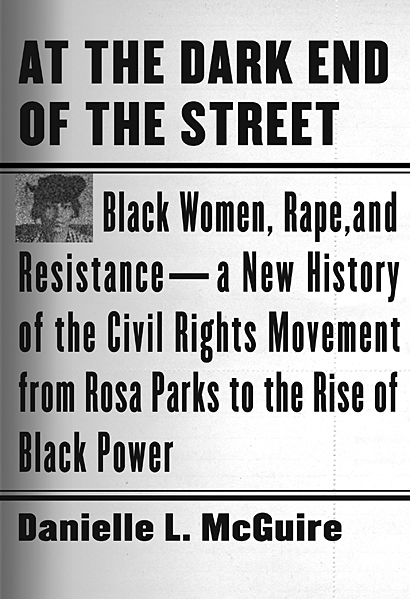
At the Dark End of the Street: Black Women, Rape, and Resistance—A New History of the Civil Rights Movement from Rosa Parks to the Rise of Black Power By Danielle L. McGuire Knopf, 2010 352 pages
Unspeakable: Father-Daughter Incest in American History By Lynn Sacco Johns Hopkins University Press, 2009 368 pages

We live in a time when rape and child sexual abuse are widespread and yet decried as horrific crimes, when doubts over some accusers’ credibility coexist, at times, with a rush to judgment. We take for granted that sexual violence is a women’s or children’s issue and that it is a a crime, but we know little about its history or its connections to other areas of society. The three books reviewed here rethink all that. They use analyses of sexual violence to reshape whole fields of study in excitingly original ways.
Danielle L. McGuire lives up to her book’s title with a genuinely new history of the civil rights movement. Lynn Sacco uses the medical history of gonorrhea to investigate father-daughter incest over time. Roger N. Lancaster theorizes the role of fear in a punitive state through the lens of excessive concern over minors’ sexual vulnerability. All three show how race, class, and sexuality influence social responses to child sexual abuse and rape.
Lancaster argues that panic around child sexual abuse justifies a racist prison system, while the specter of the white gay pedophile masks the racial logic behind fear of crime. Sacco documents how class, gender, and racial/ethnic privilege made it difficult to see incest in white, “genteel” families even in the face of incontrovertible evidence. McGuire shows that because white men’s rape of African American women was ubiquitous and unpunished, demands for prosecution “struck at the heart of the racial system of the South.” Together, they paint a complex, intersectional picture of societal responses to sexual violence and raise important questions about how sociologists and those who seek social change ought to respond.
Sex Panic is an ambitious book that engages with multiple empirical and theoretical questions. Lancaster focuses on societal views of child sexual abuse and offenders, which he argues are overly expansive and punitive, criminalize a panicked approach to young people’s sexuality, and imagine gay men as pedophiles. He illustrates with numerous brief cases (from statutory rape charges against older teens in consensual relationships, to charges brought against a man playing nude ping-pong with a teenage boy) and a detailed recounting of a nightmarish case of a friend’s conviction on false charges. The book shows that panics over sex crimes strengthened the penal system and justified an increasingly punitive state. Along the way, we have a rethinking of moral panic, regimes of power, neoliberalism, the elevation of the victim, the abolitionist critique of prisons, and the authoritarian tendencies of the U.S. state, to name a few.
One theoretical accomplishment of the book is to bring moral panic into theories of the state, showing how emotion legitimates the expansion of state power. Lancaster shows how irrational fear of sex offenders, stoked by authorities, fueled public support for a punitive state that erodes civil liberties and fetishizes retribution. Lancaster, unlike Sacco and McGuire, sees media attention to sexual violence as distracting from “the real news: political deliberations about how to steer the ship of state, whether to go to war, and whose bread should be buttered.”
Race is central to the logic of “sex panic” and its justification of the punitive state, but not in the ways one might expect, since whites are less under-represented among convicted sex offenders than in the overall prison population. Lancaster argues that the white pedophile works “to absolve the guilty conscience of racism” otherwise provoked by the mass incarceration of black men, and “circulate[s] fear of crime beyond the inner city and into the outer suburbs.” Sex panic expands fear, surveillance, and criminalization into the arenas of the privileged. The war on terror is its heir. Lancaster details this process with a learned overview of drug policy, victims’ rights, punishment as restitution, the political economy of the penal system, and the panic over terrorism.
Race is central to the logic of “sex panic” and its justification of the punitive state, but not in the ways one might expect….
Sex Panic is smart, witty, and political. The critique of state responses to sex offense is desperately needed in a policy debate that celebrates ever harsher punishment. I share Lancaster’s dismay over the rise of a punitive state, surveillance, and state power. Although I find the argument about moral panic less than convincing, especially in light of the other two books, I believe that the book is a critical contribution, both politically and theoretically.
Unspeakable is both a medical history and a history of father-daughter incest from the 1700s through the 1950s. The book is testimony to the widespread nature of incest, documented in retrospect through fathers’ and daughters’ simultaneous gonorrheal infections. And it is testimony to medical professionals’ convoluted efforts to avoid confronting that fact. Examining gonorrhea through the lens of incest, and vice versa, Sacco shows how doctors accounted for gonorrhea in girls whose fathers were also infected as due to anything but incest. Prior to the advent of reliable diagnostic techniques, girls were simply assumed to have some other, nonsexually transmitted, vaginal infection. Even doctors who acknowledged that a girl might have a venereal disease — and who reported mothers’ or girls’ claims of sexual assault — cautioned against incriminating men without ironclad medical proof. Detailed excerpts from medical writings show doctors grappling with the epidemic of gonorrhea prior to the existence of effective treatment or diagnosis, attempting to understand its prevalence among poor and immigrant populations, and failing to explain its presence in “respectable” families.
By the Progressive Era, attempts by reformers and doctors to control the spread of gonorrhea among girls produced meticulous case reports that sought to determine the source of girls’ infections. Girls who lived in “unhygienic” impoverished conditions, as well as immigrants and African Americans, were sometimes determined to have contracted the disease through sexual contact with adults. Reports on middle class girls, in contrast, often listed the source as unknown, or neutrally noted a “history of discharge in one of the parents.” Sacco meticulously shows how, by the twentieth century, case reports omitted mothers’ suspicions of incest and daughters’ reports of assault and genital injuries.
Once reliable testing could diagnose gonorrhea in girls and their fathers, doctors developed elaborate, implausible theories about the likelihood of being infected through household objects such as bed linens, which led to blame of the poor for residing in crowded housing, and blame of mothers for being poor housekeepers. Eventually, the blame for infection shifted to toilets in public schools, and many infected girls were quarantined in homes for wayward girls or special hospital wings. Even scientists who declared that transmission through toilet seats was improbable suggested no alternative explanations for the widespread incidence of infection among middle class girls. Studies failed to consider the possibility that girls were contracting infections sexually, even though they recognized that sexual contact was the only mode of transmission in other populations, including boys. These beliefs persisted over decades, even after research determined that casual transmission was virtually impossible. Despite a gonorrhea epidemic among girls in the 1960s and 1970s, in which almost all cases could be attributed to incest, many doctors continued to posit other sources of infection.
Examining gonorrhea through the lens of incest, and vice versa, Sacco shows how doctors accounted for gonorrhea in girls whose fathers were also infected as anything but incest.
Unspeakable assumes that incest was widespread not only during times of untreatable gonorrhea epidemics—when its prevalence is clearly documented—but also at other times, when treatment for gonorrhea meant that incest left less evidence. Here is an important contrast to Sex Panics: Despite Lancaster’s acknowledgment of the prevalence of incest and the severity of actual sexual assault against children, his analysis proceeds as if false accusations motivated by homophobia or panic over adolescent sexuality define the scope of sexual assault against children. But Sacco shows, both incest and the assault of children by adults with whom they are close are widespread. If they are underrecognized, they can hardly be the subject of a “moral panic.” More significantly, these are precisely the kinds of cases that complicate Lancaster’s critique of the criminal justice system—doubly so given the rhetorical power of calls for “equal justice” by those against whom violence is tacitly permitted—children and African American women.
At the Dark End of the Street is the rare book that changes how we think about a familiar subject. Its focus is African American women’s experience of, and resistance to, rape and sexual assault by white men. Using news coverage, archival materials, and interviews, McGuire shows that extensive organizing occurred throughout the twentieth century in response to sexual attacks on black women. While white men’s presumption of sexual access to black women has been widely discussed, McGuire is the first to analyze these experiences and campaigns against them in detail across the South, eloquently describing the anger, fear, and despair that women and their families felt when, in even the most egregious cases, charges were not filed. McGuire amply proves her assertion that “sexual violence and interracial rape became the battleground upon which African Americans sought to destroy white supremacy and gain personal and political autonomy. That battleground is where the modern civil rights movement began….”
McGuire shows that key civil rights organizations and activists got their start in campaigns against the rape of black women, beginning with the National Association for the Advancement of Colored People’s field organizer Rosa Parks, who organized a national pressure campaign in 1944 to prosecute the white rapists of Recy Taylor in Alabama. The groundbreaking 1955 Montgomery bus boycott built on extensive campaigns around this and other rape cases and featured many of the same individuals and organizations. Black women’s grievances against bus drivers were not simply about seating, but included sexual harassment and violence. This history linked the boycott to a struggle against sexual violence against black women and fueled the rage and conviction that sustained it. In Tallahassee, students organized in response to the 1959 rape of student Betty Jean Owens, in which a rare guilty verdict brought a relatively short sentence at a time when black men were routinely lynched or given the death penalty in response to rape allegations. Only a few weeks after the trial, a student active in the campaign organized a local Congress of Racial Equality (CORE) chapter, and the campaign’s networks supported subsequent lunch counter sit-ins. McGuire recounts similar links between “organized resistance to sexual violence” and subsequent civil rights actions in Little Rock, Macon, Washington, Birmingham and Selma.
McGuire convincingly reframes the 1959 sentencing of a white Mississippi man to life in prison for raping a black woman, and Joan Little’s 1975 exoneration after killing a white prison guard who attempted to rape her, as substantial victories for the civil rights movement. The Little verdict represented an official acknowledgment that white men did rape black women. Both verdicts, she shows, were celebrated as civil rights victories at the time.
McGuire’s revision of the history of the civil rights movement is startling and convincing. Organizing around rape cases, widely publicized at the time, was an important part of major civil rights organizations’ work. Yet, although later feminist and civil rights movements were indebted to this organizing, it has vanished from historical accounts. The fact that it has not informed previous scholarship on the civil rights or feminist movements underscores how sexual violence is defined as a separate issue from civil rights, and how white women’s activism is too often used to define feminism.
McGuire shows that key civil rights organizations got their start in campaigns against the rape of black women.
At first encounter, Lancaster’s book, with its critique of the use of public panic over child abuse to strengthen state power, differs sharply from McGuire’s and Sacco’s, which both document histories of sexual violence against girls and African American women, and point to the ways that lack of public attention and criminal prosecution strengthened the power of the privileged. While Lancaster critiques excessive media attention to sensationalized and over-blown cases, McGuire shows how Left and black newspapers used coverage of rape cases to mobilize protest and demand justice, and Sacco finds extensive, matter-of-fact news coverage of incest prior to 1950 which did not lead to a “moral panic” over incest.
Yet McGuire and Sacco share with Lancaster the view that the kinds of sexual violence and offenders that receive public attention have more to do with societal fears and power struggles than “reality.” Read together, the books paint a complex and disturbing picture of the intertwining of race, gender, and sexuality in response to sexual assault.
As I write this essay, the man accused of killing Trayvon Martin has been charged with murder after a campaign strikingly similar to the one that the NAACP organized for equal justice for Recy Taylor almost 70 years ago. These books raise knotty questions about the ramifications of such calls for prosecution. While Lancaster’s critique of the criminal justice system is easy to support in the abstract, the women and girls profiled by McGuire and Sacco, as in the Trayvon Martin case, suggest that campaigns for “equal justice” can address racism and sexism. When white rapists of black women were convicted, the convictions both extended the reach of the criminal justice system and declared that black women were human beings who were entitled to bodily integrity. Explaining simultaneous gonorrheal infection in daughters and fathers as anything but the consequence of incest, thus precluding criminal prosecution, did not strike a blow against a punitive society, but served to protect already-privileged men.
Lancaster reminds us that existing policy towards sex offenders is politically and socially regressive and justifies the expansion of state power. Racism and sexism in the criminal justice system appear both through unjust punishment of people of color, and a refusal to enforce the law when they are the victims. How should we respond? Lancaster cautions us about the limits of progressive uses of state authority. Yet, for acts that are universally considered crimes (such as murder, rape, father-daughter incest), simply dismissing calls for equal justice is not the answer. We need an understanding of sexual violence that is nuanced enough to encompass the profound power of the punitive state, as well as the social experiences and structural inequalities that lead individuals and movements to demand state action. These three books are a step in that direction.