



Abstract
Sociologist Smitha Radhakrishnan reviews the books The Managed Hand and The New Entrepreneurs. Each illustrates the opportunity and systematic discrimination faced by immigrant entrepreneurs in the United States. These works push us to reconsider the importance of minority business owners in continuing to make the American dream real for all of us.
Keywords
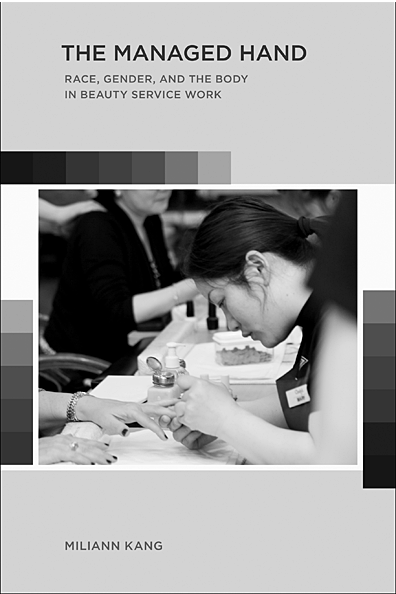
The Managed Hand: Race, Gender, and the Body in Beauty Service Work By Miliann Kang University of California Press, 2010 328 pages
The New Entrepreneurs: How Race, Class, and Gender Shape American Enterprise By Zulema Valdez Stanford University Press, 2011 208 pages
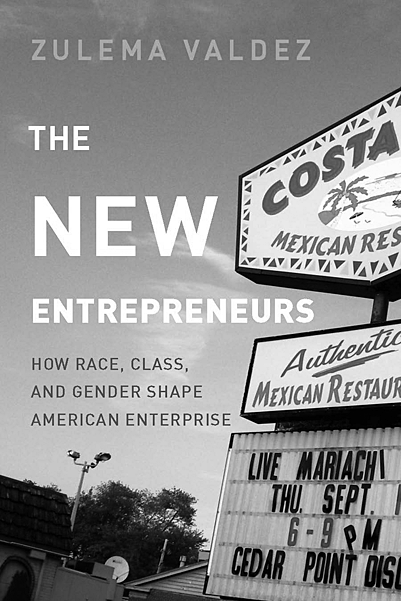
While providing us with that “authentic” Mexican meal or that perfect manicure, immigrant entrepreneurs prove to us that “making it” in America is still possible. They allow us to continue to believe in our tenuous American dream.
Especially since the economic downturn, small business owners have become a central preoccupation for politicians on both sides of the aisle. From “Joe the Plumber” during the 2008 presidential election, to the more recent debate about taxing those earning more than $250,000 per year, support for small business owners is at the heart of both parties’ legitimacy. The continued national discussion of small business owners reveals the tremendous symbolic value attributed to entrepreneurship in the United States. Small business owners are significant not just because they comprise a vital segment of the American economy, but because they embody the American dream: the idea that a person from any background, however humble, can start and run a viable business, earn a livelihood, and be her own boss.
Immigrant entrepreneurs who better themselves through their businesses, through hard work and resourcefulness, are evidence of this dream. Yet the ideal American entrepreneur, like Joe the Plumber, is invariably white and male. The complex everyday experiences of immigrant entrepreneurs remain distant from such images.
Immigrant entrepreneurs prove to us that “making it” in America is still possible.
Mainstream America enjoys a bounty of immigrant-owned restaurants, grocers, drycleaners, and beauty salons. But for immigrant entrepreneurs who provide those services, embodying the American dream through entrepreneurial activity also means facing persistent systems of racial, ethnic, gender, and class inequality. Two recent books—The Managed Hand, by Milliann Kang, and The New Entrepreneurs, by Zulema Valdez—make important contributions to exploring these issues, exploring the interconnections between migration, race, labor, gender and entrepreneurship.
Millian Kang’s book is a comprehensive ethnographic study of Korean-owned nail salons in New York City. Kang’s intimate portraits of salon owners, manicurists, and customers in three segments of the nail salon industry force us to carefully re-evaluate taken-for-granted notions of “good service” in the beauty services sector. Using the manicure as a metaphor for the “individual and social processes that shape women’s bodies, emotions, relationships, and lives,” Kang explores the nexus of empowerment and constraint on both sides of the manicure table. While Korean nail salon owners and their employees earn a living from providing manicures to clientele in different neighborhoods in the city, their position as the providers of bodily and emotional services highlights and reinforces racial stereotypes of Asian women as subservient, docile, and fundamentally unassimilable into the American mainstream. The prevalence of Korean nail salons in New York also highlights the limited economic opportunities for Korean immigrants. Yet white and black clients alike interpret their popularity as evidence of Koreans’ inherent cultural aptitude for doing nails. As one customer tells Kang, “I just put Koreans and nails together.”
These service providers must massage and tend not only to hands and feet, but also to emotions and expectations. Manicurists must overcome their feelings of disgust at intimately touching someone else’s feet and learn to look like they are enjoying it. One account is particularly revealing: Kang offers to teach English to the employees at one of the salons, but after a few sessions, the informants tell her to stop the lessons and continue her research. Hurt and a little offended, Kang asks them why they have decided not to learn English. They respond that they do want to learn, but they are not interested in the kind of English Kang was teaching them. Stacey, the manager, said, “I want to know how to say, “You look like you lost weight.” Nancy chimed in, ‘How do you say, “This color looks good with your dress’?” Another manicurist interjected, “This is the most important thing to know how to say—‘Your boyfriend will think you look pretty!’” Rather than simply wishing to assimilate to the American mainstream, manicurists strategically learn to deliver the “pampering labor” to their customers that is so integral to beauty service work.
Perhaps the most striking aspect of Kang’s study is her obvious empathy, not only with the manicurists themselves, but also with the customers, who have a range of complex motivations for having regular manicures. Refusing a simple analysis of customers as dupes of dominant beauty culture, Kang shows us how women from diverse social locations articulate their own visions of femininity through their nails. Some of the black working class women she interviews assert their positions as mothers or job seekers with relatively demure manicures, while other women at the same salon assert their taste for elaborate and unconventional styles, unwittingly reinforcing their own marginalization. White women from different class backgrounds similarly express their own understanding of white femininity through their nails. Kang’s attention to these diverse narratives provides a poignant account of the ways those seeking beauty services realize their own sense of self with the assistance of the low-wage work of immigrant women.
Manicurists must overcome their feelings of disgust at intimately touching someone else’s feet, and learn to look like they’re enjoying it.
Zulema Valdez’s book draws upon extensive interviews among Latina/o, white, and black restaurateurs in Houston. Valdez shows that entrepreneurs who run restaurants are deeply stratified along lines of class, gender, and national origin—even when they share the same ethnicity or race. The strongest portraits in the book highlight Latino/a entrepreneurs who begin businesses with dramatically different amounts of capital. While Rob Alvaro started his business with almost a quarter million dollars of personal savings, plus bank loans, Doña Toña began hers with almost no startup capital of her own, and a mere $62,000 in loans. These dramatically different starting points mean that individuals realize their entrepreneurial dreams differently. Rob Alvaro established an upscale Italian restaurant in a fashionable neighborhood, frequented mostly by white middleand upper-class customers, while Doña Toña opened a fast-food Mexican eatery in a segregated enclave of the city, serving primarily Mexican laborers and service workers. Alvaro earns about $90,000 per year, while Doña Toña scrapes by on $30,000.
But the differences do not end there. Salvadorean immigrants like Alvaro tend to arrive better educated and better off than their Mexican counterparts, which makes them interpret the entrepreneurial experience differently. While Alvaro went into business to increase his earnings and enjoy the benefit of being his own boss, Doña Toña started her enterprise to move beyond demeaning jobs with no hope of upward mobility, even if it did not mean better pay. In fact, many business owners work long hours for less than minimum wage. These outcomes are heavily influenced by the class position individuals inhabited before they began their businesses, as well as their racial positions in the stratified American economy. Forty percent of the white entrepreneurs she interviewed, for example, compared with less than 12 percent of their Latina/o peers, inherited a successful business from a parent, giving them significant resources and experience before they even began.
Some of the most marginalized entrepreneurs Valdez interviewed are aware of discrimination and exclusion on the basis of race, but still persist in their belief that these inequalities have not hindered their own business outcomes. Valdez implicitly suggests that entrepreneurs unquestioningly accept dominant ideologies, and her analysis stops short of probing why those beliefs persist. Still, the research shows that many of those who are most committed to the American dream of entrepreneurship are exactly those who are most excluded from its full realization.
Both books suggest that immigrant entrepreneurs and their social worlds do not just participate in the American dream — they make it real. They prompt us to consider how specific social positions shaped by race, class, and gender constrain and limit the seemingly meritbased and open-ended American dream of economic mobility. They force us to consider the extent to which that dream is itself constituted by the struggles and successes of those who cannot enjoy the privileges that supposedly come with economic self-sufficiency. Still, they persist against the odds, opening up new avenues of economic activity, and making a place for themselves wherever they can find one.
Kang and Valdez provide insights into the struggles of those who are at once at the center of the American mainstream, and at the same time, far removed from it. They lead us to ask: Why does U.S. political discourse hold up one ethnic group—namely Asians—as inherently resourceful and entrepreneurial, while stigmatizing other groups—namely Latinos and blacks—as unsuited for such activity? Such generalizations discriminate and assign value unfairly, and also blind us to our own dependency on immigrant entrepreneurs and their employees. This dependency is literal: “whitestream” America depends upon immigrant entrepreneurs for an ever-wider range of services. It is also symbolic: through minority entrepreneurship, Americans revitalize their own hope that the American dream is viable—even in the face of overwhelming evidence to the contrary.
Political discourse fails to capture the lived realities of immigrant entrepreneurship and our dependency—both literal and symbolic—upon “their” services and “their” American dreams. When politicians imagine small business owners in America, do they consider, for example, the effects of the chemical fumes inhaled by salon owners and their employees in the multi-million dollar manicure industry? Or the meager livelihoods of Mexican restaurateurs and Korean salon owners? To integrate such experiences into mainstream political discourse is to open the way for a more grounded, inclusive, and responsible discussion of the American dream.