



Abstract
The book Thinking, Fast and Slow is reviewed and shows what sociologists could learn from Daniel Kahneman’s work on behavioral economics by extending this knowledge to cover the study of social interactions.
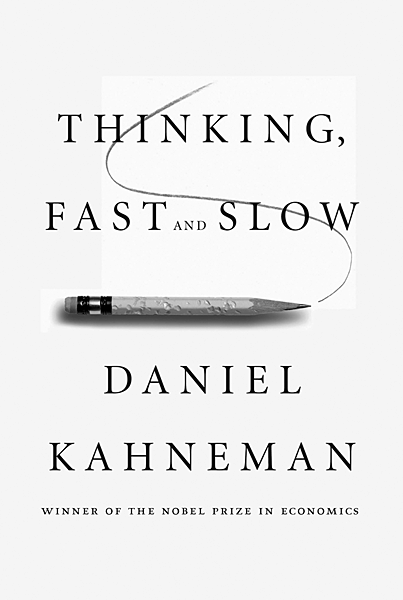
Thinking, Fast and Slow, By Daniel Kahneman, Farrar, Straus, and Giroux, 2011, 512 pages
A friend of mine checks her stock accounts every day, or at least consults an app that tells her how her total portfolio is doing. Her impression of when she can retire fluctuates according to whether her total is up or down, especially if daily changes are sizeable. I have tried to dissuade her from doing this kind of close monitoring—unsuccessfully.
According to Daniel Kahneman, my friend is likely to be less happy in the short run; the down days make more of an impression than the up days. She is also likely to be poorer in the long run; anxiety leads people to become risk averse, and to sell, for example, when markets are down. Useful tips such as these are tasty icing in this book, a grand summary of Kahneman’s unparalled intellectual career.
A cognitive psychologist who, beginning in the late 1960s, examined how people make judgments and decisions based on a range of mental tools that sometimes lead them astray, Kahneman (and his coauthor Amos Tversky) effectively discredited the models of rational choice that form the basis of modern microeconomics. Kahneman and Tversky devised one ingenious experiment after another to explain how people use and misuse the information they are given, and how contexts distort the questions we try to answer, as well as the answers we give. Their work, eventually dubbed Prospect Theory, helped create the field of behavioral economics, garnering Kahneman the Nobel Prize in economics in 2002.
Thinking summarizes Kahneman’s extensive work over these forty years, and also tells a chatty story of how that work occurred. He suggests that there are two systems of thought: fast and slow thinking. Fast thinking occurs without our—well—thinking about it, as we intuitively recognize familiar patterns, impose coherence on isolated facts, alert ourselves to novel or threatening situations, assess how well things are going for us, and perceive and move through the world around us. Fast thinking (“a machine for jumping to conclusions”) is automatic—sometimes impossible to turn off or ignore. It relies, in part, on processes that we label “emotions.” And it often leads to mistaken conclusions.
Slow thinking requires effort, and so we avoid it when we can. It permits us to “follow rules, compare objects on several attributes, and make deliberate choices between options.” It requires attention, and is easily disrupted when attention is drawn to something else. Slow thinking can also result in misperceptions, but in different ways than fast thinking. It has some, but not much, capacity to control fast thinking.
Any book that seeks to highlight a career’s worth of research and theory has a problem: How to represent the broad intellectual shifts occurring during the period? Here, the key intellectual development was the growing recognition of emotions as a source of thinking, rather than its irrational opposite. “Emotion,” says Kahneman, “now looms much larger in our understanding of intuitive judgments and choices than it did in the past.” But the findings and concepts reported in the book only occasionally incorporate emotional processes; even then, such processes are depicted primarily as disrupting rational decisions. Too often, Kahneman seems to define emotions as anything that gets in the way of careful slow thinking, implying that emotions are restricted to fast thinking.
Fast thinking is the hero of the book; we admire speed in most things, it seems. While recognizing that fast thinking works quite well most of the time, the book details its errors. In other words, Kahneman is ambivalent. He is caught up in the recent changes in neurology that have uncovered many forms of fast thinking and shown how they help us do all sorts of things. At the same time, this new research does not entirely upend earlier, contrary findings. What is most useful, he hazards, is the efficient division of labor between the two systems, which “minimizes effort and optimizes performance.”
A single, intriguing paragraph at the end of the book asserts, “Organizations are better than individuals when it comes to avoiding errors, because they naturally think more slowly and have the power to impose orderly procedures.” Bureaucracy was invented, in part, to curtail fast thinking. But Kahneman hints at a vast realm of social interaction here, about which his surveys and experiments on individuals have little to say.
The affective allegiances and moral commitments that link us to others are emotional processes that help us think fast—but also slowly. Group bonds are long-term commitments that condition our slowest reactions as well as our fastest. Emotions are appraisals, sometimes fast and sometimes slow, of how we are doing in a number of contexts: of our own body, the physical world, the social world, a more ideal moral world. The relative stability of emotions such as hate, love, trust, or respect means that they rarely lead to mistakes. They provide the goals of normal action outside the games of psych labs. This, in fact, is the world of sociology.
If Kahneman is right that context is crucial, then he really should have turned to social interaction and commitment to better understand—and better appreciate—the emotional components of thinking. He ends with a warning about group processes that will be familiar to any academic who has sat through a department meeting. “There is much to be done to improve decision making. One example out of many is the remarkable absence of systematic training for the essential skill of conducting efficient meetings.” Amen.
Emotions are appraisals, sometimes fast and sometimes slow, of how we are doing in a number of contexts.
But neither insights into fast thinking nor insights into slow thinking will help much in understanding or fixing social interactions, such as department meetings. While cognitive psychology can show the impact of context, sociology is the science of context. Sociologists have a lot of work to do to match and extend psychology’s insights into how we make judgments and decisions.