Abstract
Sociologist Raj Andrew Ghoshal explores accommodation-sharing networks and whether they provide travelers with more than just a free place to stay.
Keywords
In 2000, 22-year-old software engineer and travel aficionado Casey Fenton found himself with a cheap last-minute airplane ticket to Iceland, but nowhere to stay. He wanted to meet locals and not have his experience confined to hotels, so he accessed the University of Iceland’s email directory and spammed 1,500 students, asking for a free place to stay. To his surprise, dozens emailed him back, and he spent his time in Iceland meeting and sleeping on the couches of strangers and learning about the country in a way he never would have done if he’d been on his own.
Inspired by the experience, Fenton wanted to provide others with similar opportunities. In 2004, he launched the CouchSurfing Project, a website designed to facilitate trips like his by providing aspiring travelers and potential hosts with a place to contact each other, exchange information, and arrange for hosting, all with no exchange of money. From its modest beginnings, the project has nearly tripled in size every year since its inception. Its membership now includes 4 million people who collectively speak several hundred languages and live in 85,000 cities across every country in the world. The site has facilitated more than 4 million travel experiences.
At the core of the CouchSurfing Project’s success is its profile system and user interface, which meld elements of more well-known social networking websites like Facebook with elements of commercial sites like eBay. Users create a profile that contains a picture along with information on their location and interests, whether they are open to hosting potential visitors, and whether they can offer a couch, a bed, a spare room, or floor space. They can then use the site’s search interface to find potential hosts in any given city for upcoming trips, and contact them through the website.
Hosts receive these inquiries, and can accept, turn down, or ignore them as they please. Through the site, hosts and visitors work out how they’ll meet, whether they’ll spend much time together, and how long the stay will last. One stipulation is that the site prohibits hosts from charging travelers. After the conclusion of a stay, hosts and travelers can write each other references, which serve as guideposts for other users deciding whether to host or surf with that member in the future. There is no requirement of reciprocity; those who surf are not obligated to host.
The roots of free travel accommodation-sharing projects can be traced back to Servas International, an organization founded by peace activists in 1948 that encouraged cultural exchange by having members stay in each other’s houses as they traveled internationally. The rise of online hospitality-sharing sites is a direct result of the development and advancement of the Internet, which has greatly simplified the process of finding potential hosts and providing ever-stronger mechanisms for assessing the trustworthiness of hosts and guests. CouchSurfing is not the only project of its type; it arose nearly simultaneously in the early 2000s with several other sites, such as hospitalityclub.org (which boasts 300,000 members) and globalfreeloaders.com (whose members number about 60,000). Other similar sites include bewelcome.org and tripping.com. These online free hospitality exchange sites bear some resemblance to commercial websites like airbnb.com, which enable users to rent out rooms in their house or apartment for very short stays, but they differ in that most hosts on the free sites are also travelers (and vice versa).
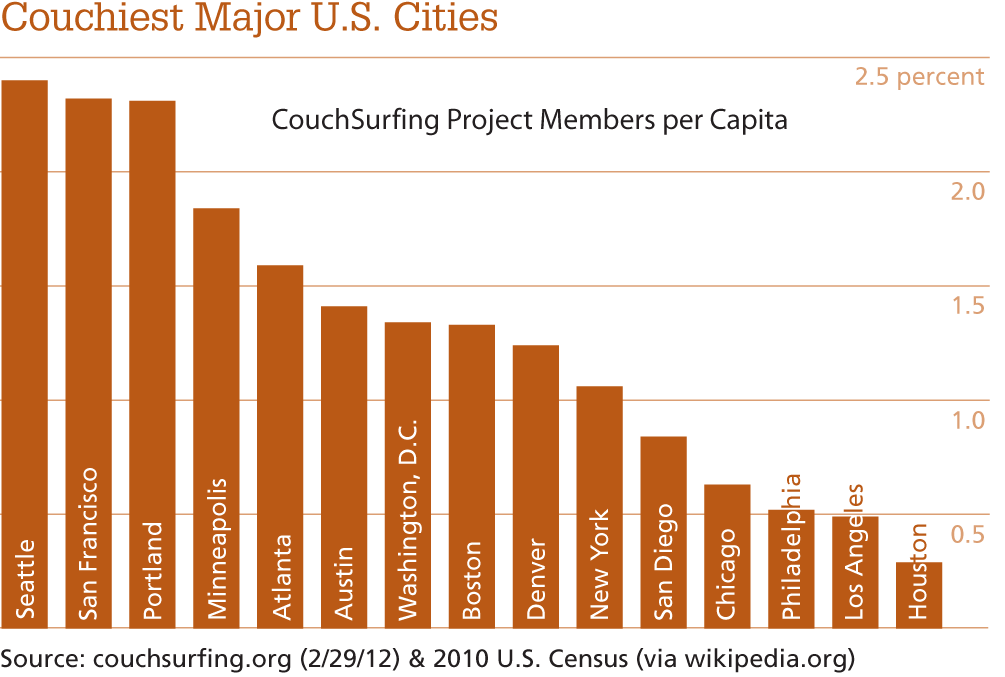
Couchiest Major U.S. Cities
Source: couchsurfing.org (2/29/12) & 2010 U.S. Census (via wikipedia.org)
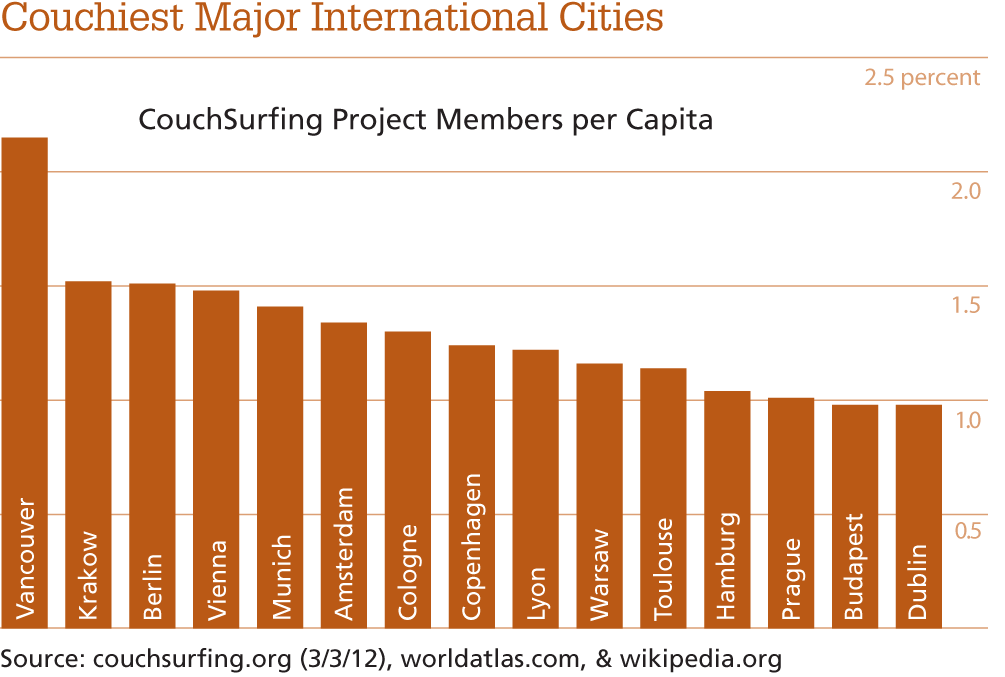
Couchiest Major International Cities
Source: couchsurfing.org (3/3/12), worldatlas.com, & wikipedia.org
Corey Fields

I’ve been involved with travel-accommodation sharing sites for more than seven years. My experience includes nearly a hundred hosting or surfing experiences and attendance at more than a hundred local CouchSurfing events. I’ve found that users are fervent about such sites, not merely because they help save travelers money, but for reasons that can be connected to two major sociological concerns: authenticity and sociability.
Surfing for Authenticity
Hospitality exchange sites help satisfy a hunger for “authentic” experiences that has arisen in response to global trends of rationalization, homogenization, and commodification. Travel, especially discretionary travel by Westerners to non-Western countries, has long been associated with escape from humdrum bureaucratic routines and the “iron cage” of advanced capitalism. However, what sociologist George Ritzer called the “globalization of nothing” has given rise to a world in which discretionary travel is ever-more similar to staying at home. The routinization of travel and the maturation of tourism industries have led to pre-packaged tours, stays in hotel rooms that are indistinguishable from each other, dining in McDonald’s and Starbucks, and little genuine contact with locals. Sites like CouchSurfing offer travelers the promise of connecting to authentic local experiences. One writer has even described hospitality exchange as “emotional tourism,” arguing that its appeal lies in its promise of firsthand connection to different experiences and worldviews.
CouchSurfing also offers possibilities for connection. Sociologists have noted that social network technologies have the potential to isolate users from each other, enmeshing people in virtual worlds while cutting them off from genuine human interaction. CouchSurfing discussions with hosts or travelers often include the claim that, unlike most online networks that atomize people, sites like CouchSurfing help bring people together in real time. One traveler I met called CouchSurfing.org the “anti-Facebook” for this very reason. While some people use the CouchSurfing site merely for travel or hosting, local groups have sprung up in hundreds of cities as a result of their online engagement. These groups hold regular events for members to meet, share travel stories, meet visitors to their town, and engage in the kind of face to face social contact that sites like Facebook do little to promote. In this way, CouchSurfing can be seen as analogous to non-travel related sites like meetup.com, which draw together people who share similar interests to plan face-to-face events where they live.
There are ironies in using technologies that some critique as inherently isolating to draw people together and escape rationalization, as well as in responding to commodification by “marketing” the importance of authenticity. Not surprisingly, CouchSurfing has its critics. For instance, after years of attempting to gain official certification as a 501c3 charity, in 2011 CouchSurfing became a Certified B Corporation and received several million dollars of venture capital. This infusion of money led to charges that the site plans to undermine its core promise that it will never charge users for hosting or staying. Some critics have charged that the site exploits the free labor of thousands of volunteers for the benefit of a few paid staff, while still others have argued that if hospitality exchange becomes too popular, it will lose the cultural niche that makes it special. As a push against the 900-pound gorilla of hospitality exchange, critics of the CouchSurfing site have even created the website opencouchsurfing.org, which features discussion boards attacking the site and promotes other free accommodation exchange services.
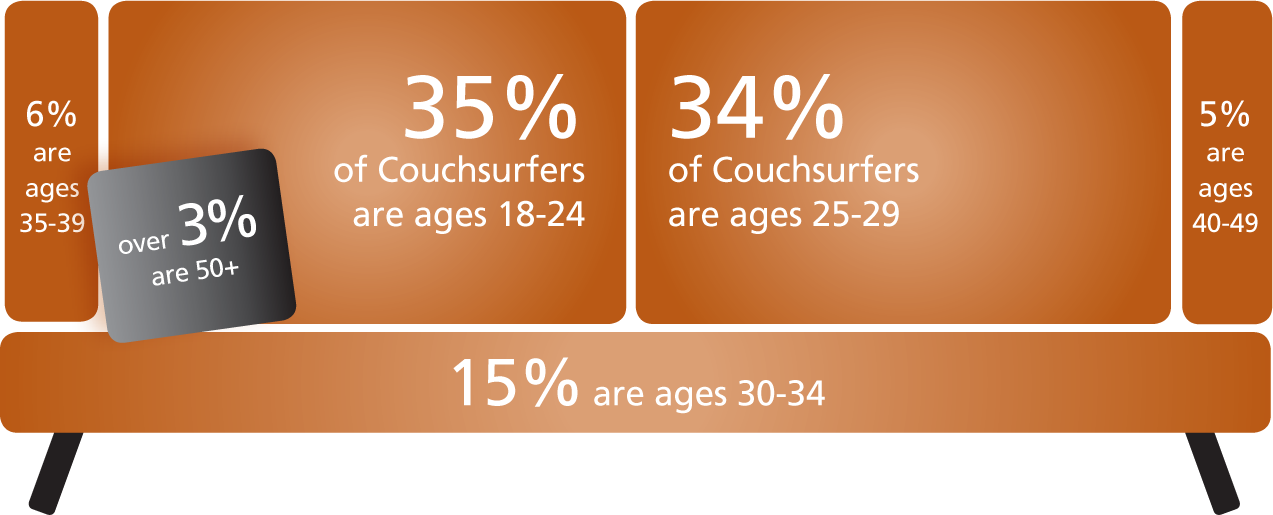
Regardless of the future of the CouchSurfing Project (with its claim to “premium” services), couchsurfing with a small “c” is likely here to stay. The availability of alternative sites means that any dramatic move toward charging for core services would simply push users into the networks that remain free, even if their interfaces are not as sleek or their user bases not yet as large. Considering the speed with which online accommodation-sharing networks have spread (given that they have until now been funded entirely by donations), the recent infusion of money into CouchSurfing, and the fact that user data shows the average age of couchsurfers has slowly gone up over the last several years, the scope of online hospitality networks is nowhere near its peak.
*Numbers do not add up to 100% due to rounding
Source: couchsurfing.org (2/29/12)