




Abstract
Couchsurfing is a website to facilitate hospitality exchange between global travelers and local hosts. As Couchsurfing was initiated, it was just an alternative accommodation for budget travelers. However, now Couchsurfing has been recognized as a stylish way of travel, which brings new forms of tourist experiences and scenarios. In the light of the transformation of Couchsurfing, this study tries to explore how social-media technologies, hosts, surfers, and spaces are mobilized to perform Couchsurfing. Goffman’s performance theory as well as the extended concepts about online performance and tourist performance is adopted to analyze the Couchsurfing practice. By studying on couchsurfers’ online performance, offline performance, as well as certain “inappropriate actions” hidden in the backstage, this study displays the series of mechanism, which pushes Couchsurfing from simply a hospitality exchange network to a specific travel style.
Keywords
Introduction: transformation of Couchsurfing
In Barcelona, I stayed with a couple for three days. During the period of time, I chatted with them, and I walked around in their house. I observed their books and CDs on the shelves, their toothbrushes, the brand of the toilet paper and the flowers they grew. I talked with their friends when their friends came for dinner. I talked with them together, and also interacted with them separately … through all of these details, I imagined their daily life. (Rachael, 24-year-old, female, Taiwanese couchsurfer)
When Rachael told me about her trip in Barcelona with Couchsurfing, she did not mention La Sagrada Familia or other must-visit destinations listed in tourist brochures, but described the interaction with the local hosts and her observation about their daily life. It seems Couchsurfing has brought in certain scenarios, which are quite different from those in a general tourist journey.
Couchsurfing is a website to facilitate hospitality exchange among global travelers. After registering as members, one can ask for free accommodation from local members through the website and stay over at their homes during the trip, instead of booking a hotel or hostel. Since the website was launched in 2004, the number of its members has rapidly grown. After a decade, it has attracted over 10 million members around the globe (Couchsurfing Statistics, 2017). As Couchsurfing develops, the use of the term “Couchsurfing,” has expanded to mean a specific way of travel, which refers to staying over at the local’s home 1 and often implies visiting a place through local eyes (Chen, 2011).
Owing to its gradual popularity among global travelers, Couchsurfing has been noticed by some social scientists and has been studied in various facets. Regarding Couchsurfing as Internet-based hospitality-exchange network, part of the studies focuses on how Couchsurfing works with the aid of social-networking tools. According to O’Regan (2013), the original model of Couchsurfing was quite simple: “if you need a place to stay, Couchsurfing enables you to identity and find someone to give over sleeping space in their home for free” (p. 179). More precisely, the functions of personal profile, couch-request (message-sending) and reputation system on the site facilitate the mutual understanding and communication between potential hosts and surfers and thus helps online-trust building, which is the key factor of organizing the Internet-based hospitality exchange (Bialski and Batorski, 2010; Rosen et al., 2011; Tan, 2010, 2012, 2013). Besides, on the site, Couchsurfing is represented as a way to learn from other cultures and to achieve the cosmopolitan utopia. Thus, the cosmopolitan atmosphere becomes extra obtainment in hospitality exchange to balance the reciprocal relation of Couchsurfing (Chen, 2011; Germann Molz, 2007).
Simultaneously, Couchsurfing practice is considered as part of phenomena of the mobile world, in which technologies support various forms of travel that generate new modes of interaction and relationship (Urry, 2007). Thus, these moving people, information, objects, and so on shift people’s worldview (Szerszynski and Urry, 2002). Bialski (2012, 2013) takes Couchsurfing as the case to demonstrate how social-networking technologies are affecting the process of sociality today. Couchsurfing, according to Bialski, enables travelers to manage the encounters during the trip in advance, and also it helps involve locals in travelers’ trips and create cross-cultural interaction between them. The face-to-face interaction generates a new form of relationship, which is usually intense, intimate yet lacking sort of any longevity (Bialski, 2012). Moreover, in many cases, the cross-cultural interaction induces the reflection on self and other (Zeuv, 2013), based on which couchsurfers are developing their perspectives on cosmopolitanism (Buchberger, 2013; Chen, 2013). As Germann Molz (2011) describes today’s Couchsurfing: “it is not just about the furniture” (p. 215), but involving the hospitality exchange network, reciprocal relationship, cross-cultural interaction, and the cosmopolitan ideologies. All these factors constitute a particular landscape of Couchsurfing (Germann Molz, 2007; O’Regan, 2009) with its own norms, applied technologies, institutional arrangements, and methodologies, which make Couchsurfing a specific travel style (Adler, 1989: 1371).
Previous studies have made some achievements in exploring Couchsurfing; however, there is still a gap between the site management of Couchsurfing and couchsurfers’ actual practice. Originally, Couchsurfing was organized for hospitality exchange, but now it is practiced as a stylish way of travel. A process of forming the social conventions in this online-to-offline community is missing. Therefore, a research question is raised here: what mechanisms have pushed Couchsurfing from just an alternative accommodation to a travel style with its own norms, value and specific ways of practice, and, how does it work?
To demonstrate the process of tone-setting in Couchsurfing community with the consideration of institutional power and couchsurfers’ agencies, this study traces how couchsurfers use the online tool to manage the encounter and how they actually behave in face-to-face interaction, based on which this study further clarifies the mechanisms that lead couchsurfers’ practice. The framework of theatrical performance by Goffman’s (1959) (which is elaborated in the next section) is used to analyze couchsurfers’ self-representation, action and reaction in online and face-to-face interaction of Couchsurfing.
Ethnographic methods are used in this study, including participatory observation, text analysis and qualitative interviews. I signed up to Couchsurfing and completed the personal profile in 2010. Since then I did the fieldwork mainly in Taiwan and the Netherlands. In the Netherlands, I opened my home in Amsterdam to host couchsurfers and started online and face-to-face interaction with other couchsurfers (2011–2014). I also traveled in the Netherlands with Couchsurfing several times, met couchsurfers for coffee, and attended couchsurfers’ meetings. In Taiwan, I traveled with Couchsurfing in 2011 and participated in several couchsurfers’ meetings. Besides, I had online interaction with other couchsurfers. All the online and face-to-face interactions are included in the participatory observation. For the text analysis, I reviewed the webpages of Couchsurfing site, as well as the personal profile of the individual members whom I met during the fieldwork in Taiwan and the Netherlands. The interactions between me and other members recorded online are also included. As for the qualitative interviews, there are 53 respondents, who are (1) hosting surfers in the Netherlands, (2) couchsurfing with locals in the Netherlands, (3) hosting surfers in Taiwan, or (4) couchsurfing with locals in Taiwan. The age of these respondents is from 21 to 60. They are 22 men and 31 women, from 13 countries. I met these respondents on various occasions of Couchsurfing: 8 of them were my hosts, 8 of them were my surfers, 10 respondents were from the Couchsurfing meetings, and 14 respondents participated in an interview after chatting online with me. The remaining respondents (13) were selected by snowball-sampling and were introduced by other respondents. The interviews mainly took place at my home (when the interviewee was my surfer), the hosts’ home (when the interviewee was my host during my Couchsurfing trip), and the cafés. The length of the interviews ranges from 1 to 4 hours, depends on how many Couchsurfing experiences he/she has and how much he/she would like to share. All the respondents are pseudonymous to keep anonymity in this study.
Performative analytical framework on Couchsurfing
In Erving Goffman’s (1959) classic work, The Presentation of Self in Everyday Life, he uses the frame of a theatrical performance to analyze individuals’ interactions in everyday life. Through the imaginative lenses of dramaturgical metaphor, people are all playing various roles to give/give-off performance corresponding to different occasions and contexts in the daily life. By changing, fixing, or complying with the settings, including the potential rules about the appearance, manner, and spatial arrangement, we convey different information, which may show one’s identity, confirm or negotiate a relationship, or define the situation. Invisible conventions, etiquettes, rituals, and informal rules are gradually recognized and formed in the performances (Jacobsen, 2010).
Goffman distills individuals’ behaviors, interactions, and spatial settings into the dichotomy of the front stage and the backstage. Formal performance and direct contact with audience take place in the front stage, where the rules of decorum are highly concerned, while the backstage is for preparation, catharsis, and relaxation, in which public masks are lifted and other aspects of self can be shown. Although Goffman’s performative conception has been proposed more than half century ago, it has continuously shown its worth and adequacy in demonstrating the newly widespread phenomena in the social life of contemporary societies, such as interaction in online communities and tourist consumption and practice.
Online performance
Information-communication technologies have brought new forms of relationship and interaction in people’s social life. Goffman’s dramaturgical approach is regarded as a useful analytical framework to study people’s online participation and the virtual world (Bullingham and Vasconcelos, 2013; DiMicco and Millen, 2007; Hogan, 2010; Ross, 2007). The metaphor of the front stage/backstage, for instance, is drawn upon to reveal the anonymous attribute and its consequence in certain online environments, like role-playing games and pseudonymous online communities. In the anonymous environment, one is able to express the real desire or certain aspect of self which is repressed in the offline environment (Ross, 2007). In other cases of social media, users are able to control other users’ access to their posts to manage their privacy. The virtual space of the sites, in a sense, is considered private and therefore, is backstage-like (Boyd, 2006; Lewis et al., 2008). The attributes of anonymity, pseudonymity, and privacy seem to make the online environment an autonomous region which allows fluid and multiple identities (Turkle, 1995).
As social media have grown in popularity, more evidence shows that the online environment and offline environment are not a simplified dichotomy of frontstage/backstage but a continuity (Bullingham and Vasconcelos, 2013). On social media, which either support the maintenance of pre-existing social networks or facilitate new connections based on shared interests, political views or activities, most people tend to use an identified name in the online profile for the networking purpose (Boyd and Ellison, 2007; DiMicco and Millen, 2007). Thus, offline interaction can be continued in online environment, and vice versa. These sites like Facebook, Twitter, Friendster, LinkedIn, MySpace et cetera, offer users another stage of self-representation, which, in Goffman’s words, constitutes an online performance for impression management (Bullingham and Vasconcelos, 2013).
In the previous case studies, the online environment can be either the backstage or the extended stage of the offline performance; it is related to how users perceive the character of the sites and how they use them as tools to manage their social life. Thus, the connection between the online performance and offline performance is significant to explore social life in the Internet age. That is, the online performance and offline performance should not be studied separately but taken as whole.
Based on character of the social-networking tools, Hogan (2010) adjusts Goffman’s performative analytical framework and categorizes various forms of self-representation on social media into two types: online exhibition and online interaction. Online exhibition, which is a static display to unidentified audience, not only presents in the forms of textual expression but also incorporates multiple forms of media to convey information, such as photos, videos or audios, whereas online interaction, which is a series of instant responses in certain situations, normally presents in texts and icons. The various forms of digital communication supported by social-media technologies constitute a communicative body in the online performance (Boyd and Heer, 2006). In this study, Hogan’s framework is adopted to analyze couchsurfers’ online performance. Simultaneously, considering the integrity of sociality in Couchsurfing, how online interaction and online exhibition connect to the tourist performance in face-to-face interaction among couchsurfers are addressed as well.
Tourist performance
Goffman’s performative metaphor is extended to study tourism phenomenon and has raised the debate on tourist practices, tourist identity, and tourist space. MacCannell (1973) is the first researcher to introduce the performative metaphor in tourism studies. Goffman’s concept of the front stage/backstage is cited and extended to support MacCannell’s idea of “stage authenticity” to illustrate the essence of tourism. MacCannell argues that tourism is the side-product of modern society, in which people mourn for the past of intimate relations and authentic experience; tourism industry offers a service for those seeking utopia and fulfills the desire for “what modernity destroys and keeps out” (Larsen, 2010: 315). To fit in tourists’ imagination of authenticity, the tourism industry cooperates with the locals and designs a series of backstage-like settings and scenarios, that is, so called “staged authenticity” (MacCannell, 1973: 92–102). All the tourist settings and scenarios are produced in a sacralizing process of “naming, framing, elevation, enshrinement and reproduction,” and socially ordered to correspond to the tourist gaze (MacCannell, 1973: 43–46; see also Urry, 2002: 9).
After MacCannell, the concept of tourist performance has been continually discussed, modified and supplemented in following tourism studies. In these studies, the research foci are extended from providers of tourist service to tourists, tourist objects and applied technologies in tourism performance. By doing so, the role of tourists, their practices, and the role of tourist spaces are reexamined and redefined. The extended discussions on performative metaphor in tourism can be roughly summarized in three aspects.
First, in the modified concept of tourist performance, tourists transcend the role of passive audience and engage in collective or individual performance as an active performer. Although tourists normally are informed by “pre-existing discursive, practical, embodied norms which help to guide their performative orientations and achieve a working consensus about what to do” before the tourist performance (Edensor, 2001: 71), however, “tourists are not just written upon” (Larsen, 2010: 322). Based on the norms and conventions of tourist practice, tourists enact their role and inscribe the places with their own stories (Edensor, 1998; Haldrup and Larsen, 2010). The discourse of tourist performance shows the situation of a traveling body, who is allowed to act, to give an impromptu response, or respond to the surroundings, but simultaneously is subject to the historical construction and stylistic constraint of the tourist role (Adler, 1989).
Second, instead of privileging visual experience as in MacCannell’s (1973) analysis of tourist performance (see also Selwyn, 1996; Urry, 2002), the discourse of tourist performance highlights the multiple bodily sensations in tourist practices and materializes the tourist practice with tourist settings which are used and lived with in it (Bærenholdt, 2004; Haldrup and Larsen, 2006; Sheller and Urry, 2004). Haldrup and Larsen further clarify the materialization of the performative turn and signify the shift of paradigm in tourist studies: “by shifting the focus from symbols and meanings to ontologies of acting and doing, the corporeality of tourist bodies and their creative potentials, as well as the significance of technologies and the material affordance of places, are exposed” (Haldrup and Larsen, 2010: 3). Succinctly saying, tourism represents the embodied and performed engagement of people, objects and places, with the mutual entanglement of practices, images, conventions and creativity (Ateljevic and Doorn, 2005; Coleman and Crang, 2002).
Third, rather than seeing places as fixed entities and containers, Coleman and Crang suggest that places should be “juxtaposed in analytical terms with dynamic flows of tourists, images, and cultures,” and all of them should be seen as fluid and created through tourist performance (Coleman and Crang, 2002: 1). Accordingly, place and its meaning are produced and consumed through the performance of spaces, tourists, and other relevant objects or people (Crouch, 2000).
The discussions above make the concept of tourist performance a useful model to study the dynamic landscape and complex network of contemporary tourism from individual perspective, and it responds to what Larsen and Urry (2011) call for that, “tourism theory needs to be on the move to capture the transformation of tourism” (preface to 3.0). This study adopts the model of tourist performance, associated with the analysis framework of online performance, to explore the dynamics of Couchsurfing, which epitomizes the transformation of tourist practice and tourist spaces as the social-media technologies and the sharing economy concept are applied in tourism at individual level. By focusing on the online and face-to-face interactions of Couchsurfing and connecting both of them as whole, this study also takes Couchsurfing as the case of the online-to-offline model, which involves a more complex and sophisticated performance in contemporary social life of this mobile world. In the following sections of analysis, through the theoretical lens of performance, Couchsurfing practice will be demonstrated in three parts: online performance, offline performance, and the backstage.
ACT I: online performance in personal profile, reputation system, and couch-request
Couchsurfing practice starts from a series of online performances. To sign up as a member, one has to fill in the personal profile with the real name, actual location, personal information, photos, and self-description. After the procedure, members are able to send a couch-request to ask for accommodation from other members. If the host accepts it, a Couchsurfing trip staying over with the locals can be expected. After the Couchsurfing encounter, members are requested to leave a reference to the host or surfer they met. The personal profile, couch-request, and reputation system all involve couchsurfers’ online exhibition and online interaction (Hogan, 2010).
Online exhibition- to set the tone of Couchsurfing
Personal profile can be the stage of individual members’ online exhibition, which includes the basic information like name, age, gender, education, occupation, spoken languages, and the autobiographical description through answering the assigned questions, like “my Couchsurfing experiences,” “(my favorite) music, movies and books,” “one amazing things I have done,” “(the things I am interested to) teach, learn and share,” “the countries I’ve visited/lived in,” and so on. It seems the personal profile enables members to display his/her personality and character (see O’Regan, 2009), and to find someone interesting among the diverse folks of the couchsurfing community (Bialski, 2011; Bialski and Batorski, 2010). Yet, rather than encouraging diversity, these questions actually guide members to display certain characteristics. For instance, the questions about Couchsurfing experiences and visited countries imply members perform a travel savvy. Members are led to enact a social person enthusiastic about sharing as they are requested to answer “the things I would like to teach/learn/share.” Also, members are displaying their cultural capital and taste through listing “my favorite music/movies/books.” It has been shown that online users normally observe the rules of the social media, and then select certain aspects of self to perform online (Bullingham and Vasconcelos, 2013); Couchsurfing members also do so. To be socially trusted and accepted in Couchsurfing community, most members tend to follow the hints to perform an open-minded, social, and cosmopolitan person online (Tan, 2013).
In the personal profile, some hosts also list their criteria of guest-selection, which imply their expectation as well as an appropriate performance of Couchsurfing from the hosts’ perspective. For example, Abel, a German host in the Netherlands, clearly described the characteristics of unwelcome and welcome guests in his profile: DON’T CONTACT ME if you[…] just need a cheap hotel, don’t speak any of my languages fluently, just wanna stay for 10 hours, just wanna drop off your bags and wanna go party with your friends, are drunk half the time … DO CONTACT ME if you’re a true Couchsurfing aficionado, have understood this whole concept is about cultural exchange and not a free ride, […]wanna get to know my culture or my city, need a guide to show you my town, wanna discuss politics/religion/philosophy/moral/arts/ music or other intellectual concepts… have brought enough spare time for a beer and a prolonged discussion.
In this case, Abel expressed his expectation of an intellectual discussion or cultural interaction with other surfers. Such online performance, according to Bialski (2011, 2013) is part of the hosts’ strategies to define the boundary between hosts and surfers and simultaneously to set the social rules of the reciprocal relation before the face-to-face encounter. To get socially accepted by hosts, surfers naturally tend to perform the way hosts expect. As the owner of the private space who has the right to refuse the hospitality in Couchsurfing, hosts are more powerfully able to define the situation of Couchsurfing interaction (Bialski, 2011). This unbalanced relation is hidden in the general saying about the concept of Couchsurfing, “it is about cultural exchange rather than a free accommodation,” which is apparently a rule for surfers from hosts’ perspective.
Reputation system, which is set for safety reasons (Tan, 2010), is another form of online exhibition contributing to give the tone of Couchsurfing. After the encounter, surfers may leave a positive, neutral or negative reference of the hosts, and vice versa. A brief description of the face-to-face interaction is attached to the reference, like one of the positive references I got from my host, a 43-year-old Dutch women: The reference for Doreen and Astor can’t be anything but positive, because they let me win a board game and claimed they liked dinner … But without kidding, I really enjoyed having them over, the only bad thing was, that these tough “biker girls” only stayed for one night!
Such descriptions capture the scenario of Couchsurfing; they may show an example of a positive/neutral/negative experience of Couchsurfing encounter and a model of a welcome/unwelcome surfer or a hospitable/inhospitable host, all of which imply appropriate/inappropriate behaviors in Couchsurfing. These references are left on the personal profile are like a participatory exhibition (Hogan, 2010). In the process of accumulating various Couchsurfing experiences in reputation system, the informal rules as well as the tone of Couchsurfing are gradually formed.
Online interaction- to define the reciprocal relationship
Couch-request is the main channel for accommodation request. Mostly, it goes along with the online interaction between potential hosts and surfers. A formal couch-request embraces a schedule form and a message including two parts: “about me” and “why I want to meet you.” In the schedule form, surfers are strongly suggested to inform the potential hosts about the accurate date and time of arrival and departure as well as the travel plan to reduce hosts’ suspicion, since people are anxious that surfers might become a long-stay parasite (Germann Molz, 2007, Tan, 2013). The formulation of couch-request guides surfers to perform as a reliable traveler with strict travel schedule for trust building.
In the first paragraph “about me,” surfers are requested to introduce themselves. Tan (2013) indicates that surfers are trying to give a trustworthy impression to get acceptance in this part of online performance. Yet, according to the couch-requests I got, more surfers are performing “cosmopolitan characteristics,” like open-mindedness and friendliness. Among the 142 couch-requests I got in 2012, the adjectives relevant with trustworthiness such as “responsible and respectful” appeared 8 times in their self-introduction, while “tidy, clean, neat and organized” appeared 15 times. On the other hand, the adjectives related to cosmopolitan characteristics like “open-minded and easygoing,” and “friendly,” appeared 39 and 15 times. In addition to the impression of a trustworthy and cosmopolitan traveler, some surfers also display their characteristics which may be welcome to the hosts, such as “interesting and funny,” which appeared 18 times in the couch-request. Through their self-descriptions, according to Goffman (1959; see also Hogan, 2010), these couchsurfers actually are not presenting an authentic version of self but an “idealized image” of couchsurfer.
The other paragraph “why I want to meet you” whereby surfers make a personal couch-request, also becomes a rule for many couchsurfers, such as Baldwin, a 30-year-old Taiwanese male host: I never accept a spammed couch-request. Come on, you don’t have to spend a cent on your accommodation. At least spend some time on your host—read the profile, send a personal couch-request and show your interest in him. … I only answer the couch-request with the password, which is hidden in my profile. Many hosts do so to filter out spammed couch-requests.
Baldwin considered starting a personalized interaction as surfers’ obligation, and his thought was clearly expressed to potential surfers as he required the password in the couch-request. For Baldwin, Couchsurfing is not an indirect reciprocal system among the whole community any longer, but a direct reciprocal relationship between surfers and hosts (Chen, 2011). Such a viewpoint becomes common among not only hosts but surfers as well. Therefore, some surfers even promise to offer gift, food, or service in their couch-request (Chen, 2011: 292) to avoid the “freeloader” image (Germann Molz, 2007) and to set up a fair relationship of reciprocity.
The online performance not only shows an expected interaction and exemplifies the formal or informal rules in Couchsurfing, but also forms a mechanism to exclude the members who do not accept the rules, like Mandy, a 34-year-old host in the Netherlands: I started Couchsurfing by hosting surfers in 2005. I didn’t think much then. I just felt good to share my space, stuff, and food to those who need them. That was simple. I quitted (hosting surfers) for a while because I moved to a small renting room. […] After my husband and I opened our flat again in Amsterdam, I realized Couchsurfing have had changed. It was mentioned in every couch-request, “I am talkative,” “I am a social person,” or “I hope to spend some time with you.” It seems that Couchsurfing requests both hosts and surfers to be social, and that is far from my idea about Couchsurfing. We felt pressure from it, so we decided to quit again.
In terms of function, social-media technologies support an indirect reciprocal system of hospitality exchange. However, the analysis of couchsurfers’ online performance has shown a more complex mechanism supported by social-media technologies, which accommodate a series of online performances to convey Couchsurfing conventions and to define the reciprocal relationship between hosts and surfers before the face-to-face encounter. Also, the mechanism helps to select certain kinds of members with appropriate behaviors and similar thoughts and to filter out the others. Hence, the thought of “Couchsurfing as simply an alternative accommodation” is consequently hidden or excluded in Couchsurfing practices.
ACT II: offline performance among hosts, surfers and spaces
Generally speaking, those couchsurfers who show interest in cultural interaction and their sincereness in a personalized couch-request easily get access to the “offline stage” (Chen, 2011), where the face-to-face interaction takes place and basically continues the practice of the rules, values, and convention shown in the online performance of Couchsurfing. The Couchsurfing interaction with the locals, for example, is represented as a particular way of experiencing a place and knowing its people. Compared to the online performance limited in literal expression and image display, these couchsurfers’ offline performance is given in more sophisticated and varied ways, through which the couchsurfer identity, the relationship among hosts, surfers and spaces, and the shared belief behind the practice are shown.
The offline performance based on “tourist-angst” phenomenon
When asked about the benefit of traveling with Couchsurfing, the couchsurfers usually mention “a different experience from the one in mass tourism,” which implies a vital part of couchsurfer identity: I don’t like the crowded tourist sites, where tourists come, take photos and then leave. I hate this way of traveling and I don’t want to be a tourist like that. Knowing a local person would make your trip different. He or she may bring you to somewhere that tourists don’t know. That’s why I like Couchsurfing. (Candice, 21-year-old, female, Taiwanese surfer) The hosts often share their favorite shops with me … I love the small tea houses, where tourists never go. (Wallis, 24-year-old, female, German surfer travelling in the Netherlands) Many tourists travel for collecting popular tourist attractions. That is not my style…For me travel is about knowing a place from the local perspective. Couchsurfing makes my trip like that. (Wade, 34-year-old, male, Taiwanese surfer and host)
These quotations embody the phenomenon of tourist angst, which can be observed in traveling writing as well, as the authors seek to “preserve their enjoyment of the periphery by banishing tourists from it, or writing out the tourists’ (Dann, 1999: 160). Couchsurfers take similar action to banish mass tourism from Couchsurfing performance and to show the couchsurfer identity: “other people are tourists, while I am a traveler” (MacCannell, 1976: 107). In many couchsurfers’ oral expression, mass tourism is related to a predictable and shallow experience of place, typified by a short stop and quick glimpse in each place (Jacobsen, 2000). By emphasizing the negative image of mass tourism, couchsurfers distinguish Couchsurfing from it and make a binary version of mass tourism and Couchsurfing (see Table 1).
Couchsurfers’ binary version of mass tourism and Couchsurfing.
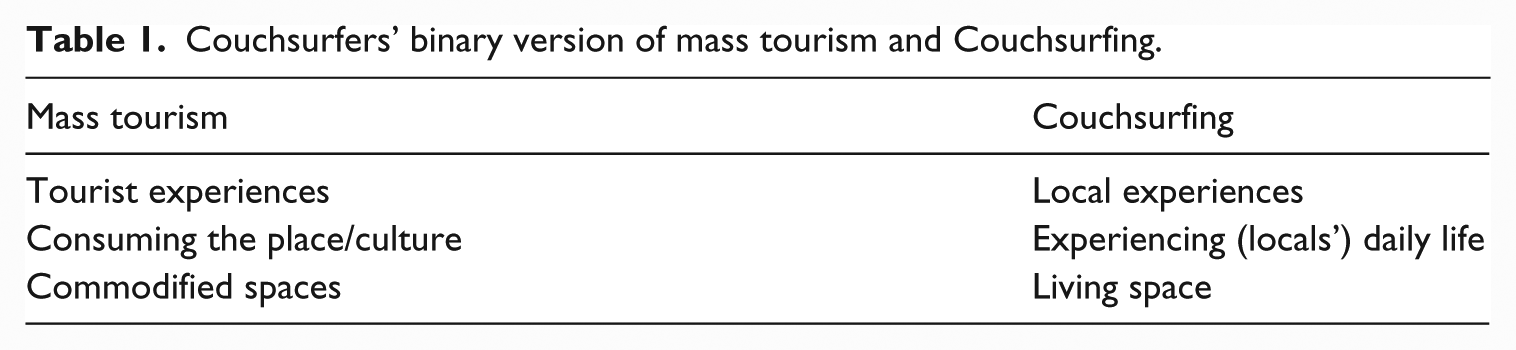
To display Couchsurfing as a specific travel style different from mass tourism, couchsurfers tend to have interaction with their hosts to emphasize the relatively close relationship with the host society while traveling. It is a shared belief that Couchsurfing invites surfers to stay with local hosts and simultaneously allows insight into the local’s private spaces and everyday life (Bialski, 2012; Chen, 2011). Hence, in the couchsurfers’ performance, hosts represent part of local culture, and hosts’ private spaces and semi-private spaces like the neighborhood represent the local living space. In other words, hosts and the (semi-)private spaces are the indispensable roles to perform the “authentic culture” and to direct “the specific ways to inscribe the place” (Crang, 2006: 48). The trip of Rachael, a 24-year-old, female, Taiwanese surfer, represents part of the scenarios of such performance: My host brought me to the places mainly for locals. We went for a drink, dancing, shopping at supermarkets, and out walking the dog in the neighborhood. […] I just followed the locals’ way of living— doing what they do, eating what they eat. Through this way I can experience the real local life.
These scenarios, such as having drinks with the hosts and walking the dog in the neighborhood, constitute Couchsurfing’s offline performance, in which couchsurfers do not passively follow the tourist gaze produced by tourism industry (see Urry, 2002), but actively experiencing the place and creating the meaning from it, that is, “the real local life.” Through actual interaction with the locals as well as the surfers’ bodily experiences, couchsurfers construct the authenticity of their own mindset, that is, couchsurfers’ way to make sense of this place (Crouch, 2000). By performing in this way, the couchsurfer identity is also strengthened (Cohen et al., 2013).
“Non-monetary exchange” is also performed in Couchsurfing to emphasize the distinction between Couchsurfing and mass tourism. The non-monetary exchange principle, which makes the non-profit image of Couchsurfing (Germann Molz, 2013), keeps the hosts’ hospitality away from commercialization, and thus the hospitality is priceless for many couchsurfers, like Jack, a 32-year-old male Taiwanese host: I can afford a hotel, so free accommodation is never a reason for me to join Couchsurfing. I am doing Couchsurfing because I want to experience the real local atmosphere, which is priceless. […] According to my own experiences, the attachment of certain places often came from the hosts’ hospitality and the interactions between us, which made the trips more meaningful.
The interesting part of this case is how a couchsurfer interprets and performs the non-monetary-exchange of Couchsurfing. The principle does not lead surfers to interpret Couchsurfing as a free accommodation, but the hospitality from “a friend you haven’t met,” that is, a friend-like relationship (Bialski, 2012), which makes Couchsurfing a more personal (Zuev, 2013) and emotional (Bialski, 2012) performance. The interpretation and performance of non-monetary-exchange principle corresponds to the value of Couchsurfing, which refers to building cross-cultural friendship and connection, rather than crashing at a place for free.
The role of space in Couchsurfing performance
Many researchers argue that space plays an active role in tourist performance (Coleman and Crang, 2002; Meethan, 2006; Haldrup and Larsen, 2010); space in Couchsurfing performance is no exception. Earl, a 43-year-old Dutch male host, indicated the active role of spatial setting to trigger the interaction: Couchsurfing is like camping. You have neighbors when you go camping. You also have neighbors at a hotel but you never see them, because they always close the door. You don’t know whether they are in their room or not. But in a camping site, you know your neighbors are there through the window of the tent. Or, you see the tent is open, and then you walk there and talk to them.
Earl used the metaphor of a camping site to illustrate how a shared space stimulates the interaction between strangers. In contrast to the divided spatial setting of the hotel, Couchsurfing makes tourists and locals more visible and approachable to each other. Bialski’s (2012) research also indicates a new relationship is easily built in the status in which the traveling strangers are sharing the same private space, like a room or a car. The contact generated in the mobile world, according to Baumann (2003: 62), “requires less time and effort to be entered, and less time and effort to be broken.” Although most surfers only stay for a short period of time, the intimate atmosphere of the private space shared by hosts and surfers often triggers and sustains a friend-like relationship in Couchsurfing.
At the same time, various spatial meanings are created in the interaction between hosts and surfers during the offline performance. Locals’ participation in surfers’ journey is important in Couchsurfing performance, because it builds personal connection between surfers and places. Although the surfers visit some must-go sites as mass tourists do, with the locals’ guide and company the surfers perform the visit as “experiencing the place through locals’ eyes,” and thus a new meaning of the space is created. Rachael’s (24-year-old, female, Taiwanese surfer) described her experience in Notre Dame, Paris: The tourist brochures may tell about the history or the art value of the Notre Dame, which means nothing to me. Although I look at every detail of the architecture, I don’t feel any connection with it. But, when I visited it with my host at two o’clock at the midnight, we drank beer outside of it, and I saw my host peeing there. These memories made me feel that, yes, I did have certain connection with the Notre Dame.
Rachael’s description, again, emphasized the contrast between couchsurfers and mass tourists through showing a different process constructing the spatial meaning. This case also indicates the complexity of tourist performance, which actually is a display imbricated by social conventions and individual identity (Edensor, 1998, 2000, 2001). Owing to the existence of the conventional meaning of Notre Dame, a distinct spatial meaning can be produced through a performance of subverting or challenging the conventional meaning. In this performance, the couchsurfer identity is shown.
Local hosts’ role in the subversion action is significant. The spatial meaning from local perspective is often connected to what Agnew (1987) called “the sense of place,” which, in many cases like Couchsurfing, has partly replaced the spatial meaning created and promoted by tourism industry through a process of sacralization (MacCannell, 1973). Therefore, Couchsurfing and its fortuitous action which challenges the tourist conventions, signify more personal and diverse tourist experiences.
The backstage
According to Goffman (1959), backstage is the region where the actors retire between performances to relax and to prepare, and it also allows concealment of activities which might discredit the performance out front. In Couchsurfing, the invisible surveillance of the reputation system divides the front and back region for couchsurfers. For a surfer, the host is the main audience in the front stage and also the one who judges the surfer’s performance through reputation system, and vice versa. To keep the impression of a good surfer, some surfers hide behaviors which seem inappropriate from the hosts. For example, Cara, a 23-year-old Taiwanese surfer tried to conceal the fact that “she was shopping like a tourist”: Normally tourists would like to buy some luxury handbags when traveling in Europe. You know, they are not that expensive there. […] When I was Couchsurfing in Italy, I was afraid that my host would find that I was shopping there. After shopping I didn’t go back to the host directly but sat by Rome plaza, unwrapped the package, stuffed my new Gucci bag into my old backpack, and then I dared to go to the host.
Cara’s concealment displays how couchsurfer identity influences the surfers’ behaviors. For those “improper manners,” such as tourist-like behaviors, which might incompatible with surfers’ image, are hidden within the backstage. The backstage of surfers not only refers to a space without hosts, but also to a period of time staying alone at a hotel or hostel. Many surfers, like, Jacqueline, 24-year old Taiwanese surfer, arrange accommodation at a hotel or hostel when they need a break from intensive interaction with the hosts: I know that many hosts expect me to spend some time together and to talk with them. […] If I don’t have enough time, or sometimes I feel tired of chatting with people, I would rather stay at a hostel. Like my trip to Cologne, I felt like to visit certain museum alone, and I only had limited time, so I didn’t do Couchsurfing.
The performative character of Couchsurfing interaction has been clearly shown in this quotation. For surfers, interaction with hosts is a necessary part of Couchsurfing performance for the hosts, so Jacqueline arranged a backstage when she felt like to stay alone, which might not fit in hosts’ expectation in a Couchsurfing performance. As MacCannell (1973) argues, the backstage functions to sustain the commonsense polarity of social life, including what is appropriate to show and what should be hidden. By creating the backstage, the social conventions of Couchsurfing are thus sustained and the inharmonious performance may be reduced.
Conclusion
Through the theoretical lens of theatrical performance, this article demonstrates the transforming process of Couchsurfing, which extends from hospitality exchange to a travel style with certain norms, value, and practice. On the stage of online performance, the site organizer has set the tone of Couchsurfing. By highlighting cultural interaction between couchsurfers, the site organizer displays a cordial, tolerant, and cosmopolitan atmosphere of Couchsurfing community. Since hosts have the right to decline the surfers’ couch request, the hosts also play a dominant role in leading the online performance, in which surfers tend to show an open-minded, friendly, and social image to fit into the hosts’ expectation.
After mutual selection, the couchsurfers who share the same value and perform properly online are selected to the stage of offline performance, while others might be excluded from the face-to-face interaction of Couchsurfing. In the offline performance, the cultural interaction between hosts and surfers is still regarded necessary and important especially by the surfers, who tend to perform it as the way to build a personal and authentic connection with the place they visit. By doing so, the surfers distinguish themselves from mass tourists and show the couchsurfer identity. The reputation system functions to monitor couchsurfers’ offline performance, and it marks the (in)appropriate behaviors in couchsurfers’ personal profile as part of online display. To avoid a negative reference, couchsurfers create a backstage to hide the “improper behaviours” which might conflict with the social conventions of Couchsurfing.
Thus, the online performance, offline performance, mutual selection, reputation system, and the backstage constitute a series of mechanism, which, integrating the hosts’ expectation of cultural interaction, the surfers’ mindset of tourist-angst, and the Couchsurfing organizer’s managerial strategy, transforms Couchsurfing practice to a stylish way of travel with authentic and personalized experience. The social-media technologies here play a role to connect the online and offline performance as whole and to stabilize the social conventions performed in both: the social-media technologies aid the selection of the proper Couchsurfing members for the offline performance. Simultaneously, the technologies help to capture the offline performance and to display it online to strengthen the rules of Couchsurfing.
Due to the ethnographical methods adopted by this study, subjectivity/objectivity is an unescapable issue. As I participated in the hospitality exchange network, I was involved in the Couchsurfing selection mechanism, which may categorizes like-minded people into groups (Bialski, 2011; Germann Molz, 2007). That means, to some extent, my identities, appearance and characteristics shown online, “a Taiwanese women working in academia abroad,” have decided the person I may meet, the data I may collect and my perspective. Instead of claiming the objectivity of this study, I admit the unavoidable limitation owing to the researcher’s identities, which simultaneously contribute to a particular angle of view for Couchsurfing studies.
Another limitation of this study is that I was not able to update the latest situation of Couchsurfing since the fieldwork was mainly done during the period 2011–2014. Couchsurfing is still growing and developing because social-media technologies, mobile devices, and the accessibility to the Internet are improving all the time. In the Couchsurfing community, a large number of new members may challenge the existing conventions and influence the balance the reciprocal relation of Couchsurfing. At the same time, a new website, Airbnb, adopts a similar idea of Couchsurfing and develops it as a new business model, which allows the hosts to charge their guests and takes commission from the hospitality exchange. Airbnb has become very popular in recent years and has attracted some Couchsurfing members to join. The appearance of such website and its influence on Couchsurfing are worthy of future research to explore the new sharing economic system in tourism or to further study the latest development of Couchsurfing.
Footnotes
Declaration of Conflicting Interests
The author(s) declared no potential conflicts of interest with respect to the research, authorship, and/or publication of this article.
Funding
The author(s) received no financial support for the research, authorship, and/or publication of this article.