




Abstract
There is a great deal of concern that U.S. prisons are generating high levels of Islamic extremism. Sociologist Bert Useem argues that the evidence fails to support this fear.
In October 2003, the U.S. Senate Subcommittee on Terrorism, Technology, and Homeland Security held hearings, warning that Islamic radicalization of prisoners is producing a formidable enemy within. Eight years later, in June 2011, the U.S. House Committee on Homeland Security held another series of hearings on the issue. In his opening remarks, Committee Chairman Peter King claimed that prisons have created “an assembly line of radicalization,” which poses a major threat to the safety and security of the United States.
Many pundits, politicians, and law enforcement officials consider prisons to be breeding grounds for terrorism. A plausible argument for the causal connection between prison and terrorism is not difficult to construct. Prisons, by design, are “bad” places to live. Their day-to-day operations are authoritarian, and their amenities and comforts are few. In this age of mass incarceration, prisons are often over-crowded. Resentment inevitably builds as prisoners come to hate “us”—unincarcerated citizens, law enforcement, and the government. They may act on that hatred, the story goes, by participating in mass political violence.
In the past, collective prison violence was expressed through internal rebellions, such as the famous riots that occurred at Attica in 1971 and in New Mexico in 1980. Today, prisoners’ thirst for rebellion is more likely to be channeled into Islamic terrorism—or so many believe. But do prisons actually breed terrorism in the U.S.?
Prison Radicalization
It’s not enough to show that some domestic Islamic terrorists have been prisoners. Serving time is no longer an uncommon experience, especially among those who are likely to become involved in Islamic domestic terrorism. By random chance alone, some terrorists will have prison records—just as some terrorists will have played dodge ball, or performed in a high school band. A more precise question is whether U.S. domestic terrorists come disproportionately from prisons.
To explore this, we need to know the demographics of both the current and former prison populations. The average state prisoner serves 2.5 years in prison, and 44 percent of state prisoners are released in a given year. At the end of 2001, 1.3 million adults were serving time, and there were an additional 4.3 million former prisoners living in this country. In other words, one out of every 37 adults—or 2.7 percent of the total U.S. population—has been imprisoned at some point. Population subgroups, such as racial minority men—from which prison-radicalized Islamic terrorists are disproportionately drawn—have even higher rates of current or past imprisonment. In 2001, 5 percent of all adult males, 17 percent of adult black males, and 8 percent of Hispanic males were current or former prisoners.
If prisons in fact breed Islamic terrorism, one would expect to see large numbers of prison-radicalized terrorists. Even if being imprisoned has a negligible impact on the rise of Islamic terrorism in this country, sheer chance alone would mean that a certain number of Islamic terrorists would have served time in prison. But if we take a closer look at the numbers, we see that the threat has been exaggerated.
Doing the Numbers
Using open sources, criminologist Mark Hamm assembled an exhaustive data set documenting cases of prison-based terrorism against Western targets. He identified 46 cases of prison-radicalized terrorists over a 41-year period, including both Islamic and other types of terrorists. For each case, he collected data on year of attack, religious conversion, ethnicity, age, and the nature of plot.
Let’s take Hamm’s data-set, but exclude those who were radicalized in a prison outside the United States (for example, “shoe-bomber” Richard Reid, who was incarcerated in Britain); those who operated before 9/11 (Black Panther Eldridge Cleaver, for one); individuals who were involved in political extremism that is unrelated to Islamic terrorism (such as members of the Aryan Circle); and those were incarcerated in a U.S. detention center because of alleged terrorist activities (such as Said Ali al-Shihri, who was captured at the Pakistan-Afghanistan border and held as an “enemy combatant” in Guantanamo Bay from 2002 to 2007). This leaves us with 14 individuals who appear to have been influenced by Islamic radicalism in U.S. prisons during the post 9/11 period. Eleven of these individuals are African-Americans, one is Caucasian, one is Hispanic/African-American, and one is African-Haitian.
Sheer chance alone means that a certain number of Islamic terrorists would have served time in prison.
Sociologist Charles Kurzman, also working with open source data, found that a total of 161 Muslim-Americans committed acts of terrorism-related violence, or were prosecuted for terrorism-related offenses from 9/11 through the end of 2010. Of these 161 men, if 14 were radicalized (as my reassessment of Hamm’s data suggests) one might conclude that about 9 percent of American Islamic terrorists in the post-9/11 period could have been radicalized in prison. But given the current size of the prison population, this number is not very different from the proportion of ex-prisoner terrorists by chance alone. The assembly line of prison radicalization seems, then, to be moving very slowly—if it is moving at all.
Only about 9 percent of American Islamic terrorists in the post-9/11 period could potentially have been radicalized in prison.
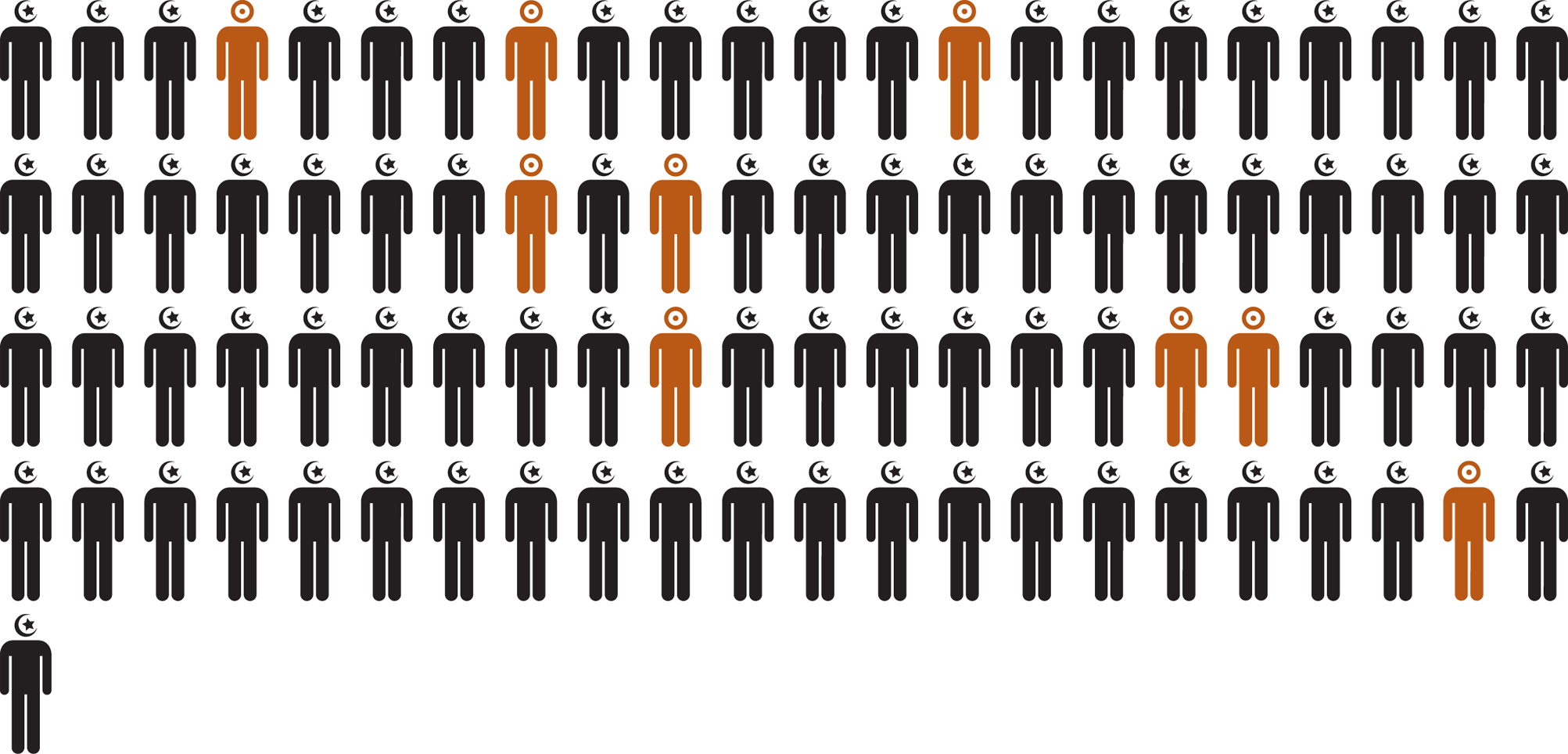
But even the notion that 9 percent of the U.S. Islamic terrorists were radicalized in prison may be too high. While prison may play some role in leading individuals to commit terrorist acts, the “breeding ground” rhetoric is overstated, as the following cases illustrate.
Men in Trouble
Ruben Shumpert
Convicted of drug trafficking, Shumpert was sentenced to the Monroe State Penitentiary in Washington State. Before his release in 2002, he converted to Sunni Islam. After his release, Shumpert opened a barbershop, which served as an informal community center in a low-income section of Seattle. After infiltrating the barbershop, an FBI agent reported: “Conversations at the barbershop shop often turned to militancy and the need to be ready for Jihad against the ‘kafir,’ or non-believers.” The acquisition of firearms was a frequent topic of conversation, he said. “Conversations in the defendant’s shop also featured open support for Jihad, as well as the desire and duty of Muslims to travel to Iraq, Sudan and Afghanistan to fight alongside their Muslim brothers. In addition, there were frequent derogatory references to Jews.”
Shumpert was charged with beating a man who refused to join his group. While in jail for this alleged crime, he was also charged with passing counterfeit money and with being a felon in possession of a gun. In a letter to the presiding federal judge, Shumpert recounted his troubled life. According to this account, it was his barbershop experience, rather than prison, that led him to radicalism. “During this time, not only was I trying to help get the barbershop off the ground, but I spent every second of my free time trying to learn my religion,” he testified. “I was introduced to many different schools of thought,” including, he said, “radical Islam or fundamentalism.” Ironically, Shumpert told the judge that it was a paid informant who introduced him to radical Islam. They became “good friends” he said, and sat “for hours at the barbershop while I would dialogue with people of the community on how we can improve our social system.”

After pleading guilty to the assault charge, Shumpert was released on bail, and met up with some Somali “brothers,” who convinced him to flee to Somali for jihadi purposes. Using forged documents allegedly provided by the Somalis, he fled before his sentencing hearing on the federal charges. In Somalia, Shumpert joined al-Shabaab, a militant organization purportedly tied to Al Qaeda in the Arabian Peninsula, and he was later killed in a U.S.-supported rocket attack. While Shumpert’s alibi (that a paid-FBI informant radicalized him) may not be credible, it does seem that his radical views developed in the barbershop, and not in prison. Though his conversion to Islam while serving time may have been a step toward radicalization, it was not decisive.
Newburgh Four
After a six-week trial, based largely on the testimony of an FBI informant, four men (leader James Cromitie, along with Onta Williams, Davis Williams IV, and Laguere Payen) were found guilty of attempting to blow up two synagogues and to fire surface-to-air missiles at a U.S. military aircraft. The informant had posed as a wealthy Pakistani businessman with connections to a foreign terrorist group. All four plotters were from poor backgrounds, barely literate, chronically involved with the law, and often drug addicted; one had a severe psychiatric disability, and experienced periodic bouts of homelessness.
At trial, the four defendants claimed that that government “created the criminal, then manufactured the crime.” The informant offered the men $250,000 and a luxury car for their participation, selected the targets, and provided all of the equipment and logistics for the plot. He also recorded dozens of conversations over the course of his 11-month investigation. James Cromitie, leader of the Newburgh Four, said that he wanted to kill Jews and retaliate against the U.S. for its aggression in the Middle East. Onta Williams said “the money helps. But I’m doing it for the sake of Allah.’’ The jury rejected the defendants’ entrapment defense.
Contrary to conventional wisdom, the death rate attributed to terrorism in the U.S. is decreasing.
A federal appeals judge later upheld the jury’s finding but noted that in reference to plot-leader James Cromitie, the Government “dangled what had to be almost irresistible temptation in front of an impoverished man.” She offered that Cromitie came from “the saddest and most dysfunctional community in the Southern District of New York.” While two of the four plotters purportedly converted to Islam in a New York State prison there is little, if any, evidence that they were radicalized in prison, or that their prison experiences contributed to their participation in the alleged plot.
Michael Finton
In September 2009, Finton was arrested in an FBI undercover operation after he drove a van packed with explosives near a Federal Building in Springfield, Illinois, and attempted to detonate it using a cell phone. In the period leading up to this attempt, an FBI informant repeatedly reminded Finton that he could walk away from the plan, but he insisted on going forward with it, saying he was greatly impressed by a recent terrorist attack in Mumbai, India, and that he believed a similar attack in the U.S. could bring the government down. Finton told the informant it was “his biggest dream to be first domino to fall, to be the one who brought the whole thing crashing down,” and later pled guilty to attempted use of a weapon of mass destruction, and was sentenced to 28 years in prison.
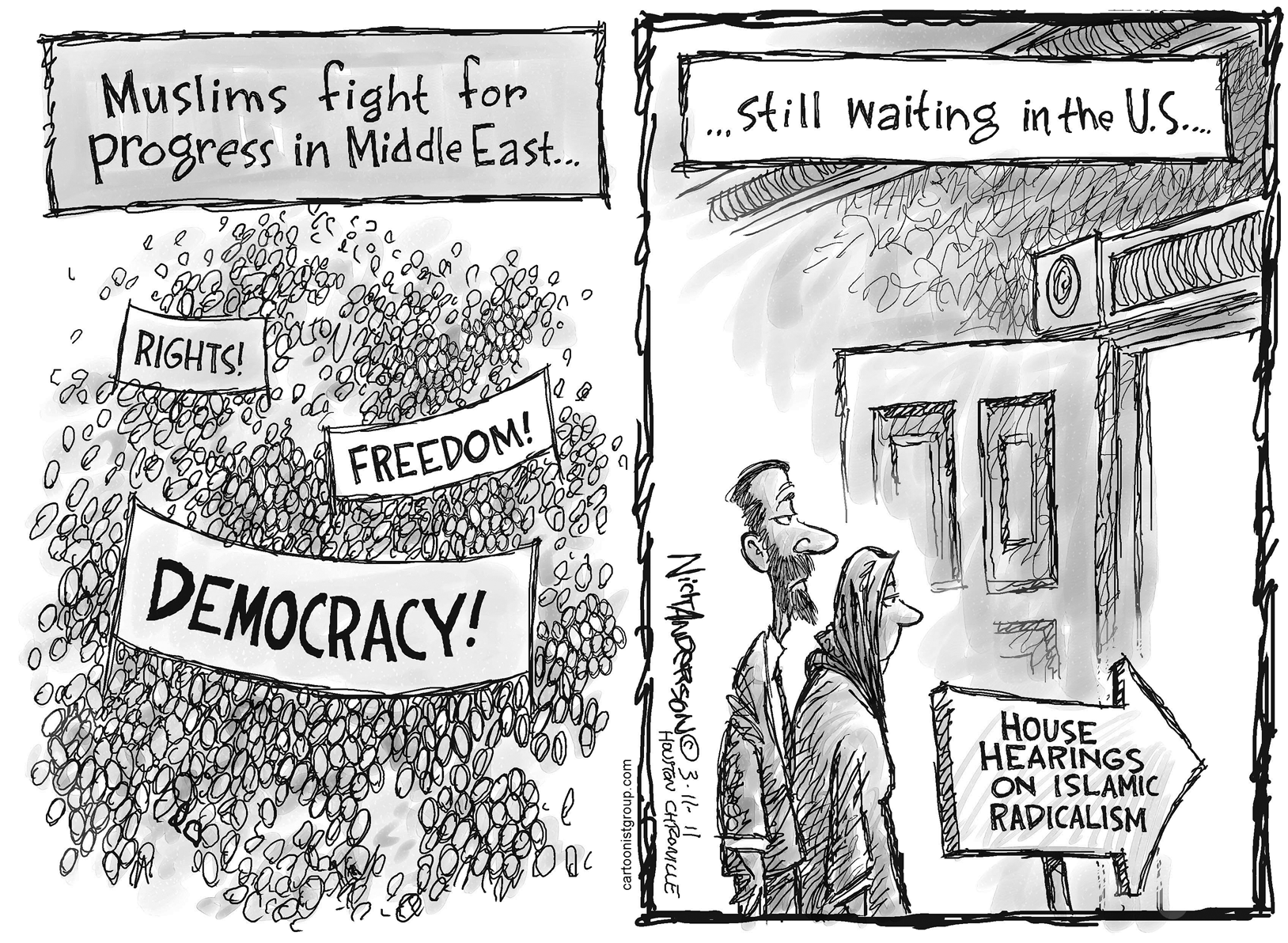
Nick Anderson Editorial Cartoon used with the permission of Nick Anderson, the Washington Post Writers Group and the Cartoonist Group. All rights reserved.
Finton had served time in an Illinois prison from 2001 to 2005 for aggravated robbery and battery. He claimed to have converted to the Islamic faith in prison, though few details are known about his supposed conversion. Some evidence suggests that he may have been considering terrorist activities while in prison. He told an FBI informant that that he had reservations about Al Qaeda because they target civilians, but if “the targets were soldiers, politicians, or generals,” he said, “he was the man.” He told the same informant that “he never liked the government,” and when he was 18, he “told his buddies in high school that he was going to join the Army so he could blow things up, and when he got out he would start a militia.” Finton also said “he had been pretty much anti-authority his whole life, and that even before Islam he hated the American government.”
Prisons have become far more orderly and secure. Signs of possible radicalization are therefore far more visible to authorities in advance.
While prison may have played some role in completing Finton’s radicalization, these accounts suggest that he was radicalized before he ever entered prison. It is possible that the prison experience deepened this commitment, leading him on the path toward terrorism.
Kevin James
In August 2005, James and three other men were indicted on terrorism charges, pleading guilty to conspiring to attack military recruitment offices, the Israeli Consulate, and synagogues in the Los Angeles area. Their goal, they said, was to kill as many people as possible at each of these sites. As an inmate in the California State Prison at Folsom, James had formed Jam’iyyat Ul-Islam Is-Saheeh (“JIS,” the Authentic Assembly of God), whose long-term goal was to help “reestablish the Islamic Khalifate throughout the Muslim world.” While in prison, James instructed members of his group that it was their duty to attack violently “infidels.”
He recruited half a dozen inmates into JIS, including Levar Washington. In November 2004, Washington was paroled. At James’s instruction, Washington recruited Gregory Patterson and Hammad Samana (neither of whom had criminal records) from a local mosque, and together the three drew up attack plans. To fund these attacks, they robbed a dozen gas stations. A cell phone dropped during one of the holdups guided local police to the apartment where Washington and Patterson lived, where they found a computer with documents detailing the full conspiracy. Federal prosecutions followed, including charges against James, who was still in state prison. All four defendants pled guilty to seditious conspiracy and were sentenced to lengthy federal prison terms.
Prison can be an incubator of terrorists’ ideas, this plot tells us. The plan to attack was hatched in prison, participants were recruited among inmates, and it was orchestrated from prison. Still, it is difficult, if not impossible, to determine whether James’s prison experience contributed to his radicalization.
James wrote a foundational statement justifying JIS and explaining its purpose—typed, single-spaced and partially handwritten in English and Arabic, and 100 pages long. If negative prison conditions and the humiliating nature of the experience moved James toward radicalization, it reasonable to expect that he would have said as much in his manifesto, but he did not. If James had not been behind bars, would he have steered clear of radicalization? There is no clear answer to this question. It is true that he was able to attract a small following in prison—which suggests that U.S. prisons may provide an environment that enables radicalization. Still, this may be an isolated case, as a Congressional Research Service report on domestic terrorism suggests. The report identified 43 attacks and plots after 9/11. Of these attacks and plots, only the JIS plot, it claims, indicates that participants were “radicalized in prison.” In other words, of all the plots and attacks conducted by so-called “home-grown” terrorists, it remains the exception.
The “Breeding Ground” Myth
Individuals who become involved in Islamic terrorism, who have also served in prison, tend to have led troubled lives—and prison is typically only one component of that trouble. Some plotters may be driven by material gain, or their terrorist designs predated their prison terms. They also tend to display exceptional levels of incompetence. From outside the prison context, would-be terrorist Faisal Shahzad, who parked his explosives-packed car near Times Square on May 1, 2010, placing hundreds at risk in New York City, is a case in point; the firecrackers he tried to use as a detonator were faulty. Much the same could be said of the JIS plot, which was “broken” by criminal investigators when one of the conspirators left his cell phone at the scene of a robbery.
There are far fewer Islamist terrorists than one might expect. And contrary to conventional wisdom, as psychologist Steven Pinker has pointed out, the death rate attributed to terrorism in the U.S. is decreasing. There are peaks associated with well-known incidents, such as 9/11 (2,996 deaths), Oklahoma City in 1995 (165 deaths), and Columbine in 1999 (16 deaths). But apart from these, terrorism is on the wane. The same is true of rates of death from terrorism in Western Europe and the world as a whole—when the civil wars in Iraq and Afghanistan are excluded. Considered in relation to broader patterns of terrorism, prison-based terrorism is a minor threat indeed.
It is plausible that the growth of the U.S. prison population over the last three decades has generated an enormous group of people who are potential domestic terrorists. Many of these men have used violence, they have time on their hands to think, plot, and conspire; and many are angry and hostile. But plausibility is not evidence.
When sociologist Obie Clayton and I conducted interviews with prisoners and prison officials in 10 states and one jail system, we found that most prisoners are loyal to the country, and do not want to threaten it or place themselves at risk. They tend to be motivated by personal profit and gain rather than commitments to broader goals. Another factor working against radicalization is that prisoners’ mail is censored and their telephone calls are monitored. They do not have access to the Internet, and they are supervised, sometimes quite closely. Over the last three decades, prisons have become far more orderly and secure—it is no longer the case that “anything goes.” Signs of possible radicalization are therefore far more visible to authorities in advance.
The claim that American prisons spawn terrorism is false—or, at the very least, overstated. U.S. prisons are not systematically generating a large-scale terrorist threat. Of course we cannot be certain that prisons will never become breeding grounds for radicalization. But the fact is that few U.S. prisoners have been radicalized behind bars, and fewer still have engaged in terrorist acts.