




Abstract
Sociologist Sangyoub Park discusses how the recession is affecting every aspect of American lives—especially those of young people.
Keywords
Those who came of age during Japan’s economic tumult of the 1990s became a generation of discouraged and reclusive people. Much of what Japan endured, including volatile real estate markets and high unemployment, is occurring in the U.S. today. If the recession continues to linger, America could be creating its own “lost generation,” characterized by dissatisfaction and insecurity.
“Generation,” one of the most widely used concepts in the social sciences, refers to an aggregate of individuals born around the same time who experienced some socially significant events in common. These shared, formative experiences frequently contribute to a unique worldview and remain powerful throughout individuals’ lives. Since each generation has its own zeitgeist, the concept of generation is a useful tool for exploring social differences.
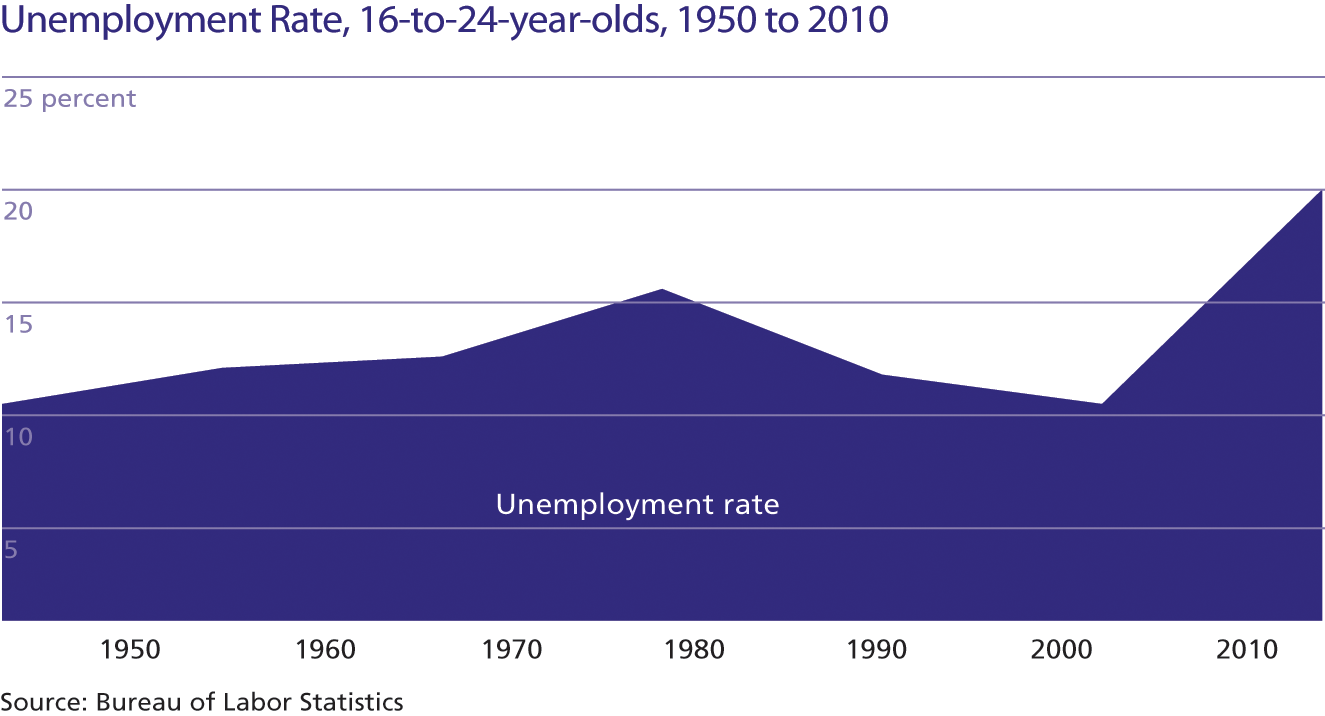
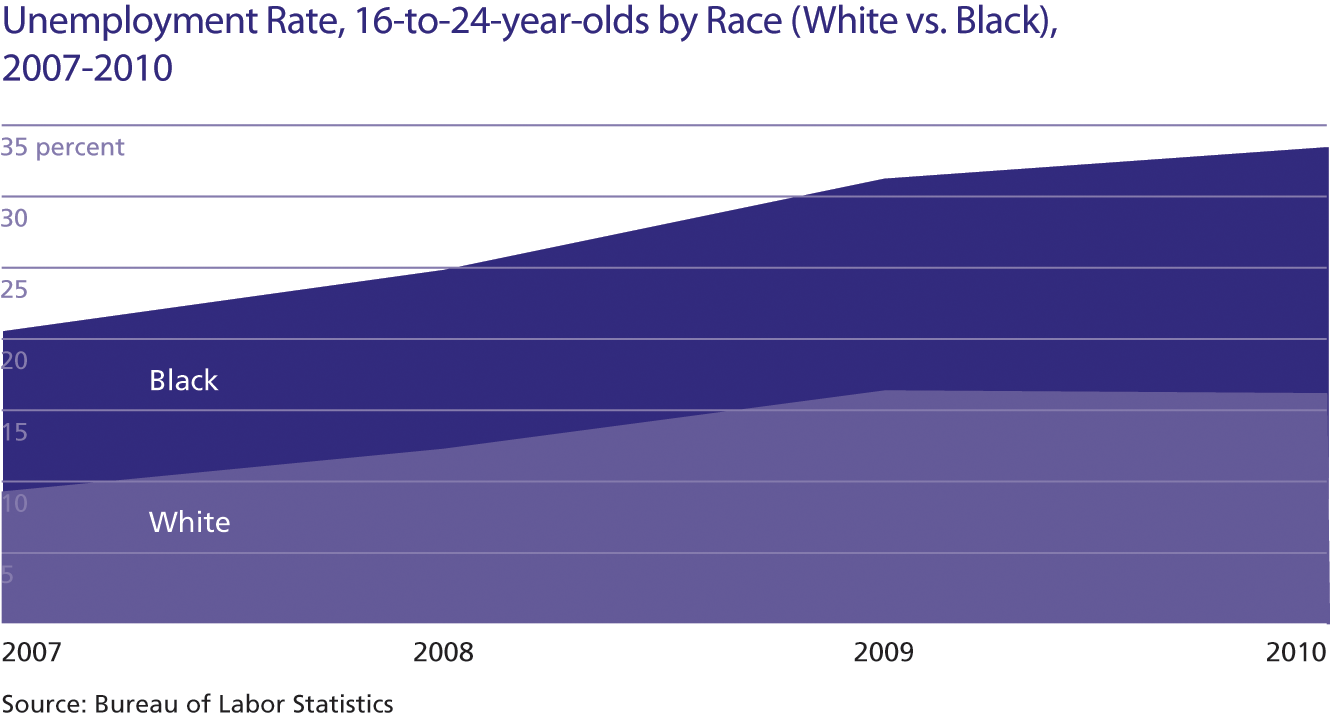
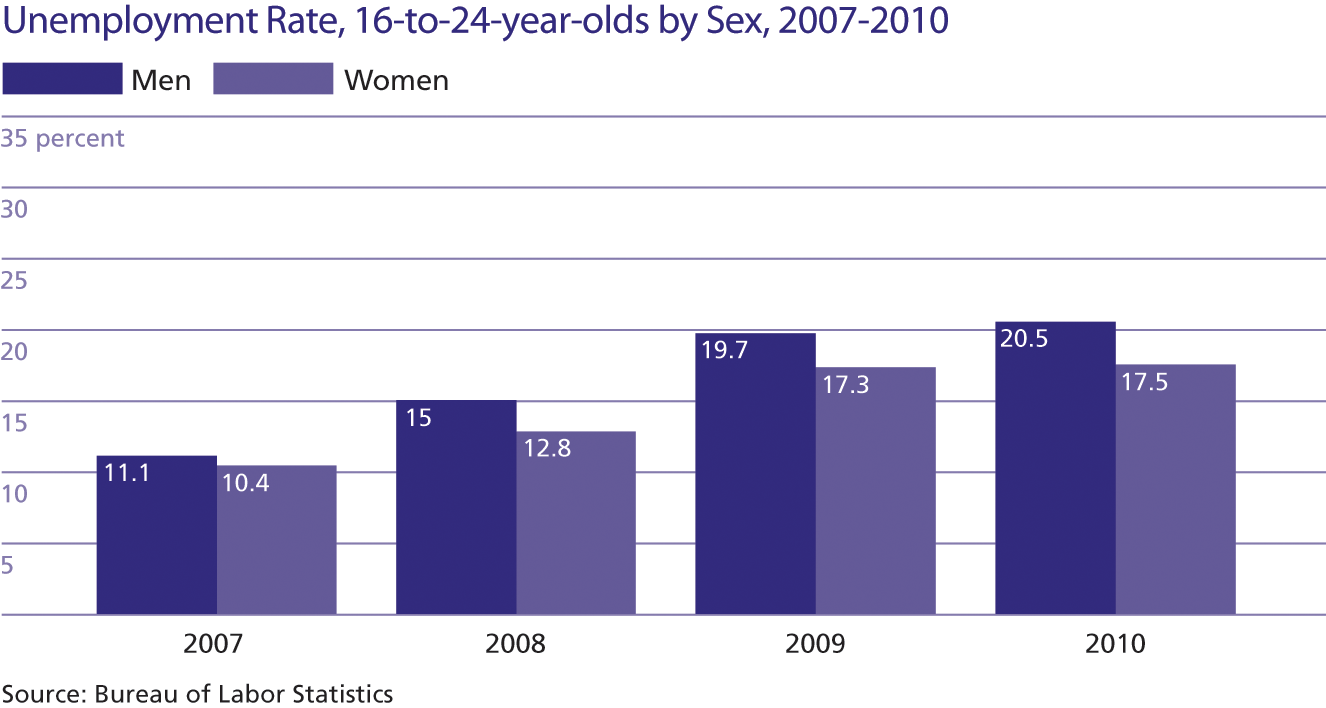
The Great Recession, though officially over, is nonetheless affecting every aspect of Americans’ lives—especially those of young people. Rates of youth unemployment drastically increased from 9.6 percent in 2000 to 19.1 in 2010, while national unemployment rates hovered between nine and ten percent during the past two years. (Figure below illustrates changes in the youth unemployment rate between 1950 and 2010.) Specifically, unemployment rates for young men (20.5 percent in 2010) are higher than those for young women (17.5 percent in 2010). Unemployment rates for young black Americans soared to 33.4 percent in 2010 (see top right). With unprecedented unemployment rates, there is little evidence that America’s economy is improving.
Unemployment Rate, 16-to-24-year-olds, 1950 to 2010
Source: Bureau of Labor Statistics
Unemployment Rate, 16-to-24-year-olds by Race (White vs. Black), 2007-2010
Source: Bureau of Labor Statistics
Unemployment Rate, 16-to-24-year-olds by Sex, 2007-2010
Source: Bureau of Labor Statistics
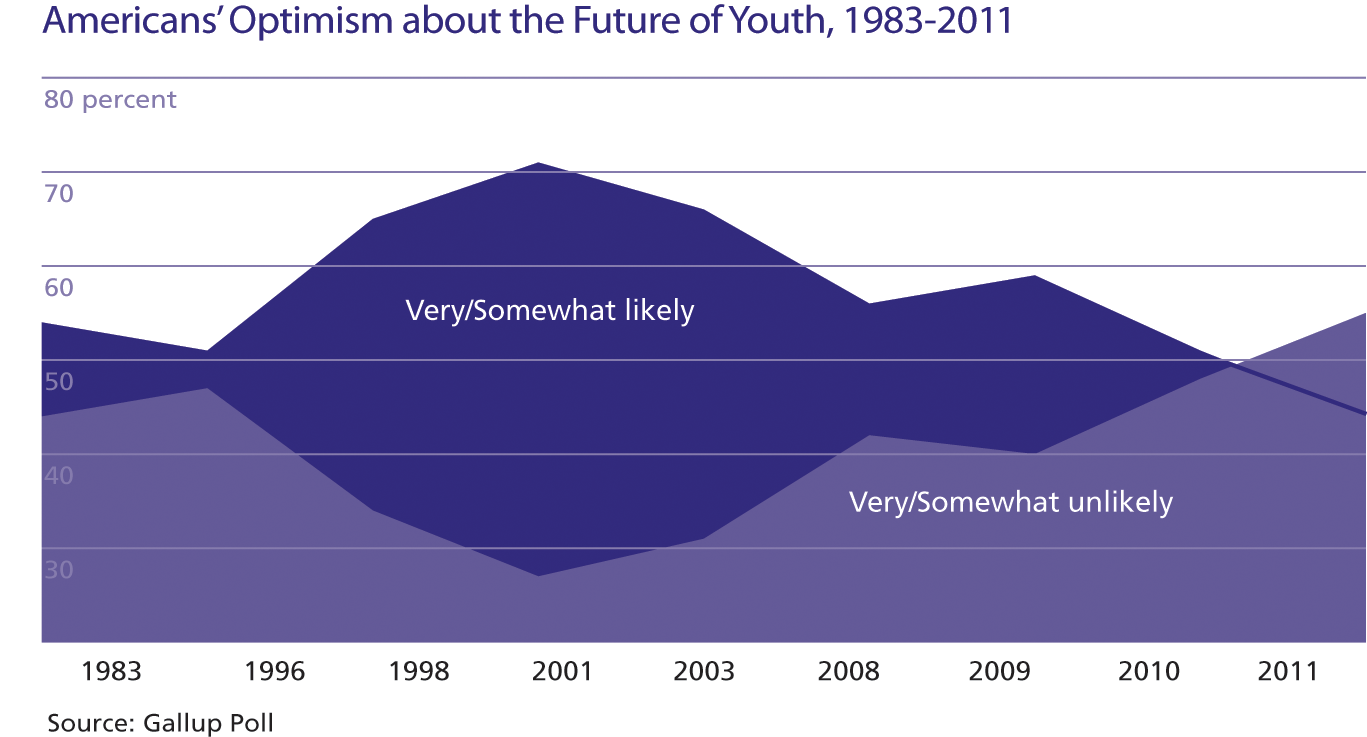
Americans’ Optimism about the Future of Youth, 1983-2011
Source: Gallup Poll
We know that a lack of job opportunities deprives young people of the ability to build their careers and frequently leads to long-term joblessness. In periods of economic uncertainty, potential employers have little opportunity to recruit the future employees who could potentially revitalize workplaces and compete more effectively in the global economy. As median incomes fell among all working-age Americans, the drop was particularly noticeable among young Americans aged 15 to 24 in 2010, according to the U.S. Census. The median income for young Americans fell nine percent, from $31,240 in 2009 to $28,322 in 2010.
So it is that all Americans seem to imagine a bleak future for our young people (see left bottom). A Gallup Poll question that’s periodically posed to respondents reads: “In America, each generation has tried to have a better life than their parents, with a better living standard, better homes, a better education, and so on. How likely do you think it is that today’s youth will have a better life than their parents?” The proportion of people who responded pessimistically has steadily increased, doubling from 27 percent in 2001 to 55 in 2011. In other words, the majority of Americans now believe that the current generation is unlikely to be better off than their parents.
These young Americans, especially younger members of Generation Y, have experienced a wide range of economic turmoil, including the debt-ceiling imbroglio and the downgrading of our country’s credit rating. This cohort may be fast becoming a generation of curmudgeons, placing their lives on hold and delaying starting families as they weather the financial storm. Currently, though, an upsurge of protests called Occupy Wall Street—adopted around the country and the world—have shown us sparks of life: some young people are raising their voices and putting their bodies on the line, calling upon public officials to address the economic insecurity threatening their generation. They may not be lost after all.