



Abstract
An imbalanced sex ratio in the 1970s and 1980s has led South Korean men to seek wives abroad. Though a solution to one problem, this spike in interracial marriage has posed new social conundrums for the formerly homogenous society.
South Korea (hereafter, Korea) is a culturally and racially homogenous country, which projects an image of a single unified Korean identity to the world. This sense of shared identity is based on common ethnic, cultural, and linguistic heritage, but it may be eroding. Some experts say that rising numbers of Korean men, facing a shortage of prospective Korean brides, are marrying women from other nations and cultures. They are unintentionally forging the nation’s transition to a more diverse society.
This “marriage squeeze”—the imbalance between the number of marriageable men and women—is a consequence of Korea’s history of an imbalanced sex ratio, especially during the 1970s and 1980s, when baby boys profoundly outnumbered baby girls. The typical sex ratio at birth in any nation is roughly 105 male babies per 100 female babies born. This ratio quickly reaches a balance, since baby boys have a higher rate of infant mortality; within the first month of life the number of boys and girls evens out.
In Korea, by contrast, the sex ratio is highly skewed, peaking at 116 boys born for every 100 girls in 1990. This stark gender imbalance can be traced to Korean parents’ historic preference for sons and the widespread practice of sex-selective abortion in the 1970s and 1980s. Although abortion was banned in 1987, the law did not succeed in curbing the practice of sex-selective abortion.
This “missing girls” phenomenon is not unique to Korea; it’s been observed in China and other surrounding nations in East Asia. The desire for boys is strongly linked to males’ advantaged social and economic roles in Korean families. Sons are expected to carry on the family name and be financially responsible for their aging parents. Families without sons often continue having children until they have a son.
Sex ratio at birth & total fertility rate (TFR) in Korea
Source: Statistics Korea
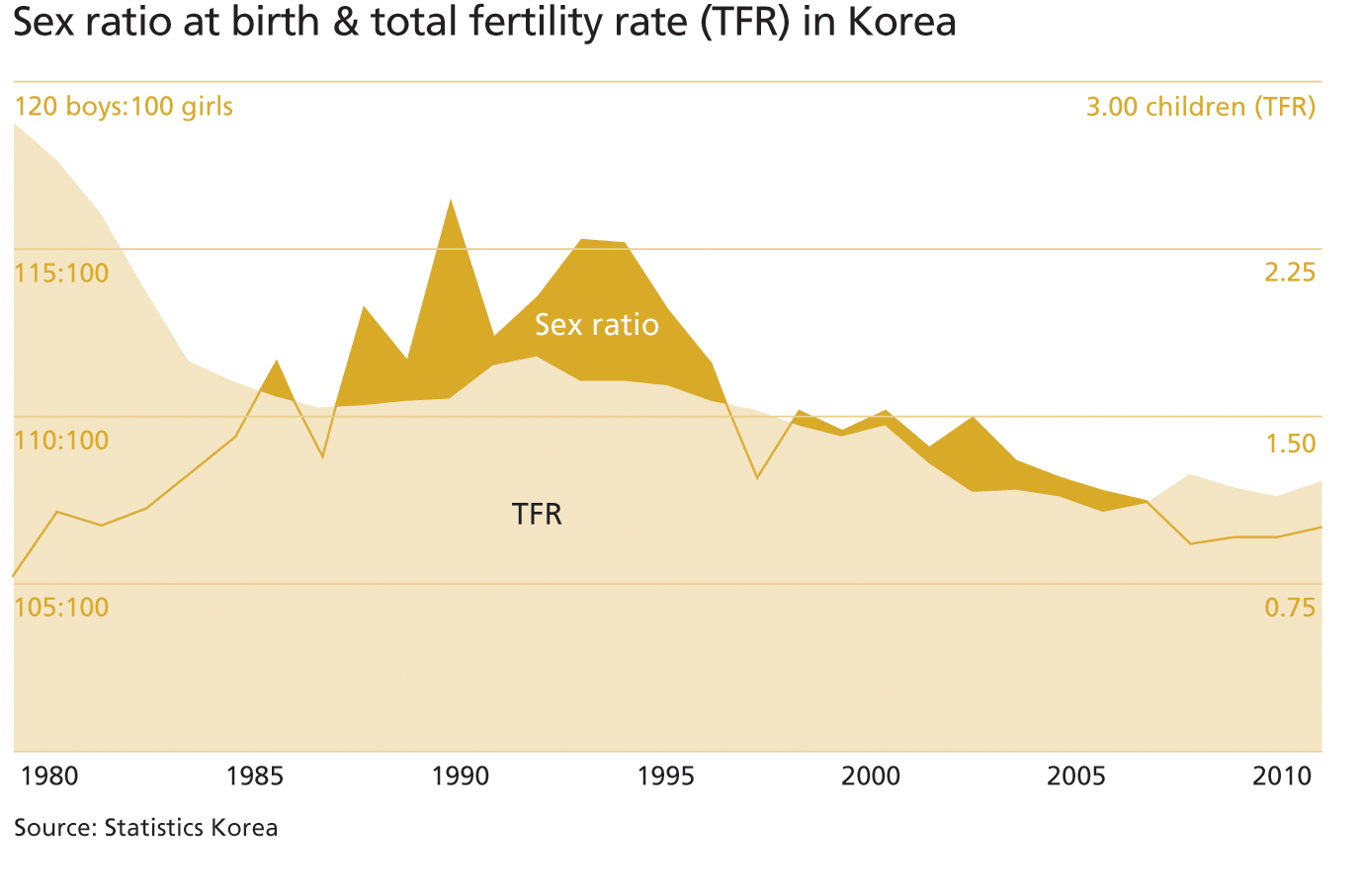
Data from Statistics Korea vividly illustrate these patterns. The graph above reveals a simultaneous decline in both the sex ratio (106:100 in 2010) and the total fertility rate (1.2 in 2010), defined as the average number of children born per woman over her childbearing years (usually considered to be ages 15 to 49). Both very low fertility rates and the typical sex ratio at birth indicate that Korean parents no longer have a strong son preference, and anecdotal evidence further suggests that Korean couples prefer girls over boys today. This tectonic change may be attributed to the fact that parents now expect no financial support from children in their post-retirement life and prefer daughters as caregivers.
Although son preference has all but eroded, Korea still pays the price for the son preference that prevailed in earlier decades. The disproportionately large cohort of baby boys born in the 1970s and 1980s—now in their 30s and 40s—has created a stark imbalance in young adults’ marriage market prospects. Prospective grooms face a shortage of “marriageable females.” This marriage squeeze is most pronounced among males who lack higher education (and are thus seen as undesirable husbands) and males in rural areas.
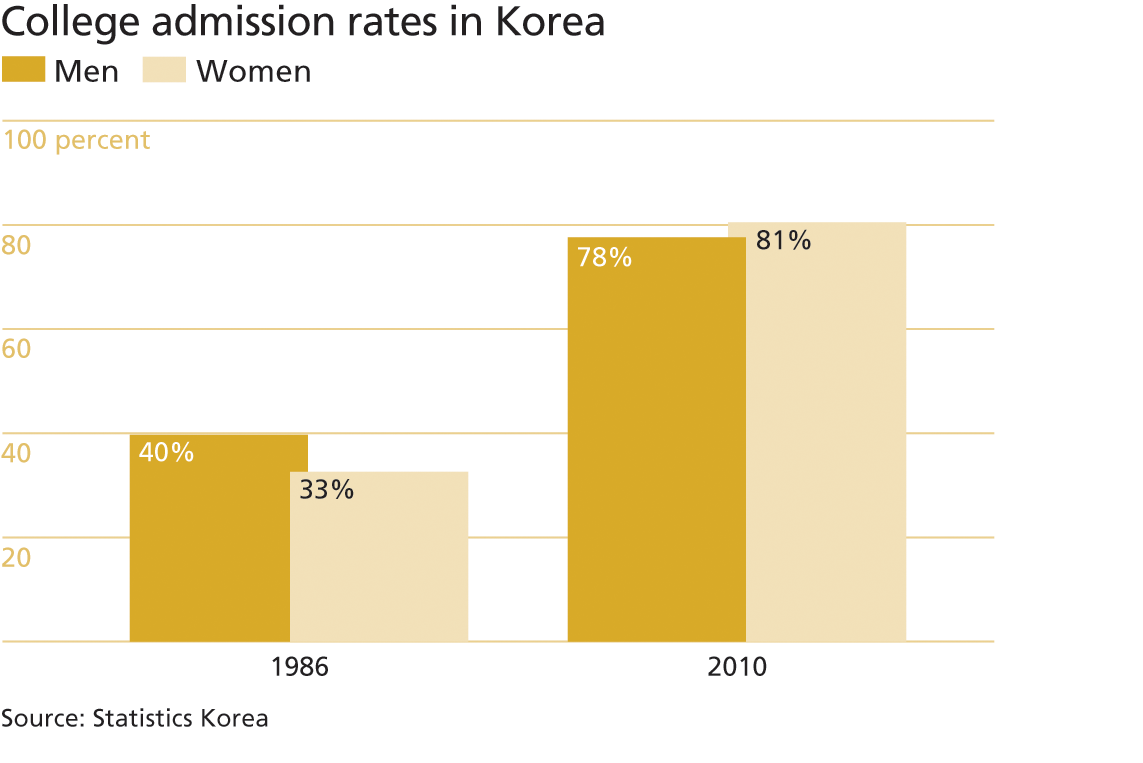
The bride shortage is exacerbated by another demographic trend: women’s rising levels of educational attainment. Korean women outpaced men in college admission rates in 2010; 80.5 percent versus 77.6 percent respectively (see next page). In contrast, a slightly higher proportion of men than women (40 versus 33 percent) entered college in 1986, according to Statistics Korea. Today’s small cohorts of highly educated young women can afford to be “choosy” when it comes to selecting a mate, and many will choose not to “marry down” with a less accomplished or less educated male.
The shortage of potential wives has forced Korean men to “import” young women from neighboring countries, especially from poor countries. Interracial marriage is encouraged to alleviate the excess of marriageable grooms. (The term interracial indicates international in Korea. Koreans also use the terms biracial or multicultural to describe interracial couples and families.) In 2010, 10 percent of married couples were interracial, an increase from four percent in 2000, according to Statistics Korea. The prevalence of interracial couples is dramatically higher in rural areas. About 40 percent of married couples in Korean rural areas are interracial couples; it is projected that biracial children will represent about 50 percent of rural children in 2020.
College admission rates in Korea
Source: Statistics Korea
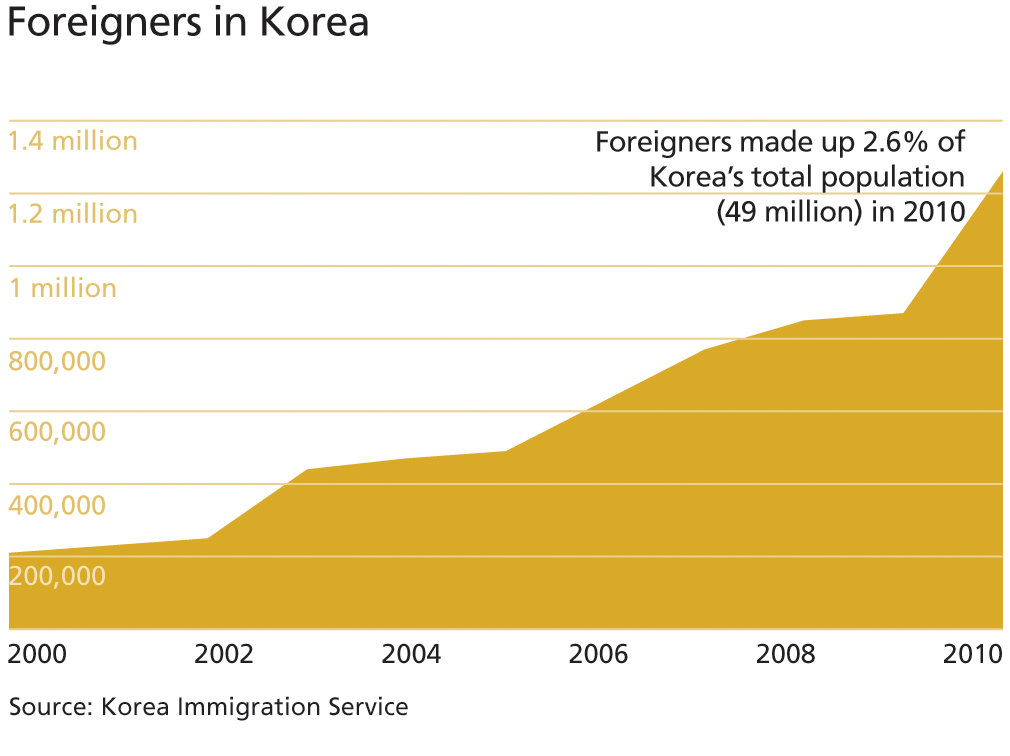
Foreigners in Korea
Source: Korea Immigration Service
A 2007 New York Times report by Norimitsu Onishi described the marriage tour of Korean grooms. The article described how Korean men take five-day marriage tours to Vietnam to meet potential brides. After the initial meeting with their brides-to-be, they travel to the brides’ home province to meet their parents and in-laws and to register for their marriages. They then marry in Vietnam and return to Korea. Vietnamese women account for about 22 percent of all interracial couples in Korea, lagging only behind Chinese women (34 percent) as the most popular international brides in 2009. The description from the Korean Times provides a vivid picture of the process of finding a mate through matchmaking companies: “[A single man has] spent an average 13 million won [$10,600] in costs for interracial marriages. It takes an average of 88 days, or about three months, to complete an interracial marriage through agencies—from the Korean applicant’s departure to interview with his or her prospective spouse and their entry here.”
Although private marriage companies are flourishing in Korea (about 1,800 companies operated in 2010), many of the matchmaking companies are unlicensed and have scammed prospective grooms. The government has had to implement tighter measures to regulate these companies. More importantly, large numbers of immigrant brides arrive in Korea unprepared for life in their new homeland. Social problems such as domestic abuse, the abandonment of biracial children, and high school dropout rates among interracial children have spread rapidly. These problems are exacerbated by language and cultural barriers.
This may explain higher rates of martial dissolution among interracial couples. According to data from Statistics Korea, in 2009, there were 33,330 biracial marriages and 11,692 divorces. Although the agency does not track divorce rates of biracial couples, specifically, it finds the average duration for interracial marriages is only 3.5 years, compared to 13 years for domestic marriages. (To place these trends in perspective, the average duration of all first marriages in the U.S. is about eight years based on a 2011 Census report.)
Increasing the immigrant population is a potential solution to a wide range of demographic problems beyond the marriage squeeze in Korea. In particular, a sharp decline in the nation’s fertility rate and a rapidly growing elderly population (The proportion of the 65 and older population is projected to grow from 11 percent in 2010 to 33 percent in 2040.) could force Koreans to bring more young immigrant workers from neighboring countries mainly due to their own shrinking labor pool (see above right). Experts project that foreigners will account for five percent of the Korean population in 2020. This explains why the government has begun relaxing current immigration laws, lowering the cash requirement for investors to obtain permanent residency, and implementing new public policies like mandatory education on the cultures of potential brides’ countries. Most of all, Korea should be prepared to embrace foreigners as full members of Korean society and to accept multiple identities in lieu of emphasizing “homogeneity identity.” When Korea becomes a more tolerant society, the descriptors multicultural and diverse will become a reality, not just rhetoric.