



Abstract
The terms “old media” and “social media” are distinctions that are commonly used but can cloud our understanding of the media’s sociability. The author argues that all media are social and explores the implications of such an understanding.
Timothy Malefyt knew he had a problem. Malefyt is a Ph.D. in anthropology who works for BBDO, a leading global advertising firm with offices in New York City. In May 2006, he enlisted twelve participants who, at the request of a premium cable channel, agreed to abstain from watching cable television for fourteen days. “It was a very low budget, low cost study,” Malefyt recalls, “to see how they [would] react without the channel for two weeks.” Within several days, though, the research participants started calling in, backing out of the study. “‘I can’t do this,’” Malefyt recalls one person telling him. Was it possible that missing a few hours of television on two consecutive Sunday nights was enough to induce people to drop out of the study all together? The answer was yes—but not for the reasons you might expect.
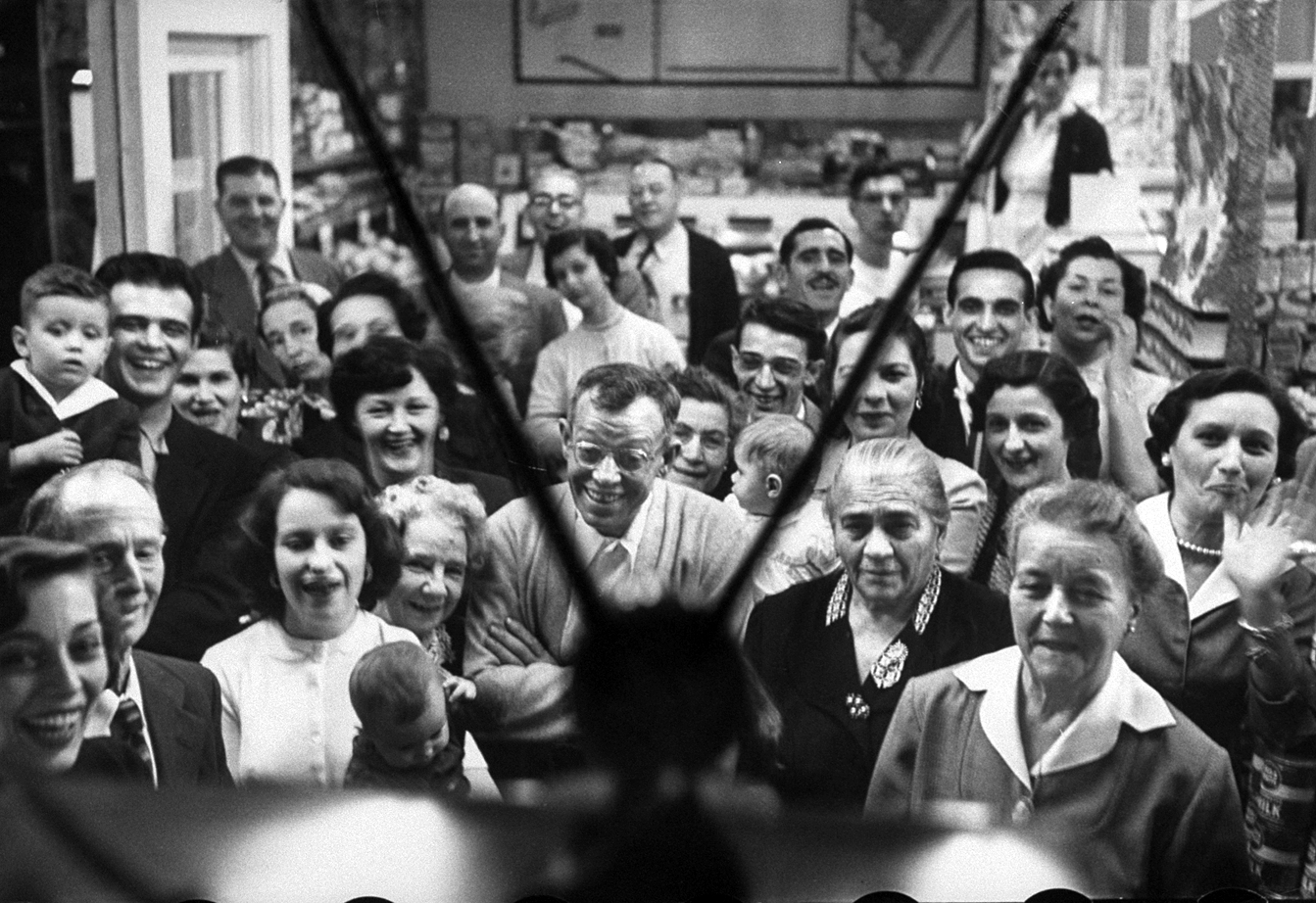
While watching cable television had become a ritual for participants, and a ritual they enjoyed, it wasn’t simply abstaining from watching television that people found difficult. Instead of passively watching their favorite programs, viewers had been using them for social bonding. Familiarity with the latest plotlines was social currency. Watching television, Malefyt learned, “was a way to open conversations, it was a way to be in social groupings. People talked about the ‘water cooler effect’: if you didn’t watch, you were out of the loop and you felt disconnected. People want stories that speak to their own lives, but they also want to have a point of contact with others.”
In the last five years, we’ve seen what is referred to as Web 2.0, or, the “rise of social media.” Since the mid-2000s, applications for social network patents and mentions of “social media” in books (as captured by Google’s NGram Viewer) have both grown exponentially. But if these new forms of media are social media, does this imply that older mediums such as film, television, and books are anti-social?
In 1994, long before the rise of social media, sociologist Elizabeth Long challenged the notion of anti-social media, which she termed the myth of the “reader who reads alone.” While we might imagine a solitary reader getting lost in a good story as she sits by her window, this picture masks the simple fact that the achievement of literacy is itself a complex and collective social accomplishment. The very desire to read for pleasure is fostered through childhood, and the availability of reading for pleasure as a leisure activity is made possible by an infrastructure of authors, publishers, distributors, booksellers, shipping companies, and all of the other collective arrangements that generate books. Perhaps most importantly for readers, the myth of the “reader who reads alone” masks the deep conversations that reading engenders; talking with others about books we have read is one of the many social pleasures of the medium. As publisher Richard Nash argued in 2009, while “reading books is a solitary activity,” we must remember that “books are also the richest kind of social glue.” Before we inadvertently dismiss older media forms as somehow anti-social, we should remind ourselves that all media are social and always have been. Recent works by sociologists signal three ways that even “old” media forms are intensely social.
Evaluation
How do we decide which books to read, which shows to watch, and which songs to listen to? Recent work by culture researchers Matthew Salganik, Peter Dodds, and Duncan Watts illustrates how intensely social these processes are. Salganik, Dodds, and Watts set up a series of artificial music markets in which 14,000 users could listen to, evaluate, and download songs. In some of the markets, participants could only see the names of songs and the bands that performed them, while in other markets participants could also see how many other participants had previously downloaded the songs. What they found in the latter markets was a process of “cumulative advantage” in which the idiosyncratic decisions of early listeners were taken as meaningful by future listeners, who continuously reinforced their viewpoints.
This means that in markets in which listeners could see each other’s evaluations, if early listeners liked a song, successive listeners tended to like it too; if early listeners disliked the song, others tended to dislike it as well. When people could not see what others thought of each tune, song popularity was much more randomly patterned. In the real world, as in the “cumulative advantage” markets that Salganik, Dodds, and Watts simulated, we are very much aware of the tastes of those around us. We get recommendations from friends or family, and we frequently readjust our evaluations of things when those whose tastes we respect have differing opinions. Deciding to like or not like—or to consume or not consume—a piece of media has always been a social process.
Interpretation
While we rely on social cues to pick songs to listen to or shows to watch, what about our seemingly personal interpretations of their content? As it turns out, the very meanings of cultural texts are also socially determined. In 2006, sociologist Jason Rodriquez conducted fieldwork in Massachusetts concert venues, interviewing white fans of “conscious” rap groups that encode topics of racial inequality in their lyrics. Rodriquez found that many white listeners used “color-blind ideology” to legitimize their appreciation of the music, transforming racially-specific lyrics into vague messages for justice. In other words, people from different social backgrounds may decode different cultural meanings from the same media objects. While we know that people from different demographic backgrounds and with different life experiences might respond to media objects differently, sociologists have often treated the relationship between identity and interpretation as somewhat pre-determined.
My own recent research with UC-Santa Barbara’s Noah Friedkin on book groups suggests that patterns of socializing, rather than just personal identification, has an independent effect on interpretation. We surveyed 18 book groups across the United States about their impressions of a novel along 57 dimensions. The group members filled out the survey before their book group meetings and again afterward. While close friends and longtime book group members of similar backgrounds entered their discussions with diverse opinions and interpretations of the novel, they left their meetings with new views that converged around collaborative interpretations. We documented how demographic characteristics and individual identities are both important for interpreting media, but still do not tell the whole story of evaluation and interpretation. Instead, intensely social processes, such as conversations within book groups, work independently to create shared understandings out of seemingly individual interpretations.
Relationality
As our evalutaions and understandings of media objects are socially determined, media also affects how we socialize. Instead of taking us away from the world, we use media to establish both individual and group identities. As anthropologist Mary Douglas and economist Baron Isherwood wrote in 1978, cultural objects “can be used as fences or bridges.” Relying on data from the General Social Survey, sociologist Omar Lizardo found that the types of media and cultural activities people engage in predicts the types of social connections they have. For example, those who engage in popular forms of media consumption, such as attending rock concerts, have many acquaintances; those who attend ballets and operas are more likely to have just a few close friends. In this regard, we can think of media as the raw materials through which we establish both social connections and social boundaries.
While we might deride some forms of media such as rock concerts or daytime television shows as being unserious and merely meant to entertain, sociologist Joshua Gamson argues that one of the “depths of shallow culture” is that it allows us to connect with each other, to talk around the water cooler, and potentially, to initiate more serious conversations. Even “old” media allows us to think about serious topics in a low-stakes setting and broach important topics in non-threatening ways. This deeply personal use of popular media is what most surprised Timothy Malefyt, the researcher who asked his subjects to abstain from cable TV. He found that “the value of the show lives way beyond the programming itself.” Participants in his study found it difficult to stop watching the programs, if only temporarily, because those shows were “a way for people to initiate discussions on very sensitive topics,” permitting viewers “to talk with their parents about life and death, and to engage others.”
When discussing “old” media, such as books or radio, and “new” media, such as Facebook or Twitter, the use of the term “social” is a misnomer. Calling some media “social media” overlooks the fact that all media are social, and that people combine old and new media to enrich their experiences with both. In a phenomenon called the “multiplier effect,” people text and tweet while watching television, and use online forums to hold book group discussions. These media seem to be more mutually reinforcing than adversarial. Just as radio did not bring about the death of live performance and television did not bring about the death of radio, we should think of media within the language of “also/and” rather than “either/or.”
It’s not that Facebook and Twitter allow us to be sociable—they’re wholly dependent on our sociability.
While all media has always been social and continues to be so, our relationship to the raw materials that make up some media has absolutely changed. “User-generated content,” frequently used interchangeably with the term “social media,” may actually be a more accurate way to describe new media such as Facebook, Twitter, or YouTube. In the traditional model, commercially-produced works such as books, television, and film were the raw materials we socially evaluated, interpreted, and used. In the new model, however, our thoughts, tweets, and inside jokes are themselves the raw materials that become monetized. It‘s not that Facebook and Twitter finally allow us to be social, but that these new mediums are wholly dependent on our sociability. Water cooler talk in these new mediums is no longer just about media, it is media itself. That’s one reason we might, at times, feel pressure from new media companies—through opaque privacy policies or opt-out email reminders—to be more social than we would like.