



Abstract
The phrase “Global South” marks a shift from a focus on development or cultural difference toward an emphasis on geopolitical power relations. Nour Dados and Raewyn Connell demystify and contextualize this term.
Keywords
The phrase “Global South” refers broadly to the regions of Latin America, Asia, Africa, and Oceania. It is one of a family of terms, including “Third World” and “Periphery,” that denote regions outside Europe and North America, mostly (though not all) low-income and often politically or culturally marginalized. The use of the phrase Global South marks a shift from a central focus on development or cultural difference toward an emphasis on geopolitical relations of power.
From its earliest days, sociology had concepts for describing global difference. From Auguste Comte and Herbert Spencer to Emile Durkheim and Lester Frank Ward, sociologists discussed social progress by drawing broad distinctions between “advanced” and “primitive” institutions and societies.
The use of the phrase “Global South” marks a shift from a focus on development or cultural difference toward an emphasis on geopolitical power relations.
They located the primitive both in the past, and in the colonized world of their own day. From the fifteenth to the nineteenth century, empire and colonization had brought a flood of information about other societies to the intellectuals of Europe and North America. The societies identified in early sociological texts as the most primitive were the San people of Southern Africa, the indigenous people of Tierra del Fuego, and the Aboriginal people of Australia. It is no accident that these were three of the southernmost populations known to European colonizers; they were literally the most distant. Thus European colonial expansion provided the historical context that underpins the way we use these terms now.
The idea of the South was placed firmly on the table by the famous Italian Marxist Antonio Gramsci whose essay “The Southern Question” began with the idea that southern Italy had, in effect, been colonized by capitalists from northern Italy. Gramsci explored the difficulties southern peasants and northern workers faced in forging an alliance with one another. In Italian social thought, most later treatments of the “North-South differential” addressed only variations in economic development. But the connection with colonialism was revived in another forum: development economics. In the 1950s and 1960s, the Argentine economist Raúl Prebisch popularized the distinction between “core” and “periphery” of the world economy. With other critics of orthodox economics, Prebisch analyzed underdevelopment and struggled for reform of the world trade system. This struggle moved the terms “North” and “South” into the international political lexicon. Developing countries (mainly former colonies), began to articulate the idea of a Global South whose interests conflicted with those of the industrialized powers, both capitalist and communist—cutting across Cold War divisions.
In northern sociology, Immanuel Wallerstein forged a “world-system approach” that made the concepts “core” and “periphery” alternatives to the “modern/traditional” binary. Similar ideas circulated in Marxist economics, while “post-colonial” perspectives were emerging in literary and cultural studies, from Edward Said, Gayatri Spivak and others.
By the 1990s these concepts were reinforced by “intersectional” perspectives in northern sociology, especially those of African American and Chicana/o scholars. Traces of colonialism were made visible within the society of the North. Gloria Anzaldúa’s Borderlands/La Frontera was particularly influential in the U.S.
With the Cold War winding down, the terms “Global North” and “Global South” spread in academic fields like international relations, political science, and development studies. The North-South language provided an alternative to the concept of “globalization,” contesting the belief in a growing homogenization of cultures and societies.
The idea of a powerful Global North and a resistant Global South was promoted by the Zapatista revolt in Mexico, the “African Renaissance,” and the World Social Forum launched in Brazil. Industrial growth in Asia, and the emerging BRIC (Brazil, Russia, India, China) group in world politics, complicated the North-South picture. But other changes in the global economy, especially the huge growth of finance capital centered in New York, London, Frankfurt and Tokyo, reinforced the economic advantage of the old imperial centers.
The world perspective from the Global South.
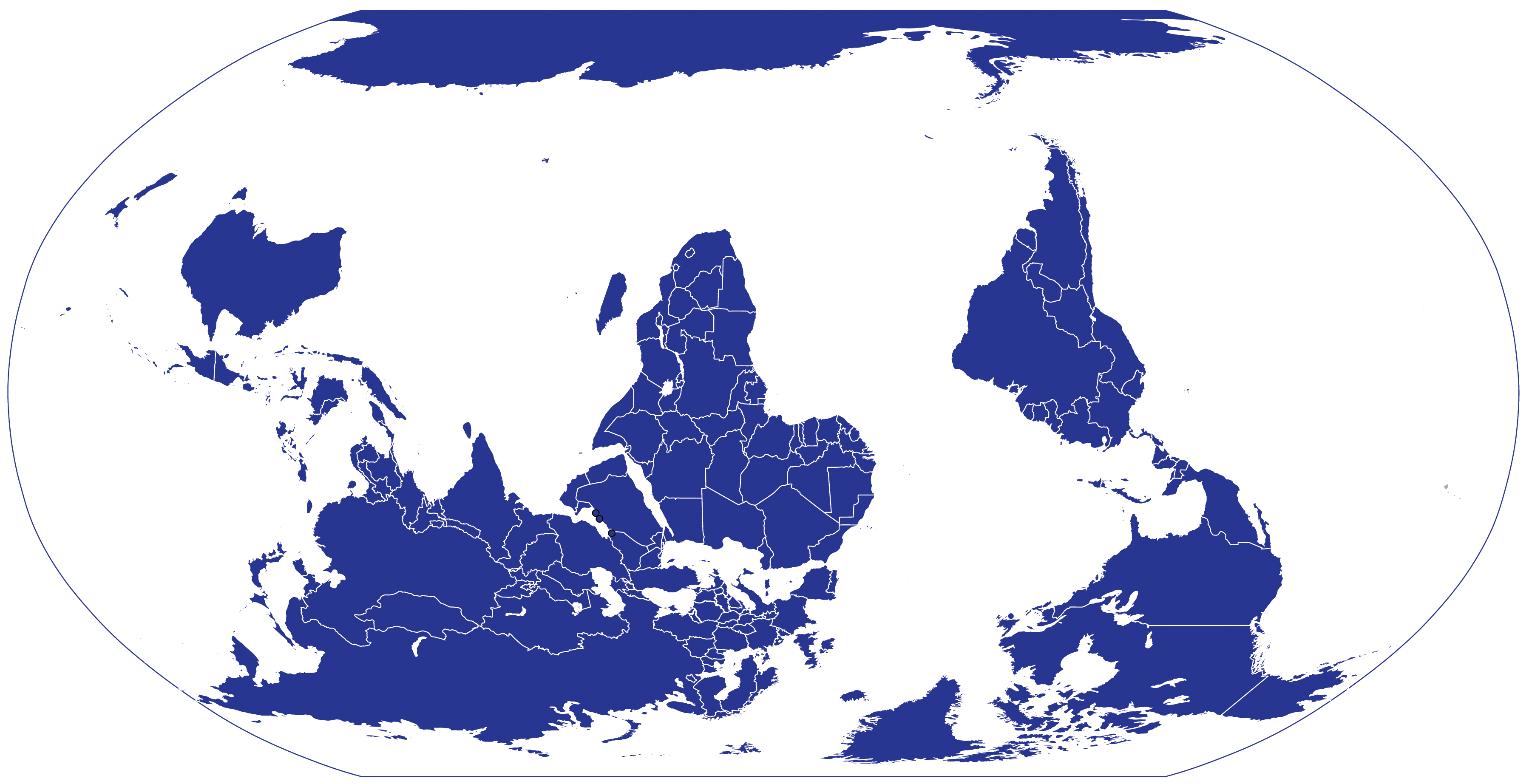
Recently, the North-South concept has acquired increased sophistication. Intellectual movements, such as subaltern studies from India have emphasized the history of resistance to empire. Peruvian sociologist Aníbal Quijano’s notion of the “coloniality of power” emphasizes the legacy of colonialism in contemporary culture and politics. The idea of the South as a region of distinctive intellectual production is articulated in Boaventura de Sousa Santos’ Conocer desde el Sur and Raewyn Connell’s Southern Theory, offering new agendas for sociology.
The term Global South functions as more than a metaphor for underdevelopment.
North-South terminology, then, like core-periphery, arose from an allegorical application of categories to name patterns of wealth, privilege, and development across broad regions. The term Global South functions as more than a metaphor for underdevelopment. It references an entire history of colonialism, neo-imperialism, and differential economic and social change through which large inequalities in living standards, life expectancy, and access to resources are maintained.