



Abstract
A revival of the hijab and an embrace of sport among young Muslim women around the world has created a contested space: their heads. Women, negotiating the rules of their teams and leagues, along with their own religious devotion, must make choices about participating—and dressing—for athletics.
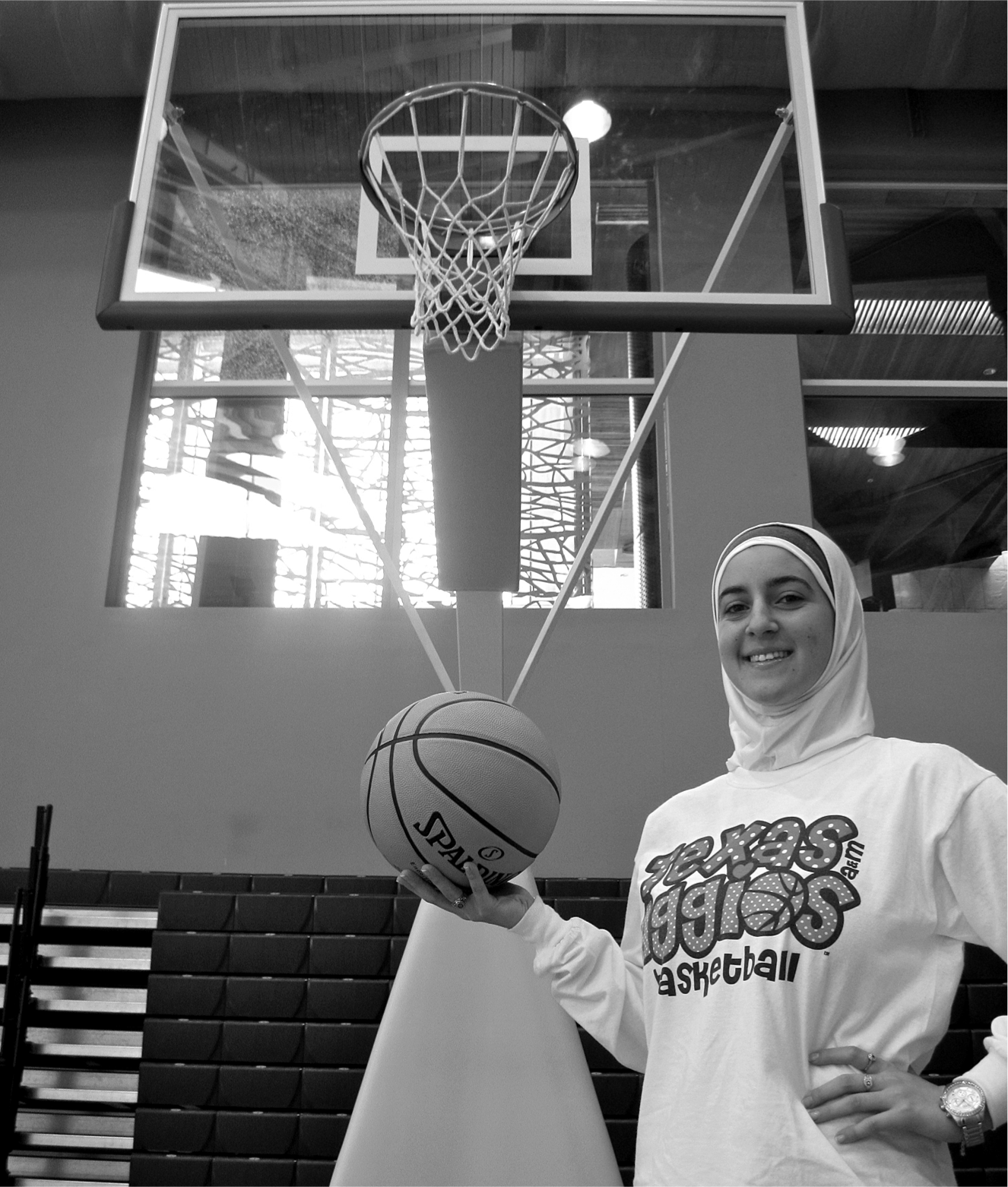
Sahar Elrefai is the captain of her basketball team at Texas A&M Qatar.
Just a cursory glance at recent headlines makes it clear that the role of women in the Middle East is undergoing rapid and vast transformation. Women have been key participants in the uprisings in Egypt, Tunisia, Bahrain, and elsewhere in the region.
“I’ll never forget what I saw,” journalist Lama Hasan wrote from Libya. “Mothers dragging their children along so they could witness history; girls who weren’t shy about mixing with boys, standing shoulder to shoulder with them to fight for their cause; and the female volunteers who helped with security, day and night.”
As these stories make headlines, a quieter gender revolution has been brewing in the arena of sports. For more than two decades, female athletic participation has been slowly rising throughout the Middle East, where it’s often tied to larger trends, including modernization, educational reforms, and the influx of wealth from oil revenues. The Islamic Federation of Women’s Sport was founded in 1991, with the goal of organizing female sporting events while retaining religious traditions, and in 1993, Iran hosted the first Women’s Islamic Games, which included competitors from ten countries. By 2005, athletes from 44 countries were taking part in the event.
These changes have had a significant impact on female sport participation, which is now commonplace in most Middle Eastern countries. Women and girls from the region who want to play sports, however, encounter a unique set of challenges not faced by their Western counterparts. While female athleticism is widely encouraged in many parts of the world, in the Middle East it is widely regarded as an affront to traditional Arab values. Female athletes in the Middle East face pressures that include family, religion, politics, and culture. These issues often take place over use or nonuse of the hijab, the traditional head covering for Muslim women. The hijab serves as a site of negotiation, resistance, and conformity.
“The reason I cover up is because of my religion,” says Rima, a Pakistani member of her university’s basketball team. “If [a game] is open to male spectators, then I don’t feel personally comfortable, even if I have my hijab on. And also my family, they do not see this as appropriate or respectful.”
Partly an expression of rebellion against post-9/11 Islamaphobia and partly because of a more general resurgence of conservative culture in the Middle East, wearing the hijab has increased over the last twenty-five years. Social scientist Symeon Dagkas and his co-authors assert that the hijab’s comeback represents “an affirmation of religious identity. For many, the hijab is a symbol of honour connected to faith and respect for the Islamic requirement to cover their hair.”
This has outraged some Western feminists, who view the hijab as the ultimate symbol of female oppression. Earlier this year, France banned public use of the niqab, the Muslim veil that covers every part of the head but the eyes, and threatened heavy fines for women who wore one publically and husbands or fathers who forced their wives and daughters to do so. French politician André Gerin declared, “The full veil is a walking coffin, a muzzle.”
This probably wouldn’t surprise sports sociologist Gertrud Pfister, who noted in a study of Muslim female athletes in Denmark that, “Headscarves provoke opposition among the mainstream population more than any other Islamic precept or interdiction.” But it hasn’t stopped a dramatic increase in the number of females wearing the hijab in Denmark and other European countries. “‘Doing Islam’ has become a widespread habit, in some cases almost a fashion,” Pfister wrote.
The hijab’s newfound chic, along with the rise in sports participation among Muslim females, has turned this piece of clothing into a cranial combat zone upon which culture wars are waged. Turkey banned the use of the hijab in competitive athletics outright, while other Middle-Eastern countries require Muslim women to cover their hair at public sporting events.
In their case study of a women’s soccer team in Palestine, Petra Gieß-Stüber and her co-authors noted that use or nonuse of the hijab “varies considerably according to the country or region of birth, social class, level of education, the religious customs of the older generation and the location.” An issue faced by scholars of the Middle East is that each country in the region has distinct values and beliefs regarding religion, culture, politics, and gender. Countries such as Lebanon are relatively progressive in their attitudes and policies towards women, while nations like Saudi Arabia and Iran are much more restrictive.
Middle-Eastern women are often lumped together as representing a collective whole, but this could not be further from reality. Indeed, many nations in the region are populated by expatriate women from other parts of the Middle East, as well as countries such as India, Sudan, and Ethiopia, making the notion of monoculture preposterous. A single sports team can include as many countries of origin as it has players, each of whom must decide how they will dress and whether or not to participate publicly.
Some of these female athletes have helped spawn a cottage industry devoted to the manufacture and sale of sportswear that conforms to Islamic standards. Web sites such as ahiida.com peddle the Burqini, a two-piece, full body swimsuit with attached “Hijood” head covering. “All eyes are on the appearance of Muslim women in sports,” writes company founder Aheda Zanetti. “Their appearance should be modest and at the same time it should reflect a professional sporty appearance with pride.” While these sartorial innovations skirt clothing regulations, they aren’t always practical for aquatic activity. Egyptian athlete Sahar Elrefai swam competitively as a child, but gave it up after she began wearing traditional Muslim clothing at age 13. “You can’t do professional swimming with [a Burqini] because it’s just too heavy,” she said.
The hijab has become a cranial combat zone upon which culture wars are waged.
Certain Middle Eastern nations (or athletic organizations within them) also require that sports be segregated by gender. Male spectators are not allowed at games that include female contestants. Others countries or organizations refuse to separate by gender, creating a quandary for conservative Muslim female athletes. More often than not, these young women refuse to take part in public sporting events.
“I don’t play in front of mixed audience because of Islam,” declares Maryam, a Palestinian woman who practices with her university’s soccer team but declines to compete in official games because there are male observers in the audience. “I am fine playing in front of girl audiences but not mixed. When you’re playing in front of mixed audiences, it’s going to be violating [Islamic principles] because you are not dressed in the right way,” she said.
Maryam’s teammate, Tara, is a practicing Muslim originally from Sudan. Tara wears a head covering in her everyday life, but she removes it to play soccer and ignores the male spectators. “I am more comfortable when there isn’t a mixed audience, but it’s not like it’s a strong enough reason for me not to play in the game,” she said.
According to the Pew Research Center, there are about 1.57 billion Muslims in more than 200 countries internationally. This represents about 23 percent of the global population, making Islam the world’s second most practiced religion, and it includes professional athletes such as Fatima Al Nabhani, an Omani tennis player who eschews traditional Muslim garb during matches, and Bahraini sprinter Roqaya Al-Ghasara, who was fully covered and wearing a hijab when she ran in the 2008 Olympic Games in Beijing. Both women not only serve as role models for aspiring female athletes from the region, but also shatter Western stereotypes.
“I am hoping to be a good example of showing that, even though there are religious restrictions wearing the veil and some girls are not allowed to play in front of men, you can still carry on and play sports,” says Sahar Elrefai, who is captain of the Texas A&M at Qatar women’s basketball team. “You see these girls out running and they are not even covered up. That just defies what people think.”