



Abstract
Racial residential segregation has a long and persistent history in the United States. Data from the most recent decade give hope that housing patterns and racial attitudes are moving—albeit slowly—toward integration.
Keywords

The Obamas are the first African American family to reside at 1600 Pennsylvania Avenue. It’s hard to tell, though, if the rest of America has followed suit, becoming a place where the color of your skin no longer determines where you live. Where you live, after all, determines much about what happens to you and your family, where your children attend school, how easily you can assess health care (and the quality of that care), your exposure to crime, your opportunities for employment, the quality of your municipal services, your local tax rates, whether your home appreciates in value, and so on. Residential segregation is a lens to assess whether the United States has achieved the equality that some felt the 2008 election symbolized. And while black-white segregation remains high in many metropolises, there are reasons to be optimistic that “apartheid” no longer aptly describes urban America.
African American migration to cities in both the North and South accelerated during World War I. Almost immediately, governments and private citizens adopted practices that insured that blacks and whites would seldom live in the same neighborhood. In almost every city, a measure of violence greeted blacks who dared enter white neighborhoods. Indeed, the most important civil rights trial of the 1920s involved a Dr. Sweet, a black dentist who purchased a home in a white neighborhood of Detroit, then sought to defend it from a mob—a defense that led to the death of a white protester. While a few cities legislated where blacks and whites might live, those ordinances were ruled unconstitutional; restrictive covenants proved a more effective and more peaceful way to insure that blacks, Jews, or Asians would never live in a particular home. A covenant was inserted into the property deed specifying that only whites could own or occupy the residence. In 1926, the Supreme Court upheld such covenants arguing that they were private agreements that did not violate civil rights. In the same decade, real estate associations began to develop “ethical principles” that prohibited brokers from renting or selling to blacks or other minorities who wished to enter white neighborhoods.
By the 1930s, federal agencies began insuring homes in an effort to stabilize the housing market during the Depression. A nationwide system for property assessment emerged. Color-coded maps were prepared to indicate the credit worthiness of a neighborhood. All neighborhoods with black residents (or those presumed to be open to blacks) were colored red—ineligible for federal loans. Later, after World War II, the federal government became active in the housing market through Veterans’ Administration and Federal Housing Authority programs. It is these efforts that were responsible for the creation of the “Crabgrass Frontier,” the suburban rings that now surround older cities. These programs weren’t directly designed to maximize black-white residential segregation, but they certainly had that result. Most suburban homes were built in areas where brokers and lenders followed the color-coded federal rules and denied housing to African Americans.
Together, governmental agencies, local officials, school administrators, and real estate dealers thoroughly segregated whites from blacks. Widely-held ideas that African Americans were prone to crime, that attending school with black children would greatly harm white children, and that housing prices would plummet in any neighborhood where blacks lived all motivated these practices. In 1965, Alma and Karl Tauber carried out the first comprehensive assessment of segregation, concluding “Negroes are by far the most residentially segregated urban minority group… This is evident in the virtually complete exclusion of Negro residents from most new suburban developments of the past fifty years.”
Racial riots in the 1960s brought segregation to the nation’s attention. President Johnson’s investigative committee, The Kerner Commission, predicted that, unless there were major changes, the country would soon consist of central cities with black and poor populations, ringed by much more prosperous and largely white suburbs. A popular Soul Music song summed it up: “Chocolate City, Vanilla Suburbs.” But change did come. After the killing of Dr. Martin Luther King, Jr., Congress enacted an Open Housing Law (timid at the start, it was subsequently strengthened). A Fair Housing movement sprung up in many cities. Associations of real estate brokers changed their ethical standards and adopted the non-discrimination policies now required by law, and numerous studies of probable lending discrimination by lenders led Congress to pass the Home Mortgage Disclosure Act in 1975.
Residential segregation is a lens to assess whether the U.S. has achieved the equality that some felt the 2008 election symbolized.
Still, in the early 1990s, sociologists Douglas Massey and Nancy Denton would write in American Apartheid, “Residential segregation has become the forgotten factor of American race relations. Until policymakers, social scientists, and private citizens recognize the crucial role of America’s own apartheid in perpetuating urban poverty and racial injustice, the United States will remain a deeply divided and very troubled society.”
Trends in Racial Residential Segregation
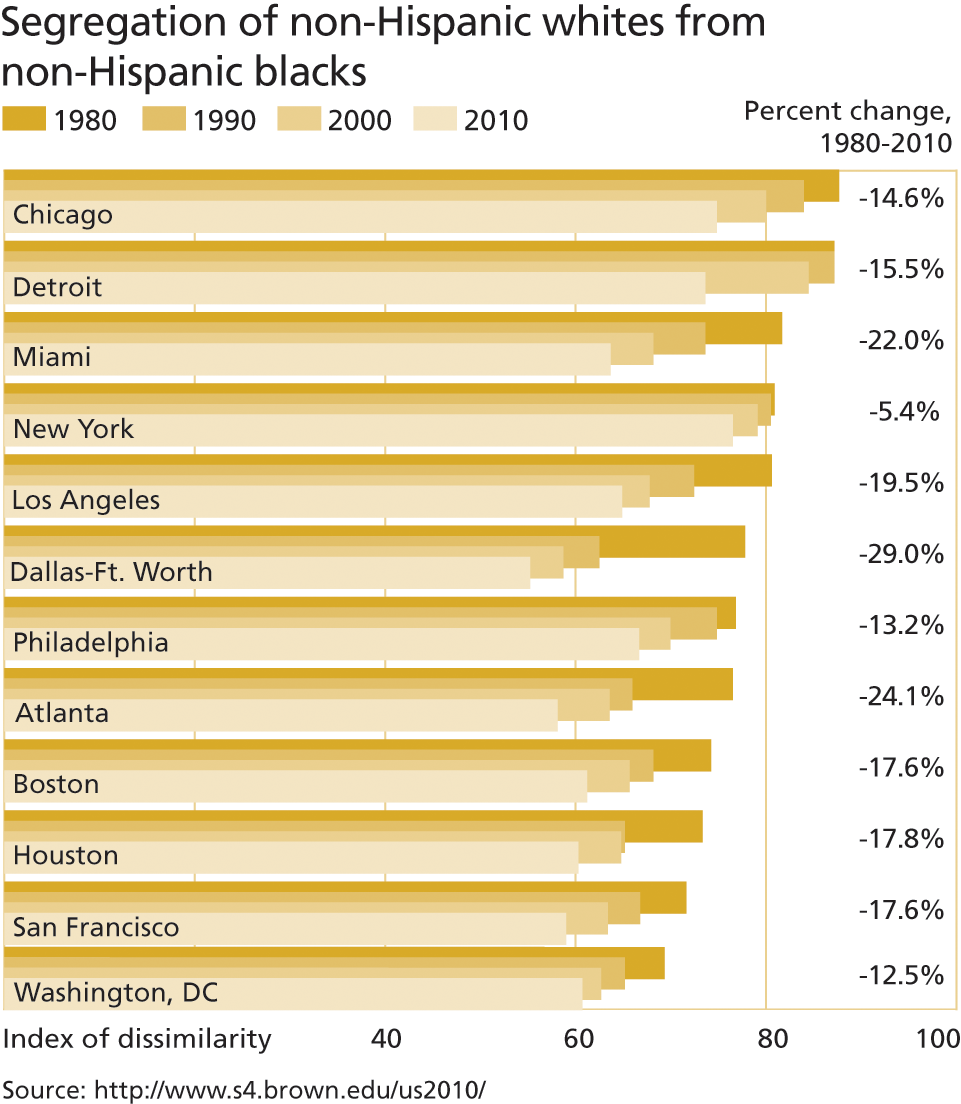
Decennial censuses provide information about census tracts—geographic units with about 4,000 residents that are often considered “neighborhoods.” These tracts provide the basis for most racial residential segregation measures , including the index of dissimilarity, which assesses how evenly two groups are distributed across a metropolitan area. If every census tract were either exclusively white or exclusively black, the index for that metropolis would be 100. If African American and white residents were equally represented in every neighborhood, the index for that metropolis would be 0 (there’d be no segregation). The chart on page 38 shows the index of dissimilarity for non-Hispanic whites and non-Hispanic blacks for each of the dozen largest American metropolises using constant geographic boundaries starting with the 1980 Census and measuring up to the 2010 Census.
As you can see, segregation declined across the decades in every location. In 1980, five of the largest metropolises had segregation scores in excess of 80, but thirty years later, the highest score was New York City’s 77. Three of the city’s 2010 scores had dropped under 60, a level that we might call “moderate segregation.” Even Chicago and Detroit, bastions of racial isolation, had become more integrated by 2010.
Segregation of non-Hispanic whites from non-Hispanic blacks
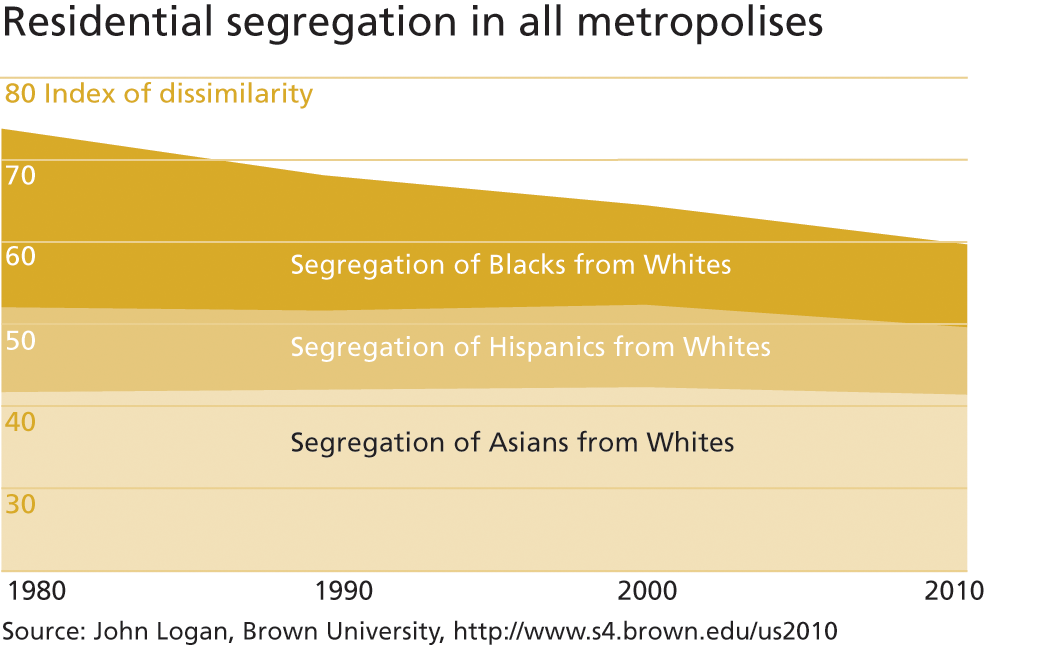
The graph on page 39 (left) shows that, in all metropolitan areas (394 are included), black-white segregation has declined steadily across the decades. In 1980, the average black-white score was 73, and 10 percent of the metropolises had scores above 75. Data from last year’s enumeration reveal an average segregation score of 59. Only three locations (Milwaukee, New York, and Chicago) had 2010 indexes over 75, and many southern and western metropolises had levels of black-white segregation that might be termed “low” or “moderate.” More than one-quarter had scores under 40, including Las Vegas, Salt Lake City, San Jose, and Tucson. The pattern is extensive: during the 1980s, black-white segregation fell in 84 percent of the metropolises; in the 1990s, in 87 percent; and in the last decade, 88 percent.
Although blacks and whites increasingly share neighborhoods, African Americans remain much more segregated from whites than do Hispanics or Asians. As the graph shows, Hispanic-white segregation hardly changed between 1980 and 2000. There was a small decline in the most recent decade, but that change was much less than the decrease in white-black segregation. The segregation of Asians from whites has barely changed at all. The Hispanic and Asian populations grew rapidly, thanks to substantial immigration, while the black and white populations are growing slowly. The arrival of many Asians and Hispanics in immigrant neighborhoods may explain why their segregation trends differ from those of African Americans.
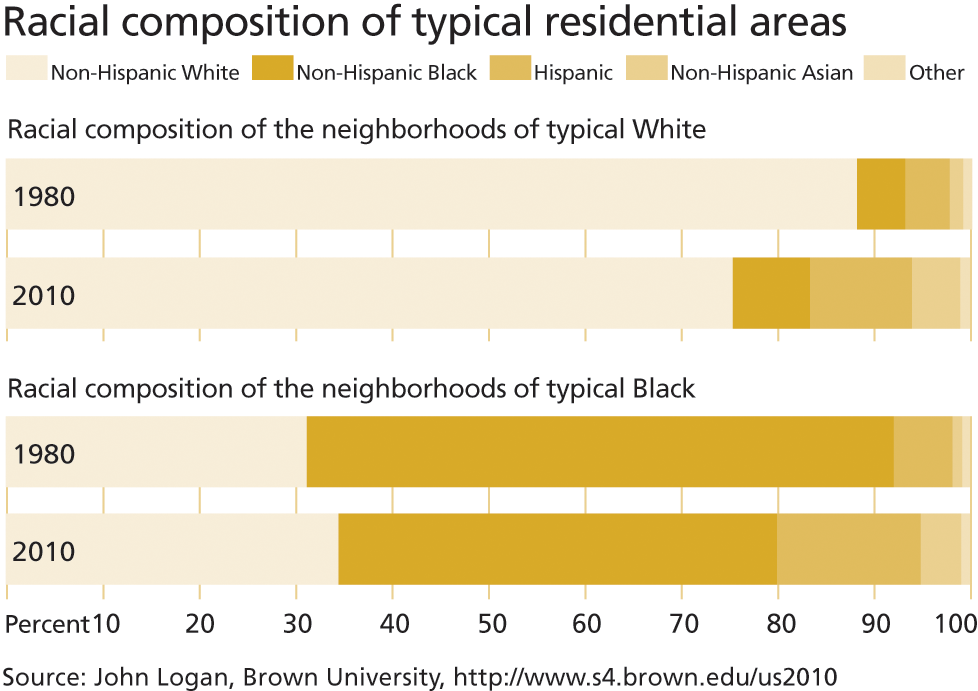
The racial composition graph on page 39 (right) shows that both whites and blacks now live in much more racially diverse neighborhoods than in the past. This is a result of decreases in residential segregation and rapid growth of the Hispanic and Asian populations. It was rare for whites to live on a block with an Asian or Hispanic three decades ago, now it’s common. As the graph shows, in 1980, the typical white homeowner was racially isolated, residing in an area in which 88 percent of the neighbors were also white. By 2010, one in every four of their neighbors was not white. Still, if race made no difference in where people lived, 14 percent of those neighbors would be black, given the proportion of urbanites who are black. The actual number is just 8 percent black.
Residential segregation in all metropolises
In 1980, African Americans were also racially isolated; 61 percent of their neighbors were also African Americans. By 2010, probably for the first time in a century, black urban-dwellers typically lived in neighborhoods in which their race was a minority. Reductions in segregation and demographic trends substantially increased the representation of whites, Asians, and Hispanics in their neighborhoods. Nevertheless, these data show that the neighborhoods of the average black urbanite and the average white urbanite remain very different in racial composition.
Racial composition of typical residential areas
Considering Neighbors
Metropolitan Detroit has consistently had extremely elevated levels of residential segregation along with a long history of racial violence. In three different decades—that is, in 1976, 1992, and again in 2004—my colleagues and I conducted investigations to try to describe the causes of this persistent segregation. Using a number of survey instruments, we tried to determine whether white residents felt comfortable with African Americans living on their block, whether they would remain should African Americans move onto their block, and whether, if they were thinking about a new home, they’d consider neighborhoods in which African Americans already lived.
Along with introductory questions about their neighborhoods, and before we got into their personal racial attitudes, we showed a large, randomly-selected sample of white respondents cards depicting neighborhoods with racial compositions ranging from all-white to one-half white and one-half black. First, we told them to imagine they lived in an exclusively white neighborhood. For white residents of Detroit, this was a realistic assumption. Then we showed them a card depicting a minimally-integrated neighborhood with 14 white families and 1 black family.
Neighborhood cards shown to white respondents
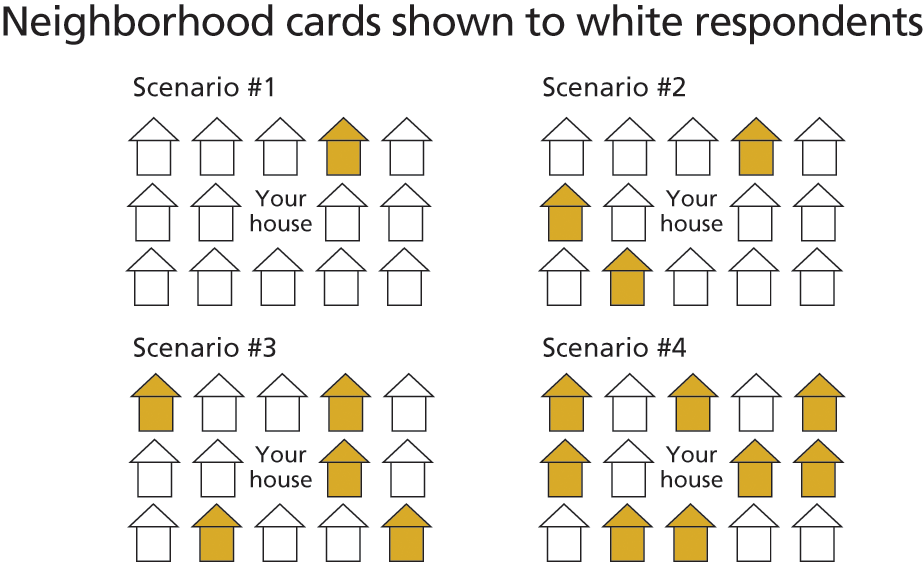
We asked whether the white respondent would be uncomfortable if his or her own neighborhood came to resemble the one shown on the second card. If they said they would feel comfortable, we presented them with a third, slightly more integrated neighborhood card with 12 white and 3 black families. We continued showing them cards until they said they would feel uncomfortable or came to the final card showing a neighborhood with 7 white and 7 black families. At whatever point a respondent said they’d be uncomfortable with the racial mix of the hypothetical neighborhood, we asked if he or she would try to move away from that neighborhood. If they said they would move out, we assumed they would be even less comfortable with higher densities of African American families, and we stopped asking questions.
Attractiveness of neighborhoods for white respondents
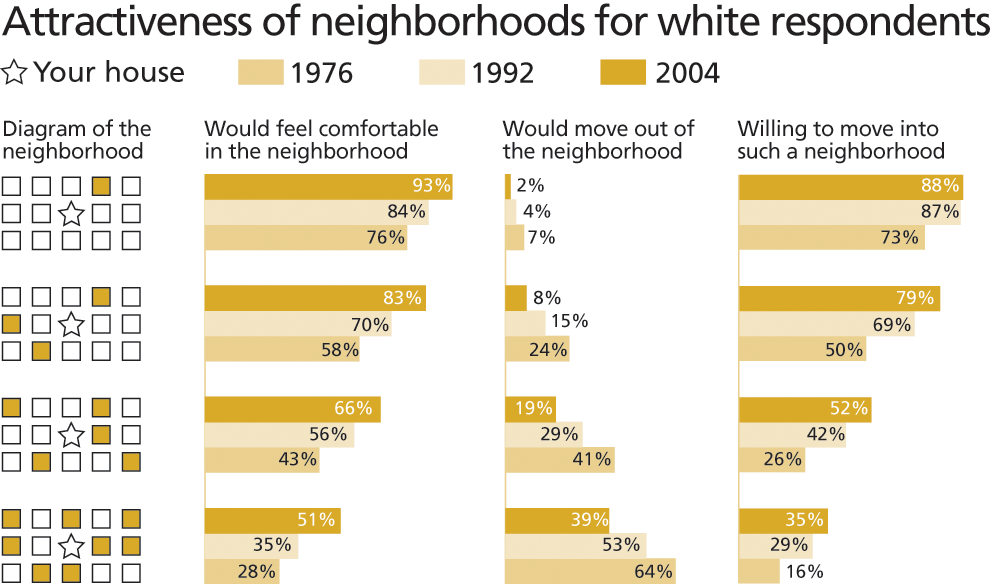
Our results are shown in the figure above right. From 1976 on, the racial attitudes of white Detroit residents shifted substantially. In 1976, three-quarters said they would be comfortable if their neighborhood had one black family. Twenty-eight years later, whites almost universally accepted that minimum level of integration: 93 percent were comfortable. The presence of blacks still made a difference, though. In 2004, two-thirds of whites said they would be comfortable living in a neighborhood of 10 white and 5 black households. But when the racial composition approached 50-50, many white respondents were uncomfortable; just one-half said they would be comfortable in such a neighborhood (in 1976, just one-quarter of white respondents could say the same).
The post-World War II years were the era of white flight in Detroit. Chicago alderman Francis Lawler once famously defined integration as that brief interval between the arrival of a neighborhood’s first black family and the departure of its last white family; historian Thomas Sugrue writes that, for many Detroit neighborhoods, that description fits the bill. But our studies show that white people’s attitudes about moving away when African American families move into their neighborhood have changed profoundly and offer some hope that white flight is over. In 1976, 40 percent of whites said they would try to move away if their neighborhood came to have a 10 white to 5 black families composition. After nearly 30 years, only 19 percent said they would try to leave if their neighborhood became one-third African American. Indeed, the majority of respondents in the most recent study said they wouldn’t try to move, even if their neighborhood came to be roughly 50/50, Still, though, a significant proportion of white respondents said they would try to move out if they became the minority group in their neighborhood.
After asking about their comfort with black neighbors and whether they would try to leave, we gave white respondents a set of all of the “possible neighborhood” cards. We asked them to suppose they had found an attractive, affordable home in each of the neighborhoods. Knowing only the racial make-up of each location, which might they consider? At all dates, white respondents’ willingness to live in a given neighborhood was strongly influenced by the number of black families living there: higher densities of African Americans meant fewer Caucasians would consider the place. In 2004, almost all said they would consider a minimally-integrated neighborhood (the one with a single black family), and 88 percent were still willing to consider the neighborhood with three black households. While in 1976 just 25 percent would consider the neighborhood that was one-third black, a majority of the 2004 sample would. Finally, shown the half-and-half neighborhood card, just one in six 1976 respondents told us they would consider buying a home there. By 2004, the number had doubled to one in three.
When people consider new homes, they are still influenced by the racial composition of the area. Importantly, though, our repeated studies demonstrate that Detroit area whites have become more willing to accept black neighbors, are increasingly likely to remain when African Americans move into their block, and, to a much greater degree than in the past, are willing to consider buying new homes in racially-mixed neighborhoods. The decrease in residential segregation in metropolitan Detroit—a 14 percent decline from 1980 to 2010—is congruent with changes in racial attitudes.
Francis Lawler famously defined integration as the brief interval between the arrival of a neighborhood’s first black family and the departure of its last white one.
Cautious Optimism
Changing racial attitudes demonstrate some areas of optimism in housing equality. After 1968, many local studies assessed the effectiveness of the Fair Housing Law by sending first a white and then a black home-buyer to a realtor to inquire about a home. In many cases, racial discrepancies were found. Sometimes this led to litigation, but often the emphasis was simply put on publicizing the discrimination. In 1977, the Department of Housing and Urban Development undertook a similar national assessment and dispatched matched pairs of white and black “buyers” to ask about housing advertised in the major newspapers of large metropolises. That study was repeated in 1989 and 2000. They revealed an unambiguous trend toward more equitable treatment of African Americans. For instance, in 1989, sales agents provided information about significantly more homes when the tester was white. By 2000, there was no such difference. Differential treatment was not completely eliminated—black testers were still shown more homes in racially-mixed neighborhoods and brokers were more likely to praise homes in white neighborhoods, for example—but it had certainly decreased substantially. Before the Civil Rights Revolution, brokers were taught that they had an ethical obligation to maintain property values by never introducing a minority to a white neighborhood. When real estate brokers are trained now, they learn about federal laws and about costly judgments levied against brokers and firms who discriminate.
Suburbanization offers another glimpse of positive changes. In the Northeast and Midwest, suburban rings boomed after World War II, as white residents fled from cities with their old stock of housing and their rapidly growing black populations. In New York, Philadelphia, Chicago, and Detroit, black families who tried to move to the suburbs were often met with violence. Suburban officials, formally and informally, let it be known that no African American was welcome (Mayor Orville Hubbard of Dearborn, Michigan became a national symbol of the implacable opposition of suburban white residents to black newcomers).
When people consider new homes, they are still influenced by the racial composition of the area.
Forty years ago, public policy and housing scholar Anthony Downs observed that opening suburban rings to African Americans was the only way to reduce segregation and avoid the racial conflicts that the Kerner Commission predicted. Now black families seeking housing commensurate with their income increasingly consider the suburbs—even those that once had reputations for extreme hostility. In 1990, 42 percent of the African American residents of metropolitan areas lived in suburban rings, and, by 2010, it was 60 percent. Between 2000 and 2010, the cities of Chicago and Detroit each lost 180,000 black residents. While some moved to the South, it’s notable that gains in the suburban black populations roughly match the loss in the central cities. Data from Census 2010 have not yet been fully exploited. In some places, central city black areas may be spreading into the suburbs, but it appears that much of the rapid African American growth throughout the nation’s suburbs is in places that have been traditionally white. Some blacks may still face discrimination if they search for suburban homes but the suburbs are much more open to African Americans now than in the past.
A demographic trend flowing from changing racial attitudes promises to gradually reduce segregation: residential integration within households. It’s an important trend, but hasn’t been discussed in this context. Consider young men who married in the years just before Census in 1970. Fewer than 2 percent of black husbands had married white wives, but that number rose to about 12 percent in the most recent Census. Black-white marriages are no longer rare. Further, the mixed race population is growing; when first given the option to identify with multiple races in Census 2000, about one million people chose both black and white. Ten years later, that increased to 2.1 million. Data from the American Community Survey also suggest that the tradition of white and black couples adopting children of their own race is giving way to a pattern in which the race of the adopted child is less salient. Racial residential segregation scores will decrease as more households include members of both races.
So, do we live in a country where the color of your skin no longer determines where you live? We certainly haven’t come that far. Race still makes a difference, and, as last year’s census reports, there are dozens of census tracts in America’s older cities that remain monochromatic (albeit with smaller populations than in the past). However, racial attitudes have changed, the ideal of equal housing opportunities is well-accepted, and many of the structures that created and maintained the American Apartheid system have been greatly weakened or removed. The long trend toward lower levels of black-white segregation seems sure to continue.