



Abstract
Brian Conway examines the decline in vocations in Ireland and the U.S., and considers what it means for the future of international Catholicism.
As Pope Benedict XVI flew to the United States in 2008 for his first official visit as leader of the Roman Catholic Church, a journalist on board his plane posed a question about the recent clerical child sex abuse scandals. In reply, the Pope expressed his deep shame about priests who abused children and stated that what the church needs now and in the future are good priests rather than many priests. Today, however, at least in the U.S., the notion of a Catholic Church of “many priests” is already a thing of the past.
The declining number of Americans working in Catholic religious vocations is well-documented. The U.S.’s story here parallels the patterns in many other countries, but compared with Ireland, a Catholic country with a very different cultural and historical experience of Roman Catholicism, it seems wholly distinct.
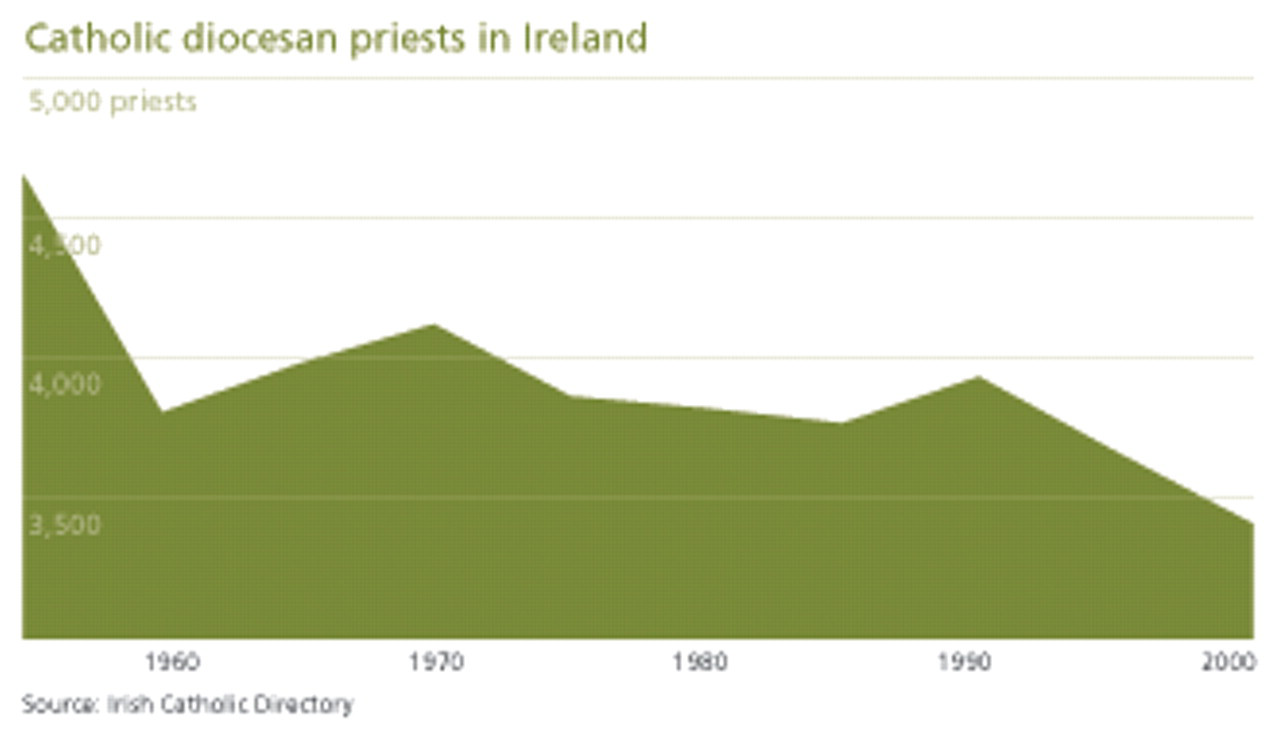
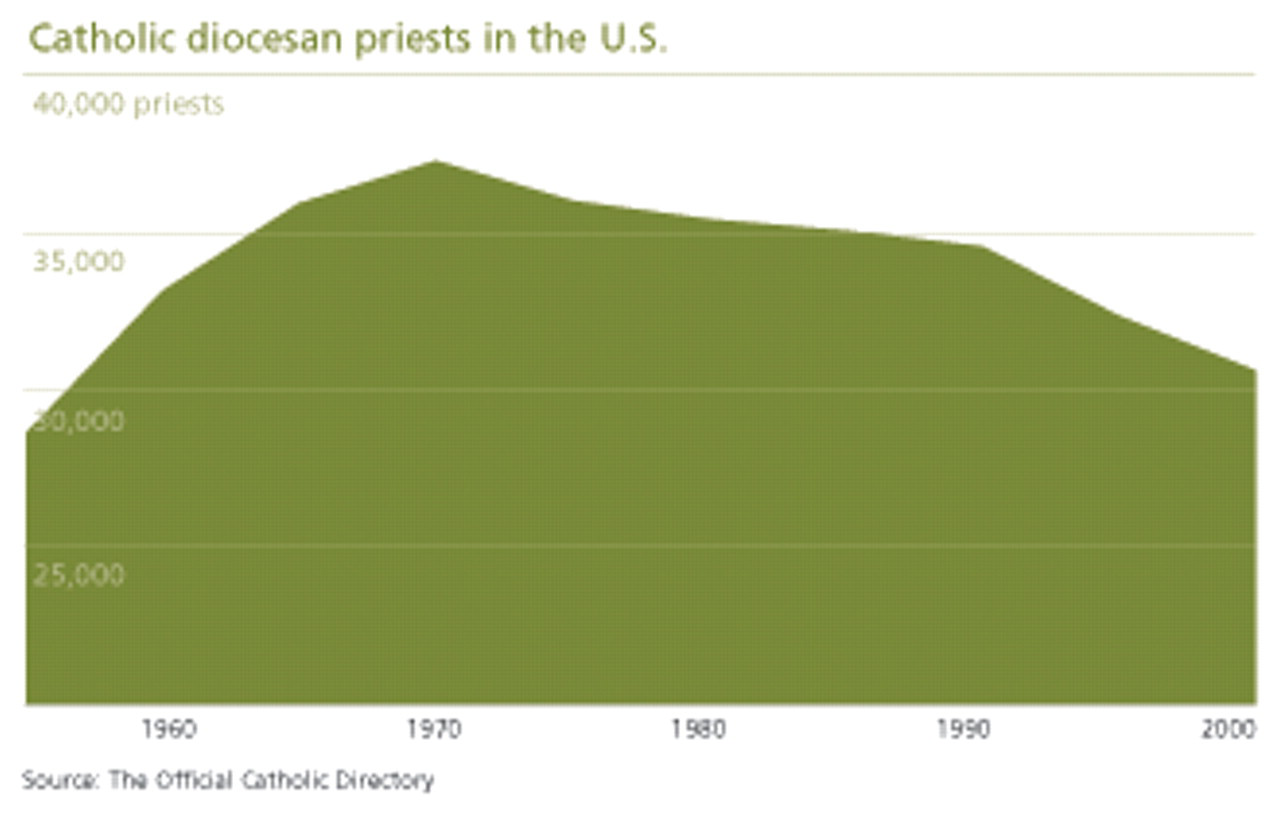
The graphs below plot two indicators of trends in Catholic vocations in the period from 1955 to 2000: the total number of Catholic diocesan priests and the number of Catholic diocesan priests per 10,000 Catholics, which reveals employment trends relative to the available pool of Catholics in each nation. The charts illustrate divergent patterns: in Ireland, both indicators began to decline sharply in the 1950s and then made a modest recovery in the late 1980s, while, in the U.S., the decline in the number of priests came later (early 1970s) than the decline in the number of priests relative to the Catholic population.
Catholic diocesan priests by proportion
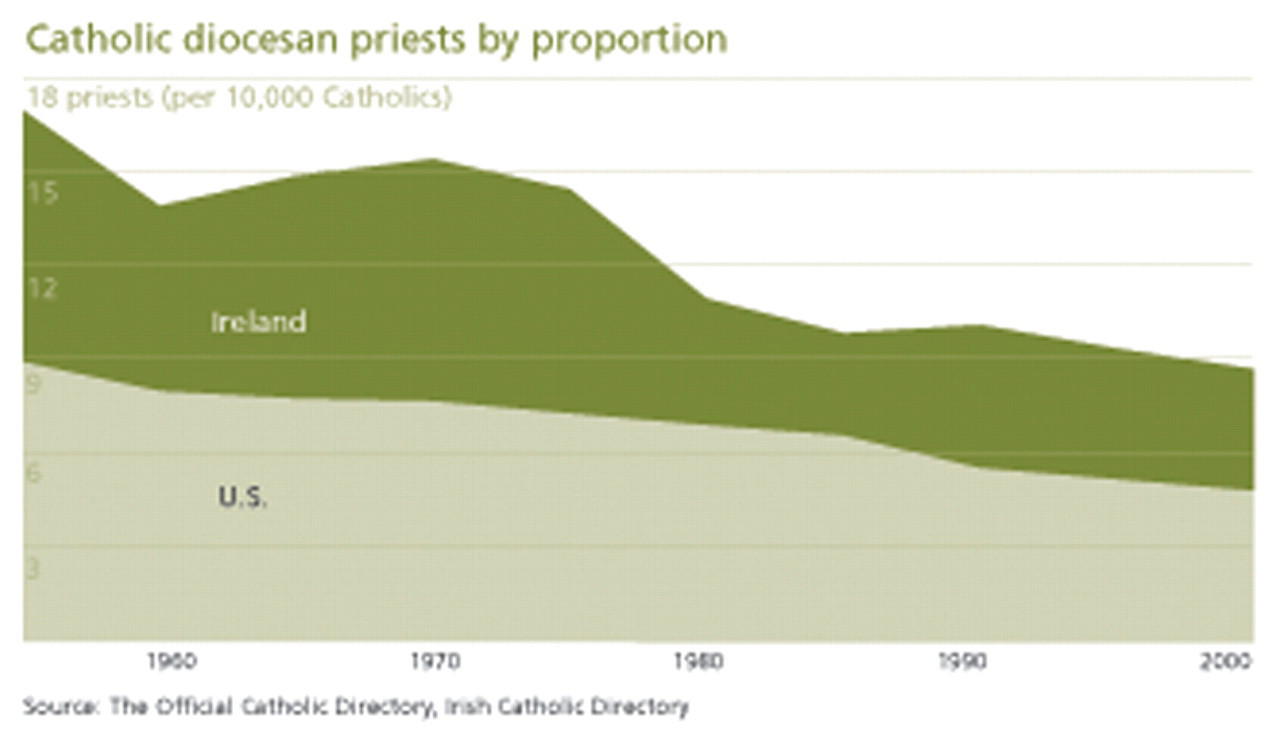
Let’s begin with the Irish story. The chart above shows a pattern of decline from the 1950s, but not a continuous one. The total number of diocesan priests actually saw an uptick toward the end of the 1980s and early ‘90s, but began to fall steeply from 1990 through 2000. The pattern in the number of Catholic priests per 10,000 Catholics (see page 65) follows a similar trend. What is interesting about the Irish trend is that the decline in the number of Catholic priests occurred prior to the Second Vatican Council (1962-65). Young Irish men began to think of career options apart from the priesthood even before the Church sought to bring itself up-to-date with the modern world of the 1960s, which saw sweeping cultural changes like expanded political and sexual freedoms.
In the U.S., the number of Catholic diocesan priests increased between 1955 and 1970 and then began to decline (see next page). Unlike Ireland, there was no American “second wave” in the diocesan priesthood in the late 1980s and early ‘90s. Instead, the number of American diocesan priests per 10,000 Catholics (see Figure 4) entered a period of continuous and steady decline after the ‘70s.
Sociologists offer at least three explanations for these trends. First, the secular opportunity perspective suggests that the decline is due to the increasing availability of opportunities for education and employment outside the church. In the past, becoming a priest was a gateway to a secure, high status job that involved a commitment to improving the lives of others. In the late 1950s and ‘60s, though, the increasing availability of secular occupations with a prosocial orientation—in the public sector and in the teaching profession, for example—attracted young men away from the priesthood.
A second explanation is that internal organizational changes, including major church-wide events such as the Second Vatican Council, spurred religious employment trends. ”Vatican II” sought to bring the Church “up-to-date” with the contemporary world by revising and updating liturgy, worship practices, and authority structures. For example, priests started celebrating Mass by facing the congregation (rather than turning their backs to it as in the past) and speaking in the vernacular language of the people rather than the traditional Latin.
A final theory holds that the Church’s celibacy rule requiring commitment to non-marriage among its solely male personnel is behind priestly vocation decline. While the celibacy rule has always been in place in the Church, sociologists argue that changing views of human sexuality that took hold in the 1960s (especially an increasing emphasis on sexual expression as normal and healthy) reduced the attractiveness of celibacy—and, therefore, a “higher calling”—as a lifestyle option.
Catholic diocesan priests in Ireland
Catholic diocesan priests in the U.S.
This meant that men who joined the Church’s workforce after the 1960s were more likely to have been conservative than men who joined in earlier periods, and that this contributed to the development of a more conservative Church in general. The fact that the growth nodes in the Church today are not in liberal religious orders and congregations but in conservative ones suggests that the post-1960s turn towards conservatism among potential recruits contributed to a renewed focus by the Church on promoting a more traditional model of theology and practice, and one increasingly at odds with Vatican II reforms.
Which of these three explanations is most compelling? Vatican II is not a plausible explanation for changes witnessed in Ireland. Nor is it a plausible explanation for the U.S. trend, because the decline in the second U.S. indicator occurred in the 1950s, predating Vatican II. The secular opportunity argument is more plausible than the Vatican II and celibacy explanations, since the thinning of the ranks of priests began before the Church’s Council and before the increasing emphasis on the integration of human sexuality into personhood associated with the 1960s.
Compared to the 1990s and 2000s, the ‘40s and ‘50s were good times for the Catholic Church. It could rely on a steady supply of priests to serve in its parishes. Joining the priesthood gave men an opportunity to offer their lives in the service of others and work in an institution which enjoyed high social status when comparable secular opportunities were scarce. Now, as the Church faces hard times as a result of declining vocations and fewer believers as well as child abuse scandals, it must rely—as these data show—on a shrinking human resource base. Recent tragic clerical child abuse scandals—extending well beyond Ireland and the U.S.—have contributed significantly to the loss of the status and authority of priests and to a more negative public image of the Church than before. Consequently, the Catholic parishes of the future will likely have fewer (if any) priests to administer their sacraments and have priests with less public legitimacy.
The story of other religious denominations—especially in the American context—is different. Consider, for example, that some Protestant religious organizations (whose rules allow female clergy) have seen a strong growth in their recruitment since the 1960s. Advances in gender equality may have made the formal sex segregation of the Catholic case less legitimate in the eyes of potential recruits, but the fact that women increasingly fill paid and unpaid parish ministries in today’s Church means that the Church’s workforce is not as segregated along gender lines as it is often assumed to be.
When looked at alongside declining levels of church attendance among Catholics and declining support for church teaching on socio-moral issues—as International Social Survey Programme (ISSP) data show—these data point to a weakening of the overall social influence of the Catholic Church.
Yet there are also sources of optimism for the Church. A smaller population of priests opens up new possibilities for co-responsibility, shared between priests and lay people, and movement away from a hierarchical model of authority and influence. Paradoxically, in the face of clerical child sex abuse scandals, the loss of legitimacy of clerical vows such as celibacy, an aging clerical workforce, and a decline in the status and authority of the Catholic priesthood, men who become priests in today’s Church may well be the most committed of any generation. Pope Benedict’s plea for good priests rather than many priests, in this light, seems apt.