Abstract
In her time as a researcher in Abdijan, Jordanna Matlon explored the African city’s peripheral economies and the men who make their livings and identities in these spaces.
Since independence in 1960, Abidjan, Côte d’Ivoire has been a center of West African urbanity and hub for regional migration, but a quarter-century of economic decline and a decade of civil conflict have limited the work available for this continually growing population. The West African Economic and Monetary Union estimated that by 2002, 75 percent of Abidjan’s working population participated in an informal economy (since war broke out in 2002, good stats have been hard to come by). But this sector poorly absorbs these surplus bodies. When asked, a restless young Abidjanais engaged in these activities will not say he “works,” but instead, “I keep myself busy.”
I say “he” because men are still the expected wage earners globally, and Abidjan is no exception. In days past, Abidjanais considered the petits metiers (“little trades”) constituting the informal economy acceptable only for struggling migrants or women. Today, though, many Abidjanais natives have little choice but to make their way in ubiquitous informal activities as street vendors, baca (local bus) drivers, and barbers. Such activities are highly public while rendering the workers, as men, largely invisible. Because their means are insufficient to establish themselves in their communities or families as “men,” their work is not a point of pride, so much as an act of desperation.
These workers’ peripheral status in Abidjan relates to changes in global capitalism that have severed men’s relationship to work throughout the global South. The men in Abidjan’s informal economy gain visibility, paradoxically, through connections to global cultural cues. These photos, taken in 2008 and 2009, supplemented my dissertation fieldwork exploring men’s lived experiences (their livelihoods and lifestyles) on Abidjan’s urban periphery. They exhibit homegrown and imported imagery celebrating black masculinity and its relationship to consumerism. And while the images predominantly pay tribute to black American hip hop culture, they likewise honor local pop culture personalities. Both instances reveal a local-global fusion or inter-Atlantic exchange.
In these photos, I show how Abidjanais men appropriate a set of cultural symbols to identify as men in the absence of dignifying work. Powerful images of successful black (especially African American) men and conspicuous consumption provide visibility to an otherwise denigrated Abidjanais masculinity. Peripheral men use these symbols to contest the dominant narrative of their invisibility locally and globally, and images like these are becoming a mainstay of African popular culture. However, it is because of the context of joblessness, informality, and the general redundancy of Abidjan’s vulnerable male populations that the symbols are so intriguing. We may only fully grasp their appeal when considering the story of African men’s changing roles within global economic restructuring.
As a participant observer, I navigated similarity and difference with men who warmed up to me, a young, black American woman, while another race, nationality, or gender may have created tension or competition. Indeed, my interest in their lives legitimated the identities they sought to embody. But I also confronted the misogynist stereotypes underpinning much of the media-saturated black masculine identities these men had embraced. Such difficulties notwithstanding, the windows my photos open onto these young Abidjanais men’s lives evidence an open cultural exchange on both a sociological and a deeply personal level.
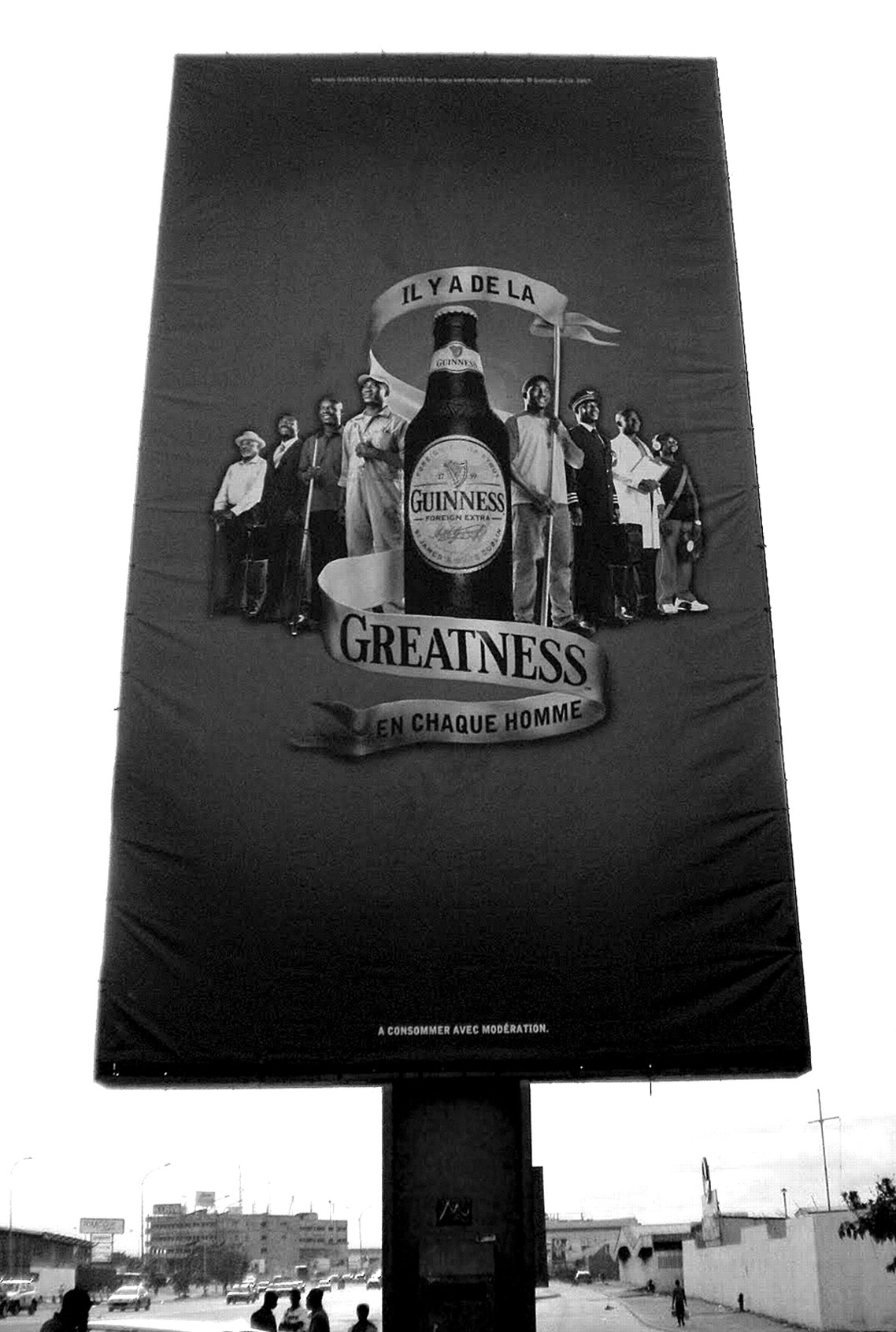
“Il y a de la GREATNESS en chaque homme” (“There is greatness in each man”). Situated at a busy intersection in the commune of Treichville, this Guinness ad affirms that black masculinity offers “greatness” (note the use of English for this as well as the label “foreign extra”). Men in the ad seem to be a retiree, a businessman, an athlete, a mechanic, an “average” guy with no discernable trade, a pilot, a doctor, and a DJ. Classically distinguished professions are fused with the informal occupations of contemporary peripheral Abidjan, and it’s the man with no discernible trade who holds the banner of “greatness.” Apparently greatness comes not only from productivity, but from consumption… in this case, of Guinness beer.
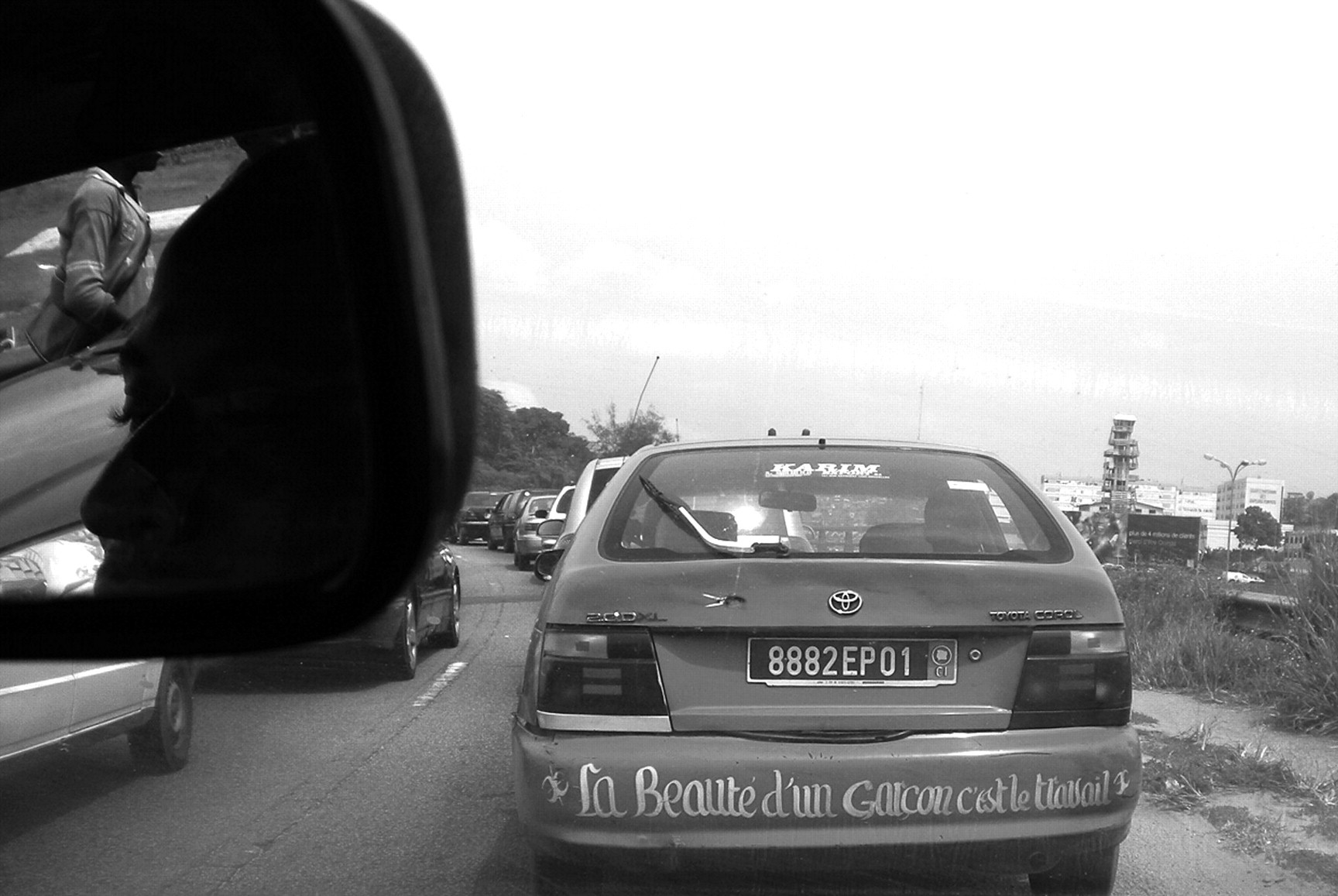
“La beauté d’un garçon c’est le travail.” In Abidjan, many signs declare that “a guy’s [literally, a boy’s] beauty is in his work” and affirm Abidjanais’ adherence to the close relationship between work and masculinity. But work is stratified by national origin. According to the Ivoirian National Institute of Statistics, fifty percent of Abidjan’s population is made up of migrants who have historically been left with the worst jobs. Today Abidjanais compete alongside migrants for anything that pays. By seeking this low-status, informal sector work, they’re often generically identified as “foreigners,” becoming the same targets of harassment their migrant counterparts have long suffered.
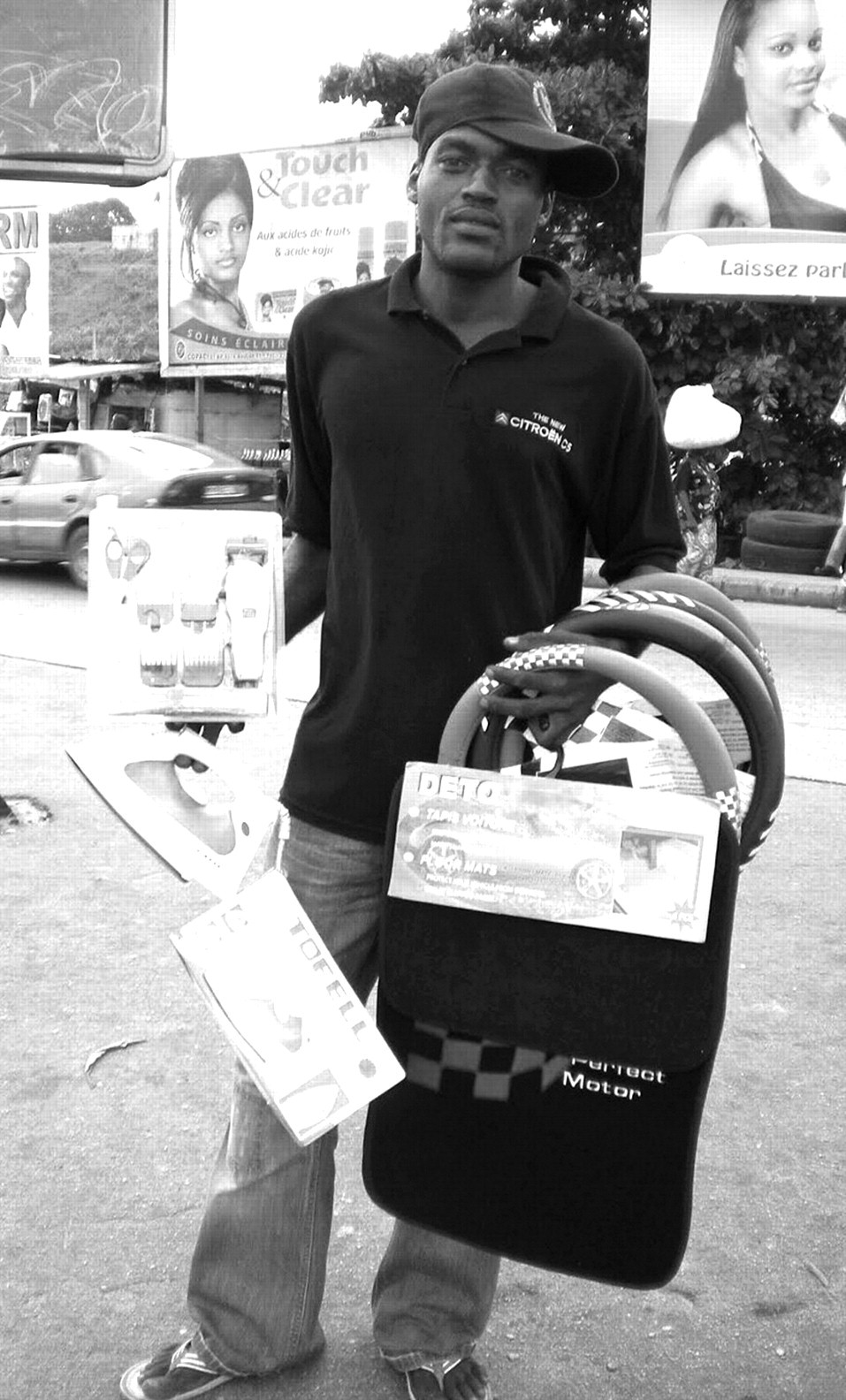
A vendeur ambulant, or “walking” street vendor (himself a migrant from neighboring Niger) sells his wares between passing cars in Boribana, a slum in the Adjamé commune. These workers are deeply peripheral, left to work in dangerous and polluted traffic-congested roads. With no shop or designated space in the market, they carry all of their capital and are vulnerable to both accidents and theft by drivers and in police raids.
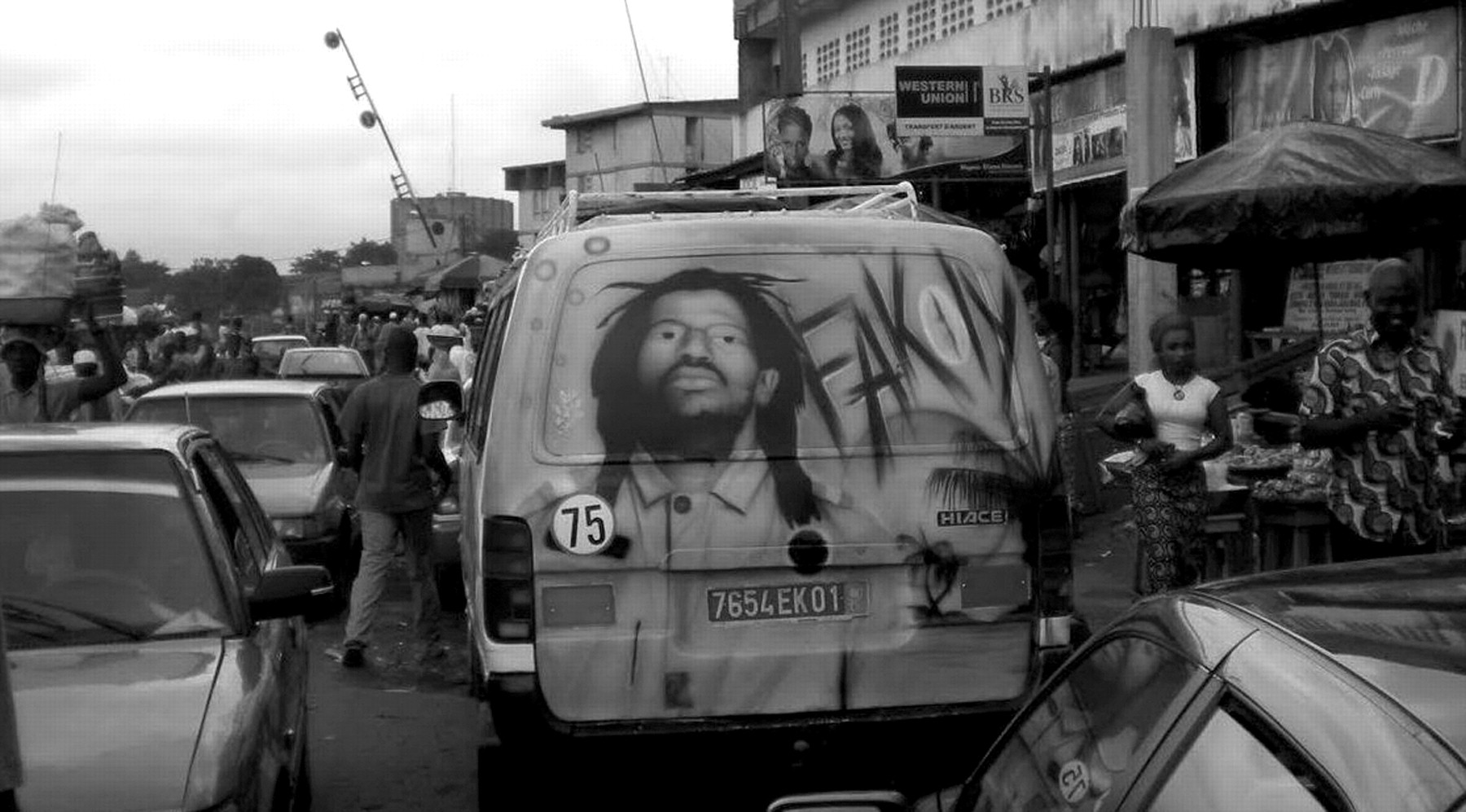
A baca passing through Yopougon, Abidjan’s cultural mecca. Bacas typically transport Abidjan’s poorer residents to and from the city’s outlying neighborhoods. Baca drivers and their assistants, often boys in their mid to late teens, are master navigators of the periphery. The assistants hang precariously out the back, clutching dirty bank notes and screaming their price and destination in fierce competition with other assistants in Nouchi (local slang). Images of black male celebrities, like this one of Ivoirian reggae artist and local boy made good Tiken Jah Fakoly (as popular in Paris as in Abidjan), are principally situated in the most male-dominated spaces (transport vehicles and barbershops), and they give the city a notably masculine feel. Everywhere you look, there seems to be the image of a man who embodies local fantasies.
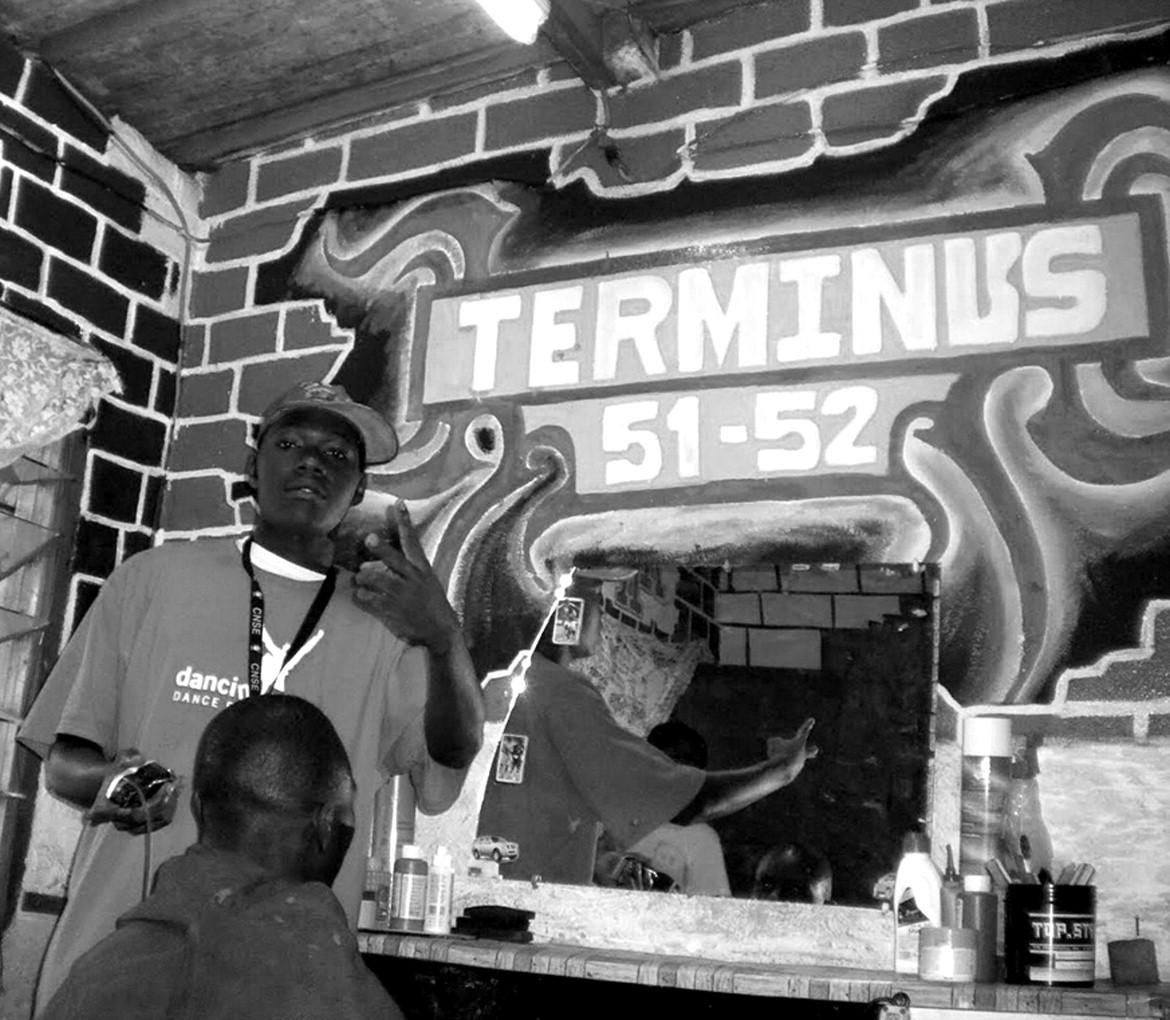
A barber, stage name Commandant Zaping, who is also the president of the Academy Rap Revolution, a music association and community organization in Abidjan’s poorest commune of Abobo, takes a moment to salute the camera. “Terminus 51-52” indicates the neighborhood; the end of the line for the now-defunct bus line 51-52, it’s far on the city’s outskirts where electricity and potable water are scarce. As early as the 1960s, barbers across West Africa began to embellish their simple stalls with colorful signage and decoration. The art now includes advertisements for a plethora of informal sector trades and demonstrates familiarity with global culture and a local flair.
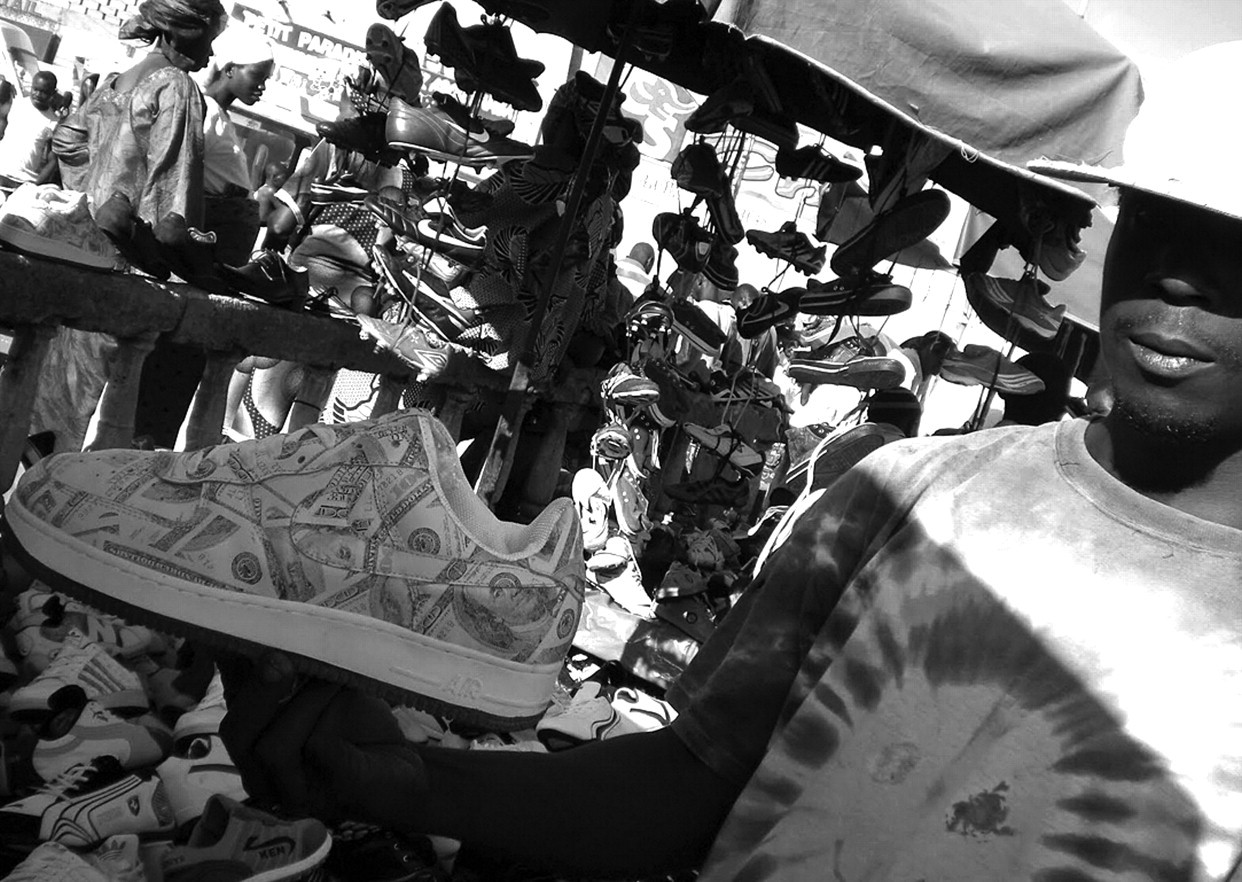
A street vendor shows off his wares—and his street smarts—in Adjamé. Higher than the vendeurs ambulants in the pecking order of Abidjan’s informal economy, this man has a permanent set-up (but no stall) in the market. This photo demonstrates the ubiquity of imported images of conspicuous consumption. Clothes and shoes are a popular commodity, and local tastes value anything with American insignia, especially the dollar. For informal sector men, images of money are stand-ins for a significant disposable income, more accessible than the things all those dollars could plausibly buy.
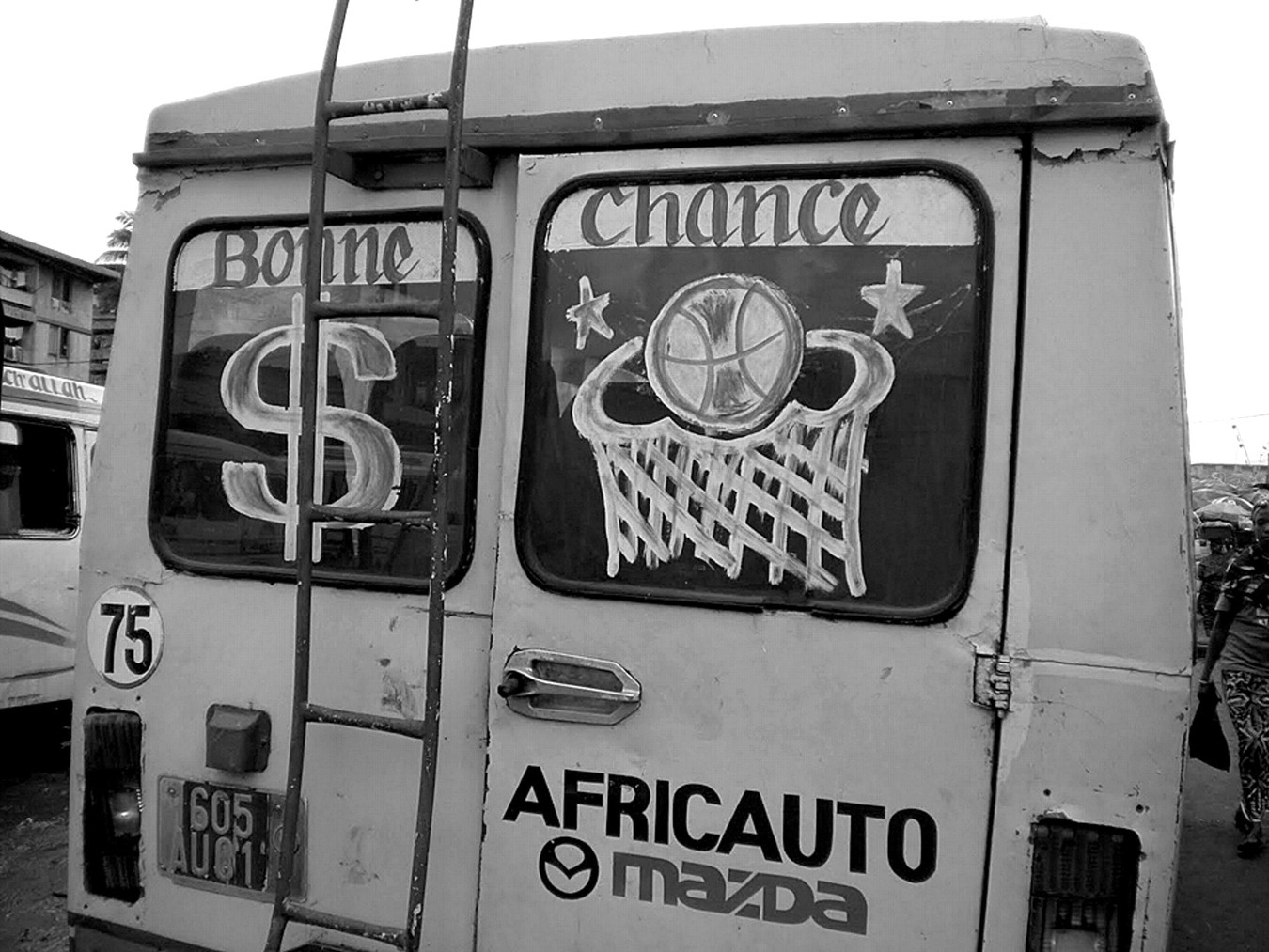
Another example of the popularity of American images, this baca in Adjamé features the U.S. dollar sign and a basketball. This merges black American style with an American capitalist ethos. Connecting the two permits Abidjanais men to identify with global capitalism despite their exclusion as unproductive men.
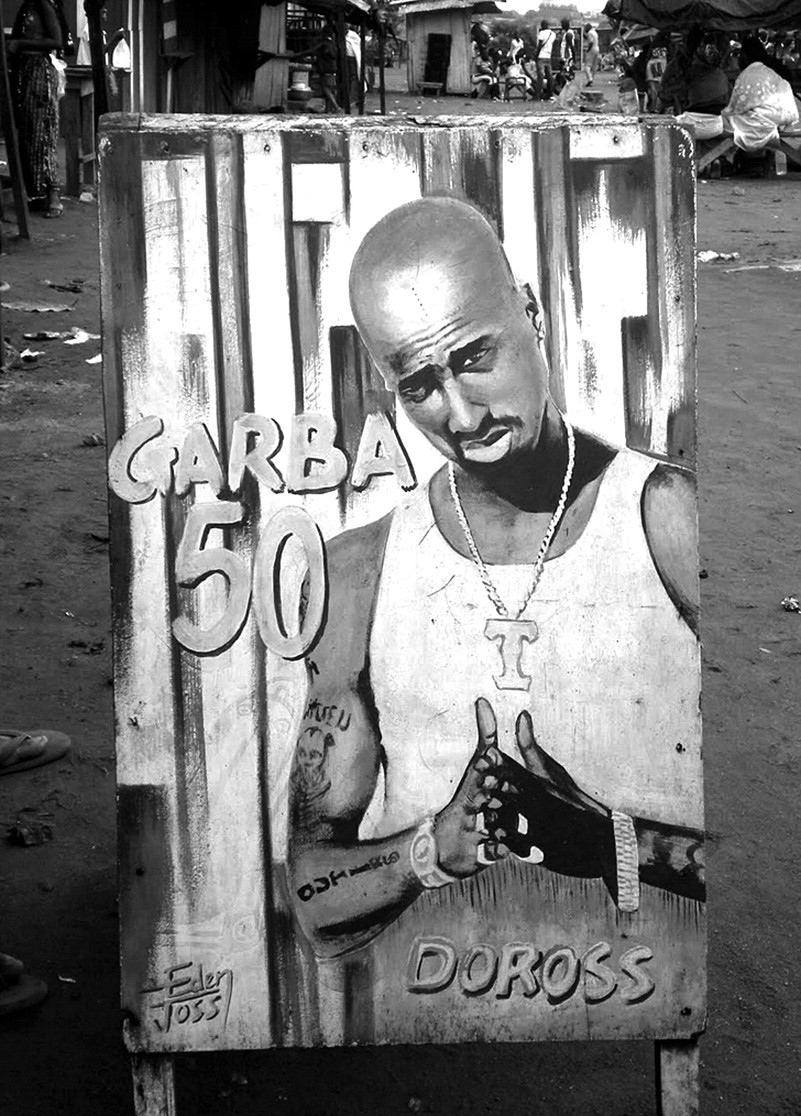
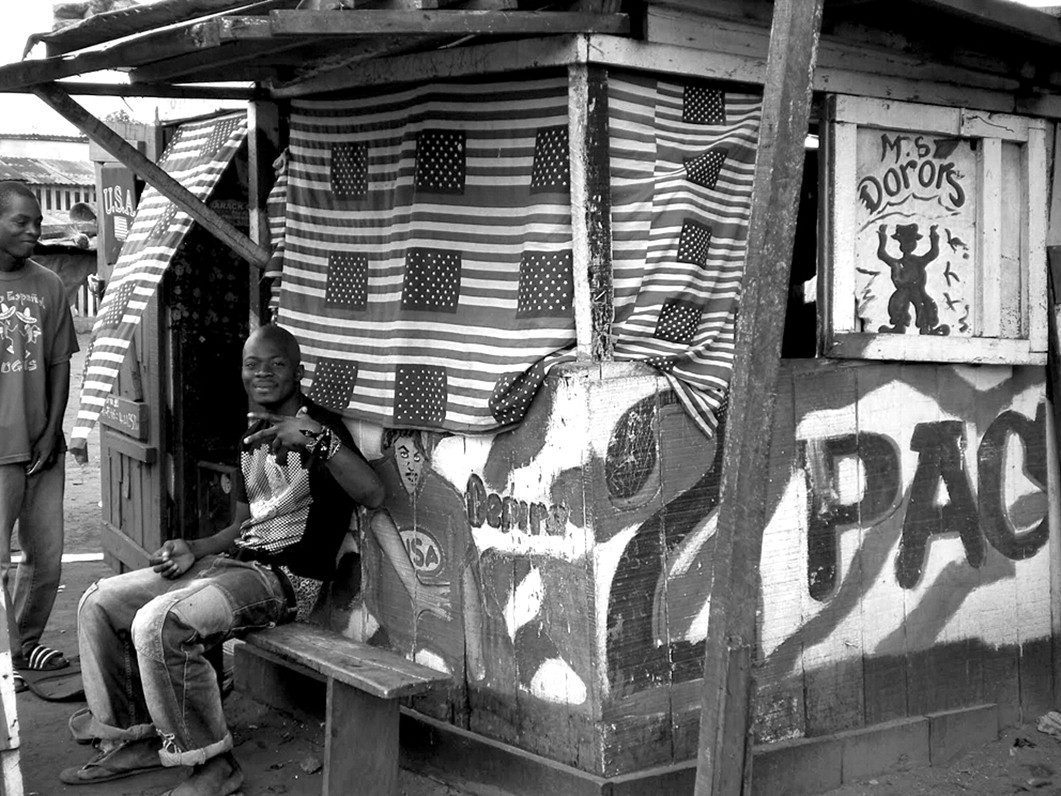
From the 1990s on, barbershop signs predominantly paid homage to iconic male symbols and related themes from African diaspora culture (especially as related to hip hop). In a crisis in which affordability has left many Abidjanais natives eating garba, a popular local dish often considered cheap, unclean, and fit only for poor migrants, this sign combines Tupac, an icon of the black American ghetto, with marginal Abidjanais reality.
Even higher up in the pecking order of Abidjan’s peripheral economy are shop owners. Usually no larger than a king-sized bed and characterized by informality, barbershops figure prominently among makeshift shops on unnamed roads. Business being slow (a typical informal sector trade may find three barbershops competing on one street), in the shops that will accommodate them barbers spend much of the day hanging out with friends.
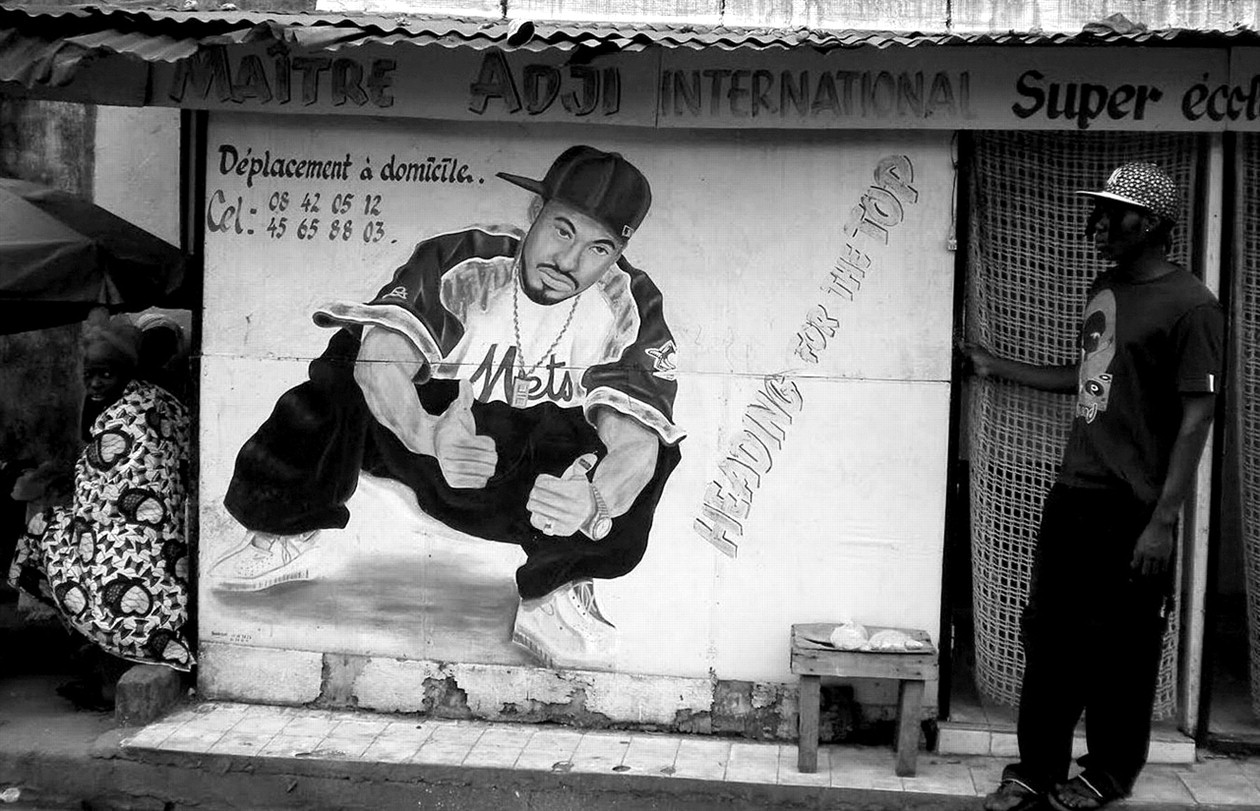
At another barbershop in Abobo, hip hop style-cum-lifestyle figures among the themes peripheral Abidjanais men appropriate. The contrast between the crouched woman in traditional dress and young man standing by the hip hop image is striking. In this city where the Ivoirian National Institute of Statistics puts the median age at twenty-two years, young men, highly mobile and appropriating new, global symbols to assert their identities, dominate public space. Women are in the background, their presence made smaller by virtue of trades that keep them seated and stationary.
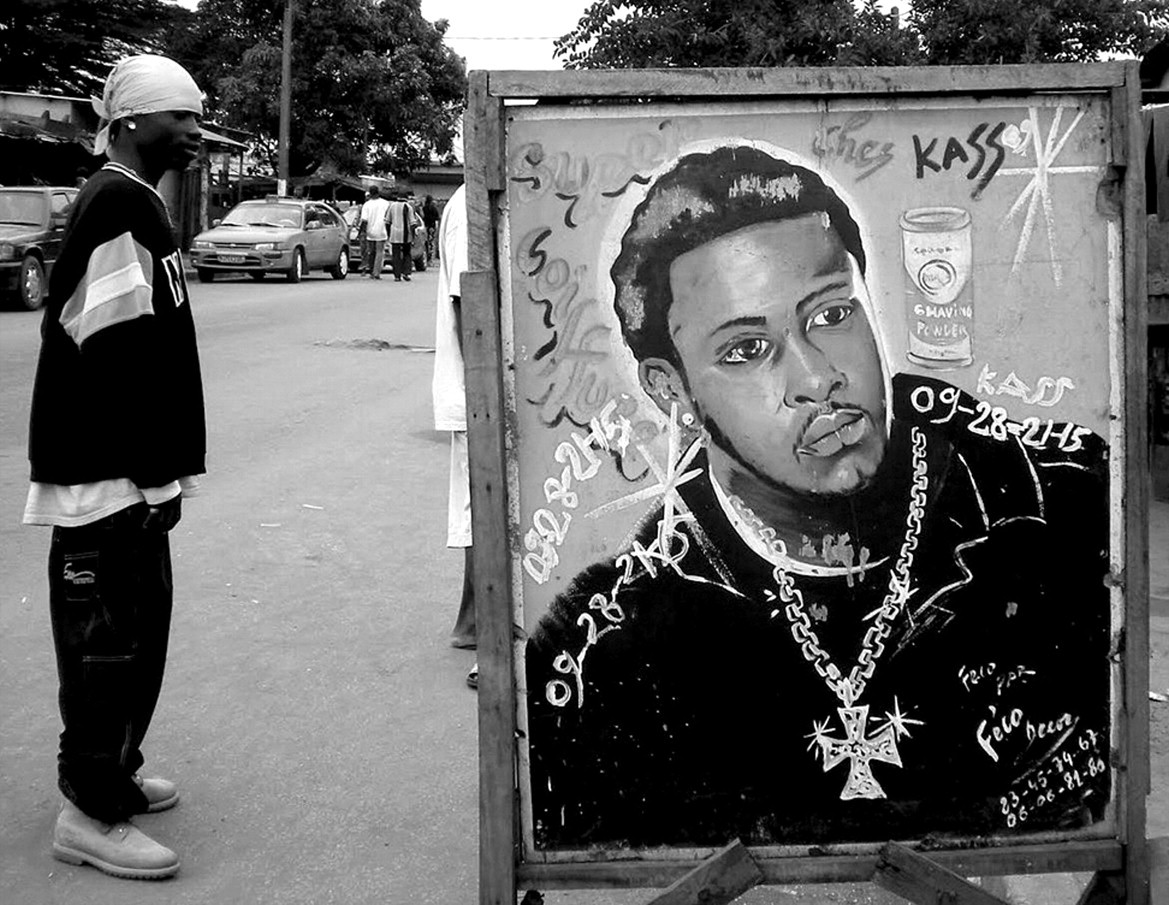
Shop owners commission local sign-makers to create veritable works of art. These signs replace the sterile printed advertising of the city’s formalized spaces, instead reflecting the impromptu, democratic flair of Abidjan’s peripheral neighborhoods, known in French as the quartiers populaires. The most familiar icons are gendered, with typical women’s salons featuring anonymous (though more elaborately coiffed) hair models. Outside this men’s barbershop in Yopougon, a hip hop theme dominates, with the male model adorned in sparkling “bling.”
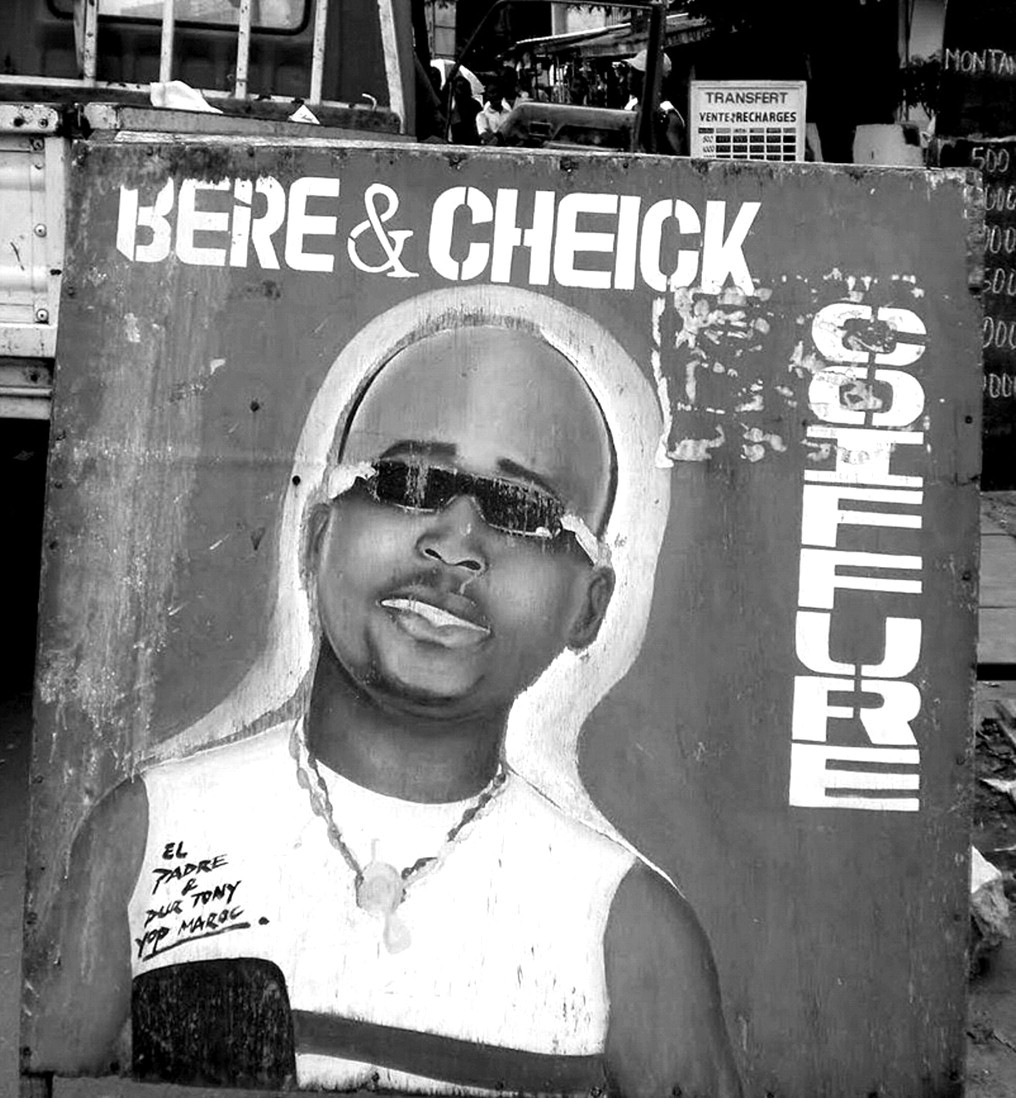
This barbershop image from Yopougon features local music sensation Douk Saga, a celebrity DJ and the first Ivoirian coupé decallé star. Coupé decallé is Ivoirian music that’s hugely popular with audiences throughout West Africa and France. Douk Saga’s gold sunglasses and chain affirm his access to familiar symbols of conspicuous consumption culture. These images of celebrity Ivoirian men offer peripheral Abidjanais inspiration and a route to masculine pride in the absence of work. The consumerist styles they emulate are equally popular.
Obama is a favorite symbol throughout Abidjan. As in many other signs, this image from Adjamé shows Obama as a black man who does his “bizness,” a popular Abidjanais slang term for a man with a successful trade (in reality more often in music or sport than finance or politics). Local ads often associate Obama’s image with the words “The Office” and, as seen here, the White House.

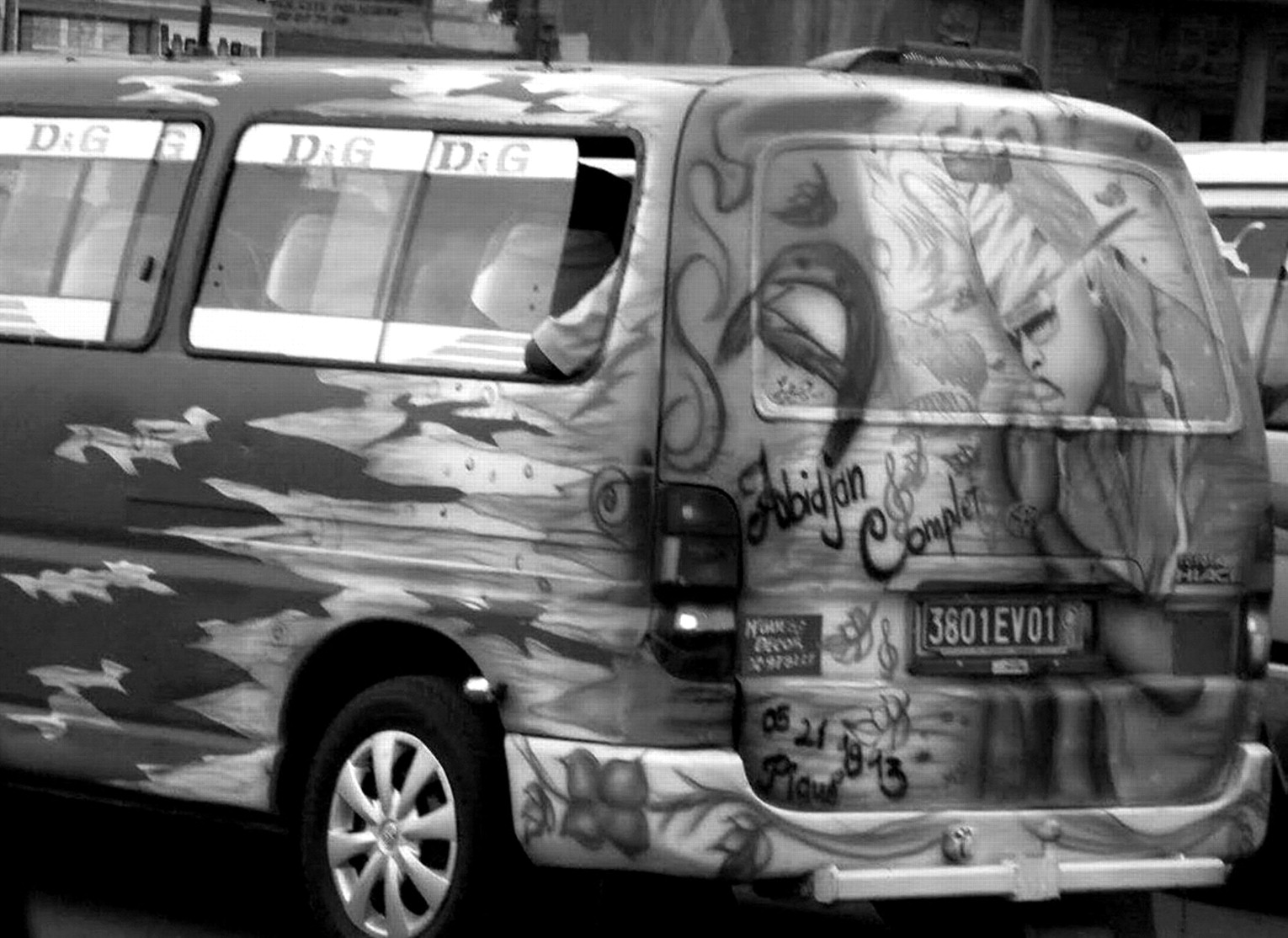
Peripheral men use consumerist symbols to create Abidjanais-specific narratives of social and cultural life. This baca passing through Yopougon displays popular Abidjan DJ Douk Saga and the words “Abidjan complet” or “wholly Abidjan.” Having once declared he’d only wear D&G, Douk Saga popularized the D&G label (for Italian luxury brand Dolce and Gabanna) on the Abidjanais social scene. Now it’s taken off as the counterfeit label of choice, and wearing it demonstrates knowledge of and participation in Abidjanais popular culture. One may find the D&G logo on under- and outerwear, footwear, and jewelry, and as a motif on traditional fabric. It figures in the names of shops, bars, clubs, and is even sprawled across public transport vehicles.
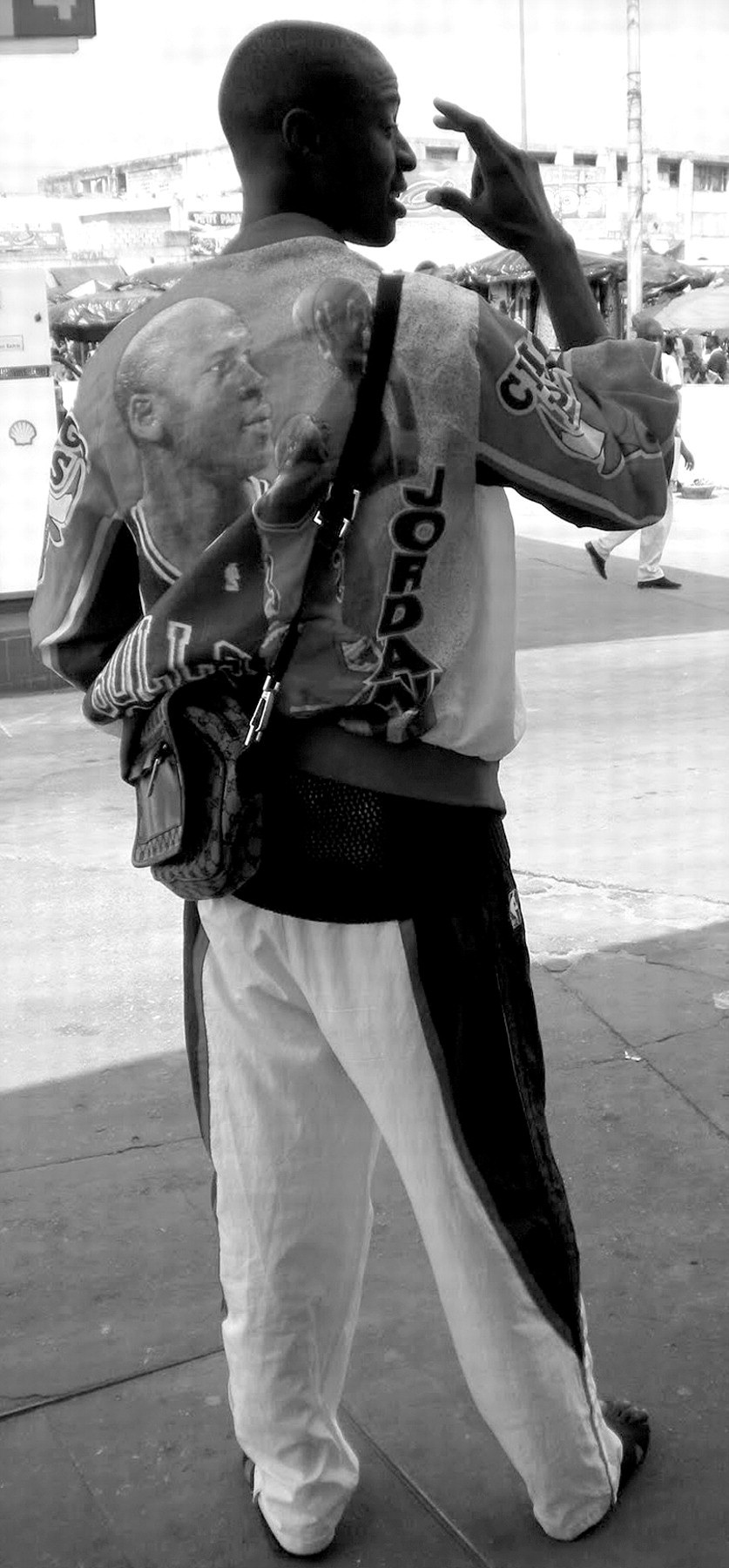
This worker in the informal economy participates in the local music scene under the stage name “Busta” (after Busta Rhymes). The juxtaposition of deep poverty against glorified American culture and black American celebrities isn’t ironic: contemporary American life extols consumption over production, image over substance, and venerates black masculinity in mainstream media. The symbols translate well for African men on the margins.
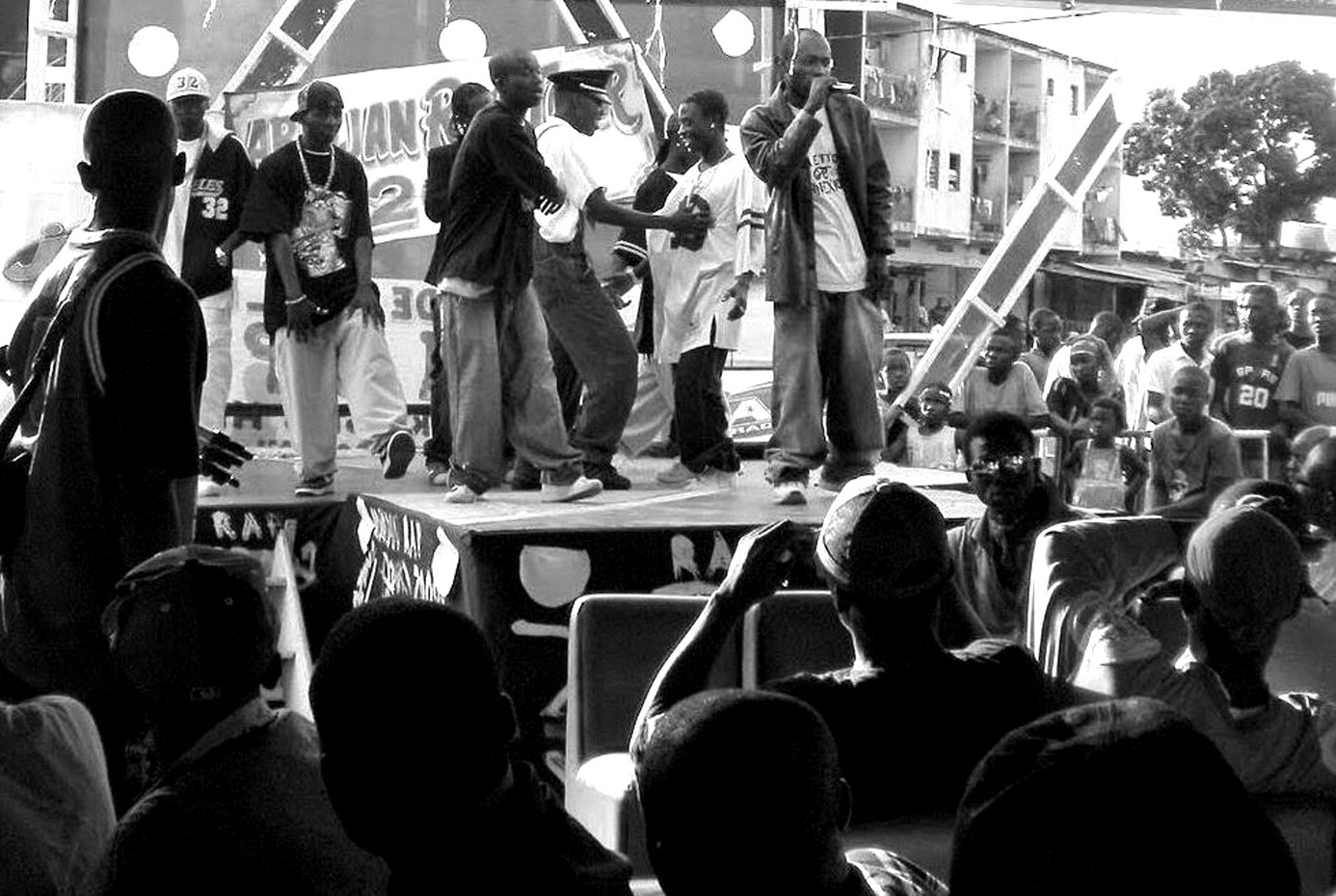
At the Abidjan Rap Tour in Yopougon, local artists can present their work on-stage on the Rue de Princess, Abidjan’s most popular destination for evening entertainment. As consumers and amateur producers of hip hop, peripheral Abidjanais men belong to an affirmed global masculine culture. Embodying symbols of culturally dominant black masculinity, the informal sector men conceal their own peripheral status, adopt MC and DJ personae, and replace the reality of economic invisibility with a loud consumerist visibility.
As a participant observer, I gained entry into the peripheral Abidjan hip hop community with the help of Tino and MC Black, the stage names of my two research assistants who were also vendors in the Adjamé market. MC Black sports a “Black Power” jersey and shows off a plastic bauble I had picked up for him in the U.S. Shortly after, he stopped wearing it, explaining that in Abijdan’s ghettos, such items were precious commodities sure to make others jealous. The very symbols of wealth assume value in peripheral Abidjan.