



Abstract
Fat stigma and size discrimination are big issues in a culture that’s more and more overweight, but less and less tolerant of obesity. The authors consider how the legal system has regarded these discrimination claims and how they might evolve in the future.
Keywords
We live, according to the Centers for Disease Control and Prevention (CDC), in an “obesogenic environment.” That is, America produces a lot of fat people. We have widespread access to unhealthy fast foods, and a combination of physically undemanding occupations like office work, labor-saving technologies (including cars), and cuts to physical education programs in schools all mean that most Americans’ daily activities do not provide the kinds of exercise we need. Even our leisure activities are frequently not physical, as more kids and adults turn to video games and surfing the Internet in their downtime.
Despite federal recommendations that adults accumulate at least 30 minutes a day of moderate-intensity physical activity (like brisk walking), a 2008 CDC survey found about 25 percent of Americans report no leisure-time physical activities.
At the same time that social changes encourage unhealthy food consumption and sedentary lifestyles, society penalizes the fat body. We live in a “culture of thinness” in which media images celebrate an unrealistically fit and firm body ideal, especially for women. Gender scholars have repeatedly underscored the constructed nature of these ideals and their oppressive effects on girls, women, and, increasingly, boys and men. In this culture of thinness, fat stigma is widespread. In fact, researchers with Yale University’s Rudd Center for Food Policy and Obesity argue that both institutional and interpersonal discrimination due to weight are not only widespread, but, at times, even more common than discrimination based on sex or race. The stigma of size leads to an array of social disadvantages for the overweight.

Size Matters
In recent years, sociologists have demonstrated stratified patterns by body size. For example, a 2007 Sociology of Education study by Robert Crosnoe analyzed data from the National Longitudinal Study of Adolescent Health (“Add Health”) and found that obese girls were less likely to enter college after high school compared to their non-obese peers. Notably, obese boys in the study did not differ from their peers.
In another study, sociologists Dalton Conley and Rebecca Glauber examined survey data from the Panel Study of Income Dynamics and found that obesity was associated with an 18 percent reduction in wages, a 25 percent reduction in family income, and a 16 percent reduction in the probability of marriage. These body mass penalties hold mainly for white women and occur across the life course.
The stigma of size leads to an array of social disadvantages for the overweight.
Are these educational, wage, family income, and marriage disparities a result of the individual choices fat people make or are they the result of the different treatment they receive? While studies such as these demonstrate the prevalence of size-based stratified patterns, researchers have also examined some of the mechanisms behind such inequalities.
Using experimental designs, researchers have asked subjects to evaluate an applicant’s qualifications or job performance where the applicant’s weight has been manipulated through photographs, videos, or written vignettes. This work has confirmed a bias against fat individuals, what social psychologist Christian Crandall, who developed the anti-fat questionnaire, refers to as “fatism.”
Eugene Kutcher and Jennifer Bragger summarized the state of the current research in the Journal of Applied Social Psychology. In their words, “Previous research has shown that overweight job applicants are viewed as possessing negative job-related traits, such as laziness, lack of self-discipline, greediness, selfishness, and carelessness.” In the same piece, Kutcher and Bragger report the results of an experiment they conducted in which subjects viewed a video interview and rated the job candidate’s performance. Videos varied by candidate’s weight and interview structure. Their results confirmed a discrimination bias against heavier candidates, but also revealed that more structured (compared to unstructured) interviews tempered this bias.
Multilevel network models created by Crosnoe, Kenneth Frank, and Anna Strassman also bolster the existence of “fatism.” Using “Add Health” data, the authors assessed the role of body size in high school networks. Their analysis points to the role of body stigmatization as a predictor of high school social relations, particularly segregation and isolation. As they put it, “larger body sizes constrained the size of adolescents’ friendship circles in high school, primarily because of the stigma attached to larger bodies.” This was particularly evident among girls.
Indeed, sociologists have long known that body size matters. Like other visible characteristics such as skin color, gender, and age, physical appearance and body size are diffuse status characteristics. Whether we want to or not, we present these characteristics to others who, in turn, may judge our character and abilities based on them. Sociologists Murray Webster, Jr. and James Driskell said it well: “Beauty or ugliness is one of the most accessible features of a person and acts as readily available status information in most encounters.”
Unsurprisingly in this cultural climate that stigmatizes and discriminates against the fat body, many people (of all sizes) attempt to lose weight. Some polls estimate that nearly half of American adult women are dieting at any given time. Weight preoccupation, which is, in the extreme, connected to eating disorders like anorexia and bulimia, is so prevalent among women that it has been labeled a “normative discontent.” The American diet craze continues, even though research indicates that 95 percent of diets fail and individuals who lose weight through dieting will almost certainly gain it back over the years.
The Law Weighs In
Historically, individuals have turned to the courts as an avenue for recourse against discrimination and as a venue for social change. In recent years, this has also been the case with size-based discrimination. But if, for instance, a worker believes she was not hired, was overlooked for promotion, or was dismissed because of her weight, does she have any legal recourse?
American law generally does not prohibit employment discrimination based on appearance, including weight. Only the state of Michigan and a handful of cities and counties (including San Francisco, CA, Urbana, IL, and Madison, WI) protect against discrimination by height, weight, or other physical characteristics. So most individuals who think they have been the victim of sizeism must turn to legislation that covers a characteristic that is protected by law. Title VII of the 1964 Civil Rights Act, which protects race, color, religion, sex, and national origin, provides one route for redress. Individuals can also turn to the 1973 Rehabilitation Act (RA) or the 1990 Americans with Disabilities Act (ADA).
For their part, employers have testified that hiring workers with a certain look is necessary for their everyday business. They claim physical attractiveness is what is called a “bona fide occupational qualification.” Otherwise discriminatory, a bona fide occupational qualification is tolerated because, businesses say, without it, their operations would be undermined. Companies sometimes use this argument to defend their preference for thin employees, maintaining that overweight employees might damage corporate image or compromise business.
Such arguments were made against Jennifer Portnick in 2002. Jazzercise, a national aerobics chain, denied her a franchise, saying that students want to see and be inspired by a “fit” and “toned” instructor. Portnick’s 240-pound body, Jazzercise argued, would jeopardize the company’s reputation. Portnick, who by all accounts was able to perform her job as an aerobics instructor, brought her complaint before the San Francisco Human Rights Commission, which ruled in her favor. The case exemplifies the important distinction between fitness and size; as a woman of size and an ambitious cardio instructor, Portnick embodied fitness and demonstrated that fat doesn’t automatically signify unhealthy.
Jennifer Portnick now runs her own successful business, Feeling Good Fitness.
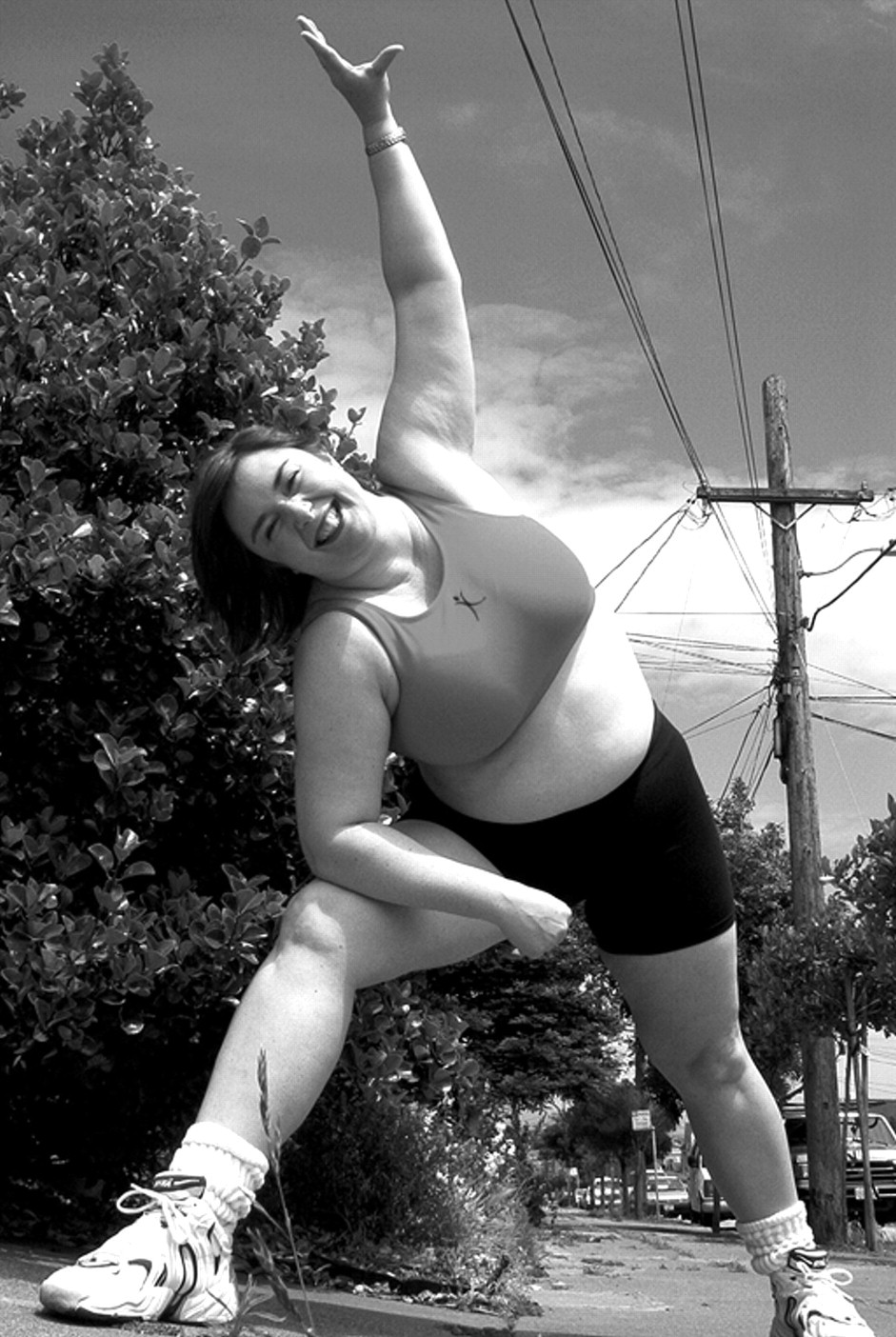
The majority of other weight discrimination cases, however, have been unsuccessful. Plaintiffs find themselves charged with demonstrating that their obesity is caused by a physiological disorder stemming from, for example, a thyroid condition, or that they are substantially impaired in life activities. Since plaintiffs are forced to prove that their weight is a disability in order to move forward in court, obesity is a prerequisite of disability-related weight discrimination suits, and being merely overweight does not qualify. This means that a plaintiff might find him or herself in the unenviable position of being too fat to get (or keep) a job or promotion, but too thin to fight for it in court.
A plaintiff might be in the unenviable position of being too fat to get (or keep) a job, but too thin to fight for it in court.
Despite the law’s failure to protect plaintiffs, some legal scholars have proposed protecting weight as a legal category similar to sex and race. For example, law professor Deborah Rhode makes a case for expanding legislation to protect physical characteristics, arguing that appearance discrimination should be banned since it offends principles of equal opportunity and rests on inaccurate stereotypes; reinforces group subordination, especially gender subordination; and restricts self-expression or cultural identity. Rhode maintains that new legislation protecting appearance (including weight) discrimination would not open the floodgates to numerous frivolous claims, and that seems to be the case: data from Michigan and the few cities and counties that currently protect physical characteristics indicate that the courts have not become clogged with appearance-related complaints, nor are they likely to. Advocates for legal changes have also argued that bona fide occupational qualification justifications are not always legal and unfettered, particularly if an employer’s preference (for, say, thinness) is tied to a protected characteristic such as race or sex.
Tipping the Scale: Numbers Up, Tolerance Down
American courts’ treatment of weight discrimination reflects larger cultural and social patterns of size-based bias, stigma, and discrimination. Since the civil rights movement, structural changes, alongside changes in individual belief systems, have pointed to increased tolerance in the public sphere of gender, racial, ethnic, religious, ability, and age differences. Regardless of this more socially progressive mindset, sizeism remains commonplace and often unquestioned. As some fat acceptance activists put it, sizeism is the last bastion of oppression.
Theories of tokenism would predict increased tolerance; typically, those who are outnumbered experience negative differential treatment. Yet public health officials, based on BMI assessments, indicate that about one-third of the adult American population can be labeled overweight and another third obese. In other words, two-thirds—a clear majority—of American adults find themselves above the “normal weight range,” yet they haven’t been greeted by increased tolerance for and acceptance of people like them.
Sizeism is at once similar to and different from other forms of discrimination, such as sexism. Historical legacies, for instance, distinguish the movements for fat equality and gender equality. Both have major spearheading organizations, but, unlike feminist groups such as the National Organization for Women (NOW), fat acceptance activist groups like the National Association to Advance Fat Acceptance (established in 1969), have relatively few supporters and less visibility and political influence. Feminists have been able to initiate major institutional and legal changes, and women have remapped the workplace and educational landscapes. Along the way, public sentiments about the meanings of motherhood and womanhood have also changed.
The Western belief that the fat body is a personal shortcoming suggests that eradicating sizeism will be a formidable task.
In the meantime, the fat acceptance movement has not only not achieved similar overhauls in legal and social infrastructure, but, crucially, it hasn’t seen a shift in cultural attitudes. This is because in our society, we think of and depict body size as controllable. Fat people are not only seen as lacking, they are seen as personally responsible for the prejudices and discrimination they endure. In this way, physical appearance can be conceptualized as a continuum. On the one end of the continuum are relatively static, unchangeable characteristics such as height and sex; on the other end are mutable and voluntary characteristics such as hair style or makeup use. Individuals typically categorize weight on the voluntary end of the continuum. The fat body is thought of as a personal choice and a moral failing, so, by that logic, fat people are blameworthy and deserving of discrimination.
In Western cultures with an ideology of individualism, this belief that we can control our destiny, including our bodies, is deeply ingrained. Sizeist attitudes are particularly embedded in individualistic cultures such as the U.S. Work by social psychologist Bernard Weiner and his colleagues shows that fat stigmatization is more likely when individuals assign individual responsibility and blame to fat people, and Christian Crandall and his colleagues’ research further shows that fatism correlates with belief in a just world, the Protestant work ethic, and conservative political ideology.
No doubt, this belief in body size as a personal responsibility is precisely the ideology underlying court decisions which have mostly denied claims of size discrimination. Body size is only protected when it is connected to an immutable characteristic such as race or sex (evident with Title VII challenges) or when a plaintiff can demonstrate that his or her body size is itself immutable because of an underlying physiological disorder (evident with ADA or RA challenges). In both circumstances, the characteristic protected is framed as “not a personal choice,” so it’s not a personally blameworthy shortcoming.
Individualistic sentiments stressing personal culpability for one’s body (and its appearance) are prevalent, even though a great deal of evidence indicates that access to leisure time, nutritional knowledge, high quality and affordable food, safe and pedestrian-friendly neighborhoods, and gym memberships—variables that all affect body size—are themselves structured by race, class, and other factors.
Contemporary malaises further complicate how individuals approach size. In times when postmodern contingencies and uncertainties abound—whether about politics, the environment, or personal security—bodies become templates for the psyche. In uncertain times, bodies are supposedly the one thing individuals can control. People thus engage in what Chris Shilling refers to as “body projects,” including weight-loss attempts, in order to signify the self, social standing, and/or moral worth. Notwithstanding physiological realities and other restrictions, “health” (and the highly interpretive qualities with which it’s equated, like thinness and sexual attractiveness) becomes a project of the self. And in a medicalized culture like ours, where medicine exerts authoritative influence, body and health projects become even greater imperatives. Individuals not only think that the body can be controlled, there are high expectations that it ought to be controlled. To ignore public health mandates is irresponsible, and those who do not comply risk further accusations that they are a burden on the American healthcare system.
If history is any indicator, threats to the institutional order—whether in the form of changes in immigration patterns, economic crisis, or a rethinking of the meaning of the family unit—often result in backlash and the rise of an unwitting scapegoat, e.g., “If the healthcare system is in trouble, maybe it’s because everyone’s so fat!” Amid today’s economic, political, and social anxieties, what is thought of as aptly-deserved sizeism thus emerges. This is particularly the case with racial minorities of size who are seen as doubly culpable, potentially threatening both the economic livelihood and moral fabric of society.
The medicalization of the fat body and the commonplace belief that fat is unhealthy (and thin is healthy) exacerbates sizeism. Public health officials define the fat body as a pressing health problem. The CDC asserts that being overweight or obese increases an individual’s risk for coronary heart disease, Type 2 diabetes, certain cancers, and hypertension, among a host of other serious health conditions. News media describe obesity as a widespread epidemic and depict fat as a preventable evil that causes a range of social ills, such as the demise of the American economy in a competitive global market, a crisis in the U.S. healthcare system, and compromised national security (stemming from the lack of potentially fit soldiers to serve in the armed forces).
These beliefs persist despite debates among scholars—from social scientists to health researchers—about the constructed nature of the obesity crisis. Dissenting voices challenge the biomedical paradigm on obesity, including those affiliated with the Health at Every Size movement, and question whether there even have been significant increases in weight across the population. They point instead to government redefinitions, which have lowered the threshold for “overweight” and led to the reclassification of large portions of the population into overweight and obese categories. They also question whether overweight and obesity are major contributors to mortality; after all, they argue, body mass is a weak predictor of mortality, and studies suggesting an obesity-death link often overlook confounding factors such as fitness, exercise, and diet quality.
From this perspective, the public health crisis of obesity might be better labeled a moral panic. These researchers argue that one can be both overweight and healthy. As such, they downplay waistline measurements, weight preoccupation, and fat reduction, moving to emphasize specific behavioral patterns and healthy lifestyles, not simple dieting.
Indeed, some sociologists and gender scholars have pointed out that, like many other social issues, the definitions and meanings of “fat” shift depending on location and social, economic, and political forces. Today, for example, Americans generally think of fat as unhealthy and unattractive; however, pre-industrial economies (before the mobilization of modern medicine and the advent of mass media) approached fat rather differently. In these times, corpulent bodies were desirable and linked to economic status, survival, and longevity. From a constructivist standpoint, it can be said that any era’s prevailing understandings of fat are tied closely to claims-makers’ interests—from pharmaceutical companies that define obesity as a life-threatening disease (and offer medications to help) to food industry lobby groups that assert the obesity epidemic is mere hype.
The deeply ingrained Western belief that the fat body is a personal shortcoming suggests that eradicating sizeism will be a formidable task. Some fat acceptance activists, with the backing of legal scholars and social scientists, champion weight as a protected legal category, akin to sex or race. Yet changes in the law are just one of many cultural and social structural reforms that would be needed to create a more tolerant environment for people of size.
Popular culture’s narrow depiction of beauty, alongside ever-present public health messages that fat is always unhealthy, shape how we think about beauty, size, and health. Even so, new legislation may pave the way for changes to prevent size discrimination, beginning with greater public awareness and a dialogue about the deleterious health effects, both physical and mental, that often come with conformity to rigid cultural body norms.