



Abstract
Methland, a journalist's portrait of what ails small-town Iowa reveals that rural problems are not so different from those of the big city. Meth in Iowa, reviewer Maria Kefalas says, is linked to larger issues of joblessness and downward mobility in middle America.
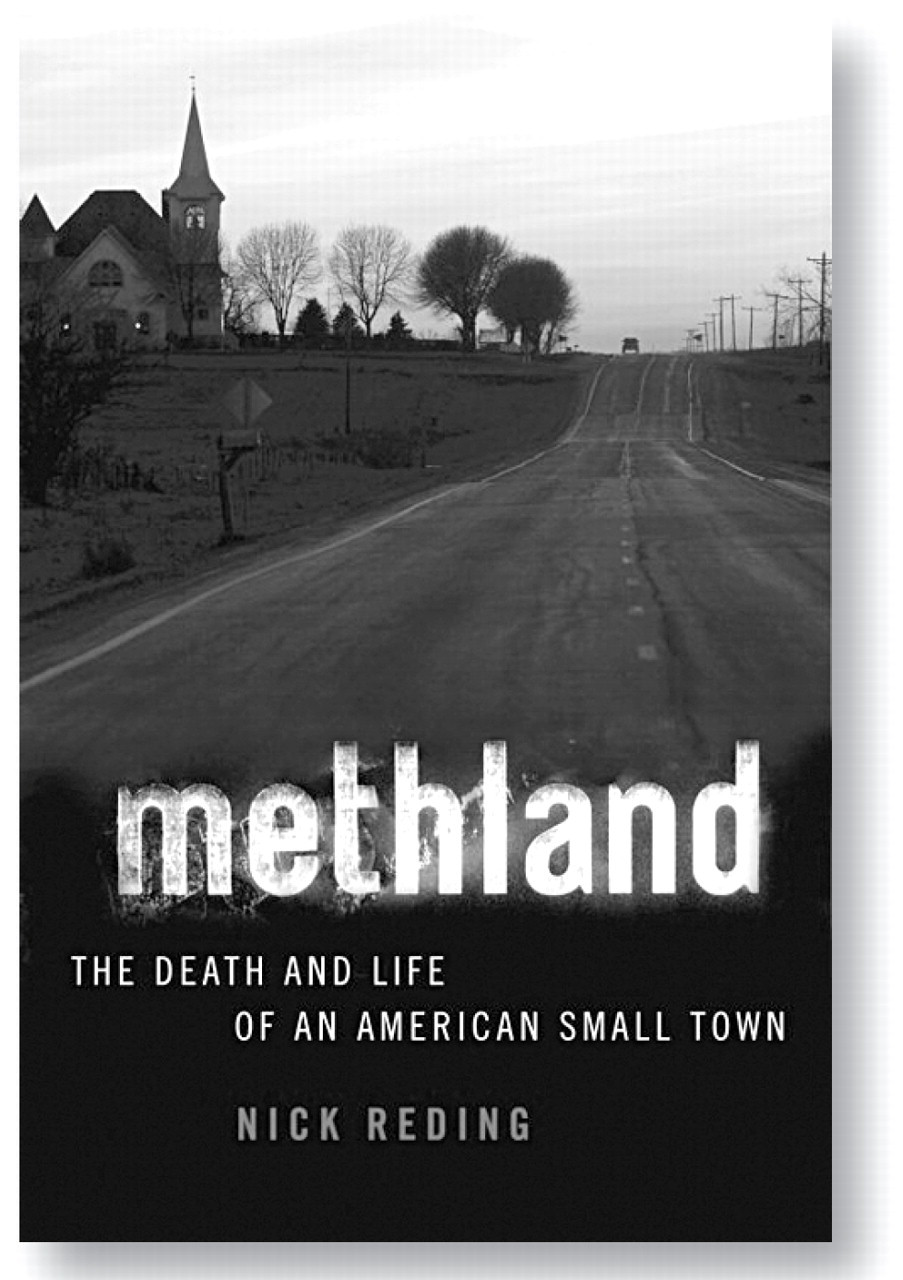
Nick Reeling's Iowa ain't your grandmother's technicolor, barber-shop quartet, gazebo-in-the square Music Man Iowa. In his acclaimed Methland, Reding takes stock of the rural crisis that has seeped like a wasting disease into the region. A journalist, the author transports us to a broken Heartland in this brilliant and horrifying account of how methamphetamines have eaten away at the northeastern railroad and meatpacking town of Oelwein.
Commentators and policymakers ramble on about globalization and jobless recoveries and the threat to the American Dream. In these discussions, decline and downward mobility are existential and theoretical possibilities, but in Methland, we bear witness to people fighting for their way of life. Worse, they're actually fighting for their very lives. You can't help but wonder how many more places face futures like Oelwein's; if Iowa isn't safe, is anywhere?
What ails Iowa, and the nation's Heartland as a whole, predates the Great Recession. The downward mobility of rural blue-collar workers was the canary in the coal mine, warning of the American Dream's nightmarish turn. Unfortunately, no one was bothering to pay much attention. Academics deserve a fair bit of the blame for this neglect. Too many scholars only think about rural America during the culture war's skirmishes or campaign seasons. So while there is an array of scholarly research devoted to chronicling urban decline, small towns' struggles happen off the grid.
Upon close inspection, even though conventional wisdom casts the small town as embodiment of all that's right with America and the inner city as all that's wrong, the rural and urban crises have a lot in common. William Julius Wilson famously described how deindustrialization, joblessness, middle-class flight, depopulation, and global market shifts gave rise to the urban hyper-ghettos of the 1970s. Now the same forces are afflicting the nation's countryside. The differences are just in the details: in urban centers, young men in NBA jerseys sling dime bags from vacant buildings, while in small towns, drug dealers wearing NASCAR shirts sell and use meth in trailer parks. There's no shortage of guns in either setting, although in North Philadelphia's Badlands those sidearms might be illegally tucked into waistbands, while in the Midwest, they're displayed in polished oak cabinets. And though urban neighborhoods have become the public face of poverty, residents of rural America are actually more likely to be poor and uninsured than their metropolitan counterparts. They typically earn just 80 percent of suburban and urban workers' salaries.
Before the Heartland could be infected by meth, the region would have to be betrayed, first by the bankers who created the credit bubble behind the farm crisis of the 1980s, next, by the politicians looking for ways to make the region's corporations more powerful and less accountable, and finally, by progress itself. The rise of agri-business and the globalized “new” economy meant that family farms, locally owned “mom and pop” businesses, and the unionized Maytag and Winnebago jobs that once supported the region have been replaced by factory farms with hog hotels and genetically modified crops, big-box retailers (nothing more than Main Street killers), and deskilled, minimum wage work only destitute refugees would see as a step up.
Meanwhile, meth has helped transform Sarah Palin's real America into a wasteland. Like crack, meth is cheap and highly addictive, and its users tend to be unpredictable and dangerous. In a place like Iowa, where farmers work as sharecroppers serving multinational food conglomerates, young men turn to the drug to ease a gnawing realization: they're the first generation of Americans doing worse than their parents or grandparents.
Iowa's Department of Family Services is now overwhelmed by “meth babies,” born to parents consumed by chasing highs or manufacturing the drug. These kids are abused, neglected, and exposed to chemicals so hazardous that scientists haven't yet comprehended the full extent of the damage done to developing minds and bodies. DEA agents, driving tinted-window SUVs, riding in on horseback, or circling overhead in helicopters, coordinate massive drug raids and later, haz mat (hazardous materials) teams come in to try to clean up the toxic mess. Not just a human disaster, meth presents an environmental disaster: for every pound of meth manufactured, six pounds of toxic waste are produced.
Reding's book reads like a fearless documentary filmmaker recording every detail with a hand-held camera. This verite style makes Methland's characters stay with you. There is Nathan Lein, the crusading county prosecutor who's the son of farmers but sees little future working the land. Lein could've taken his three university degrees and gotten out of Dodge like everyone else from his high school (Iowa has been evacuating its best and brightest for decades). Instead, he came home to lead the charge against meth. Also fighting the good fight is Dr. Clay Hallberg, one of Oelwein's only doctors. He's a chain-smoking armchair philosopher who, like Lein, spends a surprising amount of time reading German thinkers in sincere attempts to make sense of the town that's coming down around them. (Iowa is filled with these self-taught philosophers and historians.
In Iowa, young men turn to meth to ease a gnawing realization: they're the first generation of Americans doing worse than their parents or grandparents.
When you're 50 miles from the nearest Starbucks and spotty reception liberates you from the distractions possible with an iPhone or Blackberry, you have plenty of time to contemplate the meaning of life.) His own past struggles with addiction have created Hallberg's deep well of compassion for those afflicted by meth's demons.
Then there's Roland Jarvis, a Beavis and Butthead meth cook and addict whose hellish existence proves once and for all that there are things far worse than death. Reding recounts how Jarvis was burned alive in a lab explosion. Jarvis “survived.” When the paramedics arrived on the scene, they wondered if the merciful thing to do was to let Jarvis succumb to his wounds. Stunningly, Jarvis could've escaped unharmed had he not run back into the fire, repeatedly, to save his meth lab and dope stash.
Reding's portrait of Iowa and its people evoke Dante and William S. Burroughs, and it's not surprising that Methland will soon be adapted for film. And while the first chapter of the book may just be about perfect, Reding gets in trouble when he moves from the anthropologists' thick description to policy analysis. Perhaps his editors advised him that readers need discussions of big pharma and federal agricultural policy to facilitate finger-pointing, but Reding is less comfortable when he steps back from the people of Oelwein, as in the chapters where he describes how the government is to blame. Methland's strength is that it's the sort of participant observation that's scarce in this Institutional Review Board era of research design scrutiny. Extreme ethnography brings the nearly irresistible temptation for sensationalism—but, since he is a journalist and not an academic, maybe it's unfair to critique Reding for choosing “the money shot” over the “modal case.”
Then, there is the bigger question about Reding's focus on meth. I don't think meth is going to kill Iowa. After all, we don't hear too much about crack these days. If inner cities could fight off crack, then rural Iowa, which has far more resilient civic institutions than Baltimore or Camden, should be able to blunt the drug's worst effects.
To be sure, there's plenty of trouble in Iowa. The main problem is the economy (such as it is). Iowa lost 48,000 jobs from the start of the recession until the middle of this 2010. The Winnebago and Maytag factories shut their doors for good. What work there is pays minimum wage, often lacking the promise of full-time hours. Young people with college degrees are leaving the state faster than ever, and this brain drain means there are too many folks who want jobs in construction or manufacturing and too few who can work as dentists or computer engineers. Iowa's economy lacks the diversity it needs to support its people and grow for the future.
So meth is still a problem in Iowa, don't get me wrong. But even Oelwein hasn't fallen over a cliff because of it. State authorities have gotten a handle on the situation, and there has been a pretty dramatic reduction in the number of small-time labs. Oddly, part of the reason for this success in reducing the number of meth labs brings to light the real trouble facing Iowa and the Heartland as a whole. Mexican drug cartels have taken over the franchise for supplying the drug to the region. With a steady stream of meth imports, the prices have collapsed. Independent cooks can't compete. The good news is that Iowa taxpayers don't have to pick up the tab for the clean-ups and the raids as frequently as before.
But now, the meth cooks complain that their jobs got outsourced. Even meth is no longer made in the good ole U.S. of A.