




Abstract
Many “culture camps” seek to enhance transnational adoptees' sense of ethnic identify. While camps may not achieve this goal, they do provide a space for adoptees and their parents to feel supported, create networks, and explore an “adoptive” identity.
“Cristina came to us from Mexico when she was seven years old. [She] has resisted identifying with her home country and culture because she wants to fit in with her new adoptive Caucasian family and American culture. Yet, we continually try to keep her connected to her roots.”
Diane, mother to 9 year-old Cristina
According to the U.S. State Department, nearly 13,000 children were adopted internationally to the United States in 2009, a decline from the 2004 peak of almost 23,000. Like other international adoptees, many of these kids will grow up in homes with no obvious links to their racial or ethnic background. Many parents, though, are interested in “reconnecting” their children to their birth “culture,” and adoptee culture camps offer one way to do so. Begun primarily to serve the large number of Korean adoptees living in the Midwestern U.S., adoptee culture camps now exist throughout the country. Each summer they serve thousands of children, but can going to camp accomplish a task as complex as constructing an ethnic or racial identity?
Defining ethnic and racial identity can be overwhelmingly difficult, especially for transnational adoptees. Their identity development takes into account two or more different cultures (at least those of the biological parents, who are usually unknown to them, and their adoptive parents). Moreover, parents and scholars have not reached consensus over the component pieces of an ethnic or racial “cultural” identity. These can include the acquisition of taste preferences (for food or recreation, for example), skills (including language), values, or a sense of belonging to one group or another. Korean adoptee and director of the adoption documentary First Person Plural, Deann Liem points out that transnational adoptees often have no foreign history or identity to activate other than physical similarity to members of their birth culture, markedly different than that of other immigrants or minorities. That said, like multi-racial or multi-ethnic individuals, these kids may share the need to navigate conflicts between attitudes and values in multiple groups.
Ethnographic studies reveal that parents raising transnational adoptees differ in the degree to which they seek to teach their children about their birth culture. In a 2004 Race and Society article, scholars Jianbinn Shiao, Mia Tuan, and Elizabeth Rienzi look at some adoptive parents' strategies to address racial and ethnic differences within their families. Many parents feel that their children must have knowledge of their own birth culture and heritage in order to have positive identity development. But though they initially set out to provide strong ties to the culture of their child's birth, some find it difficult due to lack of proximity or connection to other ethnic and racial groups. Other parents are torn because they want their children to understand their heritage, but do not want them to be seen as “different,” particularly given the racism prevalent in American society. Culture camps try to help parents find a middle ground, providing an organized opportunity to encourage positive identity development for adopted children.
A child and her father at the 2009 Catalyst Culture Camp for Vietnamese children.
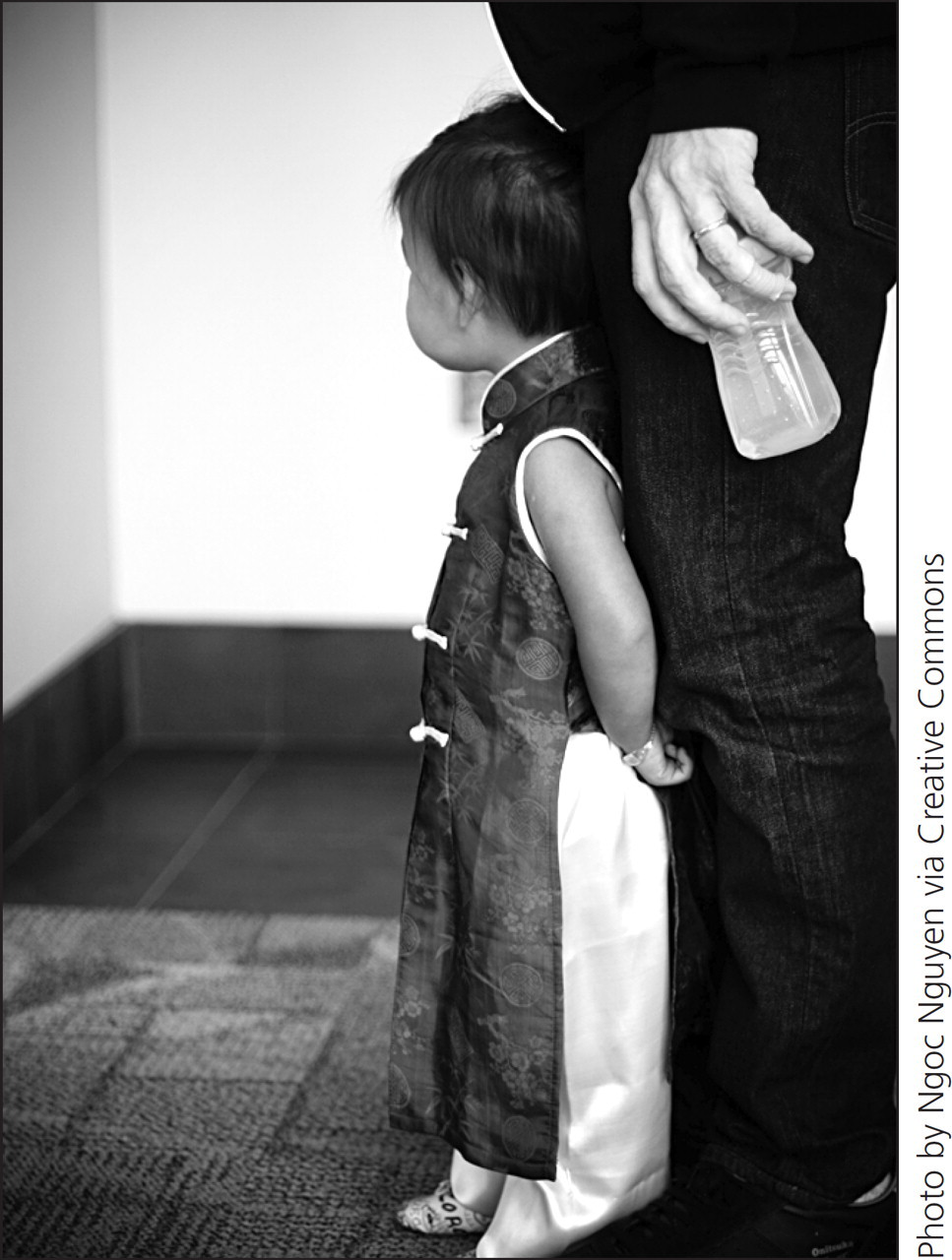
As a participant observer, I learned that culture camps' identity construction often reflects an Americanized version of national or ethnic cultures. For instance, both of the camps I attended sponsored a closing celebration during which the families dressed in clothing and ate food from the birth country of their child. Some parents acquired this “native” (typically ceremonial) dress when they visited the child's birth country during the adoption process, while it was the recent popularity of “ethnic” clothing (in particular, Asian and Latin American inspired trends) in retail chains such as Old Navy that made dressing “native” easier for the others. Moreover, campers were presented with a depiction of their national or cultural origins that often overlooked important cultural differences. Tribal, regional, national, and religious cultures were effaced, and children and their parents were presented with a monolithic, Americanized version of “national” food, clothing, and culture.
Culture camps like those I visited typically expose adoptees to aspects of their native culture that can be easily compartmentalized into the space and experience of camp. Cultural “artifacts,” ranging from models of Aztec temples made of Styrofoam to paper umbrellas with Chinese characters on them, are, according to one camp founder, meant to help children understand “how beautiful the world is.” But, there is little evidence that the children connect these projects to their own identity. Both parents and children made it clear to me that the native clothing was specifically for camp, and although they were excited to wear it, they immediately changed into their everyday clothes after the events. Further, the food at the camps was unfamiliar to the campers, and none of them knew the names of, or ingredients in, any of the “native” dishes. This food was supplemented with items from the children's “normal” diet, including pizza and buttered noodles. Although camps present elements of the children's birth cultures, these aspects can be easily inhabited and easily shed. The cultural markers do not appear to be integrated into the campers' durable identities.
Children at Concordia University-Saint Paul's Hmong Culture and Language Program Summer Camp.
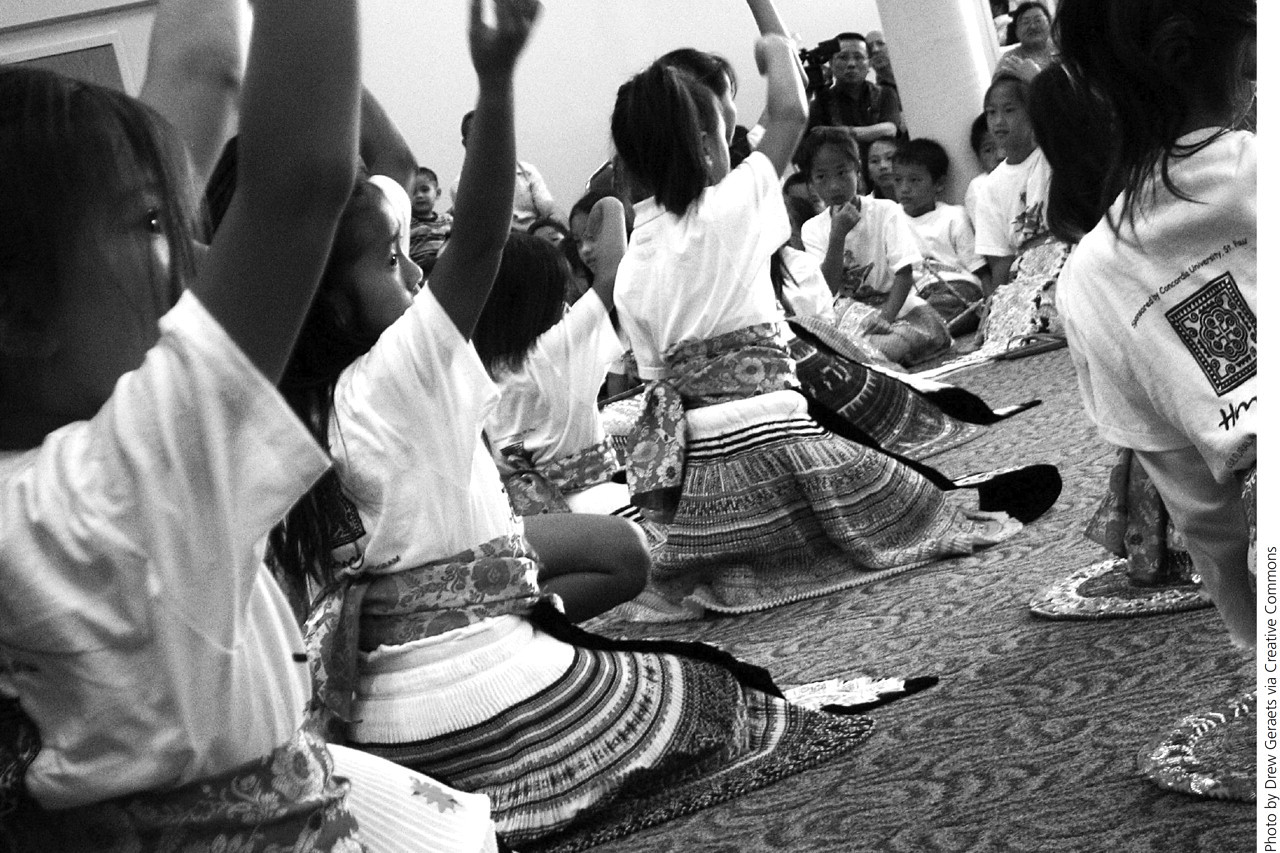
Whether or not culture camps are able to teach international adoptees about belonging to a particular culture, they do provide a space for the children to meet and gain a sense of confidence and pride about their adoption. Camps create a space for children and parents to network and support each other, and to normalize international adoption. As one mom said of her daughter's camp experience, “It is important for our children to have a place where they are in the majority and don't have to explain anything about their adoption or why their parents do not look like them, or how we are their real parents.” Parents reported this was keenly important to the identity development of older non-white campers because their ethnic and racial differences were being called into question by peers and, more frequently, peers' parents when they started dating. These teens, struggling to reconcile the outward aspects of their differences with their experience of being raised by white, American parents, connected with each other at camp. In large part, the camps function to create an adoptee culture.
Even if it's possible to do so, how can race, ethnicity, and culture be distilled into particular components and taught to children? While other groups, such as third generation immigrants, may also search for cultural connections to their origins, international adoptees lack guidance from parents or other relatives with connections to this culture. Because culture camps also serve families adopting children from countries such as Russia or Ukraine, they can unintentionally focus attention on the salience of visible differences to emphasizing or de-emphasizing ethnicity for white ethnics. And despite their potentially instructive role for scholars seeking to better understand the ways that race and culture “work,” culture camps seem to fail as a form of ethno-racial socialization. Ultimately, though, the camps succeed as support systems for transnational adoptive families, normalizing the families' experiences and helping campers cultivate their identity as adoptees.