




Abstract
The 20th century saw women take the workplace by storm. Now, the revolution has reached higher education, as women outpace men in college graduation and continue to narrow the gap in professional degrees.
Sociologists have long questioned whether the mass media reflects or shapes reality. Such questions are difficult to answer, especially when it comes to working women on television. Take, for instance, Kyra Sedgwick (playing a female detective in TNT's The Closer) and Archie Panjabi (portraying a female private investigator in CBS's The Good Wife) who won the Best Actress and Best Supporting Actress awards, respectively, at the 2010 Emmys. Their small screen dramas are among today's many popular shows featuring women in the roles of detective, lawyer, crime scene investigator, and police officer—and often showing their heroines as much more street-savvy than their male partners (see the franchises CSI, Law and Order, Saving Grace, In Plain Sight, Castle, and Chase). Are these depictions fact, fiction, or somewhere in between?
In 1994, Phyllis Moen described the steadily increasing numbers of women in the paid labor force as the “revolution in gender.” Nearly 20 years later, Americans may be witnessing another, albeit slightly different, revolution in gender. Women are currently outpacing men when it comes to college graduation and labor force participation, and they are rivaling men when it comes to holding jobs in law, medicine, and other traditionally male-dominated professions. The Bureau of Labor Statistics (BLS) reports that 61 percent of all women were in the labor market in 2009 (compared to 40 percent in 1975) and that women outnumbered men in the workforce for the first time in 2010. According to BLS data, 64.2 million payroll employees were women (just 63.4 million were men) in January 2010.
What accounts for these patterns and whether they are a blip or a continuing trend? Some economists say that women now outnumber men in the labor force because the current recession has disproportionally struck male-dominated industries including finance, insurance, real estate, and construction. Pundits have even dubbed the economic climate a “he-cession” or “man-cession” to reflect the fact that 80 percent of the jobs lost in the downturn had been held by men. Still, though, many experts expect the trend to reverse or plateau once the recession passes.
25-34 year olds who completed at least 4 years of college: Source: Current Population Survey
Note: Data not available for each consecutive year prior to 1964
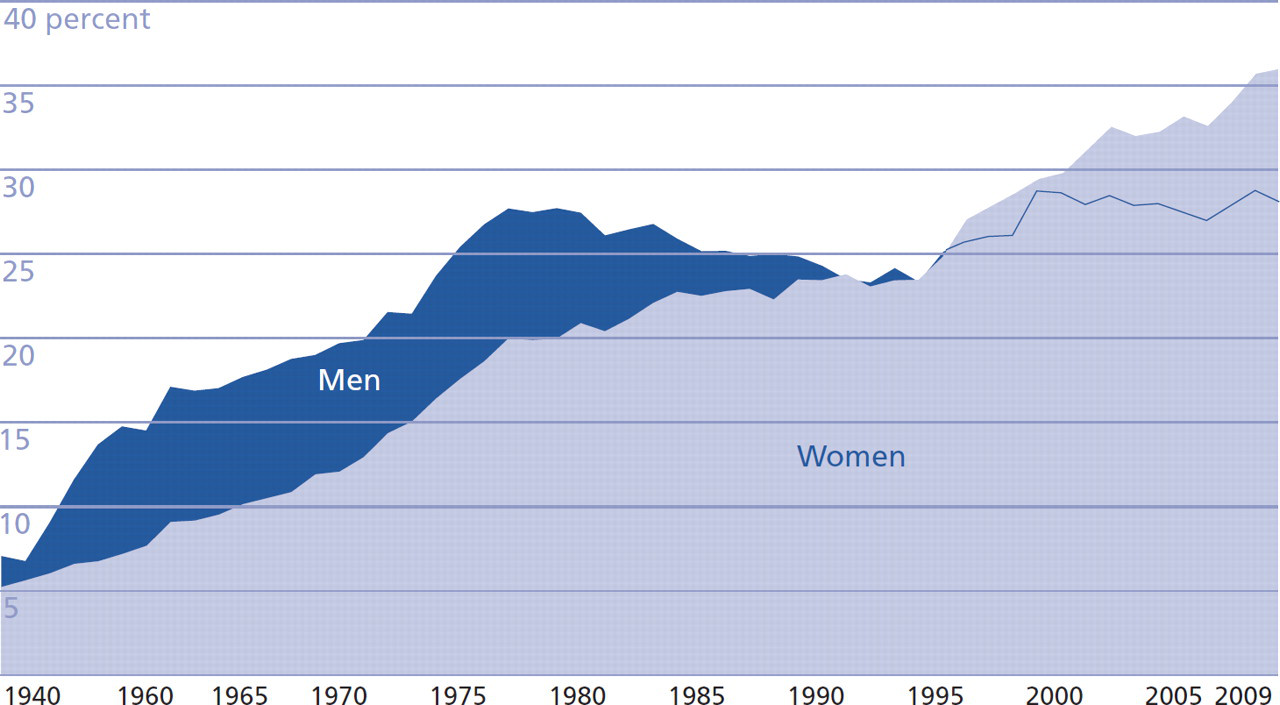
Other observers counter that the trend of women outpacing men in the workforce is here to stay. A shift in educational attainment is the main reason behind the steady rise in women's employment. Since 1991, the percentage of young women both attending and graduating college has outpaced men; a greater proportion of women ages 25 to 34 have completed four years of college or more, relative to their male counterparts. And by 2009, about 36 percent of young women completed at least a four-year college degree, compared to 28 percent of young men.
This new gender revolution is increasingly visible on college campuses; according to the Census Bureau, 53 percent of college students in 2008 were women. Experts project that women will soon outnumber men on college campuses by a ratio of 1.5 women per every one man. The “degree gap” is more pronounced for racial and ethnic minorities, especially for blacks. Black women outnumber black men almost two to one in higher education. This striking trend suggests that women may become the majority of American workers, provided they are given the opportunities to blend work obligations with family responsibilities and female-friendly policies.
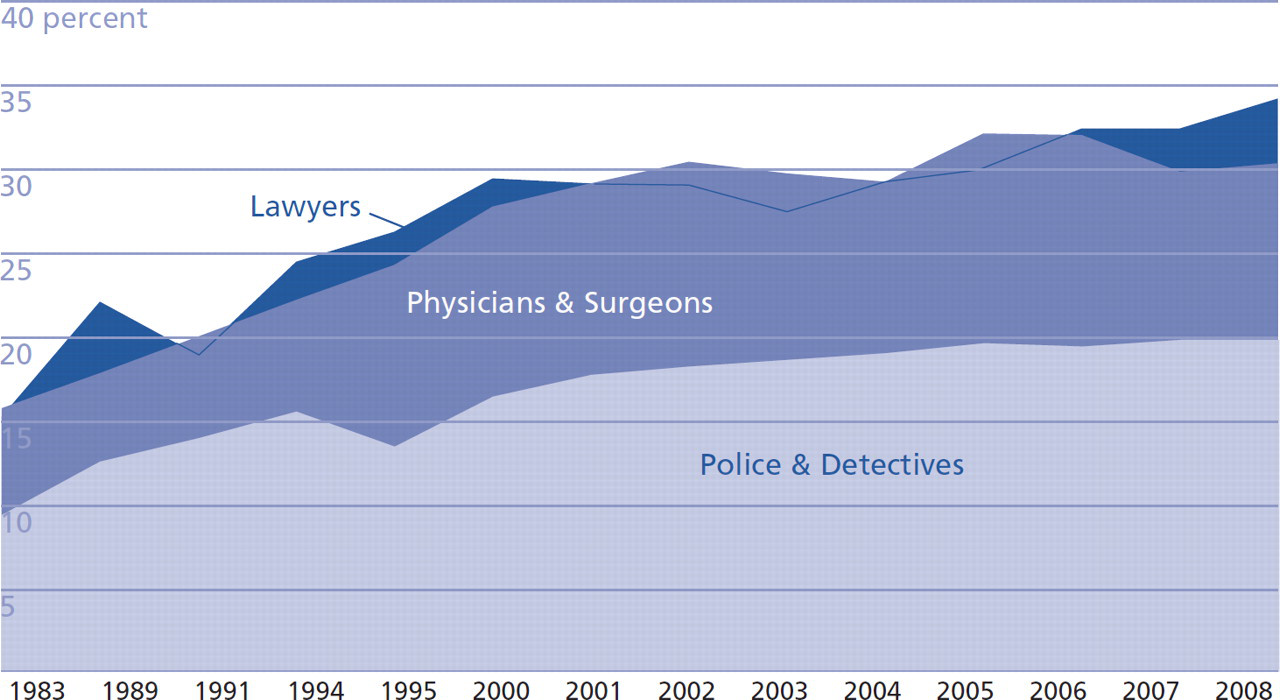
It's not just women's rates of overall employment that are remarkable, but the fact that women are steadily filing into occupations that were historically men's domains. I focus here on just three: detectives, lawyers, and physicians. Although the gender composition of these three occupational groups is not yet 50:50, the pace of change is very steep. The chart on the next page illustrates changes in these three occupations. You can see, for instance, how the percentage of all police officers and detectives who are women has increased steadily over the past 25 years.
Women in historically male-dominated professions: Source: U.S. Census Bureau
Note: Percentage in Police & Detectives was estimated after 2002 due to changes in Census Bureau occupational and industrial classification systems.
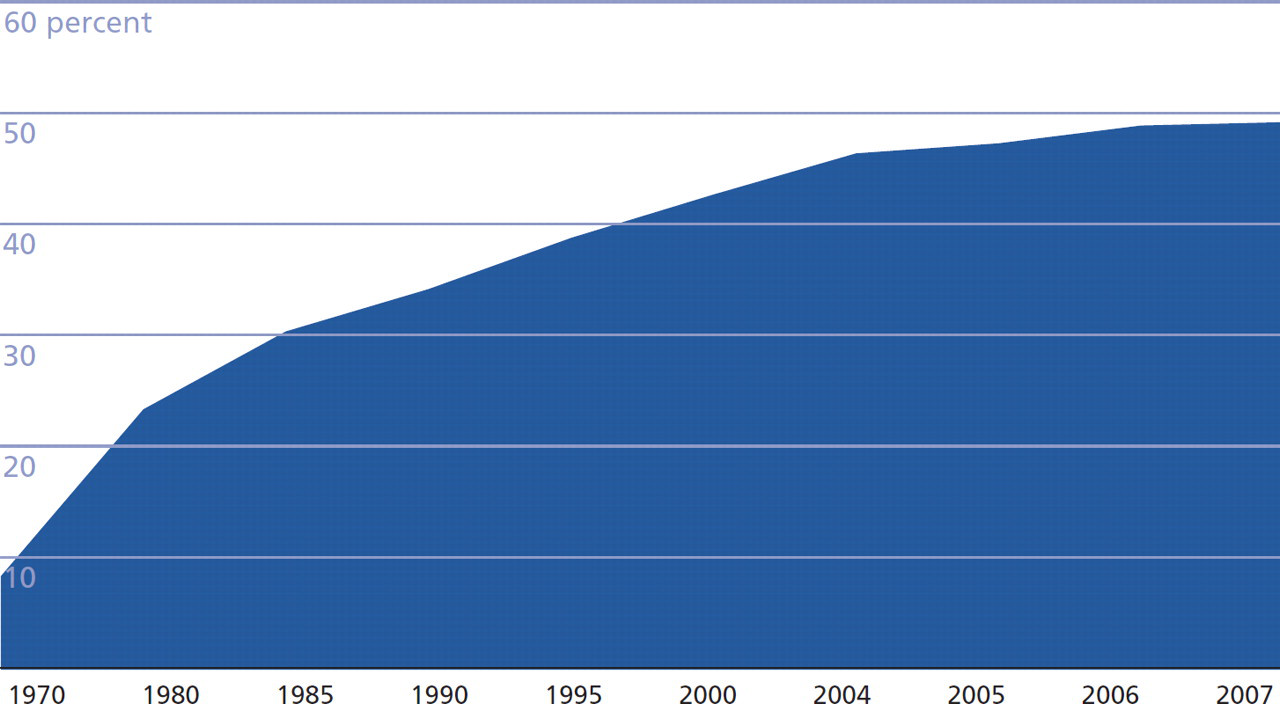
Women in medical school enrollments: Source: U.S. National Center for Education Statistics, Digest of Education Statistics
Similar trends are evident for the highly prestigious and historically male-dominated professions of law and medicine. The proportion of all lawyers who are female more than doubled, rising from 15 percent in 1983 to 35 percent in 2008, and a virtually identical pattern emerges for medicine. While 16 percent of physicians were female in 1983, by 2008 this proportion increased to 31 percent. The fact that one third of doctors and lawyers are women reflects the considerable strides that women have made in education over the past three decades.
Experts anticipate that this pattern will continue; the entering classes of medical schools and law schools now include more women than men. According to the Association of American Medical Colleges, female applicants to medical schools outnumbered male applicants in 2003 and women comprised nearly 50 percent of graduates of medical schools in 2008. The U.S. National Center for Education Statistics reported that half of those who earned a Doctor of Medicine degree in 2007 were women. (The chart above demonstrates this remarkable change in the proportion of women enrolled in medical schools).
Further, 2009 marked the very first time American women earned more doctoral degrees than men, according to the Council of Graduate Schools. Women represented approximately 51 percent of awarded doctorates (although men continue to earn the majority of doctorates in traditionally male-dominated fields such as engineering with 78.4 percent and mathematics and computer sciences with 73.2 percent).
With more young women represented in higher education and the current recession, labor market analysts project that women will outnumber men in the labor force, at least for the foreseeable future. This partly reflects the fact that the majority of women still are employed in recession-resistant (and female-dominated) fields such as education and health care. At the same time, an increasing number of women are making inroads into a wide variety of male-dominated fields beyond law, law enforcement, and medicine to fields such as technology and finance.
These strides do not necessarily reflect a wholly “good news” story, however. Women are still more likely than men to exit the labor market when they have children, and many face institutional obstacles as they strive to balance work and family. Although the gender pay gap is now at its all-time narrowest, where women now earn 82 cents per every dollar earned by a man, the declining gap is due to the erosion of men's earnings rather than an increase in women's pay. The true “gender revolution” will be achieved only when men and women earn equal and sufficient economic resources to support themselves and their families.