



Abstract
Collaborative efforts in the Ozarks develop and apply knowledge about social capital to bolster civic engagement.
Keywords
We sociologists tend to talk a lot about “public sociology” and “engaged scholarship.” We do so because our goal is to bring the insights of our field to the wider world, to make a difference. And in the Ozarks, we're doing just that.
Over the last 20 years, research has shown that social capital can be understood as an indicator of well-being at the community level. It has many important benefits for both individuals and communities. In the fall of 2007, the Community Foundation of the Ozarks (CFO), whose mission is to “enhance the quality of life [in the Ozarks] through resource development, community grantmaking, collaboration, and public leadership,” released its third Community Focus Report, designed to foster civic discourse and guide public policy by identifying numerous community strengths and weaknesses. In essence, the report measured social capital. By sheer coincidence, while the CFO was seeking to systematically address community strengths and weaknesses in an effort to guide public policy, we in the sociology department at Missouri State University (MSU) were in the early stages of building a public sociology emphasis to demonstrate how rigorous social science could benefit the community.
This is a story about how studying social capital—networks of trust, interaction, and reciprocity among people— has aided in community development by identifying civic engagement as a problem. It is also a story about how studying social capital unexpectedly integrated our group of sociologists into the community development process and actually stimulated the creation of new social capital.
Introducing Social Capital to the Community
Missouri State University is located in Springfield, Missouri, a mid-size city in Greene County in the northern part of the Ozarks. This the fastest growing region of the state; home to five colleges and two major health care systems, Springfield serves as the major metropolitan hub for southwest Missouri. Often referred to as the “Buckle of the Bible Belt,” the city is home to multiple mega-churches, as well as the international headquarters of the Assemblies of God and its national university, Evangel University. Social life for the area's large population of evangelical Christians typically revolves around attending church and participating in faith-based groups and clubs. The city is uncommonly homogeneous: it's 93 percent white, and many of Springfield's citizens hold conservative opinions on a range of cultural and social issues. Its residents face a wide range of social problems including relatively high rates of alcohol and drug abuse, along with high rates of domestic violence and child abuse. Compounding these social problems is the fact that the city government has been trying to rebuild its reputation following several recent high-profile scandals.
To help civic leaders make sense of these challenges and possible approaches to dealing with them, sociologists at Missouri State University set out in the spring of 2008 to provide a systematic description of community well-being in the Ozarks. We looked at using the Social Capital Community Benchmark Survey, which measures levels of trust, social networks, and civic engagement, because we believed that the concept of social capital had direct relevance. One of us (Mike Stout, newly hired at MSU), suggested that the Social Capital Survey could be used for the next Community Focus Report in 2009, especially the section on Citizen Participation. Soon, three of us (Stout, John Harms, and Tim Knapp) had set up a meeting with CFO leadership to discuss working together on the next Report and using the Social Capital Survey. At the meeting the CFO representatives enthusiastically expressed interest in reliable, systematic information on their community's strengths and levels of civic participation to inform their next Report. We agreed to collaborate.
Seeing how the collaboration would promote both MSU's public affairs mission and the public sociology initiative, the school provided an $8,500 grant to fund our research and support this work. With the grant money, we hired university students to administer the survey through MSU's Center for Social Sciences and Public Policy Research. By the end of June, 800 Greene County residents had been surveyed about their various social connections and their levels of trust. For an academic timeline this is extensive, quick work.
Levels of general trust
Eventually, our survey results became a 30-page report presented to the CFO's Community Focus Report steering committee, comprised of numerous community leaders. The committee was intrigued by our report, and a lively discussion of its implications followed the presentation. Our team was invited to present the report to the Mayor's Commission on Children, the City Manager and city department heads, the United Way of the Ozarks, and the Good Community Committee, a civic group made up of leaders from business, government, media, and faith-based communities. In addition to the presentations, the report was also the focus of two separate discussions on Springfield's local public radio station, KSMU. The first radio interview involved a discussion of neighborliness in the Ozarks, and the second summarized and addressed the main findings of the Social Capital Survey. As a result of these highly-visible engagements, our survey findings came to circulate among a diverse network of Springfield's community leaders, policymakers, and citizens.
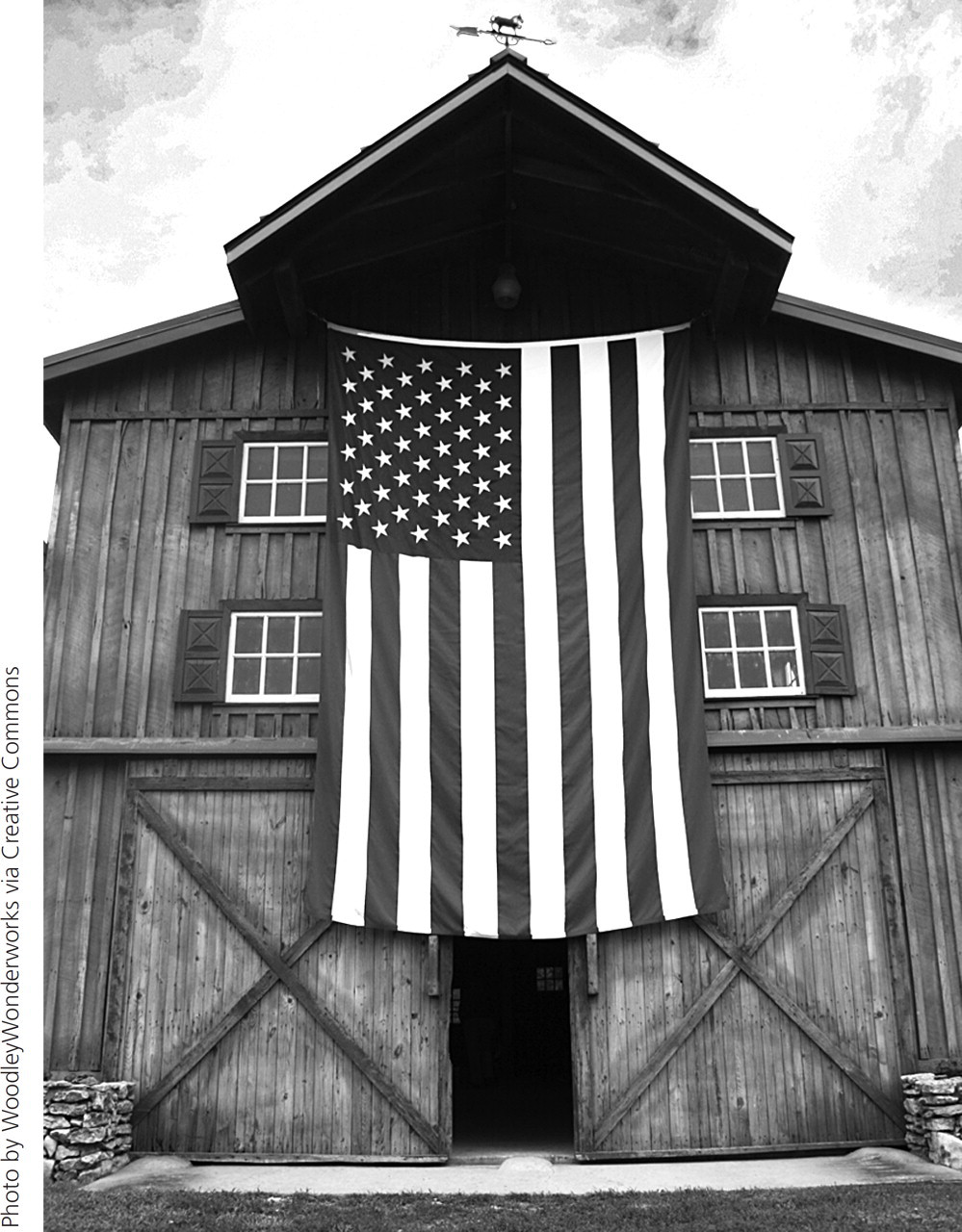
A barn in the Ozarks, decorated for the Fourth of July.
Levels of local trust
Survey Findings
The Social Capital Survey asks questions related to social capital and civic engagement. Measuring social capital involves taking into account the attitudinal (e.g., trust and reciprocity) and structural dimensions (e.g., the characteristics of network ties) of social networks, as well as membership and participation in voluntary associations. Therefore, we asked questions that tapped each dimension. For example, the question, “Generally speaking, would you say that most people can be trusted or that you can't be too careful in life?” helped us understand attitudes, while, “How many of the people that you trust are you pretty certain attend religious services on a regular basis?” hit on more concrete patterns of behavior and interaction. “In the past twelve months, have you served as an officer or served on a committee of any local club or organization?” gave us measures of activity and membership in social networks, institutions, and organizations.
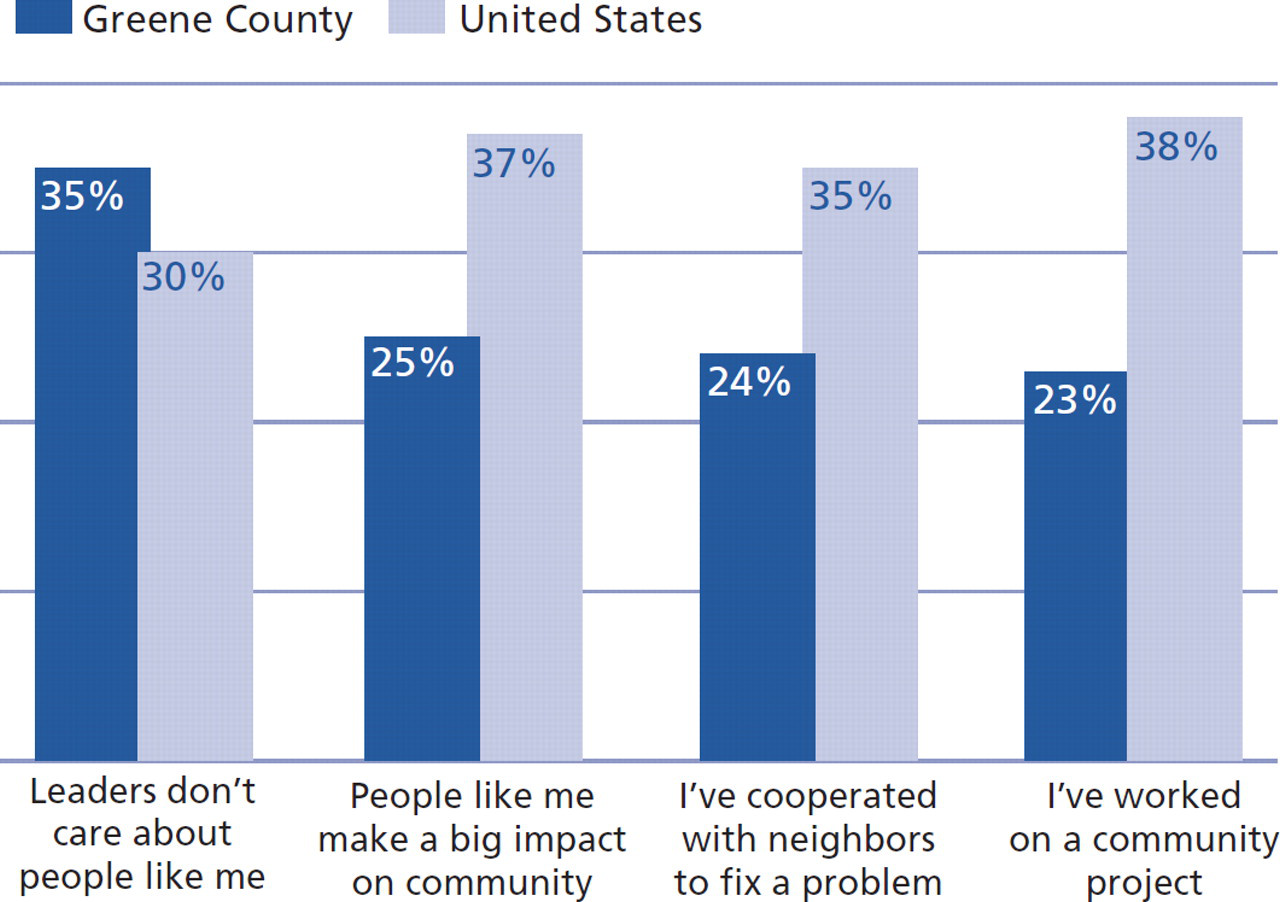
The attitudinal measures of civic engagement also examined levels of political alienation (“The people running my community don't really care much what happens to me”) and political efficacy (“How much impact do you think people like you can have in making your community a better place to live?”), while the behavioral measures of civic engagement examined both individual actions (“Did you work on a community project in the past 12 months?”) and cooperative efforts (“In the past two years, have you worked with others to get people in your immediate neighborhood to work together to fix or improve something?”)
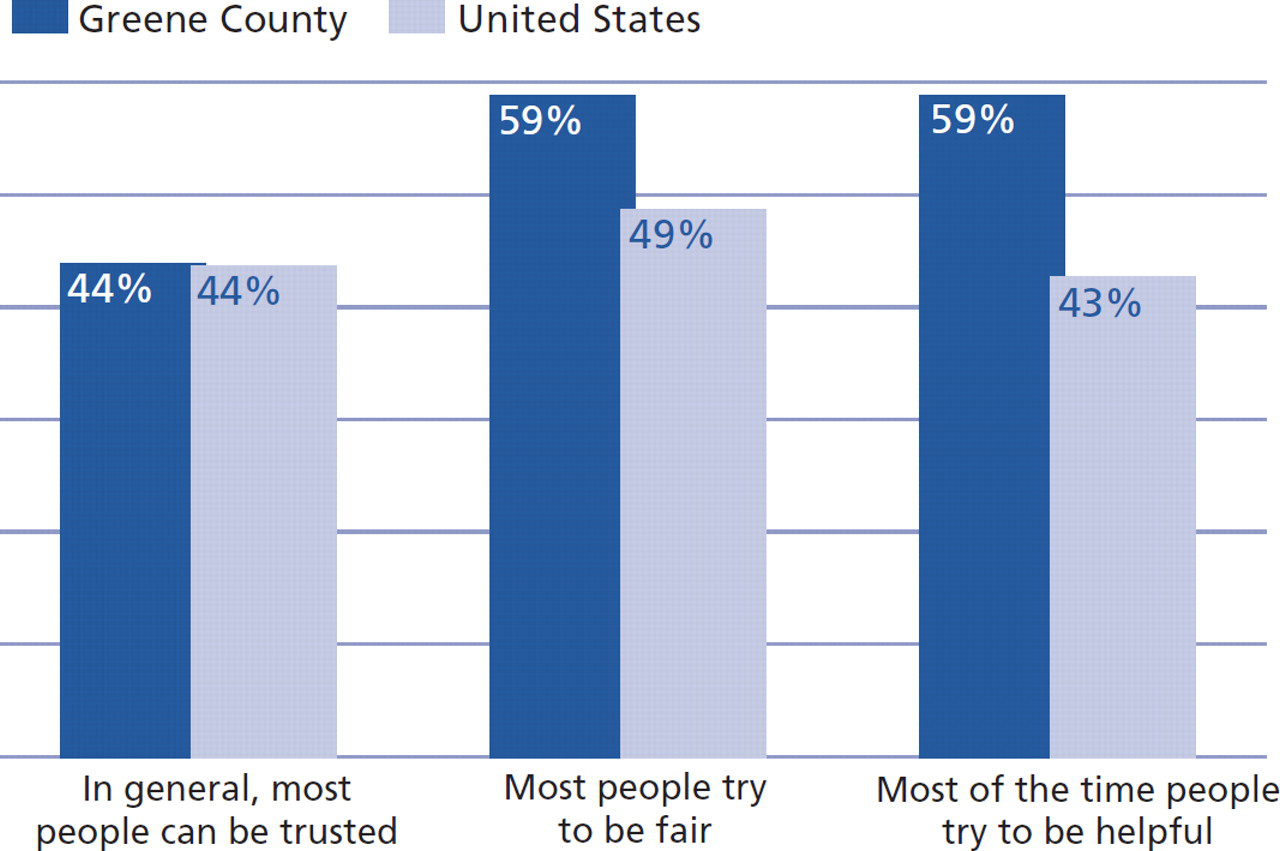
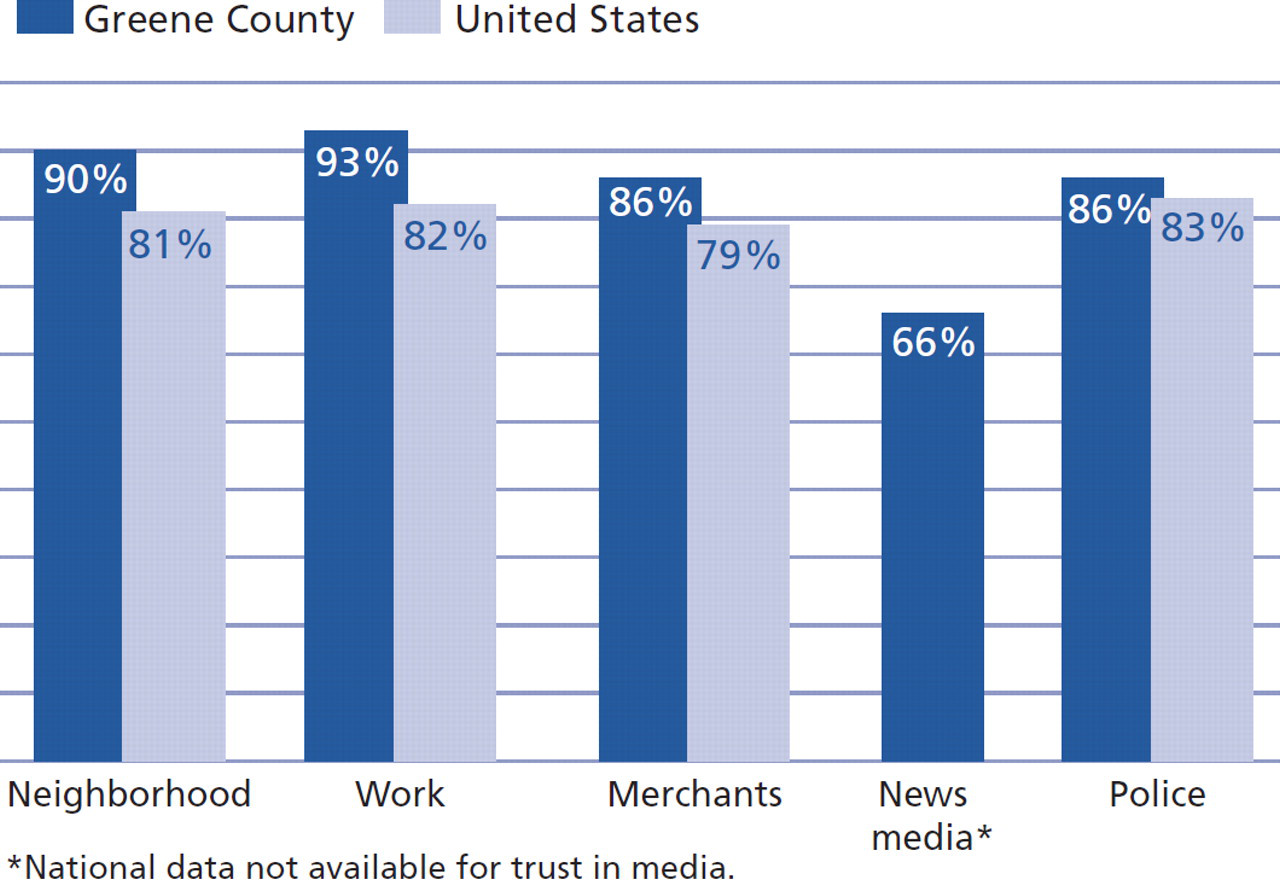
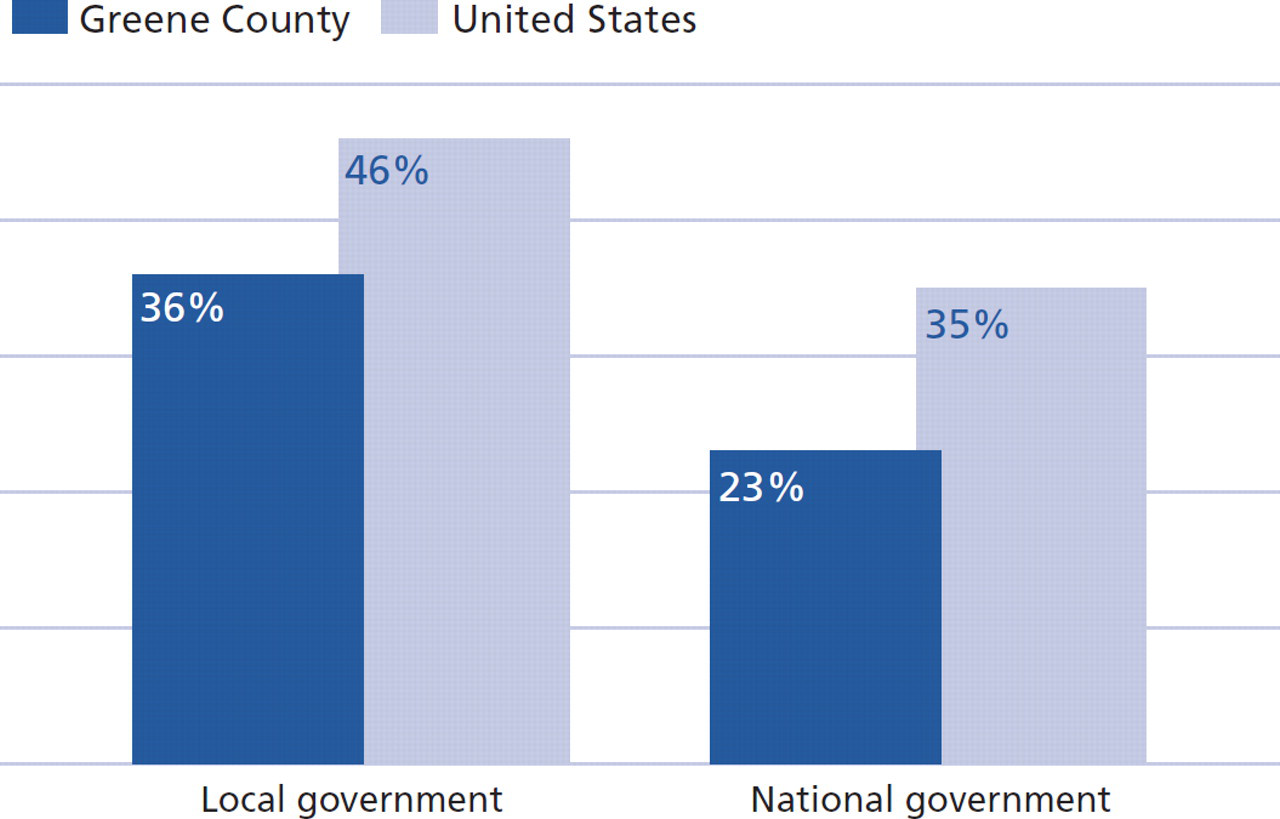
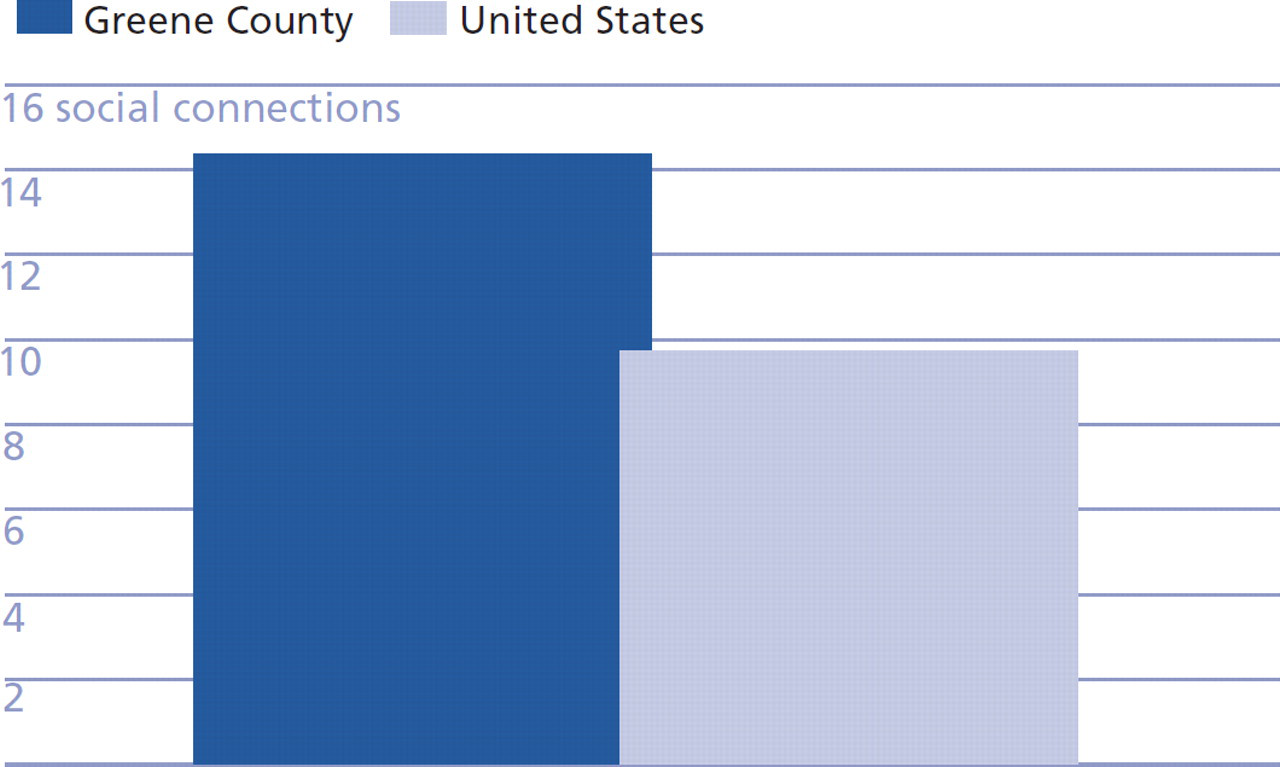
The Social Capital Survey revealed that, overall, Greene County residents had more social capital than Americans as a whole (see above), and Ozarkers had strong connections to their neighbors and voluntary associations, supported by strong levels of trust. Theoretically, these results would suggest high rates of civic engagement. But, while levels of social capital were high, levels of civic engagement and political efficacy were low (see above). This finding ran counter to the CFO's 2007 Community Focus Report, which claimed that “past history suggests that citizen involvement will continue to provide the important social capital that makes the Springfield region successful.” Civic leaders seized on our contradictory conclusion: they sprang into action asking how to explain it and what to do about it.
Trust in local and national government
Our social capital report provided a new foundation for identifying and understanding the community's strengths and weaknesses. Now Springfield's community leaders had a specific problem to address—low civic engagement—and the social capital language giving them a framework to take it on. According to CFO Executive Vice President Brian Fogle, the social capital report “has done a remarkable job in changing our vernacular and dialogue in the community.” Similarly, City Manager Greg Burris commented, “the Social Capital Survey report proved to be extremely valuable to the city of Springfield and others interested in re-establishing civic engagement in our community.” This was reflected in the CFO's second Community Focus Report, released in early 2009, which contained a summary of the Social Capital Survey findings.
According to the 2009 Report: “Compared with a national sample, Springfield-Greene County had larger social networks than the national average and were more likely to believe that people in general and their neighbors and coworkers are trustworthy… Distressingly, the Social Capital Survey found that 35 percent of local residents believe that the people who run the Springfield-Greene County community do not care about them and only about 25 percent (compared to 37 percent nationally) believe they can make their community better.”
The survey presented a perplexing riddle: How can Springfield have high levels of social capital, yet low civic engagement and strong feelings of political alienation? We knew from the data that most social capital indicators were stratified by education, income, and age, suggesting that there were barriers to forming bonds. At the same time, the data on religious-based social capital were not stratified by these factors, suggesting that religion promoted social solidarity. These findings resonated with political scientist Robert Putnam's concepts of bridging and bonding social capital, so we introduced them into the dialogue about the results.
Alienation, empowerment, and civic activities
We explained that bridging social capital is characterized by high levels of generalized trust and less intense, or weak, social ties that connect people who are different from each other, while bonding social capital is characterized by high levels of in-group trust and more intense, or strong, social ties that connect people who are similar to each other. The concepts of bridging and bonding social capital called attention to the nature of the ties that connect people and suggested a solution to the riddle. Springfield's high levels of social capital but low civic engagement came from its strong bonding social capital and its weak bridging social capital.
Studying social capital has created new social capital in the Ozarks.
The survey findings clearly revealed how powerful religiosity is in the structure of our community's social relations. For example, while Springfield citizens had more social connections than the national average (see p. 24), those connections were mostly attributable to friendships within their religious congregations. That is, they had high levels of bonding social capital. We knew from organization and strategy researcher Sean Safford's (2009) book Why the Garden Club Couldn't Save Youngstown that networks with diverse ties were more innovative and democratic than those with more homogeneous ties. This is because bridging social capital provides people with access to economic, social, and political resources that lie beyond the boundaries of their primary groups. With that in mind, we suggested to civic leaders that the lack of civic participation was related to the difficulty of getting diverse groups of people to work together to solve community problems. Specifically, there needed to be higher levels of interaction and participation with civic leaders on the part of Springfield's religious community.
Average size of social networks
Community Responses
Informed by the distinction between bonding and bridging social capital, civic leaders began incorporating ideas for building bridging social capital into the community development process. For example, a Diversity and Economic Development conference was sponsored by MSU. The conference explicitly incorporated bridging social capital as part of the discussion on ways to promote diversity in Springfield. Panelists at the conference included representatives from a wide cross-section of Springfield's civic leadership, including the CFO, the Council of Churches, the Springfield Chamber of Commerce, and the county and municipal government. Tim Rosenbury, the CEO of the Springfield Chamber of Commerce, repeatedly emphasized the need to build bridging social capital to spur community and economic development. The conference participants demonstrated how the results of our Social Capital Survey, which was mentioned repeatedly, would facilitate discussions on community development amoung diverse groups.
Unlike physical capital, which depreciates, social capital accumulates as it is used.
The Social Capital Survey findings also informed City Manager Greg Burris's decision to make building social capital and increasing civic engagement one of the four major focal concerns guiding the city's long-range planning process. As part of that process, Burris conducted a series of community “listening tours.” Consistent with his concern for diverse participation, Burris also structured the committee memberships of the planning process so they'd include a mix of local volunteers, professionals, and community leaders. As a result of his work on the social capital study, Burris asked Stout to serve on the Strategic Plan Coordinating Committee, which will unite the findings of thirteen separate sub-committees around the issues of civic engagement and social capital. Burris also asked our team to lead a discussion with the Coordinating Committee on how social capital can inform strategies for increasing civic engagement.
The Springfield Civility Initiative serves as another example of how the findings from our social capital research have made an impact in the community. In addition to his role at the CFO, Brian Fogle also chairs the Good Community Committee. Under his leadership, the group has decided to focus on civic engagement as a result of the Social Capital Survey findings. Specifically, the committee is concerned that there is a lack of civility in the public debates surrounding the important issues confronting Springfield. The group has begun an initiative to encourage constructive, civil discourse. The decision to focus on civility was based, in part, on the emerging understanding that building bridging social capital requires norms of civility and bonds of trust so that different viewpoints can be heard and considered. The decision was also informed by the experience of Duluth, Minnesota, whose own community foundation had commissioned a Social Capital Survey and successfully launched a city-wide civility initiative.
Following the Duluth model, and in response to the findings of the Springfield Social Capital Survey, the Good Community Committee has formed a steering committee to investigate ways of promoting civil discourse in the Ozarks. Fogle, who organized the steering committee, recruited a diverse array of local citizens, including one of us (Stout), who have become actively involved in the community's dialogue on civic engagement and community development.
One thing that has become apparent as the Social Capital Survey findings circulate is the recognition by community leaders that social capital is a valuable resource for community development. A significant part of that value involves the vernacular of social capital, especially the distinction between bridging and bonding social capital. The language of social capital has given the civic leaders in our community a common starting point for discussing civic engagement and has highlighted the important role played by bridging social capital. This discussion has united a diverse group of civic organizations and generated new community networks based on trust and reciprocity.
Tellingly, one consequence of learning about and understanding social capital in the Ozarks has been the creation of new networks of trust bridging government, business, philanthropic, academic, and faith-based groups. The new networks allow a much wider group to collaborate on solutions to the problem of civic engagement. Put simply, studying social capital has created new social capital in the Ozarks. This development reflects a distinguishing characteristic of social capital. Unlike physical capital, which depreciates with use, and can often only be used by one person at a time, social capital accumulates as it is used (generally by many people at once). In terms of developing community and civic engagement, then, finding ways to invest in social capital is crucial, and community leaders in Greene County have come to recognize this.
Next Steps
Our work on social capital in the Ozarks will continue, and the scope of our project will be expanded. The community-wide discussion of social capital and civic engagement has prompted Conco Companies (a local construction company), the Community Foundation of the Ozarks, the Missouri State University Foundation, and the Springfield Chamber of Commerce to collaborate with us and fund a second Social Capital Survey. In the second survey, we will build on the findings of the first study and expand it to include the ten-county region served by the Ozarks Regional Economic Partnership. Moving beyond Greene County is necessary in order to address several regional issues such as the outmigration of young professionals and the in-migration of lower socioeconomic groups who are putting a strain on social services providers in the area. Additionally, we will examine how social capital and civic engagement are distributed across neighborhoods in the region, which will help identify areas where increases in social capital are needed.
As with the 2009 Report, the 2011 Community Focus Report will be informed by a survey of social capital and our collaboration with the CFO will continue, except this time Harms will serve on the Report's steering committee. Combined with Stout's participation in both the civility committee and the city's planning process, Harms's inclusion on the Report's steering committee shows how measuring social capital has developed and bridged new networks within the community. What began as a collaboration between a few sociologists from Missouri State University and the Community Foundation of the Ozarks has expanded into a diverse network that includes the Springfield Chamber of Commerce, the City of Springfield, Conco Companies, and Springfield's faith-based community.
This year, through funding provided by MSU, we are also collaborating with the National Conference on Citizenship to produce a report on the Civic Health Index, which also measures social capital and civic engagement for the state of Missouri. Taken together, the collaboration with the NCOC on the Missouri Civic Health Index and the collaboration with the local community on the second round of the Social Capital Survey will expand public discourse beyond the Ozarks to the entire state of Missouri and will help create a statewide network concerned with civic participation, with MSU at the hub.
Looking back, the Social Capital Survey findings and vernacular promoted the development of new social networks concerned with civic engagement and community well-being, and they also provided fertile ground for the practice of public sociology—the essence of which is academic and community collaboration. When this project began, we had no idea that we would become so enmeshed in the community development process. This project has also set the stage for our students to become involved with public affairs and to become active participants in the community dialogue surrounding civic engagement. What we have observed in the Ozarks reflects a larger trend occurring across the United States, where divisive social issues and deteriorating economic conditions have weakened civil society. This fraying of social ties and weakening of civil society ultimately undermines democratic participation. Our story of measuring social capital in the Ozarks provides solid evidence that it is a powerful tool for understanding and building community in the 21st century—and it describes one way that public sociology can be practiced successfully.