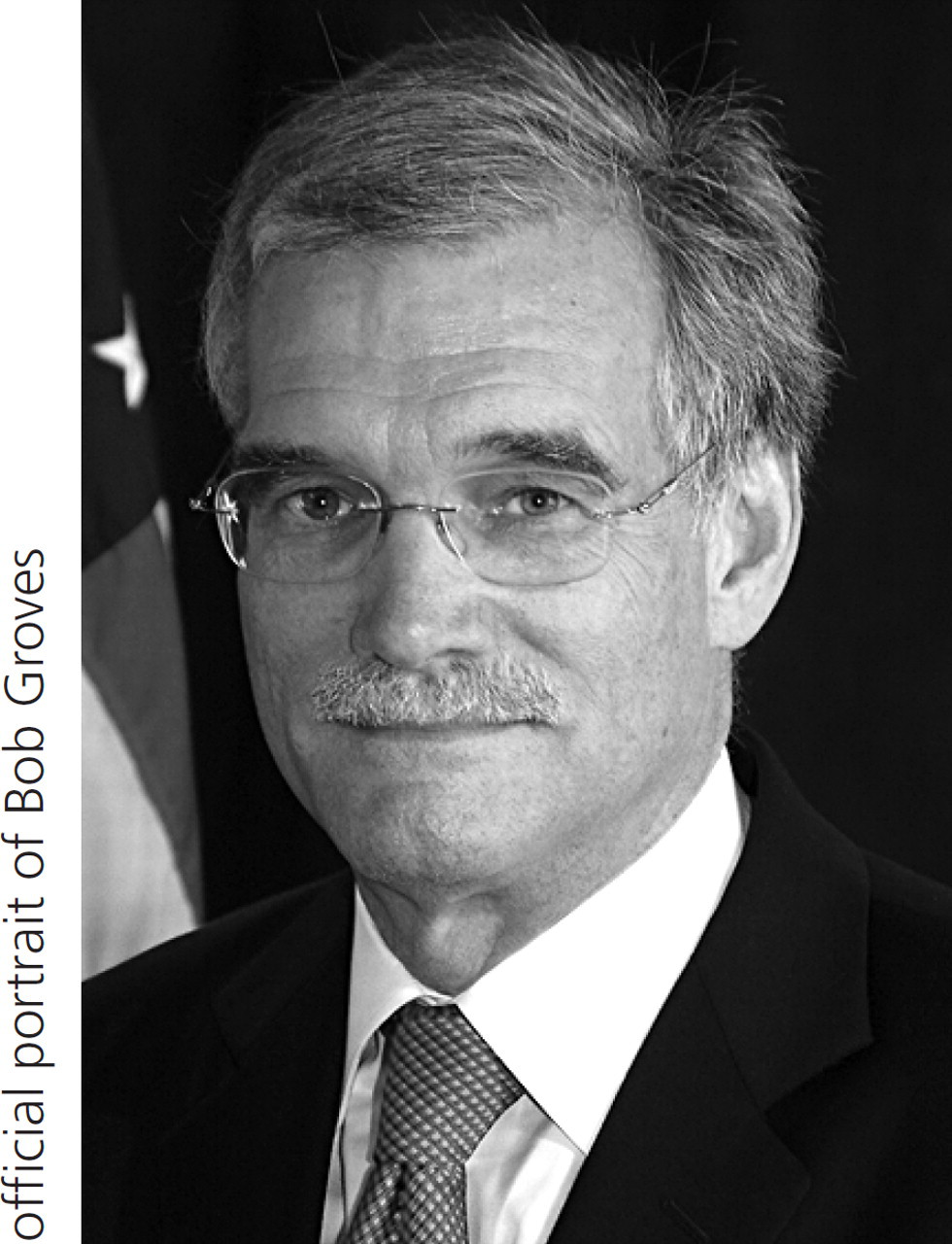
In the Fall 2010 issue of Contexts, we reached out to a number of high-level government sociologists to learn just how they ended up in our nation's capital. Among those influential social scientists and public servants was the U.S. Census Director, Bob Groves, who graciously agreed to sit down with Contexts' graduate board alumnus Jesse Wozniak to get into the nitty gritty of the scope, mechanics, and mission of his bureau and its most famous project: our “national ceremony.” In their wide-ranging discussion, Wozniak and Groves covered once-a-decade enumeration, what happens in the off-years, and just why we count the way we do.
Jesse Wozniak: The Census Bureau doesn't just collect the Census once every ten years and go away like Punxsutawney Phil. Let's start with the other things the Census Bureau does.
Bob Groves: The Census Bureau is the largest data collector in the United States of things that are relevant to sociologists, I think, so it is the sorts of information about basic demographic trends, of the diversity of the population racially and ethnically, it is the source of information of a lot of welfare—[that is], how well is the society doing… Some of that comes from a very, very large sample survey called the American Community Survey, which is constantly going on and generates data sets that can be reanalyzed by sociologists around the world (and, indeed, data sets that are analyzed). On the economic side of the society, we collect a lot of the basic data you see in newspaper articles about how we're doing as an economy. So, housing starts (what new housing construction is going on), retail sales, the movement of firms in size and basic health of firms, all those data come out of the Census Bureau, and that's what we do the “other nine years.”
JW: What might be some statistics that a non-researcher might have actually seen from the Census Bureau?
BG: Well, two that are really quite prominent, especially in these times of a deep recession, [include] the unemployment rate. [It] is a number that's released… the first Friday of every month … by the Bureau of Labor Statistics. It's a survey that we do jointly with the Bureau of Labor Statistics, so we at the Census Bureau collect those data. … [A] similar arrangement is with the Consumer Price Index. So if you ask the question, “Is the cost of living going up? Are the prices of consumer goods going up?” those are the basic data that supply that. But it goes beyond that. We collect data for a lot of different agencies. Our knowledge, our understanding of how people face different likelihoods of being victimized by crime come from data that are collected through the Census. So, mention a topic of interest to sociologists, and …there are pretty high odds that we're collecting some sort of data relevant to it.
JW: Even now, we do a full Census, knocking on every door across the country. And some argue that a sample Census could make more sense and maybe even be more accurate. What does a full Census give us over a sample Census that might be faster, cheaper, easier?
BG: That's a great question, an important question, actually … Read Article 1, Section 2 of the Constitution. … The Census looks like a statistical or social science kind of event, but in this country, it really is an event that was specified for surely political reasons: the reapportionment of the House of Representatives. In the Constitution, the words are “There shall be an actual enumeration of the population.” Most scholars believe the word “actual” means a contemporaneous enumeration, but there have been a lot of court cases about [it], since political power and large sums of federal money are at stake on population counts.
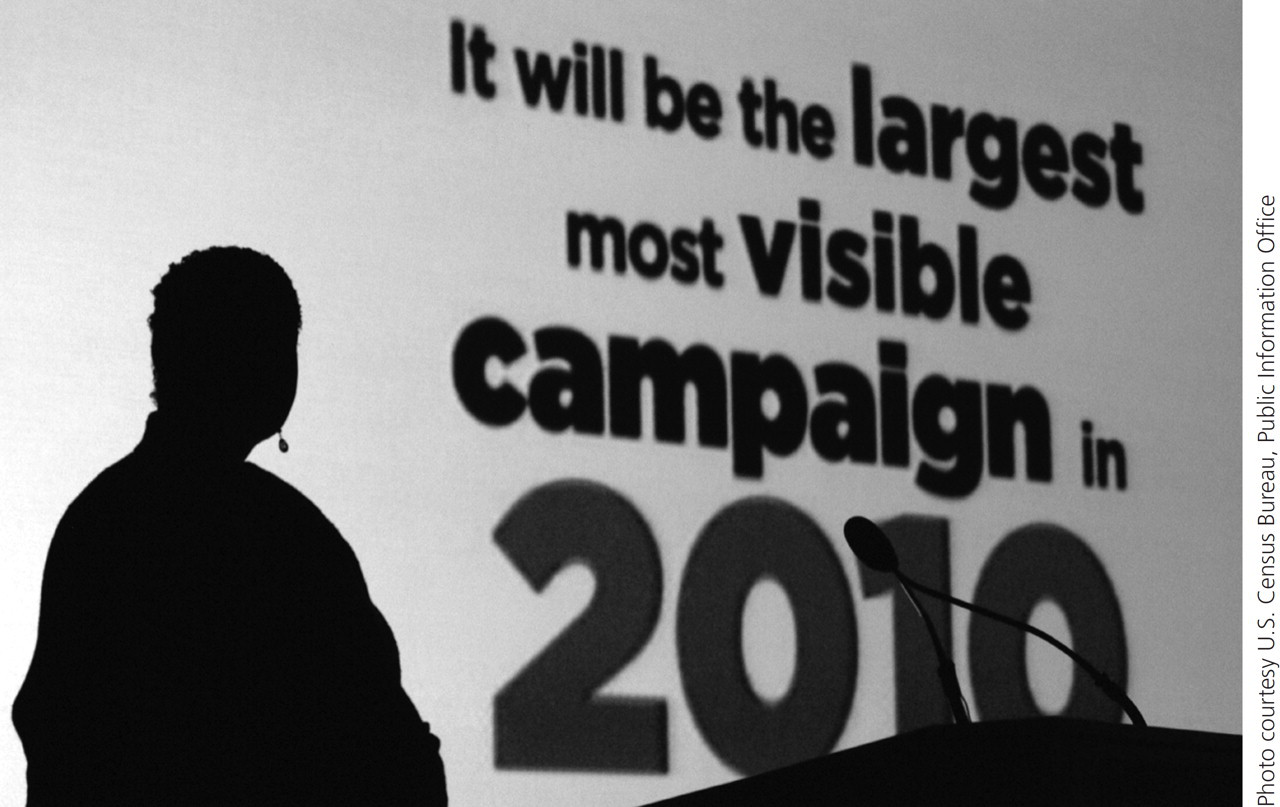
The 2010 Census launches its advertising campaign.
Most recently, at the end of the 90s, the Supreme Court ruled that any use of statistical sampling was unconstitutional because of those words “actual enumeration.” …So, not from a social science standpoint, but from a legal standpoint… that's how we do it!
JW: Beyond the Constitutional mandate, what else does a full Census offer?
BG: Well, again, let me urge us to separate our social science thinking … from the Census Bureau's burden and challenge of executing this Constitutional mandate. So, it is also appropriate, as you're pressing me, to know that every other source of data on our society comes from sample surveys. Basically, we have very few data sources that are based on measuring everybody in the population. The birth and death registry is about what we have. And … we know as social scientists and researchers, that if we draw a sample of the population and then use the savings from not having to measure everybody to spend more money measuring just the sample, we can often get more accurate data, albeit estimates that are subject to some sampling variability. So that logic that we've all learned in our stats classes, you know, is correct, I believe. That doesn't mean that, for this national ceremony, this Constitutional obligation, that that's the lens through which we should view the Census.
JW: I like that term—a national ceremony. And that leads into another question: in the 2010 Census, there were a lot of new methods for trying to get at a 100 percent return rate. Could you talk a little about those?
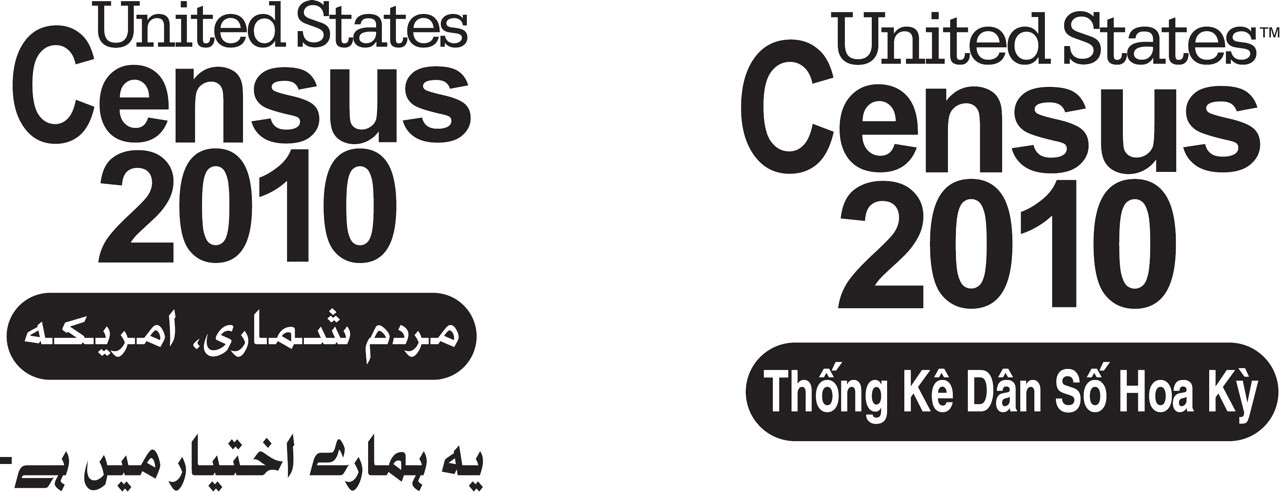
BG: Over the decades,… the Census Bureau (much before I got there) has learned that using a single method to measure the population (essentially, running the Census out of Washington, D.C.) increasingly didn't work… for a variety of reasons. One, you make perverted decisions about what the country looks like on language. … We think of this as a kind of an English and maybe Spanish country, but it's much more diverse than that. So, in the 2010 Census, there were 6 different languages used for the questionnaires. We advertised to try to motivate people to return their questionnaires in 28 different languages, we had 59 different languages that were used for language assistance guides, our staff spoke over 150 different languages. So, when you make the observation, “Gee, it looks like there are a lot of different things happening…” Well, it looks like you have to do a lot of different things to measure a diverse country like this.
The second thing that happened this year is that we used social science…, good survey methodology, and we sent replacement questionnaires and bilingual questionnaires. We had a lot of different messages to the population, and that seemed to be effective. We did not, as many people note, use an Internet option, and we'll do that in 2020, but the concern there was really about security. … We think we can solve that going forward.
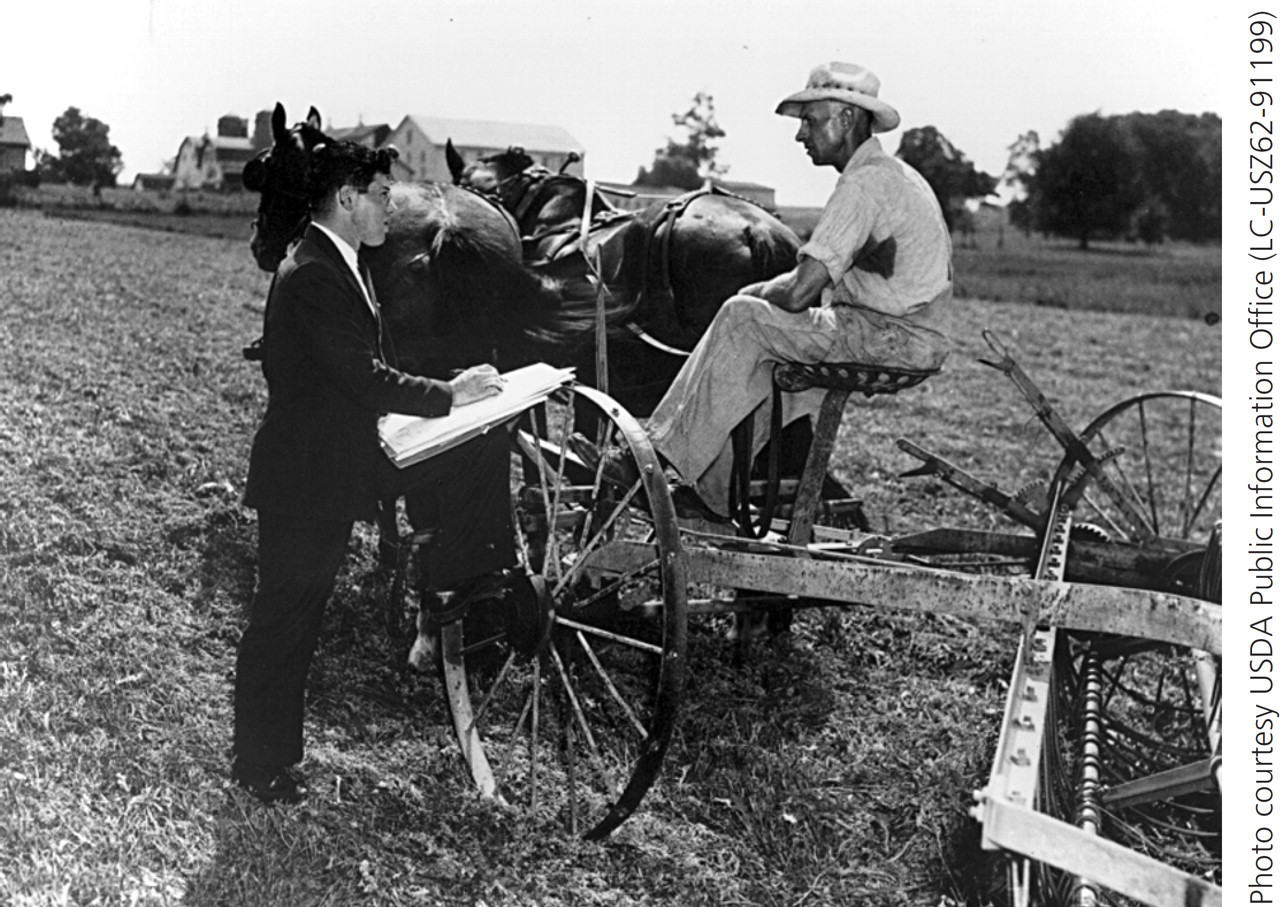
The way it used to be: a Census enumerator at work in 1940.
JW: How does the Census go about, say, counting the homeless, which is both a growing demographic and one that seems very difficult to successfully enumerate.
BG: Whether it's growing or not is a complicated issue—in fact, that's one of the reasons we do these measurements—but that it is a difficult population to measure is non-controversial. What does the Census do? On March 29, 30, and 31st of 2010, there were three operations that… were really the culmination of a lot of work, collaborative with local community groups. So, over the months before those dates, we contacted community groups that work with the homeless, and we asked for their assistance to identify places that are providing services to the homeless (food, clothing, and so on), providing shelter—temporary shelter—to the homeless, and outdoor locations where homeless people might be sleeping. Using that information, on those three days, we went to every soup kitchen, every shelter, and enumerated people individually. And then on the third night, we went to outdoor locations.
If you think about this for more than just a little bit, you can realize that that is targeting clusters of homeless people. A homeless individual who lives out in the woods in a tent by him or herself, living on the land, we don't count. I mean, we must admit, we just… A homeless person who actually was aware of these activities and didn't want to be counted, avoided those facilities and the usual sleeping place on those three nights, we didn't count. So, no one, to my knowledge, has solved this problem in a democracy. We give people the freedom to sleep where they want, and if we want to live in that kind of society, there's a cost to the measurement of that society. People are free to avoid that measurement, and we do the best we can…
JW: What about more controversial populations, like undocumented migrants? Do you grapple with that?
BG: We do, and there are sort of two ways… of estimating population sizes. One really flows out of sociology, demography especially, and that is the assembly of birth registration data, death registration data, and then counts of emigrants (people who left the country) and immigrants (people who came into the country). And the term for that is “demographic analysis.” And we will release, in early December, national estimates of people broken by age, gender, and black/non-black status, based on that kind of record-keeping.
The way it used to be: a Census enumerator at work in 1940.
Now, you point out a weakness of that method… how do we get the counts of immigration? Well, there are registered immigration sources, but we know, or suspect, that there are large numbers of undocumented immigrants.
Mention a topic of interest to sociologists, and odds are high that the U.S. Census Bureau is collecting relevant data.
The estimates vary. We assembled a wonderful workshop of really good demographers from around the country a few months ago and said, “Okay, what should we do about this? Is there a consensus estimate?” And it became clear quite quickly, there's no consensus estimate. There are strong arguments to favor higher numbers and lower numbers. So, for the very first time, at the beginning of December, for demographic analysis, we will present multiple estimates of the national population (estimates that make reasonable different assumptions about undocumented immigrants).
Now, so that's demographic analysis. We also attempt to count undocumented immigrants in the Census. The first question is, “Why do you attempt to do that? Why don't we just count citizens?” And this again has to go back to the Constitution. In the very first Census Act of March 1790, the first legislators said we will count everyone, everyone who's living in the country, whether they're a citizen or not. We've done that every ten years [since]. Counting undocumented immigrants is a great challenge, and [it's difficult] enumerating populations where people are afraid with regard to deportation because … they don't have papers. We reached out to those populations and learned a lot about how critical grassroots organizations are to gain trust of people that the Census, even though [it's] done by an agency of the federal government, is not connected to enforcement agencies of the federal government. Emphasizing that the sacred pledge of confidentiality that we give everyone is really important. It was important for us to say it, but even more important for trusted local voices to say that.
JW: Let's get into sort of a historical perspective on the Census. There's a lot of politics and debate behind even what might seem like simplistic wording changes, especially the controversies over multiracial definitions.
BG: Well, I think the first thing to note is that the measurement of race and ethnicity in this country is controversial every ten years. … This country has a particular history with regard to race that is related to that, I think. It's also a country of immigrants, and so the composition of ethnic and racial groups is constantly changing. Those two things, I think, combine for the controversies of this 2010 cycle.
So, [this time around] there were several: one has to do with a use of the word “negro” to describe, as one of the categories, in a check box that said “Black, African American, or Negro.”… Some people said, in the African American community, “We find this term offensive,” despite the fact that that term had been used in prior decades (in fact, maybe because it had been used so long ago, some drew offense). … That term was used in the 2000 Census [because] focus groups and other inquiries [had] led to the conclusion that there was a set of older African Americans who, when posed with the question, “How would you describe yourself?” no cues at all, would forward “negro” as the description. That led to the inclusion of that term. … About 55,000 people in the 2000 Census both checked that box and then below, in an open form, wrote in the word “negro.” So they really, we inferred, wanted that label, wanted to claim that label. When you look at the age distribution, about half of them were less than 45 years of age, so it was a big surprise. … [That said], we are redoing that research over this decade. We will begin to look forward. … I've apologized publicly to people who were offended by that term and tried to convey the point that what we're about, at the Census Bureau, is using all of the possible words that someone might relate to, so somewhere, in those questions, they see the term that they want to choose for themselves. And it's a balancing act.
The other controversy, with regard to race and ethnicity, think, was one in the Arab American community, where notions of race are culturally quite different. And so I had wonderful meetings with the Arab American community leaders where they said, “This thing ‘race’? What do you mean? Is it color of the skin, is that what you mean by race? … We have people who are lighter skinned and darker… do you want us to check skin color? Is that what you mean? Or is it country of origin? What do you mean by this?” So, sociologists, I think, are ahead of the game on this. They've known for decades that the whole notion of race and ethnicity are culturally situated constructs. That is really the underlying reason for the controversy about measurement of race and ethnicity: the cultures keep changing in a country like this, and we keep rethinking these labels, and we give different tone to the labels as time goes on. So, it will always be controversial, is my prediction.
JW: In Minnesota, we have Representative Michelle Bachmann's district. She's one of the most famous “anti-Census” people in recent memory. What are these fears about the Census, or what is making the Census controversial? And are these completely unfounded, or are there some legitimate critiques being raised?
BG: I think the most important thing to note is that there's nothing new in these discussions. Americans are feisty kinds of folks, right? And there are wonderful debates about the 1790 Census, our very first Census, that are just like this. One of the real fathers of the Census was James Madison, and he was a member of the very first House of Representatives. We had this fresh Constitution, but, as you know, in the Constitution, it says Congress is going to specify how the Census is going to be done. So Madison proposed that the questions on the Census be age, race, sex, and occupation. Now, if you think about that for mere reapportionment of the House, race was needed mainly because slaves were counted, in a compromise, as three-fifths [of a person]. That's in the Constitution, but Madison added occupation [and] talked his fellow House members into approving that. When it got to the Senate, they said… “What is this? If you read the Constitution, all we're supposed to do is count the people in order to reapportion the House. Why do we need, you know, this occupation thing? Madison, you're turning this into some social science exercise.” Actually, they didn't have the term “social science” then. But so, even then, at the birth of the Census, there's this controversy: is there a solely Constitutional reason for the Census, or are we trying to gather other data of use?
“How are we doing and should I vote the government out?” The Census is a critical feedback loop in our democracy.
And that second purpose, if you think about it, your reaction to whether that's useful or not depends on your political view of what the government should be collecting from its citizenry and for what purpose. It is that portion that gets controversial, and every decade it is controversial.
JW: I am a social scientist, so I'm biased to think, “What could be the harm in more information?” But why do a certain number of people find this information-gathering objectionable?
BG: Well, some people view the amendments of the Constitution as collectively giving us a right to privacy. So, we have, they assert, a right to be left alone, and every question that is posed to us, especially by the central government—about which I remind us, our founding fathers were greatly suspicious… There are all sorts of checks and balances; nobody trusted the central government. So the answer … really is: the proof of justifying … intruding on my property to ask me something about myself for purposes that I don't completely control, the burden of proof is on you. Why should the federal government ask anything?
Now, what we have done over the decades, Congresses have done, is to say, for the welfare of the state, of the society, we do need information. And it has then produced a counter-ethic: … the people, in order to be part of an informed citizenry in a democracy, need information about how the society's doing. … That's the belief system we have in this country: to regulate government as an informed citizen, I need information. And so the statistical system … has evolved to provide to the people that power of knowledge to ask the question, “How are we doing and should I vote the government out or should I reelect these guys?” So it's a critical feedback loop in the democracy.
But what I just articulated has some political ideology underneath it. That is a particular perspective about what is the role of the central government, and that's what we feisty people in this country argue about all the time.
JW: An argument about knowledge as power is a great place to end!