



Abstract
Georg Simmel famously argued that the sensory onslaught of the urban environment forces people to reduce the world to calculable quantities over colorful qualities and adopt a blasé attitude of muted emotions. Today’s digitally mediated city involves levels of quantification that Simmel could have scarcely imagined. However, rather than exacerbating the blasé attitude, this paper makes the case that digital technologies potentially increase our emotional and moral attachments to the urban environment—a phenomenon that can be called “scoreboard urbanism.” From Yelp ratings to Fitbit step scores, our relationship to the city is increasingly mediated by quantitative metrics. The purpose of this paper is to outline the basic characteristics of scoreboard urbanism as a distinct mode of life that entails new ways of perceiving and interacting with the urban public realm. In doing so, the paper argues that this phenomenon has transformed the city into a “gamespace” characterized by the competitive and exhilarating drive to score points.
Prologue: The Unicorn Sundae
The “Unicorn Sundae” is made with vanilla soft serve ice cream, plumes of pink and blue cotton candy, and topped with a “horn” made from an upside-down waffle cone dipped in rainbow sprinkles. The sundae’s kitschy, vibrant appearance made it an Instagram sensation in 2016 where carefully constructed photographs of the concoction began scoring hundreds of “likes.” Buoyed by its social media success, the Calgary-based “microcreamery” that serves it has attracted huge crowds. Inside the creamery, customers snap photos for social media on their smartphones. Whatever pleasure comes from consuming the sundae is enhanced by attracting online engagement, quantitatively measured in “likes” and “retweets.” Such pleasure leads many of these consumers to “check in” and rate the microcreamery on sites like Yelp and Facebook, further raising its social media profile.
Nearby, wanderers feeling a pang of hunger might stop to pull out their smartphones, searching Yelp for “ice cream.” They will immediately be presented with over a dozen different options within walking distance. The microcreamery likely tops the list due to a variety of factors including the number of reviews and the average “star” rating. Ignoring the other options, these hungry wanderers are directed by Yelp down a series of streets that are perhaps unfamiliar to them. As they walk, their Fitbit counts their steps. In a few minutes, they begin to hear, and then see, the jovial crowds hanging out on the sidewalks outside the microcreamery and are assured that they have made the right choice.
Introduction
The success of the Unicorn Sundae, and the microcreamery that makes it, reveals not only the growing ubiquity of “ratings and rankings” in contemporary society (Esposito and Stark 2019:4), but also how these scores increasingly mediate a variety of encounters with and within the urban public realm. The “digitally mediated city” (Rose 2017) is saturated with public scores that make certain locations and experiences salient while obscuring others. Every business and Uber driver has a star rating. Every set of directions has an estimated time of arrival (ETA). Moreover, digital platforms encourage users to appropriate the urban environment in pursuit of personal scores (Barns 2020; Lupton 2016). Fitness buffs take the long way home to maximize their Fitbit step count. Gamers stop at the local park to battle at a virtual “Pokégym.” Uber drivers pack their cars full of perks to elicit 5-star ratings. Commuters try to beat their Google Maps ETAs. As will be discussed, not everyone is equally wrapped up in this phenomenon, but it does span many institutional and socio-economic divides, manifesting in work, leisure, and politics in unique ways.
How should we think about this proliferation of scores and its impact on the unique “mode of life” that Louis Wirth (1938) termed “urbanism”? To answer this question, this paper begins by considering one of the most influential theories on quantification in urban life: Georg Simmel’s 1903 essay “Metropolis and Mental Life.” Following Simmel, the paper investigates the interrelationship between the sensory experience of the city, use of quantifying technologies to navigate it, and the emotional-psychological condition of urbanites themselves. However, in contrast to Simmel, who described urbanites as cold, calculating, and “blasé,” the paper proposes the idea that numbers actually increase the emotional and moral salience of even mundane daily activities, leading urban life to take on the qualities of a video game. It is a phenomenon that can be termed “scoreboard urbanism.”
The argument is advanced in four parts. Part 1 discusses the study of quantification in sociology and urban geography, including Simmel’s famous essay. It highlights the traditional conceptualization of quantification as a form of rationalized control that threatens human agency—making people feel like “a single cog” in a vast machine (Simmel [1903] 1971:337). By contrast, recent studies of quantification demonstrate the potential of numbers to be personal and emotionally meaningful, giving actors a sense of control over their lives. This trend is exemplified by the phenomenon of “gamification,” which introduces elements of game design, such as quantitative scoring systems, into everyday non-game situations (Khaled 2014:304).
Part 2 develops a theoretical model for how quantification operates within the contemporary digitally mediated city. The model describes a “cycle of quantification” in which encounters within the urban environment are mediated by dynamic scores transmitted from a variety of electronic interfaces and which change based on the behavior or the user. This “cycle” has clear parallels with gamification and differs from the more static forms of quantification of Simmel’s nineteenth-century metropolis.
Part 3 asks: if Simmel’s metropolis gave rise to the “blasé” attitude, what is its equivalent in the digitally mediated city of the twenty-first century? The answer is a hypothesis that digital technologies encourage urbanites to experience the city as a “gamespace,” conceptualized by philosopher McKenzie Wark (2007) as a digital arena where the competitive and exhilarating drive to score points eclipses all other concerns. The argument is not that everyone experiences the city in this way, but that the cycle of quantification creates the potential for (and encourages) game-like experiences in a variety of different situations.
Part 4 examines how scoreboard urbanism manifests in terms of new modes of spatial perception and practice involving the appropriation of the urban environment in the pursuit of high scores. To illustrate, the section presents a series of empirical examples including a discussion of the “social media influencer” as the “flaneur” of the digitally mediated city, as well as how scoreboard urbanism has become integrated into urban social movements, the labor market, and art and culture. In doing so, it enables new strategies for political action, social mobility, and artistic expression, while also creating new sources of inequality and exploitation.
Through the concept of scoreboard urbanism, the paper brings a distinctly sociological perspective into dialogue with the “digital turn” in urban geography (Ash, Kitchin, and Leszczynski 2018), a field focused in part on how digital technologies are “mediating and augmenting the production of space and transforming socio-spatial relations” (p. 29). While geographers have examined how digital technologies relate to human subjectivity and agency in everyday life (Barns 2020:8; Graham, Zook, and Boulton 2013; Rose 2017), most have overlooked the centrality of game-like scoring systems. This paper argues that the ubiquity of scores forces us to rethink urban life in a variety of arenas from leisure, to work, to politics. As such, this paper also advances the study of urbanism, addressing the question of what it means to inhabit the city in an era in which most people carry smartphones (Pew Research Center 2019, 2021), which have been purposely designed to keep them obsessively checking their screens. Even those who resist the temptation or who do not own a smartphone are being continually tracked by sensors embedded in the urban environment. What constitutes agency in this digitally mediated world? And do these technologies give us the ability to be more than just cogs in a machine—or just more efficient cogs?
Quantification, Rationalization, and Agency
Sociologists define quantification as the “production and communication of numbers” and argue that it “is a constitutive feature” of modern life (Espeland and Stevens 2008:402). Notably, quantification establishes commensurability between objects, allowing them to be evaluated or measured against a common metric (p. 408). Quantitative valuations of objects typically take the form of either rankings or ratings (Esposito and Stark 2019). Rankings establish ordinal hierarchies, whereas ratings assign values relative to a common quantitative scale. In this paper, the term “score” refers to both rankings and ratings.
Because of its power of commensuration, quantification has traditionally been linked to processes of rationalization, modernization, and industrialization. For Marx, money and exchange value imposed commensurability on the products of labor, obscuring inherently incommensurate social relations (Espeland and Stevens 1998:320–21). For Weber, increasingly sophisticated methods of quantification gave modern societies unprecedented “control over material objects, social relations, and [the] self” (p. 321) while also “increasing depersonalization of structures of power and authority” (Espeland and Stevens 1998). This perspective was subsequently developed by postwar theorists who linked quantified rationalization with the tempo-spatial dimensions of social life. Giddens (1990), for example, argued that clocks and geocoordinates have fundamentally changed the experience of time and space, dislodging social life from the daily rhythms of actual places (pp. 17–23). Similarly, building on Marx, Harvey (1991) identified the continual “compression” of time and space as a strategy for capital accumulation. Meanwhile, for Foucault (1995), the quantification of time and space is a core practice in modern disciplinary power.
The “digital turn” in urban geography has similarly conceptualized quantification as a form of rationalized control. For example, Dodge and Kitchin’s (2004) concept of “code/space” describes the “control and regulation” function of computer code that makes certain material spatial configurations possible (p. 198). Using airports as an example, they demonstrate the codependency of the algorithmic structures through which software processes data, and the material structures through which passengers, airplanes, and other objects are moved through space. Meanwhile Graham et al. (2013) describe how the “augmented reality” created through the use of platforms and digital devices creates a new means of power that can be exercised by shaping people’s perceptions of space and place. As well, so-called “smart cities,” which incorporate real-time data collection and analysis into governance and operations, have been theorized by Sadowski and Pasquale (2015) as constituting a “spectrum of control” that involves both subtle forms of surveillance as well as aggressive policing strategies.
As a technology of control, quantification is often conceptualized as a direct threat to human agency. Through technological dominance, “the individual is atomized, blown apart into streams of data [and] fed into processors” (Sadowski and Pasquale 2015:n.p.). The potential for people to agentically affect change is usually theorized as existing outside technology, confined to the “glitchy margins” where digital platforms breakdown and stop functioning (Leszczynski 2020), or by wresting control of these technologies from corporations and governments (Sadowski and Pasquale 2015:n.p.).
Rose (2017) has criticized this approach, arguing that it treats agency as “an apparently unmarked cipher: the site of undifferentiated ideas, experience, and resistance” (p. 783). By contrast, she advocates theorizing how agency is exercised through technology. In the last few years, more scholars have pursued this direction, studying digital technologies as the means through which people express themselves and pursue their goals (e.g., Barns 2020). Yelp reviews, for example, have become an important data source for understanding the way people relate to the city, though many of these studies have focused on the qualitative discourses of the written reviews (Olson et al. 2021; Zukin, Lindeman, and Hurson 2017).
Despite the prominence of rankings and ratings in many of these digital platforms, few scholars have specifically examined how quantification itself factors into the phenomenological experience of the digitally mediated city. To better understand this experience, we can turn to Georg Simmel’s ([1903] 1971) essay “Metropolis and Mental Life” (hereafter “MML”), which articulates perhaps the most influential theory on the interrelationship between quantification, human agency, and the urban environment.
Quantification in Simmel’s Metropolis
Simmel is a risky starting point for an analysis, since his work has inspired a dizzying array of distinct research traditions in American sociology, often portraying him in seemingly contradictory ways (Broćić and Silver 2021). As Simmel is not the main focus of this paper, the analysis below focuses primarily on MML, referencing only occasionally some of his other works. There are a few justifications for adopting this narrower focus. First, through its influence on Wirth (1938), the essay can be seen as launching the study of “urbanism” in American sociology. Second, the essay itself has often been interpreted in ways that are consistent with the concept of quantification as rationalized control discussed above. Finally, MML lays out a clear explanation for how quantifying technologies mediate between the objective urban environment and subjective human experience. This explanation serves as a blueprint and launching point for the analysis of the digitally mediated city provided below.
MML combines two distinct conceptions of quantities (and, by extension, qualities). First, the essay reflects Simmel’s concern with the quantity of individuals within a group, and his insight that “smaller groups have qualities, including types of interaction among their members, which inevitably disappear when the groups grow larger” (Simmel 1950:87). This interrelationship was most famously examined in his essays on the dyad and triad, demonstrating that when groups change quantitively (from two to three, or from small to large), they create qualitatively distinct social experiences. Writing during a time of unprecedented urban growth in Western Europe, Simmel was specifically interested in the effect of large, dense cities on the mental life of urbanites. In particular, he argued that urban living created a state of sensory overload: too many people and things moving far too quickly to be effectively grasped by the human psyche (Simmel [1903] 1971:324–25).
To manage this onslaught, urbanites turn to a technological solution: quantification. This is Simmel’s second usage of quantification, referring to techniques and technologies such as money and clocks that impose commensurability on their environment, making it easier to manage large quantities by suppressing qualitative differences. These technologies work by “transforming the world into an arithmetical problem and . . . fixing every one of its parts in a mathematical formula” (Simmel [1903] 1971:327). For Simmel, the power of quantification is its impersonal predictability: “the technique of metropolitan life in general is not conceivable without all of its activities and reciprocal relationships being organized and coordinated in the most punctual way into a firmly fixed framework of time which transcends all subjective elements” (p. 328).
Navigating large populations with quantifying technologies is a qualitatively different experience than socializing within smaller groups. However, according to Simmel, it is an experience in which qualitative differences themselves get suppressed in favor of quantitative differences. Quantifying technologies such as money allow social interactions to be reduced to basic math problems, requiring little if any emotional attachments or personal trust. Indeed, the same sensory overload that forces city-dwellers to rely on quantifying technologies also causes them to mute their emotions, developing instead a “blasé” attitude in which things in the world are experienced “in a homogeneous, flat and grey color with no one of them worthy of being preferred to another” (p. 330). Thus, while quantification is an essential prerequisite to the establishment of large, modern cities, it has the side effect of making people feel like “a single cog as over against the vast overwhelming organization of things” (p. 337).
There is a clear parallel between Simmel’s nineteenth-century metaphor of the “cog” in a machine, and contemporary descriptions of urbanites as bits in an algorithm (Sadowski and Pasquale 2015:n.p.). Quotations like these have led Simmel to be interpreted along the lines of Marx, Weber, and the Frankfurt School, for whom modern, technocratic life was a source of cultural alienation and personal disempowerment (Aho 2007; Dodd 2014 Ch. 7; Zelizer 1997). According to this line of reasoning, modern urbanites retreat increasingly to leisure and consumerism as a (perhaps futile) effort to bring meaning and control back into their lives.
It should be noted that more recent scholarship has sought to nuance understandings of Simmel, highlighting the potential he saw for urbanites to affirm their individuality and achieve “creative self-transcendence” (Broćić and Silver 2021:100; Dodd 2014; Silver 2019:95:95). On the whole, Simmel’s thoughts about quantification and agency are complex and cannot be reduced to a single essay. Nonetheless, if we focus primarily on MML itself, we see a clear theoretical statement that pits the impersonal, objectifying nature of the urban environment against peoples’ own emotional investment in the world and subjective sense agency. The theory’s clarity and parsimony make it an excellent launching point for considering the role of quantification in urban life. Our task now is to compare this mechanical age theory to contemporary research on quantification in the digital age.
Colorful numbers
Contemporary sociologists who study quantification agree with Simmel that modernity involves a proliferation of ever more sophisticated processes of quantification and scoring (Berman and Hirschman 2018; Espeland and Stevens 2008), including those associated with the rise of the internet (Esposito and Stark 2019), credit scoring (Fourcade and Healy 2017), and auditing and performance metrics, including within academia itself (Espeland and Sauder 2007; Pardo-Guerra 2022). However, whereas MML relates quantification to predictability, impersonality, and the colorless existence of the blasé urbanite, contemporary scholars have often emphasized how numbers take on deeply personal, emotional meanings.
Particularly influential is Zelizer’s (1997) Social Meaning of Money, which is framed explicitly as a critique of Simmel’s characterization of the “colorlessness” of money (p. 1). Though Zelizer’s interpretation of Simmel is not without criticism (Broćić and Silver 2021:100), her work has helped to recast money (and quantification generally) as creating “profound differentiations” tied up with “social relations, emotions and moral beliefs” (Bandelj, Wherry, and Zelizer 2017:5). Distinctions between “honest” and “dirty money,” for example, demonstrate how people understand quantities in terms of moral judgments and emotional intuitions such as gratitude or disgust (Zelizer 1997:3).
Other research goes further, demonstrating how quantitative scoring systems exacerbate the emotional, social, and moral salience of small and/or arbitrary qualitative distinctions (Berman and Hirschman 2018:263). The price attached to a bottle of wine affects the experience of its taste (Schmidt et al. 2017). “Like” counts on social media are associated with self-esteem (Burrow and Rainone 2017; Rosenthal-von der Pütten et al. 2019). Algorithmically determined credit scores create new and powerful categories of moral worth (Fourcade and Healy 2017). University ranking systems exaggerate differences in quality and legitimacy among institutions (Espeland and Sauder 2007). “Self-trackers” incorporate biosensing apps into deeply intimate practices associated with self-reflection, self-care, sexuality, and reproduction (Lupton 2015, 2016; Nafus 2016).
Thus, in contrast to the “de-coloring of things” (Simmel [1903] 1971:330), this research portrays quantification as a method for cranking up the saturation of the world, filling it with vivid hues charged with emotional and moral significance.
Gamification
Though this research changes how we understand the phenomenology of numbers, it does not necessarily contradict earlier perspectives that equate quantification and rationalized control. In fact, when numbers take on deeply personal significance, they arguably function even more effectively as a means of control, defusing the tension between outer and inner worlds identified in MML. Quantification is no longer experienced as an intrusion upon agency. To illustrate, consider one particular form of quantification: “gamification,” a phenomenon in which otherwise non-game situations are redesigned to produce game-like experiences (Khaled 2014:304). In gamification, we can see how systems of rationalized control can work by creating opportunities for people to feel agentic. It accomplishes this not by hiding quantification, but explicitly introducing it into the conscious experience of actors in the form of a “score.”
Within video games, scoring systems are a core feature of “affective design,” defined as “the process of attempting to indirectly generate particular kinds of affects or response through material and aesthetic design of products in order to capture and hold users’ attention” (Ash 2012:2–3). Highly visible scoring systems have proven particularly effective in “amplify[ing] feelings of success” (Ash 2012:14) and instilling a sense of competition, which is one of the primary psychological motivators behind game-like experiences (Khaled 2014).
Illustrating this phenomenon, Ranganathan and Benson (2020) document the implementation of a scoring system in an Indian garment factory that “measured individual worker’s productivity in real time in a way that was visible to both workers and management” (p. 580). They found that productivity increased significantly after the implementation of the system, despite the fact that productivity targets were unchanged and no new rewards or sanctions were imposed to motivate workers. Through interviews, they discovered that workers engaged in “auto-gamification,” competing with themselves to beat previous performances.
Ranganathan and Benson highlight two particular characteristics of gamification. First, rather than being impersonal and predictable (like clocks), the factory’s real time scores were dynamic, unpredictable, and partially controllable by workers. The workers monitored their progress, adjusting the pace of their work in an effort to drive up their score, but the results of their efforts were never certain. Second, these game-like qualities actually enhanced the personal and emotional salience of otherwise monotonous work. In fact, the more monotonous the work, the more productivity increased (p. 595).
From a critical perspective, the workers remained “cogs” in a machine. Their labor was tied up with rationalized systems of quantification that measured their productivity. However, when elements of quantification were introduced into their conscious experience, rather than feeling even more like cogs, the workers felt the opposite. They experienced work as more personally and emotionally meaningful, likening it to leisure activities like sports (p. 584). Ironically, this feeling of personal achievement made them even more efficient cogs.
There are two important points to take from studies of gamification. First, there is an important phenomenological distinction to be made between forms of quantification that either mute or heighten one’s sense of personal and emotional investment in the world. Second, whichever phenomenological experience people have will likely affect the way they participate in the system of quantification itself.
Quantification in the Digitally Mediated City
Applying the insights of the sociology of quantification to urbanism requires us to examine how numbers are produced and communicated specifically within the urban environment. To do so, I draw on findings from the digital turn, identifying three interrelated technologies of quantification: algorithmic processing of big data, sensors and surveillance within the urban environment, and the ubiquity of screens and other electronic interfaces. As I will argue, these three technologies combine to create a “cycle of quantification” that resembles gamification.
Big data and algorithms
Central to quantification in the digitally mediated city is the accumulation of “big data,” defined as data that accumulates rapidly and automatically in real-time, has no significant limits, and is highly variable in terms of what it represents (Kitchin 2014:3). Because of its volume and complexity, big data can only be processed with sophisticated computer algorithms that can increasingly be described as “artificially intelligent” (O’Neil 2016:75), meaning that they make independent determinations about what data should be analyzed and how. Due to this independence, and the incomprehensibility of the data itself, these algorithms operate in a virtual “black box” that is impenetrable to the general public (and perhaps even to specialists) (pp. 8–9).
Though often described as operating in some ethereal “cloud,” algorithms are bound to spatial-material structures. As was mentioned, Dodge and Kitchin’s (2004) concept of “code/space” refers to a hybridization of physical spaces and digital algorithms. Data that get generated in physical space are fed into digital algorithms that produce output which guides the continual reorganization of the physical space. In most cases, these parallel worlds interact “seamlessly” allowing them to “blend fluidly and smoothly into the different ways users go about their everyday businesses” (Licoppe 2016:103). However, in other cases, code/space can experience “glitches” (Leszczynski 2020) or complete “breakdown” (Dodge and Kitchin 2004:202), resulting in major disruptions to daily urban life, like when a crashed airport computer system causes travel delays to cascade across the continent.
Sensors and surveillance
Where does big data come from? In part from digital sensors scattered throughout the urban environment. “Smart city” initiatives led by local governments, real estate firms, and tech companies, for examples, have led to “extensive embedding of software enabled technologies into the fabric of cities to augment urban management” (Kitchin 2015:131). Once associated with landmark redevelopment projects such as Korea’s New Songdo City, sensors are now ubiquitous around the world (Kuecker and Hartley 2020), integrated into everything from traffic lights and garbage cans to interactive shopping mall directories that secretly gather facial recognition data (Tunney 2020).
People are also surveilled by the personal devices they carry around with them, including smartphones and fitness trackers. Barns’ (2020) concept of “platform urbanism” calls attention to the way people have integrated these devices, and the apps they contain, into their daily routines. She argues that the level of surveillance available to tech companies such as Google and Uber through these personal devices far exceeds even that of the smart city. Of particular importance to urbanism are sensors associated with “mobile locative media” that quantify spatial relations between people and objects, fundamentally transforming the way people interact with and within the urban environment (Licoppe 2016). In some cases, these sensors are wielded intentionally, as when someone actively records their geolocation by “checking in” (Wilson 2011) or “self-tracks” (Lupton 2016). More commonly, surveillance occurs quietly without our knowledge (Barns 2020:10). The result is that virtually everyone emits “data exhaust” that can be sucked up by sensors, whether or not they are a dedicated self-tracker, social media junky, or even own a smartphone (Barns 2020).
Sensors continually convert physical processes and events into digital information that can then be transmitted across networks and processed by algorithms (Nafus 2016). As artificially intelligent algorithms become more independent, the urban environment itself is increasingly dynamic. Physical infrastructure and personal devices are now able to interact in real-time not only with humans, but also with each other. In the words of Thrift (2014), “a conversation is being conducted exclusively between the billions of things in cities and is being endlessly reconfigured in ways which form a kind of sentience” (p. 9). Rather than something out of science fiction, it is best to think of this “sentience” as comparable to the artificial intelligence systems employed by video games designers to hold the attention of players, nudging them through a virtual world while also allowing them to retain a sense of control (Ash 2012).
Screens and other electronic interfaces
Big data, algorithms, and sensors generate and process numbers largely outside human awareness and understanding. One of the results of these processes, however, is to generate some output that will be explicitly communicated to human actors in a form that is not only intelligible and intuitive, but also appealing and attention-grabbing. This communication is made possible through the proliferation of electronic “interfaces,” including personal devices like smartphones and public interfaces such as large screens and information boards scattered throughout the city (Rose 2016:336). Examples of the latter include public stock tickers as well as “bike totems” that track and display the number of passing cyclists, often set up next to new bicycle lanes to encourage cycling.
As mentioned, despite the attention paid to electronic interfaces and the information they communicate, few urban scholars have considered the fact that much of this information is delivered in the form of rankings and ratings—or “scores.” What explains the prominence of scores? Two explanations are suggested by the existing literature. The first relates to sheer volume of information. Rose (2016) argues that interfaces differ from more traditional cultural objects due to the “massiveness of digital cultural production” (p. 339). An endless stream of content is being delivered continually through the digital interfaces that surround us. Moreover, this digital content is “mutable” (Rose 2016). In contrast to a printed train schedule in Simmel’s metropolis, a digital screen on a subway platform displays a dynamic ETA that counts up and down depending on changing conditions in the system. The subway screen likely also displays advertisements, news updates, and other information, adding to a general state of media “supersaturation” (Gitlin 2002). Recall here Simmel’s insight about the power of quantification in the face of sensory overload. When social media gives us access to thousands of restaurant reviews for a single neighborhood, or Google Maps presents several possible routes to our destination, a ranked list or rating system reduces our choice to simple math. As Esposito and Stark (2019) argue, rankings and ratings systems proliferate in the modern world not because they are accurate, objective, or transparent, but because they are effective at reducing complexity.
Beyond reducing complexity, recall the importance of scores in affective design (Ash 2012). Most electronic interfaces are not installed as a public service; they are tools employed by “attention merchants” who seek to monetize our eyeballs in order to sell advertisements or acquire valuable data (Wu 2017). Within the relentlessly competitive “attention” economy, the spoils go to those who design interfaces that impress themselves most forcefully and addictively upon the perceptual fields of the public (Wu 2017).
Finally, while video games are designed to keep our eyes on the screen, many urban interfaces are designed more like transparent lenses. They draw in our attention while also directing it toward particular destinations—often by attaching high scores to those places. As such, the interfaces “mediate social encounters within spaces and provide different ways to know and navigate locales . . . augmenting a whole series of activities such as shopping, wayfinding, sightseeing, and protesting” (Ash et al. 2018:32).
The cycle of quantification
Combining these three technologies reveals a cycle of quantification through which numbers are produced and communicated within the digitally mediated city. This cycle can be understood as a technological scaffolding that increasingly structures life in cities. The cycle has three stages:
At the center of any form of urbanism is the urban encounter: the conditions under which actors interact with and within the urban environment. Today, however, these encounters are often mediated by quantitative scores that are made visible through a variety of electronic interfaces which are co-present in the encounters. These interfaces are designed to affectively impress themselves upon the actor’s perceptual field, becoming subjectively salient aspects of urban encounters. Actors draw on these rankings and ratings in the course of their everyday routines and, in doing so, incorporate scores into their own perceptions of place.
Also co-present in these interactions are a variety of sensors that continually translate physical events, states, and processes into digital data. These sensors may be invisible to the actor, passively collecting data without the actor’s knowledge. Alternatively, the actor may actively and intentionally wield the sensors as part of their spatial practices.
Finally, data from the sensors are transmitted across networks of digital devices where it is processed by various computer algorithms that, among other things, use the data to update or create new scores.
The accumulated effect of these features (depicted in Figure 1) is that quantification in the digitally mediated city can be said to have both a visible and invisible side. On the visible side, scores impress themselves upon the actor’s consciousness. The actor, in turn, orients their actions in response to the scores. They check a Yelp rating before stepping into a restaurant. They see a trending photograph of a protest in their city and decide to take part. They look up the ETA before deciding whether to ride their bike or take transit to get there.
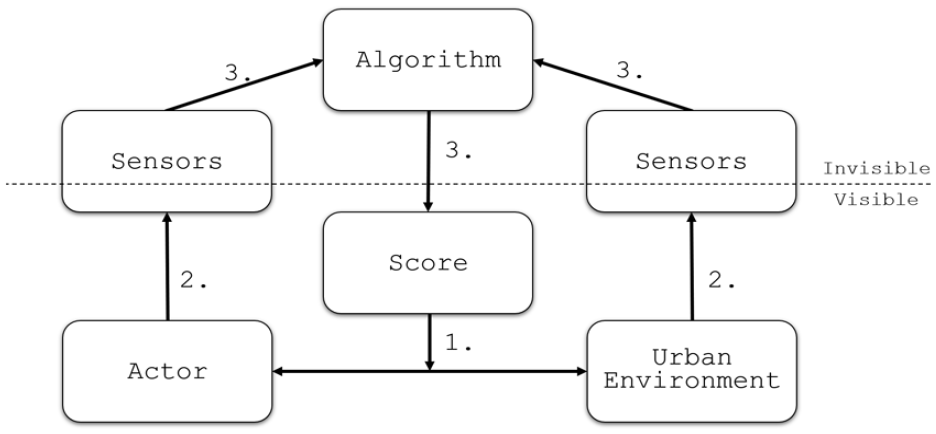
The cycle of quantification in the digitally mediated city.
Actors are also aware that, under certain circumstances, their actions affect the scores themselves. They leave a bad Yelp review after an unpleasant experience at the restaurant. On their way to the protest, they go out of their way to cycle past a bike totem to drive up the count. Once at the protest, they upload additional pictures of the crowd, attaching a political hashtag to elevate it on social media feeds. The cumulative effect of all this activity causes the scores to move up and down dynamically.
The result is a system that shares the game-like characteristics identified by Ranganathan and Benson (2020): dynamic, unpredictable, subject to a limited amount of personal control, and potentially charged with emotional and moral salience. Without being technologically deterministic, we can see how the system not only facilitates a game-like experience of the city, but actively encourages it. The ubiquity of this digital mediation makes it hard for anyone to avoid. Most people generate data exhaust even if they are not constantly checking their phones. Googling the address of a restaurant will tell you how many stars it has received whether or not you wanted that information.
However, when one embraces the game-like nature of the system, consciously or unconsciously, when chasing high scores becomes integrated into one’s daily mode of life, this cycle of quantification gives rise to scoreboard urbanism. To better understand this concept, we need to shift from discussing the objective system of quantification, to its relationship with subjective human attitudes.
Urban Space to Gamespace
If Simmel’s metropolis inculcated a “blasé” attitude in which things appear “homogeneous, flat and grey [in] color with no one of them worthy of being preferred to another” (Simmel [1903] 1971:330), what is its equivalent in the digitally mediated city? What does the world look like to someone engaged in scoreboard urbanism? A possible answer is provided by philosopher McKenzie Wark’s (2007) concept of “gamespace.”
Gamespace arises when the “real world” is transformed into a hyper-competitive digital space resembling a video game: “The lines are clearly marked. Every action is just a means to an end. All that counts is the score” (p. 8). It is a realm of “purely relative and numerical value” (p. 92) that dices “everything analog into the digital, cutting continuum into bits” (p. 23). Our affective attachment to gamespace means that anything falling outside “has become mere detritus without which the gamespace cannot exist but which is losing, bit by bit, any form or substance or spirit or history that is not sucked into and transformed by gamespace. Beyond gamespace appear only the spent fragments of nameless forms” (p. 18). However, reduced to its essence, gamespace is “all just an algorithm with enough unknowns to make a game of it” (p. 9).
There are some interesting similarities and differences between Wark and Simmel. For both, quantification works to integrate people into a larger, impersonal system of rationalization. Likewise, both recognize that within this system, numbers can become an end-in-themselves. In The Philosophy of Money, for example, Simmel ([1900] 2011) calls money the “most perfect example of the psychological raising of means to ends” (p. 252). Within gamespace, meanwhile, “uncritical gamers do not win what they desire,” Wark (2007) argues, “they desire what they win” (p. 21). The emotional thrill of scoring keeps people engaged in the game with little sense of what it all amounts to in the end.
However, Simmel and Wark provide different explanations for why numbers become ends-in-themselves. For Simmel ([1900] 2011), money becomes an end-in-itself because of its utility. As the ultimate means to virtually all conceivable ends, money vastly overshadows the importance of any particular end (p. 249). Scores, by contrast, are not typically means to ends—at least not within the pure logic of gamespace. Rather, we might better describe scores as “ends to means.” The purpose is to compete; the score is simply a positive feedback mechanism that keeps people engaged in the competition. Recall the garment workers who increased their efforts to drive up the score, despite receiving no external rewards for doing so.
The parallel between gamespace and the garment workers points to another contrast between Simmel and Wark: their conception of work and play. Within gamespace, this division disappears: “play is no longer a counter to work. Play becomes work; work becomes play” (Wark 2007:16). This perspective strongly contrasts at least with the neo-Marxist interpretations of Simmel that emphasize a sharp division between the drudgeries of work and the fleeting release of leisure (e.g., Aho 2007). In this account, work life is dominated by impersonal, rationalized forces, and above all, boredom (Aho 2007). Leisure and consumer activities, by contrast, offer the promise of excitement and emotional satisfaction, providing “temporary relief” from the blasé state (Simmel [1900] 2011:277).
While Wark (2007) would agree that gamespace can never offer true satisfaction, neither is it characterized by boredom. Boredom is a threat to gamespace. When “even the most deluded of gamers . . . realize their strivings have no purpose,” they will begin to question the game itself (p. 166). This is the major threat to social media platforms: that people will simply get bored of how many “likes” they receive and start looking for some other score to pursue.
To summarize, the blasé attitude is a protective mechanism through which modern urbanites attempt to “maintain the independence and individuality of [their] existence against the sovereign powers of society” (Simmel [1903] 1971:324). The gamer attitude, on the other hand, reacts to those same forces not by withdrawing from them with muted emotions, but by developing an emotionally-charged laser-like fixation on one small part of them—a score—and pursuing it relentlessly.
Cogs versus gamers
Both attitudes can be conceptualized as extreme states in which numbers come to completely dominate the human psyche, becoming ends-in-themselves and crowding out the world beyond. Combined, they constitute the logical endpoints on a spectrum of how actors relate to numbers within the urban environment. Within this spectrum we can plot all the messier, empirical situations in which numbers function as means for navigating the city, while still subtly influencing the practices and perceptions of urbanites. As depicted in Figure 2, this spectrum can be conceptualized along two dimensions.
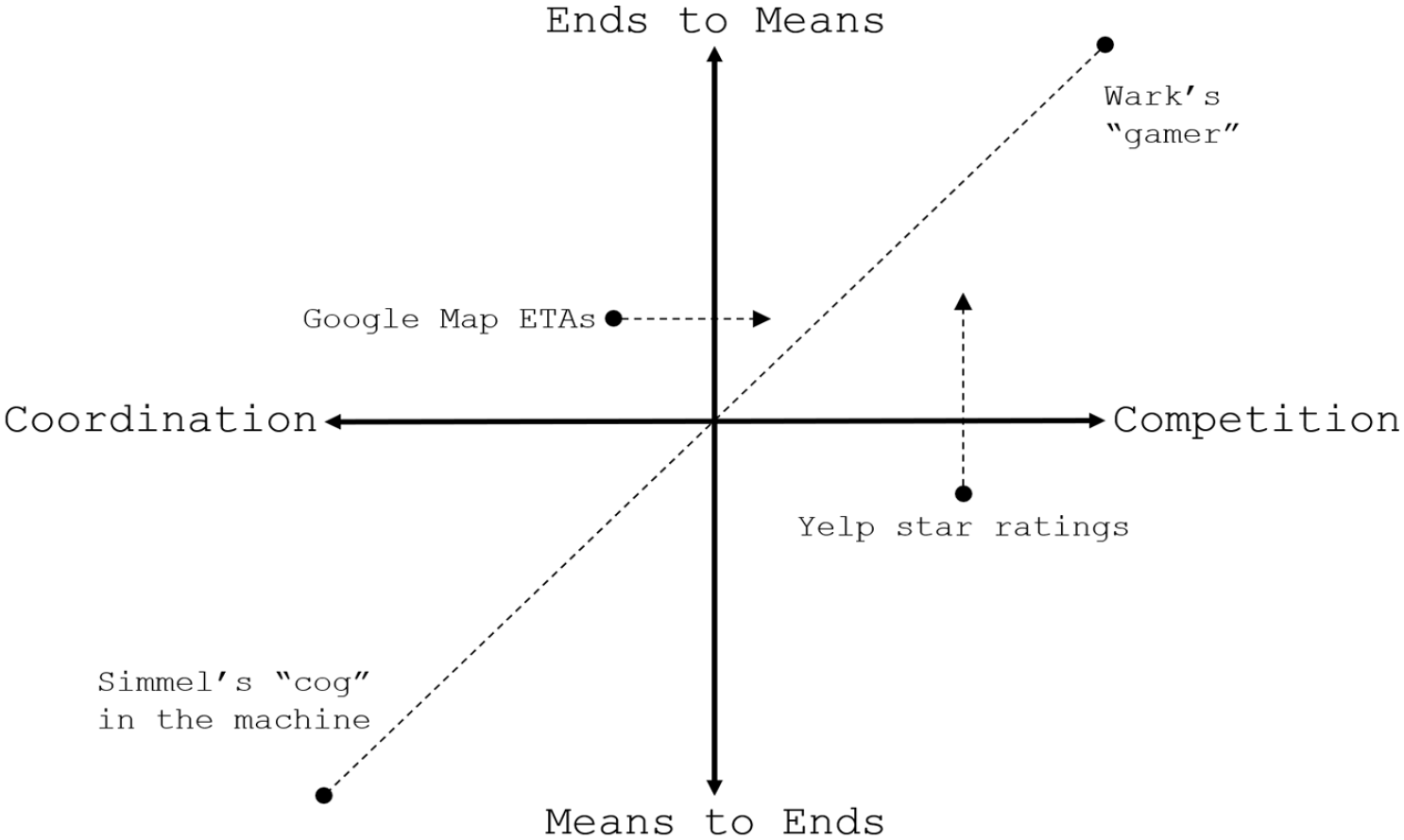
The spectrum of attitudinal orientations toward numbers in the urban environment.
The vertical axis represents the status of numbers as means versus ends. At the bottom, we find numbers as the ultimate “means to ends,” described in Simmel’s Philosophy of Money, where their utility completely overshadows all other possible ends, turning the world colorless and meaningless. Moving up this axis represents a transition in which numbers no longer reduce the moral and emotional salience of the world, but actually start to enhance it. At the top of this axis, numbers are the ultimate “ends to means,” the point at which the experience of chasing scores is all that motivates the gamer.
The horizontal axis represents the relationship of numbers to actors’ sense of agency, which can be understood as a contrast between coordination and competition. As pure coordination, numbers form a “fixed framework” that “transcends all subjective elements” (Simmel [1903] 1971:328), severely suppressing actors’ personal sense of agency. As pure competition, numbers do the opposite, giving actors a sense of heightened agency that comes from driving up the score and vanquishing competitors.
It is important to stress that Figure 2 refers specifically to attitudinal orientations. Actors may feel competitive without realizing that they are being coordinated. Likewise, numbers can affect actors’ subjective sense of stakes irrespective of whether they are engaged in activities with large external stakes (like a social movement) or none at all (like playing Pokémon-Go). As attitudinal orientations, the “cog in the machine” feels no personal control over the machine or their place in it, and cares little about what the machine is actually doing. The gamer in gamespace, meanwhile, feels that enormous stakes rest upon their own personal performance. 1
The theory of scoreboard urbanism is essentially a hypothesis that the digitally mediated city subtly and continually nudges people toward the top-right quadrant of Figure 2 as they go about their daily lives. A Google Map ETA may initially seem like a means of coordination (to arrange a meeting with a friend, for example). However, as the ETA ticks up or down on the dashboard, it creates the possibility for this sense of coordination to give way to a competition with Google’s AI. Likewise, Yelp ratings may be simple utilitarian tools adopted within market competition, allowing consumers to find the best products and services. And yet, as already discussed, scores have the potential to become self-fulfilling prophecies that amplify small or arbitrary differences in actual quality (Berman and Hirschman 2018:263)—or even just the spontaneous feelings of a single Yelp user who happens to leave the first review or have a large number of followers.
Back to Urban Space
What makes this phenomenon a type of urbanism, specifically? Although these forms of quantification exist all over the world, there are a couple ways in which they manifest uniquely within cities. First, true to Simmel’s original argument, the sheer concentration of social life within a city demands quantification. From the user’s point of view, scoring systems are most useful when one is overwhelmed by choice. Apps like Yelp make less sense in small towns with only a few consumer options. Furthermore, the digital platforms themselves often rely on a critical mass not only of people and businesses, but also of sensing devices. Google Map ETAs are calculated from the geolocation data of travelers who use the platform; more users means better results. For this reason, cities have become extremely important sources of data for tech companies whose business model depends on collecting and analyzing more data than their competitors—what Zuboff (2019) calls “surveillance capitalism.”
Second, scoreboard urbanism is an urban phenomenon because it concerns how people interact with and within the urban public realm. As Freese and Hargittai (2010) note in their article on geocaching, 2 despite initial assumptions that digital media would pull people out of public spaces and into private seclusion, these technologies have frequently had the opposite effect. Though people use digital media to navigate rural as well as urban areas (Freese and Hargittai 2010), sociologists have long recognized that urban public spaces have unique interactional dynamics (e.g., Lofland 1998). The remainder of this paper takes up the question of how digitally mediated game-like experiences influence the dynamics of the urban public realm.
Cognitive maps and spatial practices
In addressing this question, it is useful to draw on the twin concepts of “cognitive maps” and “spatial practices” discussed in Patterson (2016). Originally conceived by Kevin Lynch (1960), cognitive maps refer to the spatial reference points that people use in perceiving and evaluating place, including identifying meaningful destinations, available routes, and impassible boundaries. Cognitive maps are selective; they include some reference points and not others. Within this process of selective perception, scores constitute a powerful and unambiguous “common reference for all observers” (Esposito and Stark 2019:17). Whether you agree with them or not, Yelp scores and other sets of rankings and ratings provide the best evidence available for what everyone else thinks about a particular destination. This characteristic, combined with the affective design that keeps tugging our attention back to our smartphones, means that scores can exercise huge influence over the development of cognitive maps.
Beyond suggesting specific reference points, digital scores also potentially predispose us toward a “gamespace” attitude, encouraging us to perceive place in terms of dynamic competition, while also amplifying and stratifying qualitative differences. Empirical research on the use of apps like Yelp to navigate the urban environment does seem to support this hypothesis (Zukin et al. 2017). Likewise, digital scores also enable more dynamic cognitive maps. In addition to fixed destinations, digital screens can display mutable spatial references that spontaneously “pop-up” and move around. It is perhaps no coincidence that trend-conscious urbanites now routinely chase food trucks and other “pop-up” experiences across the city (Stillwagon and Ghaziani 2019; Wessel 2012).
Whether racing across town to get to that five-star food truck before it sells out or taking the long way to work to pump up a Fitbit count, cognitive maps are always developed and employed within the course of “spatial practices” and routines (Patterson 2016). Concurrent with new forms of spatial perception, scoreboard urbanism entails new practices that involve the appropriation the urban environment in the pursuit of high scores. This pursuit can be an end-in-itself, as in the case of Pokémon-Go and other “augmented reality” games, or integrated into other spatial practices related to travel, work, leisure, and even politics.
The relationship between cognitive maps and spatial practices is reciprocal: perceptions and actions are intertwined. Within scoreboard urbanism, this plays out in a particular way. Those who are most skilled (or at least most successful) in chasing scores have an outsized effect on how the urban environment itself gets scored. As Graham et al. (2013) note, though control of digital content tends to be “decentralized and user-generated,” in reality much of that control is concentrated among a tiny minority of high-level users (pp. 468–469). When an Instagram user with a high follower count posts a picture of a photogenic work of graffiti they found in a random alleyway, that photo will be prioritized by the algorithm, showing up on more users’ screens and becoming integrated into more cognitive maps. Soon, a previously obscure corner of the city may become a well-known destination as droves of people seek it out to get their own photo.
Social media influencer as digital flâneur?
In fact, there is a name for the figures who wield this power: social media influencers (SMIs) who are able to cultivate massive followings through performative consumerism (Hearn and Schoenhoff 2015). If, as Zukin (1998) has argued, urban social change can be understood by contrasting idealized types of actors who have risen to prominence within different historical eras, then it is worth dwelling on the figure of the SMI.
The SMI can be contrasted not only with Simmel’s “cog,” but also with another important figure of nineteenth-century urbanism: Baudelaire’s flâneur. Unlike the cog, the flâneur is someone with the economic means to avoid the drudgeries of work life. Instead, they “stroll the city’s streets and frequent the consumption spaces of cafes, nightclubs and shops, on the lookout for the new, the exciting and the unfamiliar” (Zukin 1998:828). Rather than muting the sensory experiences of the world, the flâneur is excited by crowds and public life, becoming “a mirror as vast as the crowd itself; or . . . a kaleidoscope gifted with consciousness, responding to each one of its movements and reproducing the multiplicity of life and the flickering grace of all the elements of life” (Baudelaire [1863] 1995:9).
Many of these characteristics apply to the SMI as well. Both the flâneur and the SMI appear to be driven by an authentic and “insatiable passion” that is, Baudelaire ([1863] 1995) argues, antithetical to the blasé attitude. To some extent, the SMI also reflects the flâneur as a skilled performer who sees the streets as a theater stage and the public as an audience toward whom they communicate through visible, performative actions and (often outrageous) fashion (Sennett 1992:125–26).
As a performer, however, the SMI may be an order of magnitude beyond the flâneur. The flâneur’s audience are the dozens of strangers co-present in physical space. The SMI’s audience are thousands or millions of strangers co-present in cyberspace. In fact, upon encountering an SMI in physical space, one is treated to a rather amusing reverse performance. You see the SMI instructing their annoyed partner to retake a photo while trying to maintain an expression of spontaneous joy. Or you might see them let their pasta get cold as they try to get the noodles to hang off the fork just right in one hand while angling their smartphone for a picture in the other. In Goffman’s (1959) terms, the physical spaces of the city are the flâneur’s frontstage, but they are the SMI’s backstage for a performance that is oriented primarily to cyberspace.
Also unlike the flâneur, the SMI does not “rejoice in [their] incognito” (Baudelaire [1863] 1995:9). Quite the contrary. The SMI embraces self-tracking. They co-opt digital surveillance in an effort to drive engagement with their online identity (their brand). Like gamespace itself, the SMI transcends the work/play dichotomy. Activities that are leisure for the flâneur are both leisure and work for the SMI. Every restaurant meal or trip to a museum is an opportunity to drive the scores higher. For the most successful SMIs, these scores can be monetized in the form of sponsorship, subscriptions, or merchandise (Hearn and Schoenhoff 2015:202). However, the vast majority of people engaged in these practices will not, and likely do not plan to, receive direct monetary rewards. Thus, further reflecting the logic of gamespace, whether the scores are a means to an end (money) or an end to a means (performance) remains ambiguous perhaps even to the SMI themselves.
The SMI is, therefore, not the flâneur reborn in the digital age, but a strange hybrid that includes elements of Simmel’s cog. They are the ultimate example of what Zygmunt Bauman (2007) calls a “consumer-by-vocation” (p. 55): in perfecting their own consumption practices, they transform into a high-demand commodity themselves (Bauman 2007), accumulating “likes” and “views,” if not dollars. And while SMIs and SMI-wannabes may be a small minority, they are a regular fixture in the digitally mediated city. To inhabit the urban public realm today often means sharing it with the SMI, and perhaps even engaging in some attempted social media influence yourself.
Frontiers of scoreboard urbanism
As a social type, the SMI provides a useful illustration of how gamespace logic manifests in the urban public realm. However, scoreboard urbanism is important because it potentially emerges in a multitude of different situations. While it might be tempting to dismiss the SMI as a frivolous figure, we should not overlook the fact that driving up scores has become an important tool in some of the most pressing social issues confronting cities today. To illustrate this fact, the remainder of this section provides a few brief illustrations of the role of scoreboard urbanism within (1) urban social movements, (2) labor and stratification, and (3) arts and culture. Because only a few statements can be made about each of these issues, this section also serves to chart out new frontiers for how the concept of scoreboard urbanism can help to advance understanding of more familiar urban issues.
Urban social movements
Much has been written on the role of social media in contemporary social movements, often examining how activists use these technologies to coordinate across networks and influence public discourse (Ince, Rojas, and Davis 2017; Kidd and McIntosh 2016). Black Lives Matter (BLM) is particularly notable in this regard and offers an important illustration of the integration of spatial practices and digital quantification. The #BlackLivesMatter hashtag, devised by activists long before it ever went “viral,” had the effect of knitting together a huge array of images, videos, and messages into a single, quantifiable metric that has routinely risen to the top of social media feeds, capturing the attention of a global audience (Freelon, McIlwain, and Clark 2016)—and beating out competing hashtags such as #AllLivesMatter and #BlueLivesMatter (Carney 2016). However, as Freelon et al. (2016) have emphasized, the success of BLM as a social media phenomenon has occurred in concert with the offline activities of activists. The images, videos, and other material that carry the #BlackLivesMatter hashtag were generated on the streets by vigilant bystanders who recorded and uploaded acts of anti-Black police violence, as well as by activists who organized massive street protests. It was the performative power of these offline acts that created the potential for them to go “viral” online, and it was their online virality that allowed them to transform from isolated, local events, to a major social movement on a global scale (Alexander 2017; Freelon et al. 2016).
BLM is in a league of its own, but it is hardly the only urban social movement that combines online scoring systems with offline spatial practices. Consider another, less well-known, example from Calgary, Alberta, where the municipal government initiated a pilot program involving a network of bicycle lanes throughout the downtown core, which included a series of bike totems displaying daily and all-time cyclist counts. Cyclists routinely stopped to take and upload photos of the higher-than-expected totem scores. Eventually someone set up an automated Twitter account that reported the daily scores, allowing them to be “liked” and “retweeted” by supporters. This all culminated in December 2016 when Calgary city councilors (many of them avid Twitter users) debated and eventually voted to make the bicycle lanes permanent—emboldened by the higher-than-expected scores.
In both these cases, we see a feedback loop between digital scoring systems and spatial practices that play out in city streets. Many of these practices constitute performative “social dramas” (Alexander 2017) that generate a powerful sense of moral and emotional stakes connected to winners and losers, as well as heroes, victims, and villains (Alexander 2017). Far from suppressing its emotional and moral salience, the scores provide a clear, unambiguous target that focuses and amplifies the drama, while also giving it a broader audience and allowing it to spread from city to city.
Labor and stratification
As BLM makes clear, scoreboard urbanism is not limited to a privileged “leisure class.” Marginalized groups can and have used these tools to demand change, drawing attention to places, people, and events that have long been ignored. This is due partially to the high availability of the requisite technology. Pew Research Center (2021) reports that 85 percent of the American public use smartphones and 72 percent use social media. In many middle-income countries, both rates are well above 50 percent (Pew Research Center 2019). These numbers are even higher within cities (Pew Research Center 2021). To understand how scoreboard urbanism intersects with stratification, therefore, we should examine not only who has access to these opportunities, but also how this phenomenon manifests itself differently across socio-economic boundaries.
While survey research would ultimately be required for confirmation, it is possible to hypothesize about this relationship. First, to engage in scoreboard urbanism recreationally—particularly at the level of an SMI—requires sufficient leisure time, access to amenity-rich neighborhoods, and other social, cultural, and economic resources. It is likely that this form of scoreboard urbanism correlates with a younger, more educated, urban, and affluent demographic.
Second, we must also recognize that scoreboard urbanism is not just a recreational pursuit. Workers in the service sector and “gig economy” are now routinely subjected to quantitative evaluations by customers and clients (O’Neil 2016). The success of restauranteurs and Uber drivers depends on continually maintaining higher scores than their competitors. And though we may not consider these activities to produce the same game-like experiences as leisure, this is an empirical question that requires further study. It is worth recalling once again the garment workers who turned labor into leisure, and the SMIs who turn leisure into labor.
Questions of who engages in scoreboard urbanism, how they do it, and to what end, points to the larger issue of how these digital technologies are transforming class stratification within urban economies. O’Neil (2016) argues that being able to avoid constant quantitative evaluation has become the privilege of elites. Elites stand above gamespace, relying instead on informal personal networks to get ahead. Meanwhile, Fourcade and Healy (2017) point to the opposite end of the socio-economic spectrum, describing the “lumpenscoretariat” as those so marginalized that they are ignored even by scoring systems (and therefore excluded from any associated rewards). Combined, these two insights point to a vast middle and working class whose life chances are increasingly determined by various types of scoring systems. To the extent that this new labor market is structured within local economies, and that the various positions within it entail distinct spatial practices and associated cognitive maps, it is a fundamentally urban sociological phenomenon.
Arts and culture
A final example concerns how scoreboard urbanism potentially influences the generation and diffusion of new forms of cultural and artistic expression within the urban realm. Artistic content that plays well on social media and goes “viral” can reach a massive audience, circumventing the traditional gatekeepers of the art world. In fact, the art world increasingly takes cues from social media, as with the production of art and architecture designed to attract selfies (van den Berg 2018). Photogenic artwork such as Yayoi Kusama’s “Infinity” rooms have thrived under scoreboard urbanism (Smith 2017). The quality of this artwork that makes it attractive in digital images (no matter the skill of the photographer) also causes it to proliferate across social media, raising the profile of the art, artist, and museum where it is on display.
Similarly, as mentioned, there is an affinity between the mutability of urban scoreboards and the rise of “pop-up urbanism,” involving social and cultural events that temporarily take over particular public spaces (Stillwagon and Ghaziani 2019; Talen 2015). Although pop-up urbanism can be employed by corporate actors, it is also a useful tool of marginalized communities and “guerilla” activists who have little formal control over urban space (Stillwagon and Ghaziani 2019; Talen 2015). Likewise, research has shown how digital media feeds into the spread and spatial practices of urban subcultures, such as those associated with parkour (Kidder 2012).
Finally, scoreboard urbanism potentially changes the more formal, consumer-oriented parts of the urban cultural economy. In the 1990s, Hannigan (1998) coined the term “Fantasy City” to describe the development of large entertainment districts modeled on theme parks—places where alienated office workers could escape to on weekends to enjoy simulated adventure. It is worth considering the possibility that digital platforms such as Pokémon-Go have supplanted the Fantasy City. Simulated adventure can now be found in as mundane an activity as walking to the corner store.
These examples serve to illustrate the wide-ranging implications of scoreboard urbanism for urban sociologists. Across these diverse arenas of life, scoreboard urbanism hypothesizes that scores increasingly influence people’s spatial perceptions and practices and, in doing so, predispose them to competitive, game-like experiences with amplified emotional stakes. Testing these hypotheses does not necessarily require new methodologies. Rather, it means that sociologists who study different types of urban inhabitants—taxi drivers, artists, shoppers—should explicitly account for how quantification enters into daily routines and practices. 3 Figure 2 is offered as a potential framework for systematizing variation in terms of how numbers fit into these practices, allowing us to better understand the complex interrelationship between quantification and qualitative experience, which Simmel identified a century ago.
Conclusion
This paper was motivated by a limitation within the current literature on digitally mediated cities. Despite all the focus on how people incorporate digital platforms into their daily lives (e.g., Barns 2020; Graham et al. 2013), few if any scholars had considered the role of scores in mediating interactions with and within the urban environment. This limitation immediately calls to mind “Metropolis and Mental Life” and how a similar conceptual approach might apply to the digitally mediated city. Following Simmel’s focus on the interrelationship between the urban environment, quantifying technologies, and human subjectivity, the paper presented a conception of urban life that contrasts dramatically with the blasé urbanite who feels like a cog in a vast machine. Instead, it points to an urbanism with parallels to video games, where actors experience a heightened sense of emotional stakes and agency. Despite these differences, however, a major question remains: are the gamers of scoreboard urbanism just cogs in a machine that have been tricked by algorithms into thinking otherwise?
Some of the illustrations discussed in this paper certainly suggest this interpretation, including Ranganathan and Benson’s (2020) study of the garment factory workers. A similar interpretation could be made of the SMIs who become living advertisements. On the other hand, this paper has also presented examples in which driving up scores has become a strategy in pursuing real social change. BLM and pop-up urbanism demonstrate how scores can be used to draw attention to places, experiences, and communities who have been systematically excluded from the urban public realm. And yet, while the achievements of these movements is undeniable, their success has also been actively monetized by companies such as Twitter and Meta in terms of advertising sales.
While gamification is not synonymous with commodification, there is a deep affinity between the two. Gamification is used to great effect by the “attention merchants” (Wu 2017) and “surveillance capitalism” (Zuboff 2019) to keep our eyes on the screen and our bodies generating “data exhaust” (Barns 2020). These corporations have the means and motivations to create the most ubiquitous, addictive scoring systems, beating out potential grassroots and non-profit alternatives.
However, as smart city developments in places such as Toronto, Canada (Peel and Tretter 2019) and Gujarat, India (Datta 2015) have demonstrated, these systems of quantification are not beyond political criticism and opposition. Public debate continues to rage over who is scored, how scores are calculated, and who owns and controls the data. There is widespread recognition that these important decisions can no longer be left to the whims of secretive tech companies. Within this debate, better understanding the way that quantification manifests in everyday urban life can potentially help inform how these systems can be designed to realize “a just urbanism in the digital age” (Rosol and Blue 2022:698).
Whether this goal can be achieved remains uncertain. Therefore, it is perhaps fitting to take a cue once again from Simmel and end on this note of ambiguity. Simmel saw alienation as “inherent” to human existence and recognized that the modern, rationalized city threatened to greatly intensify this condition—but not without also offering opportunities to overcome it (Silver 2019:90).
Footnotes
Acknowledgements
The peer review process for this paper was exceptionally productive and strengthened it considerably. I thank the three anonymous reviewers and editor Richard E. Ocejo for their detailed comments and suggestions. The idea for this paper first developed during my participation in the “Social Justice and the Smart City” working group at the University of Calgary led by Byron Miller. I received particularly helpful and early feedback from fellow participants Alan Smart and Jack Lucas. While writing the paper, I benefitted greatly from frequent conversations with Phillipa Chong.
