



Abstract
Urban density is central to pressing questions concerning low-carbon lifestyles, affordable housing and global land use patterns. However, for many densifying cities, problems of inequality, climate emissions and social sustainability often remain unsolved or exaggerated. Adopting a relational perspective, this paper explores the politics of urban densification in Oslo, Norway. Arguing that urban density is assembled as particular political projects, the paper seeks to understand the achievements urban densification projects bring together, from housing policy to environmental policy, property schemes and financial strategies. Based on a qualitative study of urban densification strategies and projects in Oslo, the paper develops a typology of hegemonic and counterhegemonic urban density discourses and contributes to a discussion of how economically, socially and environmentally different kinds of urban densities may be assembled.
Introduction
Often situated within a compact city approach, urban densification strategies, address the call for more sustainable urbanisation (Angelo and Wachsmuth, 2020; Kjærås, 2021; Ottelin et al., 2015). Arguably, urban densification strategies provide a dignified response to the interconnected challenges of population growth, climate change and environmental degradation (UN-Habitat, 2020).
Globally, research shows that in the last decades cities have been sprawling rather than densifying (McFarlane, 2020) and strategies to contain urban development are important to limit the global urban footprint (UN-Habitat, 2020). However, in densifying cities, issues related to social sustainability, inequality and environmental sustainability remain pertinent problems, and are sometimes even exaggerated through urban densification processes (Cavicchia, 2023).
Recently, critical research has taken an interest in urban density, questioning existing conceptualisations of urban densification processes (Charmes and Keil, 2015; Chen et al., 2020; McFarlane, 2020; Pérez, 2020). This research shows that particular policies and practices, such as financial models and property schemes (Chen, 2020), housing typologies (Blackwell and Kohl, 2018) and state (dis)investment in housing (McFarlane, 2020) are often overlooked in debates over urban density.
Contributing to this emerging literature, this paper adopts a relational perspective and analyses the hegemonic and counterhegemonic urban density discourses in Oslo, Norway. Building upon the author’s earlier work on a relational conception of the compact city (Kjærås, 2021), this paper seeks to enrich a critical geography of compact urbanism by developing a typology of hegemonic and counterhegemonic urban density discourses. Identifying and discussing how economically, socially and environmentally different kinds of urban densities may be assembled, the paper aims to critically address the socio-spatial imaginaries of urban densification in Oslo.
A relational perspective herein implies an understanding of urban density as something which ‘cannot be conceived or acted upon in and of itself, because it is always a relation to other issues, spaces, and actors’ (McFarlane, 2016: 630). Combining this understanding with a Gramscian approach to societal change, the paper explores hegemonic and counterhegemonic discourses on urban density through a qualitative study of urban densification projects and strategies in Oslo.
A relational approach to urban density
Historical perspectives on urban density reveal striking contrasts in how density is perceived, built and lived (McFarlane, 2016; Tonkiss, 2013), from overcrowding in early-20th-century industrial cities, the promise of Le Corbusier (1985 [1923]) ordered high-rise urbanism, to the intricate and diverse densities associated with Jacobs’ (1961) depictions of inner-city life. The idea that urban density means something different to different populations and individuals across space and time is well established (Cohen and Gutman, 2007; Jacobs et al., 2007; Tonkiss, 2013) and often entails a research focus that starts from a relational perspective. This approach runs parallel to research that seeks to more generally understand the variegated relationship between urban morphology, population density and factors, such as liveability or economic growth (Ahlfeldt and Pietrostefani, 2019; Bruyns et al., 2021; Mouratidis, 2018). While these approaches often entail contradictory conceptual lenses, their main difference lies in the questions they ask about urban density. The purpose of this paper is not to challenge the legitimacy of the latter approach, but rather to show the relevance of the former.
Adopting a relational approach, this paper aims to better understand the political project that urban densification in Oslo entails. Arguing that contemporary renderings of sustainable urbanism tend towards naturalising urban density as a given ‘socio-material epistemology’ (Pérez, 2020: 617), this paper draws on a critical urban density scholarship to question such naturalised conceptualisations.
Facing climate change, urban densification has been viewed as a favourable strategy for ensuring environmental sustainability, reducing the per capita ecological footprint, promoting economic vitality and providing affordable housing (Angelo and Wachsmuth, 2020; Ottelin et al., 2015; Tonkiss, 2013). However, urban gentrification (Anguelovski et al., 2019; Lees et al., 2008), escalating housing prices (Wetzstein, 2017), struggles over rights to urban space (Brenner et al., 2012; Di Feliciantonio, 2017), indebted citizens (Aalbers, 2019) and rising global emissions (Moran et al., 2018) all contradict the ideals fashioned through these iterations of urban density.
In this context, critical research has contributed with analyses of the socio-spatial politics that are developing as cities extend vertically (Graham, 2016; Harris, 2015). Chen’s (2020) research in Taipei shows how high-rise and sky-scraper constructions are shaped by the financialisaton of the built environment through urban air rights. Chen’s research exemplifies how urban density often obscures a complicated relationship between use value and exchange value as building events become complex achievements with a multitude of motivations beyond the urban environment’s ascribed functions (see also Aalbers, 2019; Christophers, 2011; Harper, 2019). For example, while urban densification is understood to alleviate the scarcity of urban land – making more housing available for a bigger portion of the population – a global urban affordability crisis (Wetzstein, 2017) is making urban housing a place of struggle for emancipatory democratic politics (Di Feliciantonio, 2017; García-Lamarca, 2017).
Critical scholarship is challenging established approaches to urban density (Charmes and Keil, 2015; Chen et al., 2020; Keil, 2020; McFarlane, 2016, 2020; Pérez, 2020; Robinson and Attuyer, 2020), contributing with an understanding of the political agendas embedded within urban densification projects. Pérez (2020: 633), analysing urban densification in Bogotá, Colombia, shows how the ‘urban epistemology and […] aesthetic-material ideology [of urban density], naturalizes urban development and both obscures and limits urban politics’. Through a historical analysis, Pérez (2020: 634) depicts how urban density discourses are politicised, while nevertheless assimilated into the ‘entrenched grammar of density, limiting the stakes and scope of urban intervention’.
Similarly, urban climate research illustrates how urban density disguises a complicated relationship between low carbon lifestyles, income and socio-spatial organisation (Heinonen et al., 2013; Moran et al., 2018; Ottelin et al., 2015; Wiedenhofer et al., 2018). Ottelin et al. (2015: 9574) note, ‘[i]n many policy reports, climate change mitigation in urban planning has become almost synonymous with increasing the density of urban settlements and avoiding urban sprawl’. However, recent research show that the relationship between higher built densities and climate emissions is not straightforward (Heinonen et al., 2013). Rather, situating low-carbon lifestyles might be a question of urban affordability, just socio-spatial distribution, time use and low-carbon infrastructure (Heinonen et al., 2013; Wiedenhofer et al., 2018).
By understanding urban density relationally – as a collection of different achievements (Kjærås, 2021; McFarlane, 2016, 2020) – the politics and material practices embedded within urban densification projects may be better understood. As McFarlane (2020: 316) states when describing his relational approach to de/re-densification processes, ‘[a] whole set of drivers enter into the making of this relational process: economic cycles of (dis)investment, ideologies of planning and design, ideals of modern living, social differences of gender and race, and so on’.
Acknowledging the expansive field of approaches to urban density, this paper aims to show how a relational approach to urban density allows for understanding of the ideological and material relations brought together in urban densification projects and policies. While recent research has come far in uncovering the politics of hegemonic urban densification schemes (see e.g. Chen et al., 2020), less focus (with the exception of Pérez, 2020) has been placed on how alternative articulations of density are constructed. To approach alternative conceptualisation of urban density, I ground this analysis in a Gramscian approach to change to better understand the discursive struggles over urban density.
Unpacking the political struggles of urban density
This paper understands discursive expressions as embedded in material life (Laclau and Mouffe, 1985). Urban density, for example, can be understood as expressing particular discourses and practices. Here, struggles over particular issues do not only pertain to representations of, for example, a house as ‘a commodity’ or as ‘a right’, but to the processes and practices that make housing materialise as ‘a right’ or as ‘a commodity’. For this purpose, a Gramscian and non-teleological approach to dialectics is adopted. Dialectics is understood as ongoing relations of material practice and the world of abstractions where actors, objectives, problems and positions are (re)articulated (Hoare and Smith, 1971; Im, 1991).
Gramsci’s understanding of hegemonic and counterhegemonic struggle plays a particular role in structuring this analysis. According to Gramsci, hegemony entails the organisation of consent and encompasses those relations that appear natural (Laclau and Mouffe, 1985). Stoddart (2007: 201) therefore argues that hegemony: is a form of social power that relies on voluntarism and participation, rather than the threat of punishment for disobedience. Hegemony appears as the ‘common sense’ that guides our everyday, mundane understanding of the world.
However, Gramsci understood neither hegemony nor counterhegemony as totalising structures – hegemony only appears as such.
Counterhegemonic relations, on the other hand, appear more fluid and fragmented and often represent a variety of different political struggles (Hoare and Smith, 1971). The counterhegemonic discourses analysed in this paper can be understood as existing in flux, as ongoing processes of discovering potential paths for change.
Methods
The analysis herein is part of a research project aimed at understanding the mobilisation and contestation of compact city and urban densification strategies in Oslo. To analyse the interstitial spaces of policy development and urban politics emphasis has been placed on researching sites and situations challenging established approaches to compact, low-carbon and affordable livelihoods. Multi-sited fieldwork has been carried out in Oslo, London, Malmö, Copenhagen and Berlin in the period from 2017 to 2019. The data material consists of 50 interviews with 49 informants, including politicians, architects, city employees, activists, developers, private and public actors, as well as civic actors; participation and observation in 25 public meetings and conferences, three exhibitions and one study trip; and the collection of key policy documents, planning documents, reports, newspaper articles, podcasts and social media coverage.
For this paper, discourse analysis of 28 transcribed interviews 1 pertaining to Oslo has been carried out and data has been categorised according to four categories: hegemonic discourses, counterhegemonic discourses, problem formulations and subject positions. The resulting discourses, problem spaces and subject positions have been triangulated against central policy documents on urban density in Oslo and a selection of 173 newspaper articles selected through the search: (kompakt by* OR fortetting*) AND (Oslo OR Hovinbyen OR Hauskvartalet) AND (bolig* OR klima*) in the period from 29 April 2017 to 29 April 2020 in 10 mainstream newspapers and magazines (Aftenposten, Arkitektur N, Morgenbladet, Dagbladet, VG, Dag og Tid, Finansavisen, Kapital, Dagsavisen, Klassekampen). The newspaper articles have been analysed using the four categories described above for the purpose of uncovering and verifying discourses and positions.
The Statistics Norway (2020a, 2020b) data sets ‘06513: Dwellings, by type of building and utility floor space (M) 2007–2020’ and ‘06070: Private households, by type of household (M) (UD) 2005–2020’ have been used.
Urban densification in Oslo
The Municipality of Oslo, Norway, is a relatively small, fast-growing city with approximately 700,000 inhabitants (Statistics Norway, 2020c). Since the early 1990s, compact urban development has been the overarching land use strategy in Oslo, including an urban containment boundary and urban densification policies (Næss et al., 2011). The Municipality of Oslo (2019) describes urban densification as an urban land use strategy for achieving diversity, vitality and quality of life, while simultaneously preserving land by concentrating development and achieving efficient resource use through collective organisation. Urban densification strategies in Oslo follow two main principles: development from inner to outer city, and development alongside transportation corridors (Municipality of Oslo, 2018).
Since the mid-1980s, the greater Oslo region has experienced a reurbanisation trend, with urban densification responsible for the greatest portion of new housing (Tiitu et al., 2021). The city’s morphological population density increased ‘by 38% from 27.0 to 37.3 persons per hectare between 1985 and 2018’ (Tiitu et al., 2021: 1099).
While urban densification and compact city strategies are viewed as successful in Oslo, especially in reducing car dependence (Næss et al., 2011), research also suggests that these urban strategies may be in conflict with social sustainability (Cavicchia and Cucca, 2020; Schmidt, 2014) and goals for achieving low-carbon urban lifestyles (Holden and Norland, 2005). Since the 1980s, Norway’s regulatory planning system has also shifted towards developer-initiated urban development, where the municipal government has taken on a brokering role through strategic planning while private actors initiate most planning initiatives. The municipality largely refrains from initiating zoning plans or utilising land acquisition for steering urban development (Røsnes, 2005).
Oslo is not a city associated with particularly high built densities and the politics of urban density have been especially concerned with the shifting skyline of the city landscape (Kjærås, 2009), that has been changing at a more rapid pace since the early 2000s. Contestation over urban densification projects have often been dominated by discussions concerning building heights, architectural design and the scale of development (Andersen and Røe, 2017).
Today, the debates over urban density in Oslo are changing. Topics like climate friendly lifestyles, affordability, neighbourhood qualities and social sustainability are increasingly central to questions concerning urban densification processes and the experiences of lived densities in Oslo. The municipality’s urban densification approach has attracted critique and resistance, especially from local neighbourhoods and interest groups (Skrede and Andersen, 2022). As alternative approaches to densification in Oslo are gaining public interest, publics in Oslo are learning other ways to relate to urban density. Discussions over urban densification in Oslo are evolving through critical debates concerning housing, environmental policy, democratic governance, property schemes and financial strategies.
In this section I analyse different discourses associated with urban densification processes in Oslo and the epistemic problem spaces – the knowledge and practices defining the discursive realm of an identified problem – that are addressed. I organise the analysis in ‘hegemonic’ and ‘counterhegemonic’ discursive positions.
Hegemonic discourses: The common sense of neoliberal densities in Oslo
The hegemonic urban densification meta-discourse in Oslo can be described as neoliberal, where central urban problems are solved through market solutions and where a particular modernist logic of urban density is a tool for economic growth. The meta-discourse of neoliberal densification is constituted through three discourses, construing urban density as relative to economic growth, spatial optimisation and the commodification of housing. These three discourses – urban entrepreneurialism, market-based homeownership, and technical environmentalism (see Table 1) – describe the specificity of Oslo’s hegemonic approach to urban density. Together these discourses create an epistemic problem space where densification provides an urban solution to climate change, growing populations and economic sustainability.
Hegemonic positions on urban density in Oslo.
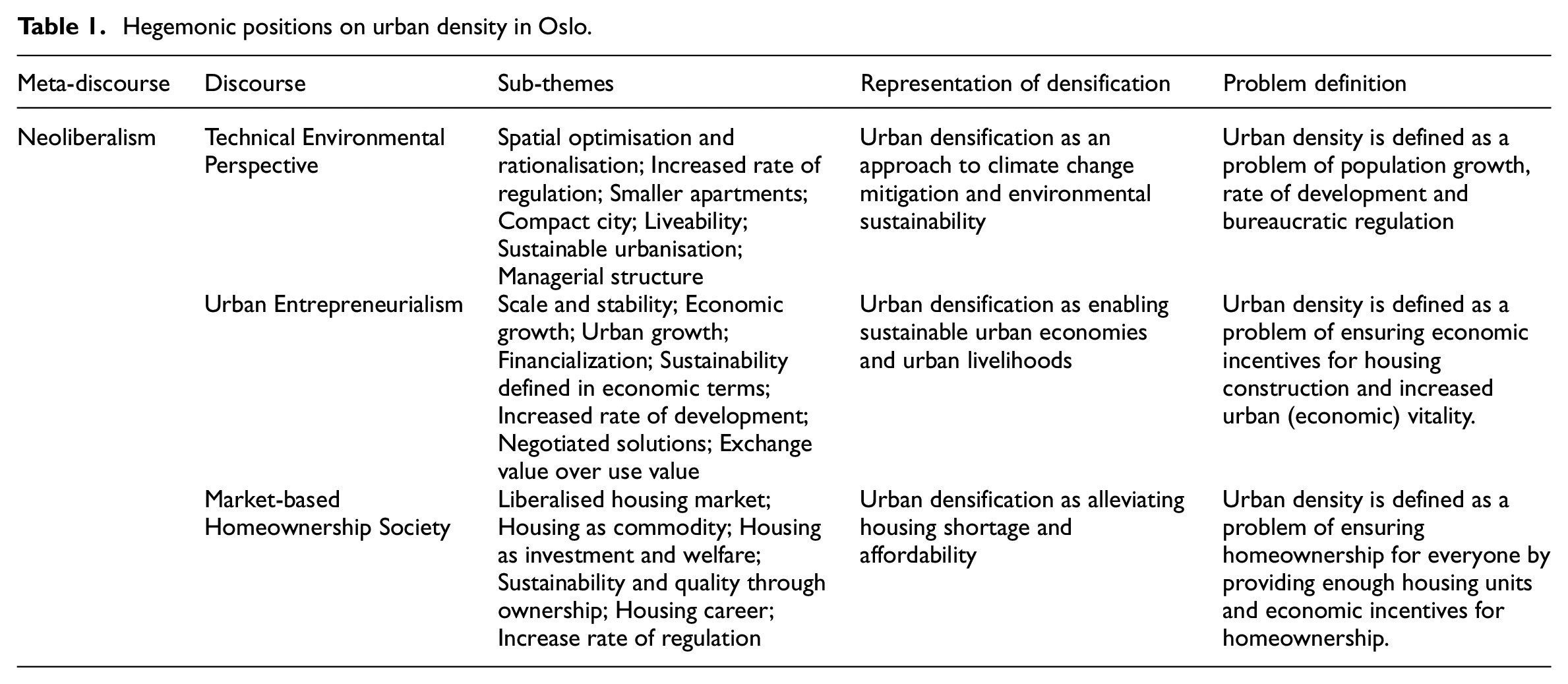
While a considerable proportion of informants agree that this epistemic construction constitutes the hegemonic position on urban density in Oslo today, many actors, primarily architects, planners, activists and politicians, are critical of its legitimation and the common sense it constitutes. Below I detail the three discourses that constitute Oslo’s neoliberal and hegemonic approach to urban density.
Technical environmentalism
The articulation of urban densification policies in the Municipality of Oslo’s (2019) official strategies and planning documents typically takes place on environmental terms. Climate friendly mobility is often emphasised (Municipality of Oslo, 2018), while compact units and high-rise developments are understood to achieve efficient use of space and optimised energy use (Municipality of Oslo, 2003, 2015, 2019). This technical environmental perspective on urban density can be placed within the environmental discourse of ecological modernisation (Dryzek, 2013 [1997]) where spatial optimisation and technical solutions guide decision making.
These environmental justifications for urban densification are confirmed by several informants. Most informants understand urban densification as a necessary approach for achieving sustainability. However, many informants view densification as a double-edged sword. One architect, who previously worked for the State Housing Bank, argued that there is a ‘densification ideology’ justifying the development of poor-quality urban housing on environmental grounds. He stated that: ‘25 years ago, we didn’t build apartments smaller than 50 m2. Today we are building apartments as small as 30 m2 without discussing the societal consequences’.
Currently, 84% of all units built or changed since 2008 are under 100 m2. Approximately half of these units are under 50 m2. According to Heindl (2016: 98) the trend of smaller apartments can be viewed as ‘a new existential minimum’ where smaller living units are seen to optimise living arrangements at reduced prices. Smaller units, proximity and more shared infrastructure are generally seen as positive in environmental terms. Yet the decrease in household size is also associated with increases in urban consumption, suggesting that there is a rebound effect of the emission reductions achieved by reducing household size (Heinonen et al., 2013).
In Oslo, about 24% of the population (accounting for about 47% of all households) live alone and research reveals that many first-time parents leave inner-city Oslo for the suburbs (Wessel and Lunke, 2021). While there are many factors that influence where people move and why, the societal consequences of building smaller apartments may have environmental consequences beyond the suggested benefits of spatial optimisation.
Urban entrepreneurialism
Several informants understand that a particular financial logic determines urban densification in Oslo. This rationale positions the financialisation of urban space through urban densification as a precondition for urban sustainability. As argued by an architect working for a large housing developer in Oslo, ‘You need high densities to be able to afford affordable housing and public goods.’ This logic can be associated with an urban entrepreneurial discourse. The general shift towards urban entrepreneurial governance in the 1980s has signified a politics of attraction where local government support for private market forces remains key for making the city competitive in a global perspective (Harvey, 1989; Jessop, 1998). For urban densification strategies, this shift plays a significant role in establishing urban densification as a tool for the financialisation of urban space and economic growth.
This discursive position is adhered to by developers, who perceive economic sustainability as the ability to make enough profit from investments to ensure further investment and expansion in the future. An informant from a housing association who earlier operated as a non-profit developer describes the shift towards generating equity that took place in the 1980s: [Some housing associations] turned around [early on] and acted more like a regular market player than other housing associations who may have sold homes at cost price for quite some time. [But if] you do not build up equity then you cannot finance new projects.
The shift that this informant describes refers to the deregulation of the Norwegian housing system that took place during the 1980s, shifting state policy from supply-side subsidies, direct state involvement and securitisation and price regulation mechanisms in parts of the sector, to a liberalised housing scheme by the 1990s (Oust, 2018; Sørvoll and Nordvik, 2020; Turner and Wessel, 2019).
Interviews with other developers confirm that these financial incentives trump social and environmental sustainability, housing affordability and housing quality. For example, developers work to offer slightly more affordable units without compromising their return-model. In an interview with a developer working on an urban eco-project in Oslo, they confirmed that marginal cost optimisation schemes, such as low-tech environmental solutions (e.g. wooden constructions and do-it-yourself apartments) could be a solution towards more affordable homes in Oslo.
While, the Municipality of Oslo holds considerable weight in steering the densification process with regards to urban form and design, they have, according to the national planning act, no opportunity to regulate the economic models employed by developers. Rather, national and EU regulation supported, market-oriented policies are practised, with the goal of ensuring fair competition (interview with planning official). Overall, developers hold an authority in determining economically sound practices, pushing planners, architects and other professionals to practise within the economic models provided to them. This skewed position is primarily legitimised by the fact that for-profit developers are the only actors in Oslo with the expertise and capital to carry out urban densification projects.
Market-based homeownership society
Lastly, several informants hold the perspective that urban densification in Oslo is legitimised by urban dwellers themselves being part of the speculative endeavour of urban housing through homeownership. From a Gramscian position, homeownership plays the role of ‘organising consent’ for neoliberal densification for the general population by promising personal wealth creation. Despite considerable resistance and debate on the issue regarding urban densification, ‘people have become housing speculators’ (interview with architect). For example, resistance expressed by local neighbourhood groups against densification is parallelled by an economic incentive caused by increasing housing prices.
A key rhetorical device which illustrates how the homeownership discourse has established itself through the meta-discourse of neoliberalism is the term ‘housing career’. This idea holds a temporal trajectory where you gain access to a better home by profiting from buying and selling your dwelling and thereby gaining the capital to invest in bigger and better dwellings over time. As stated by an architect working for a small architecture firm in Oslo, ‘people don’t want to buy an apartment without making a profit’.
Several architects, planners and housing experts understand this consolidated perspective of ‘housing as speculative object’ to allow for a general lack of knowledge regarding housing quality and affordability among people. Several informants understand this ‘common sense’ to legitimise the economic and environmental perspective of optimisation as ‘people don’t know what they can get and accept reduced quality and reduced diversity of options’ (interview with architect). Exchange value ends up guiding perceptions of use value. While the technical environmental perspective and the urban entrepreneurial perspective are upheld through support from experts and developers, people in general support the homeownership discourse because of the economic promise of urban housing investments.
Counterhegemonic discourses
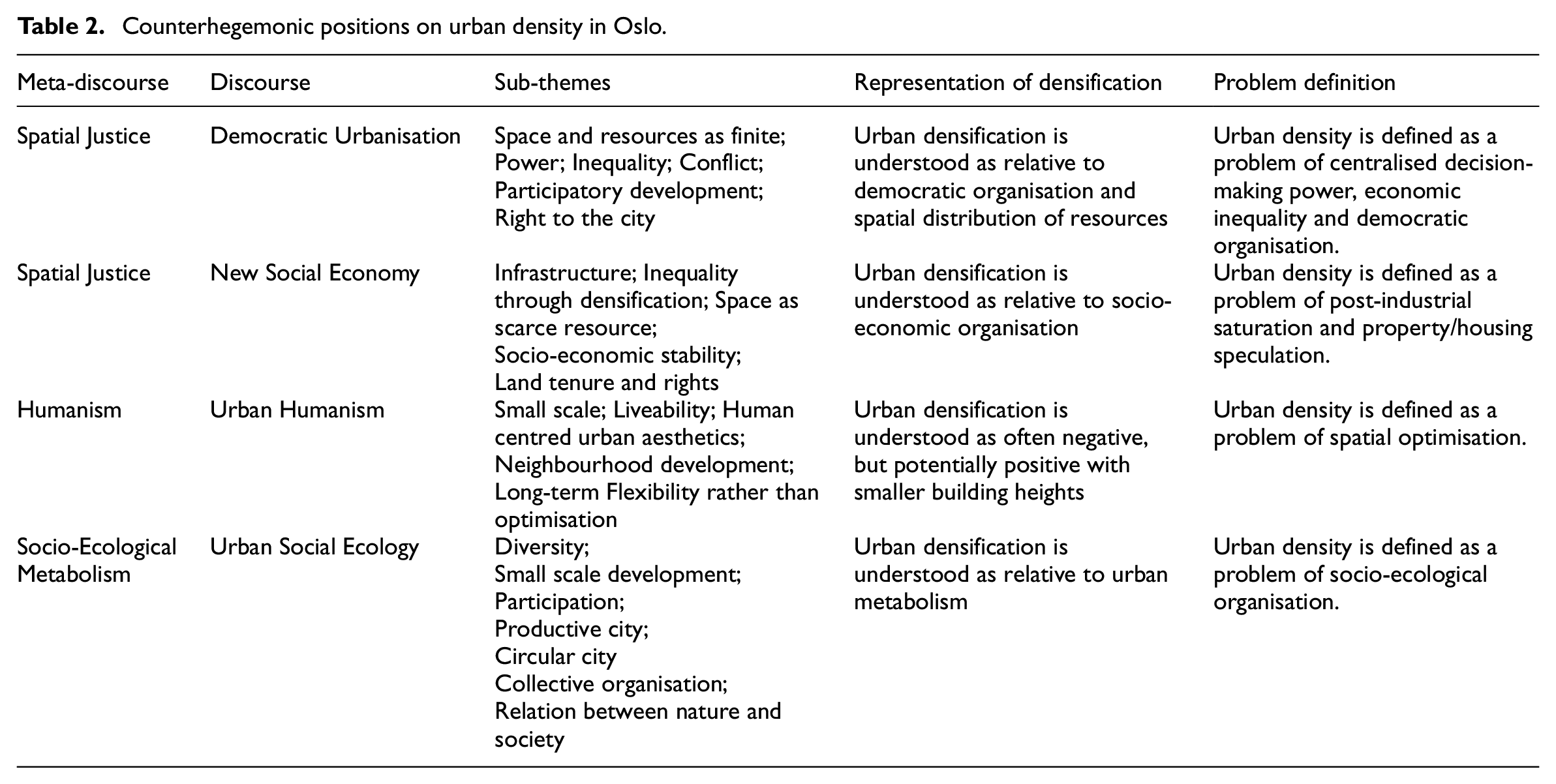
Counterhegemonic discourses on urban density in Oslo represent a diversity of meta-discursive and discursive positions (see Table 2). Importantly, these discourses are not anti-densification discourses, rather they suggest that urban density may be assembled differently than the hegemonic discourses described above. In this section, I describe four counterhegemonic discourses.
Counterhegemonic positions on urban density in Oslo.
Democratic urbanisation
One counterhegemonic position within the urban densification debate in Oslo can be understood according to a spatial justice perspective where the process of urban development is perceived as increasingly unjust due to unequal or undemocratic power-relations that materialise through urbanisation. This corresponds to critical perspectives on densification policy such as Ahlfeldt and Pietrostefani (2019: np) who argue that ‘densification policies may lead to aggregate welfare gains, but there may be regressive distributional consequences’. Some informants view unequal power-relations and financial motivations for densification as a democratic problem. One informant who has attempted to collaborate with a developer in Oslo, states that dialogue is determined by ‘monetary power’ (interview with local entrepreneur). From this discursive position, several informants argue for rearticulating the relationship between urban density, the economy and democratic participation.
Many informants understand the conditions for providing new housing units in Oslo as complex and costly. One informant states: if you […] are to be able to buy a property, regulate it with all the uncertainty and the time it takes, build, meet building requirements, contribute through development agreements, then you have to have quite strong financial muscles. This means that the housing market and housing production will be very concentrated on some actors (interview with municipal planner).
This is confirmed in a study from 2015 (The Competition Authority, 2015) which shows that the property market in Oslo is concentrated; three developers hold 79% of the shares of future land area with potential for housing in Oslo. The report notes that small and medium sized actors have a hard time acquiring land for development, carrying the cost associated with housing development, and the risk associated with planning processes.
Overall, the Democratic Urbanisation discourse can be described by three interlinked positions. First, informants argue that participatory planning does not suffice in addressing the structural inequalities of urban densification and other participatory development processes must be sought. Here democratic participation is understood as active partnerships achieved through new alliances and roles, or as a right. Group and organisational empowerment where local citizens are given authority to shape the development process of urban densification projects are suggested by some informants. Local organisational forms such as building collectives, delegated decision-making power and partnership coalitions are also viewed as viable options.
Second, urban densification policies are understood to centralise decision-making power and contribute to economic inequality. Some informants argue for infrastructural support for different and smaller actors, in particular developers. This argument builds on a distributive understanding of justice and aims at targeting the infrastructure that would allow for equality of actors across scale, organisation and size. Under the current system, financial flexibility is afforded by larger for-profit actors who can distribute their risk and receive more subjective evaluations by banks (interview with bank employee) compared to smaller actors. Informants suggest regulating risk, introducing qualitative competition requirements and introducing state or municipal support.
Third, informants argue that value produced from the community must be invested back into the community. Informants understand that current urban densification projects extract value from the neighbourhood through gentrification processes and marginalise actors without economic capacity to purchase a home (see also Sassen, 2014). The spatial justice meta-discourse is articulated by informants through the argument that there is an unjust scalability of economic relations structuring urban densification. Local economic return models, such as land value capture (see e.g. Nordahl, 2018), land trusts and other partnership models are suggested as potential regulatory tools.
New Social Economy
Many of these apartments go to speculators, to rental and to Airbnb etc. (interview with architect).
The second spatial justice discourse understands urban density as primarily expressing an economic problem. Informants adhering to a New Social Economy (NSE) discourse understand unjust relations achieved through urban densification as products of the political economic nature of urban development and ownership policy (including property relations). While not necessarily deterministic, informants argue that the current rate and form of urban densification leads to a form of urban saturation where the optimisation of lofts, basements, and the transformation of industrial or abandoned buildings push marginalised populations and alternative lifestyles out of the city. Informants understand such optimisation as the result of particular economic models and practices. They suggest that new political economic frameworks can allow for urban densification projects and urban ways of life not currently viable in Oslo.
This discourse is informed by an understanding that urban densification in Oslo exaggerates inequality, particularly through existing housing and property policies. Recent research confirms that urban homeownership is contributing to social and economic inequality in Oslo and is at danger of excluding marginalised groups from the city (Cavicchia, 2023; Galster and Wessel, 2019).
Informants adhering to the NSE discourse are critical of the speculative practices allowed for within cities. For example, an interview with a developer confirms that property prices do not necessarily reflect the market price suggested by regulated building heights in zoning plans, but the speculative potential of the building site. Developers confirm that they often push the margins of their economic return models when purchasing property. From this discursive position, urban density can be understood as a particular problem of economic rent expressed through the housing market (Ryan-Collins et al., 2017), where the politics of land is disguised through the optimisation that vertical urbanism aspires to. Urban densification strategies have the potential to exalt this dynamic as the availability of ‘new’ land is made more scarce through the establishment of urban growth boundaries (Ahlfeldt and Pietrostefani, 2019).
Informants adhering to the NSE discourse advocate new political economic models for urban densification, particularly the financial models that structure development and use. First, informants argue that non-profit actors are better suited to achieving affordable housing as they are less inclined to adhere to speculatory and extractive practices. Affordable housing is understood as a product of de-commodifying housing. Some informants view non-profit developers, long-term property leases (50–100 years), and municipal land banks as potential approaches to curb the speculative potential of property, urban development and ownership.
Secondly, informants argue that indebtedness and speculatory practices in housing hinder innovation and diversity in use and alternative tenancy models are argued for. Some informants also argue that speculatory practices in housing hinder diversity in use and that non-commercial or low-profit functions (such as productive or artistic spaces) are marginalised in current densification processes. These informants argue for long-term tenancy agreements, stronger tenancy rights and the regulation of non-commercial land-use objectives.
Thirdly, informants understand the financial incentives currently structuring urban densification to necessitate stronger state and municipal involvement, as they understand urban functions to follow from the economic models applied in concrete densification projects. Some informants suggest that state/municipal actors should take on more risk, for example, through lender security and by regulating expectations for economic profit.
Urban Humanism
The humanist meta-discourse constitutes a counterhegemonic position focused on quality of life and social aspects of urban dwelling and urban lifestyles. The Urban Humanist discourse understands spatial optimisation to challenge social sustainability and quality of life. High build densities are often viewed negatively from this discursive position, as they are seen to counteract housing quality in the current system. As argued by a political advisor discussing building heights, ‘all negotiations are at the expense of housing quality’. However, this is a relative position, and while there is a consistent scepticism towards smaller apartments (under 50 m2), informants also argued that higher build densities can be aligned with social sustainability and quality of life. Affordability holds a contradictory position within this perspective as informants view it as (a) necessary for achieving dignified housing relation and counteracting the commodification of housing, and (b) as a factor that often affects housing quality negatively.
The critique directed at neoliberal densities encompasses how this hegemonic approach to urban density simultaneously entails more expensive housing, poorer quality of housing and less dwelling space per inhabitant. An implicit understanding in this perspective is that a dignified housing situation is fundamental for achieving sustainability. Architects worry that neoliberal densities are driving a homogenisation of living typologies where apartments are stripped down to their basic functions. One architect states ‘there is little willingness to think more freely, see opportunities and experiment with new solutions’.
The commodification of housing, the homogenisation of building typologies and the reduction in housing quality and size are seen by several informants to reduce people’s ability to establish good and ethically sound dwelling situations. Some informants also understand the high turnover rate on apartments to negatively affect neighbourhood sustainability. Several informants argue that smaller apartments exacerbate urban housing mobility as they perform as temporary dwelling situations, and/or investments. From this perspective, urban flexibility is viewed as a form of resilience where the individual is afforded the autonomy to stay put – to remake themselves within the existing housing situation.
While this discursive position is often held by architects, it is not a design-focused perspective. First, informants argue that new qualitative measures and standards are needed. While some informants argue for universal standards, dominant in Norway until the 1980s, others argue for stronger architectural and dweller involvement in housing construction to achieve diversity in form and function. This perspective also involves a critical perspective on the different functions a housing unit in an environmentally, socially sustainable city should provide.
Second, informants understand neoliberal densities and associated urban lifestyles as contradicting the potential for sharing that the urban entails. Several informants argue that the commodification of urban space and housing hinders collaborative practices and sharing. Organising new forms of sharing (especially through non-commercial uses) is understood as important for combatting loneliness and for achieving social sustainability and robust neighbourhoods.
Third, some informants argue that the diversity in urban housing typologies is diminishing and they support housing solutions that enable a broader range of living situations. The end of the nuclear family as a universal standard is acknowledged and new typologies of urban living arrangements that can provide long-term stability are sought.
Urban Social Ecology
Finally, informants supporting an Urban Social Ecology discourse seek to rearticulate urban life along more sustainable nature–society relations. This discourse is anchored in discursive positions critiquing post-industrial urbanisation and mobilising notions such as ‘the productive city’, ‘the circular city’ and multiple urban socio-ecological imaginaries. Informants adhering to this discourse align their argumentation for reconfiguring the nature of the city largely with an urban metabolism perspective (Swyngedouw, 2006). Informants view current forms of urbanisation as unsustainable due to the material flows and socio-ecological processes that reproduce the city beyond its territorial boundaries. While urban densification is understood as potentially positive, allowing for the sharing of resources and minimising energy use, informants view the current articulation as increasing material consumption and enforcing alienation from nature.
While being a particularly fragmented discourse, informants advocating this discursive position are less concerned with urban densification processes and more interested in the ways of life that arise from different urban densities. For example, one informant (interview with planner, Municipality of Oslo) describes their concern for how the unaffordability of housing in Oslo combined with the unprofitability of circular economy practices, such as repairs, mending, and upcycling, provides a lock-in for unsustainable lifestyles. This informant argues that sustainable urban densities would need to enable altered global relations of consumption.
Overall, the Urban Social Ecology discourse can be described by three interlinked positions. First, informants critique existing property relations and argue for rights-based land use approaches based on the principles of use and stewardship. Some informants are motivated to transgress the domination of monetary value in determining relations of urban life and value informal urban practices.
Second, informants argue that sustainable densities are enabled by the inclusion of diverse and small-scale organisations and groups in densification processes. Here, the organisation of local autonomy is sought as an alternative to the dominance of global and national economic relations. Informants argue for localising networks of exchange and trade and incentivising production related practices, such as urban farming.
Third, an understanding of relational materialism guides this discursive position. Informants focus on the reuse, upcycling, recycling, fixing and sharing of resources. Collective living arrangements, circular models for materials and incentivising a reuse economy are argued for.
Conclusion
In this paper, I have analysed hegemonic and counterhegemonic urban density discourses to better understand the politics of urban densification in Oslo. I have described the hegemonic approach to urban density as consisting of a Technical Environmentalist discourse, an Urban Entrepreneurial discourse and a Market-Based Homeownership Society discourse, assembled through the meta-discourse of neoliberalism (identified as neoliberal densities). The counterhegemonic discourses described herein are Democratic Urbanism, New Social Economy, Urban Humanism and an Urban Social Ecology discourse.
While the neoliberal densities’ meta-discourse renders counterhegemonic densities unsustainable or illusionary, advocates of the counterhegemonic discourses are politicising urban densification processes in Oslo by directing their critique at the exclusionary and environmental effects of urban density. Informants advocating for the counterhegemonic discourses outlined in this paper attempt to rearticulate urban density along more sustainable trajectories rather than rejecting Oslo’s overarching urban densification approach. Contrary to the hegemonic position, these counterhegemonic discourses adopt a longer-term temporal perspective and view the city’s spatial and scalar configuration differently. For example, proponents of the Urban Social Ecology discourse view the environmental sustainability of densely built urban neighbourhoods as relative to the global environmental footprint these urban settlements afford. Informants adhering to the Technical Environmental discourse, on the other hand, view the environmental sustainability of densely built urban neighbourhoods as relative to the local energy consumption sustaining these settlements. These differences play a role in how concepts are applied, how problems and solutions are understood and how translating different discourses into actionable knowledge within existing hegemonic relations is made legible.
As recent scholarship on urban density also shows (Charmes and Keil, 2015; Chen et al., 2020; McFarlane, 2020; Pérez, 2020), socio-economic and socio-ecological organisation is central to debates over urban density. This paper contributes to this literature by mapping dominant and alternative articulations of urban density in Oslo and develops a typology of hegemonic and counterhegemonic urban density discourses. Adopting a relational perspective allows for a critical approach to the often-naturalised assumptions associated with urban density. Depicting how urban density expresses particular economic, social and ecological relations, this paper highlights central contradictions of the hegemonic approach to urban density in Oslo.
It is important to note that the counterhegemonic urban density discourses presented in this paper are fragmented and multidirectional. These discourses represent the unfinished work of challenging and rearticulating the relations that urban density in Oslo brings together. As plastic and fragile discourses, they tend towards possible rearticulations of urban density, rather than presenting any real alternatives to urban densification processes in Oslo. Informants advocating for these counterhegemonic discourses are initiating discussion on the values, ways of life, perspectives, economic models, organisational forms, roles and alliances that may contribute to assembling more sustainable trajectories of urban densification in this city.
Footnotes
Declaration of conflicting interests
The author declared no potential conflicts of interest with respect to the research, authorship, and/or publication of this article.
Funding
The author disclosed receipt of the following financial support for the research, authorship, and/or publication of this article: This research was funded by Trond Mohn Foundation (‘European cities’ project, grant no BFS2016REK04).
