



Abstract
While the nexus of time and space in cities is an established tradition in urban research, the specific temporality of urban planning and redevelopment projects is an emerging theme in the field. Focusing on the intensified interactions in various arenas around a controversial housing renovation program in Moscow, this article examines how and where urban futures are created from a polyphony of individual perspectives, aspirations, and projects. The housing renovation program (“Renovation”) aims to demolish thousands of socialist-era prefabricated apartment buildings and relocate the residents to yet-to-be-built high-rises. The project sparked popular mobilizations both in support of and in resistance to the demolitions. This article examines how Muscovites articulated and probed different future alternatives, matching them to their personal strategies and trajectories in various interactive arenas—from public hearings to homeowner assemblies to evening conversations with their family members. This future-probing became a key process that helped incorporate the temporal landscape of Renovation in people’s lives.
“We talked about it in the kitchen,” said Masha, describing how she and her husband Leonid responded to the news about their apartment building’s inclusion in “Renovation,” Moscow’s housing demolition and relocation program. Many Muscovites in the socialist-era buildings potentially eligible for Renovation spent their evenings in their kitchens, talking to their family members, trying to make sense of the prospect of relocations, imagining a life in the promised new apartments, and developing strategies for action. Later, mobilized neighbors met in these kitchens, planned their campaigns to support or resist the demolition plans, and prepared the paperwork for homeowner assemblies. Kitchens, traditional domestic spaces for socializing, became fundamental arenas for deliberation, strategizing, and future making, where families and neighbors could address the uncertainty of the looming demolitions and relocations.
Urban redevelopment projects are often associated with an intensified sense of uncertainty. Residents of the transforming urban areas can experience the future of their inhabited urban worlds as unpredictable and beyond their control. Still, these moments of uncertainty are not “empty”: they are filled with action, emotion, and meaning making. In fact, like many crises, the uncertainty of urban redevelopment can become a creative condition, a “portal” (Roy 2020) to a new urban future. While the nexus of time and space in cities is an established tradition in urban research, the specific temporality of urban planning and redevelopment projects is an emerging theme in the field. In recent publications, urban scholars have foregrounded the ruptures between the time of urban planning and people’s time (Koster 2020) and the specific temporal regime that urban projects create between their announcement and implementation (Kemmer and Simone 2021).
This article aims to take this emerging way of thinking about urban futures further and focuses on the time in-between to explore how urban futures are made in moments of uncertainty. It argues that by focusing on the intensified interactions in a variety of arenas around urban redevelopment projects, scholars can unpack and demystify uncertainty and understand how and where new futures are created from a polyphony of individual perspectives, aspirations, and projects. It also suggests that people test, probe, and negotiate different future alternatives, matching them to their personal strategies and trajectories, before they can accept, “stand by,” or reject the impending change. This period of future-probing is key to the course of the redevelopment proposal.
The analysis presented here engages recent developments in sociological theory, specifically the theories of anticipation and future coordination, to enrich our understanding of urban processes and introduce new conceptual tools for urban sociological analysis. These new tools allow us to explore the interactive mechanisms of urban change and examine how private lives connect to macroprocesses.
In the context of urban redevelopment, this approach requires focusing on the “timespace in-between” (Kemmer and Simone 2021) the initiation of a project and its fulfillment. The uncertainty of an impending change often triggers a multitude of reactions from urbanites and energizes interactions between neighbors, public officials, and project architects. These interactions become sites of “hyper-projectivity” (Mische 2014), where a new urban future can be created. To examine the processes of future-probing in urban redevelopment projects, this article employs the analytical tools developed by the sociological theory of future coordination (Tavory and Eliasoph 2013). The theory suggests that people need a coordinated vision of a shared future to be able to act. As they interact with each other, people coordinate their futures in three modes: temporal landscapes (naturalized, predictable series of steps), protentions (immediate future-orientations in the present), and actor’s trajectories (people’s plans, aspirations, and strategies). In the context of urban redevelopment, the project proposals introduce new temporal landscapes with implications for people’s trajectories. Urban dwellers, city officials, and other players need to coordinate their actions in light of these new circumstances. Using the analytical distinction between the three modes of future coordination, I examine how future-oriented action and meaning making evolve in a variety of arenas and propel, modify, or impede the transformation course suggested by urban redevelopment.
Empirically, the article builds on a case from Moscow, a city less familiar to North American sociology and thus a valuable opportunity to foreground the processes of urban future making beyond the better-studied urban contexts in advanced democracies. Moscow’s characteristic “authoritarian neoliberal urbanism” (Büdenbender and Zupan 2017) retains some democratic as well as authoritarian features, which makes the processes of negotiation and contestation of urban alternatives less routine and predictable, and the transgressions between formal and informal political spaces and actions more salient.
This analysis relies on the data collected during the crisis around the Renovation project in Moscow. The massive program was announced in early 2017 and suggested demolishing thousands of socialist-era apartment buildings across the city and relocating the residents into new high-rises. The project was set to run until 2032, establishing a new temporal landscape for Muscovites. The residents of the eligible buildings were invited to vote to get their homes included in or excluded from the demolition lists. The new prospect triggered mobilizations among both the opponents and supporters of demolitions.
Over the months between the announcement of the program and the finalization of the demolition lists, Muscovites participated in district-level gatherings both in favor of and against Renovation and in large citywide rallies. They also attended various hearings and meetings with city officials and turned their familiar spaces—building lobbies, courtyards, and even their private homes—into public arenas of agitation, discussion, and decision making. All these spaces became strategic sites where people probed and questioned the potential scenarios for the future of the renewal proposal and their own prospects on this new temporal landscape.
The empirical sections of this article focus on each mode of future coordination consecutively, although it must be noted that, in real-life interactions, they are often intertwined. With this limitation in mind, the first section focuses on the introduction and naturalization of the temporal landscape of Renovation and its coupling with the broader arc of Moscow’s development as a modern and global city. Muscovites appropriated and incorporated this new temporal landscape into their own futures and modified their actions accordingly. The following section explores the processes of articulating and probing future alternatives during face-to-face interactions at public meetings. It also shows how participants at these meetings coordinated their short-term futures by rallying behind distinct future alternatives and deciding to act collectively. This section also demonstrates how past experiences are incorporated in future coordination. Finally, the last empirical section focuses on the two types of personal trajectories most affected by urban redevelopment plans in Moscow: people’s civic and housing strategies, which many Muscovites had to rethink and revise following the Renovation-related interactions.
Temporal Modes of Urban Redevelopment
The nexus of time and space in cities has previously drawn scholarly attention (Laszczkowski 2011; Lombard 2013; May and Thrift 2003), but the specific temporality of urban planning and urban redevelopment proposals came to the fore relatively recently. In an ethnographic study of urban redevelopment in Brazil, Koster (2020) shows how the urban redevelopment timeline, “project time,” interferes with the “people time” of the citizens’ own plans and trajectories, which they need to adjust with the project time.
The project time, however, is not always clear and definite. Incomplete and unfulfilled projects create a timespace of uncertainty, to which people in the affected areas must adjust their lives. Kemmer and Simone (2021) see cities as “promising machines”: they promise improvements or new infrastructures and keep the residents in a “stand by” mode. “Standing by” a promise, people “risk to be disappointed, worn out, or hurt; they attach themselves to the things promised; yet, at the same time, they manage to outlive the failures and mismatches that fill the time-space in-between the issuing of the promise and its un/fulfillment” (Kemmer and Simone 2021:575).
The “timespace in-between” is defined by uncertainty, but this uncertainty is not passively waited out. Rather, it is filled with meaning, emotion, and action. Both political sociology and urban studies have noted that uncertainty can be a potentially productive, creative condition. It can have stimulating effects, pushing people to (inter)act; it can be the driving force of contention and an opening for innovation (Tilly, Tarrow, and McAdam 2001). Urban scholars have similarly noted that unpredictability can have “creative potential; it can be a premium drive for action in a condition of urbanity” (Boudreau, Boucher, and Liguori 2009:339).
By contrast, there is plenty of evidence of the dampening, disempowering effects of uncertainty (Auyero and Swistun 2009). This duality has to do with the temporal logic of human agency. According to Emirbayer and Mische’s (1998) definition, uncertainty is: a temporally embedded process of social engagement, informed by the past (in its habitual aspect), but also oriented toward the future (as a capacity to imagine alternative possibilities) and toward the present (as a capacity to contextualize past habits and future projects within the contingencies of the moment). (p. 963)
Obstacles to the future-oriented part of agency result in the inability to strategize, make plans, or even imagine the future alternatives. Moreover, this future-oriented dimension of agency is socially stratified; powerful players can manipulate other people’s ability to imagine and control their own futures by delaying and making them wait or rushing and making false promises (Auyero 2014).
Unpacking uncertainty and examining the interactive processes that evolve during these moments can help us understand how and where new futures are created from a polyphony of individual perspectives, aspirations, and projects. In the context of urban redevelopment, this requires focusing on the “timespace in-between” the initiation of a project and its fulfillment, a site of future coordination and projectivity.
The making of futures is an emerging theme in sociology (Mische 2009, 2014; Tavory 2018; Tavory and Eliasoph 2013). Sociologists examine how futures crop up in interactions as people coordinate their individual perspectives and actions. To be able to act, people need to share “an image of a future together, even if implicitly” (Tavory and Eliasoph 2013:909), and “regardless of whether future projections ‘actually’ predict the future, they do have an influence on action” (Mische 2009:699). Crises and other episodes of uncertainty are moments when the previously coordinated visions fail, and the new ones are urgently needed for people to proceed; these moments are, therefore, strategic sites to study future coordination.
Tavory and Eliasoph (2013) identify three modes of future coordination: protentions, temporal landscapes, and actors’ trajectories. Protentions are “moment-by-moment anticipations,” “orientations towards the immediate future” (Tavory and Eliasoph 2013:913) in the actor’s present. In interactions, actors demonstrate and read other actors’ future-orientations, revealing disjunctures, making missteps, calibrating their images of the future and their future-oriented action. Temporal landscapes are a naturalized, predictable series of steps, which actors may experience as external factors they need to consider while constructing their own projects (such as a calendar grid or a project timeline). Actors’ trajectories include people’s plans, aspirations, and strategies. These modes of future coordination are intertwined in everyday interactions: in their protentions, actors “invoke and reinforce” the temporal landscapes or trajectories, and “can have different immediate futures—protentions—at hand, partly depending on what ‘trajectory’ is in play” (Tavory and Eliasoph 2013:918). The connections between temporal landscapes, personal trajectories, and immediate interactions allow us to see the nexus between microinteractions and macroforces.
While future-oriented protentions are part of all interactions, Mische suggests that studying future making is most fruitful in the “sites of hyper-projectivity”: “arenas of heightened, future-oriented public debate about contending futures, such as those taking place in communities, social movements, and policy arenas” (Mische 2014:438). The “political moments” (Becher 2012) of urban controversies usually evolve in a variety of arenas where multiple players try to achieve competing goals (Jasper and Duyvendak 2015), often with an intensified sense of urgency (Araos 2021). Future-oriented emotions (such as hope, fear, and anxiety) are important elements of these interactions: they help people make sense of each other’s actions and prompt them to take sides in a controversy. These emotions connect old and new in a meaningful way (Mische 2009:694), helping people “attach” themselves to a project (Kemmer and Simone 2021).
In what follows, I will apply the future coordination lens to examine the interactions during the crisis around urban redevelopment in Moscow, focusing on the few months between the announcement of the Renovation program in February 2017 and the finalization of the demolition lists in August of the same year. While the three modes of future coordination are intertwined in real-life interactions, in this article, three empirical sections focus on each of the modes consecutively. First, I explore the creation of the temporal landscape of Renovation, then examine the protentions in the public arenas where Renovation was contested and negotiated. Finally, I focus on the adjustments in private housing and civic trajectories in the context of the new temporal landscape.
Data and Methods
This article is based on a qualitative study combining interviews, observation, document analysis, and digital ethnography conducted between 2017 and 2019. I selected four neighborhoods based on the results of the voting on Renovation: one from the upper quartile (neighborhoods most opposed to Renovation), one from the lowest quartile, and two from the middle of the distribution. For the interviews, I selected respondents who supported, opposed, or were indifferent to relocations from buildings directly affected by Renovation and from others nearby. I collected 45 face-to-face interviews in which 53 people participated, as well as 10 conversations online via text messages. All interviews were conducted in Russian, the native language for the interviewer and all interviewees.
Along with interview data collected during three field site visits in summer 2017, spring 2018, and summer 2019, I used notes and recordings (audio and video) from various Renovation-related public events (homeowners’ assemblies and other formal and informal arenas, where neighbors faced each other with their houses’ fate at stake). An important resource for the data collection is the social media platforms dedicated to Renovation, citywide and neighborhood-based and both pro- and anti-Renovation. I monitored local social media communities (communities dedicated to the neighborhood in general, as well as specific neighborhood communities dedicated to Renovation) in the four selected neighborhoods. In these groups, people exchanged news and information, reported on their activities in their buildings, sought advice, and engaged in emotional fights. I have written fieldnotes and archived the important posts and conversations (“digital fieldnotes”).
Project Background: Moscow’s Housing Renovation Program
More than three decades after the collapse of the Soviet Union, Moscow, an aspiring global city immersed in beautification and the revitalization of public spaces (Murawski 2018; Trubina 2020), seems to have moved on from its socialist past. Massive construction efforts (Argenbright 2016) and the ongoing beautification of the city are characteristic of the past decades. Still, most of the city’s housing stock stems from the era of Soviet mass housing construction. In Moscow, the residential microdistricts (“microrayon”) erected in the postwar decades (the 1950s and 1960s) are usually well located (accessible by public transportation, often relatively near the center of Moscow) and equipped with developed infrastructure and generous green and public spaces. However, the quality of the prefabricated buildings significantly varies (some of the solid buildings have brick walls, others are made of concrete panels or blocks, and the apartment layout and overall quality of the materials differ). Since the 1990s, several waves of government-led demolitions and relocations have taken place, mainly affecting the so-called “disposable series” of prefabricated buildings, which experts identified as beyond saving.
The previous Moscow mayor, Yuri Luzhkov (1992–2010), implemented his long-running program in the late 1990s and early 2000s. It was not uncontested but still popular among Muscovites for its lucrative relocation conditions. Residents received new flats according to the socialist-era norms of square space per person, which allowed families sharing small apartments to significantly increase their housing size. Still, not everyone was on board with this program: the government officials often refer to the “last resident problem,” which describes a situation when one homeowner from the building refused to leave and stalled the demolitions.
Luzhkov’s relocations affected 1,772 five-story socialist-era buildings; the program was launched in 1999 and still was not finished in 2017, when the more ambitious Renovation, scheduled for 2017–2032, suggested demolishing almost 5,000 buildings. This program was launched by the administration of Luzhkov’s successor Sergey Sobyanin. To enable the program on this scale and remove the “last resident” problem, the Mayor’s Office devised new legislation (the “Renovation bill”) and rushed it through the parliamentary approval process. The new bill allowed circumventing the negotiation rights of individual homeowners. Under the amended legislation, the neighbors in each apartment building were invited to vote and collectively decide the fate of their building. Individuals could not negotiate the outcome of the vote and had to comply with the majority’s decision.
The city administration advertised the process as unprecedentedly democratic, and this format served several purposes. Based on the popularity of previous relocation programs, the government expected that most Muscovites would be on board with Renovation, and the democratic appearance would help legitimize the demolitions and force the anticipated minority of opponents into silence. It would also help the government minimize the discontent while not risking the program as such. Under time pressure, the opponents of Renovation would rush to save their buildings, and their ability to challenge the program’s core principles would be limited.
The buildings included in the program vary in quality. Some were built in the Khrushchev era (thus called “khrushchevki”) following the model of quick and cheap construction, with smaller apartments, to solve the housing crisis and relocate people from communal apartments and dormitories into separate flats (see Figure 1). There are different “series” of khrushchevki, some considered better than others, built with improved materials and apartment layouts. Other buildings included in the program come from an earlier period, often called “stalinki” (after Joseph Stalin): solid buildings with more spacious apartments and good wall material (see Figure 2). For the homeowners in many stalinki, it was a shock that someone would consider their buildings dilapidated: stalinki are generally viewed as decent, affordable housing. The lack of clear eligibility criteria and the inclusion of physically solid buildings in the demolition lists contributed to the confusion among Muscovites. Multiple intersecting factors, including class, experiences with the housing market, and trust toward authorities, influenced people’s decisions to support or resist the Renovation program (Zhelnina 2022).
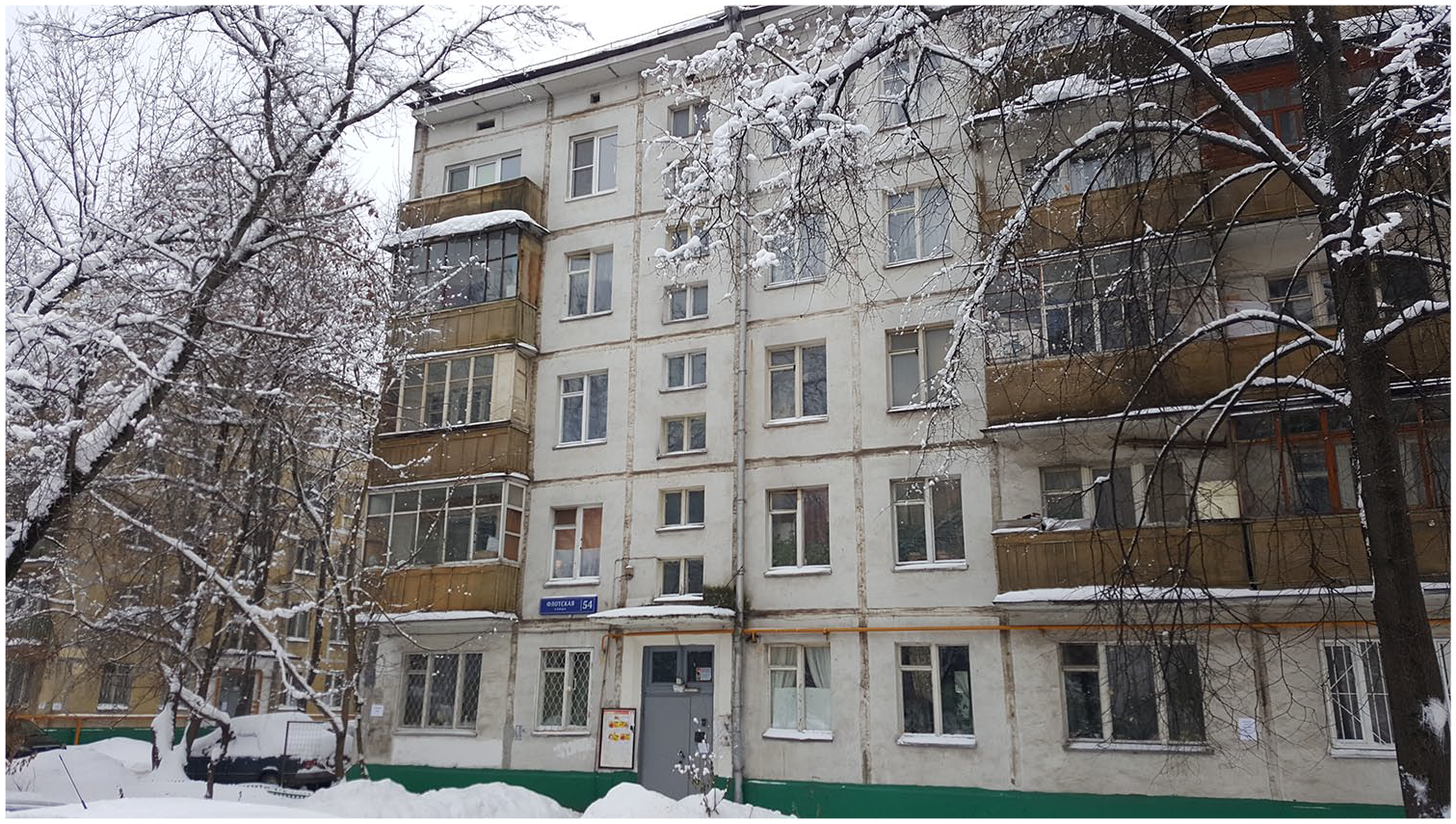
“Khrushchevka” with walls made of prefabricated blocks. Photo by author.
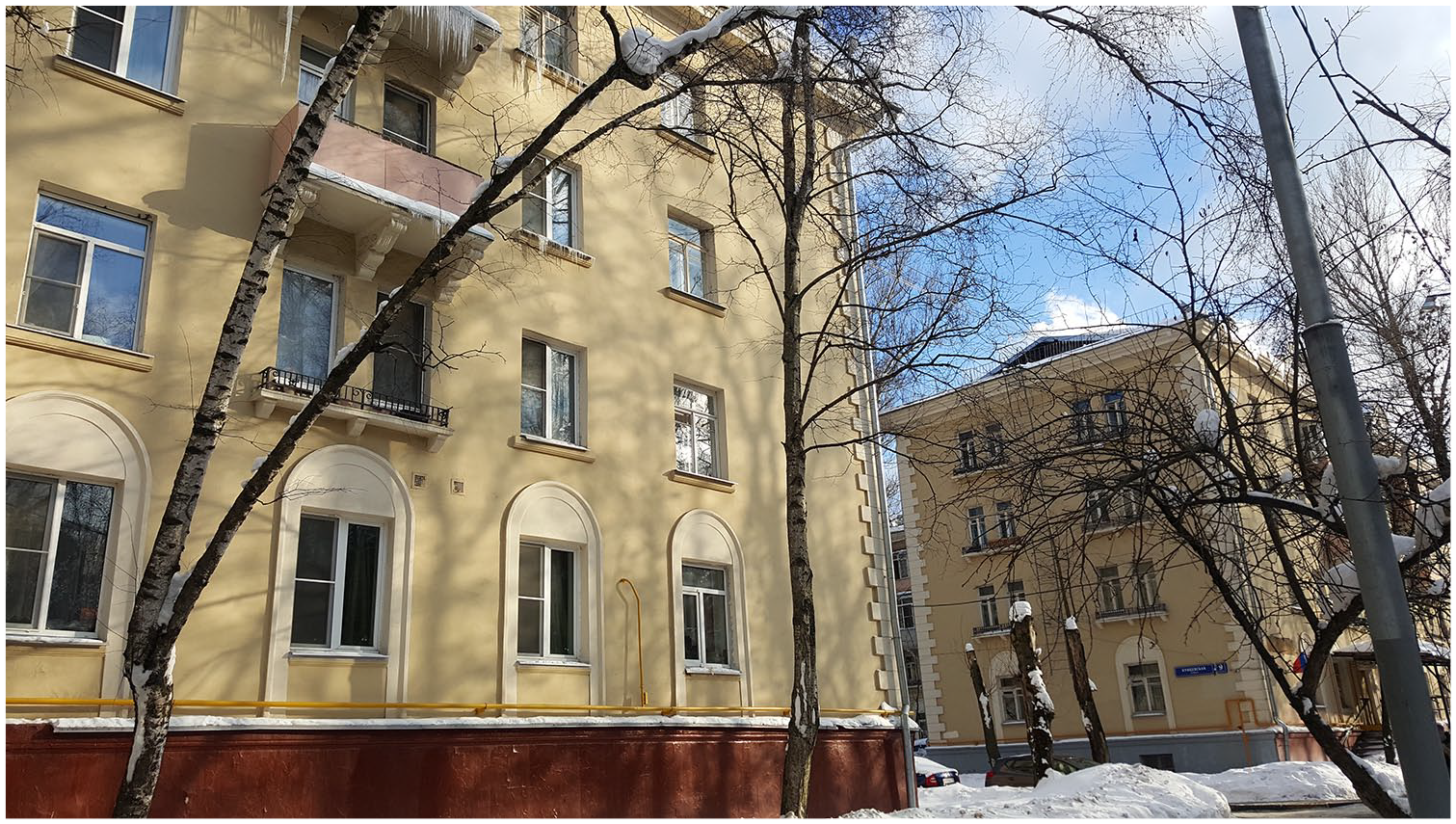
“Stalinki” included in the Renovation. Photo by author.
The project timeline of Renovation is convoluted; the features of the program kept changing in the first months of its mounting, adding to residents’ confusion and increasing the sense of uncertainty and crisis. After the program was announced in February 2017, within weeks the draft bill was submitted to the State Duma for approval. The parliamentary hearings and amendments to the proposed legislation took about three months, and the President signed the bill into law on July 1, 2017. The legislation clarified the conditions of the relocations and how residents could make their decision. These rules changed as the bill proceeded through parliamentary hearings. For example, initially a simple majority of votes was enough to include a building. But the final version of the law stipulated that two-thirds of the residents had to agree. It also added the possibility to hold a homeowner assembly on the issue of inclusion and an option to choose between monetary compensation or a new apartment.
Residents were invited to vote while the process of amending the program was ongoing: people had to make the decision before the bill became law. The list of the buildings suggested for the vote was published in early May 2017, just two weeks before the start of the voting period (May 15—June 15). Within this month, residents could cast their votes on an online voting platform, “Active Citizen,” or on-site at a one-stop governmental service center. They could also hold homeowner assemblies which had an extended deadline: they were initially allowed to take place until July 14 or until the bill’s signing into law. The latter happened on July 1, abruptly ending the process and voiding the decisions of the assemblies that took place after that date.
According to the project’s timeline, people had a few weeks to vote and/or host a homeowner assembly to come up with a decision about their building’s fate. In many buildings and districts as well on the city level, various initiative groups and movements advocated and organized to support or oppose the program. Out of the initial 4,547 buildings, 483 opted out of the program, but more than a thousand held homeowners’ assemblies to petition to be added to the list. These numbers show that there has been a significant effort on both sides of mobilization.
Introducing the New Temporal Landscape: The Inevitability of Renovation
The city administration promoted its new relocation and demolition program as a way to fix several of the city’s issues at once: housing affordability crisis, transportation, and environmental issues, to name a few. This program logically followed other “fixes” (Harvey 2018) that the city government implemented in the past decades: the beautification and improvement policies that allow the city government and corporations to funnel resources in (often unnecessary) rebuilding, generating revenues, and deepening the existing inequalities between cities and different city districts (Trubina 2020).
The attachment of the project’s timeline to the overall development trajectory and needs of Moscow is an essential feature of the temporal landscape of Renovation. In various public arenas and the media, experts, municipal deputies, and city officials introduced and naturalized the new temporal landscape as an absolute necessity and inevitability. These interventions emphasized that the city had to change to pursue the image of a global, modern, and comfortable city. In the following statement, Mayor Sobyanin links the housing improvement for individual Muscovites and the systemic improvement of the city: The tasks that this program must complete in the first place, this is, of course, providing those citizens who live in dilapidated buildings with solid housing, creation of a new high-quality urban environment, solving the transportation issues, environmental issues, overall improvement [blagoustroystvo]. (Mos.ru 2017)
Other officials and experts echoed these ideas. Some emphasized the collapsing housing and transportation situation in the city, where new high-rise estates popped up around the margins. Only a complete overhaul of the housing districts near the city core could fix this problem, according to Nadezhda Kosareva, the President of the Foundation “Urban Economics Institute”: “this urban structure doesn’t have a transportation solution, it is irrational from the urban planning point of view” (Moscow Public Chamber 2017).
The promise of the overall improvement that Renovation would enable dominated the media. TV channels, social media, district newspapers, and even the wi-fi sign-in screens on the Moscow subway were full of renderings of bright high-rises with contemporary amenities inside (elevators and plumbing were prominent elements of these future-visions). As is often the case, this development drive was associated with a particular aesthetic (Ghertner 2015; Ren 2011), which the prefabricated socialist-era housing estates did not fit.
The disjuncture between the socialist residential areas and the images of the modern, comfortable city was amplified through social media, where an ecosystem of similar groups and channels publicized the complaints of “ordinary Muscovites” about their poor housing conditions and their excitement about the impending relocations. According to an investigation by a journalist, Alexey Kovalev, these efforts were concerted and implemented by members of the youth branch of the United Russia party passing as “ordinary Muscovites” (Sergey Sobyanin, as most high-ranking officials in the country, is also a member of United Russia and has access to its resources). They were financed from the city’s budget for “informational campaigns” supporting Renovation (Kovalev 2017). The orchestrated media campaign promoted the new visions of Moscow’s future and invoked the discrepancy between the city Moscow aspired to be and the socialist housing estates holding it back. It also created an impression of overwhelming support for relocations among Muscovites.
The introduction of the new temporal landscape, although it often took the form of announcements, official speeches, and social media posts, was an interactive process. Muscovites engaged with these seemingly unidirectional messages, discussing them with their family, neighbors, and sometimes contemplating them on their own (“self-interactions,” as Passy and Monsch [2014:30] call people’s efforts to self-educate and seek information). People’s kitchens, where families would get together and imagine how they would design their new flats in the promised high-rises, became one of the important arenas where Muscovites invoked and discussed the new temporal landscape of urban renewal.
Mikhail and Tatyana, a married couple who supported Renovation, actively engaged with the program’s promises: they often talked about their design ideas for their would-be apartment in the evenings. Their imagination took off after they visited the “Renovation showroom,” an exhibit of life-size models of the apartments that the residents of the demolished buildings were promised: Mikhail: “There were the apartments, in full.” Tatiana: “Like you could come in and live there. We asked [the attendant]: Is this what it will be like, or how will it be?” And she says: “Everything will be exactly as shown, except the furniture.”
After this, they discussed at length the finishings, the quality of materials in the new flats, and what they would add to make a cozy home in their new apartment.
Imagining and matching the future with one’s personal trajectory often requires an updated interpretation of the past and present. The socialist five-story residential blocks became especially unattractive in the context of the promises of the renewal program and the overall development of the city. Walking in the city was one of the arenas where the disjuncture became apparent. For example, Zinaida, a Renovation supporter, took me for a ride around her neighborhood to show it to me. “You will see for yourself!”—she promised—“This is not beautiful at all! It is like you are coming into a village.” A new high-rise housing complex visible from where she lived reminded her how anachronistic the socialist residential areas were: “I think the urban infrastructure must change according to what there is, and we have a huge unbalance in our neighborhood.”
Opponents of Renovation, on the contrary, attached completely different feelings to the impending project. Aleksandra, who lived in the same area as Zinaida, told me about feeling sad and nostalgic when we walked through the same residential blocks and talked about their looming demolition.
Seeing the place while walking energized people’s feelings about its past, present, and possible future: opponents felt nostalgic and hurt, while the supporters were full of hope and anticipation. Seeing and visualizing were important components of the mobilizing work on social media as well. Both opponents and supporters of Renovation created the “before and after” images which summarized their visions of the past and future of their homes (see Figures 3 and 4). The images in the online communities supportive of Renovation emphasized the quality of the anticipated homes (bright hallways and apartments, shiny new plumbing equipment) and opposed them to the dark, cramped, and shabby common areas and apartments in the old buildings. Opponents of Renovation engaged in similar projectivity, comparing images of their cozy homes and courtyards with the dystopian imagery of concrete high-rise estates that were to replace them. The users of the “Muscovites against Renovation” Facebook group collected and posted online a gallery with Soviet-era paintings featuring five-story buildings. Each picture was accompanied by a subscript with someone’s reaction. Most of them signaled nostalgia, pain, fear of losing the cherished urban landscape, along with calls to defend the “Moscow we love” (digital fieldnotes, May 2018).
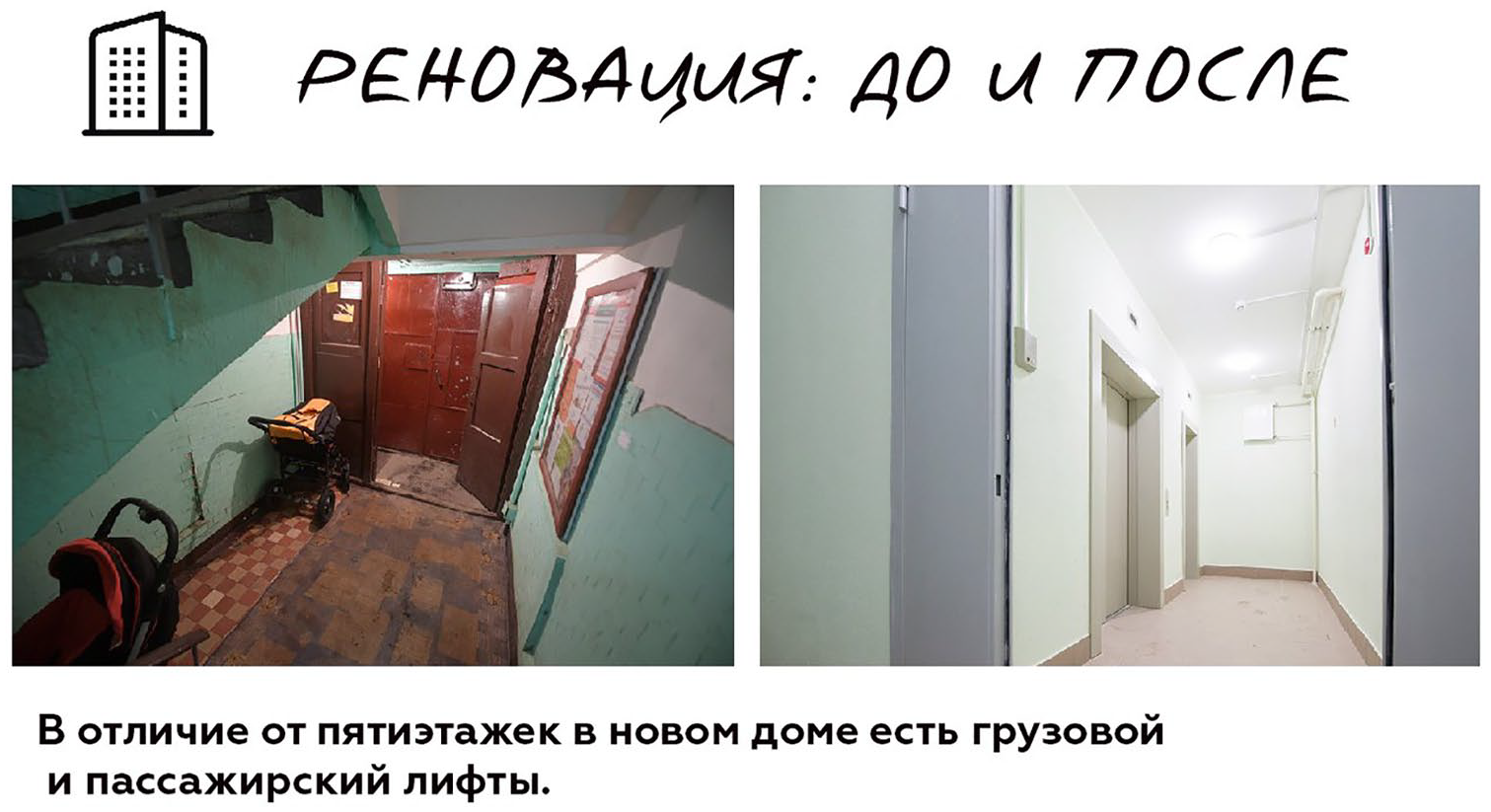
A “before and after” comparison posted in one of the pro-Renovation groups.
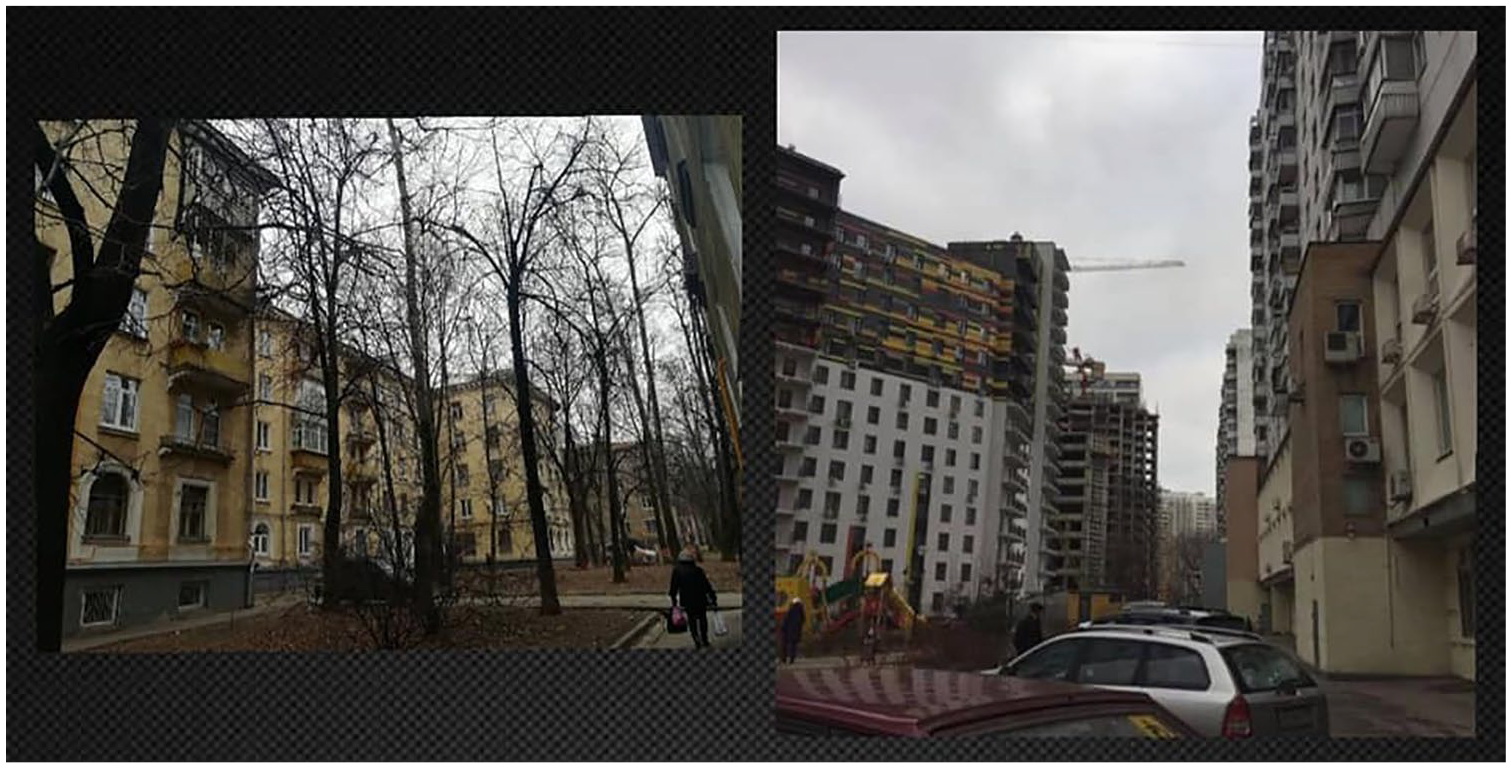
“Before and after” view of the courtyard, posted in an anti-Renovation group
The announcement of the program imposed a new temporal landscape with which everyone, whether they agreed with the premise or not, had to coordinate their actions. The relatively abstract images of the future translated into a more concrete series of steps and stages, the “project time” (Koster 2020) of Renovation. The residents were supposed to wait for the publication of the list of buildings invited to vote, then use the suggested tools of decision making (voting and homeowner assemblies) within the period allocated for these procedures, and after receiving the outcome, continue waiting for the clarification of the relocation schedule. The progression of these steps and the relocation schedule were not immediately known when the project was first announced. In combination with the vague inclusion criteria and the constantly changing conditions of relocations, the project created an atmosphere of uncertainty and anxiety in the potentially eligible neighborhoods.
Coordinating Futures With Neighbors: Public Arenas of Renovation
In this section, I examine how residents adapted to the new temporal landscape of Renovation in their interactions in public arenas. In their protentions—future-oriented actions, feelings, and statements—people invoked varying visions of the future (and the past), around which they could join forces and coordinate action.
In April 2017, before the publication of the lists of buildings considered for demolition, a series of meetings with district officials took place in every city district with potentially eligible housing stock. They were set up to inform the residents about the city’s relocation plans and were supposed to be relatively unidirectional. Unlike the vote, the homeowner assemblies, or the phone polls commissioned by the city government, these meetings were not specifically aimed at collecting feedback or allowing for meaningful discussions. However, arena creators cannot always control what happens in their arena (Elliott-Negri et al. 2021).
At the time, residents had very little information about the conditions of the relocations or the eligibility criteria, and the bill was still making its way through parliamentary hearings. Under these conditions of uncertainty, Muscovites crowded their district meetings, trying to get a sense of what to prepare for. The district officials knew little more than the concerned residents: across districts, their speeches followed the same script that the Mayor’s Office suggested. They repeated almost the same information already available on the government’s websites and in the media.
At some meetings, attendees refused to listen to speakers passively, and vocally opposed and interfered in their speeches, invoking different interpretations of events and questioning the feasibility of the new temporal landscape. For example, at a meeting in Oreshino, the official began his speech by repeating the idea that the socialist-era five-story buildings were beyond repair. Trying to conjure some support from the audience, he added: “you know it yourself.” He misread the mood in the room. In response to this statement, someone in the audience began shouting in disagreement, which annoyed the speaker: “Could you withhold your comments? Be patient, listen first!” he asked. He received yet another challenge from an audience member: “It is difficult to be patient when listening to your lies!” (April 19, 2017, Oreshino meeting notes). Some attendees arrived at the meeting prepared to reject the interpretation of the present and the suggested future that the redevelopment proposal implied. Others were less determined and were still trying to make up their minds. The ensuing interactions exposed a disjuncture, a clash in the visions of the future and the participants’ roles.
In these interactions, it is possible to identify protentions, future-orientations in the present. For example, the meeting in Losevo was especially contested and emotional. There, the attendees were angered from the start by the local administration’s choice of a small venue, which made them suspect that the administration was deliberately trying to limit participation. Eventually, the residents took over the microphone, completely overwhelming the officials and disrupting their script for the event. They took turns at the mic, articulating their doubts in the feasibility and benevolence of the program’s promises. One speaker summed up the fears: “Do people know where they would be relocated? Are there even any new buildings here? They will plug them right in the neighbors’ courtyard” (April 19, 2017, Losevo meeting notes). The audience met this remark with applause, indicating that many attendees agreed with this skeptical assessment of the program’s risks.
Such protentions show how future-visions are rooted in the past. They invoke certain past experiences; in this case, previous redevelopment programs and the city authorities’ patterns of action. Luzhkov’s relocation program was an important past context for the new program, and, despite its overall popularity, it had an imperfect track record. In combination with the long and vague timeline of Renovation, it prepared people to be suspicious, like Alla: “The program is scheduled for such a long period of time. Even Luzhkov’s program, it was changing all the time. And not for the best.” The previous demolition program shaped people’s perception of the current one in several ways. Luzhkov’s program targeted the so-called “disposable series” of khrushchevki, but some residents in the ineligible buildings began hoping that their turn would also come sooner or later. Some made preparations by registering their relatives in their apartments, which under conditions of Luzhkov’s relocations would entitle them to larger flats. The rumors about and anticipation of relocations circulated in many khrushchevki areas for years, shaping the expectations of some of the new residents as well. For example, Alena, who inherited a flat in a khrushchevka from her grandmother and moved in just a couple of years before Renovation was announced, told me that she often heard the “relocation talk” from her older relatives and neighbors. Still, there were also people who bought or inherited the flats in the buildings affected by Renovation and planned to live in them for years to come. With this vision of the future in mind, they invested money and effort into renovating their flats, which made the prospect of giving them up additionally painful. Many of the buyers took out mortgages, and, for them, the announcement of Renovation was especially shocking: these people told me that, as part of the mortgage approval process, their banks evaluated their flats as ineligible for demolition and thus approved their mortgage. Because of this evaluation, they felt secure in their homes. Renovation canceled out all these future projections.
The interactions invoking different visions of the past and future alternatives at the public meetings prompted people to take on a particular course of action. Opponents and supporters of Renovation could identify each other in the audience, and when the meeting was over, people exchanged contact information, found their neighbors, and coordinated their actions to influence the fate of their buildings and coordinate with the efforts in the adjacent buildings as well to try and preserve whole neighborhoods. At the Oreshino meeting, an anti-Renovation activist waited for her turn at the mic and energetically denounced the program and the fact that citizens were invited to agree to unknown relocation conditions before the relevant legislation was passed. She provoked a loud response of approval as well as disapproval from the audience, and then “moved to the back of the room, still shouting, distributing leaflets, encouraging people to read the bill on the Duma website” (April 19, 2017, Oreshino meeting notes). Her actions and visibility prompted some opponents of Renovation in the room to gather around her after the meeting.
From the point of view of the future coordination, these district meetings were sites of hyperprojectivity, arenas where immediate future action could be coordinated. Diana, one of my interview partners, for example, after attending the emotional meeting in Losevo and seeing how vague the project was, realized that participating in it was very risky. She and her neighbors decided to hold a homeowner assembly as soon as possible to prevent the authorities from even considering their building for inclusion in the program. Thus, they could distance themselves from Renovation’s fuzzy temporal landscape.
While the city government had full control over the timing of the vote and the deadlines for the homeowner assemblies, citizens had control over the timing of homeowner assemblies that were organized before the suggested period. Unlike the voting process, which was specially established for the purposes of the program by the Renovation bill, homeowner assemblies are regulated by the Housing Code as a standard tool of homeowner self-management. It can be used for any kind of collective decision making about the building and adjacent territories (such as installing ramps, boom barriers, or choosing the maintenance company). Therefore, activists had the right to hold such assemblies and inform the authorities of their decisions before the lists were finalized and the voting process began. As Diana put it, “We didn’t know [what they were doing] with these lists, so we decided to know in advance where we’re at.” This way, they could regain control over their own time and future.
In fact, many Muscovites mobilized in response to the announcement of Renovation much earlier than the project’s timeline invited them. Many of those early responders sensed a threat to their homes as early as February after the mayor got the green light to start the program from President Vladimir Putin at their highly publicized meeting. In March and April, as some people were “standing by,” waiting for more clarity about the relocation conditions, the first activists mobilized against the inclusion of their buildings. While the project timeline was still in the making, they actively created their own timeline: they held homeowner assemblies and collected signatures to petition the government not to consider their buildings for inclusion in the voting process.
These examples show how people coordinated their actions on the new temporal landscape of Renovation. The clashing views over the longevity of the buildings considered for demolition, the governments’ benevolence, and their ability to implement the redevelopment at this scale without hurting people’s personal trajectories manifested in their questions, speeches, and actions. Based on these interactions, people attached different feelings to the project and coordinated actions with their neighbors to join it or stay out.
Public meetings, homeowner assemblies, as well as interactions between neighbors in their courtyards and building lobbies turned into “sites of hyper-projectivity” (Mische 2014:438), where neighbors articulated the risks and promises of the program, their individual aspirations and plans, and tried to come up with a coordinated action strategy. The new temporal landscape also became a backdrop for people’s personal trajectories, especially in the domains of housing and civic strategies (Zhelnina 2022). For some, their understanding of what it means to be a homeowner and a citizen changed.
Calibrating Personal Trajectories: Housing and Civic Strategies on the New Temporal Landscape
After the contested voting period, Muscovites managed to amend the list of buildings included in the demolition program. Hundreds of buildings opted out, sometimes as a result of a coordinated negative vote of several adjacent buildings, which ensured that no demolition and new construction took place nearby. More than a thousand not initially included buildings had requested to become part of the program.
Still, the temporal landscape of Renovation became a reality with which people had to coordinate their lives from now on. Some anticipated that, regardless of a negative vote, their buildings were not entirely safe from the massive redevelopment that Moscow “needed.” Viktor, who organized an assembly and convinced most of his neighbors to vote against relocations, felt that his property rights were not protected against the needs of the government: “My home is my castle, but this castle stands on sand.”
Regardless of the voting outcome in their buildings, most Muscovites anticipated that the program would proceed according to the government’s plans. These plans became the new backdrop of people’s own plans and strategies. The imposition of the new temporal landscape on people’s lives created new factors in their thinking about the past and the future. Two kinds of trajectories were most affected: people’s strategies as citizens and as homeowners. People had to make new plans for where and how to live and got some new ideas about what it meant to be a citizen in Moscow. Against the new temporal landscape of Renovation, people adjusted their private housing and civic strategies.
The experience with Renovation and the way the engagement process was organized made many Muscovites more aware of the ways of urban politics and local governance. People learned about the participatory instruments available to them and began using them, making them part of their strategic “toolkit” (Swidler 1986). For example, Artur tried to organize an assembly in his building twice. At his first assembly, he failed to comply with the bureaucratic requirements, and his second was scheduled for early July when the new deadline abruptly invalidated its decisions. However flawed, his first experience with organizing a homeowner assembly was consequential. He felt that he had learned a lot and began using his new knowledge to demand services from the local administration and service companies (he made the local authorities fix a hole in the pavement in his building’s courtyard that was there for years). Interestingly, Artur did not give up hope for relocations in the future; he “stood by” the promise of urban redevelopment.
On the other side of the controversy, Alla, a Renovation opponent, felt empowered by her mobilization experience. She was exposed to the world of urban politics and activism for the first time and was pulled into it, first seeking help from more experienced activists in preparing her homeowner assembly and then discovering that more issues were requiring her attention in the neighborhood. She joined a political party and even ran as a candidate in municipal elections. Her civic strategy changed because of the Renovation-related interactions with other activists and her neighbors: [There was an] influx of people. I [joined the neighborhood movement] definitely because of Renovation. I didn’t know any of those people! I live here—and nearby [they are planning to build a highway], and [the activists] have been collecting signatures [against it] for two years now! Why didn’t I know about it?
While some people became more active, others felt the dampening effects of what they perceived as an act of state violence over individual rights. For example, Lidia felt unprotected and chose to retreat—not just from public life but even from her residential block. A woman in her 60s, she went to a few meetings with the authorities and spoke to some of her neighbors about the risks of the program, and quickly realized that many of her neighbors were willing to move out, and the authorities were uninformed and unresponsive. She felt crushed by this new understanding: “This wheel really rolled over me! [. . .] The authorities, the deputies, all the lies on the TV.” Based on her interactions with the authorities and neighbors, she felt depressed and decided to spend most of her time in the countryside where she had a cottage. This way, she could avoid the pain of an extended wait for relocations and did not have to face her neighbors with whom she was so bitterly disappointed.
The turmoil of Renovation also made people adjust their housing strategies. Viktor, who managed to save his building by organizing a homeowner assembly, told me that despite the initial success, the relationships with neighbors who supported Renovation became tense. In combination with the anticipation that the government would find a way to demolish their building, it made living in his current home uncomfortable. He considered selling his flat and moving elsewhere.
Varya, who liked her home and did not want to move out, also had to adjust and calibrate her strategies based on what she learned about her neighbors and what she expected from city officials. She accepted the inevitability of the relocations and coordinated her future with the government’s plans and her neighbors’ actions. She formulated best- and worst-case scenarios and had a plan for both of them: I began saving money in case there would be an opportunity to buy a third room. If it would be possible and we’d be fine with everything—then we stay. If not—we will wait for the moment when we can sell it, and we’ll sell. And we move to the neighborhood that we’re okay with. I realized that this was going to happen [no matter what], and I won’t be getting upset about it.
Thus, people changed their housing futures, planning to escape the homes that became uncomfortable after the heated months of controversy and trying to regain some control over their own time and plans that were disrupted by Renovation’s vague “project time.” They decided to make these adjustments based on the interactions with other players, neighbors, and authorities, which created new anticipations and expectations about what was likely to happen in the city next.
Conclusion
This article has demonstrated how general sociological theory can enrich our analysis of classic urban themes such as urban change and conflict, community inequality and empowerment, collective action, and power imbalances. The theories of future coordination and the attention to contentious interactions allow us to analyze moments of uncertainty and hyperprojectivity as sites of negotiation between multiple players, both powerful and powerless, and reveal the connections between macro-level processes, micro-level urban change, and people’s private lives. Interactionist approaches help us examine how the images of the past interact with innovation and imagination of the future to create new social realities. The suggested approach relies on qualitative, ethnographic methods, which allow for scale-switching and moving between temporal landscapes and immediate here-and-now interactions to foreground the mechanisms of change.
Three modes of future coordination (temporal landscape, protentions, and actors’ trajectories) are intertwined and can energize an interaction synchronously. This interconnectedness reveals how macro-forces connect to micro-processes through practice and observable interactive situations. Through interactions, large-scale urban redevelopment projects become naturalized and incorporated into people’s futures and everyday lives.
The temporal landscape of the urban redevelopment proposal ties together the political and economic forces (the need to boost the city’s economy and address systemic issues) and people’s lives. People invoked this temporal landscape and matched it to their plans and aspirations during interactions with significant others, neighbors, local bureaucrats, and strangers online. This probing and matching allowed them to coordinate action with others and adjust to the new timescape or modify it. Notably, the past is part of future making: it informs people’s anticipations and expectations in present situations, which resonates with previous research (Hilbrandt 2021; Robinson 2013).
Urban redevelopment changes the physical appearance of cities and neighborhoods, but it also triggers social and political change. New solidarities, social networks, and alliances emerge in various arenas where decisions about the new future are at stake. These arenas become “sites of hyper-projectivity” (Mische 2014:438), where people voice, probe, and question future possibilities, attach emotions and meaning to different scenarios, and coordinate their actions to pursue or prevent some of them from happening.
In the case of Renovation, not only the “invited” spaces (Miraftab 2004) of participation—the voting platform, homeowner assemblies, and meetings with authorities—became sites of intensive future coordination, residents also turned their familiar places into political arenas: kitchens, building lobbies, courtyards, and playgrounds. They invoked the large-scale change in these very different interactive situations and matched it to the concrete possibilities of change in their neighborhoods, homes, and personal trajectories. Importantly, people also devised new immediate futures based on these interactions: they decided to organize to resist or demand the inclusion of their buildings in the redevelopment plans and stood by or distanced themselves from the redevelopment promises.
Collective action is an immediate outcome of the interactions discussed in this article. Different visions and interpretations of the future that the Renovation program suggested helped people coordinate actions with their neighbors and neighborhood activists to demand or refuse inclusion. In the long term, these interactions also informed changes in people’s own trajectories and strategies as citizens and homeowners. Against this background, people made housing decisions and modified their civic practices, becoming more or less engaged in urban politics.
Jointly, future-oriented interactions can shape the city’s future, sometimes in a different way from what the project planners initially had in mind. People’s ideas about what is possible and desirable can also shift as a result. Even under the conditions of a centralized authoritarian government, Moscow’s leaders were compelled to make some changes to their plans, like adjust the relocation conditions and edit the list of condemned buildings (although these changes did not affect the project’s core principles). However, in addition to these immediate small-scale changes in the program’s layout, the interactions during the political moment of the first months of Renovation laid a foundation for a new course of development for the city’s political field. New activists and aspiring politicians also joined the field because of the program.
Future research can examine another important dimension of the future coordination processes which mostly remained outside the scope of this article: the role of social differences and inequalities in urban future making. We know from the literature that the temporal horizons of planning and the “capacity to aspire” differ across social classes (Appadurai 2007; Mische 2009:699). How does it affect people’s involvement and voice in the interactive sites of future coordination around urban redevelopment? In Moscow, some residents were better equipped or more flexible in dealing with the temporal pressures that the announcement of Renovation imposed on them. They were able to take time off work and other duties to fully concentrate on activism. Clearly, certain occupations had more flexibility to do so, even though most of them lost business and income; the social differences in access to future making, the differences in planning horizons, and their impact on imagining urban futures are important avenues for future research.
In February 2022, five years after Renovation was first announced, debated, and launched, Russia started a war in Ukraine. However remote these events may seem, the invasion has immediate implications for the implementation of the program. The international sanctions imposed on Russian companies disrupt the availability of construction materials, and the economic shock of the war strains the state budget. This means that the planned demolition and relocation schedule is at risk and becomes even more uncertain, which prompted some users in the anti-Renovation social media communities to ask whether the beginning of the war meant the end of Renovation. The city officials were quick to comment that they would make extra efforts to keep the construction sector going. Still, the shock and uncertainty of the new crisis seem to have shattered the predictability of the future for both ordinary Muscovites and the city officials responsible for Renovation. It remains to be seen how the global future-visions of Moscow would change under the circumstances of Russia’s increasing international isolation, but the timelines and plausibility of the specific urban projects have already been affected and require re-coordination and adjustment. This situation reveals once again how macroprocesses, including at the global level, connect to micro-level urban change and people’s private lives through the mechanisms of future coordination in times of uncertainty.
