



Abstract
Using interview data from three mixed-income neighborhoods—one predominantly white and two multiracial neighborhoods—we find that an overwhelming majority of white, middle-class respondents did not shop in their local grocery store (n = 68). To explain this phenomenon, we propose a concept of everyday disinvestment to capture the interplay between individual-level decision-making and structural-level disinvestment under racial capitalism. We identify three practices of everyday disinvestment—avoidance, distancing, and selective engagement—as well as the rationalizations residents present for their behaviors. We argue racial capitalist ideologies of antiblackness and consumption as freedom are foundational to residents’ justifications of disinvestment from grocery stores in mixed-income communities. Everyday disinvestment not only expands our understanding of disinvestment as a mechanism of racial capitalism, but it deepens our understanding of food apartheid as a relational process.
I hate that Food Lion. I’ve just, I’ve tried it so many times and got such rude treatment. I love the Harris Teeter. I guess it’s a really good store. [. . .] I’ve written them letters twice about how great their store is but I’ve sworn off that Food Lion area. [. . .] I feel like the reason that I get bad treatment at Food Lion sometimes [is] sort of a reverse discrimination kind of thing. So, I don’t like that area over there.
Keith, a white homeowner in his 50s, lived in Creekridge Park, a multiracial and mixed-income neighborhood in Durham, North Carolina. Keith would not have chosen to live in Creekridge Park if it were not for his financial situation. As he put it, “I ended up in this neighborhood because I was in financial straits.” Though he appreciates his “cheap” home and does not plan to move, it is not a neighborhood that he loves. It is not surprising, therefore, that he opts out of shopping at the neighborhood Food Lion. In fact, his assessment of the grocery store is so negative that it shapes how he feels about the entire surrounding area. Keith perceives poor treatment from nonwhite workers at his local Food Lion and prefers the “good” Harris Teeter. Whether it is due to customer service, food selection, or the other patrons, references to “good” or “bad” grocery stores are common in the United States. How do we explain these local designations and residents’ decisions about where to shop for groceries?
Using data from three mixed-income neighborhoods (two of which are multiracial and one of which is predominantly white), we trace how 68 white middle-class residents optin or optout of their neighborhood grocery stores and how they make sense of these decisions. In the three study neighborhoods, only 12 percent of white middle-class residents regularly shopped in their local store. While there were slight variations in levels of “engagement, the middle-class.” Add the white residents we spoke to overwhelmingly opted out regardless of how they felt about the neighborhood. We explain this pattern as a type of everyday disinvestment pursued by middle-class whites that reflects racial capitalist ideologies of antiblackness and consumption as freedom. To be precise, everyday disinvestment is a practice of food apartheid, which we argue is a mechanism of racial capitalism.
We study grocery stores as sites where corporations and individuals co-enact disinvestment and maintain the status quo of racial capitalism, chiefly defined by racial devaluation and exploitation. We pay particular attention to racial capitalist ideologies of antiblackness and consumption as freedom, and how white individuals draw on them to justify disinvestment from grocery stores in mixed-income communities. Disinvestment is a key mechanism of racial capitalism in U.S. cities and we identify the exchange between structural and individual-level practices in maintaining this system. While the political economy of racial capitalism has been described by scholars at the macro level, we endeavor to highlight the multilevel ways that racial capitalism is reproduced, taking what people say and do seriously. In doing so, we better understand the perniciousness of racial capitalism and its effects on neighborhoods and how we relate to one another within them.
Below we review the literature on racial capitalism, with specific attention to disinvestment. We argue that food apartheid is a sector-specific manifestation of racial capitalist disinvestment. We then discuss the role of ideologies in maintaining racial capitalism and the specific ideologies that justify disinvestment, chief among them being antiblackness and consumption as freedom. After, we present an overview of the three neighborhoods we studied and the cities where they are situated (Durham, North Carolina and Cincinnati, Ohio) before we dive into the patterns of everyday disinvestment residents enacted.
Literature Review
Racial Capitalism in Urban Space
Capitalism, as an economic mode of production based on labor exploitation and the accumulation of self-valorizing value (Heinrich 2012; Marx [1867] 1990), was theorized in the early twentieth century by scholars such as Cox (1948) and Du Bois (1935) as a system that feeds on racial differentiation. According to early scholars of racial capitalism (Cox 1948; Du Bois 1935), capitalism operates on differential valuation—the valuation of some people, places, or things over others. Such differentiation manifests as racial domination through mechanisms of investment and disinvestment in people, places, and commodities (Hall 1980; Robinson [1983] 2021). The development of modern capitalism itself was based on the system of Black chattel slavery, a racialized system of investment in the exploitation of Black labor power coupled with the disinvestment in Black life. Capitalism thus feeds on racism (Du Bois 1935; Fraser 2019; Go 2020; Robinson [1983] 2021).
An analysis of racial capitalism illustrates how values are assigned differently to people and geographies (Hall 1980; Pulido 2017). As Pulido (2017) asserted, this “differential value” is “critical in the accumulation of surplus” and is key to capitalist acquisition of “both profits and power” (p. 527). For Pulido, relational analysis is imperative for understanding the mechanisms by which capitalism feeds on racial difference—it helps us to see how whiteness and capital are entangled in a relation of domination and exploitation of the nonwhite “other” defined in relation to whiteness. Poor and working classes of all racial groups experience devaluation, at varying degrees and contexts—manifesting as differential treatment, different levels of exploitation, dispossession, and disinvestment in neighborhoods or public infrastructure. 1 Differential valuation is also reflected in ideologies regarding who (as a consumer or worker) or what (as a product) is valuable (Hatch 2016; Reese 2019). Consumption and its ties to valuation, devaluation, and self-making are central to our analysis of grocery shopping within racial capitalism. 2
In the context of cities, the production of difference and differential value is embedded in the valuation of space. Through urban processes of disinvestment and uneven development, nonwhite and poor places have been devalued to create white value. Gilmore (2002) has long argued that racism under capitalism is necessarily about “group-differentiated vulnerability” in tightly interwoven yet uneven and different political geographies. Purifoy and Seamster’s (2020) recent work on “creative extraction” similarly proposes a relational analysis of Black and white places. Redlining, racial covenants, and racial violence are all well-documented practices of racial capitalism (Anderson 2016; Rothstein 2017; Taylor 2019) that continue to shape the racism and class inequality of U.S. neighborhoods, particularly through the normalization of disinvestment in Black places.
Disinvestment as a Mechanism of Racial Capitalism
We understand disinvestment as the practice of resource allocation and the underlying decision-making processes of where resources should be spent—by governments, by corporations, and by individuals (Travis 2019). Under racial capitalism, to choose to invest in one space is, by definition, a decision to not invest elsewhere. These practices of disinvestment necessitate relational racist logics and further immiserate the poor and working class. Under racial capitalism, these logics transform structural processes of disinvestment into common sense understandings of “bad” and “good” spaces, whereby the original processes of disinvestment are laundered and forgotten, or at the very least seen as so far in the past they hold little bearing on the present. Putting more resources into these “good” places becomes a logical conclusion of this uneven development, further entrenching racial capitalism into the urban landscape. In this way, disinvestment is both a mechanism and a logic of racial capitalism.
Decision-making processes about locations of grocery stores, the availability of products in these stores, and even the number of employees a store can afford to schedule for shifts—which influences the maintenance of the store as well as the customer service experience (Agyeman 2021)—are all conditioned by the material ideologies and realities of racial capitalism. These processes—of investing in some places and people and actively disinvesting in others—are what we mean when we refer to structural disinvestment by grocery store corporations. We echo the work of many scholars of racial capitalism (Gilmore 2007; Pulido 2017; Purifoy and Seamster 2020) who argue that the system of racism and capitalism is not broken but is built upon and feeds on inequities—it is working “how it should work, as the push to maximize production and consumption while devaluing labor are integral to capitalist production” (Garth and Reese 2020:4). In the following section, we discuss how this broader system of racial capitalism and the particularities of disinvestment manifest in how we access food in the United States.
Food Apartheid as a Product of Disinvestment
Food inequities are intrinsic to the system of racial capitalism. As Leah Penniman has asserted, “[r]acism is built into the DNA of the US food system” (quoted in Garth and Reese 2020:2). To describe persistent food inequities, scholars have frequently used the term “food desert,” which implies a location with very little or no access to fresh foods (Hamidi 2019; Thibodeaux 2019). Recent food justice scholarship has warned that there is much this phrase does not capture (Garth and Reese 2020), and there is evidence its assumptions about consumer behavior are wrong (LeDoux and Vojnovic 2013). Reese (2019) has rejected the term “food desert,” as it not only appears to indicate a “neutral” or “natural” condition, but also raises a question of “lack”—a limited way to conceptualize the self-reliance of Black people and their use of food (Reese 2019). While scholars suggest the terms “foodways” or “foodscapes” to describe the social and geographical relations around food, we appreciate the political emphasis of the term “food apartheid.” Reese (2019) and other scholars such as Sbicca (2012) and Bradley and Galt (2014) have used “food apartheid” to emphasize the unnatural, systemic aspects of uneven food distribution, access, and consumption in a racist economic system. For our analysis, we argue that food apartheid is a mechanism of racial capitalism. In other words, food apartheid is a manifestation as well as an arm of a broader structure of dispossession and devaluation that in the United States stems from chattel slavery (Reese 2019; Robinson [1983] 2021).
A focus on food apartheid allows us to understand the relationship between urban and suburban resources, infrastructure, and disinvestment. But the unequal food distribution system is not the malicious scheme of any one actor or set of actors—it is the resulting structure of dynamic racial capitalist processes. As Deener’s (2020) work showed, contemporary food inequities have been shaped by the changing food distribution landscape, with its primary focus on efficiency, profit maximization, and minimizing risk for corporations. Cities’s adherence to market logics have largely trumped population health, marking a shift from nourishing and feeding people to maximizing profits and minimizing corporate risk. Access to healthy food is seen as secondary to maximizing a small annual profit of around 2 to 6 percent (Nonko 2019). Business concerns with profit maximization have fundamentally altered the grocery store landscape, changing where and how people shop for food.
But it is not just profit maximization that matters in (re)creating food apartheid. As Eidlin and McCarthy (2020) argued, dynamic capitalist processes harness upon, deepen, and reproduce the ideologies of racial difference which were created during slavery. In particular, antiblackness is foundational to where and how grocery stores operate within racial capitalism. Detroit, MI (population 714,000, 83 percent Black in 2010) serves as a powerful case in point: in 2007, Detroit’s only grocery store, Farmer Jack, closed, leaving city residents without a major grocery store for five years, until Whole Foods opened a store in a gentrifying area of the city (White 2018:131). During this five-year period, Detroit residents were forced to drive to stores in the suburbs or to frequent one of the city’s many “fringe markets” (e.g., pharmacies, gas stations, and convenience stores) to access food (White 2018:131). We argue that the lack of grocery stores in cases like Detroit is a result of capitalist logics of profit-making alongside antiblackness. We must understand U.S. capitalism as racial capitalism, because as Bledsoe and Wright (2019) have argued, the exclusion of Black people as consumers vis-à-vis spatial segregation only makes sense if we understand the imperative of profit-seeking alongside the logic of antiblackness (Bledsoe and Wright 2019).
By combining the insights of racial capitalism and food apartheid, we argue that grocery stores are an ideal site to study how disinvestment as a logic and practice shapes residential placemaking. While scholars of racial capitalism and food apartheid provide excellent analyses of the material conditions that reproduce racism and class inequality in the food industry, we now turn to how individuals make sense of these inequities. How do the residents of our studies’ neighborhoods understand their food choices? What relationship is there between their understanding, their positionality, and their decision-making? We explore the ideological foundations of disinvestment as it pertains to grocery shopping to understand how individuals explain and reinforce systems of inequality.
Ideologies of Disinvestment
We argue that the beliefs and behaviors of residents produce an everyday disinvestment that reflects and reinforces the structural arrangements and ideologies of racial capitalism. In particular, we argue that antiblackness and consumption as freedom are two ideologies that justify structural disinvestment and consequently undergird residents’ everyday disinvestment in neighborhood grocery stores. These ideologies, which are the basis for how we talk about grocery stores, rest on and obscure a racist system and oppressive class structure designed to benefit white middle and upper classes. Much of the scholarship on racial capitalism is situated in the analysis of political economy at the macro level. We add to this scholarship by focusing on how racial capitalism is maintained and understood by individuals, and the importance of consumption to contemporary capitalist exploitation and reproduction.
Under capitalism, consumer culture facilitates individuals’ creation and maintenance of brand and identity; it shapes a “sense of being in the world” (Lehmann 2015:35). This can manifest as a focus on purchasing “quality” products at the “right” places. The right or wrong grocery stores are relationally “understood . . . as ‘safe’ or ‘risky’ racialized shopping environments” (Mansvelt 2005:31). In a consumer culture whereby families across race and class are pressured to provide “quality,” “healthy,” or so-called “clean” foods for their children, our shopping choices are conceived of as consumer empowerment: products of various prices and qualities are offered in different locations, and the ideology of consumption as freedom frames and naturalizes this array of choices as empowerment (see Bowen, Brenton, and Elliot 2019). It simultaneously belies how keeping production costs low depends on undermining worker power and the working class making poverty wages. Under racial capitalism, consumer empowerment also obscures the system of food apartheid that constrains the poor and working class and makes it possible for privileged shoppers to make individual choices about where they shop. In this way, the ideology of consumption as freedom is predicated on both antiblack racism and classism.
Ideologies of choice and consumption as freedom are a constitutive part of capitalist social relations that shape the social world. Our desires are shaped by external forces of racial capitalism, despite our experiencing them as deeply personal and intrinsic. As McMillan Cottom (2019) explained, “‘I just like what I like’ is always a capitalist lie” (58). In other words, our conversations about healthy food preferences miss the forest for the trees. With talk of personal preferences, we obscure the structural disinvestment that gives some people more consumer power than others. Ideologies of consumption-as-freedom are predicated on, as well as obscure, racist and classist ideas—such ideas manifest as ahistorical notions about which stores are the “best” stores and which foods are the healthiest. With a food apartheid lens, we problematize the notion of choice as well as the ideas of “healthy” or “unhealthy.”
Equally as important for our analysis is how antiblackness is foundational to U.S. racial capitalism and processes of disinvestment. Building on the work of Bledsoe and Wright (2019), we argue that antiblackness is a mechanism of global capital with its own specific set of consumer ideologies, exploitative and oppressive practices, and spatial logics. Such logics are instantiated as a devaluation of Blackness in relation to a simultaneous valuation of whiteness in terms of spaces, people, and things, based on an ideological notion of Blackness as inhumanity and a-spatiality. A-spatiality in the context of antiblackness refers to the notion that Blackness constitutes a “nothing” space which can be selectively appropriated, or, in this case, avoided. As in the historical case of redlining, association with Blackness is sometimes all that is needed for an investment to be deemed “risky” or undesirable; this is mutually co-constitutive of an active investment in white spaces. While Bledsoe and Wright have examined antiblackness in the meso and macro context of urban spaces, we build on this work to examine it in the context of consumerism, where we can see logics of devaluation and valuation in the places people shop and in the commodities people purchase—through white, middle-class practices of avoidance, distancing, and selective engagement.
An analysis of how these ideologies justify everyday disinvestment helps us to understand the multilevel workings of racial capitalism. As Bhattacharyya (2018) argued, “Racial capitalism operates both through the exercise of coercive power and through the mobilisation of desire” (ix). In this paper, we aim to understand how that desire is understood and mobilized by individuals. In doing so, we come to better understand how whether a neighborhood has a grocery store is an important but incomplete measure of disinvestment. How residents engage with these spaces is an additional element of disinvestment that helps us better understand inequality within mixed-income neighborhoods.
Data, Methods, and Settings
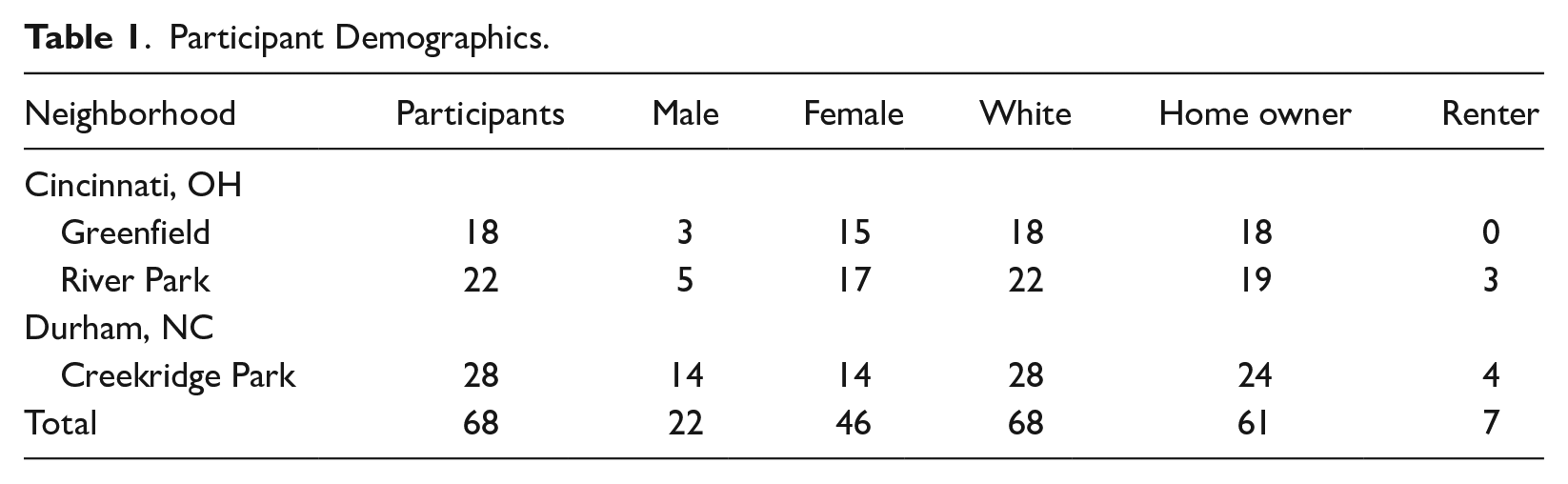
To analyze the ideologies of grocery shopping, we use interview data from 68 residents of three mixed-income U.S. neighborhoods, which were collected as part of two studies. Sarah Mayorga completed a study in Durham, North Carolina, while Megan Underhill conducted her study in Cincinnati, Ohio. Participant demographics are listed in Table 1.
Participant Demographics.
Both Mayorga and Underhill used NVivo to manually code their transcribed interviews. For this paper, they coded their data and then shared their data and codes with one another for review and discussion. Mayorga and Underhill examined shared themes and analysis with Lauren Crosser, who also brought in relevant literature to inform the coding and analysis. Below we detail information about both the settings and our data collection processes.
Neither project focused on grocery stores, but rather residential experiences in multiracial and/or mixed-income neighborhoods (more details below). Given our mutual focus on social relationships, the role of neighborhood grocery stores was not immediately of interest beyond gaining a general understanding of residents’ sense of place and neighborhood identity. In this way, we replicated common-sense assumptions that do not take grocery stores as primary sites of scholarly inquiry. However, Mayorga and Underhill asked all 68 white, middle-class residents included in the sample where they did their grocery shopping. Given that grocery stores were also part of the study neighborhoods, local grocery stores were also discussed outside of grocery-related interview guide questions, including where in their neighborhoods residents spent time or avoided. We rely on resident accounts of grocery stores to tell the story of everyday disinvestment as part of a larger structure of racial capitalism in urban neighborhoods.
Durham
Durham is currently the fourth largest city in the state of North Carolina with a population of 287,865. Formerly famed for tobacco production and textile mills, Durham is best known today as one of the three cities that constitute North Carolina’s Research Triangle Park, a special tax district created in the late 1950s to attract research and development firms to the area. Between the 1980s and 1990s, Durham’s population increased by 35 percent as more and more firms relocated to the area. Although population growth has since slowed, it remains high. For example, between 2010 and 2016 the population of Durham County grew by 14 percent (see De Marco and Hunt 2018). Durham is also a “new destination city” for Latinx immigrants, whose migration to the area started in the 1990s.
As is true of many southern cities, Durham is less residentially segregated than many northern and midwestern cities and remains a racially unequal city. Data from the 2012–2016 American Community Survey indicates that 72.7 percent of white residents own their own homes compared with 45.8 percent of Black residents and 42.9 percent of Latinxs. Like many cities across the United States during the mid-twentieth century, Durham was redlined. 3 Disparities in homeownership and wealth were further exacerbated by the city’s pursuit of urban renewal policies in the 1950s, which forcibly displaced 4,000 Black households and 500 businesses from the Black middle-class neighborhood of Hayti to accommodate the construction of a highway (De Marco and Hunt 2018:15).
Poverty in Durham is also higher than the national and state average but less severe than poverty in Cincinnati, Ohio (21 percent vs. 31 percent). Like financially vulnerable residents everywhere, Durham’s poor struggle with food insecurity. Data from 2014 to 2019 indicate that 17 percent of Durham County residents are food insecure (Durham County Government 2019). Furthermore, 16 percent of Durham County residents live in areas without access to grocery stores (Tucker 2014). Amid these structural inequities, Durham is heralded as a progressive bastion in a swing state. Creekridge Park is an exemplar of that juxtaposition.
Creekridge Park
Creekridge Park is a pseudonymous 4 mixed-income multiracial neighborhood in Durham, North Carolina. A historically white mixed-income neighborhood, Black residents became part of the fabric of the neighborhood in the 1980s. Latinx residents arrived in larger numbers, as they did across the state, starting in the 1990s. Mayorga completed her fieldwork in Creekridge Park between 2009 and 2011 when 34 percent of Creekridge Park residents identified as white, non-Hispanic; 39 percent identified as Black, non-Hispanic; and 26 percent identified as Latinx. 5 Mostly a residential area, businesses are just around the perimeter of the neighborhood. These include a bakery and cafe, three Mexican restaurants, and a Food Lion grocery store. In 2011, housing values varied between approximately $69,000 and $201,000, and most respondents agreed that the neighborhood was home to a mix of middle-class and working-class homes. White residents were equally as likely to be renters or homeowners, while Latinx and Black residents were more likely to be renters (87 percent and 83 percent, respectively). There is a large, predominantly Black and Latinx apartment complex in the northeast corner of the neighborhood called Pine Grove apartments. The southwest corner is home mostly to white homeowners. While the neighborhood qualifies as statistically integrated at the aggregate according to common sociological definitions, such as the dissimilarity index, racialized spatial patterns still existed in Creekridge Park.
For this article, our analysis is based on interviews with 28 white residents. 6 Mayorga excluded interviews with white residents that did not discuss grocery shopping, which was added to her interview schedule mid-data collection. Black and Latinx interviewees are also excluded from the analysis as they did not fit the patterns of everyday disinvestment of their white middle-class neighbors. To wit, the working-class 7 Black residents she spoke to shopped at the local Food Lion and Dollar General, while Latinx residents were more likely to shop at Compare Foods, a regional market that catered to local Latinx populations. 8 Compare Foods is so associated with the Latinx community in Durham that even English speakers used the Spanish-inflected name (Com-PAR-eh Foods) rather than the English pronunciation (Com-PAIR Foods).
Interviews ranged from 30 minutes to over two hours. Mayorga either met residents at their homes or a neighborhood business. She was interested in the experiences of Black, white, and Latinx residents in a multiracial and statistically integrated neighborhood. One of the main findings from Mayorga’s research is that white residents lauded the neighborhood’s diversity, more so than Black and Latinx residents. At the same time, white residents had overwhelmingly white networks, and social control and social distancing were common interracial practices enacted by white homeowners. Rather than a contradiction, Mayorga argues that this simultaneous reality is a function of how we define diversity—as vaguely about acceptance rather than equity and sharing power (see Mayorga-Gallo 2014).
Cincinnati
Cincinnati is a midsized river city (population 296,943), located in the south of Ohio. Known locally as the “Queen City,” the Ohio River winds its way along the city’s outermost limit, separating Cincinnati and the state of Ohio from its southern neighbor, Kentucky. Like many other northern U.S. cities, Cincinnati did not become residentially segregated until the 1920s when city officials began implementing racist zoning laws and housing regulations that restricted Black residents to one of two neighborhoods in or near the urban core (Casey-Leininger 2008). In the wake of these policies, Cincinnati quickly became one of the most residentially segregated cities in the United States, an ignominious distinction that, as the 12th most segregated metropolitan area in the country, it still holds today (Logan and Stults 2011).
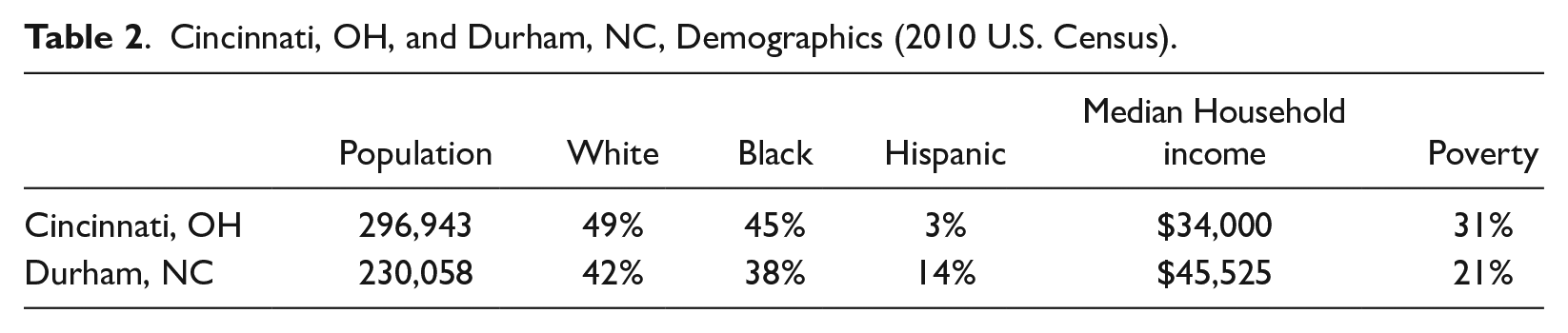
The legacy of these policies has resulted in a bifurcated city characterized by dramatic and enduring racial inequality. As of 2010, more than 31 percent of Cincinnatians lived below the poverty line, but the burden of poverty was twice as high for Black (42 percent) than for white residents (19 percent) (see Table 2 for further demographic information). According to data from the 2017 Community Health Survey, a third of Cincinnati adults live in food insecure homes. However, Black residents are nearly twice as likely to suffer from food access issues than their white counterparts (38 percent v. 21 percent) (Interact for Health 2017). Of note is Cincinnati’s status as the birthplace and corporate headquarters of Kroger, one of the largest and highest grossing grocery store chains in the United States.
Cincinnati, OH, and Durham, NC, Demographics (2010 U.S. Census).
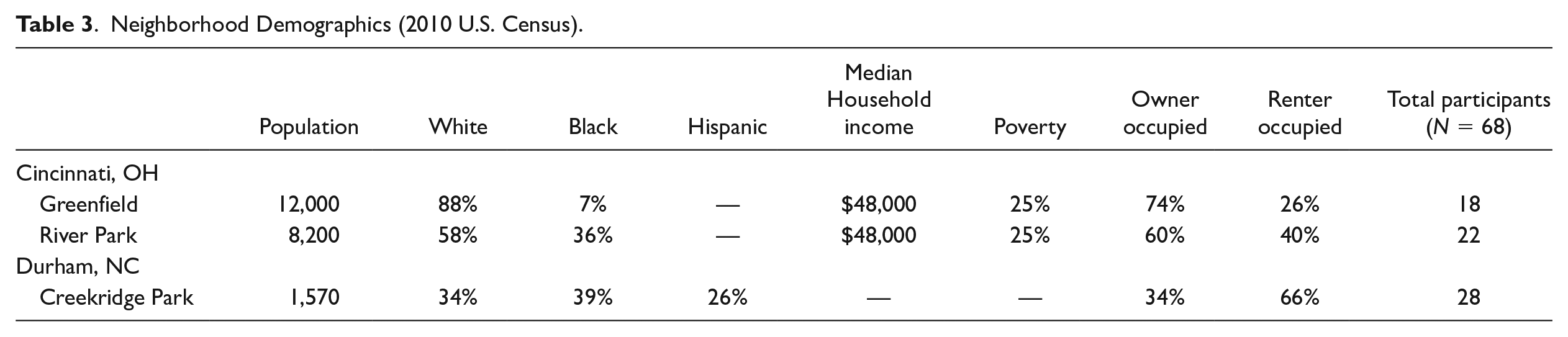
Underhill completed her study of two mixed-income, pseudonymous Cincinnati neighborhoods in 2014 and 2015. In both neighborhoods, the median household income is $48,000 per year and 25 percent of residents live in poverty. While both neighborhoods have a similar economic profile, River Park is multiracial (58 percent white and 36 percent Black) and Greenfield is predominantly white (88 percent white and 12 percent Black). She interviewed 40 white, middle-class parents across both neighborhoods; 22 in River Park and 18 in Greenfield. Underhill’s study examined racial and class socialization among middle-class, white parents focusing specifically on how parents negotiated cross-racial and cross-class contact for their children. To address issues of social contact, she asked participants questions about places in their neighborhood they frequented and avoided with their children; in both samples, the neighborhood grocery store was a site participants discussed avoiding.
River Park
River Park is a multiracial, mixed-income neighborhood located 15 minutes from downtown on the eastside of Cincinnati. 9 Residents describe River Park as a racially diverse and community-oriented neighborhood that attracts socially and politically progressive residents, many of whom have young children. Historically a predominantly white neighborhood, in 1980 83 percent of residents identified as white, while 16 percent identified as Black. By 2010, River Park was 58 percent white and 36 percent Black.
In many ways, River Park feels like a lively neighborhood. Sidewalks line most of the residential streets and it is common to see people walking or riding bikes en route to the neighborhood recreation center, the library, or the small commercial strip that features a coffee shop, several Black beauty and hair supply stores, an English pub, and a handful of buildings with papered windows and “For Rent” signs taped to the front door. Residents can also purchase goods at one of the two chain grocery stores located in strip malls at the outer edge of the neighborhood, near the highway on-ramp. Flanked by gas stations and fast food restaurants, both grocery stores feature sprawling parking lots that are rarely, if ever, full—an assessment that accords with the shopping practices of River Park participants, almost none of whom shop locally, preferring to frequent “newer” stores with “better variety” in distant neighborhoods (see Table 4 for shopping frequencies).
Greenfield
Like River Park, Greenfield is also a mixed-income, inner-ring suburban neighborhood on the east side of Cincinnati whose residents possess a similar median household income and poverty rate as River Park residents (See Table 3). Unlike River Park, Greenfield is a majority-white neighborhood (99 percent in 1980, 88 percent in 2010) with a much more understated sense of community spirit. Though participants—all of whom were white—appreciated the affordability of Greenfield’s single-family homes, they were decidedly antagonistic about the poor white residents who lived in the inexpensive rental units scattered throughout Greenfield’s residential streets and clustered around the neighborhood’s small commercial center featuring an ice cream parlor, a Dollar General, a laundromat, karate studio, and Safeway—a chain grocery store. Despite being within walking distance of their home, many participants foreswore the Greenfield Safeway, citing the “sketchy,” poor white patrons who “milled” about the store in clothing participants described as stained, and ill-fitting: “their stomachs hanging out, wearing shorts that are entirely too short.” While many Greenfield participants would “pop in” to the local Safeway for milk or eggs, most conducted their grocery shopping at “the fancy Safeway,” a 10 to 15 minute drive from their home where most of the store patrons were middle- and upper-class whites.
Neighborhood Demographics (2010 U.S. Census).
Results
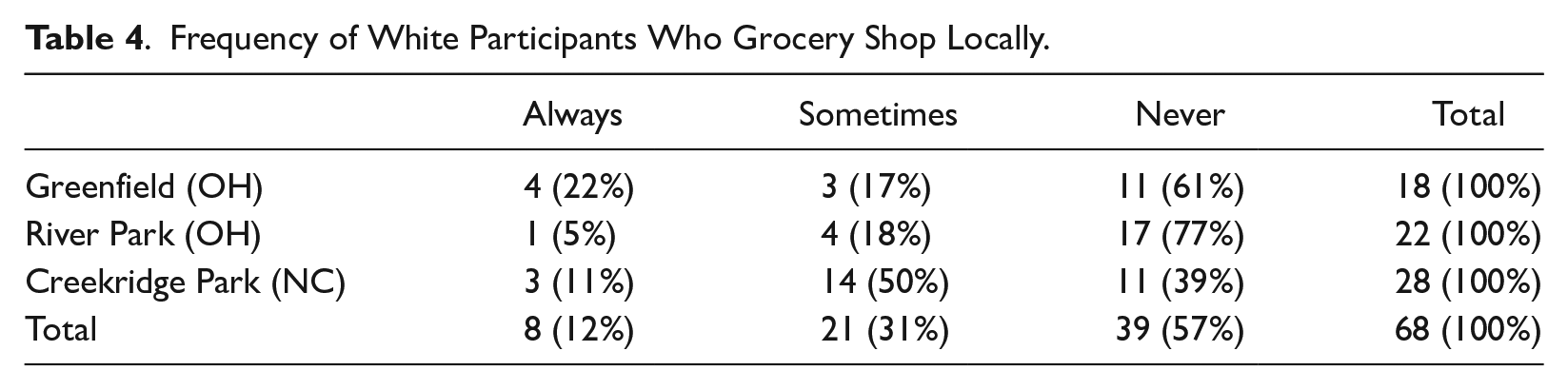
We argue that the structural reality of food apartheid, as a product of racial capitalism, shapes and is shaped by residents’ shopping practices, leading to everyday disinvestment among the white middle class in mixed-income neighborhoods. We focus on three broad patterns of everyday disinvestment—avoidance, distancing, and selective engagement—that middle-class white residents enacted toward their local grocery stores. Racial capitalist logics of antiblackness and consumption as freedom are essential to understanding residents’ decision-making. All strategies were found across the three neighborhoods, but were exemplified in different sites. While we focus on avoidance in River Park, distancing in Greenfield, and selective engagement in Durham, there were overlaps in the patterns across neighborhoods. We chose a single site to represent each pattern for readability and to privilege local details. While we argue that these are broad patterns, their exemplification in certain sites may be related to the race and class contexts of each neighborhood. In other words, we find preliminary evidence that avoidance is more likely in Black and white neighborhoods where white middle-class residents are aiming to avoid Black neighbors; distancing is more likely in mixed-income predominantly white neighborhoods where the white middle class is negotiating its relationship to poor whites; and selective engagement is more likely in multiracial neighborhoods where Latinx communities reshape the meaning of nonwhite spaces for middle-class whites aiming to consume diversity. While consumption as freedom is an important logic for all residents, we argue that antiblackness is a key explanation for the strategic differences between neighborhoods. Table 4 provides an overview of how many residents engaged in these broad patterns.
Frequency of White Participants Who Grocery Shop Locally.
Avoidance and Distancing in Cincinnati
In Cincinnati, River Park participants were the most likely to completely avoid a neighborhood grocery store. In fact, only 23 percent of River Park participants exclusively or sometimes shopped in their local grocery stores (See Table 4). This low number is particularly striking because River Park was home to two grocery stores, while Greenfield had a single grocery store. What is interesting about River Park is that very few white residents gave long justifications for why they shopped elsewhere. This is in contrast to both white Greenfield and Creekridge Park residents who had a lot to say about their local grocery stores. We argue that white middle-class residents in River Park avoided these local stores because of the presence of Black residents and poor Black residents in particular in these spaces. As discussed by Underhill elsewhere, while white participants talked about how much they valued the diversity of their neighborhood, they avoided neighborhood spaces Black residents used, such as the neighborhood pool, and exercised social control when they were in shared spaces, such as the park (Underhill 2018). When it came to grocery stores, though residents did not say much about them, their avoidance marked them as an unsuitable place. One resident of five years, Stephen, even claimed that there were “no grocery stores” in River Park despite there being two stores within walking distance from his home. This statement illustrates the notion of antiblackness as a-spatiality, as described by Bledsoe and Wright (2019). They argue that spaces with “(Black) populations occupying them receive no recognition as” being “viable”; such logics “are only possible via the understanding of spaces inhabited by Black populations as empty” (Bledsoe and Wright 2019:13–14). In addition, the presence of “unhealthy places” like Wendy’s and Burger King, both of which flanked the two neighborhood grocery stores, rendered them invisible and unusable to Stephen, who cited their presence as one of the main factors that undermined his sense that he was raising his white daughter in a “good healthy nest.” Stephen’s perspectives highlight the ways that ideologies surrounding food selection are political; every notion surrounding food under U.S. capitalism seems to carry “moral, ethical, and health implications” (Bowen et al. 2019:35). Ideas of healthy food and choice are classed as well as racialized (Guthman 2003). With a food apartheid lens, we problematize the notion of choice as well as the ideas of “healthy” or “unhealthy”; not only are “clean” and “healthy” foods often associated with white middle-class ideals of organic and “natural” products, but those with the resources to “vote with their forks” tend to be white and middle class (Bowen et al. 2019:113; Guthman 2003).
Fiona (white homeowner, 40s), a long-term resident of River Park, was one of the few white River Park participants who alluded to race when explaining why she avoided the newly remodeled Biggs down the street from her home. She and her “white friends” called it the “ghetto Biggs,” a distancing tactic that both Greenfield and Creekridge Park residents also used (more below). In explaining its “ghetto” status, Fiona said, “there’s not enough people there that buy the organic or the healthy stuff so that stuff ends up going away and then it’s all the trash stuff.” Fiona did feel guilty about her avoidance, but it did not cause her to make different choices: I kind of feel guilty that I don’t support [my local grocery store] but . . . I go to Kroger’s, because Kroger’s is on my way to and from work in Blue Ash [a majority white, upper middle-class community ten minutes from her home]. So it ends up being more convenient and I don’t have to worry about something they don’t have. There and Trader Joe’s is the other place I shop . . . because . . . it carries a lot of stuff that other places don’t carry. So and then, very occasionally, Whole Foods.
Fiona ultimately framed her decision to disinvest from her local store as an exercise of consumer preferences and convenience, despite relying on a racist and classist “ghetto” characterization to initially explain her avoidance.
Sixty-one percent of participants in predominantly white Greenfield completely avoided the local grocery store like their counterparts in multiracial River Park. Barbara (white homeowner, 30s), for example, described driving 15 minutes to a high-end Safeway across town because she liked that the store catered to the “upper middle class”: they have chefs there, a sushi station, and even a jewelry store. It’s a little over the top but it’s beautiful inside and they have special foods you can’t get at the neighborhood Safeway [because] it caters to a background of people that might need cheaper prices.
Few other middle-class residents directly cited the upper-middle-class clientele as the reason they attended the “bigger and fancier Safeway” in the more affluent community next to theirs, but most alluded to the higher-class patrons in other ways, describing the people who shopped there as being more “health conscious” or socially or environmentally aware than the patrons of their neighborhood store—qualities that heightened individual feelings of status and superiority.
In contrast to most River Park participants, white middle-class Greenfield residents were much more vocal about their distaste for the local Safeway. Greenfield residents most often cited the poor white shoppers at the neighborhood Safeway (i.e., the “Deliverance Safeway,”) as the primary factor that motivated them to frequent stores in wealthier communities. As a majority-white neighborhood, the poor residents of Greenfield were also white. Tara (white homeowner, 30s), for example, described feeling like “such a brat” for avoiding the neighborhood Safeway but explained that “some of the people in [the Greenfield Safeway] make me lose my appetite. And that sounds awful but I just can’t, I can’t [go there]. It honestly makes me feel like the food is gross.” For Tara, her negative feelings toward the poor white patrons transfers to the food, making the food itself “gross” by association. Many white women participants also described feeling “unsafe” shopping at their neighborhood Safeway due to the store’s location next to “low rent apartments.” Residents of these buildings were described as “unsavory” and “suspicious” due to rumors participants heard about the preponderance of “prostitutes, sex offenders, and heroin addicts” who were “doing shady stuff in the parking lot” behind the Greenfield Safeway. Here we see how shared stories, including rumors, play a role in how the local store and its surroundings get marked as “suspicious” by the white middle class and how consumption as freedom is predicated on classism. A few white women participants also cited the “people you always see with signs that they’re homeless looking for money . . . standing across the street” as the reason they avoided the Greenfield Safeway and frequented stores in higher-income neighborhoods among people whom they felt “safer” around.
Although Greenfield residents were quick to malign the poor white patrons of the Greenfield Safeway, they were also more likely to shop locally despite these negative characterizations (see Table 4). For example, while Camelia (white homeowner, 30s) shops at many stores, she also frequents the local Safeway, which she refers to as “the Geriatric Safeway,” “if we have no food at home and I need to run in and get groceries just for today.” We argue that nicknames like “Geriatric Safeway” and “Deliverance Safeway” are important distancing tools, whereby residents indicate that they may shop at these spaces, but they are not of these spaces. Interestingly, many people who used these names referenced how they were in-jokes with friends, further evidence of shared stories and language as key to local practices of avoidance and distancing. For example, Lauren (white homeowner, 30s) laughingly recalled how she and her friends “always kind of joked about [how the people who shop at the Greenfield Safeway] look like the funny pictures you see of people at Wal-Mart.” 10
Gwen (white homeowner, 30s), a long-term resident of Greenfield, is one of four Greenfield participants who shopped exclusively at the local Safeway because she “can get in and out” of the store quickly. While the Greenfield Safeway is “fine” for Gwen to frequent, she specifies that she would not feel comfortable with her nine-year-old son walking around the store unattended: “there is some kind of element around some of the people there . . . [that makes] my son get nervous. People who mumble to themselves when no one is around. And I don’t blame him, you know?” We interpret Gwen’s comments as another type of distancing; she is setting boundaries around her engagement with the local Safeway and the poor white patrons who frequent the store. While it may meet her food needs, it is not a comfortable place.
Overall, white middle-class residents in predominantly white Greenfield were much more comfortable sharing negative characterizations of neighborhood residents and spaces than River Park residents, a practice we attribute to the different weight society accords classist versus racist comments and behaviors. As Hartigan (2005) argued, “white, middle-class liberals learn very young not to use epithets with racial connotations, but they receive quite different messages concerning labels for poor whites” (p. 150). At the same time, residents’ actions point to the different practices of the white middle class: avoid places with Black people, and while poor whites are undesirable neighbors who should be avoided, you may still frequent shared spaces as long as you mark yourself as different from them.
Selective Engagement in Durham
Most Durham residents we spoke to had multiple grocery stores where they shopped and the overwhelming majority (89 percent) did not shop at the local Food Lion on a regular basis. The most common reasons given for shopping at other places was the item selection, which is unsurprising given the way that residents talked about their grocery shopping practices in general. For those white and middle-class participants who selectively engaged in the local store, the decision was most often framed around the “quick shop” designation (50 percent). Many white middle-class residents in Creekridge Park distinguished between weekly grocery shopping outside of the neighborhood and quick trips at their less desirable local Food Lion. In all of the study neighborhoods, white middle-class residents characterized the neighborhood grocery store as good for only certain shelf-stable items. This practice, however, was particularly acute in Durham, where many residents had detailed protocols and explanations for the multiple places they frequented. For this reason, we highlight selective engagement as a key pattern in Durham.
We interpret this multi-site shopping as a type of white middle-class performance of consumer optimization, where searching for the best products from different locations is an enactment of consumer freedom and distinction. Within this middle-class, white habitus, Food Lion is a store with limited allure. As Seth (white homeowner, 40s) put it, he went to the Food Lion in Creekridge Park “For small things and the less interesting things.” Terry (white homeowner, 50s), an exemplar of the multi-site shop, described his food acquisition habits as follows: We shop a lot at Whole Foods for fresh foods. I shop at Food Lion for beer and mayonnaise, and things that we don’t have to buy at Whole Foods. We’re part of a raw milk co-op, so we get most of our dairy from a raw milk co-op. We used to shop all the time at the Durham Food co-op, but that’s no longer there. We don’t shop very much at the Farmers’ Market. We do have—we do grow a few vegetables here in our backyard, some apples and stuff, and we’ve done a little more of that in the past. We’ve had less time for gardening in the last couple of years. We used to garden pretty extensively and grow quite a bit of produce, but we’ve sort of been slack on that the last couple of years.
While for some residents the Food Lion was a stigmatized space that was deemed temporarily acceptable by the quick shop or convenience designation, for others it was a useful place where they could get Latinx products. For example, Adrienne (white homeowner, 30s) said that she sometimes pops into the local Food Lion for “particular stuff,” such as “Mexican, Latino, Hispanic type foods and I also like to get those candles. The tall Catholic candles with a saint on them.” Her husband, who does their regular grocery shopping, typically shops at Whole Foods and Harris Teeter. Julie (white homeowner, 30s) said that most people in Creekridge Park appreciate that Latinxs live there: What I love about Creekridge Park—most of the people around here, and most [of] the people I know, love the fact that we have such a huge Latino population. Like, they love the restaurants, they love that the Food Lion is stocked with spices that you wouldn’t normally get at a Kroger, and that’s like, a neat part about living here and not a drawback. And that most people in this neighborhood think that’s fun.
Julie’s comments draw attention to the literal and figurative spice that Latinxs bring to Creekridge Park, capturing the selective valuation of Latinidad within racial capitalism; such comments are illustrative of differential valuation within racial capitalism more broadly, as Pulido (2017) has argued. For white middle-class residents in particular, the proximity of Latinx residents shapes the grocery store stock in a way that allows them to construct a positive white identity as omnivorous and cultured—two key elements of contemporary foodie culture (Peterson and Kern 1996). In these cases, Latinx products were consumable diversity for white residents, thereby serving as a buffer against the stigma of Food Lion’s poorer and Black clientele. We argue that a consumable Latinx buffer is one reason why there are differences in how Creekridge Park residents talked about the local Food Lion when compared with River Park residents despite both being multiracial mixed-income neighborhoods where white middle-class residents said they value diversity. Interestingly, despite these small differences, in both of these multiracial neighborhoods the vast majority of residents we spoke to avoided the local store (see Table 4).
Self-identified “working-class kid” Luke (white resident, 30s) discussed worker treatment as one of the reasons he avoided Food Lion, which he called “the Food Dog”: I have hours-long stories about having to wait 30 minutes to get a jar of garlic. It’s horribly inefficient, you can get what you need there, but so many people that are working there are so unhappy and it’s evident in the way they treat the customers and each other. It seemed like they’re understaffed. And it’s not their fault. I think they’re unhappy because their job doesn’t treat ’em real well.
Luke went on to describe his conversations with a deli worker about the lack of safety mats and supportive footwear and the physical toll working at Food Lion was having on her: That’s part of why I don’t like going there. I see people are suffering. I mean, they have a job, but it’s a miserable fucking job. It’s not a fun job if you feel bad, if you’re hurt, if other people aren’t supporting you, if your customers are rude.
Luke was unique in his assessment of why customers received poor customer service at the local Food Lion. In contrast to other Creekridge Park residents who described employees as inherently rude and unfriendly, Luke argued that employees’ terse demeanor was a product of management decisions that resulted in store employees being overworked, understaffed, and poorly treated. Only one other white Creekridge Park resident articulated a similar understanding of the challenging workplace culture of Food Lion employees. Judy (white homeowner, 40s) highlighted Food Lion’s antiunion practices and said “it just didn’t seem like a very happy place to work.” Most, however, compared their customer service experience at Food Lion to that of grocery stores in more affluent communities where they perceived stores as better staffed and, in the case of Whole Foods, employees paid a higher hourly wage. While we do not have data to compare staffing between these stores, what we want to highlight is the centrality of the consumer role to most white middle-class residents’ understandings of grocery shopping and the corresponding lack of empathy with workers on which ideologies of consumption are predicated.
Our findings show that white middle-class residents who witness or experience terrible treatment of customers, or even workers, opt-out of these spaces. Their actions make sense within “the language and logic of market exchange” (Centeno and Cohen 2012:331). We vote with our wallets. Boycotts and divestments can be incredibly effective when they are broad scale and communal. The logic of consumption as freedom is so strong that we tend to think of our individual-level consumption decisions as engines of social change. And while those individual-level actions can be personally meaningful, they are unlikely to—on their own—result in the kinds of structural changes necessary to improve worker conditions. In fact, losing customers who care about worker conditions and could lobby management for better treatment in solidarity with workers is not likely to improve worker conditions.
Conclusion
Everyday disinvestment includes practices of avoidance, distancing, and selective engagement that are iteratively justified by and subsequently reinforce racial capitalist ideologies of antiblackness and consumption as freedom. But these ideologies do not just exist in the minds of white middle-class residents. They are material, connected to actual outcomes and resources (Hall 1986). While we highlighted how these ideologies were reflected in white middle-class behaviors here, we have elsewhere extended our discussion to think about how they also shape the material conditions of poor and working-class neighborhoods (see Mayorga, Underhill and Crosser under review). Everyday disinvestment matters because it reinforces food apartheid and racial capitalist ideologies, which by definition exploit and disregard poor and working-class people and their spaces. While in the short term, everyday disinvestment may not seem to matter, it helps normalize structural disinvestment, antiblackness, and classism. We invite scholars to continue to map the interplay between structural and everyday disinvestment in future work.
Our focus on the everyday disinvestment of white, middle-class residents contributes to the literature on racial capitalism by adding a micro-level analysis to traditionally macro-level political economic arguments. While the structure of racial capitalism is of central importance, we argue that understanding how individuals experience and translate this system is of value for scholarly and liberatory ends. By studying grocery shopping—a system that most people in the United States are implicated in—we provide a tangible entry point to understanding the effects of racial capitalism on everyone and highlight the benefits of this theoretical framework for building a more just world. We argue that everyday disinvestment is useful for understanding how racial capitalism shapes our behaviors and common-sense understandings of “good” and “bad” stores and food. Everyday disinvestment denaturalizes the economic and consumption-based justifications that residents provide for their decision-making and makes racism and capitalism central frameworks with which scholars must contend. Disinvestment is a logic and practice that connects the micro and macro of racial capitalism, and we hope scholars use it to explain a variety of taken-for-granted urban phenomena.
Everyday disinvestment also illuminates the relationality of food apartheid. While it may seem that the decision-making of white middle-class residents has nothing to do with the circumstances of poor and working-class residents, we argue that everyday disinvestment practices of avoidance, distancing, and selective engagement are fueled by and reinforce the same ideologies that justify white flight and structural disinvestment. Pinpointing the ways that common-sense decisions around groceries are made helps us more clearly see how food apartheid is normalized and misread under racial capitalism. With the concept of everyday disinvestment at our disposal, we are better able to challenge the ideologies of antiblackness and consumption as freedom that permeate not just grocery shopping, but also such sector of society as education, housing, and healthcare.
Footnotes
Acknowledgements
Thank you to the Theodore and Jane Norman Fund as well as the Brandeis University Library whose financial support has made it possible for this article to be open access. We also extend our heartfelt thanks to Richard Ocejo and the anonymous reviewers whose incisive comments helped us strengthen our paper.