



Abstract
This article analyzes two planned cities—Belo Horizonte (Brazil) and Bloemfontein (South Africa)—to investigate connectivities across geographies and temporalities and reveal the role of urban planning in racial capitalism. Early works in urban sociology underscore the color line in producing differentiation in capitalist development. But color-blind analyses of capitalism have undermined the role of race in the urbanization process and formation of value—of places and people—and how the modern triad—colonial, racial, and capital—is deeply implicated in power modalities. Based on policy analysis, we historicize political choices discussing urban planning and national developmentalist schemes after redemocratization that produced racial-spatial inequalities. We argue that color-blind urban policies still neglect the role of race in the production of Brazilian and South African cities under the guise of “planning innocence.” This discussion expands our understanding of urbanization and capital accumulation as a dialectical process of Black dispossession and the protection of White property in the postcolony.
Introduction
Decades of progressive urban policies in Brazil and South Africa that have focused on reducing social inequalities have had little impact on the historical patterns of high concentration of wealth and land in the hands of White people, unveiling the limited scope of color-blind approaches to tackle inequalities in these countries. This article draws on the complex interrelation between race, class, and space as a contribution to the growing efforts to articulate the legacy of racial slavery, colonialism, and urbanization in Brazilian (Alves 2018, 2020; Leu 2016; McDonald 2021; Vargas 2005) and South African cities (Madlalate 2017; Samara 2011; Seekings 2011). We focus on urban planning, as a state technology, and its role in protecting White property through Black dispossession, even in recently-implemented progressive urban policies.
We depart from the premise that urban planning policies have left unchallenged the processes of uneven racialization of space by historical regimes that privileged White people, discussing it as “planning innocence” in relation to racism. By implementing class-based efforts to produce social inclusion, urban policies have focused on poverty alleviation measures, subsuming race to class. Unveiling the mechanisms that condone planning’s perceived neutrality requires an understanding of the “constitutive nature of capitalism and racism in producing the urban” (Dantzler 2021:2). A clear articulation of the field with Critical Race Theory and racial capitalism is our proposal to provide theoretical tools to unpack capitalist production of urban space in the postcolony. 1
Early works on urban sociology called attention to the problem of the color line in producing differentiation in capitalist development (Du Bois [1903] 1994). Nevertheless, a color-blind analytical treatment of capitalism has understated how race affects urbanization processes and shapes value—of places and people (Dantzler 2021). Nor has it fully considered how the modern triad—colonial, racial, and capital—is deeply implicated as power modalities (da Silva 2019:161). Both considerations are paramount to further discuss the continued role of planning in urbanization.
To date, as Benediktsson (2018) suggested, focusing on “emplaced inequality” has produced powerful research in urban sociology and offers an opportunity for transdisciplinary research that grasps the complexity of the urban phenomenon, providing opportunities for dialogue with the fields of urban planning and law. However, studies on sociospatial inequalities have centered analyses on “globalization and neo-liberalization processes” (Jabareen and Eizenberg 2021:212), overlooking some of the premises in racial capitalism scholarship (Bhattacharyya 2018; Chakravartty and da Silva 2012; Melamed 2015; Pulido 2016b).
Black and critical race studies expose how the violence licensed in the present can only be understood by reconstructing the past. Race and space are contextually constructed through the histories of racial slavery and colonialism that shaped the modern world (da Silva 2019; Hartman 1997; Pulido 2016b). This article thus explores a deeper articulation of urban sociology and critical race studies, applying theoretical and analytical tools that unpack racism as a structural system of oppression (Goldberg 2002; Harris 1993; Hartman 1997; da Silva 2019).
Existing critical studies taking race, capitalism, and urbanization into account still concentrate the locus of analysis on the geographies of the global North (Bonds and Inwood 2016; Dantzler 2021; Dorries, Hugill, and Tomiak 2019; Gilmore 2002; Goetz, Williams, and Damiano 2020; McKittrick 2006; Pulido 2016a, 2016b; Thomas 2008). And studies on countries in the Global South, such as Brazil (Bledsoe and Wright 2019), rarely focus on urbanization processes. In addition, race as an analytical concept remains underexplored in mainstream planning theory (Yiftachel and Huxley 2000).
A growing body of literature focuses on the Global South and the lingering colonial structures and Eurocentric planning practices that still define power dynamics and shape spatialities in the postcolony (Parnell and Robinson 2012; Patel 2016; Roy 2009; Sundaresan 2020; Watson 2014; Winkler 2018). Even when considering race and racism, though, these studies have not made them as central to the analyses as they propose. And even fewer studies focus on the patterns of racialized regimes in secondary cities, despite their growing importance in the broader literature (Marais and Cloete 2017).
Exploring how planning practices impact the production of space by engaging with racial capitalism in Brazil and South Africa enables research to expand reflections on racial inequalities in postcolonial contexts, including beyond these two countries. We therefore present a relational approach as proposed by critical race studies (Goldberg 2014; Lentin 2017). This means engaging with the connectivities across geographies and temporalities that reveal how “the colonial shaped the contemporary, planted racisms’ roots in place, designed their social conditions and cemented its structural arrangements” (Goldberg 2014:1280–81). By relating Brazil and South Africa, we are able to, on the one hand, identify arguments present in urban planning discourses that are common to globalized trends on the field, such as sanitation or modernization (Swanson 1977; Watson 2003). This challenges South Africa’s exceptionalism, which has historically been attributed to apartheid, and provides venues to better understand racialized regimes in other geographies. On the other hand, this approach equally confronts Latin American’s exceptionalism, based on an idea that “the salience of racial classifications is debatable” in that context (Go 2021:41), by demonstrating how racial lines are continuously regulated in Brazil (Hernández 2013; Vargas 2005) and could relate to other geographies in the region.
This article’s main question is to assess how progressive urban planning practices perpetuate the uneven racialization of space in the postcolony. We engage with this question through a dialectical analysis of the intertwinement of Black dispossession and the protection of White property as the main mechanism of a racialized regime at work in urban planning practices that foster racial capitalism. We ground our analysis in two secondary and planned cities—Belo Horizonte (Brazil) and Bloemfontein (South Africa). We look at two different historical moments: 1) early twentieth-century plans; and 2) more recent developmentalist urban policies, namely the Growth Acceleration Program (PAC) in Brazil, and the Reconstruction and Redevelopment Programme (RDP)/Growth, Employment and Redistribution (GEAR) in South Africa. We draw on an extensive literature review on the absence/presence of race in planning research (encompassing each national context) and document both time periods. We also use visual maps of available census data that show racial segregation in relation to planning choicesto sustain our argument. Finally, we scrutinize the impact of national developmentalist policy frameworks in local planning by discussing progressive urban planning practices in Belo Horizonte and Bloemfontein.
The analysis reveals urban planning’s central role in enabling capitalism’s expansion through racialization, regardless of whether governments acknowledge or deny the existence of a racialized legal regime. In addition, by expanding on the limitations of a class-based effort to address social inequalities, we critique color-blind political choices and urban planning solutions that sustain “planning innocence.” Focusing on urban planning policies in relation to national developmentalist schemes contributes to current debates of racial capitalism in urban studies by exposing the interconnection between spatial (racial) regulation and capitalist expansion in postcolonial contexts.
This article is divided into four parts. The first focuses on the entwinement of racial capitalism, urban planning, and developmentalism, exploring the idea of “planning innocence” that underpins the analysis. The second part explores how the recent history of urbanism has shaped racial arrangements spatially. In the third, we present Belo Horizonte and Bloemfontein (the latter as part of the Mangaung Metropolitan Municipality [MMM]), connecting their history of racial-spatial segregation with current urban projects implemented with their national governments’ investment. Lastly, we put those contexts in relation to one another to reflect on how racial capitalism benefits from the permanent process of Black dispossession and the protection of White property through color-blind urbanism.
Racial Capitalism, Urban Planning, and Developmentalism
Capitalism requires inequalities to thrive, and racism continues to provide for “unequal differentiation of human value” (Melamed 2015:77), which assumes a spatial dimension through the production of “a racially devalued place” (Pulido 2016a:8, see also Pulido 2016b). Racial capitalism works as a powerful framework to expand urban research in postcolonial cities, unveiling the racialized regimes underpinning spatial formation in territories where the production of urban space is rooted in anti-Black and anti-Indigenous logics (Dorries et al. 2019:6). As such, Blackness and Indigeneity are constructed as antithetical to modernity, which normalizes both Whiteness and racialized legal regimes that protect Whiteness’ rights and expectations (Harris 1993). Furthermore, racial capitalism unveils how creating empty territory is an active and violent process, “planned and operationalized as part of an explicit project of racial subjugation” (Bhattacharyya 2018:133), which a focus on urban planning—as state technology—can further disclose.
Diverse scholarly fields address the racialization of space and Black dispossession from different standpoints. Settler colonialism scholarship, for example, underscores the transfer of wealth to Whiteness and the consolidation of a legal framework that “produce[s] a racialized system of property ownership” through settler-colonial dispossession (Dorries et al. 2019:5). Those accounts unveil the functioning of a “racial capitalist settler coloniality” (Melamed 2015:84), which is in dialogue with the past, underscoring how such a system is mostly kept unchanged in the era of liberal democracy (Bonds and Inwood 2016:729). Critical geography and Black studies investigate current patterns of racial subjugation through the legacy of racial slavery (cf. Gilmore 2002; Harris 1993; Hartman 1997; McKittrick 2006, 2011; Pulido 2016b). These studies highlight that despite attention being given to the deterritorialization of the Black diaspora, the African continent was also mapped as res nullius, or empty space (Ramutsindela 2012).
Therefore, mobilizing racial capitalism to understand the production of space requires a historical gaze that: uncovers the legacy of processes that “shaped the modern world, such as colonization, primitive accumulation, slavery, and imperialism” (Pulido 2016b:527); untangles how producing differentiation as racial is continuously updated (da Silva 1998:208); and unveils new and unpredictable modes of racialized dispossession that develop alongside sedimented histories that shape our spatial/economic life (Bhattacharyya 2018). Focusing on the racialized production of space allows a reflection on racial capitalism from histories of dispossession and accumulation that are context-specific but reveal global patterns of racialization to further capitalism.
While debates on racial capitalism seem to converge around the central role of racism and slavery for the development of capitalism, a question remains regarding how such relations have been established. Framing this in three productive tensions, Go (2021) questioned how constitutive of or contingent to capitalism racism actually is, arguing that this is a thorny problem we should engage in. While we recognize the relevance of such a proposition, especially in the European context, and acknowledge the seminal work of Cedric Robinson (2000) to historicize the imbricated relation of race and capital, we argue with Denise da Silva (2019) that in the postcolonial context there is no capitalism dissociated from racism and colonialism.
In Unpayable Debt, da Silva (2019) provided a deep theoretical reflection on how these three elements—racial, capital and the colonial—are indissociable. In this article, their entwinement is made visible as the cases brought forward disclose that Black dispossession for White benefit is not located in the past, as part of primitive accumulation in colonial history, or a mere consequence of this past. The logics informing—“collection of knowledge dispositifs”—and enforcing—“a political/symbolic instrument that operates in the political, juridical and institutional spheres”—the racialized regime are still operative (da Silva 2019:66).
Our approach gives one more perspective to understand the works of racial capitalism when looking at urban planning policies, contributing to studies that demonstrate how capitalism develops in concrete histories shaping the spatial and in contexts where the racial is inextricable to how value—of places and people—is formed.
“Planning Innocence”
Looking at planning alleged neutrality is a needed step to scrutinize how urban policies and practices continue to further Black dispossession. For that, we turn to Goldberg (2002), who argued that the racial state, “racially conceived, ordered, administered, and regulated” (p. 98), relies “on the embodiment and reiteration in everyday practice” (p. 108), thus becoming virtually invisible in almost every interaction. Such invisibility is granted by a relationship between state regulation and law. There in lies a presupposed rationality which, understood as universal and neutral, holds a moral blindness (Goldberg 2002:141). Thus, despite the proliferation of “state control and discipline across the landscape” (Goldberg 2002:139), technical or rational arguments have been and continue to be used to differently regulate populations, allowing mono-esthetical ideas of civilization and progress to linger even in more recent and progressive urban policies.
Urban planning, as part of the state regulatory apparatus, has also kept race more or less “out.” Fostering urban transformations under the rationality of modernity, seeking progress and development is perceived as racially neutral in different historical moments. Integral to this idea is the prevalence of what we call “planning innocence,” which we build from Peter Fitzpatrick’s (1987) “innocence of law.” He argues that liberal law creates a “universalistic ordering which transcends material life,” effectively concealing its own foundations rooted in racism. By “shaping [elements of racism] in its own terms”—outside legality—law protects (1990: 122) itself against any accusation of racism while furthering it, thus carving its innocence.
Drawing on those arguments—which unveil institutional strategies and everyday practices that systematically mask and further structural racism—we argue that planning, as a regulatory field, enables capitalist expansion through urbanization even in progressive governments by shaping how race is contextualized to its own terms. By assuming a class-based approach, planning and planners render racialization invisible and reduce those under racialized conditions to “the poor,” confining “them to an impoverished discourse of poverty alleviation which offers little hope of emancipation from their systemic disadvantage” (Madlalate 2017:494). Such a feat was possible by construing “poverty, health, education, hygiene, employment, and the poor quality of life in towns and cities” as social problems. Depoliticized, these were to be addressed through technocratic planning interventions, guided by scientific knowledge, and always seeking modernity (Escobar 1995:23).
In Brazil, urban studies have thus far largely focused on socioeconomic inequalities, discussing how capitalism and neoliberal governance impacts the “poor” (Garcia 2009) and planning policies have not assumed a racial vocabulary. In South Africa, where contemporary policies mobilize a racial vocabulary, the government still averts addressing the impacts of urbanization for the Black population, avoiding “the specifics of ‘race’ and ‘racial redress’ in postapartheid spatial or territorial reconstruction” (Parnell and Crankshaw 2013:590). However, we must recognize the current implication of Black dispossession since colonial times and the fact that Africans were only tolerated in South African cities as temporary and cheap labor during apartheid.
Relating Brazil and South Africa
Approaching Brazilian and South African contexts enables us to trace how the historical processes of colonization continue to shape the present, thus avoiding assumptions that racisms are merely colonial. Both countries seem to have had diametrically opposing approaches to race. While South Africa is still marked by its overt racial regime, Brazil has invested in the denial of racism’s existence under the racial democracy myth. Nonetheless, as we will further develop, both have historically relied on Black dispossession and the protection of White property.
In Latin America—and Brazil particularly—direct mentions of apartheid are used to deny the existence of a racialized regime, in what Tanya Hernández (2013) has called “racial innocence.” Critical research on urban sociology, drawing on the vital role of space regulation by race, contests this “racial innocence” by investigating how Brazilian cities are a political spatial formation founded on anti-Blackness (Alves 2018, 2020; Vargas 2005). The modern state was built on the myth of racial democracy, which in practice furthered a perverse “silence about race” (Vargas 2005:78), leading to what João Vargas (2005) conceptualized as the “Brazilian apartheid.” Amparo Alves (2020) noted an ongoing “biopolitical project where a new urban life, safe, sanitized, dynamic and connected with the modern nodes of transport and regional production is concretized” (p. 27) on the production of anti-Black spatialities.
In contrast, the term racial capitalism was first used by anti-Apartheid movement activists in South Africa in 1976, reflecting the long-standing debate on spatial racial control and capitalism in the country (Kundnani 2020). Beyond its ideological racist underpinning, apartheid was a capitalist response to the increasing Black resistance against the living conditions imposed by the colonial state and worsened with urbanization and industrialization in the 1940s. Its coercive measures halted Black insurgence and guaranteed that privileges of an Afrikaans petit-bourgeoisie and the labor reserve of White workers be maintained (Wolpe 1972). While race was an overt sociolegal construct that allowed racial classification to assume a commonsensical significance (Posel 2001), planning held its innocence by assuming scientific discourses to gain legitimacy toward “improving welfare and modernization” (Watson 2003:26). Being defined as technical by governing authorities, planning shielded itself from the political and economic goals underpinning racial segregation. Redemocratization focused on a nonracial democracy agenda, pushing anti-racialism and failing to dismantle the racial structures shaping society then and now.
In both countries, inequality patterns between Black 2 and White populations are striking. In Brazil, White people are 42.7 percent of the total population, comprising 70.7 percent of those with higher income, while Black people 3 (56.2 percent of the total population) are 75 percent among those with the lowest income (Instituto Brasileiro de Geografia e Estatística 2019). In South Africa, White people report an income that is eight times the average per capita income of Africans. (Gradin 2013). Furthermore, the Black population lives in urban areas with disproportionately deficient access to public services, public investment, and housing quality in both countries (Hernández 2013; Turok, Visagie, and Scheba 2021). In rural areas, land distribution remains unequal. In Brazil, the White population owns 70 percent of large properties, according to the rural census of 2017 (Belandi 2019). In South Africa, despite land redistribution focusing on rural areas, less than eight percent of available land has been redistributed, and the White population, who represents seven percent of the total population, still owns 72 percent of the land (Lahiff and Li 2014).
The high level of inequality has been acknowledged by past progressive governments and policies implemented to promote “poverty alleviation” and reduce socioeconomic gaps. In both countries, developmentalism became the backdrop for a progressive turn from despotic governments and the lost decades of the 1980s and 1990s, when liberal reforms weakened state capacity (Kieh 2015; Siqueira 2015).
Recognizing that social inequalities are also spatial required a juridical framework open to progressive urban policies. The Brazilian Constitution of 1988 introduced urban policy in Chapter II, stating the social function of the city and urban land (Article 182) to be later regulated by the City Statute (Law 10.257/2001). Innovations in legal instruments supporting urban reform have caught worldwide attention and been praised for “provid[ing] lessons for the Global South” (Friendly 2020:306). 4 The South African Constitution (1994) was also innovative. It went further as to assume the state’s historical debt and its responsibility to address dispossession through legislative reform (Joseph, Magni, and Maree 2015) by clearly defining nonracialism as a state policy, opposing the racial lines that defined previous legislation and presenting a land reform program.
At the national level, massive housing and informal settlement upgrade programs composed larger developmental frameworks and encompassed infrastructural projects: in South Africa, the RDP (1994)/GEAR (1996); and PAC (2007) in Brazil. Economic growth (reflected in GDP) was sought to achieve social distribution and would be delivered by a liberal economy with a strong state presence (Carrillo 2014; Fine 2013). Nevertheless, in practice, the interaction between state and market has been controversial. Existing neoliberal policies, following a global pattern, encompass the flexibilization of urban legislation, private use of public investment, massive evictions, and increased criminalization of resistance (Franzoni 2018). The developmentalist state is further strangled by globalization and financialization that shape, directly and indirectly, economic and social policy (Fine 2013). However, research critically engaging with those national programs (PAC-UAP and RDP/GEAR) and the growing intricate relation between financial capitalism and city management (Fine 2013; Franzoni 2018; Karriem and Hoskins 2016; Rolnik 2015) has mostly privileged a class angle, thus taking Black poverty as a fact.
Urban Histories of Planned Black Dispossession for White Profit: Belo Horizonte and Bloemfontein
In this section, we historicize Belo Horizonte’s and Bloemfontein’s racialized urban planning. We show how local urban planning decisions, portrayed as technical, responded to national political projects to protect White privilege. To achieve such ends, urban policies placed the Black population in a permanent state of precariousness and dispossession, which continues today. We offer context to the current situation in both cities.
Urban Planning and Whitening Policy in Brazil: Belo Horizonte Is Born
Brazil’s Republic was promulgated in 1889, one year after slavery’s abolition. This historical moment, marked by the need to create a unified narrative for the “nation-state,” was highly influenced by eugenic theories and discourses around progress and civilization. Brazil was the destination of almost half of the people enslaved from the African continent during the transatlantic slave trade. 5 In the nineteenth century Brazilian White elites portrayed the country’s large Black population as a threat, pushing policies to “de-Africanize” the country (Góes 2016). In cities, the Black population was targeted by the increasing policing of public space (Batista 2003). A series of epidemics in the 1850s was used as argument that the Black population was contagious and sick, paving the ground for a series of evictions in the country’s capital of Rio de Janeiro (Chalhoub 2017). By the end of the nineteenth century, the “sanitation syndrome” (Swanson 1977) underpinned interventions targeting collective housing areas occupied mainly by Black residents.
In the State of Minas Gerais, the lack of progress was blamed on its population, depicted as being “inferior quality” and in need of racial improvement. A new capital city was part of an ambitious project where a “public spending campaign centered on three expenditures: the new capital, railroads, and immigration subsidies,” and Whitening was an “essential aspect of modernization” (McDonald 2021:32). At the national level, the Republic’s Whitening project led to public-sponsored initiatives to foster European immigration, seen as the country’s salvation. White newcomers were offered property titles to produce within a growing agricultural economy (Prioste 2017), while the Black population was continuously undervalued and underpaid for its labor (Moura 2019). Already placed in precarious conditions, their situation deteriorated with the promulgation of the Land Law of 1850, which stipulated that land could be only acquired by purchase, therefore not recognizing land tenure.
Belo Horizonte elites embodied a view that “assign[ed] particular importance to planned urbanization as part of a larger scheme to Whiten their entire state”(McDonald 2021:32). The city became the first planned capital in the Republican era in Brazil. Rationalist international models, namely the Haussmann plan for Paris and the functionalist plan for Washington, D.C., inspired the plans for an ordered, functional, and modern city. It was meant to become a “beautiful city”—as its name translates—clean, ordered, with its rigid urbanism and hygienic forms expressing the “cultural habits” of the elite (Monte-Mór 1997:477). From its onset, the city was segregated. The inner-city was designed to accommodate the state government and elite. Rigid access control was imposed on the central area to guarantee its White residents’ “quality of life” (Monte-Mór 1997:477), while the precarious labor force, composed mainly of Black people, was depicted as unhealthy and disorderly. Excluded from the original plans, they were instead “allowed” to stay temporarily in defined suburban areas, deprived of services and infrastructure close enough to provide cheap labor for the city’s construction. Evictions were constant, as the city rapidly needed to grow outward and house “desired” residents (Costa and Ribeiro 2004:7).
The first favelas were established at the city’s founding (Fernandes and Pereira 2010), Since then, they have been places of dispossession and constant intervention by the state. Even when Minas Gerais failed to attract the envisioned number of White immigrants in comparison to wealthier states such as São Paulo, “the commitment to maintaining the property market in the urban core caused most population growth to occur in the city’s [Belo Horizonte] peripheries, including the formation of some of Brazil’s first favelas” (McDonald 2021:31).
Until 1921, the city was still spatially confined to its original plans, and the city administration oversaw plot allocation (that is, land occupation). From the 1930s to the 1940s, public-led urban expansion was concomitant with private initiatives, opening new plot developments (Matos 1992), seeking to profit from the growing housing demand generated by rural-urban migration. New industrial jobs pushed massive migration to the cities from the 1950s onward (Martine and McGranahan 2013:9). During Brazil’s dictatorship period (1964–1985), BNH (National Bank for Housing) was created to centralize urban development and housing policies. In Belo Horizonte, the new framework also regulated the allocation of new plots. However, neither those nor housing initiatives accommodated low-income populations, and the few social housing produced by the BNH was insufficient to meet the growing demand (Epaminondas 2006:40). Favelas continued to grow, and the “usual solution in place was to eradicate them in the most valuable locations, pushing them to distant regions” (Matos 1992:24, our translation). In 1976, the first land-use law controlling land occupation and influencing real estate market development was issued (Epaminondas 2006:42). Studies on the impact of this law demonstrated that until the mid-1980s, only middle-income residents benefited from new plots offered, contributing to the patterns of dispossession in precarious settlements (Epaminondas 2006; Matos 1992).
The absence of a racial discussion in most of the work debating urban regulation and transformation processes in Belo Horizonte reveals how often the racialization of Brazilian cities is subsumed into a class-based analysis. Looking at the existing documentation through a racial capitalism lens unveils how state-led capitalism invested in White property ownership at the expense of the Black population. Aided by racist immigration policies, planning ordered space to privilege the allocation of White people within the planned city while sentencing the Black population, labeled as unfit to the modern image of the city, to a permanent state of precariousness and dispossession. This process shaped the unequal city that is now being reshaped under the guise of development, as discussed in the next section.
Bloemfontein planning as a historical example of institutionalized racialization in South Africa
South Africa’s explicit goals for racializing space date back to European colonialism in the seventeenth century. They were hardened throughout the twentieth century, first with the creation of the South African state which excluded the Black population to appease the internal power dispute among the White population—Afrikaans and British elites—then made explicit with the apartheid regime (Marx 1997).
The modes of production closely articulated racial proscriptions. In the nineteenth century, urbanization and racial control policies catered to the increased demand for labor in mining and commercial agriculture in White-owned farms (Dewar, Todes, and Watson 1985; Wolpe 1972). The Glen Grey Act—or the “one-man-one-plot rule”—for instance, limited land concentration for African hands, even when there were collective or private means for purchase. The 1913 Land Act allowed only 13 percent of South African land to be made available for African ownership (known as reserves and later Bantustans). Africans were forced to migrate and work in other economic sectors, to decrease competition with White farmers. The act also guaranteed land reserve, limiting the risk that plundered land be repurchased by Africans with communal or private capital (Dewar et al. 1985; Wolpe 1972).
Rural areas played an essential role during industrialization, keeping the fragile balance between the supply of temporary urban migrants and the subsistence of family members who remained in the reserves. Subsistence agriculture relieved industry, the agriculture sector, and local authorities from assuming the reproduction costs of a “permanently urbanized African workforce” (Dewar et al. 1985:180). Nevertheless, the increasing demand of an urban proletariat combined with the harsh conditions in the reserves progressively forced Africans to migrate to squatter camps on the fringes of the White city.
Racial policies promoting urban segregation was a response to the growing African urban population, who White colonialists considered to be a threat to the social order. Such policies used scientific discourses of health and safety to disguise their racist underpinnings (Harrison, Todes, and Watson 2008; Mabin and Smit 1997; Parnell 2002). Planning regulations, such as the 1919 Health Act and the 1920 Housing Act, targeted overcrowding and slum removals as early mechanisms to ensure the living standards of the White poor in detriment to the Black population, guaranteeing the “racial division of urban space” (Parnell 2002:473). The Native (Urban Areas) Act of 1923 6 gave municipalities the authority to define White-only areas and move Black residents to “segregated locations.”
Planning regulated housing to ensure the supply of cheap Black labor for the economy’s advancement (Strauss 2019). Such practices, naturalizing racialization, served as the basis for apartheid’s policies that aimed at complete segregation (Mabin and Smit 1997). This process culminated with the 1950s Group Act that enforced racial zoning, and large-scale forced removals and resettlements in townships (Harrison et al. 2008).
Developed by English colonial authorities to govern the Transgariep area (today called the Free State), Bloemfontein was soon passed into Boer governance in 1856 (Westhuizen and Cloen 2012). It was planned as a segregated city, marked by two initial phases: the first segregating White and Black, and the second, colored and Black. 7 These patterns were later applied by the apartheid regime nationally (Kotze and Donaldson 1998). The colonial phase (1846–1910) was marked by two waves of migration: the large-scale forced migration of farm laborers during the Anglo-Boer war and the migration of Black and colored populations following the construction of the Cape Town and Johannesburg railway. The rapid migration triggered stricter racialized spatial segregation rules for (Rex and Visser 2009). The following period, 1911–1950, marked the expansion of White areas and the displacement of the African population (mainly the Waaihoek). A sectoral plan established the western part of the railway line for White people, and the eastern, for Black people, and both where to expand outward (Rex and Visser 2009).
Enforcing apartheid legislation (1951–1985) required less radical restructuring in an already segregated city (Kotze and Donaldson 1998). Authorities channeled Black urbanization to the homeland (rural) areas, thus protecting White South African urban areas (Marais and Ntema 2013). Planning followed European and North American ideals of sanitation. Among them, one finds large investment in low-density suburbanization, motorway-driven development, zoning schemes with separate land uses, and Modernist architecture. Such plans were not sensitive to the domestic, social, and cultural needs of the Black, Indian, and colored population (Harrison et al. 2008:30). Spatial control was achieved through “displaced urbanization,” that is, while the White population continued to occupy Bloemfontein’s economic center, (Krige 1991 in Marais and Ntema 2013), Black migrants were sent farther away to Thaba Nchu (1968) and Botshabelo (1979)– 65 km and 55 km from Bloemfontein, respectively–with at least 170,000 residents commuting daily to the Bloemfontein.
Country-wide, the growing discontent with the living conditions sparked grassroots political opposition in the 1980s. Township residents stopped rent and service payments causing financial constraints in many municipalities (Mabin and Smit 1997). These protests were addressed in the 1986 White Paper on Urbanisation, which foregrounded migration and rapid urbanization in the urban peripheries of South African cities (Mabin and Smit 1997; Strauss 2019). This lengthy process culminated in the end of apartheid, leaving the unequal distribution of urban resources and inefficient spatial patterns of occupation to be addressed by the new regime.
In Bloemfontein, the abolition of influx control and the unbanning of the African National Congress (ANC) in the 1990s signaled political change and led to the establishment of Namibia and Freedom Square settlements, located in Mangaung township, as a political and urban response to the end of the regime and the housing shortcomings for Black people in Bloemfontein (Rensburg, Botes, and de Wet 2001). Occupying land closer to Bloemfontein was first an opportunity to move closer to work and, later, led to an expectation to enter the real estate market (Marais, Ntema, et al. 2018). Nevertheless, the lack of state policies sponsoring residential integration gave the Black population no access route to private property (Rex and Visser 2009). The sharp increase of informal settlements in the south-eastern peripheries of Bloemfontein reflected the fact that resources were not allocated to address urban migration of Black Africans, and the occupation of marginal land expanded the apartheid city (Rex and Visser 2009).
The Democratic Shift: Embracing Developmentalism and Color-Blind Urban Planning
This section focuses on the centrality given to planning in addressing social inequalities in the post-redemocratization period. Drawing on recent planning projects in both cities, we expose the contradictions of color-blind developmentalist approaches used by progressive planning regimes. We show how, by centering on the “urban poor,” these practices still perpetuate the racial lines responsible for segregation and inequality.
Belo Horizonte and the Growth Acceleration Program—PAC
In Brazil, redemocratization (1985) led to a series of progressive legislation. Belo Horizonte was a pioneer in implementing progressive urban planning regulation when, in the late 1980s, a left government shifted the public approach to slums from eviction to recognition. The Pro-favela program, dating from 1983, was one of the first in the country to open legal venues to recognize property rights for slum residents. For the first time, rather than disguised as “green areas” or empty spaces (as in the 1976 land use regulation), informal settlements were made visible in municipal maps as special zoning of social interest (ZEIS) to be regularized (Fernandes and Pereira 2010:178). Nevertheless, implementing progressive initiatives to promote large-scale land regulation of informal settlements remains a challenge in a capitalist legal and institutional framework, as further discussed.
Today Belo Horizonte has around 2.5 million inhabitants in its 331 km² of area. 8 According to the 2010 national census, 51.98 percent of the population self-identified as Black, while 46.07 percent identified as White. Of the 12.9 percent of people living in favelas, 74.35 percent are Black, while 89 percent of the population in wealthy areas are White (Costa and Ribeiro 2004:13). Figure 1 9 confirms this pattern: most people living in precarious conditions are Black (category encompassing pardos and pretos, please see endnote 2), whereas White people mainly occupy the “planned city,” where the racial division intended in the original city planning lingers. The occasional green/red clusters (pardos/pretos) within this blue cluster represent favelas in the map, often occupying slopy, unstable terrain.
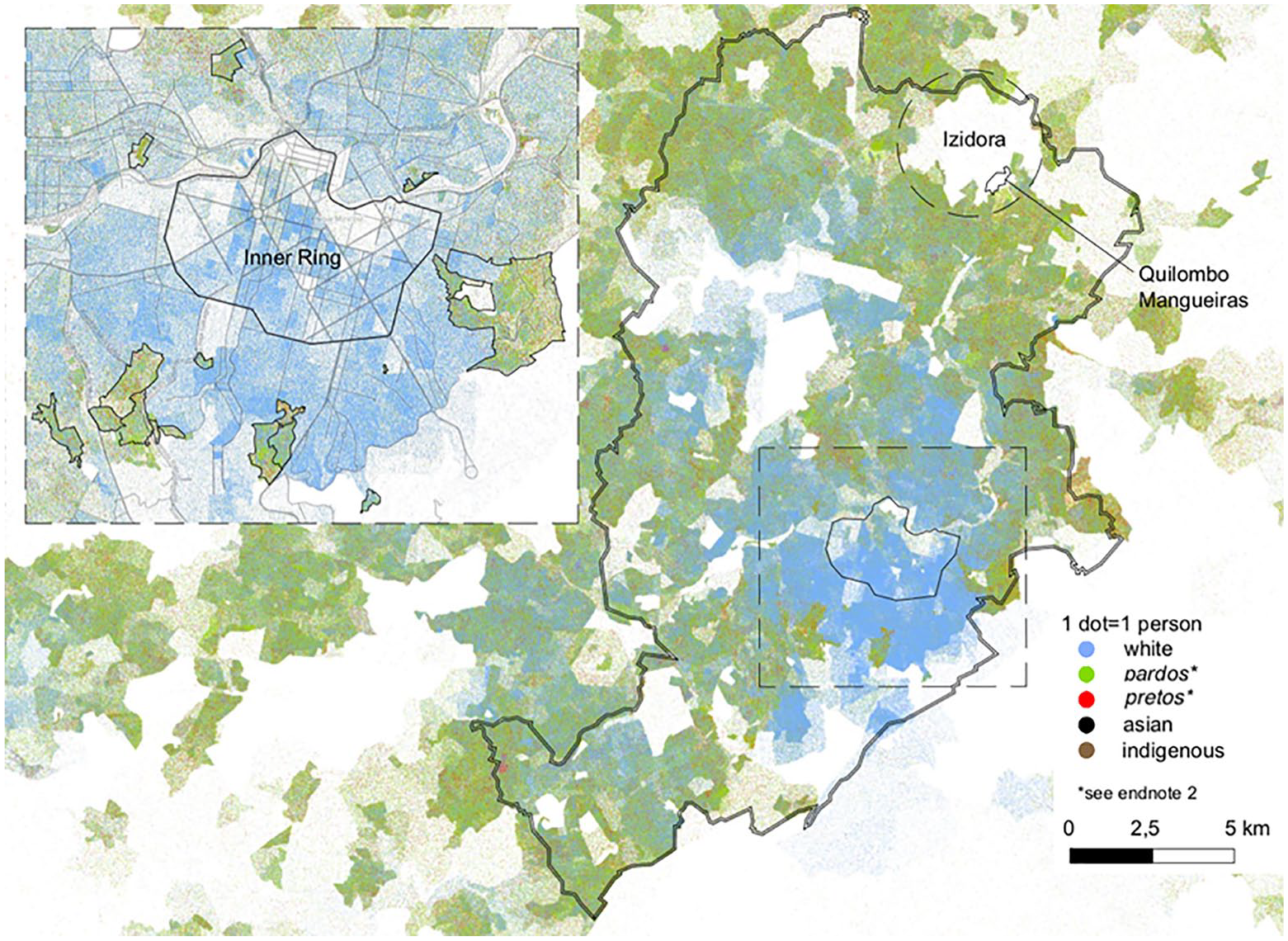
Racial Map of Belo Horizonte Produced According to the 2011 Census, Highlighting the Inner Ring (Originally Planned City), the Favelas in the Central Areas of the City and the Izidora Region.
Although the census in Brazil has historically collected data on race, and since 2000 such information is georeferenced, little work draws on the raw data to discuss race and space in Belo Horizonte (cf. Costa and Ribeiro 2004). Therefore, we resort to the power of the data visualized in the map to argue that properly naming the outcomes of the racialization of space in Belo Horizonte is a necessary step for planners to engage with racialization beyond taking it as fact, that is, naturalizing Black poverty.
From 2007, interventions enabled by federal government investments visibly impacted Belo Horizonte’s landscape. The Growth Acceleration Program (PAC) included mega infrastructure projects, a massive housing program (MCMV—Minha Casa Minha Vida), and the urbanization of precarious settlements (PAC-UAP—Urbanização de Assentamentos Precários). The latter upgraded 3,113 favelas nationwide in two phases from 2007 till 2012 (Cardoso and Madeira 2017), and the MCMV built 5 million houses. In Belo Horizonte, the local informal settlement upgrading project (part of the PAC-UAP framework) was named Vila Viva (Living Village). The Vila Viva project encompassed a series of urban interventions, including infrastructure, housing, and land regulation, and was implemented in 12 different informal settlements in Belo Horizonte (around 165,000 thousand residents were directly impacted). Other projects were simultaneously implemented, such as the Northern corridor, which included mobility and new developments to steer the expansion of the city northward (Diniz and da Silva 2019), and large social housing projects under MCMV, such as Izidora (Franzoni 2018). A brief description of those various initiatives prompts the contradiction of the developmentalism present in national policies and the neoliberal urban strategies that followed a global pattern: local flexibilization of urban legislation, private use of public investment, massive evictions (fostered by mega projects), and increased criminalization of resistance (Franzoni 2018). Those patterns also expose who benefits from public investments 10 and who is kept in a loop of dispossession under racial capitalist logic.
The municipality announced Vila Viva as the country’s largest informal settlement upgrade project ever implemented. Despite the significant investment in precarious and underserved areas, the project led to the eviction of thousands of families (an average of 30 percent) to implement highways, parks, and apartment blocks. Only 40 percent were resettled within the community; the others received compensation that pushed most to the outskirts (Gustin 2013:25). An economic underpinning justified the evictions: “urban land is expensive” was a mantra repeated to pressure residents to accept resettlement conditions unquestionably. Nevertheless, existing urban instruments to counter land speculation, brought by the City Statute, were never implemented together with informal settlement upgrading schemes. Urban planners in charge of the project incorporated a rhetoric that people should be grateful for public investment in an area “illegally occupied,” an argument that also justified precarity and disinvestment.
Recognizing people’s tenure was a luxury favela residents could not afford, in spite of the City Statute granting the right of ownership over tenure, where five-year possession entitles property rights in “low-income informal communities.” Despite the progressive legislation in place, the municipality preferred not to regulate communities located in privately owned areas, arguing that compensation for landowners was unaffordable (Fernandes and Pereira 2010:181), and focusing the project’s interventions only on public land. Even in this case, the high number of evictions in the Vila Viva project was possible because compensation did not account for the price of the plot but only the material used in the construction (Gustin 2013). This clearly exemplifies the two-sidedness of the protection of property rights: accessing rights and land titles are racialized when only White property is secured (Harris 1993). Regardless of the legal condition defining property rights, the rhetoric of legal and illegal continued to be drawn along racial lines in the city, confirming the premise of “Black populations being conceptually unable to legitimately create space” (Bledsoe and Wright 2019:12).
Furthermore, assessing which instruments of the City Statute were implemented or not in different areas in the city reveals how the logic of racial capitalism impacts decisions over urban planning. For instance, the Statute provides a series of instruments to counter land speculation and even expropriate vacant urban land which does not fulfill their social function. The municipality could deploy such instruments and relocate the evicted population to well-served areas in the city which are unoccupied. As those plots are in mostly White-only areas and with high market value, this solution was never on the horizon. Consequently, Vila Viva reinforced existing spatial segregation, unveiling how color-blind urban policies do not adequately address the historicized practice of Black deterritorialization and White property protection.
Indeed, those patterns of urban violence have not gone without resistance, and various organized social movements have questioned the two-sidedness of the implemented policies (Franzoni 2018). When favela residents mobilized to demand their tenure rights, arguments legitimizing Black deterritorialization were updated, and new modes of dispossession followed. The Strategic plan BH2030 (Decree 14.791/2012), for example, associates the goal of reducing the housing deficit with the need to eliminate geological hazards (Article 3, IX). Under this decree, houses were marked to be razed, and occupants, evicted. Nevertheless, even though Belo Horizonte’s hilly topography not only includes favelas, but also middle-class and wealthy neighborhoods in “risky areas,” and despite the recent collapse of middle-class apartment buildings due to the neglect of proper safety measures to build on slopes (Medeiros 2016), those latter neighborhoods were neither the object of intervention nor were their houses included in the lists of housing deficit. Risk hazards function as “new and unpredictable modes of dispossession” (Bhattacharyya 2018: X) only in places of Blackness.
Officials’ argument of land scarcity seemed disconnected from the real estate boom opening new fronts for capital investment northward. In anticipation of the 2014 World Cup, the municipality also invested in the BRT (Bus Rapid Transit) and road works in the avenues connecting the city center to the international airport, located north of the Belo Horizonte metropolitan region (Nogueira 2019). Izidora was a megaproject designed already in 2000 as part of the northward expansion plan for Belo Horizonte and restructured in 2014 to accommodate 15 projects within the PAC framework, including the most extensive social housing project in the country—13,000 residential units. Its process sheds light on how new developments count on “dispossession business” (Franzoni 2018:226), as its implementation required mass evictions of current residents, the majority of which were part of the Black community, and included African ancestral land (Quilombo das Mangueiras). Social movements and organized occupations successfully resisted and denounced the state-market alliance in a multibillion dollar development, leading to a judicial investigation that exposed a corruption network which included various corporate actors (Franzoni 2018).
The case of Izidora reveals that PAC and MCMV were used by the private sector to profit from large social housing schemes. Such projects relied on the dispossession of Black people so that private ventures could redevelop newly empty spaces under the guise of improving their quality of life. There is an increasing awareness of the detrimental role of both housing and settlement upgrade projects in the first decades of the twenty-first century concerning capitalist interests for the city (Rolnik 2015). However, critiques to projects such as Vila Viva and Izidora overlook how racialization, entrenched in development-driven urban transformation, still shape even progressive governmental policies.
Planning innocence renders invisible the racial bias in urban planning practices, which is not yet sufficiently problematized. Thus, the high number of White segregated well-served areas to the detriment of Black areas are left untouched by interventionist policies. In the end, “the geographic locations in which Black populations reside are treated as open to the varied agendas espoused by dominant spatial actors” (Bledsoe and Wright 2019:12). Belo Horizonte’s case illustrates how urban planning from the beginning was meant to create adequate space to host “desired residents” and serve as a motor for capitalist expansion. Despite changes in political circumstance and discourse, urban legislation and practice continue to ignore the consequences of more than a century of investment in White property by adopting a class-based approach to tackle socio-spatial inequalities, which is incomplete and, above all, color-blind. Planning practices, as we argue, perpetuate the cycle of Black dispossession to the benefit of White owners even when large investments in urban development are directed at underserved areas.
Bloemfontein and the Mangaung Metropolitan Municipality
Bloemfontein, with 483,340 inhabitants, is part of the Mangaung Metropolitan Municipality (MMM) together with Thaba Nchu, and Botshabelo. As in the rest of South Africa, redressing apartheid’s sociospatial and structural inequalities required a spatial development framework focused on the densification of housing (Chobokoane and Horn 2015) and desegregation. The latter implicated a class bias to allow the Black population access to facilities and social services in previously White areas (Saff 1994) and became a central goal for the ANC government.
In MMM, desegregation happened at a slow pace in the 1990s, and despite intensification in the 2000s, remains uneven today, as Figure 2 shows. While an increasing Black middle class emerges with the end of the racial laws, the “many tangible effects remain and are slow to change precisely because social stratification is still bound up with race” (Turok et al. 2021).
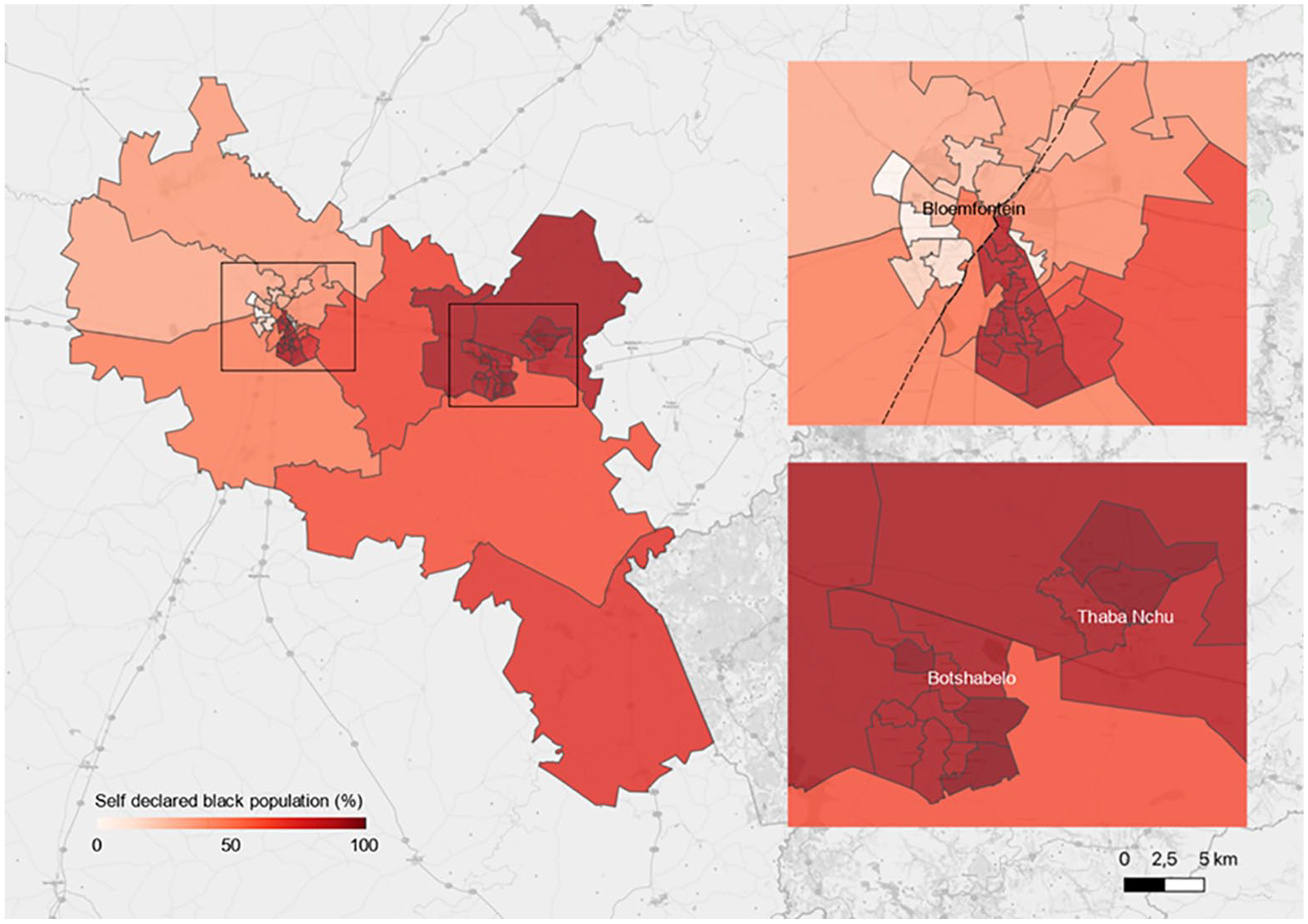
Mangaung Metropolitan Municipality Map According to Racial Distribution, Highlighting Bloemfontein (Top Right) and Botshabelo and Thaba Nchu (Bottom Right).
Spatializing the racial distribution of the population at MMM shows discrepancies in accessing the house market, highlighting how complex socioeconomic dynamics intersected with the increase of intra-racial inequalities. To a large extent, the demographic change was motivated by the suburbanization of the White population, especially in larger cities (Christopher 2005; Kotze and Donaldson 1998). While a new Black elite has strived to move to formerly White higher-middle class areas, in search of better infrastructure and social services (Christopher 2005), the emergent Black middle class continues to have limited opportunities in the real state market. Decisions regarding housing mobility are made based on limited resources and strategically striving for the best economic value from their investiment (Rex and Visser 2009).
Furthermore, desegregation has been higher in land with lower market value, often close to former townships (Rex, Campbell, and Visser 2014). These areas remain underserved by infrastructure and social welfare, as the state continues to leave apartheid’s spatial legacy intact. The eastern part of Bloemfontein, Botshabelo, and Thaba Nchu are still densely occupied by the Black population, while the western part of Bloemfontein still houses the White population, following the racial segregation established at the beginning of the twentieth century. These data suggest limited deracialization, that is, a demographic shift with a marginal spatial inclusion and little social impact for those moving in (Saff 1994).
RDP (Reconstruction and Development Programme) had an initial ambition to define “a path of radical deracialization and social development” (Wolpe 1995:99) through a developmental approach. The state was responsible for providing basic infrastructure and services to an increasingly urban population and a plan for integrated cities, towns, and rural areas while promoting local economic development (Todes and Harrison 2004). Spatial planning was broadened to include economic and social development, and planners assumed a pivotal role in initiating development (Harrison et al. 2008; Todes and Harrison 2004).
Despite such intentions, RDP did not “explore a radical reformulation of property relations” (Wolpe 1995:101). 11 The government recommodified rented units and assumed self-help as an official policy, leading to increased informal housing like backyard rentals (Mabin 2020). In the following years, it assumed a supply-side approach, arguing that RDP
“functioned not as a development framework, but as an aggregation of social policies designed to alleviate poverty without affecting the complex economic policies and practices that reproduce poverty and inequality” (Cheru 2001:507).
In 1996, the GEAR (Growth, Employment and Redistribution) report advocated for an outward-oriented economy to respond to global market pressures: redistribution through growth (Peet 2002, original emphasis). Influenced by the liberal think tank Urban Foundation, bankers and developers steered the housing provision process, with sites-and-services and credit schemes available at market-based rate (Cheru 2001; Christopher 2005).
The first large-scale informal settlement upgrade scheme in South Africa took place in Freedom Square and Namibia, in Mangaung, with a gradual process of infrastructure delivery (settlement upgrading, 1992–1994), subsidy for housing (1995–1999), and provision of 24 square meters houses mediated by a contractor (1998). In total, 4,000 plots were made available in the area (Marais and Ntema 2013). Steered by a neoliberal underpinning, the project had drawbacks, including the fixed amount of subsidy, which resulted in small plots and little flexibility in the development process (Marais and Ntema 2013).
Launched in 2004, The Breaking New Ground (BNG) program continued the mass provision of housing in the country, and in nearly 20 years more than 2.7 million RDP/BNG houses have been built, accommodating one in five South Africans (Turok and Borel-Saladin 2014). The program is highly criticized for its discourses on poverty eradication, the reduction of vulnerability, and the promotion of social inclusion, which have been used as arguments to justify displacement and the “eradication” and “elimination” of informality (Huchzermeyer 2009). Furthermore, RDP/BNG housing schemes are criticized by their quantitative focus, inability to respond to local conditions, and failure to deliver low-cost housing in urban centers, thus producing dormitory settlements far from amenities and jobs, which are low-paying (Harrison and Todes 2015; Turok and Borel-Saladin 2014; Turok and Scheba 2019). Lastly, this strategy represents “asset-based welfare” (Litheko et al. 2019), which presupposes access to residential property as a means of inclusion: those previously excluded from the market can benefit from subsidies to accumulate assets and create wealth, climb the housing ownership ladder, and thereby escape poverty.
Nevertheless, wealth accumulation through property value increase, while a necessary mechanism in the asset-based welfare system, is not feasible in a dysfunctional housing market where access to existing housing stock is limited to properties with little market value and which are difficult to be traded up (Marais et al. 2020) 12 ; or which housing backlog is still high. In MMM, the backlog is estimated at 31,200 (11 percent) housing units (Mangaung Metropolitan Municipality 2017). Housing subsidies to the local government have been inconsistent and unevenly distributed in MMM so that no long-term plan could be established. Due to land costs, the local government struggles to provide housing in the central areas, and the repurposing of apartheid buffer zones was not enough to avoid an eastward sprawl of formal and informal housing. Perpetuating the racial lines observed during apartheid, today 65 percent of new housing is still built on the peripheries (Figure 2). The logic of land scarcity remains, where the expropriation of vacant private land (especially in the former White areas) or urban reform is not even considered, given their economic costs.
Even when desegregation happens through the real estate market, it unevenly concentrates in the south-eastern part of Bloemfontein, where plots are smaller and have a lower market value (Rex and Visser 2009). In a recent study, Marais, Hoekstra, et al. (2018) looked at residential mobility of the Black middle class to argue that of 401 housing states investigated, 75 percent of ownership is still located within former Black townships and only 15 percent in formerly White suburbs (desegregated in the 1990s). Furthermore, a series of recent evictions in regions such as Lourier Park, one of the most desegregated areas in the municipality (Rex et al. 2014), beyond underscoring discontent among the population (Heerden 2020; Setena 2020), point to how the asset-based welfare model, built on the premise of climbing the property ladder without challenging White ownership, continues to marginalize most Black individuals (Marais et al. 2020). The Black middle class, which has ascended through property acquisition, remains economically vulnerable—at “one paycheck from poverty” (Zizzamia et al. 2016 in Friedman 2019).
Acknowledging racial inequality through slow-paced backlogged housing policy does not challenge apartheid-era spatiality, especially when the state avoids confronting how apartheid denied a Black urbanization altogether, implicitly rejecting cities as Black spaces (Parnell and Crankshaw 2013). Such a denial is made patent by its refusal to propose urban reform (Huchzermeyer et al. 2019). Instead, a de facto approach promoting the “elimination” of informal settlements, However, the actual approach, still impregnated with the idea that “formal” equals “development”, continues to promote the “elimination” of informal settlements, remains. Such a framework still assigns “blame for the exclusion of the poor from their rights as citizens on the poor themselves” and justifies evictions and relocations to substandard “formal” housing (Bradlow, Bolnick, and Shearing 2011:267). While South African planning legislation acknowledges its racialized past, it rids itself of guilt by structuring its actions on a class-based approach. Such an approach, assumes that spatial desegregation will follow a socioeconomic framework shift built on asset-based welfare, thus rendering the Black middle class in a precarious position on the property ladder and condemning a large part of the population to remain at the urban margins.
Contexts In Relations: Concluding Remarks on the Role of Urban Planning For Racial Capitalism
We put South African and Brazilian experiences in relation, highlighting the bottlenecks of “progressive” planning to address the racialization of urban spaces as part of broader trends, particularly those tied to the entwinement of racial capitalism and urbanization. We do it, firstly, by underscoring the limited (albeit essential) role of recognizing the legacy of racial segregation in the postcolony and, secondly, by reinforcing the role of property for the reproduction of the Black dispossession/White privilege continuum. Two main questions guide those reflections: (1) Is recognizing the legacy of racial segregation enough? (2) Which are the persistent racial traits of the property regime in such a context?
The changing legislative framework in South Africa since the end of apartheid insists on a nonracial democracy, highlighting the legacy of apartheid in defining the lingering inequalities in the country. Nevertheless, such a legacy was only considered as a departing point: race was acknowledged, and a nonracial democracy, where everyone is equal, became a desired outcome. RDP aimed for a “fundamental transformation” that entailed eliminating racial and gender inequalities, eradicating poverty, and deracializing the economy (Wolpe 1995). The program failed to provide a framework where such deep transformations were possible. Making concessions to previous economic policy, RDP continued to be driven by a capitalist view of development (measured by GDP), which subscribes to specific forms of capitalist reproduction even if not openly abiding by racial lines. It unsuccessfully sought redistribution through economic growth, creating a precarious Black middle class and exacerbating class inequalities within the Black population. Recognizing the country’s open racist history is insufficient if the inherited political, juridical, and institutional structures—both product and structure of modernity, and therefore, inherently racist—are left untouched.
Contrarily, the Brazilian legislative framework does not challenge the racial democracy myth, framing “urban” and “social” problems from a socioeconomic perspective. By evading the discussion of racial-urban inequality and neglecting the legacy of racial spatial formation, race is placed outside urban planning concerns and, thus, planners are not confronted with the need to pursue an active deracialization of the unequal production of Brazilian cities. Poverty alleviation strategies based on massive investment in urban development guaranteed profits to the groups already inserted in the logic of the market, be it the owners, the capital agents themselves, or developers. This process is naturalized by capitalist formulation of development, regardless of how the majority of the Black population is impacted by the large-scale urbanization projects. Their uneven (racial) results perpetuate the segregation of the Black population in marginalized, under-serviced areas of the city.
Focusing now on the property regime, if we follow the land, we can underscore continuities in patterns of racial segregation production for the benefit of racial capitalism. Capitalism needs the stability of contractual and property relations to thrive. The racialized property regime in place in both cities aimed, from their onset, to support the interests of White elites and also control the production and reproduction of relations within a racialized labor force and exclusive access to property. Its consequences are still present in the unequal land access between Whites and Blacks, echoing Harris’s (1993) remarks that “the interaction between conceptions of race and property [. . .] played a critical role in establishing and maintaining racial and economic subordination” (p. 1711).
In both cases, urban space and its uneven racialized property regime have been left at the service of financial capital to profit through urbanization. After all, urbanization is a major motor of racial capitalism, which depends on racist governmentalities to serve the purposes of racial capital. The public investment in majority-Black neighborhoods, which is highly needed, does little to challenge the historical investment in White property and White access to the city and its benefits, including the benefit to profit from land speculation and development schemes. Informal settlement upgrading schemes or social housing schemes do not confront the fact that the White population continues to enjoy elevated levels of “residential exclusivity” (Christopher 2005), and self-segregated spaces remain uncontested and even desired today. Such segregation also marks a division of access to social welfare and urban infrastructure. The relocation of the population to social housing and plots they own title deeds for only includes them at the margins of the property market, trapping the Black population into a system they cannot escape (Marais, Hoekstra, et al. 2018).
White property is still protected by the legal regime and planning practices in Belo Horizonte through a double-standard for tenure/property compensation and implementation of City Statute regulations. In MMM, its protection is guaranteed through the limited and uneven market-led desegregation in the past decades that limits the opportunity of Black ownership. This outcome is also the result of the relationship between racialization and the production of “valued spaces” in racial capitalism, as White spaces are still perceived as more desirable and valuable than undervalued Black spaces. Those logics are forming the basis for planning practices and choices.
For studies on urban sociology committed to social justice, the cases discussed here also illustrate what Chakravartty and da Silva (2012) concluded when they argued that “the targeting of ‘othered’ populations can hardly bring about radical social or global justice” (p. 381). This conclusion relates to how modern logics constantly reproduce racial difference for the working of capitalism. Planning innocence, in this sense, is one facet of modernity that updates emplaced racial difference by reproducing race-based value. In this manner, even progressive policies perpetuate the spatial precarity of Blackness while reinforcing Whiteness’s rightful gains in urbanization.
To conclude, we argue that racialized spatial segregation in the postcolony is a result of planning and public investment and not the lack of them. Hence, placing the solution to urban inequality on urban planning without challenging its role in promoting and organizing value-differentiation through racial segregation will hardly change the racially unequal access to urban resources and social welfare or the unequal distribution of public investment.
We suggest that planning as a field in general, but specially planning policies and practices in particular, must denude itself from its innocence to grapple with its own contribution to the lingering of “racial states.” And while racial conception is relational, and institutional arrangements are deeply local, we agree with Goldberg (2014:1273) that “local resonances nevertheless are almost always tied to extra- and trans-territorial conceptions and expressions, those that circulate in wider circles of meaning and practice.” As such, this article hopes to contribute to transdisciplinary approaches to critical studies on race and space that explore racial capitalism as a framework and further critical work that centers the postcolony.
Footnotes
Acknowledgements
Both authors contributed equally to this article. We thank the reviewers, the editor of City & Community, and the editors of this special issue, whose commitment and generosity throughout the peer review process were essential for the development of the final version of this article.
Funding
The author(s) disclosed receipt of the following financial support for the research, authorship, and/or publication of this article: The authors are funded by different sources. The work of Luana Xavier Pinto Coelho is funded by the European Research Council (ERC) under the European Union’s Horizon 2020 research and innovation program (grant agreement No. ERC-2016-COG-725402), research project POLITICS—The politics of anti-racism in Europe and Latin America: knowledge production, political decision-making and collective struggles. Lorena Melgaço’s work was funded by the Institute for Urban research at Malmö University. Currently, she is an associate senior lecturer at the Department of Human Geography at Lund University.
