



Abstract
We are today increasingly experiencing the city through interfaces of platforms like Google Maps, Instagram, TripAdvisor, Airbnb, and Yelp. As our very sense of the city is shaped by these technological interfaces, the media are acquiring a constitutive role in reshaping contemporary urbanity. To conceptualize how media represent urban change, this paper draws on media studies and particularly the concept of “mediatization.” The paper studies the changing media representations of the gentrification of Rio de Janeiro’s favela Vidigal over fifteen years across different media. Using computational methods and interpretative analysis, we find that global media representations represented Vidigal as a site for adventure and investment. However, the media representations are far from monolithic. At one moment, they mobilize cosmopolitan fascination with the “other,” promoting slum tourism gentrification. At the next, they amplify critiques of gentrification and local protests against displacement. We argue that media representations are driven by their own variegated forces and cultures, which are increasingly coming to shape the dynamics of urban imaginaries.
Today we increasingly know and navigate the city through the interfaces of digital platforms like Google Maps, Facebook, Instagram, TripAdvisor, and Airbnb, whose sophisticated algorithms help us pursue our daily desires—finding a place for coffee, a park for a walk, or a bed for the night. Through this mediation, these platforms have profound effects on the city at large: their representations reshape urban phenomena, shifting flows of visitors, coloring our imaginaries of place, and deciding which communities will have their voices heard. While the role of the media in shaping the urban experience has long been of interest to urban scholars—including key figures like Walter Benjamin and Henri Lefebvre—this growing and deepening role of the media challenges conventional understandings of where the city is situated and how it is constituted (Brown-Saracino and Rumpf 2011; Jansson 2019). In response, a proliferating body of work addresses the imbrication of the city and the media, examining, inter alia, how the public realm is produced across the city and the media (McQuire 2017; Rodgers, Barnett, and Cochrane 2009), how places and networks are redefined through the use of social media and mobile phone applications (Halegoua 2020; Lane 2018), and how social media reflect and reinforce urban inequality (Boy and Uitermark 2017; Zukin et al. 2017).
Media representations and the spatial imaginaries they produce play an important role in steering both financial and tourism flows (e.g., Harvey 2012:140), and understanding their dynamics is thus important in studying urban phenomena (Krajina and Stevenson 2019). Urban studies has traditionally conceptualized media representations as simply reflecting the interests of urban elites—seeking to support growth and gentrification (e.g., Logan and Molotch 1987: 70). This notion has, however, come under criticism, as studies of news articles have found media representations more variegated and complex than such a monolithic conceptualization would suggest (Brown-Saracino and Rumpf 2011). This has, however, left open the central question of how media’s role in urban phenomena should be conceptualized, and what forces and interests shape media representations.
To deepen the understanding of the dynamics of representations of urban place, this paper draws on media studies to conceptualize the role of media in contemporary urbanity. While urban scholars have tended to think of media as an external force acting on the city, we adapt the media studies concept of “mediatization” to the urban context (Couldry and Hepp 2018), emphasizing media as co-constitutive of urbanity—part of the very elements and building-blocks from which urban place is produced. This does not mean that the city is only its representations, but that the media is one site, or rather a collection of sites, where the city is constituted.
Drawing on this media studies approach and perspective, the paper examines media representations of the gentrification of Vidigal, a favela located in central Rio de Janeiro. We note from the outset that we do not study Vidigal on the ground or what is conventionally understood as “the place itself.” Such research is for good reason the mainstay of urban studies. Here we study how Vidigal is constituted in media representations. We follow media studies’ emphasis on the need to study representations across media platforms, focusing on YouTube, Airbnb, Flickr, and traditional newspapers (cf. Rogers 2017). Although we cannot establish the exact impact of media representations on the ground, which would be challenging considering the wide range of forces shaping neighborhood dynamics, we are able to examine in which direction these media representations push (cf. Bronsvoort and Uitermark 2021). Some media representations present Vidigal as a dangerous place to be avoided, others promote it as a site for investment, while yet others give voice to residents. We empirically examine how gentrification in Vidigal is represented and seek to explain variation across different media platforms.
Using computational methods and interpretative analysis (Törnberg and Uitermark 2021b), we find a neighborhood that travels in the global urban imaginary through media representations. We thus argue that understanding mediatization contributes to literature on planetary gentrification—in which gentrification is disassociated from the context of deindustrialization and working-class displacement in the Global North in favor of a broadening understanding in terms of global flows and local urban restructuring (Butler 2007; Sigler and Wachsmuth 2015). Mediatization tilts power balances over place and destabilizes existing land-use arrangement by allowing urban place to be experienced and consumed at a distance. Platforms like Google Maps, Airbnb, and TripAdvisor help globalize consumption by allowing cosmopolitan consumers to navigate unfamiliar urban spaces and window-shop for places in distant cities, thereby facilitating mediatized forms of global gentrification that have yet to be explored in the literature. The representations of Vidigal are, however, far from monolithic: while Vidigal’s representations may at one moment fit global middle-class imaginaries of authentic and picturesque urban place, they may at the next amplify critiques of gentrification and local protests against displacement. These representations do not simply reflect realities on the ground but are shaped by the logic of media platforms through which they circulate; depending on their audiences, technological affordances, and financial interests, media platforms represent realities, and places, in particular ways. This suggests that mediatization means that urban phenomena can become implicated in a complex media ecosystem of platforms operating under different logics, which come to impact the making of urban place. This serves as a call for further studies of media representations, and in particular their potential influence on gentrification and urban change.
Mediatization and Gentrification
Media representations are endemic to urban neighborhoods. For instance, residents might share images through social media and talk about newspaper articles, while politicians might base their policy decision on what they see on the evening news. Occasionally, the media dimension of a neighborhood becomes intensified, such as when a neighborhood is hyped in lifestyle magazines, becomes a site for protests, or figures in sensationalist reports on crime or corruption. Understood in this way, the changing nature and intensity of media representations profoundly affects a place’s power geometry (Massey 1993). Groups are positioned in different ways in relation to these representational flows: sometimes they produce representations in pursuit of an objective (a real estate agent propping up the image of the neighborhood to sell properties), sometimes they are subject to them (as when a population is stigmatized in sensationalist reporting), and sometimes they are ignored altogether. As these definitions and examples suggest, the role of media representations and their impacts vary over time and across space.
It has long been recognized that the media fulfill an important role in urban phenomena in general, and gentrification in particular (Brown-Saracino and Rumpf 2011; Gin and Taylor 2010; Jansson 2005; Lane 2018; Slater 2006; Zukin et al. 2009). Zukin (1989, 1996) showed how lifestyle magazines and local newspapers mark centrally located, stigmatized neighborhoods as “up and coming,” effectively guiding investors toward them. Smith (2005), likewise, considered the role of the media in propelling a discourse of gentrifiers as bold pioneers traversing the urban frontier. More recently, Zukin et al. (2017) examined how online restaurant reviews picture traditional Polish restaurants in predominantly white neighborhoods as authentic and cozy, while associating predominantly Black neighborhoods with dirt and danger.
While urban studies has recognized the media as “important actors in promoting gentrification” (Wilson and Mueller 2004:282), the media rarely receives sustained interest. Detailed research showing variation of representation across media platforms, between places, or over time is largely lacking (Collins 2020; Jansson 2019). This is perhaps because it is assumed, as Croteau and Hoynes (2006:24) write, that media “tend to reflect the views and interests of those with wealth and power.” This assumption goes back to the literature on urban growth machines, with Logan and Molotch (1987:70) arguing that the “newspaper has no ax to grind except the one that holds the community elite together: growth.” While there are a few media analyses of ongoing gentrification processes (Brown-Saracino and Rumpf 2011; Gin and Taylor 2010), urban studies largely posits that the media, and especially local newspapers, play an important but rather predictable role as cheerleaders of gentrification. This urban studies understanding of media has been criticized for being rudimentary and oversimplified (Brown-Saracino and Rumpf 2011). This problematic conception is growing increasingly problematic, as our experiences of and interactions with the city are more and more becoming mediated by digital platforms. To move beyond this traditional urban studies understanding of media, we turn to media studies and develop the notion of urban mediatization.
Urban Mediatization
Media studies tends to view social reality as inherently mediated: reality is rendered—filtered and construed—through power-laden representations rather than simply captured (Couldry and Hepp 2018). This is contained in the concept of mediatization, which emphasizes the media as having a deeper role in transforming the social world. Mediatization means that “the very elements and building-blocks from which a sense of the social is constructed become themselves based in technologically based processes of mediation” (Couldry and Hepp 2018:7). Adapting this concept to the context of cities, this means that the urban resides, in part, in the media. Mediatization of a place means that media representations of that place multiply and become more tightly interwoven with its everyday life, changing both the stakes of local politics and the range of actors involved (Uitermark and Gielen 2010). The spatial practices associated with digital media—checking in, posting stories, taking selfies, searching and receiving suggestions for places and services, a bed for the night or the closest park for a stroll—blur, if not completely erase, the line between the spatial and the digital (Gordon and de Souza e Silva 2011; M. Graham and Zook 2013). These media enable and mediate social encounters, allow us to see and navigate unfamiliar places, and augment everything from sightseeing and shopping to protesting and dating. Digital interfaces transform the “social production of space and the spatial production of society” (Sutko and de Souza e Silva 2011:812), thereby generating new spatialities (Gordon and de Souza e Silva 2011; M. Graham 2013; M. Graham and Zook 2013; S. D. N. Graham 2005; Leszczynski 2015). Just as Couldry and Hepp (2018) note that the imbrication of online environments and everyday life means “that the construction of everyday reality has itself become subject to major new disturbance and conflict” (p. 24), so does urban mediatization destabilize place by creating new fields in which conflicts over the construction of place may play out. It thus increase the possibility that local conflicts scale up while distant conflicts are brought home.
This perspective stands in stark contrast to the traditional urban studies view of the media as being defined by the singular pursuit of the interests of those in power, highlighting precisely the heterogeneity of media. Each media platform pursues certain strategies and discourses, shaped by its particular figurations of technologies, economies, and cultures (Couldry and Hepp 2018). For instance, traditional news media frame and present reality in a certain way to draw and maintain the viewer’s attention: presenting the world as a continuous flow of events, with the focus on topics waxing and waning and exhibited in such a way so as to maximize viewer interest. As Galtung and Ruge (1965) argue, events that are likely to receive attention from the news media are negative and intense, sudden and unexpected, yet still familiar and meaningful for the target audience. The event should further be easy to interpret, and possible to personalize, preferably through celebrities.
These classic media logics shift in important ways with the advent of digitization and the rise of social media (Harcup and O’Neill 2001, 2017; Phillips 2012; van Dijck et al. 2013). One effect is that the competition for attention has intensified, creating further emphasis on stories that are loud, conflictual, shocking, and engaging (Goldhaber 1997; Marwick 2015). Studies have shown that negative messages tend to be more engaging than positive ones, which creates a bias for outrage and anger, in particular in relation to known personalities (Berry and Sobieraj 2013; Crockett 2017). Another effect of the rise of social media, and more specifically the consolidation of global platforms, is that media representations now flow more easily across local and national borders. A third effect is that media representations become more personalized: social media revolve around self-presentation and encourage users to interpret and represent the world through their specific experiences and viewpoints (Hearn 2008; Marwick 2013). Since social media posts are appraised by other users through comments and likes, they are often designed to elicit admiration or sympathy.
Spurred by digitization and the rise of social media, the ecology of media platforms has grown larger and more complex. The various platforms operate under different logics, but are closely connected, together enabling an “interlinked ecology of platform-based message circulation” (Couldry and Hepp 2018:65). From a media studies perspective, “the media” are far from the monolithic actor described in gentrification research, which implies the need for careful dissection in order to understand their variegated and occasionally contradictory dynamics (Bratton 2016; Rogers 2013). Some media will be characterized almost exclusively by commodification (e.g., Airbnb), while others take a strong interest in conflict (e.g., newspapers), and yet other media are more ambiguous (e.g., Flickr).
A media text—whether a photo on Flickr, a tweet, an Airbnb review, or a newspaper headline—represents the moment when a particular set of power relationships becomes crystallized onto a particular technological surface (Iqani 2016). Studying a text—what meanings it privileges, what it brings up and leaves out, what relationships it imagines, and what world it envisions—can therefore allow us to gain insight into the social imagination it helps to produce, thus revealing how power relationships co-construct the narratives that become dominant in global media cultures (Massey 1993). These relationships of power operate on multiple levels: both on the microlevel of each text and also across discourses, through contestation and counter-discourses in an increasingly global media culture (Machin and Van Leeuwen 2007).
In sum, it is widely recognized that media representations play an important role in gentrification, shaping spatial imaginaries which are central in attracting both financial and tourism flows (e.g., Harvey 2012: 140). Digitalization has further expanded the role of media in urban processes, making media part of the very social production of space and the spatial production of society (Sutko and de Souza e Silva 2011). Urban studies has traditionally understood media representations as reflecting the interests of urban elites, seeking to commodify place and support gentrification (Logan and Molotch 1987: 70). This conceptualization has, however, come under criticism: studying news articles, Brown-Saracino and Rumpf (2011) find that media representations of gentrification are variegated and complex, contradicting urban studies’ traditional monolithic conception. But while Brown-Saracino and Rumpf criticize the idea that media simply reflects the interests of capital, they do not propose an answer to the question of what interests and biases do shape media representations, but instead call for further research on media representations of gentrification. Scholars within media studies, however, seek to answer precisely the question of the forces shaping media representation (Couldry and Hepp 2018). In contrast to the traditional urban studies perspective, media studies emphasizes the diverse nature of the forces and interests that shape media representations, with media being characterized by variegated cultures and interests—in particular following the emergence of digital media (Rogers 2017). While media studies has a richer conceptualization of the forces of media representations, it does not examine these forces in relation to the production of urban place.
In this paper, we therefore seek to answer Brown-Saracino and Rumpf’s (2011) call for additional research on media representations of gentrification by following media studies’ emphasis on the need to study representations across platforms. It is through this lens that we study media representations of the Rio de Janeiro favela Vidigal. Three questions guide our analysis. First, we ask how the neighborhood is represented over time. Second, we ask, more specifically, how the gentrification of Vidigal was portrayed and whether it was promoted or criticized. While we cannot establish a causal link between media representations and changes on the ground, we can examine how Vidigal is construed in media representations and consider what sort of neighborhood changes such representations prefigure and promote. A third question is how we can explain differences over time and, especially, across different media platforms. By answering these questions, we address the broader theme of how transnational representational flows construe, and thereby shape, urban change.
Case, Data and Methods
Vidigal: Rent-Gaps and Quasi-Military Occupation
The media discourses through which Vidigal is imagined and represented are produced and interpreted against the background of the social, economic, and historical context in which Vidigal’s gentrification process is situated. The history of Rio’s favelas can be traced back to slavery, as favelas were often constructed as temporary homes by freed slaves who needed to live close—but not too close—to the white settlers’ neighborhoods they were expected to service (Iqani 2016). Over time, as rural migrants moving to the city settled in those same areas, favelas grew in size and became more permanent and formalized (Perlman 2010). The predominant poverty in favelas started to be associated with crime as Rio de Janeiro became a jump-off point for cocaine trafficking to Europe in the 1980s. Since then, the military has continually carried out “security campaigns” within and against the neighborhoods, which have remained separated from the rest of the city, both physically and symbolically.
During Brazil’s economic boom between 2003 and 2013, the country was one of the fastest-growing economies in the world, owing in part to the commodity super-cycle of the mid-2000s, but also to the 2008 financial crisis causing global liquidity to surge into emerging markets. This boom ended as commodity prices decreased in 2011, seeing destabilization of the national currency and the beginning of the country’s longest recession to date. The growth in Brazil and Rio during the boom years generated mounting economic pressure for action toward Rio’s favelas, as the potential profits locked into their land became increasingly enticing for real estate capital. Rio de Janeiro is characterized by an extraordinarily close proximity between wealthy and poor residents, with many favelas situated in prime locations. Vidigal, for instance, is close both to upscale Leblon and some of the city’s most attractive beaches (Godfrey and Arguinzoni 2012). More than 20 percent of Rio’s inhabitants live in one of its approximately 750 favelas, but in the city center, this ratio is significantly higher—over 40 percent (Janoschka and Sequera 2016:1185). As Rio’s economy grew, the discrepancy between the potential and actual ground rent—what gentrification researchers call a “rent gap” (Smith 1987)—increased, intensifying economic pressures to redevelop the favelas.
The state took such an active role in this process that Rio’s favelas are held up in the gentrification literature as “a unique case of a strategically planned and assembled long-term reconfiguration of urbanity” (Janoschka and Sequera 2016:1184). This state-led urban reconfiguration was organized in large part through a series of globalizing mega-events (Broudehoux and Sánchez 2015; Pauschinger 2017; Roche 1994)—the 2014 FIFA World Cup and 2016 Summer Olympics being the foremost—that functioned as mechanisms for sustaining a continuous “state of exception” (Broudehoux and Sánchez 2015) that created legitimacy for aggressive state action and redevelopment.
The state has pursued different strategies to take control over its central favelas (Janoschka and Sequera 2016), including their “pacification” by the paramilitary Pacification Police Units (UPPs) that, since 2008, have dismantled the control of drug gangs over several favelas through quasi-military occupation (Janoschka and Sequera 2016). In pacified favelas, police forces perpetrate severe violence, with approximately 1,000 favela inhabitants shot by police every year. In addition to pushing back gangs, pacification opens the favelas up for redevelopment and investment by formalizing housing contracts, as well as municipal and private services. When such services become regulated and thus must be paid for, both property values and the cost-of-living increase substantially, resulting in displacement pressure on poorer residents.
This background captures the supply-side context of Vidigal’s gentrification process. However, a rent-gap is also dependent on a corresponding demand-side (Clark 1992). In its standard formulation, the rent-gap is understood as responding to demand for housing coming from relatively wealthy residents drawn from elsewhere within the city-region (Sigler and Wachsmuth 2015). In this case, however, the demand was to a large extent global (Gotham 2005, 2018) and, we argue, enabled by media representations of Vidigal that promoted it as a site for adventure and investment. Vidigal is a favela located in the Zona Sul, seen from Ipanema beach climbing up the iconic mountain top duo of Dois Irmãos, looking out over the Atlantic Ocean. The latest official census suggests that Vidigal is home to 12,797 residents (IBGE 2010), but the actual number is likely significantly higher. Vidigal borders the rich Leblon to the east, São Conrado to the west, and on the other side of the mountain to the north lie Gávea and Rio’s biggest favela, Rocinha. While Vidigal is only about a tenth of the size of Rocinha, it stands out as one of Rio’s favelas most subject to media attention. This media focus, combined with its centrality in discussions around favela gentrification, motivates our choice of Vidigal for this study.
Studying Representations of Vidigal
The study employs a cross-media content analysis to examine how the gentrification of Vidigal was portrayed across different platforms. One criterion for our selection of sources was diversity, with the inclusion of very different kinds of media to capture the differences in their representation of the same place (van Dijck et al. 2013). Another criterion was practical: we needed sources that go back at least ten years in order to include representations from before pacification (2011), during gentrification (2011-2018), and after gentrification (2019-2020). We thus arrived at four data sources: Traditional newspapers—We downloaded all available international news articles mentioning the keywords “Vidigal” and “Rio” from the news database Lexis Uni. This resulted in 880 news articles, spanning roughly 1,885 pages. YouTube—Using custom-made web scrapers, we downloaded all YouTube videos resulting from a search for “Vidigal,” together with their text descriptions and associated comments. After filtering out non-relevant results, this came to 514 videos from 2009 to 2020. Airbnb—Using InsideAirbnb (Cox 2015), we downloaded all Airbnb listings and reviews in Vidigal, as well as the rest of Rio de Janeiro for comparison. This data includes 160 listings in Vidigal, with a total of 1,777 reviews. Flickr—Again using custom-made web scrapers, we downloaded all photographs geotagged in and around Vidigal from the photo-sharing platform Flickr. While in recent years Flickr’s reach and popularity have been significantly smaller than platforms like Instagram, it has the benefit of spanning a longer time-period (from 2004 to 2020) and allowing complete data-gathering back in time based on geotags. This scraping resulted in 1,531 photographs with associated descriptions.
While we collected and processed these data with computational methods, our analysis is mostly interpretative, supplemented and aided by quantitative measures. For the newspapers, we read and coded all the articles. For Airbnb material, we read all the listing descriptions, as well as a sample of 20 percent of the reviews. For YouTube, we read and manually coded the videos’ titles and descriptions (viewing them only when the text data did not provide sufficient information). Flickr photographs were analyzed using the Google Vision API, which automatically labels photographs according to their content.
The analysis of all media was carried out through content analysis, reading all the material and inductively identified themes. This resulted in specific themes that characterize the ways the neighborhood is represented: tourist destination, poverty story, crime report, military occupation, human-interest story, celebrity visit, negative impact of gentrification, photograph-of-the-day, social problem report, positive impact of investments, and investment opportunity. In addition to this, and building on the identified themes, the articles were also classified into one of three categories: poverty/violence, which are characterized by stories about Vidigal as an undesirable place of poverty, crime and violence, as well as of military and police interventions; pro-gentrification, which highlights Vidigal as a sound real estate investment, or a desirable destination for adventure and tourism; and gentrification-critical, which describes negative impacts of tourism and gentrification for long-term residents. This approach allows a nuanced view of how the neighborhood was discussed, while also giving easily quantifiable measures of the articles’ positions in relation to gentrification.
The primary way in which we employ the data is by telling the story of the Vidigal favela as seen through its media representations. This story is illustrated by examples as well as a number of figures. To show the shifting distribution of media activity in and around the favela, we create heatmaps of activity by using the geolocation of Flickr photographs and of Airbnb reviews. We use alluvial charts to capture different themes in news reports as well as in photographs on Flickr.
We did not require the use of any translation service, since the articles and data sources were all in languages spoken by the authors. If not otherwise stated, translations in the article are made by the authors. For figures, maps, and calculations, we used Python and MongoDB. This allowed us, for instance, to track the number of Airbnb listings and produce an attention map showing where photographs on Flickr were taken.
As we stressed above, our study focuses solely on the media representation of Vidigal. While the first author did visit the neighborhood and talked to local residents and researchers, this was to provide background to the focus of study: Vidigal as a media phenomenon. We do not gauge whether these representations are accurate but examine how they construe Vidigal and what kind of changes they promote or criticize.
The Rise and Fall of Vidigal’s Mediatized Gentrification
Vidigal entered the spotlight of the global imagination as a desirable object of consumption around 2011, following its pacification (see Figure 1). Around 2015, this gentrification boom gradually turned into a bust, with articles focusing on criticism of gentrification. After 2017, the global media largely lost interest in the neighborhood. In the following section, we trace and describe media representations of Vidigal through its boom-and-bust cycle. This section examines these periods in turn to answer our three questions and infer broader implications with respect to urban mediatization.
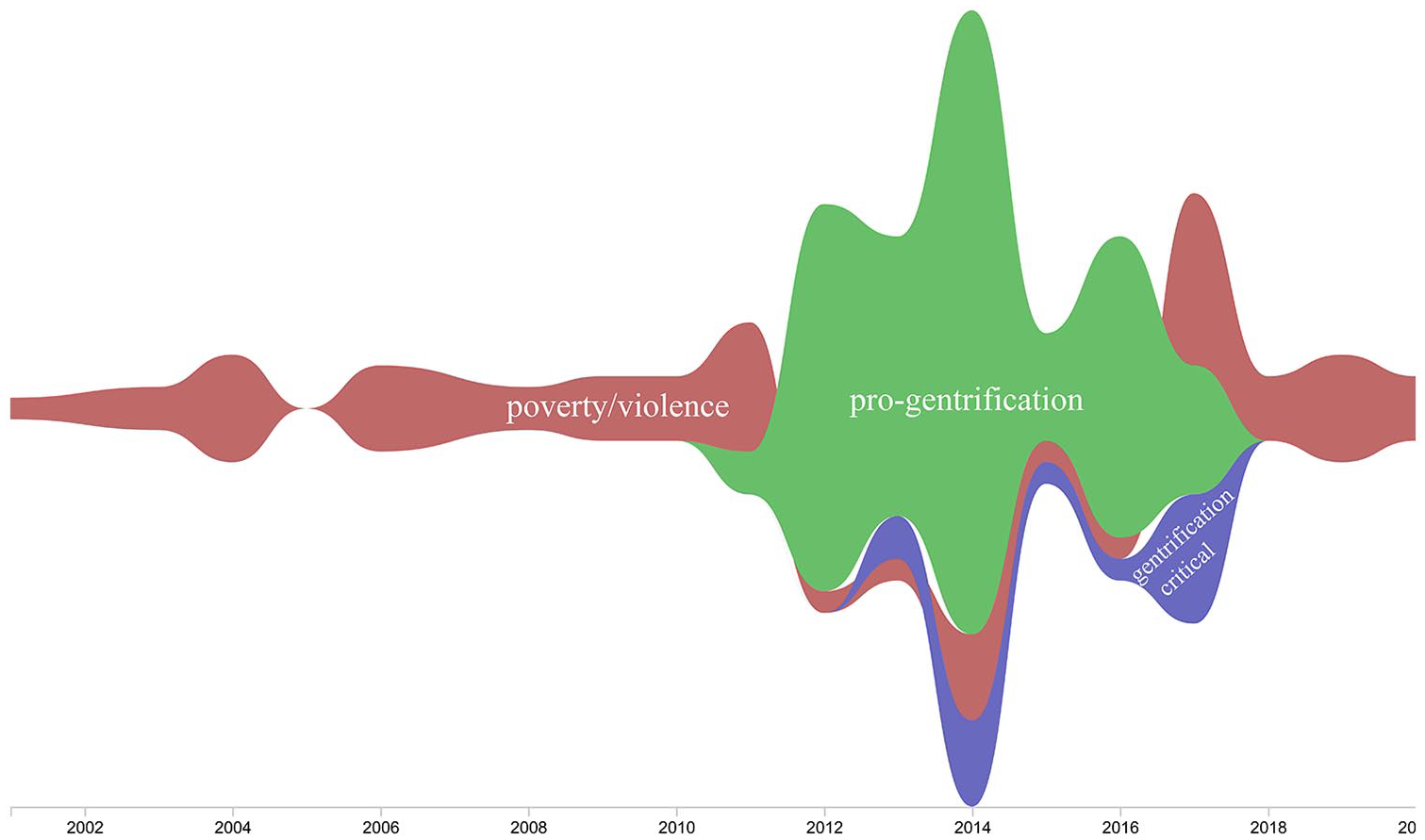
This figure shows the frequency of the coding of news stories over time.
The Gentrification Boom
The idea of the “favela” made its international debut in the global imaginary with the 2002 movie City of God, which brought “global circulation of the favela as a trademark” (Freire-Medeiros 2009:581). The imagined favela that became a global symbolic commodity is a place of violence and struggle; a fascinating place, but one best admired from a safe distance. Prior to the pacification of Vidigal, there was limited media attention to Vidigal outside of occasional reports of drug violence and killings. Photographs on Flickr during this period are almost exclusively taken outside the favela, centering on the nearby Sheraton Hotel and the beach, or capturing the favela through the safety of a zoom-lens.
This media representation shifted quickly and profoundly following Vidigal’s pacification. As Figure 2 shows, these photos focus not only on the Vidigal beach, but also on tourism, graffiti, and street life. Figure 3 shows that photographers on Flickr began to enter into the favela rather than capturing it from the outside. Their attention is focused on a number of hotspots—the foremost being the hostel Alto Vidigal. This hostel was founded by Austrian-born Andreas Wieland, at the top of Vidigal’s hill, with an impressive view over the favela and the city. Alto Vidigal started hosting parties that became an attraction not only for tourists, Brazilians, and expatriates from outside the community, but also for many Vidigal residents. These parties replaced Vidigal’s bailes funk, 1 which were shut down by authorities after the pacification, resulting in Alto Vidigal becoming the new center-point of the favela’s increasingly trendy nightlife. Alto Vidigal was also the first expression of larger-scale real estate speculation in a favela, initially being part of a series of early investments made by a German entrepreneur with the aim to build up the community’s touristic amenities (Cummings 2015; Perlman 2010). This is reflected in the social media representation of the favela, with the hostel’s parties and terrace view featuring prominently.
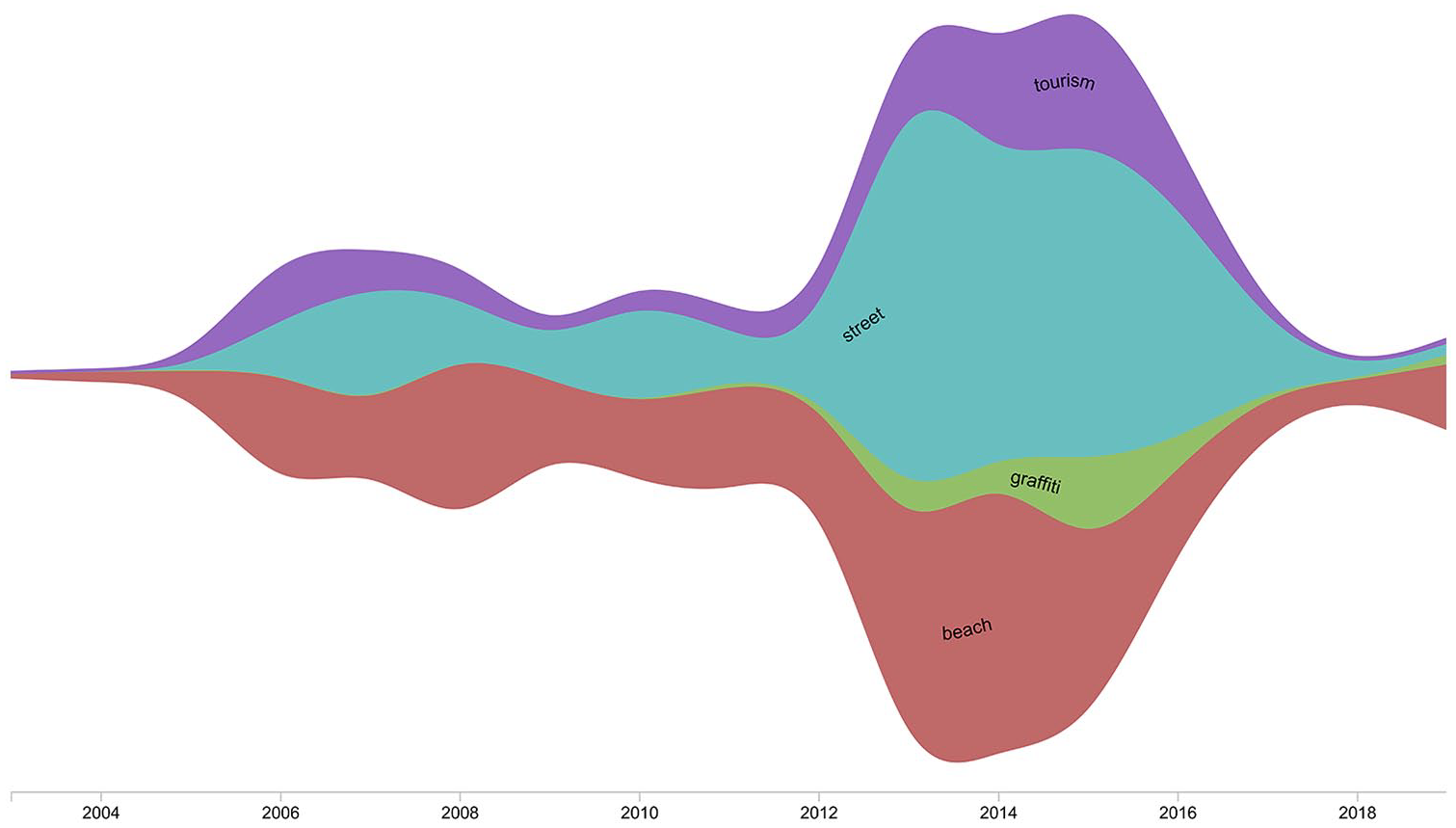
This figure shows the frequency of Flickr labels per year, as labeled by Google Vision.
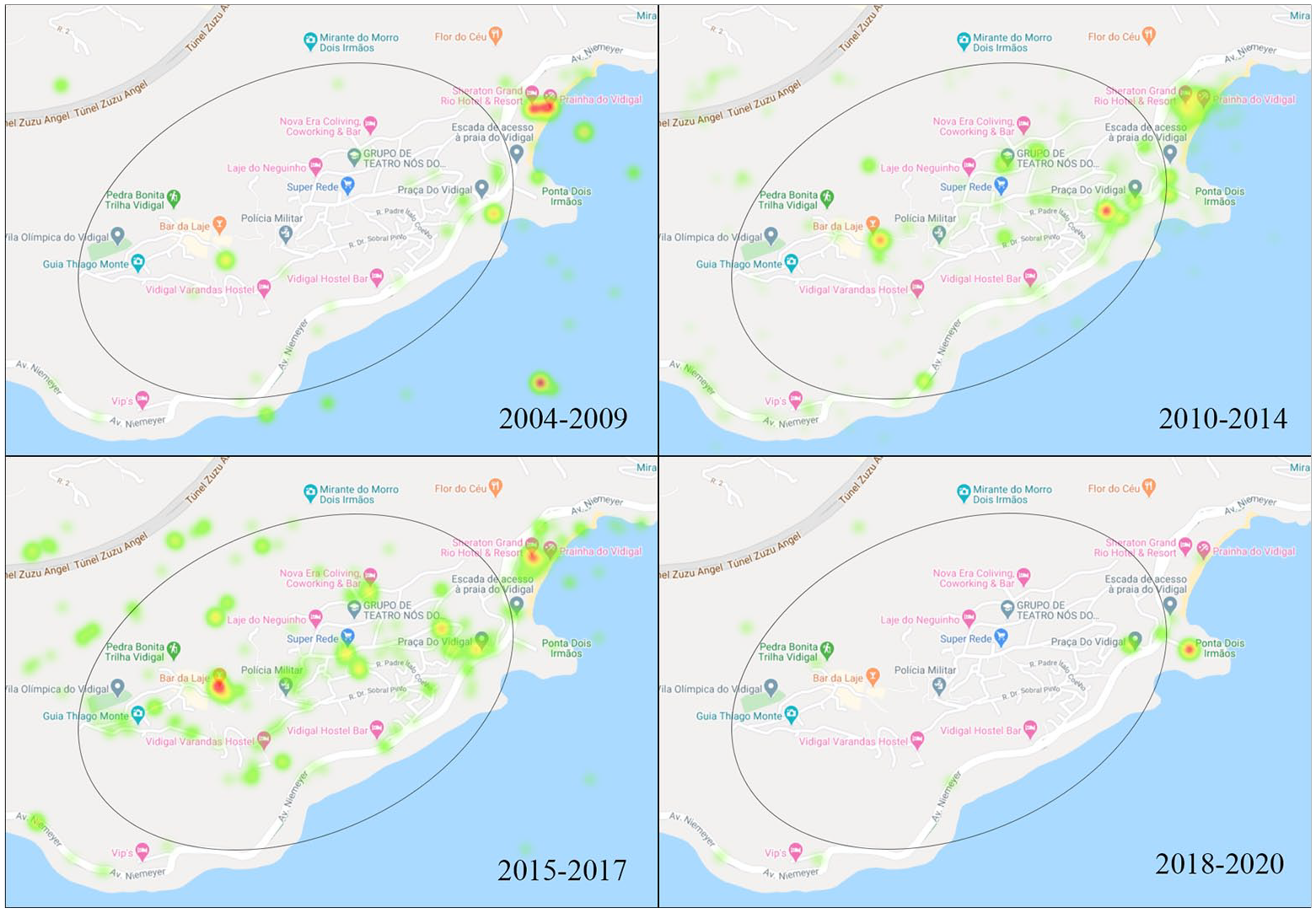
This attention map shows locations of Flickr photographs in Vidigal, divided into the time periods.
One of the most striking expressions of the discovery of Vidigal as a space of investment opportunity is the 2013 Financial Times “buying guide,” with advice for investors interested in purchasing real estate in pacified favelas (see Figure 4). Like many articles during this period, the piece describes how artists, architects, and expats are moving in. The emphasis, however, is on Vidigal as an investment opportunity, weighing “risks”—such as contentious ownership rights and unclear property titles—against profit potential. The article interviews Andreas Wieland and details how he won a dispute over his ownership of Alto Vidigal against a community resident, with the property value then increasing from $10,000 to $300,000 in four years. The article also warns about the potential impact of slowing GDP growth and currency volatility on the favela market, suggesting that property in the well-established Ipanema and Leblon neighborhoods may be safer investments, in particular if using the property for short-term rentals.
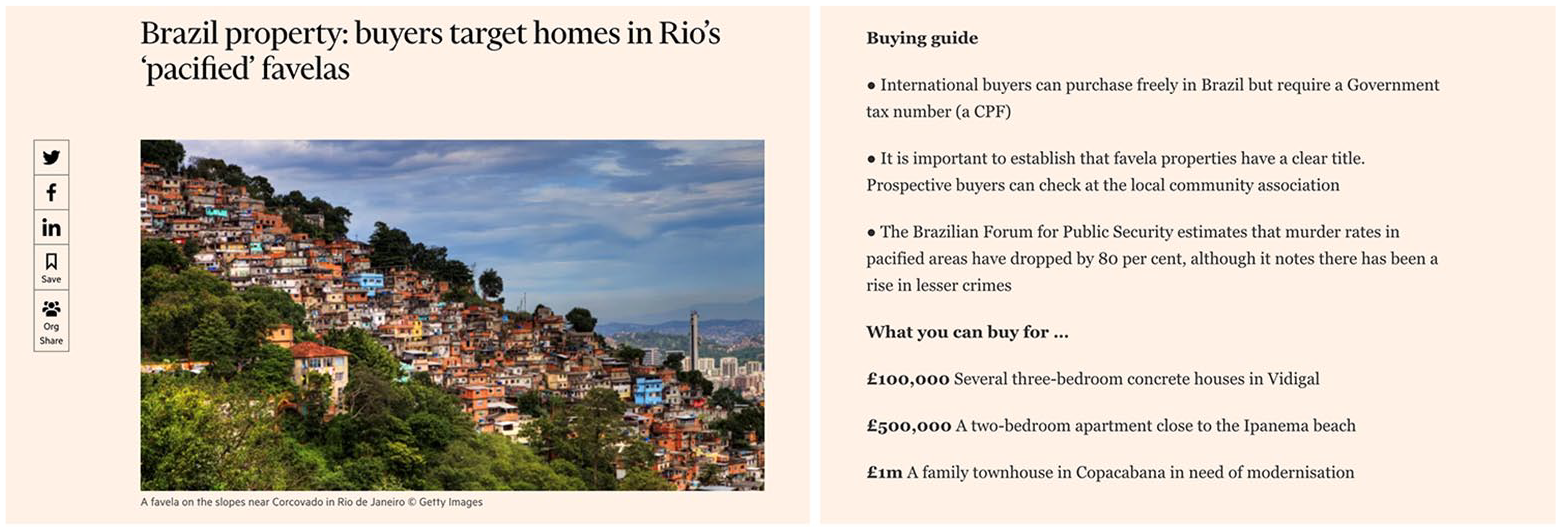
Financial Times’s 2013 “buying guide” for housing investments in Rio’s pacified favelas.
This period also saw the growth of “poverty tourism,” particularly in the form of “favela tours” (Freire-Medeiros 2009; Frenzel et al. 2015; Frisch 2012). As Newsweek reports in 2013, “Brazil’s scariest slums have become a must-see for tourists.” In these tours, tourists from primarily the middle and upper classes go on guided visits of the “slums,” in which they are shown the residents’ daily life. Freire-Medeiros (2014:167) refers to this as a “commoditization of the curiosity to gaze upon the poor, consuming destinations advertised as iconic loci of poverty, and the global mobility of images.” These tours involve the casting of poverty, deprivation, and violence as sources of commodifiable difference, by packaging them as tourism products. The tours have been subject of significant academic interest under a growing range of concepts like “slum tourism,” “dark tourism,” “disaster tourism,” or “poverty tourism” (Dürr and Jaffe 2012; Frenzel, Koens, and Steinbrink 2012; Frenzel et al. 2015; Frisch 2012; Lennon and Foley 2002; Sharpley 2005).
These experiences often use the imaginary of the favela as dangerous as part of the excitement of the experience, serving to emphasize the adventurous spirit of the tourist. This can also be seen in the mediatization of favela tourism, which often uses violence to draw the audience’s attention. An example is a 2017 YouTube video titled “FAVELA VIDIGAL VIDEO / GUNS & DRUGS in Rio de Janeiro,” which, despite what its titillating title may imply, features a middle-aged man going to a restaurant in Vidigal for a rather uneventful dinner. A similar tendency toward exaggerated narratives of danger and excitement can frequently be seen in the traditional news media, such as in a Daily Telegraph tourism piece referring to Vidigal as “one of Rio’s most dangerous favelas” (despite the fact that Vidigal is arguably one of Rio’s safer favelas). The discovery of Vidigal as a site of danger and adventure coincides with the international growth of the cosmopolitan taste for the favela chic (Cummings 2015), with bars in London, Berlin, and New York redecorating into favela aesthetics, selling caipirinhas in spaces designed to look like shanty towns (Iqani 2016; Jaguaribe 2014). The “favela” began to see a broad international media circulation of images, building expectations and fostering desire in tourists (Freire-Medeiros 2009: 4).
As Alto Vidigal is followed by other hostels, as well as by co-working spaces and similar services associated with gentrifying neighborhoods, these “poverty tourism” registers become, at times, hard to distinguish from those about the favela as an “up-and-coming” neighborhood attracting international residents and expats. Newspapers and posts during this period often emphasize the “adventurous” spirit of these new residents, seeking the “authentic life” of the favela communities. The articles are often strikingly similar to the gentrification narratives of the Global North, focusing on “creatives,” “artists,” and “bohemians” (Ley 2003; Lloyd 2002; Zukin 1989). As French newspaper La Croix writes in a 2014 article (translated from French by the authors): the small favelas located in the southern area of the city, close to the beautiful districts, now attract foreigners, students and even some Brazilians, artists or bohemians, who flee the exorbitant rents of Ipanema or Copacabana. They also come to seek a more “authentic” life.
These narratives and symbols are reflected also in the Airbnb marketing of listings in Vidigal, which often emphasize the same gentrification narrative. As the “neighborhood description” of a local host puts it: Vidigal, our neighborhood, is the most successful “pacified” favela of Rio. During these last years it has become the cool spot in town; it is where artists and hipsters are moving—all newspapers are writing about it. The neighborhood is situated in between pleasant Ipanema and Leblon. Favela Vidigal is a community of artists, very stylish, and it is dynamic and safe. (Translated from Portuguese)
Newspaper articles about Vidigal often feature nationals from the newspaper’s country who have made the favela their home. Typical of this theme is a 2014 article in de Volkskrant, a Dutch newspaper, with a firsthand portrayal of the life of a Dutch woman who moved to the favela: Within five minutes I am in a completely different world. From the community, the us-know-us-favela, to anonymity. The first steps on the “asphalt” of Copacabana I still nod friendly to people. But I immediately notice that this does not belong here. This is the big city. I am away from my comfort zone, away from my protective neighbors. (Translated from Dutch)
Similarly, newspaper Der Tagesspiegel features, in 2014, a profile of German artist Jan Siebert, who lives in the favela. The article describes him as now painting “with bullets flying around his ears,” and praising his ability to see the beauty in the “inconspicuous and apparently ugly.” These narratives contain common pro-gentrification tropes, highlighting the cosmopolitan capacities of gentrifiers and celebrating their ability to find community and belonging in the type of simplicity and authenticity that poverty is suggested to provide.
Another common narrative around the “up-and-coming favela” is focused on celebrities visiting Vidigal. One of the most well-reported stories of this period is of football star David Beckham coming to Vidigal in 2014. Photographs of Beckham playing volleyball with “favela locals” are shown in dozens of newspapers around the world. Newspapers also report that Beckham—“rumor has it”—was investing in property in the favela. In these narratives, Vidigal plays the part of a wild dangerous adventure, full of poor children to be helped, casting Beckham as a kind-hearted adventurous traveler—or a pioneer going “into the unknown,” as registered by the title of a 2014 KickOff article (see Figure 5). Beckham’s visit is frequently brought up also on Flickr, YouTube, and Airbnb, often employed as proof of the favela’s “coolness.” Some Airbnb hosts pick up on this narrative and employ it in the marketing of their listings: David Beckham and Madonna just bought houses in our neighborhood, but it’s not too crowded yet. (translated from Portuguese) Vidigal is well-known in Rio as the favela chic since, for many years, there have been many famous artists who live and frequent the place, like the famous English football player David Baker [sic] (owner of a house), Thiaguinho of the musical group Melanina Carioca (who lives a few meters away from my house), and so on!” (Translated from Portuguese)
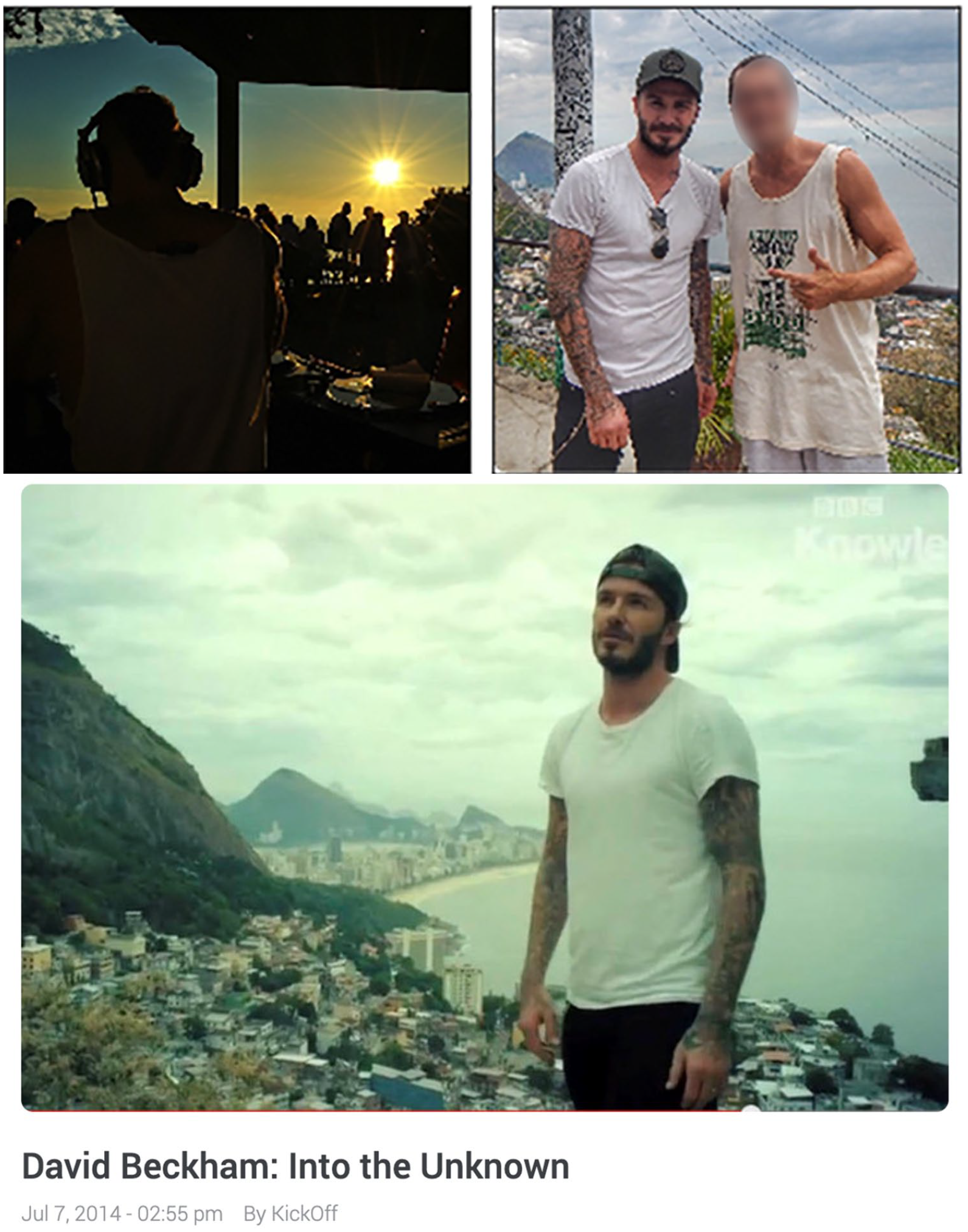
Top: typical Flickr photos of the period.
Media representations of Vidigal are almost exclusively pro-gentrification during this period, with few local voices on the changes in the neighborhood. The exception to this is YouTube, where locals voice their concerns about gentrification on channels like “Vidiga Vidigal.” This channel features mainly video interviews recorded on cellphones, such as a 2012 interview titled “Displacement, tourism and indignation in Vidigal.” The interviewee, a Vidigal resident, says that the government is using false claims of unsafe building conditions to justify uncompensated forced displacement of the residents of the most valuable properties in the favela while less safe but less valuable properties remain untouched: what is happening here is real estate speculation. If we leave, it’s going to become a huge economic asset. A huge business redevelopment, with hotels, with buildings, with mansions.
Cristina also describes their resistance to real estate speculators, with residents throwing buckets of water on investors offering to buy their property.
The Gentrification Bust
Following the gentrification boom came a bust period marked by more critical representations of the gentrification of Vidigal, with fewer stories based on the fascination of favela tourism and more on its negative impacts on the local community. There nevertheless continued to be high levels of tourism activity in the favela in this period, which are reflected in the heatmap of Flickr activity.
Just like the narratives about the up-and-coming neighborhood, the critiques also appeared almost exclusively in the international press, with virtually no mention in Brazilian media. In 2017, for instance, Thai News Service issued an article about “slum gentrification” (a concept coined in Ascensão 2015) in relation to Vidigal, discussing the impact of the formalization of property ownership on community life and the risk of displacement. Another example is Danish newspaper Politikken’s 2016 article titled “The Legacies of the Olympics,” which calls the 2016 Summer Olympics in Rio “the games of ethnic and social cleansing,” accusing the government of having used the event to legitimize displacement of disenfranchised communities.
The “favela gentrification” discourse is not exclusive to longform in-depth news articles; it also reaches celebrity and tabloid media. The most striking example is a 2015 article in British tabloid MailOnline titled “‘David Beckham ruined my favela!’ Slum-dwellers attack star after Rio shanty-town turns into luxury enclave because of rumors he had bought a ‘trendy shack.’” This article turns real estate speculation and growing cultural conflicts between locals and tourist gentrifiers into a celebrity gossip conflict narrative focusing on Beckham’s supposed purchase of a favela property. It explores the favela gentrification and points to displacement and other negative consequences for locals, focusing on the cultural conflicts between newcomers and old-timers and discussing their claims to the favela: This used to be our favela, but now we have to ask permission to walk down our own streets. – Long-time resident The only downside of living in the favela, Laetitia says, are the “uneducated” favela people. She says: ‘People are very ignorant here. Our neighbors play loud music any time of the day or night, there are no rules here.
– French newcomer
This media turn toward critical examination of favela gentrification comes with criticism of the cultural appropriation of the favela chic aesthetics, illustrated by a 2017 The Telegraph article titled “Madonna’s favela fashion ignites outrage in Brazil.” It reports “outrage on social media” over a photo posted by Madonna on Instagram in which she, dressed in combat fatigues, poses with armed military police outside Rocinha. The article largely consists of a collection of quotes from Twitter users who criticize Madonna’s “embarrassing,” “oblivious,” and “ridiculous” self-marketing use of favela chic aesthetics and symbols of violence and poverty.
In 2017, YouTube saw the release of artist Anitta’s music video “Vai Malandra.” Recorded in Vidigal, the video had over 400 million views as of August 2020. It features highly sexualized expressions of Black Brazilian culture and favela chic aesthetics—such as the bikinis made of electrical tape that favela residents use as sunbathing wear—cast as a form of female empowerment and celebration of favela culture. This sparked a significant debate around race, class, and gender, and the complicated boundary between “celebrating” and “appropriating” culture. In comments on the video, some users criticize it for depicting “rich girls” (patricinhas), and poorly representing the lived experience of favela women; “stop wanting to be so gringo, we are Brazilian and we shouldn’t pretend like things are easy here,” as one of the comments read (translated from Portuguese). Newspapers, primarily but not only in Brazil, picked up on the debate—both in tabloid press and in longform think-pieces. The YouTube video thus moved throughout the media ecosystem, as a lightning rod for discussions at the intersection between race, class, and gender, problematizing the commodification of favela culture.
The interest in Vidigal declined sharply after the end of 2017, following an economic recession which saw a fall in both real-estate prices and the value of the Brazilian currency. The few stories published are almost exclusively about an increase in violence, extra-legal paramilitary executions, or police officers killed by criminal gangs. Few Vidigal photos are uploaded to Flickr and, as it happened during the first studied period (2000-2011), they were generally taken at a safe distance, from the beach and the area around Sheraton Hotel (see Figure 3). On Airbnb, the number of reviews and the review scores are quickly falling. In early 2020, Vidigal was among the neighborhoods with the lowest review scores for “location” of any neighborhood in Rio (of neighborhoods with more than fifty listings), besting only Vargem Pequena. One Airbnb guest writes in a 2019 review that Vidigal is known for its dangers. I heard shots in the morning and night. The police harassed me every other day as I walked back home. Not an experience for a bohemian or any other type of traveler. This place really is not recommended for many reasons.
Discussion
A Digital Neighborhood at the Global Urban Frontier
The first question we sought to answer is how Vidigal is represented over time and across different media platforms. Contrary to expectations that gentrification will take on very different forms depending on the geographical context (Butler 2007; Sigler and Wachsmuth 2015), media representations of Vidigal feature familiar narratives. Well-aware of the tastes of gentrifier tourists, the marketing imagery of the favela casts it in tropes of Northern-style gentrification, marketing the favela for and by Northern gentrifiers. This meant that the mediatized favela was shaped to speak to many prevailing gentrifier tastes and aesthetics, with familiar clichés of an “edgy,” “gritty” neighborhood, with a “creative” and “authentic” flair (Ley 1996; Zukin 1996, 2008). The “other,” who is at the narrative core of these imaginaries, has merely been replaced by those living at the global urban frontier. The mediatized Vidigal is in this sense a global neighborhood, not bounded by the history of its physical location. Although we cannot establish the impact of these media representations on the ground, we can say that the media enabled a cosmopolitan middle-class to experience Vidigal vicariously through sites like Flickr and to window-shop for short-term housing through sites like Airbnb. Vidigal was presented in the media as both an investment opportunity and an object of desire and consumption.
As neighborhoods of the Global South are represented in Northern media, the boundaries between poverty tourism and gentrification become fuzzy, with both seeking places that enable middle-classes to display their ability to overcome encounters with difference, marking their cosmopolitan capacities (Giddens 1991:190). Here, cosmopolitanism implies and enables “an orientation, a willingness to engage with the Other” (Hannerz 1990:239); being faced by difference without being overcome by it. Cosmopolitanism is thus both a competence—needed to “make one’s way within other cultures and countries” (Szerszynski and Urry 2006:114)—and, at the same time, a form of cultural capital, used by the middle classes to distance themselves from those who lack this good taste, through the consumption of difference (Hage 2012). The overcoming of difference is dependent on having a difference to overcome—an “other” is needed to define the self—which is the foundation for the cultural value of both gentrifying neighborhoods and the loci of poverty tourism (Elsrud 2001).
What emerges with the globalizing tendencies of mediatization that have shaped the gentrification of Vidigal is thus an amalgamate—a slum tourism gentrification which draws out the desires that are at the essence of both gentrification and tourism: a cosmopolitan fascination with the exotic “other” and longing for a conceived authenticity that can only be found in alterity, expressed as a cultural commodification of poverty itself. While Marx suggested that under capitalism the only thing that cannot be bought or sold is poverty itself (Freire-Medeiros 2009), it is precisely poverty that has become the symbolic product of gentrifier taste—framed and packaged for consumption as a quintessentially urban experience.
In this slum tourism gentrification, the favela is discursively constructed as a spatialization of the exotic “other,” which becomes circulated globally through its media representation. It is cast as a wild and exotic place, which enables a titillating meeting with “the real.” At the same time, this celebration and romanization of the “favela” coincides with the replacement of local culture and population, as local bailes funk parties are criminalized and locals displaced. This has clear parallels to the intertwined processes of othering and commodification described in the gentrification of majority-Black neighborhoods in the United States, where White newcomers describe high-poverty areas as “edgy” and “authentic,” while low-income Black residents view them as dangerous and degrading (Hyra 2017; Törnberg and Chiappini 2020; Zukin 2008).
The City as a Media Phenomenon
The second question guiding our exploration focuses on whether media representations of Vidigal are indeed consistently biased toward gentrification, as reflecting the views and interests of those with wealth and power, as has been suggested by the urban studies literature (e.g., Logan and Molotch 1987:70). In contrast to this, our cross-media analysis revealed striking differences in the representation of Vidigal’s gentrification. The same media channel may in one moment give voice to locals’ claims to their right to the city and, in the next, market the same locals’ homes for touristic exploitation. While media were largely positive about gentrification during Vidigal’s boom phase, over time they became more critical, with the favela’s depiction changing from a poor and dangerous slum into, first, a destination of tourism and gentrification and, subsequently, a victim of the same. Criticism of gentrification became a frequent occurrence in the press, not only in long-form think-pieces, but also in the celebrity gossip of tabloids, often making use of concepts from the academic gentrification literature.
While media platforms play a central role in the promotion as well as critique of Vidigal’s gentrification, these effects did not appear to be intended, but rather seemed an unaccounted-for side-effect of the media’s internal logics. As suggested by the literature on news value (e.g. Galtung and Ruge 1965), media reporting on Vidigal showed a preference for the sensationalistic, conflictual, and outlandish—the surprising yet familiar. Each story creates the preconditions for the next step in the narrative trajectory. The global imaginary of the favela, shaped in part by movies like City of God, enabled the telling of captivating stories about Vidigal as an exciting and dangerous place of violence and poverty. This made it a potent background scene for renditions of familiar storylines, such as the explorations of “brave adventurers” at the frontier of global urban tourism that are well-known in the gentrification literature (Smith 2005). But these narratives would just as quickly become stories of colonial exploitation, in which the concept of “gentrification” was employed to tell “unexpected but yet familiar” stories, turning the same brave adventurers into oppressive colonizers, driving righteous indignation and outrage. In each step, the stories of Vidigal are filtered and adapted for news values: they are personalized and made relatable by way of turning urban conflicts over “the right to the city” (Lefebvre 1991) into celebrity gossip and individual conflicts. This could be seen in reactions to Madonna’s symbolic use of the favela aesthetics and Beckham’s presumed housing investments, drawing the cultural commodification and gentrification of Vidigal into a form of celebrity conflict narrative. This—almost incidentally—gave voice to and empowered long-time residents, showing how media can, under specific conditions, provide space for dissent.
While the news media portrays Vidigal through a hyperbolic filter that presents it in sensationalistic, conflictual, and outlandish terms, social media add biases of their own (Van Dijck and Poell 2013). Social media’s focus on identity-oriented content and self-presentation (van Dijck 2013) can be seen in that Vidigal on such platforms often tends to be represented as a reflection of selfhood, featuring as a background in selfies or to tell a story, thus drawing it into symbolic expressions of self-representation (Törnberg and Uitermark 2021a). As Vidigal becomes a narrative prop in tourist narratives, its representation empowers a type of symbolic engagement that constitutes a commodification and “outside” experience that contributes to reshaping the production of urban space (Lefebvre 1991; Zukin 2008). Users employ Vidigal to decorate expressions of selfhood, part of the assemblage of an “adventurous” traveler lifestyle (Featherstone 1987). Social media platforms may, in this way, help mobilize symbolic consumption, expanding cultural commodification and appropriation as community is reduced to symbolic products (Törnberg and Chiappini 2020).
A Place of Many Platforms
A third question we raised is about the differences between media platforms with respect to their representations of the neighborhood and the kind of voices they amplify or ignore. While the media platforms have in common that they enable experiencing the neighborhood from afar, we found important differences between them. The tendency for touristic self-presentation is most visible on Flickr, on which Vidigal appears in selfies and tourist photos as a prop in touristic adventures (Castells 2010; van Dijck 2013). In periods when Vidigal is perceived as more dangerous than hip, Flickr reveals, however, the photographers’ physical retreat, showing Vidigal only through zoom lenses in photos taken from the safe distance of a nearby hotel.
Airbnb gives space to symbolic self-expressions through its review function, but the platform is overall more geared toward the marketing side of urban commodification. Airbnb appears as a digital interface for a symbolic marketplace, or a form of interactive lifestyle magazine for urban place that helps expand cultural commodification and appropriation by treating place like any other postindustrial product (Zukin 1989, 2009). The platform gives voice to the marketing of urban space as a consumer product, turning its users into “place entrepreneurs [. . .] set to extract value from the tastes of a global middle class by marketing place and community to outside groups” (Törnberg and Chiappini 2020, 554). Vidigal is here presented through the lens of gentrification aesthetics—a gritty and hip neighborhood ripe for consumption.
YouTube featured commercial music videos in which the “dangerous” and “exciting” Vidigal features as an effective backdrop. However, the platform also provides space for the critique of the cultural commodification in which such videos engage, as well as for locals to celebrate their own cultural expressions in uploaded smartphone videos, such as illegal bailes funk parties. The possibility for longer videos on YouTube also affords more in-depth critical content, such as long-time residents discussing their experience of gentrification.
While the different media thus operate under different logics, they cannot be understood as separate entities. The media are entangled in a complex ecosystem, with content constantly cross-pollinating across media platforms. The same event is often referenced in newspapers, Airbnb, Flickr, and YouTube, although framed and fitted into their particular formats. Beckham’s visit to Vidigal, for instance, is used to tell an adventure story in a newspaper, picked up on Airbnb to market a listing and featured in a tourist selfie on Flickr. Each of these provides its own lens on the story, rendering Vidigal in ways shaped by the interests of the particular platform.
Conclusion
The media invariably have an important role in shaping perceptions and orienting behaviors of people in neighborhoods and cities. This paper has called for bringing together urban studies and media studies in order to understand urban mediatization, that is, the process through which media representations are woven into daily life and come to shape urban change. As places multiply in media representations, the sites of urban research do too. This poses a challenge to urban studies. The task of urban studies thus becomes to not only study places on the ground but to track places as they travel the world, and explain how they are represented, by whom, and for whom. Mediatization impacts different urban groups’ abilities to stake their claims to their right to the city, as the visibility of these claims is shaped by how well they can fit into the logic of media channels. This speaks to a notion of the right to the city as entailing more than “politics of occupation” but also the question “who has the right to inhabit the dominant image of the city” (Zukin 1996:43).
This calls for studying the city and its places also as media phenomena—taking the media and their dynamics seriously on their own terms. Employing this approach, this paper found that platforms shape the dynamics of the production of place, with urban culture thus becoming intermingled with digital media cultures. Just as particular geographical contexts within which a place is embedded play into the trajectories of urban cultural change, so does the particular media within which the place is embedded shape the dynamics of its transformations.
We have argued that the rise of digital media contributes to the planetary scale of cities, and thus of gentrification, by enabling urban space to be produced and consumed from afar. While most literature on planetary gentrification has focused on infrastructure and finance, media representations, too, are an integral aspect of these global flows (Dávila 2004; Zukin 2008), as they shape imaginaries “which have a significant drawing power upon the flows of capital” (Harvey 2012:140). While we cannot know whether these representations are causally implicated in the gentrification process, we can say that they promote certain voices and interests over others.
While the geographical historical context and economic processes of Vidigal are very different from the context of deindustrialization and working-class displacement of the Global North, the favela was slotted into familiar topes of Northern-style gentrification. However, while media representations often cast Vidigal as a consumption good or investment opportunity—in line with the gentrifying interests of the local urban elite—they occasionally also give space to discontents. While the local elite may favor pro-gentrification representations, the global media platforms operate under different interests, such as maximizing user engagement, which shapes media that follow their own logics and biases (Törnberg and Uitermark 2021a). Nuances and the everyday insider experience are often erased or trumped as the neighborhood is defined through national and global media, producing a deterritorialized neighborhood, which travels the world through media representations. In those media, it becomes merely a story among others, evaluated for its news value and capacity to produce attention-grabbing headlines.
The paper identified remarkable variations in the media representations of Rio de Janeiro’s favela Vidigal over time and across different media. The global neighborhood Vidigal exists not merely as a place that is construed locally but also as an emblem in media discourses that are shaped by the dynamics of media platforms. Mediatization allows the neighborhood to be culturally unmoored from its geographic locale, much as financialization brought the unmooring of capital flows, thus becoming part of the dynamics of transnational gentrification. The neighborhood is filtered and refiltered, as it moves through a heterogeneous media ecosystem—it is commodified and sensationalized, reframed in hyperbolic, conflictual, and outlandish terms, drawn into the online self-expression of self-described adventurers. This is the complex space within which urban conflicts over the right to the mediatized city take place, simultaneously as media phenomena and part of urbanity. The neighborhood is not only more than a physical place undergoing urban dynamics, or even a media phenomenon; the neighborhood is many places, shaped by the cultures and affordances of the various platforms within which it is embedded.
In this article, our main concern was with media representations of place and the sort of urban change they promote. Although in some instances it was clear in which direction the media representations were pushing (as in the case of newspaper articles explaining to a global audience how to invest in favelas), our methods did not allow us to establish a clear causal link between media representations and changes on the ground. Here there is an exciting opportunity to combine computational and interpretative research on global media representations with the ethnographic, locally grounded studies of urban change that have been a staple of urban sociology.
Footnotes
Funding
The author(s) disclosed receipt of the following financial support for the research, authorship, and/or publication of this article: This project that has received funding from the European Union’s Horizon 2020 research and innovation program under grant agreement No. 732942. PT would like to acknowledge funding from the research program VENI, financed by the Dutch Research Council (NWO), project VI. Veni.201S.006.
