



Abstract
Introduction:
Laboratory biosecurity is of continuously growing interest due to increasing concerns about deliberate misuse of biological materials and emerging biological risks. These risks continue to be magnified by globalization, the rapid pace of scientific development, and dual-use technologies. Worldwide laboratory capacities are expanding, which calls for concrete actions to improve laboratory biosafety and biosecurity practices to protect researchers and the community. Hence, laboratories require comprehensive biorisk management programs to minimize the risk of accidental and deliberate release of infectious biological materials.
Objective:
Malaysia has prioritized the concern of national biosecurity and aims to consolidate laboratory biosecurity performance to detect and prevent the deliberate release of biological agents.
Methods:
Two 3-day workshops were organized over the course of four months in which Malaysia collaborated with The Netherlands. This bilateral engagement aimed to integrate biosecurity practices in their national biorisk management programs, and resulted into a comprehensive biosecurity checklist for laboratory assessment and monitoring.
Results:
This biosecurity checklist is based on Malaysian and Dutch expert opinions and national and international guidelines and regulations. The biosecurity checklist is a survey-driven tool that consists of a set of concrete questions for each key biosecurity area, which are discussion points for assessment.
Conclusion:
We display a practical biosecurity checklist for laboratory assessment and monitoring. Although the presented checklist was the template for the specific Malaysia checklist, it could serve as a template for other countries.
Keywords
Over the past decades, biosecurity has gained global attention due to increased concerns about deliberate biological incidents and emerging and reemerging biological threats. 1 With a more globalized world, infectious diseases can spread more rapidly within and across country borders. 2 In addition, the existing risks of a significant biological incident will continue to be magnified by rapid advances in technology that may facilitate the modification or creation of pathogens with pandemic potential.3,4 This calls for new global and concrete actions to improve laboratory biosafety and biosecurity to protect both researchers and the community. In particular, facilities storing dangerous pathogens for disease diagnostics and/or the development of novel therapeutics, pose risks given the potential for diversion, loss, theft, misuse, or intentional release of dangerous pathogens.5,6 This is more likely to occur in laboratories where biosafety and biosecurity measures are insufficiently embedded within a biorisk management program. 7 To improve the biosafety and biosecurity situation in laboratories, it is crucial to identify vulnerabilities and address such issues with appropriate solutions.8,9 Countermeasures could in this regard prevent insiders or intruders with malicious intentions to access pathogens, equipment, and technologies. 7 Hence, laboratories require an adequate level of biosecurity to reduce these potential risks.
Biorisk management refers to a system or process to control and minimize safety and security risks associated with the handling, storage, and disposal of biological agents and toxins in laboratories.5 -7 The implementation of a biorisk management system integrates both laboratory biosafety and biosecurity practices. At the same time, it is critical to maintain a functional balance between securing biological materials and preserving an environment that promotes fundamental research. 10 In addition, to ensure an effective and efficient laboratory performance, the organization needs to focus on the causes of nonconformities and seek ways on how to continuously improve biorisk performance within the organization. 7 In this regard, a biosecurity risk assessment could assist in systematically identifying and evaluating facility-specific biosecurity risks and could aid in determining the required level of security.7,11 The outcomes of an assessment therefore aid in determining and prioritizing mitigating measures to reduce the risks to an acceptable and manageable level. Subsequently, these solutions could then be incorporated into a biorisk management program.
Different biorisk assessment instruments or guidelines to establish strong biosafety and biosecurity capabilities exist—for example, the Biorisk Assessment Model (BIORAM) developed by Sandia National Laboratories 11 ; the Danish biosecurity book, An Efficient and Practical Approach to Biosecurity 12 ; the Food and Agriculture Organization’s (FAO’s) Safety Laboratory Mapping Tool 13 ; and the Biosecurity Self-Scan Toolkit 8 and the Biosecurity Vulnerability Scan, 9 both developed by the Netherlands Biosecurity Office. 14 Although different instruments are available to assess biosafety and biosecurity programs within institutions or to identify biosecurity/biosecurity gaps at the national level, there is currently no publicly available biosecurity checklist for laboratory assessments. Malaysia has recently identified the need for such a biosecurity checklist to strengthen its laboratory capacities regarding safety and security by focusing on enhancing biosecurity performances within laboratories to detect and prevent the deliberate release of biological events. To develop such a checklist, Malaysia has reached out to the Biological Weapons Conference for assistance.
The multilateral Biological Weapons Convention (BWC) was established in 1972 to prohibit the development, production, stockpiling, and use of biological weapons in warfare. 15 Currently, 182 signatory countries of the BWC have pledged to implement procedures to improve international cooperation in the field of peaceful biological activities. As stated in the sixth review conference of the BWC, all state parties are required to establish a legislative framework to secure and account for biological materials in laboratories that pose proliferation threats. 15 Within the framework of the BWC, an Extended Assistance Programme was initiated as part of the European Union Council Decision 2016/51 in support of the BWC. 16 This Extended Assistance Programme addresses the importance of promoting adherence to the BWC and enhancing national capabilities for implementing obligations under the BWC. Malaysia was one of the signatory parties to be selected, and the Ministry of Defence's Science and Technology Research Institute for Defence (STRIDE), the lead technical agency in Malaysia for the BWC, has signaled the need to address laboratory safety and security and establish more robust systems to prevent the deliberate release of biological agents. The primary aim of this capacity-building initiative is to improve Malaysia’s capacities in the area of biosecurity by developing a comprehensive biosecurity checklist for laboratory assessments and monitoring. A tailored biosecurity checklist could offer a systematic approach for organizations to evaluate and monitor their biorisk management program, especially in the area of biosecurity. In this article, we describe the development of a biosecurity checklist for laboratory assessment by Malaysian and Dutch experts. The presented checklist was the template for the specific Malaysia checklist, but it could also serve as a template for other countries.
Material and Methods
The initiative was co-organized by Malaysia and the Implementation Support Unit (ISU) of the BWC, United Nations Office for Disarmament Affairs, and sponsored by the European Union and the Netherlands Ministry of Foreign Affairs. The Netherlands Biosecurity Office, part of the National Institute for Public Health and the Environment (RIVM), was selected by the Netherlands Ministry of Foreign Affairs and granted expert guidance and assistance throughout this project. The Biosecurity Office is the information center for the government of the Netherlands and for organizations that handle and store high-risk biological material. 14 Acting as the national biosecurity information platform in the Netherlands, the Biosecurity Office shared expertise on the 8 biosecurity priority areas, assessments, and auditing instruments but also displayed the Biosecurity Self-Scan Toolkit and the Biosecurity Vulnerability Scan.8,9,14
Two 3-day workshops were organized over the course of 4 months in Malaysia. The initial workshop took place in April 2018, in which the framework for the checklist was established. This checklist was then further refined and finalized in the second workshop in July 2018. A group of 24 biosafety and biosecurity experts from the public health, veterinary, and agricultural sectors was selected to attend both workshops, thereby promoting a one-health approach. During the first workshop, expert opinions were solicited to share their views on the key biosecurity priority areas. In addition, different biosecurity aspects and specific needs were discussed, and experts visited the veterinary laboratory at the Universiti Putra Malaysia to obtain more insight into the specific biosecurity challenges in national laboratories. During the second workshop, the initial checklist was fine-tuned and amended. Furthermore, a site visit at the KPJ Lablink, a private medical laboratory in Kuala Lumpur, allowed the participants to evaluate the workability and applicability of the biosecurity checklist. Based on the results of this pilot assessment, the biosecurity checklist was finalized.
Results
In a bilateral engagement program, Malaysian and Dutch experts developed a comprehensive “laboratory biosecurity assessment and monitoring checklist” (Table 1). This biosecurity checklist is an information-gathering tool for external assessments and is aimed to assist organizations that handle valuable biological materials (VBMs), to assess the aspects of biosecurity and laboratory capacity. Through this practical approach, laboratories can continuously monitor the biosecurity program efficiency and effectiveness. The identification of the biosecurity vulnerabilities within the organization also aids laboratories to determine and prioritize which biosecurity countermeasures are yet to be taken to strengthen their biosecurity management program. Having a comprehensive biosecurity management program in place could contribute to preventing potentials for accidental and deliberate releases of VBMs.
Biosecurity Checklist That Covers the 8 Priority Areas of Biosecurity.
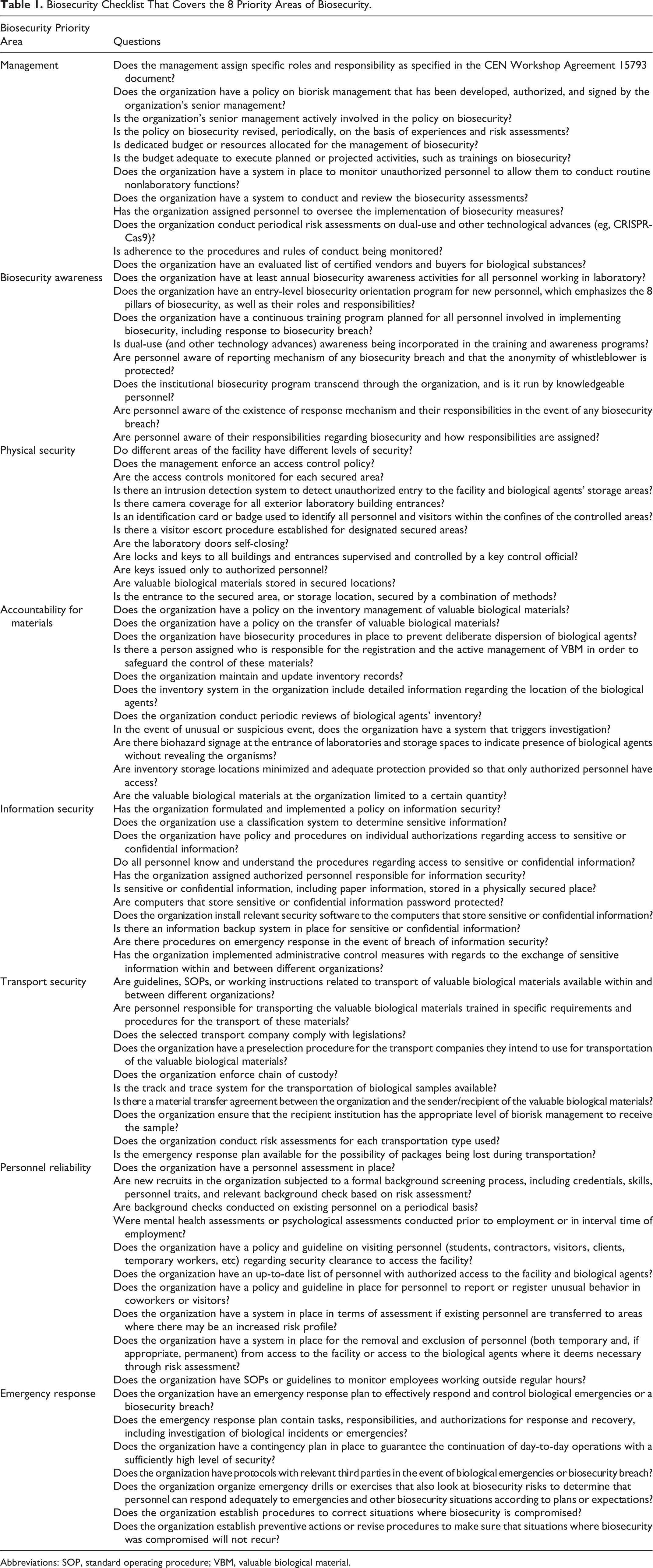
Abbreviations: SOP, standard operating procedure; VBM, valuable biological material.
The checklist covers the 8 priority areas of biosecurity as previously set up by the Netherlands Biosecurity Office.8,9,14 The biosecurity checklist is designed in the form of questionnaire covering the 8 focus areas of biosecurity to provide an indication of the current level of biosecurity of an organization. The checklist consists of a set of concrete questions per focus area and can be used by, for example, biosafety and biosecurity professionals. The intended user could answer the different questions with “yes,” “no,” or “in progress.” The latter option indicates that the respective laboratory is in the progress of addressing the specific biosecurity gap. Where any of the questions of this biosecurity checklist are not applicable due to the nature of the organization, that specific question could be considered for exclusion. In this case, the user can fill in “not applicable.” In addition, the questions taken up in the checklist can be accompanied with country-specific explanatory or background information to prevent misinterpretation. The questions that are included in the questionnaire are discussion points for the assessments and can be used as a template in the evaluation of any full assessment cycle. In addition, this biosecurity checklist is targeted on interagency assessments and monitoring and is therefore significantly different from, for example, the Dutch Self-Scan Toolkit. 8 This toolkit is aimed at self-assessments, provides guidelines, and can be used for training activities within an institute. Although the biosecurity checklist covers the same key areas, it is primarily targeted on external evaluations.
This biosecurity checklist could pave the way to identify and understand biosecurity aspects that constitute areas for improvement. The checklist is a concrete tool that can be incorporated in an organization’s laboratory biosecurity assessment cycle. Such an assessment is foreseen to be carried out by individuals who are familiar with biosafety and biosecurity practices and biorisk management. The intent of the biosecurity assessment is to enable discussions on best practices and recommendations on how to improve laboratory biosecurity performances. In addition, the outcome of the biosecurity checklist could aid in determining and prioritizing mitigating measures to reduce the risks to an acceptable and manageable level. This provides more insight into what mitigating measures are necessary as to maintain a workable balance between securing VBMs and preserving an environment that promotes fundamental research. The workable balance, and therefore the required level of security, is strongly dependent on the type of organization, the nature of the VBMs stored within the organization, and the research being conducted within that organization.
If the assessment is carried out on a voluntary basis, weak biosecurity performance could be used as a starting point for improvements, hopefully in a collaborative effort (eg, in a laboratory network) or jointly with the external assessor. However, this may vary per country. Different key factors are important to establish a successful institutional biorisk management program. Successful biosecurity programs largely rely on a commitment by the management, such as the allocation of resources and making sure that biosecurity measures are integrated throughout the organization. 7 In addition, another key factor to implement a successful biosecurity management system requires continuous improvement. 7 This indicates that the laboratory assessment can be part of a routine in which biosecurity performances are periodically monitored, opportunities for improvement are identified, and where root causes are determined to prevent recurrence.
Discussion
Laboratory biosecurity remains often an undervalued aspect in the field of biorisk management. With the development of the described biosecurity checklist for laboratory assessment and monitoring (Table 1), countries will be able to further strengthen their capacities in the area of biosecurity. As it is a practical tool, various laboratories, irrespective of their biosafety containment level or the type of work, can use this biosecurity checklist. Notably, the biosecurity checklist should be considered a living document, which means that the checklist should also be frequently reviewed after its implementation. Revisions, updates, and customization to national guidelines are strongly recommended as biosecurity involves challenges that are continuously changing and evolving, primarily due to newly emerging biological agents, bioterrorist threats, or cutting-edge technologies. Therefore, revisions should take place at a national level, through a cycle of planning, implementing, reviewing, and improving the biosecurity checklist, and should continue to take place at regular intervals for as long as the checklist exists. 7 Although the presented checklist has been used as a template for a dedicated Malaysia checklist, it can also serve as a template for other countries.
One of the most important elements for successful implementation of biosecurity initiatives partially depends on the biosecurity culture, meaning a scientific community that has a proper understanding of the essence and importance of biosecurity, as well as a community that shows commitment to address biosecurity issues. 12 With the development of this biosecurity checklist, Malaysia has taken an important step toward its obligations to the BWC. This biosecurity checklist is intended for all laboratories that pursue to improve their current level of biosecurity and to identify gaps in their existing biosecurity program. Malaysia is faced with a new challenge to raise more awareness concerning the newly developed laboratory biosecurity checklist, thereby having institutions to understand what biosecurity risks are involved in their work, as well as to make them understand why certain control measures are necessary. After all, this biosecurity checklist is about a common interest in preventing security breaches, biological warfare and bioterrorism, and the exploitation of legitimate science. As an initial step toward establishing a comprehensive biosecurity oversight system, Malaysia anticipates introducing a peer review system in which external experts from a respective laboratory will carry out a biosecurity assessment within another laboratory, thereby using the developed checklist. The external assessor could act as a partner that can help and advise the facility on how to enhance laboratory biosecurity. This requires a safe and trustful environment where both facilities share biosecurity knowledge and issues in an open and friendly manner and where solutions to address these issues are sought. The biosecurity checklist could, in this case, be used as a guidance document to encourage an open dialogue between the external assessor and the respective laboratory.
Conclusion
Here, we describe the development process of a biosecurity checklist for laboratory assessments and monitoring in support of the Biological Weapons Convention. In addition, we displayed a generic biosecurity checklist that could either be directly adapted or be further tailored according to the country-specific needs. This biosecurity checklist provides a practical and universal approach for laboratories that pursue to improve their current level of biosecurity within the organization, to create awareness among all stakeholders within the organization, and to provide solutions to improve the weakest organizational biosecurity performances. In this way, countries can address their laboratory safety and security posture to establish stronger biosecurity systems to detect and prevent the deliberate release of biological events.
Footnotes
Acknowledgments
The authors thank Malaysian biosafety and biosecurity experts who were key with regard to the development of the laboratory biosecurity checklist: Faizatul Lela Jafar (University of Malaya), Amrish Shah Osman (National Public Health Laboratory), Venugopal Balakrishnan (Universiti Sains Malaysia), Nor Yasmin Abd Rahaman (Universiti Putra Malaysia), Clarence Ko Ching Huat (Universiti Kebangsaan Malaysia), Tan Cheng Siang (Universiti Malaysia Sarawak), W. Nur Afiza W. Mohd Arifin (National Public Health Laboratory), Saleha Shahar (Universiti Teknologi Malaysia), Haryanti Azura Mohamad Wali (University of Malaya), Junaimah Jasman (University of Malaya), Wee Seng Kew (Universiti Malaysia Kelantan), Priya Madhavan (Taylor’s University Malaysia), Loong Shih Keng (University of Malaya), Noor Faizul Hadry Nordin (International Islamic University Malaysia), Chubashini Suntharalingam (Malaysian Agriculture Research and Development Institute), Kumravani Santhirangathan (KPJ Lablink), Wong Eng Hwa (Taylor’s University Malaysia), Raha Ahmad Raus (International Islamic University Malaysia), Rahizan Issa (Institute for Medical Research), Salmi Afidah Shabuddin (Universiti Sabah Malaysia), and Ahmad Razi Mohamed Yunus (STRIDE). The authors also want to express their gratitude toward the experts from the Netherlands Biosecurity Office: Saskia Rutjes, Mirjam Schaap, André Jacobi, Petra Hogervorst, Stephanie Meulenbelt, and Arnout de Bruin.
Ethical Approval Statement
Not applicable
Statement of Human and Animal Rights
Not applicable
Statement of Informed Consent
Not applicable
Declaration of Conflicting Interests
The authors declared no potential conflicts of interest with respect to the research, authorship, and/or publication of this article.
Funding
The authors disclosed receipt of the following financial support for the research, authorship, and/or publication of this article: This project was funded by the European Union Council Decision 2016/51 in collaboration with the Biological Weapons Convention Implementation Support Unit and by the Dutch Ministry of Foreign Affairs.