




Abstract
In many research and diagnostic facilities, liters of biologically contaminated liquid waste are produced on a daily basis and need to be safely disposed of. The gold standard is steam sterilization, namely, in most cases autoclaving for 20 minutes at 121°C. Here we demonstrate the importance of the following parameters when autoclaving liquid waste solutions in a laboratory setting: (1) size of the receptacle for the reference probe, (2) material of the vessel containing the liquid to be autoclaved, and (3) volume of the liquid in the receptacle. If not appropriately controlled, the temperature required to inactivate the liquid might never be reached at all, thus representing a biohazard that should not be underestimated. Our results demonstrate that it is critical to use identical receptacles and liquid volumes for the temperature reference probe and for the liquid to be autoclaved.
Introduction
Autoclaving, namely, treatment of material with high temperature in a humid atmosphere, is the gold standard for the preparation of sterile products and treatment of laboratory waste for safe disposal. Besides treating dry materials, proper sterilization procedures for liquids are very important in production processes as well as in biological sciences.1 –3 On one side, in food and pharmaceutical production, requirements and clear validation criteria for the production of sterile products exist to prevent any contamination with microorganisms. On the other side, autoclaving is a crucial step in the waste disposal of contaminated liquid waste solutions in a laboratory setting to prevent biological agents or genetically modified microorganisms to be released into the environment. 4 However, many research and diagnostic laboratories do not show the efficacy of their inactivation procedures for specific loads or particular materials according to their needs. 5 Frequently, standard programs provided by the supplier of the autoclave are used without proper verification of the process. In many cases, these standard programs may fulfill the purpose, and the correct treatment of the material for safe disposal is assured. Nevertheless, it is the responsibility of an institution to demonstrate the efficacy of these standard programs considering the different types of waste loads. This work highlights important aspects to consider when autoclaving liquids in a laboratory setting, such as the influence of the container material (eg, propylene vs glass) and the size of a receptacle for the temperature probe on the steam sterilization process. Furthermore, we discuss which program parameters of the autoclave have to be changed to achieve a successful inactivation of biological agents in liquids.
Materials and Methods
The following flasks were used in the experiments and were filled with different volumes of water for the autoclaving process (Figure 1): Glass and plastic bottles used in the different experiments. Schott glass flasks of different sizes: 1 L, 0.5 L, 0.2 L, and 0.1 L Pyrex and Duran flasks (borosilicate glass) of 5 L volume: 5 L GlassA and 5 L GlassB 2 different types of polypropylene (PP) flasks:
5 L PP: 5 L volume, thickness of walls: 2 mm (Nouvag, Switzerland) 4 L PP: 4 L volume, thickness of walls: 4.8 mm (Integra, Switzerland).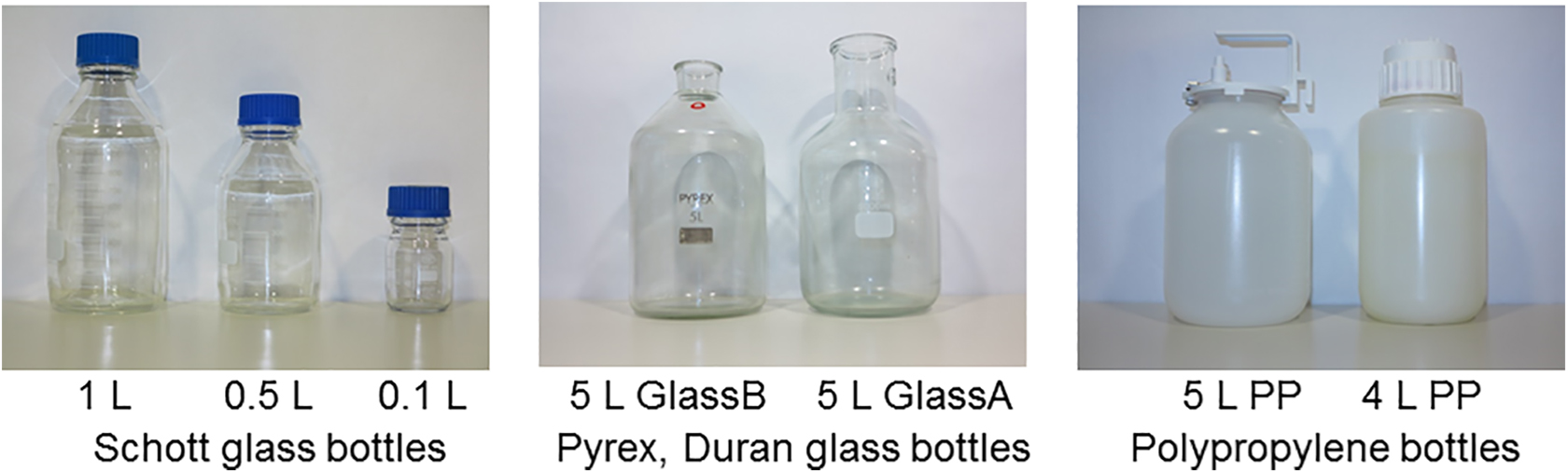
The Schott bottles (1 L, 0.5 L, 0.2 L, and 0.1 L) were filled to their complete volume (eg, 1 L water in 1 L bottle, Figure 2) or only with 0.1 L of water (data not shown), respectively. The different types of 5 L and 4 L flasks were filled with 3 L of water each. The filling volume was measured with calibrated measuring cylinders. The Schott flasks and the 5 L PP flasks had a loosely fixed lid, whereas the 5 L PP flask had a lid with holes, and the Pyrex and Duran flasks had no lid at all during autoclaving. Temperature data loggers (Datatrace, MESA Labs, USA) were added, and the liquids were autoclaved with a preset standard liquid autoclave program (General program parameters of the MMM autoclave are: liquid cycle with pre-vacuum; heating phase: time out at 120 minutes for glass flasks and 180 minutes for PP flasks; sterilization time: 20 minutes; sterilization temperature: 121°C –0°C/+3°C; cooling: active cooling with water. The other 2 autoclaves had similar parameters.) Temperature data loggers were submersed in the water and placed at the bottom of each receptacle. They were programmed to take a temperature measurement every 10 seconds. The calculation of the autoclave time was started at the timepoint when the logger showed a temperature ≥121°C and was stopped when the temperature dropped to ≤121°C. For a liquid autoclave cycle, the reference probe of the autoclave determines the time when the sterilization process starts and stops. Electronic readout of the loggers was performed directly after the autoclave run. To exclude machine-specific results, 3 different autoclaves (pass-through with water cooling system [MMM Group, Rudolfstetten, Switzerland]; pass-through no water cooling system [Belimed, Zug, Switzerland]; top-loading with water cooling system [Systec, Cham, Switzerland]) were used for the experiments. However, only results obtained with the MMM autoclave are shown in the figures. Each type of autoclave run was performed at least twice using duplicates for each bottle type. The reference probe of the autoclave, which guides the different phases of the run, was mounted in the lower third or at the bottom of the reference probe bottle.
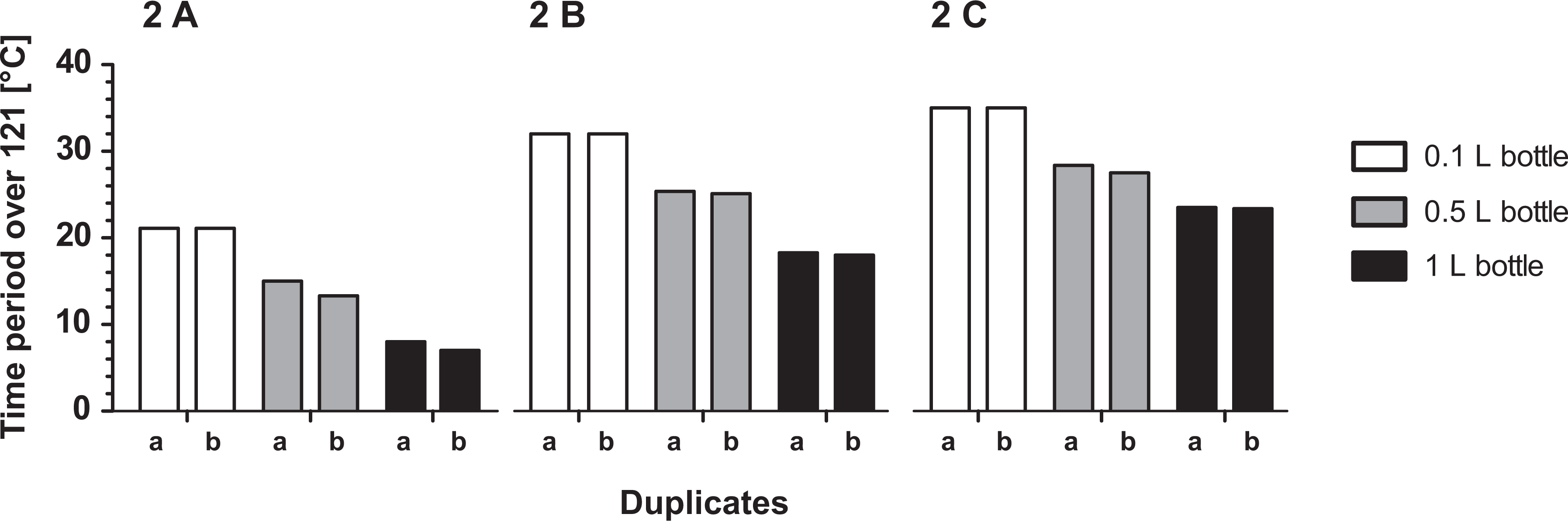
Influence of the volume of liquid on the heating up process in glass bottles of different volumes. Shown are 3 independent experiments using 0.1 L bottles (white bars), 0.5 L bottles (grey bars), and 1 L bottles (black bars) filled with 0.1 L, 0.5 L, and 1 L of water, respectively. In each experiment, the thermal reference probe was placed in a different reference bottle: (A) 0.1 L bottle, (B) 0.5 L, and (C) 1 L bottle. Time periods when the temperature of the water was above 121°C are shown.
Results
Autoclave experiments were performed in 3 different brands of autoclaves with the glass and plastic bottles displayed in Figure 1. The results were qualitatively identical for every type of autoclave (data not shown), and thus results of just 1 autoclave will be shown.
To demonstrate the influence of the heat transfer of liquids in glass bottles, 3 different experiments were performed, namely, 3 different positions of the reference probe were tested. Different glass bottles (1 L, 0.5 L, or 0.1 L) were used as recipients for the temperature reference probe of the autoclave (Figure 2). These glass bottles of 1 L, 0.5 L, and 0.1 L were filled with 1 L, 0.5 L, and 0.1 L of water, respectively. Based on the readouts of the data logger of the 3 different autoclave runs, the time period when the temperature of the liquid was ≥121°C was calculated for each of the 3 bottles. When the temperature reference probe of the autoclave was placed in the 1 L bottle (Figure 2c), the temperature readout of the data logger was ≥121°C for about 23 minutes. As expected, for the 0.5 L bottle, the time ≥121°C increased up to 28.6 minutes and further increased for the 0.1 L bottle up to 35 minutes. This result demonstrates that smaller volumes are heated up faster and will therefore remain for longer at ≥121°C. When the temperature reference probe was placed in the 0.5 L bottle containing 0.5 L water (Figure 2b), the temperature remained for 25.4 minutes ≥121°C and in the 0.1 L bottle for 32 minutes. As expected, the 1 L bottle reached the minimum temperature of ≥121°C for only 18.3 minutes. This effect became even more pronounced when the temperature reference probe was placed in the 0.1 L bottle (Figure 2a): 0.1 L = 21.2 minutes ≥121°C, 0.5 L = 14.3 minutes, and 1 L = only 7.8 minutes. These results clearly show that the temperature reference probe should be placed in an equivalent bottle with the same amount of the liquid to be autoclaved.
To study the influence of the bottle size on the steam sterilization time, 0.5 L, 0.2 L, and 0.1 L glass bottles were used and all filled with 0.1 L of water. The temperature reference probe of the autoclave was placed in the 0.1 L bottle (data not shown). Duplicate bottles of 0.1 L, 0.2 L, and 0.5 L were ≥121°C for 21.2 minutes/20.7 minutes, 21.5 minutes/21 minutes, and 21.2 minutes/19.8 minutes, respectively. The volume of the bottle had no effect on the sterilization time as long as equal volumes of liquid were used.
In another series of experiments, the effect of different bottle materials on the heat transfer profile was analyzed (Figure 3). For this experiment, 4 L and 5 L polypropylene bottles (4 L_PP and 5L_PP; 4 L_PP containing the reference temperature probe of the autoclave) and 5 L glass bottles (5 L GlassA and 5 L GlassB) were used, all of them filled with 3 L of water. As expected, the heat in the autoclave chamber increased very rapidly to reach the sterilization temperature ≥121°C. The 3 L of liquid in the glass bottles took more time to heat up than the chamber. However, due to the different types of glass bottles, small differences in the temperature profile during the heating up process of the liquid were observed. By contrast, the heating up of the liquid in the polypropylene bottles took much more time than in the glass bottles. Also, small temperature differences in the heating up profile were observed between the 2 types of plastic bottles, which might originate from the different wall thicknesses of the various PP flasks (see below). Therefore, the remarkable time differences in the heating up profile can only be explained by different heat transfer due to the material of the bottles.
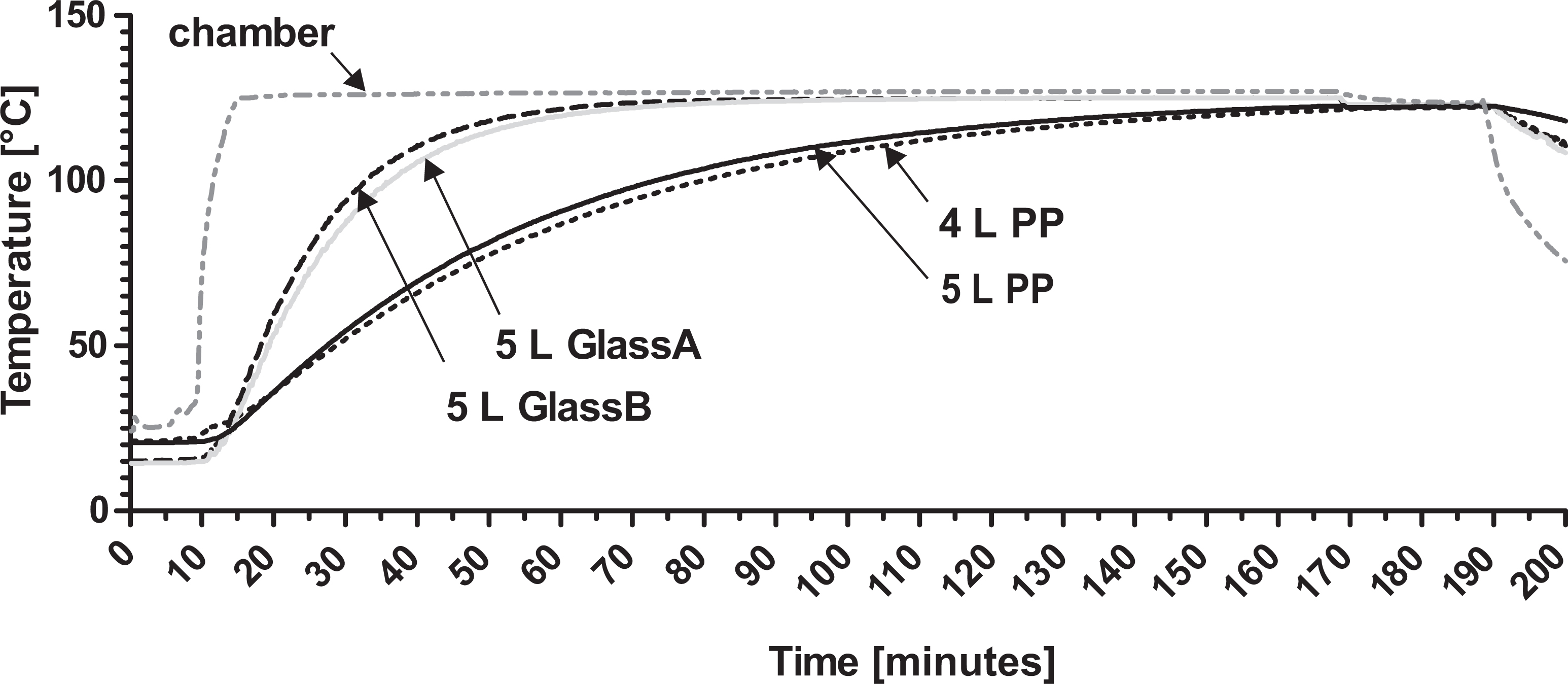
Influence of container material on heat transfer of liquids. Temperature profile of a typical experiment for glass bottles (5 L GlassA bottle: grey line; 5 L GlassB bottle: black dashed line) and polypropylene (PP) bottles (4 L PP bottle: black dotted line; 5 L PP bottle: black line) all filled with 3 L of water and for autoclave chamber (chamber: irregularly dashed grey line). The 4 L PP bottle contained the reference probe of the autoclave.
During the experiments with the plastic bottles, the standard program for liquids delivered with the autoclave did not work properly, and the program automatically interrupted due to overtime in the heating up step, namely, did not reach the preset temperature in the preset time. As a consequence, the program parameter for the preset time for the heating up for liquids was increased until the process was successfully completed. One of the autoclaves used for the tests was not equipped with an active cooling system. Therefore, the time of the entire process was 2 to 3 times as long as compared to an actively cooled autoclave (data not shown).
We also compared the thickness of the wall of the polypropylene bottles and its influence on the heat transfer process (Figure 4). The volumes of the bottles used were either 5 L or 4 L. These bottles had a wall thickness of 2 mm (5 L PP) or 4.8 mm (4 L PP) and were filled in this experiment with 3 L of water. The reference probe of the autoclave was placed in the 4 L PP bottle. The bottles with the thinner wall stayed 45.8/43.3 minutes ≥121°C, whereas the bottles with the thicker wall stayed only 28/27.3 minutes ≥121°C. This means that the liquid in the bottles with the thinner wall was approximately 1.5 times longer ≥121°C than the liquid in the bottles with the thicker wall. This indicates that the different wall thicknesses of the polypropylene bottles influenced the heat transfer profile. In summary, not only the material of the bottle containing the liquid but also the wall thickness influence the heating up profile. As a consequence, it is crucial that the bottle containing the temperature reference probe of the autoclave is identical to the sample bottle.
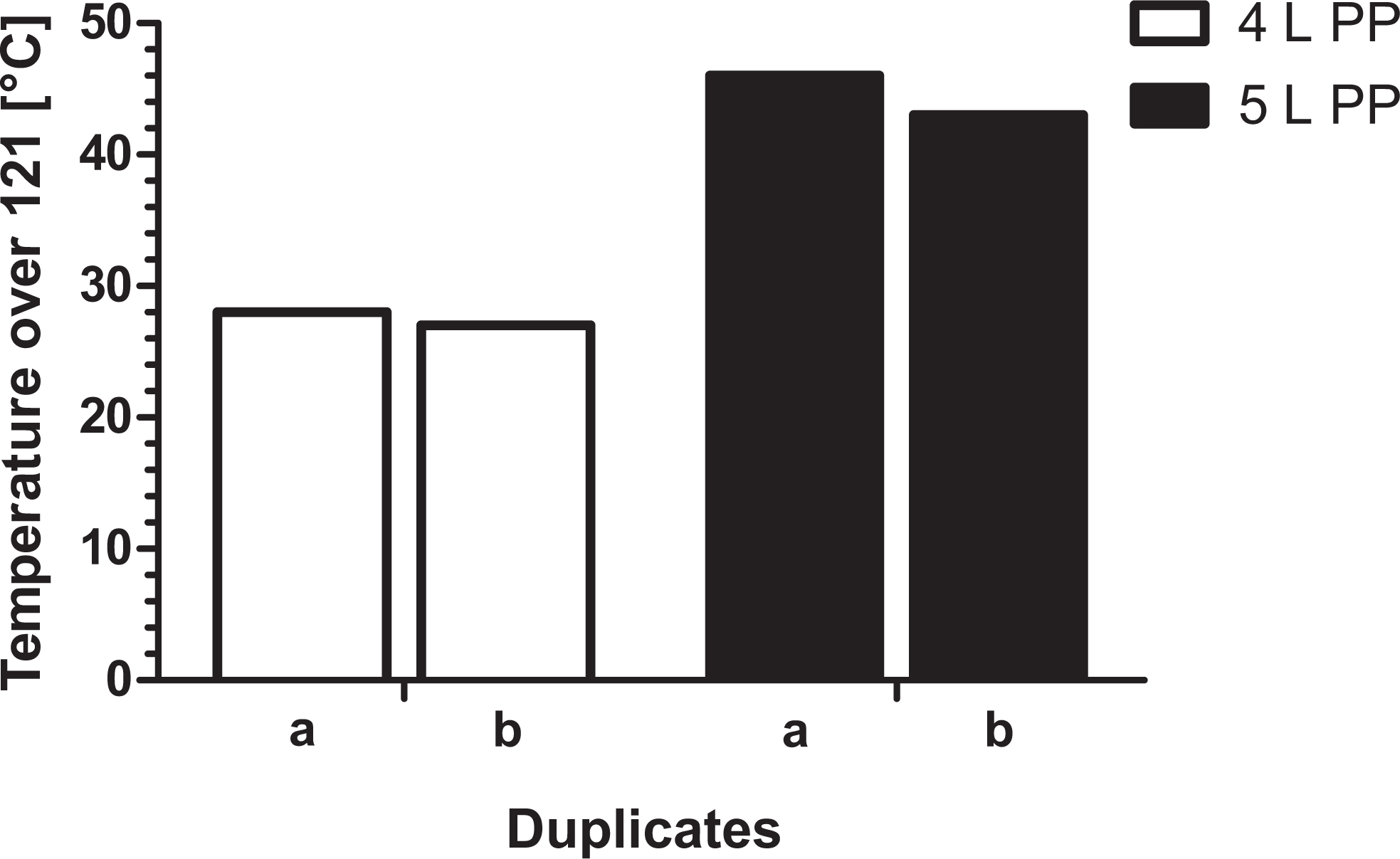
Influence of different wall thickness on heat transfer. The 4 L polypropylene (PP) bottles (4 L PP: white bars; wall thickness 4.8 mm) and 5 L PP bottles (5 L PP: black bars; wall thickness 2 mm) were filled with 3 L of water and autoclaved. The temperature reference probe was placed in 1 of the 4 L polypropylene bottles. Time periods when the temperature of the water was above 121°C are shown.
Discussion
In this work, we evaluated the characteristics of autoclaving liquids using steam sterilization and showed which parameters need to be considered to achieve a proper sterilization/inactivation. Additionally, we showed that the parameters of the standard autoclave programs may need to be adjusted if the process terminates prematurely during the heating up step.
It is obvious that a temperature probe in an autoclave chamber reacts very fast on process steps such as steam injections. As soon as the probe is placed inside a medium to be heated up, the process consumes much more steam and as a consequence takes more time until the temperature of ≥121°C is reached. However, not only the media to be sterilized is responsible for prolonging the time during a sterilization process, but the material of the container in which the liquid is autoclaved plays an important role as well. However, to define an exact time factor allowing the correlation of the used material/wall thickness and the change of the temperature profile, additional experimental data using different plastic bottles would need to be collected. We have performed these experiments only with water and not with any other (more) dense material. We are fully aware that the same experiments with more dense material might increase the observed effects we report here.
The comparison of glass and polypropylene containers demonstrated that it takes much longer to heat up liquids in the plastic containers because the plastic walls do not transfer the heat as fast as glass. Therefore, the program parameters provided by the supplier of the autoclave have to be carefully analyzed to guarantee proper sterilization of liquids. They may be adapted in such a way that also plastic bottles containing liquid waste can be treated efficiently (eg, increasing the steam injection rate, prolonging the heating up phase). However, in most cases, such program changes can only be done with the help of the manufacturer itself and may be quite time consuming and cost intense. Therefore, it may be a good idea to discuss the issue of liquid sterilization upon installation of the autoclaves.
The fact that qualitatively identical results were obtained with 3 different types of autoclaves clearly indicates that the results presented are of general significance. Some autoclave types (eg, table top autoclaves) are not equipped with an integrated reference probe for liquid cycles, but in such cases, the manufacturer’s specifications should indicate for which type and size of bottles the autoclave factory default programs were validated. If the autoclave load of the user differs from the one specified by the manufacturer (eg, material or size of bottles are different or the liquids were precooled by the user before the autoclave run), then the user should test if the default settings are still adequate by using biological indicators and/or temperature data loggers.
All institutions are required to properly inactivate their liquid wastes containing pathogenic or genetically modified microorganisms. Thus, the sterilization parameters for contaminated liquids are crucial, namely, sterilization time and temperature have to be exactly controlled. This control can only be achieved by performing the appropriate tests similar to the ones we have described in this study.
Footnotes
Authors’ Note
Some data were presented by Daniel Kümin at ABSA International, Grapevine, TX, USA, 2016 (Title: Get the Kettle Going—Why Checking Your Steam Sterilisation Procedures for Liquids Is So Important).
Acknowledgments
We thank Monika Gsell, Daniel Kümin, and Matthias Schweizer for critically reading the manuscript.
Declaration of Conflicting Interests
The authors declared no potential conflicts of interest with respect to the research, authorship, and/or publication of this article.
Funding
The authors disclosed receipt of the following financial support for the research, authorship, and/or publication of this article: This research was funded by the Swiss Government.