




Abstract
For biocontainment laboratories, nothing is more important than the safe conduct of work with infectious and toxic agents and materials. Accidents and incidents can have significant consequences for institutions—including lost or restricted workdays and other impacts on productivity; lost national or international prestige; damaged credibility with employees, regulators, and the community; and negative impacts on health and the environment. All accidents can be prevented, and the goal of any health and safety program should be a record of zero accidents from year to year. The traditional metrics used in accident prevention are Occupational Safety and Health Administration recordable accidents, which are effective at comparing total recordable case rates among similar organizations within a specific industry. However, these lagging metrics (reporting past events) are viewed as having weak predictive value for preventing accidents. Some industries, including construction and maritime, have demonstrated that tracking near-miss events and process failures to be a far more powerful predictive metric for the prevention of accidents.1-3 This article provides performance data from 2011 to 2014 and explains how the National Biodefense Analysis and Countermeasures Center uses tracking of near misses and process failures to prevent and reduce the severity of accidents.
Biocontainment laboratories, such as the National Biodefense Analysis and Countermeasures Center (NBACC), work with infectious agents and toxins that have the potential to pose a severe threat to human, animal, or plant health or to animal and plant products. 4 As such, these laboratories often adopt the principles of high reliability organizations (HROs) traditionally associated with operators of petrochemical plants, commercial nuclear power plants, commercial passenger flight operations, and surgical services. An HRO is “an organization that conducts relatively error-free operations over a long period of time, making consistently good decisions that result in high quality and reliable operations.” 5
According to the Occupational Safety and Health Administration (OSHA), US businesses spend $170 billion a year on costs associated with occupational injuries and illnesses. 6 For biocontainment laboratories, events such as potential exposures, releases of infectious materials or toxins into the environment, and other process failures can have significant negative outcomes not only on the institution and its staff but also on the community and environment. At a minimum, these outcomes can be in the form of a lost-time injury (or illness), a loss of productivity and money, and a loss of prestige. Even small improvements in accident and illness prevention can save an organization significant resources.
Executives, leaders/managers, and safety professionals at biocontainment laboratories bear a significant responsibility to prevent accidents and injury as well as manage risk in these institutions. A defense-in-depth approach is required that includes redundant and overlapping systems of engineered controls (eg, biocontainment facilities), process controls (eg, standardized operating procedures), trained and expert staff, personnel reliability, quality management, and engaged workforce and leadership with a culture of responsibility 7 and safety. 8 We present data from 2011 to 2014 for tracking minor and near-miss events at the NBACC that reinforce our laboratory’s layered defense in depth.
Traditionally, health and safety organizations track and trend ongoing or past events in an effort to predict and prevent future negative events. Required measures include the DART (days away, restricted, or transferred) and TRCR (total recordable case rate,) which are reported to OSHA and the employees at the organization. Examples of key safety metrics follow (all by quarter and year):
Safety training compliance OSHA-recordable accidents (Figure 1) Internal safety inspection findings External safety audit findings Occupational heath office visits Project-based risk assessment scores
While these traditional metrics are important to monitor, they are weak indicators of safety performance because they measure past events (OSHA-recordable accidents or the number of employees who have complied with required safety training) and have a limited capacity to predict future events or even measure safety in the workplace.3,7,8 Because of their weak predictive value, many biocontainment laboratories (and HROs) require a metric that supplies an organization’s staff and leadership with a way to look at the present operations to better understand where more serious potential problems and risks may arise in the future. Tracking near misses—or the recording of relatively inconsequential events, such as first aid-only injuries, spills within primary containment (eg, biological safety cabinets), and failures in procedures—is a powerful and predictive method to track minor events and identify error precursors before they become a significant accident or crisis. Establishing a culture that encourages timely reporting of minor events and near misses also reduces the social barriers that might inhibit reporting more significant events. In addition, because there are so many more near-miss events than OSHA-recordable accidents, there is a greater capacity to see patterns and trends in laboratory safety, employee compliance, and poor engineering/process design. As we shall see in several case studies, establishing a robust culture of near-miss reporting can also lessen the severity of more serious accidents.
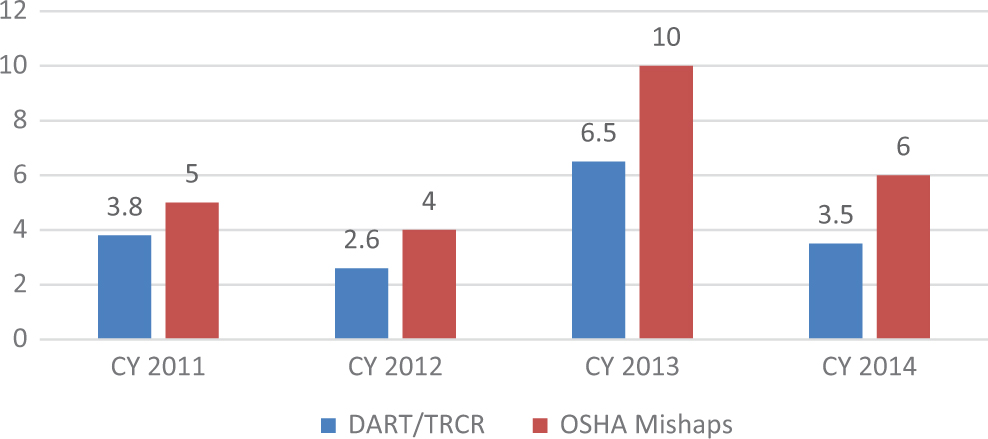
DART, OSHA mishaps, and TRCR by calendar year (CY). Number of injuries / (number of employee hours worked/200 000), Because the skin is an important barrier, any injury that causes a imperfection in the skin results in a work restriction of a laboratory employee from working with biological agents. The DART rate is largely attributable to this strict restriction criterion. DART, days away, restricted, or transferred; OSHA, Occupational Safety and Health Administration; TRCR, total recordable case rate.
Last, near misses are information-rich events. They often reveal risks or aspects of scientific or infrastructure operations that were previously unknown. It is this last piece of data—managing the unknown or unexpected—that is of greatest value to the senior leaders of a biocontainment organization.
Near Misses, First Aid-Only Injuries, and Process Failures
The NBACC started tracking near misses or process failures in 2009 while laboratory operations were located within leased laboratory space, and expanded data collection occurred with activation of the NBACC’s biocontainment laboratories in 2011. It is important to note that first aid injuries are not near misses—they are events that have a negative outcome for an employee. These injuries can be a simple cut finger, or they can be more serious, like a cut finger within a biological safety level 3 (BSL-3) or BSL-4 space. Such events bring all facets of occupational health and safety together to determine if the employee has a simple injury or if he or she is potentially exposed to a risk group 3 or 4 biological agent or toxin. First aid injuries are often ignored as reportable events in most industries, because tracking them is time-consuming and corrective actions are usually at the individual level. However, recording first aid injuries can reveal weaknesses in standard operating procedures as well as trends in how the staff are complying with wearing personal protective equipment. As a result of this, the NBACC Health and Safety Office labels all events and near misses into the following categories:
First aid-only injuries: cuts, bruises Equipment failures: failures of centrifuges, biological safety cabinets, ice machines, freezers (ie, failures that affect laboratory or infrastructure operations or place employees at risk) Personal protective equipment failures: failures of respirators, BSL-4 suits (including gloves) Facility process failures: failures of building systems, such as effluent pipes and vents, autoclaves, and HVAC (heating, ventilating, and air conditioning; eg, supply air, grade D breathing air) Security failures: failures of security and biosecurity procedures (eg, doors left unsecured, misplaced keys, record discrepancies) Laboratory process failures: failures of laboratory procedures (eg, spills, failed shipments, improper airlock procedures, improper disinfectant)
Preventing Accidents
The success of the program increases with the number of near-miss events being reported. At the NBACC, new hires are trained on the importance of reporting injuries (no matter how small) and near-miss events from their initial on boarding with the company. The emphasis on reporting is reinforced in other safety trainings as well as through a pervasive culture of continuous improvement and a no-fault culture of reporting (eg, when there are no negative consequences for staff reporting mishaps).
Case Study
Once a significant number of events have been recorded, hazard trends can be tracked and targeted for meaningful corrective action. For example, in 2012, the NBACC commenced its BSL-4 operations, which included the start-up of a BSL-4 suit laboratory. In these spaces, workers are required to wear supplied air completely encapsulating environmental suits. They are also required to complete a chemical decontamination shower while wearing the suit as they exit the BSL-4 suite. During these initial stages, there were many reports of BSL-4 suits leaking as employees took their chemical showers (Figure 2). The cause of the leaks turned out to be tiny imperfections in the seams of the suits or simply pin holes. Although the leaks did not represent a risk to staff, the reports allowed the NBACC to identify specific problem areas on the suits and, more important, prevent further leaks by reinforcing seams and other identified weak points. The NBACC even changed the type of suits that were ordered as a way to further prevent suit leaks. The result of this effort was a 61% reduction in BSL-4 (personal protective equipment) failures.
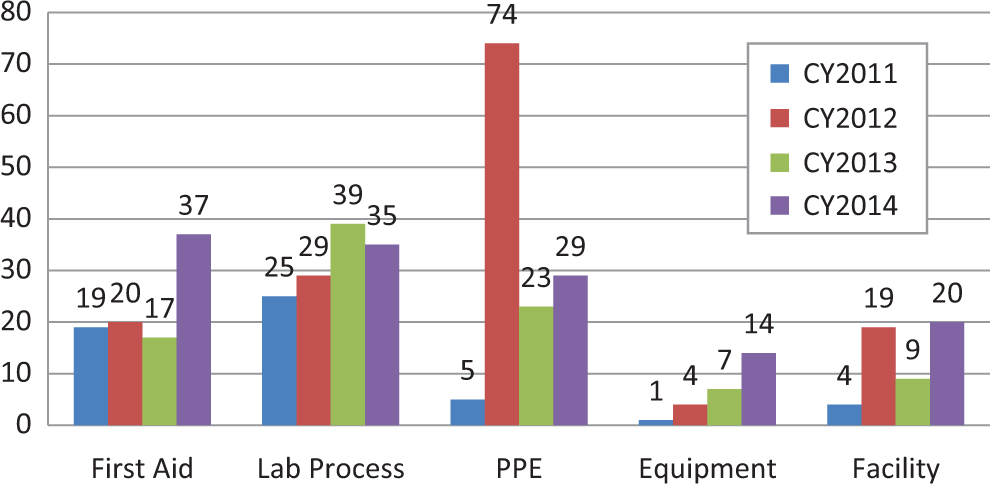
Near-miss data by year and category. Although the National Biodefense Analysis and Countermeasures Center (NBACC) had a small bioforensic footprint in another facility prior to calendar year (CY) 2011, it commenced biosafety level 2 (BSL-2), BSL-3, and BSL-4 operations in CY 2012 in approximately 11 000 ft2 of laboratory space. Animal biosafety level 2 (ABSL-2), ABSL-3, ABSL-4, and BSL-4 suit operations and cabinet laboratory operations commenced in CY 2013 to bring the total research space to approximately 50 000 ft2—an increase of 354%. More medium- and high-risk research equated to more reports of mishaps in CY 2013. OSHA mishaps decreased in CY 2014, as the NBACC found ways to limit the number of injuries in which staff were actually restricted from working within the containment suites. CY, calendar year; PPE, personal protective equipment.
Reducing Risk
Once a strong culture of reporting has been established within an organization, trends in hazards or risks can be followed with more accuracy. In general, the goal is to reduce the number of serious or more consequential accidents and illnesses. However, another benefit of a robust near-miss reporting system is the reduction in the severity of an event. Staff are not only encouraged (and often rewarded) to report failures but also empowered to do so quickly. This speed at which a failure is reported can significantly influence the outcome of the event.
Case Study
An employee working in a BSL-3 space dropped 5 bacterial plates inoculated with a risk group 3 biological agent. Three of the plates opened on impact, and the employee instinctively put the lids back on, placed them in the biosafety cabinet, and disinfected the area. The employee was not wearing respiratory protection at the time. The entire sequence took <45 seconds—without a culture of near-miss reporting, such an event might have gone unreported. After all, there was no spill of liquid material from the plates, and there seemed to be no consequences to this event. However, the employee reported the event immediately to the Health and Safety Office, and the speed of the report as well as the resulting medical response significantly reduced the severity of the outcome of the event.
The risk group 3 agent that the employee was incubating had a particularly low infectious dose (<100 colony-forming units), and following the protocol published by the Centers for Disease Control and Prevention, the NBACC competent medical authority recommended a full panel of blood tests and postexposure prophylaxis to be started immediately. As it turned out, the blood tests taken postevent revealed that the employee had seroconverted to the agent in the plates. It is reasonable to assume that the cause of the seroconversion was the 45 seconds spent in the vicinity of the dropped plates without respiratory protection. The drop to the floor had imparted enough energy to aerosolize the agent from colonies adhered to the media on the plates.
Although the employee completely cleared the bacterial agent over the course of the eradication phase of treatment, it is the medical opinion of the competent medical authority that, had the incident not been reported immediately and the employee immediately placed on postexposure prophylaxis, the outcome would have been more severe—possibly even with the employee presenting with disease. This case study is an example of an information-rich event: the NBACC learned a great deal about the weaknesses in laboratory practices, as well as incident response. Many procedural changes and corrective actions resulted from the event. For example, improvements were made in the methods of securing plates of infectious material during movement outside primary containment. In addition, a new policy was published and implemented mandating the use of respiratory protective equipment for any procedures in which an agent with an infectious dose <1000 plaque-forming units is outside primary containment and not inside a sealed container. These changes help to ensure that that an exposure of this type would not be repeated in the future. Although costly for the employee and the organization, the event is a good example of how a robust no-fault culture of reporting that is embraced by employees reduced the consequences of an unfortunate accident.
Managing the Unknown: New and Evolving Risks
Risk identification is the term used for how risks come to be identified and initially known within an organization. Biodefense laboratories are facilities that are engineered for personnel, product, and environmental protection; consequently, they are some of the most complex and interdependent building systems in the world. The NBACC was designed, constructed, and subjected to commissioning and endurance testing on all safety and security systems prior to the commencement of biological select agents and toxins operations. 9 However, there are many performance characteristics of engineering systems, equipment, and standard operating procedures that can be seen only in real time when the building is under its baseline “research load.” There is a multitude of potential process failures, including facility process failures, equipment failures, and laboratory process failures, that result from the highly interdependent nature of engineering systems. These interoperability effects are simply unknown to the designers and do not present until all systems are fully operational and interacting.
Near-miss reporting at the NBACC also takes into account the recording of facility and equipment failures. The preoccupation with failures—with what can go wrong—is another hallmark of an HRO and one that is well tested in other industries, such as commercial nuclear power production and commercial airlines. 10 All NBACC staff are trained to pay attention to small operational deviations and disruptions to ensure that unexpected events are reported, investigated, and ultimately used to manage the risk of novel and evolving system failures from ballooning into a major accident.
Case Study
In 2013, an NBACC BSL-3 suite began to experience backflows of air and water from the drain piping connected to the effluent decontamination system. These backflows were discovered by staff who would enter a laboratory and notice a small amount of water on the floor next to a sink or toilet. This unexplained event, however, was immediately reported to the Facilities Management Office, and there was increased vigilance by all staff for any repeats of this type of potential backflow. Other backflow events occurred and could be correlated with other building systems operations (eg, the operation of the autoclaves and the effluent decontamination system). After it was confirmed that a backflow of pressure was occurring in the drain lines, major resources were brought to bear on the problem, which was favorably resolved by adjusting the plumbing network. This case study is just one example of how a culture of near-miss reporting can identify new risks and vulnerabilities in building or operational systems, reduce the consequences of events, and prevent future failures.
Communicating Lessons Learned
Tracked data, including near misses, are provided to the NBACC leadership and are a standing agenda item at its weekly meetings. The NBACC communicates summaries of all accidents and process failures (including all first aid and near-miss events) to its staff through a monthly “Lessons Learned” document, which is reviewed in the Institutional Safety Committee and published through the Infrastructure Operations Director. The publication includes a summary of the incident without sensitive information (eg, security-related information or personally identifiable information [to permit broader distribution]), a cause of the incident, details of corrective actions, and any global lessons that can be learned. The incidents from each month are reviewed in detail during the monthly Institutional Safety Committee meeting, where any committee member can add to or comment on any event for the publication.
Although corrective actions are tracked and closed out through a different system, distribution of the monthly “Lessons Learned” publications is an important way to keep the staff informed about how their actions—namely their reports—are taken seriously, and it reinforces a culture of continuous improvement within the organization. The process also allows the NBACC leadership to ask its own questions and engage employees about accident trends from the executive and strategic levels.
Conclusions
Reporting and tracking of first aid, process failure, and near-miss events is an effective way to identify and manage risk in biocontainment laboratories. It takes dedicated technical staff and disciplined managers to be vigilant for detecting weaknesses in operational processes and challenging the status quo with what could go wrong. Safeguarding staff and preventing environmental releases are the ultimate goals of any health and safety program. Recording seemingly inconsequential events as part of a no-fault culture of near-miss reporting, in addition to OSHA reporting, is a powerful tool that can reduce the severity of accidents, prevent serious mishaps in the future, and help to manage new and evolving risks.
Footnotes
Declaration of Conflicting Interests
The author(s) declared no potential conflicts of interest with respect to the research, authorship, and/or publication of this article.
Funding
The author(s) disclosed receipt of the following financial support for the research, authorship, and/or publication of this article: This work was funded under agreement HSHQDC-07-C-00020, awarded to the Battelle National Biodefense Institute by the Department of Homeland Security Science and Technology Directorate for the management and operation of the National Biodefense Analysis and Countermeasures Center, a federally funded research and development center. The views and conclusions contained in this document are those of the authors and should not be interpreted as necessarily representing the official policies, either expressed or implied, of the US Department of Homeland Security or the US government. The Department of Homeland Security does not endorse any products or commercial services mentioned in this presentation.