




Abstract
Background:
Cancer pain, a common complication of this disease, has been widely treated by electroacupuncture in recent years. However, there are numerous treatment parameters that are not conducive to clinical translation applications. This study aims to summarize the stimulation parameters commonly used in electroacupuncture treating cancer pain by data mining and visualization techniques to provide a basis for the future acupuncture technology transformation and selection of optimal stimulation parameters.
Methods:
Nine databases, including Pubmed, Cochrane Library, Embase, Web of Science, OVID, China National Knowledge Infrastructure Database, China Biology Medicine disk, China Science and Technology Journal Database, and Wanfang Database, were searched for clinical studies on electroacupuncture treatment cancer pain published between January 2012 and September 2022. A database was established using Microsoft Excel 2020 and analyzed with SPSS Modeler 18.1 software and SPSS statistics 26.0 software.
Results:
Twenty-four articles were included according to the established criteria. The most used electroacupuncture stimulation parameters were a dilatational wave, the current frequency of 2/100 Hz, stimulation duration of 30 minutes per treatment, and frequency of treatment once a day. Fifty-eight acupoints were mentioned, and the total frequency of acupoints involved was 156 times. The most used ones include Zusanli (ST36), Sanyinjiao (SP06), Hegu (LI04), Neiguan (PC06), Quchi (LI11), Taichong (LR03), Ashi point, Jiaji point, and those most generally used acupoints that are closely arranged on the Stomach Channel of Foot Yangming and the Spleen Channel of Foot Taiyin. The association analysis of acupoints revealed that the most supported acupoint pair was Sanyinjiao (SP06) and Zusanli (ST36). Cluster analysis demonstrated 3 groups, 1 for obligatory acupoints, 1 for Ashi point, and the third for Jiaji point.
Conclusions:
A dilatational wave, the current frequency of 2/100 Hz, 30-minute stimulation, and acupoints of the Stomach Channel of Foot Yangming and the Spleen Channel of Foot Taiyin selection are frequently used in electroacupuncture for treating cancer pain. Due to the limitations of this study, further research and more standardized, multi-center, large-sample clinical trials can be carried out to guide optimizing acupuncture treatment schemes and promote the formation of TCM-characteristic technologies for cancer pain.
Introduction
Caner pain is defined by the International Association for the Study of Pain defines chronic cancer related pain as chronic pain caused by the primary cancer itself, or metastases or its treatment. 1 Pain is one of the most common, disabling, and frightening symptom of patients with cancer, with an incidence rate close to 70%.2,3 Pain management is one of the key parts of comprehensive therapy for cancer as it affects the quality of life (QoL) of patients. 4 Modern medicine adopts “three-step” analgesic drug therapy to treat cancer-related pain. 5 However, due to its inevitable adverse effects such as nausea and vomiting, constipation, even respiratory depression, and potential to promote tumor growth, as well as the subjective resistance of patients to analgesics, the use of conventional analgesics is limited. 6 For these reasons, it is desirable to develop complementary and alternative methods with increased efficacy and safety for relieving cancer pain.
Acupuncture, a traditional Chinese medicine (TCM), is important in treating cancer pain. 7 In TCM theory, cancer pain refers to “Pain Syndrome,” and the major etiology and pathogenesis are caused by 2 factors: one is the cold evil that stagnates qi and blood, blocking the channel circulation; the other is the deficiency of qi and blood and the loss of channel nourishment. Acupuncture can unblock the channel and relieve pain. Studies have depicted that acupuncture can relieve cancer pain and reduce the dose and side effects of analgesics.3,8 Moreover, acupuncture is more accepted by patients, which improves their compliance. 9
Electroacupuncture (EA) is a modified method of traditional acupuncture, combining needles and electrical stimulation. 10 EA has the characteristics of precise stimulation amount, simple operation, standardized treatment, improved efficacy, and labor cost saving. EA can also improve the pain threshold of patients and reduce their sensitivity. 11 Saraswati et al 12 found that medical therapy combined with EA decreased the pain scale, increased plasma β-endorphin levels, and improved the QoL of patients with stage III cervical cancer. Therefore, it is significant to actively explore treating cancer pain with EA.
EA has the characteristic of parameter objectification. However, in clinical applications, there are many EA parameters to choose from in treating cancer pain, lack of uniform specification, and few relevant studies. Therefore, we evaluated the literature of the last decade to analyze the EA stimulation parameters by data mining and co-occurrence analysis techniques to provide evidence for the optimal parameter selection for EA treatment of cancer pain.
Methods
Retrieval Strategy
We searched 9 databases, including Pubmed, Cochrane Library, Embase, Web of Science, OVID, China National Knowledge Infrastructure Database, China Biology Medicine disk, China Science and Technology Journal Database, and Wanfang Database from January 2012 to September 2022. Search keywords were as follows and modified according to different databases: “Electroacupuncture,” “electrical acupuncture,” “Electrical stimulation,” “Cancer pain,” “Cancer-Associated Pain,” “Neoplasm-Related Pain,” “Oncological Pain,” “Tumor-Related Pain,” “Cancer Related Pain,” and “Neoplasm Associated Pain.” Further relevant studies were manually searched. There was no language limitation.
Inclusion Criteria
(1) Types of studies: Randomized controlled clinical trials that evaluated EA for cancer pain were included.
(2) Types of participants: Patients with pathologically or cytologically diagnosed malignant tumors, with pain caused by tumor factors and not related to treatment modalities such as radiotherapy or surgery.
(3) Interventions: EA as the major intervention or with additive treatments.
(4) EA has definite efficacy in treating cancer pain.
(5) Clinical trials on EA treatment with explicitly selected points and parameters.
(6) Studies with the same data and results were regarded as one article.
Exclusion Criteria
(1) Pain caused by non-tumor factors.
(2) Nonclinical studies such as animal experiments, reviews, meta-analyses, or erratum.
(3) Studies that do not apply EA as the major intervention.
(4) Studies that do not list any parameters observed in this study or only describe the general information without any detail.
(5) Studies for which the full text is not available.
Literature Quality Management
Three levels of quality control were strictly used for literature management. First, all the titles and abstracts of the retrieved articles were screened by 2 independent reviewers (QY Li and WX Yang), and those which did not meet the criteria were excluded according to the inclusion and exclusion criteria. The second screening was performed by reading the full text of the remaining articles, mainly for the clearly stated parameters (ie, current frequency, wave, and stimulation duration) and statistical significance of the difference in efficacy between the treatment and control groups. Finally, 2 researchers (LJ Jiao and H Liu) were responsible for the complete examination and data extraction with a predefined form. Any disagreement in the process was resolved by discussion between the 2 reviewers or after consultation with a third reviewer (J Shi).
Data Extraction
Microsoft Excel 2020 was used to establish the database. Eight items, including the title, the name of the authors, year of publication, stimulation duration, current frequency, wave, frequency of treatment, and acupoints selection, were recorded in the database. After entering the data, proofreading was carried out to ensure the accuracy of the data.
Literature Quality Evaluation
The bias risk assessment tool was used to evaluate the quality of the included literatures, including randomized method, assignment hiding, blinding, conclusion data integrity, selective reporting, and other biases. Each is classified as high risk, low risk, or unclear.
Data Analysis
Excel was used for the descriptive statistics of the stimulation time, current frequency, waveform frequency, and treatment frequency of EA acupoint frequency and channels in the included literature. SPSS Modeler 18.0 was used to perform the association analysis for EA parameters and acupoints and analyze their correlation. SPSS statistics 26.0 was used to perform the cluster analysis of acupoints.
Results
Retrieval of Studies
A total of 1992 articles were found in the 9 databases and then imported into NoteExpress Version 3.6.0 for selection. Among these, 411 were removed for duplicates. Then 1488 articles were excluded after screening the titles and abstracts; 93 articles were eliminated through full-text assessment. Finally, 24 articles were included for further analysis. The exclusion criteria and selection flow are displayed in Figure 1. The literature characteristics are shown in Table 1.

Flow diagram for the selection of articles.
Basic Features of the Included Literature.

Among the 24 included articles, 10 articles14,15,17-20,22,24-26 were grouped by random number table, and 13 articles13,16,21,23,27-35 only mentioned random allocation, among which 1 article 36 was grouped by according to analytical methods and intentions. Five articles15,20,21,32,33 involved the allocation hiding. Four articles15,21,28,31 involved blind method, and the rest were not mentioned. The data of 24 articles were complete, and there were no selective reporting results and other bias, in Figures 2 and 3.

Risk of bias graph.
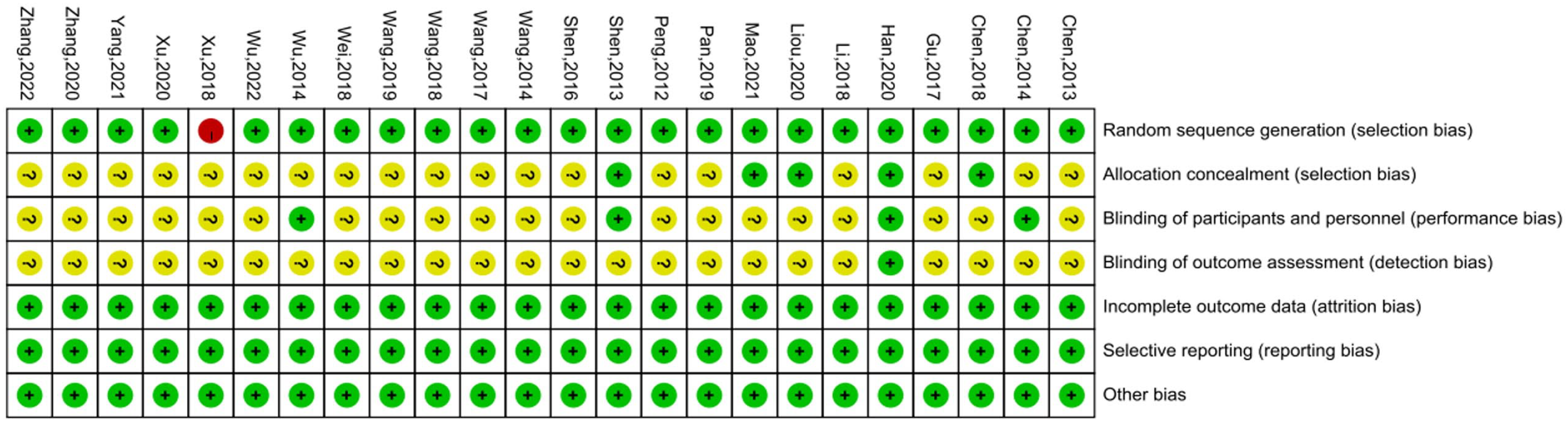
Risk of bias summary.
Frequency of Treatment
Four frequencies of treatment were mentioned in the 24 studies. The top 3 were: once a day (70.83%), once every other day (16.67%), and once a week (12.5%), as illustrated in Table 2.
Frequency of Treatment.

Frequency of EA Parameters
Frequency of stimulation duration
Three stimulation durations were mentioned in 24 studies, including 30 minutes (79.17%), 20 minutes (16.67%), and 15 minutes (4.17%), as demonstrated in Table 3.
Frequency of Stimulation Duration.

Current frequency
Seven current frequencies were mentioned in 23 studies, ranging from 2 to 100 Hz. The top 3 were: 2/100 Hz (39.13%), 2 Hz (30.43%), and 15 Hz (13.04%), as displayed in Table 4.
Current Frequencies.

Frequency of waveform
Twenty-one studies mentioned the waveforms. Dilatational waves (52.38%) were used significantly more frequently than Continuous waves (33.33%), as illustrated in Table 5.
Frequency of Waveform.

Association analysis of EA parameters
The association rules were analyzed for 4 parameters (stimulation duration, frequency of waveform, current frequency, and frequency of treatment). The minimum support level was set to 20, the minimum confidence level was set to 80, and the maximum number of antecedents was 2. Eight association rules were obtained with the Apriori algorithm, as displayed in Table 6 and Figure 4. The results demonstrated a combination of dilatational wave, 30 minutes stimulation, current of 2/100 Hz, and once a week was most commonly applied EA treatment of cancer pain.
Association Analysis of EA Parameters.


The network of association analysis of electroacupuncture (EA) parameters.
Analysis of Acupoints and Channels
Analysis of acupoints
Fifty-eight acupoints were mentioned in the included studies. A total of 156 mentions of acupoints appeared in these studies. Acupuncture points mentioned more than 5 times included Zusanli (stomach meridian, ST36), Sanyinjiao (spleen meridian, SP06), Hegu (large intestine meridian, LI04), Neiguan (pericardium meridian, PC06), while Quchi (large intestine meridian, LI11), Taichong (liver meridian, LR03), Ashi point, and Jiaji point had a cumulative frequency accounting for 46.79% of the total, as illustrated in Table 7.
Acupoints Mentioned More Than 5 Times in Included Studies.

Analysis of channels
The 58 acupoints were statistically analyzed for their corresponding channels. Sixteen channels were involved, of which the Stomach Channel of Foot Yangming was the most used. The top 3 with the highest frequency were the Stomach Channel of Foot Yangming, the Spleen Channel of Foot Taiyin, and the Large Intestine Channel of Hand Yangming, with a cumulative frequency accounting for 40.38% of the total. The frequency of acupoints and the channels they belong to are depicted in Table 8.
Analysis of the Channels.

Association analysis of acupoints
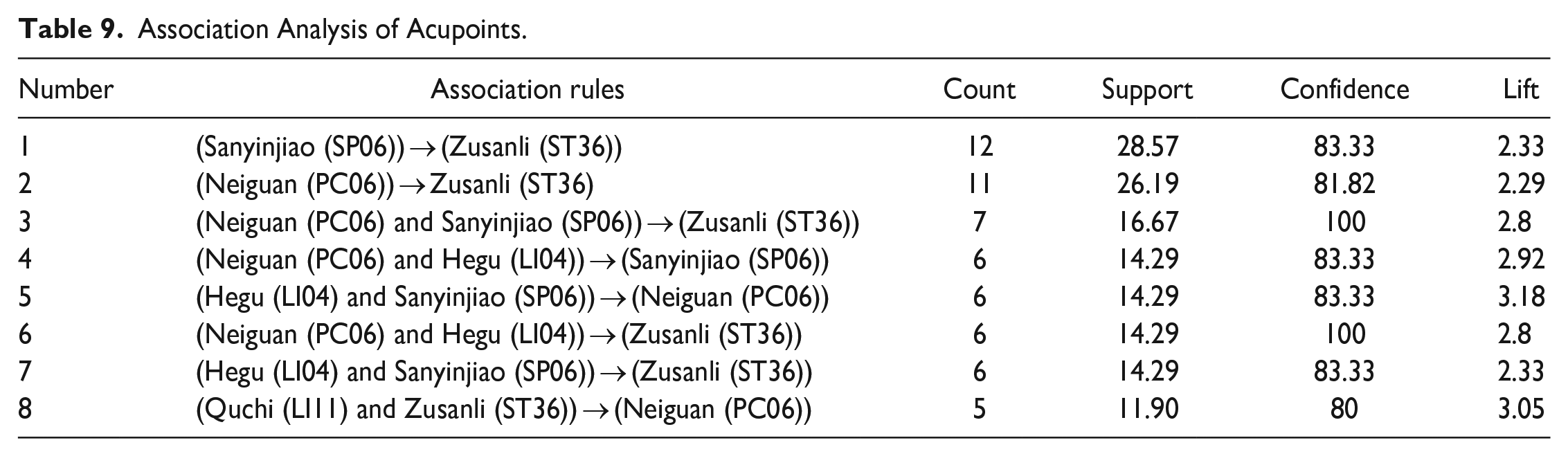
The association analysis was performed on the acupoints used at least 5 times, with the setting of the minimum support to 10, the minimum confidence to 80, and the maximum number of priors to 2. A total of 8 association rules were obtained with the Apriori algorithm, as illustrated in Table 9. The visualization result is displayed in Figure 5. The results indicated that Sanyinjiao (SP06) and Zusanli (ST36) had the strongest association.
Association Analysis of Acupoints.

Network of association analysis of acupoints.
Cluster analysis of acupoints
A cluster analysis was performed on acupoints used at least 5 times. Three categories of effective clusters were obtained, 1 of which contained 2 groups of acupoints: Zusanlii (ST36)-Sanyinjiao (SP06)-Neiguan (PC06), and Hegu (LI04)-Quchi (LI11)-Taichong (LR03); one for Ashi point (Ouch point); and the third for Jiaji point (Figure 6).

Cluster analysis of acupoints.
Discussion
Cancer pain takes pain as the main symptom, which belongs to the category of “pain syndrome” in the theory of traditional Chinese medicine. It is closely related to the theory of “meridians, qi and blood, and viscera.” Acupuncture can dredge the channels and harmonize qi and blood. Acupuncture combined with electrical stimulation can effectively play an analgesic role. Therefore, EA has a positive significance in treating cancer pain. However, in clinical practice, the choice of EA parameters is easy to ignore, among which the main parameters are stimulation duration, waveform, current frequency, and frequency of treatment.
Our study indicated that the stimulation duration of EA for cancer pain varied from 20 to 30 minutes, with 30 minutes being the most common duration. Wang and Qiang 37 found that the duration of clinical EA stimulation was 25 to 45 minutes, and the most commonly used treatment was 30 minutes, which achieved better efficacy and was consistent with the course of acupuncture. Ye et al 38 also reported that 30 minutes of EA stimulation for analgesia was appropriate because the amount of cyclic guanosine monophosphate (CGMP) in the telencephalon of rats was significantly reduced and slightly increased in the brainstem, while the pain thresholds were significantly increased during this process. Ye et al 39 also found that 30 minutes was the best analgesic time for EA, which can significantly reduce the content of guanine riboside-3'5'-cyclic phosphate lipid in rat telencephalon and increase the pain threshold.
EA is mainly used to treat pain because opioid peptides and other related factors in the body can regulate the endogenous physiological mechanism, inhibit the transmission and expression of pain information, and play an analgesic role. 40 However, the release of opioid peptides induced by EA is dependent on the frequency and intensity 11 ; that is, the types of neurotransmitters released by EA at different frequencies are different. A frequency of 2 Hz can cause the release of neuropeptides such as endorphins and enkephalins, whereas 100 Hz can cause the release of dynorphin. On the other hand, the density wave used at 2 and 100 Hz produces a synergistic effect and plays a strong analgesic role. In our study, frequency analysis of the current revealed that 2/100 Hz was the most frequently applied. Also, the analysis of waveforms depicted that dilatational wave was the most used for cancer pain, and both results were consistent. Jie et al 41 found that 2/100 Hz revealed superior clinical efficacy in treating migraine compared with 2 and 100 Hz. Clinical studies have depicted that 2/100 Hz significantly reduces the dose of fentanyl requirements in patients after lung surgery compared with the application of 2 or 100 Hz EA stimulation. 42
In clinical research, the dilatational wave is more effective than the continuous wave in releasing the pain caused by cervical spondylosis and could shorten the course of treatment of cervical spondylosis. 43 Three waveforms were used to intervene rats with spinal cord injury in an experimental study. Compared with sparse and dense waves, the dilatational wave was not easy to adapt to the body. Dilatational waves could effectively maintain the amount of stimulation, promote nerve regeneration, repair the injury in rats, reduce secondary spinal cord injury, accelerate blood circulation, and promote the recovery of motor function. 44
Currently, there is a lack of universal clinical guidelines for the frequency of acupuncture treatment. 10 Zhao et al 45 explored the analgesic effects of EA in rats and concluded that EA had no analgesic effect at 3 or 6 hours intervals but at 12 hours or 24 hours, with 24 hours being the most effective treatment. Wang et al 46 also found that at different intervals, the 24 hour group was significantly more effective in reducing pain levels and increasing pain thresholds in rats with inflammatory pain and in promoting POMC mRNA and PENK mRNA expression were more effective. In addition, Chen 20 found in the treatment of patients with liver cancer pain by electroacupuncture combined with ear acupuncture that patients with different degrees of cancer pain were given different electroacupuncture treatment schemes. Patients with mild to moderate cancer pain were treated once every other day, 3 times a week, and patients with severe cancer pain were treated once a day, 6 times a week, and both were treated with dense waves, with a frequency of 2/100 Hz. The results showed that both of them could reduce NRS scores and the number of episodes of pain, and improve the quality of life of patients. This study result also indicates that increasing the frequency of electroacupuncture treatment can significantly improve cancer pain in patients.
The analysis of channels revealed that clinical EA treatment for cancer pain attached importance to point selection among the Stomach Channel of Foot Yangming and the Spleen Channel of Foot Taiyin. According to traditional Chinese medicine theory, the spleen and stomach channels have a close relationship between the external and internal channels. The spleen and stomach are the sources of qi and blood biochemistry. If the spleen and stomach are out of balance in the setting of cancer, it becomes a consumptive disease, consuming qi and blood and resulting in a lack of qi and blood. This causes or aggravates cancer pain. 47 As a channel with sufficient qi and blood, the Yangming channel has a large amount of qi and blood. Combined with the Spleen channel, it can not only stimulate qi and blood but also achieve the therapeutic purpose by connecting the Large Intestine, Stomach, and Spleen channels in sequence, which can pass through the whole body and also regulate the qi of the channel to unblock the qi and blood of the channel. 48 Hu 49 found that warming acupuncture and moxibustion combined with oxycontin in the treatment of primary liver cancer pain, which selects the upper acupoints of the spleen and stomach channels, when compared with the control group can quickly and effectively relieve the pain of patients.
The acupuncture points with a frequency greater than 5 were Zusanli (ST36), Sanyinjiao (SP06), Hegu (LI04), Neiguan (PC06), Quchi (LI11), Taichong (LR03), Ashi point, and Jiaji point. The acupuncture points are mainly used to regulate the spleen and stomach and unblock qi and blood, which are mentioned in other studies. 50
Zusanli (ST36) belongs to the Stomach Channel of Foot Yangming, which can regulate the spleen and stomach and dissipate phlegm for resuscitation. Lee et al 51 found that EA stimulation of Zusanli (ST36) significantly decreased substance P and increased the concentration of beta-endorphin in blood and brain samples in a cancer pain mouse model. Sanyinjiao (SP06) belongs to the Spleen Channel of Foot Taiyin, which can regulate the function of the liver, spleen, and kidney and also strengthen a healthy qi. Shen et al 52 found that in the rat model of childbirth, EA stimulation of Sanyinjiao (SP06) point can increase the pain threshold of rats and the expression level of enkephalin in serum. In the association rules of acupoints, Zusanli (ST36) and Sanyinjiao (SP06) have the most closely related acupoints, which coincides with the frequency analysis results of acupoints. Therefore, these 2 acupoints can be used as the most commonly used acupoints for cancer pain treatment. Hegu (LI04) is the source point of the Large Intestine Channel of Hand Yangming and one of the siguan point, which is an important point for treating pain. Hegu (LI04) was also mentioned in Zhang et al 48 that Hegu (LI04) can be used as the basic point for treating cancer pain. The Large Intestine Channel of Hand Yangming belong to channel of Yangming, which is rich in qi and blood. By stimulating the points on the channel of Yangming, it can promote the circulation of qi and blood. 53 Quchi (LI11) also belongs to the large Intestine Channel of Hand Yangming, which can harmonize qi and blood and unlock the channel to relieve pain.
Studies have demonstrated that Ashi point is closely related to the level of pain threshold, disease state, and mood of patients, 54 and as the location of pain points caused by different tumors is different, the selected acupoints are also different. 48 Therefore, the acupoints and stimulation methods differ when EA acts on the Ashi point to treat pain in different tumor states. In addition, in 1997, Melzack et al 55 found a good correspondence between myofascial trigger points and acupuncture points. With the deepening of research, it was confirmed that acupuncture points and myofascial trigger points had a good correlation 56 and a high degree of consistency (99.5%), especially in the treatment of painful diseases. 57 As the reaction point of disease, the Ashi point is also a special point for the treatment of pain. 58 Wang et al 59 depicted that stimulation of the Ashi point could downregulate the expression of inflammatory mediators in the area of pain, inhibit the expression of neurons in the posterior horn of the spinal cord, and inhibit osteoclast and osteoblast cell activity, thus increasing the local pain threshold. Taichong (LR03) belongs to the Liver Channel of Foot Jueyin, which can adjust qi and regulate the liver, soften tendons, and relieve pain. Acupuncture points are used to activate blood and relieve pain by loosening muscle ligaments.
Cluster analysis indicated 3 major categories among the acupoints used at least 5 times. One was 2 groups of acupoints: Zusanlii (ST36)-Sanyinjiao (SP06)-Neiguan (PC06) and Hegu (LI04)-Quchi (LI11)-Taichong (LR03), one for Ashi point (Ouch point), and the third for Jiaji point.
Zusanlii (ST36), Hegu (LI04), and Quchi (LI11) are Yang Ming meridian points; the combination of the 3 points mainly regulates qi and blood so that qi can rise and fall and blood can flow. Neiguan (PC06) is 1 of the 8 confluence points, and Sanyinjiao (SP06) is an intersecting point of the Spleen, Liver, and Kidney Meridians; the combination of the 2 points can dredge channels and collaterals. Tai Chong dredges qi to relieve pain. Combined with clinical experience (ie, the frequency of use of the above points), the first and second categories of the cluster analysis represent the core acupoints of acupuncture for cancer pain and can be used as the basic prescription of acupuncture for cancer pain. The third category can be used as a supporting acupuncture point, such as the inaccessible cancer type of cancer pain can be added to the Jiaji point.
In summary, acupuncture for cancer pain should be based on invigorating qi and blood and draining the meridians, with Zusanlii (ST36)-Sanyinjiao (SP06)-Neiguan (PC06) and Hegu (LI04)-Quchi (LI11)-Taichong (LR03). Zusanlii (ST36), Sanyinjiao (SP06), Neiguan (PC06), Hegu (LI04), Quchi (LI11), and Taichong (LR03) combined with Ashi point as the basic acupuncture point prescription.
However, during the treatment process of EA, patients may experience potential side effects and risks. 60 When adjusting the frequency of current, it is not possible to suddenly increase the current, which can easily cause strong muscle contraction, resulting in needle bending or breakage. The stimulation duration should not be too long. If the patient is in a state of mental tension, prolonged electrical stimulation can cause needle sickness. Different frequency of treatment can change the sensitivity of the body to electroacupuncture, thereby affecting the therapeutic effect. In addition, although different waveforms can improve patients’ tolerance, prolonged alternating electrical stimulation can leave patients in a highly concentrated state, which can easily affect their psychological status and clinical efficacy. Therefore, it is necessary to develop standardized and individualized treatment plans based on the patient’s physical condition, psychological state, and patient compliance, in order to improve the clinical treatment effect and achieve the goal of treating the disease.
In addition, the small sample size and the low quality of literature included in this study, and there is a lack of scientific and standardized evaluation standards for the quality of the literature, which maybe affect the results of this study.
Conclusions
There is an interaction between EA parameters. Most scholars have explored more effective frequencies, waveforms, and stimulation times of the same acupoint, which provides data support for guiding standardized treatment of cancer pain.
In our analysis, dilatational wave, a current frequency of 2/100 Hz, 30 minutes stimulation, acupoints of the Stomach Channel of Foot Yangming, and the Spleen Channel of Foot Taiyin selection are the most frequently used EA treatment for cancer pain. Due to the potential side effects and risks, EA treatment should be performed under the guidance of a professional physician.
Due to the limitations of this study, further research and more standardized, multi-center, large-sample clinical trials should be carried out to guide optimizing acupuncture treatment schemes and promote the formation of TCM-characteristic technologies for cancer pain.
Footnotes
Acknowledgements
The authors would like to thank all the researchers in the working group.
Author Contributions
WXY obtained funding for the study. All authors conceptualized and designed the study. QYL, WXY, HL, and LJJ did the literature retrieval work together. QYL, WXY, and YBG were responsible for literature screening. QYL and WXY extracted, assembled, analyzed, and interpreted all the data, and drafted the manuscript. YS conducted a critical review of the manuscript. All authors read and approved the final manuscript.
Availability of Data and Materials
All data generated or analyzed during this study are included in this published article.
Declaration of Conflicting Interests
The author(s) declared no potential conflicts of interest with respect to the research, authorship, and/or publication of this article.
Funding
The author(s) disclosed receipt of the following financial support for the research, authorship, and/or publication of this article: This work was supported by National Natural Science Foundation of China (No. 82205213), Shanghai Sailing Program (No. 20YF1450800).
Ethics Approval and Consent to Participate
All data used in this study drew from publicly available sources and ethical approval was not required. Not applicable.
Consent for Publication
No data from any individual person was contained. Not applicable.
