



Abstract
We reviewed the research into the mechanisms of growth of triple negative breast cancer (TNBC) based on laboratory pre-clinical studies that have shaped understanding of the disease over the past decade. In response to these findings, we propose an approach to potentially prevent cancer metabolic adaptation and recurrence. This paper collates pre-clinical results, first to determine the tumor’s mechanisms of growth and then to source natural substances that could potentially suppress those mechanisms. The results from in vivo and in vitro studies of TNBC were combined first to select 10 primary mechanisms (Hypoxia-inducible factor 1α, Hedgehog, MAPK, MTAP, NF-κ B, Notch, P13K, STAT3, and Wnt signaling pathways plus p53 and POL2A gene expression) that promote TNBC growth, and second to propose a treatment array of 21 natural compounds that suppress laboratory models of TNBC via these mechanisms. We included BRCA mutations in the review process, but only pathways with the most preclinical studies utilizing natural products were included. Then we outlined potential biomarkers to assess the changes in the micro-environment and monitor biochemical pathway suppression. This suppression-centric aim targets these mechanisms of growth with the goal of potentially halting tumor growth and preventing cancer cell metabolic adaptation. We chose TNBC to demonstrate this 5-step strategy of supplementary therapy, which may be replicated for other tumor types.
Keywords
Background
The world’s cancer burden has risen to 18.1 million new cases and 9.6 million cancer deaths in 2018, with breast cancer leading the cause of cancer death in women (15.0%). 1 People suffering from malignant tumors that are unresponsive to traditional treatments and those living in disadvantaged societies are most vulnerable to mortality. Cancer tumors can survive by changing and adapting their mechanisms of growth in response to chemotherapeutic agents. Some tumor types fail to respond to standard chemotherapy regimens. Tumors can also adapt and alter their mode of action to use biochemical pathways not influenced by the standard pharmaceutical therapies. If a tumor type fails to respond to chemotherapy agents, then some cancer patients can have poor outcomes with no more viable, physiological options available to combat lethal disease progression.
Our aim is to devise a potential treatment approach for the prevention of cancer recurrence using non-pharmaceutical natural compounds. Prospective randomized clinical trials would eventually be required to test the efficacy of this natural therapy strategy. This treatment is intended to be complementary to traditional cancer treatments such as chemotherapy, immunotherapy and radiation, and not a substitute. It is primarily for those patients whose tumors have no pharmaceutical agents left available to them, whose traditional treatment has been completed and those to whom it is not accessible. Our strategy may potentially also be useful for patients with ongoing chemotherapy or immunotherapy treatment if there are no contraindications between the post-treatment drugs and their mechanisms of action and the substances determined using our steps.
The tumor type we use to demonstrate this methodology is triple negative breast cancer (TNBC). TNBC, defined by lack of expression of estrogen and progesterone receptors and lack of human epidermal growth factor HER2 amplification, comprises between 10% and 20% of all breast cancers. 2 Cytotoxic chemotherapy is the typical treatment for TNBC patients, but overall survival is shorter for women with TNBC than with other breast cancer types, with 1 study showing 77% of women survive 5 years after diagnosis compared with 93% of hormone receptor positive patients. 3 Radiotherapy is also typically used and recently immunotherapy has been shown to be effective. No ongoing or maintenance treatment is available. By contrast, hormone positive patients have endocrine therapy (pharmaceutical drugs) available to them as ongoing anticancer treatment. TNBC cell lines representing the various subtypes have different sensitivities to targeted therapies that are under laboratory and clinical investigation. 2 Tumourigenesis in TNBC is influenced by the tumour suppressor gene p53 and mutated or abnormally expressed DNA repair genes, such as the BRCA genes.
Our review involved evaluating in vivo and in vitro studies and review papers to determine mechanisms of growth in TNBC and then to find natural substances suitable for ongoing anticancer treatment. We targeted compounds that are known to inhibit TNBC proliferating pathways. We aimed to find at least 2 natural suppressor substances for each TNBC growth mechanism. Ideally, we hoped to find individual natural compounds that suppressed more than 1 pathway. The natural compounds were ranked as more suitable, according to how many of the specific TNBC growth pathways they are known to suppress. We propose that this new suppression-centric anticancer natural strategy (SCANS) may be applicable to a range of cancer types. By using natural substances that inhibit biochemical pathways and mechanisms that cancer cells are known to exploit, this treatment could potentially act as a secondary form of defense against metastatic growth. This strategy mimics the concept of modern military strategy known as Network-Centric Warfare4,5 which pools resources such as communications and intelligence, amalgamates strategies and applies weapons in combination to create a synergism of effects making a system more lethal than its component parts.
It is thought that only a few tumor-specific metabolic vulnerabilities in cancers have been successfully targeted 6 due to “metabolic plasticity of cancer cells that allows for compensatory adaptions.” 7 Mendez-Lucas et al suggest “There is high flexibility of tumor metabolism and blocking the mechanisms of compensation can lead to stronger inhibition of tumor growth in vivo and the exploitation of combinatorial interventions against compensatory metabolic pathways may lead to more robust inhibition of tumor growth.” It is this metabolic adaptation capability of cancer that our suppression-centric concept addresses. Like the military Network-Centric Warfare concept, targeting many potential routes of adaptation all at once may lead to more effective counter-pressure against tumor progression.
There are currently no clinical trials on humans determining the efficacy of these natural substances on survival rate of TNBC patients. To assist this, we outline biochemical markers that may be suitable for monitoring physiological change while consuming the specific natural substances.
This is the first time that a tumor type has been (1) profiled specifically for its mechanisms of growth and (2) targeted in a suppression-centric way using readily available natural substances identified from pre-clinical laboratory studies with (3) potential biomarkers identified to monitor the potential inhibitory effects of the substances (blocking actions on the identified pathways) with the aim to prevent cancer recurrence.
Methods
A way to visualize the methodology is with the following formula;

Variables: tumor type (T), mechanism (M), suite of mechanisms (SM), SCANS eligible natural compounds (E), SCANS treatment array (TA).
The principle of this formula is to use information from preclinical studies of natural compounds to potentially suppress tumor progression along multiple pathways simultaneously.
The mechanisms (M and SM) are what drives tumor progression in a specific tumor type (T). Eligible compounds (E) are only those that fit the suppression-centric anticancer natural strategy (SCANS) criteria of:
(1) natural compound (2) shown to directly suppress tumor growth (3) in preclinical studies (or human trials) (4) via mechanisms known to influence specific tumor growth (5) that are accessible and obtainable, and (6) have no major drug interactions or medical contraindications.
Our suppression-centric anticancer natural strategy involved 5 steps. These steps are:
Step 1: Search for TNBC Suppression Mechanisms
Step 2: Suppression of TNBC by Natural Compounds
Step 3: Availability of Natural Compounds
Step 4: Safety
Step 5: Measuring Change in Microenvironment
Step 1: Search for TNBC Suppression Mechanisms
First, we searched the medical literature to determine the typical microenvironment and mechanisms of growth of TNBC tumors. In total, we carried out 3 literature searches using the database, Web of Science (v5.13.2) of publications in the 10 years between 2010 and 2020. The first search included the search term TNBC refined by Topic Title of MECHANISM. We also included any suitable additional papers cited from these sources not identified in our search. For these, the time period was not applied.
Some studies demonstrate how conventional chemotherapy agents block specific pathways; however, many of these substances are usually synthetic, available only through pharmaceutical companies and restricted by official health control regulations. These substances, because they are not freely available, are not useful in our SCANS framework for combating tumor growth and do not fit our criteria for practical and feasible blocking mechanisms. However, the mechanisms that chemotherapy agents use to combat TNBC growth are what we searched and focused on. We included only active natural compounds that are shown to have significant effects on TNBC cells in vitro, TNBC in vivo or TNBC human studies. This allowed us to determine different suppression mechanisms to restrict the growth pathways of the tumor type. After identifying mechanisms of TNBC growth, we then searched the database using the mechanism name, for example, “STAT3,” “TNBC” and “In vivo” in an additional, more directed search.
Step 2: Suppression of TNBC by Natural Compounds
Next, we used the Web of Science database and a general internet search engine to find in vivo, in vitro and human studies that show active natural compounds that are found in easily available substances, that is, for sale without prescription by a physician and that successfully inhibit cancer growth of TNBC via the inhibitory mechanisms determined in the first step.
The second database search retrieved published literature (2010-2020) describing animal and human studies, in vivo or in vitro that focused on TNBC using the following “title” or “abstract” search terms; NATURAL then refined by ANTICANCER then BREASTCANCER then TBNC.
Additional publications were included outside of these parameters that we sourced from those publications found within the search. For these, the time period was not applied. When a potential natural compound was identified such as resveratrol, another search using the compound name “RESVERATROL” was used instead of “NATURAL” to capture those articles that omit the word “Natural.”
We ranked each natural substance from 1 to 3 depending on the number of pathways it is shown to suppress. For example, a ranking of 1 is for those natural compounds (that fulfill criteria for Steps 3 and 4) that suppress 1 or more TNBC cell line growth pathways. Our search was completed once we found at least 2 substances for each pathway with at least some that also worked for more than 1 pathway. A large treatment array (TA) of substances allows for choice and substitution if a certain substance does not fit the criteria of Step 4 (safety) for an individual or the supply of a substance cannot be accessed for some reason. A higher ranking reduces the total quantity of compounds required on a daily basis as 1 substance acts on more than 1 pathway.
Step 3: Availability of Natural Compounds
A component of SCANS is for patients to be successful in accessing the natural compounds. Pharmaceutical drugs that suppress cancer proliferation are restricted to patients undergoing traditional anticancer therapies such as chemotherapy, radiotherapy and immunotherapy. These therapies require specialized facilities and are not always available to all that would benefit from them. To ensure the natural compounds that we identified from the literature as suppressors of TNBC cell lines are freely available, we entered both the compound name and the word “BUY” as search terms in the search browser “GOOGLE.” If the compound is sold outside of medical use purposes, then we included it as a candidate for SCANS. These natural compounds are usually not freely accessible in isolated and pure form but can be sourced from herbal medicines, extracts and natural supplements.
Step 4: Safety
We then checked the Australian Register of Therapeutic Goods regulatory body to ensure the substance is listed as an evaluated and accepted product. More specifically, we checked: The Therapeutic Goods (Permissible Ingredients) Determination 2020. This specifies “those ingredients that may be contained in a medicine that is listed in the Register, and requirements in relation to the inclusion of those ingredients in such medicines.” All of the active compounds are available either in pure isolated form such as resveratrol supplements and fisetin supplements or as a herbal medicine supplement such as ashwagandha supplement and ginseng supplements.
This step also involved checking all possible actions of the substance to ensure absence of major contraindications or drug interactions. For example, garlic, containing diallyl trisulfide is likely to interact with anticoagulant and anti-platelet drugs causing an increased risk of bleeding. At typical dosages of these natural compounds, these events are not common.
Only dosages within the recommended therapeutic range are contemplated in this model. These dosages may not be enough to elicit change in the microenvironment, but taking 2 different substances for each or some of these pathways may potentially do so. Until animal or human trials test dose rates of these compounds used simultaneously, we will not know the effective dosage of these compounds to suppress each individual pathway to significant levels. If possible, substance activity should be measured in the body over time.
Step 5: Measuring Change in Microenvironment
We interrogated studies to see if the mechanism of action can be measured via biomarkers. If any potential biomarkers are found they will first need to be shown to be associated with progression in TNBC. This is an area for further research and they will need to be tested in preclinical and clinical trials. If biomarkers are found, we recommend testing baseline levels of the marker prior to commencement of using the substances. Another example is assessing the mitotic rate and proliferation index of the tumors before and after treatment to assess for any changes in, for instance, Ki67 protein. Finding and using biomarkers that directly test changes in the pathways that the compounds potentially suppress are ideal for assessing the success of SCANS. If no suitable biomarkers are available or do not exist, assays that indicate the level of bioavailability of the substances would be useful as an indirect measure of compound uptake.
Results
Step 1: Search of TNBC Suppression Mechanisms
The first search included the search term TNBC (Results: 5682) refined by Topic Title of MECHANISM (Results: 1127) and refined by Document Type of “Review” resulted in 70 publications. We also included additional papers cited from these sources but not identified in our search. Not every mechanism of TNBC is included in our focus of suppression; BRCA mutations for instance, were omitted due to the small number of relevant natural compounds. However, those with a higher number of relevant natural compound-based preclinical studies are listed.
We identified 10 main pathways (some are interlinked) that enable the growth of triple negative breast cancer:
HIF-1hypoxic factor
Hedgehog canonical signaling pathway
MAPK pathway
MTAP used for polyamine synthesis
NF-κB signaling pathway
Notch pathway (Ligands: Jagged1, Jagged2, and δ-like ligand 1, 3, and 4)
PI3K/Akt/mTOR signaling pathway
p53 and POLR2A gene expression
STAT3 signaling pathway
Wnt/ β-catenin pathway
Our next search of the database using “TNBC” and the mechanism names resulted in the following number of publications; “Hypoxic Factor” = 17 and “HIF” = 64, “Hedgehog” = 30. “MAPK” = 118, “MTAP” = 2 and “Methionine” = 11, “NF kappa” = 167, “Notch” = 55, “PI3K/Akt”=159, “p53 gene” = 137, “STAT3” = 115, “Wnt” = 143.
The mechanisms with a high number of studies reflect the high volume of research into pharmaceutical drug actions as opposed to actions of natural compounds and herbal medicines. This is the case for Wnt. The keyword “Methionine” was used in addition to “MTAP” after only 2 publications were found for “MTAP.” See Table 1 for summary of studies of TNBC and mechanisms of growth.
1. HIF 1
Triple negative breast cancer shows over-expression of hypoxia-inducible factor-1 (HIF-1) target genes and is the breast cancer type most often associated with hypoxia. 8 Parts of hypoxic tumors have lower oxygen concentrations than healthy tissue. This hypoxic tumor environment selects more for a malignancy with increased mutation rates, evasion of apoptosis (programmed cell death), cell proliferation and less drug permeability. 9 HIF-1promotes metastasis in axillary lymph nodes, 10 lungs, 11 and bones 12 in TNBC. Standard treatments for TNBC do not target HIF-1 and yet it is described as a driving force for TNBC progression. 13 HIF-1 has a dominant role in the response to acute hypoxia and HIF-2 in chronic hypoxia in solid cancer tumors. 14
HIF-1 regulates transcription of genes encoding glycolytic pathway enzymes, for example, Lactate dehydrogenase 5 exhibits oxygen dependent regulation. 15
2. Hedgehog canonical signaling pathway
The Hedgehog/glioma-associated oncogene pathway is a signaling cascade fundamental for functions in vertebrate embryogenesis and adult tissue homeostasis. 16 During evolution the Hedgehog pathway has diverged and intermeshed with other signaling pathways to control cell growth and patterning. 16 Direct inhibitors of Hedgehog/glioma-associated oncogene signaling inhibit growth of TNBC cell lines.17 -19
3. MAPK pathway
The Mitogen Activated Protein Kinases pathway (MAPK) is also known as the Ras-Raf-MEK-ERK pathway. It is a chain of proteins within the cell that communicates a signal from a receptor on the surface of the cell to the DNA in the nucleus of the cell. Short transient receptor potential channel 3 (TRPC3) which is part of this pathway has been found to regulate the proliferation and apoptosis resistance in TNBC cells. 20
4. MTAP pathway
Polyamines are organic compounds having more than 2 amino acid groups. They interact with negatively charged particles such as DNA, RNA and proteins and influence cell growth, survival, and proliferation. Synthesis of polyamines occurs in the cytoplasm of cells in all tissues from the amino acids: L-methionine and L-ornithine (amino acid produced via the urea cycle and not found in proteins). Due to their rapid growth, cancer cells require larger quantities of nutrients such as amino acids and glucose than non-cancerous cells. Methionine dependence in cancer cells may be a result of deletions, polymorphisms or alterations in expression of genes in the methionine de novo and salvage pathways. These defective cancer cells are unable to regenerate methionine via these pathways. 21 A by-product of polyamine synthesis is methylthioadenosine (MTA). MTA is broken down by the enzyme, methylthioadenosine phosphorylase (MTAP) and is a step in the salvage of methionine. 22 All normal mammalian tissues contain MTAP. Methylthioadenosine phosphorylase is encoded by the MTAP gene. Polyamine content is increased in many cancers arising from epithelial tissues such as skin, colon, and breast. The ductal or luminal cells of the breast are specialized epithelial cells. Cancer cells require much more methionine than normal cells. 23 Methionine deprivation in hormone receptor breast cancer cells reduces growth of tumor-initiating cells. 24 Cancer cells cannot produce enough polyamine in methionine restricted diets. Methionine deprivation suppresses TNBC metastasis both in cell lines and in rats. 25 Loss of MTAP expression is observed in many cell lines including TNBC 26 and MTAP is involved in polyamine synthesis from methionine. 21 The MTAP gene encodes an enzyme involved in polyamine metabolism. Cancers that lose MTAP expression need methionine and fail to grow when deprived of it.26 -28 Loss of MTAP expression from the methionine salvage pathway is a major factor of methionine dependence in cancer and MTAP itself may act as a tumor suppressor. 21 A RNA sequencing study of 17 breast cancer patients (6 TNBC), found one of the most commonly expressed genetic variation (single nucleotide polymorphism or novel SNP) to be a novel missense variant in previously linked breast cancer gene, MTAP (p.K71R). 29 A study using fresh human breast tumors found the more aggressive TNBC has less MTAP expression than Luminal -A hormone positive breast tumours 30 and the authors concluded; “the observation suggests that this class of patients could benefit from treatment with antimetabolites.” Methionine is in proteins and is highest in fish, beef, dairy, eggs, nuts, seeds, and grains.
5 NF-κB Signaling pathway
Members of the transcription factor nuclear factor kappa-light chain enhancer of activated B cells (NF-κB) family activate a rapid progression of gene expression and play a primary role in various responses leading to host defense such as the immune response. NF-κB regulates the expression in TNBC cells MDA-MB-231 and SUM159, of the cell surface glycoprotein known as CD44. 31 CD44 is involved in cell adhesion, migration and proliferation and suppression via NF-κB inhibition decreased proliferation and invasiveness of TNBC cells. CD44 is involved in inflammation.
6. Notch pathway
The Notch signaling pathway is a highly conserved and evolutionarily ancient cell signaling system present in most animals. It affects the instigation of differentiation, proliferation, and apoptotic programs, providing an overall developmental influence on organ formation and morphogenesis. 32 Notch regulates TNBC mitochondrial activity, stimulates P13K/AKT phosphorylation (see below), oxidative metabolism and transcription of survival genes in PTEN wild-type TNBC cells. 33
7. PI3K/Akt/mTOR pathway
The phosphatidylinositol 3-kinase (PI3K) and Akt/Protein Kinase B (PI3K) signaling pathway includes of multiple proteins/enzymes such as mTOR and Akt. The main mediator of the PI3K signaling pathway, Akt, is phospho-activated by either PDK-1 or mTOR. Akt positively controls cyclin D1, negatively regulates cyclin-dependent kinase inhibitors (CKIs) p21 and p27, and primes the G1/S of cell-cycle transition, driving oncogenic growth. 34 Compared to other breast cancer types, TNBC has the highest PI3K signaling activation via mutations in genes encoding proteins within this pathway. 35
8. p53 gene, POLR2A suppression and MDM2 oncogene
The Tumor Protein (p53) gene is a tumor suppressor gene stopping the formation of tumors. Over 50% of human tumors contain a mutation or deletion of the p53 gene. 28 This gene is the most frequently mutated or missing gene in TNBC; another gene, POLR2A is closely related. 28 The p53 tumor suppressor protein is short-lived and its levels are controlled by mouse double minute 2 homolog (MDM2) protein. The regulation process involves binding of the MDM2 protein to the transactivation domain (defined by: transcription factor scaffold domain which contains binding sites for other proteins) of p53 which is followed by ubiquitination (defined by: small regulatory protein) and rapid turnover of p53. 36 A recent study by Xu et al 37 found that inhibiting the POLR2A gene kills TNBC cells but maintains healthy cells.
9. Stat3 signaling pathway
Human cancers can be initiated, and progression promoted by the Signal Transducer and Activator of Transcription (STAT) protein family via inhibiting apoptosis and inducing cell proliferation, angiogenesis, invasion and metastasis. The suppression of STAT3 activation results in apoptosis in tumor cells. 38 A human clinical trial of a STAT3 inhibitor shows modest efficacy against advanced unselected tumors. 39 The transcriptional protein STAT3 has heterogeneous functions controlling tumor microenvironments 40 but studies specific to breast cancer41,42 and TNBC43,44 suggest STAT3 is necessary for these tumors to thrive. STAT3 is overexpressed and activated in TNBC and is highly related to TNBC initiation, progression, metastasis, resistance to chemotherapy, and poor survival outcomes. 45 STAT3 appears to be involved in the regulation of invasion mechanisms in TNBC and pro-metastatic gene signatures in a TNBC subtype specific manner. 44 Standard treatments for TNBC do not currently target the STAT3 signaling pathway.
10. Wnt/β-catenin pathway (Wnt ligand)
The Wnt/β-catenin pathway (Wnt ligand) (WNT) signaling pathway regulates cancer stem cell (CSC) activity, promoting tumor progression and distant metastasis in breast cancer. The protein Cadherin 11 (CDH11) is overexpressed in invasive breast cancer cells and involved in distant bone metastases in numerous other cancers. 46 Growing evidence suggest that cadherins play critical roles in WNT signaling pathway. Signaling Cadherin 11 regulates the canonical WNT signaling pathway inhibiting the CSC-like metastatic phenotypes and tumor growth of TNBC cells. 46
Sample of Pre-clinical Studies Indicating Mechanisms of TNBC Growth.

Step 2: Suppression of TNBC by Natural Compounds
The search terms refined to the last 10 years resulted in the following number of publications; NATURAL = 81 3567 then refined by ANTICANCER = 9213 then BREAST CANCER = 1722 then TBNC resulted in 36 papers. To ensure we had chosen effective terms, we also searched TNBC and each MECHANISM and NATURAL but this failed to capture many studies sourced from the above search and those within Review papers and so we did not include this.
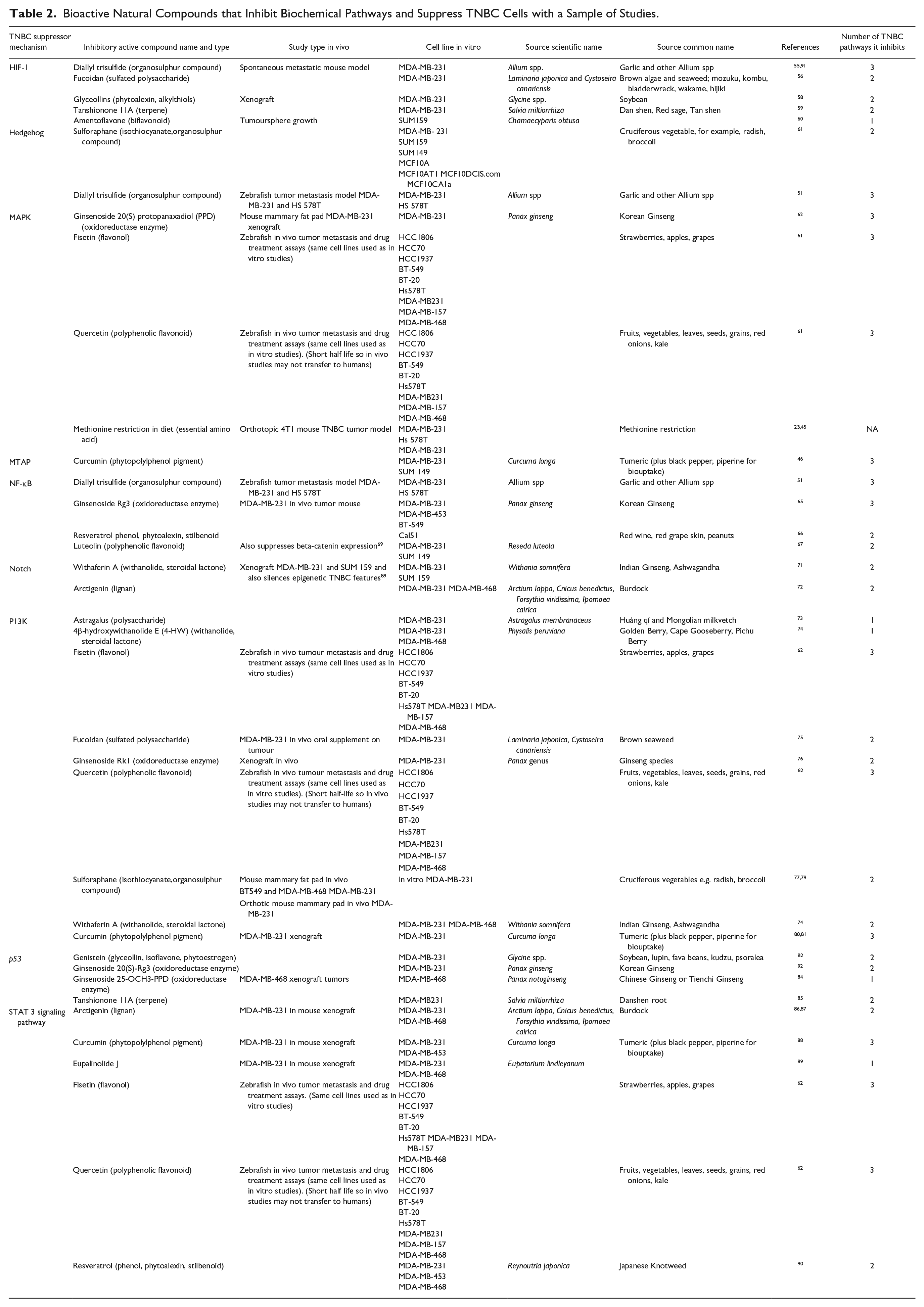
We found a total of 21 natural substances that restrict cancer growth by inhibiting eight of the 10 biochemical pathways in TNBC (see Table 2) and fit criteria for SCANS and thus are suitable for inclusion in a TNBC Treatment Array. We found no natural compounds that suppress TNBC via the Wnt/β-catenin pathway that also fit the “available” criteria for SCANS. The natural compound Jatrophone inhibits TNBC via the Wnt/β-catenin pathway 54 but currently does not fit Step 3.
The active components (in alphabetical order) of natural substances that we found to block pathways relevant to triple negative breast cancer are as follows:
1. HIF-1 suppressing compounds
(1) Diallyl Trisulfide, an organosulphur compound in garlic, induces a suppression effect on TNBC metastasis mediated by decreasing expression of the thioredoxin system (Trx) 55 which is involved in regulating intramolecular oxidative states.
(2) Fucoidan, a sulfated polysaccharide in brown seaweed, inhibits epithelial-to-mesenchymal transition via regulation of the HIF-1 alpha pathway in mammary TNBC cells under hypoxia. 56
(3) Glyceollins, secondary metabolites of isoflavones known as phytoalexins, are found in soybeans and under hypoxic conditions block HIF-1 synthesis by inhibiting the P13K/AKT/mTOR pathway. 57 They suppress tumourigenesis in TNBC cell lines. 58
(4) Tanshinone IIA is the pure extract of Dan shen root (Salvia miltiorrhiza) and represses HIF-1 expression and inhibits TNBC breast cancer growth (in vitro and in vivo) via vascular endothelial growth factor (VEGF) with the involvement of the mTOR/p70S6K/4E-BP1 signaling pathway. 59
2. Hedgehog Pathway suppressing compounds
3. MAPK pathway suppressing compounds
(1) Diallyl Trisulfide suppresses MMP2/9 in TNBC cells by blocking ERK/MAPK signaling pathways 51 .
(2) Fisetin, a flavonoid in plants, inhibits migration of TNBC cells by targeting kinase signaling. 62
(3) Ginsenoside 20(S)-protopanaxadiol, an active metabolite from Panax ginseng, inhibits tumor metastasis of TNBC by targeting the RGFR-mediated MAPK pathway. 63
(4) Quercetin, a flavonol in plants, inhibits migration of TNBC cells by targeting kinase signaling. 62
4. MTAP suppressing compounds
(1) Dietary restriction of the amino acid methionine suppresses breast cancer metastasis in TNBC in vitro and in vivo. 25 Restriction of methionine in the diet rather than consuming natural substances is one way to suppress the MTAP pathway. Certain foods have higher quantities than others of this amino acid.
5. NF-κB pathway suppressing compounds
(1) Curcumin inhibits the nuclear activation of NK-κB. 64 In MDA-MB-231 and SUM 149 cell lines in vitro studies; curcumin derivatives inhibit NF-κB DNA-binding activity 50 and decrease NF-κB transcriptional factor activity. 49
(2) Diallyl trisulfide suppresses MMP2/9 in TNBC cells by blocking NF-κB signaling pathways. 51
(3) Ginsenoside Rg3, a steroidal saponin isolated from Panax ginseng, inhibits NK-κB signaling in TNBC in vivo and in vitro studies. 65
(4) Resveratrol upregulates expression of programmed death of ligand 1 (PD-L1) by resveratrol in TNBC cells via HDAC3/p300-mediated NF-κB signaling. 66
6. Notch pathway suppressing compounds
(1 Luteolin, a flavone, suppresses Notch4 signaling (by preventing activation of YB-1 pathway) and subsequently inhibits proliferation, anchorage independent growth and mammosphere formation in TNBC. 67 There is known crosstalk between Notch signaling and VEGF. 68 Luteolin has also been shown to have anti-metastatic properties that block VEGF in TNBC, inhibiting tumor cell migration. 69 In addition to the Notch pathway, luteolin also suppresses the metastasis of TNBC by reversing epithelial-to-mesenchymal transition via downregulation of beta-catenin expression 70 demonstrated by in vivo xenograft studies.
(2) Withaferin A, a steroidal lactone, inhibits in vivo growth of TNBC cells accelerated by Notch2 knockdown. 71
7. P13K suppressing compounds
(1) Arctigenin, a STAT3 inhibitor, inhibits the Akt pathway by reactivating the protein phosphatase 2A pathway (PP2A), a tumor suppressor, and promoting an anti-metastasis effect in TNBC cells. 72
(2) Astragalus polysaccharides intervenes with TNBC cell invasion, proliferation, and apoptosis via the PIK3CG/AKT/BCL2 pathway. 73
(3) 4β-hydroxywithanolide E (4-HW) inhibits the viability of TNBC cells through induction of cell cycle arrest and apoptosis/necrosis via the P13/Akt signaling pathway. 74
(4) Fisetin, a flavonol inhibits migration of TNBC cells by targeting kinase signaling. 62
(5) Fucoidan induces caspase-dependent and caspase-independent induction of apoptosis in TNBC via the PI3K/AKT/GSK3 beta pathway. 75
(6) Ginsenoside Rk1 significantly represses tumor growth with low toxicity to major organs and inhibits cell proliferation, colony formation, induces cell cycle arrest, apoptosis and blocks the P13/Akt pathway in in vivo and in vitro studies of TNBC. 76
(7) Quercetin, a flavonol, inhibits migration of TNBC cells by targeting kinase signaling. 62
(8) Sulforaphane is a naturally occurring isothiocyanate derived from cruciferous vegetables, such as broccoli and radish. It suppresses TNBC in vivo 77 via the PTEN and P13-kinase pathway. PTEN and P13-kinase are major negative and positive regulators, respectively of the P13-kinase pathway which regulates, growth, proliferation and survival and are 2 commonly mutated proteins in human cancers. 78 Results of another in vivo study suggest that sulforaphane may control the malignant proliferation of cancer stem-like cells in TNBC via the Cripto-mediated pathway by either suppressing its expression and/or by inhibiting the Cripto/Alk4 protein complex formation. 79
(9) Withaferin A inhibits the viability of TNBC cells through induction of cell cycle arrest and apoptosis/necrosis via the P13/Akt signaling pathway. 74
8. p53 and POLR2A and MDM2 protein Regulator
(1) Curcumin interferes with breast cancer proliferation by regulating the p53 protein in TNBC cancer cell lines.80,81
(2) Genistein is an isoflavone found in soy and inhibits breast cancer cell growth by induction of apoptosis in TNBC in vitro. 82
(3) Ginseng compounds have an inhibitory effect on TNBC. The first, 20(S)-Ginsenoside RG3 (2), is isolated from Panax ginseng and the second, 25-OCH3-PPD, is isolated from Panax notoginseng. Ginsenoside RG3 increases the association between p53 and MDM2 in breast cancer cells. 83 Ginsenoside 25-OCH3-PPD inhibits cancer cell motility through inhibiting MDM2 in preclinical in vivo and in vitro studies of breast cancer cell lines including the TNBC cell line MDA-MB-468. 84
(4) Tanshinone I (T1), a compound of Dan shen root, has potent activity in inhibiting the growth of the triple-negative breast cancer cell line MDA-MB231. 85
9. STAT 3 pathway suppressing compounds
(1) Arctigenin, a bioactive lignan found in the seeds of Arctium lappa, is a STAT3 inhibitor and induces cytotoxicity in TNBC cells.86,87
(2) Curcumin, the primary bioactive ingredient in turmeric inhibits STAT3 phosphorylation, DNA-binding activity and transactivation in vitro in the TNBC cell line (MDA-MB-453) and in vivo using the TNBC cell line MDA-MB-231. 88
(3) Eupalinolide J, the active compound and a sesquiterpene lactone of Eupatorium lindleyanum, promotes the degradation of STAT3 in TNBC cell lines MDA-MB-231 and MDA-MB-468 in vivo mouse xenograft model and in vitro. 89
(4) Resveratrol (3,5,4′-trihydroxystilbene), a polyphenolic compound found in red grapes and several other plants, inhibits STAT3 in TNBC cell line (MDA-MB-468) and other breast cancer and prostate cell lines. 90
Bioactive Natural Compounds that Inhibit Biochemical Pathways and Suppress TNBC Cells with a Sample of Studies.
Step 3: Availability of Natural Compound
An example of finding a substance that does not fit our criteria for inclusion is during the search using 2 keywords of TNBC and HIF. One study 93 found that “psammaplin-based histone deacetylase (HDAC) inhibitors were found to differentially inhibit HDAC activity, induce activation of hypoxia-inducible factor-1 (HIF-1), and disrupt organotropic metastatic TNBC subclone growth.” However, we then read that psammaplin has been isolated from the marine sponge Aplysinella rhax and an online search to buy this active compound suggested this is only available via chemical companies for the experimental research market. If psammaplin were available in the retail market, this would have been included.
Step 4: Safety
All substances are currently listed as regulated products. We checked all possible actions of the substances and eliminated all substances that are potentially unsafe. For example, our search found celestrol from Tripterygium wilfordii or thundergod vine can suppress TNBC cell growth via the P13 pathway 94 but this natural substance also has been linked to kidney toxicity, 95 so we rejected it as a candidate to include in our treatment array for combating TNBC.
The level of dietary methionine restriction in humans is between 800 mg and 1200 mg daily or 15 mg per kg. The dose for a 60 kg person is 900 mg or 0.9 g. A 100 g portion of beef has about 0.7 g of Methionine (Table 1).
To ensure safety when undertaking this approach to combating cancer, a methionine restricted diet would only be commenced after all traditional chemotherapy, immunotherapy and radiotherapy treatments are completed. A restricted methionine diet for example can limit protein intake which may be harmful during traditional anti-cancer treatments. Contraindications between substances and any prescribed drugs would be checked with a qualified pharmacologist before consuming.
Until further studies are done, the effective dosage of these compounds (either in isolated form or as herbal medicines) is unknown. The safe dose of herbal medicines is presumed to be that recommended by the product manufacturer.
Step 5: Measuring Change in Microenvironment
We searched for biomarkers of the various suppression mechanisms and found a few potentially useful tests. This is an area for further research, not a recommendation for clinical trial or clinical management implementation. These biomarkers would need to demonstrate that the strategy is effective against TNBC and that they are directly measuring change in the microenvironment as a result of consuming the compounds. Examples of potential biomarkers are briefly described below.
1. HIF-1
Antibodies to hypoxia inducible factor-1 (HIF-1) cytokeratin 20 (CK20) and cell proliferation factor Ki67 may be useful as these are used as prognostic biomarkers for various cancerous tissues.
2. Hedgehog
A study by Jia et al 96 found CXCL14 (a gene that encodes a soluble secreted chemokine) to be a candidate biomarker for Hedgehog signaling in idiopathic pulmonary fibrosis. It is this experimental approach that may find CXCL14 to also be a suitable plasma protein biomarker for Hedgehog signaling regulation in TNBC and other cancer patients.
3. MTAP
Changes before and after dietary restriction of this amino acid may be measured via blood testing of the metabolic pathways of methionine specifically testing levels of S-adenosyl methionine (SAMe) and methionine.
4. NF-κB
NF-κB is a cytokine that is produced by many transcription factors and can be measured by blood plasma tests. The levels have successfully been measured in pancreatic cancer patients that showed an increase in cytokine inflammatory response with corresponding upregulated NF-κB. 97 A quantitative sandwich ELISA technique was used for the determination of serum NF-κB. 97
5. Notch
Delta-like canonical Notch ligand 1 (DLL1) has been used as a novel biomarker for sepsis during upregulation of the Notch pathway in human monocytes. 98 Quantification of soluble DLL1 in plasma has been performed using a commercially available ELISA kit. As the Notch Ligand 1 is implicated in TNBC, 99 this may also work in measuring downregulation of the Notch pathway during consumption of Notch pathway suppressers identified in Step 2.
6. p53
Anti-p53 antibodies may be useful as a biomarker 100 with high levels suggesting accumulation of a mutated form of p53 protein in cells. Oxidative stress markers such as malondialdehyde (MDA) and 8-hydroxydeoxyguanosine (8-OHdG) and antioxidant enzymes activity measured by superoxide dismutase (SOD) and glutathione peroxidase may be useful biomarkers. Another possible test for high expression of endogenous MDM2 is the form of the C410 antibody levels. An alternative but indirect method is to measure the plasma levels of compounds that suppress the biochemical pathways. For instance, high plasma levels of genistein may indicate p53 is regulated by MDM2. Verheus et al 98 found that high plasma levels of genistein were associated with reduced breast cancer risk in Dutch women.
A study by Kantor et al 101 measured changes in urinary 8-isoprostane and PGF2a concentrations using enzyme immunoassays before and after consumption of glucosamine and chondroitin. These biomarkers indicated a reduction of oxidative stress. These may be useful biomarkers to measure changes in oxidative stress from consumption of supplements that affect p53 as found in Step 2.
7. STAT 3
A methylation specific PCR method could possibly be used to evaluate the STAT3 methylation status using genomic DNA. 102
8. WNT/β-catenin pathway
The serum level of Dickkopf-1 (DKK1), a secreted Wnt protein, is elevated in breast cancer patients suggesting that the serum expression level of DKK1 could be a useful biomarker in breast cancer, 103 possibly indicating levels of WNT pathway regulation within these patients. Altering the Wnt pathway (with suppressive natural compounds identified in the future) may be reflected in changes to DKK1 serum levels.
Treatment Array
A potential treatment array would include the compounds that suppress 3 or 2 pathways. For our example of a treatment array compiled of herbal medicines and natural supplements from the 21 compounds, we might choose 7 (two from each pathway) that potentially suppress all 10 pathways simultaneously.
From each pathway, these include;
HIF: Garlic and Soybean
Hedgehog: Garlic and Sulforaphane
MAPK: Panax ginseng (Korean Ginseng), Fisetin and Quercetin
MTAP: Curcumin (with piperine to assist uptake)
NF-κB: Garlic and Panax ginseng (Korean Ginseng)
Notch: Arctium lappa (Burdock), Withania somnifera (Ashwagandha) and Quercetin
P13K: Withania somnifera (Ashwagandha), Sulforaphane, Panax ginseng (Korean Ginseng) Curcumin (with piperine) and Quercetin
p53: Panax ginseng (Korean Ginseng), Curcumin (with piperine) and Soybean,
STAT 3: Arctium lappa (Burdock) Fisetin and Quercetin
The 7 substances of our final array are Curcumin, Burdock, Garlic, Fisetin, Korean Ginseng, Sulforaphane and Quercetin.
Discussion
Our review found 10 different mechanisms of growth suppression in TNBC cells and 21 natural compounds, that are available as supplements for retail purchase, that suppress them. They are sold either as the isolated active agent as in fisetin or more commonly as a herbal medicine of the source substance such as Ashwagandha produced from the plant Withania somnifera. These natural substances have bioactive compounds that directly suppress the growth of TNBC cells via 1 to 3 of these 10 mechanisms. The studies comprised both in vivo and in vitro studies. The basic requirements for potential chemopreventive and therapeutic agents require them to be effective against tumor cells in vitro and in mouse tumor models in vivo, relatively non-toxic to the normal cells, and have presumed adequate bioavailability. Curcumin however, requires piperine to enhance uptake 104 and amentoflavone may not have adequate uptake from source plant species such as Gingko biloba. 105 Our treatment array fit these requirements. A limitation of the strategy is that at the present time, we do not have precise estimations of bioavailability of individual compounds and bioavailability under conditions of combined uptake when taken together.
Clinical trials have not been specifically carried out for the use of these substances to test the efficacy in combating cancer in any cohort of triple negative breast cancer patients. Nor has any retrospective or longitudinal study been conducted. The selected substances have however, all passed evaluation for safe consumption by the Australian Register of Therapeutic Goods. Our results do not represent an exhaustive list of inhibitory mechanisms and potentially inhibitory natural substances known to affect TNBC. They do seem to be the most ubiquitous at the present time. Other pathways, mechanisms and natural compounds may also be equally relevant. A limitation of our methodology is choosing search terms. Broadening the search terms will give more results. We are constrained here by the purpose to enable replication of our formula and therefore we used a set of keywords that yielded the highest hit of relevant studies. Additional keyword combinations are likely to capture more studies that are relevant. For example, searching for “Wnt” and “triple negative” and “natural” “product,” found 2 additional Wnt related studies106,107 unrelated to pharmaceutical studies. Although these are relevant to SCANS, as they were not found via our standardized methodology, we did not incorporate them here.
Many studies show the action of inhibiting cancer prolific biochemical pathways on malignant cells and tissues. As our cellular environment is not inert and static, but dynamic and modifiable, when a biochemical pathway is altered, it is likely there will be a biomarker that reflects this. The development and use of biomarkers focusing on the primary mechanisms of action for specific tumor types is likely to be most useful in determining efficacy of intake of the natural substances on potential cancer cell growth. Limitations of biomarkers are that first, they can be an indirect measure of actions at points along the biochemical pathways. Second, they may measure the biochemical changes to maintain an anticancer environment, but not whether cancer cells are managing to proliferate in the presence of those inhibitory mechanisms. For example, blood testing of methionine levels does not directly indicate inhibitory effects of the amino acid restriction on cancer cells. Third, biomarkers do not necessarily measure the bioavailability of the substance to the relevant inhibitory mechanism and may give an overestimate of the extrapolated action on the mechanism. The merits of biomarkers to test the suppression of tumor possibly be tested at the presurgical stage of treatment. An example of this is a study in which after taking green tea for a month prior to surgery, plasma, urine, breast cancer tissue, and surrounding normal breast tissue was tested for uptake of epigallocatechin-3-O-gallate (EGCG) and its effect on cell proliferation and circulating biomarkers in breast cancer patients. 107 Another example is a study in which human prostate tissue was tested for an oxidative stress biomarker and changes in NF-kB after orally administered pomegranate extract was taken during the 4 week period before prostatectomy.108,109
The burgeoning field of metabolomics has merit for using metabolites as biomarkers to describe mechanistic pathways and their regulatory or expression levels. This will involve placing metabolites into their biological context by identifying their roles in metabolic pathways, their interconnectivity with other metabolites, and their relationships to upstream genes and proteins. 110
Targeting the biochemical pathways as opposed to targeting organs may optimize the effectiveness of consuming specific substances. SCANS can potentially be applied to other tumor types and has the potential to assist in the possible extension of life of people recovering from cancer treatment. A further potential avenue for this strategy is to include research into the prevention of initial cancer growth. People with no diagnosed (current) cancer, but who have mutations in genes that suppress cancer, such as the breast cancer BRCA gene mutations, perhaps may benefit from a biochemical assessment using biomarkers for possible inhibitory mechanisms. This could allow identification of significant biochemical imbalances that could then possibly be modified using successfully trialed agents. This could then also be monitored with the aim of maintaining the biochemical environment to prevent cancer growth and adaptation.
This review involved TNBC and it relied heavily on preclinical studies. Reversing the focus from tumor to agent, there are human studies that provide data to support our choice of treatment array in terms of safety (and to an extent effect) for other cancer types. For example, in a cohort of 1455 breast cancer patients, it was found that consumption of ginseng before cancer diagnosis was associated with increased overall survival rate. 111 A pre-surgical pharmacological study measuring concentrations of resveratrol and its metabolites in the colorectal tissue of humans who ingested resveratrol found that it is well tolerated and reduced tumor cell proliferation by 5%. 112 A randomized double-blind placebo-controlled trial showed administering garlic increases the number and activity of natural-killer cells in patients with advanced cancer of the digestive system. 113 We used TNBC as a representative cancer to demonstrate SCANS. When using this strategy for other cancer types, after the treatment array has been determined a final step may be to switch the search focus to the natural agents themselves to gain additional relevant and broader information.
Preclinical studies pave the way for clinical trials. The usual approach of preclinical trials and human clinical trials (for example,108,109 when investigating the effects of natural compounds and herbal medicines on cancer growth) is to focus on 1 compound and its limited mechanism/s. We have developed a novel, testable, potential approach using a suppression-centric model to target many mechanisms at once with the assistance of many natural compounds/herbal medicines, to gain a synergistic anticancer response.
Opportunities to test the efficacy of SCANS are with standard clinical trials and possibly pre-surgical phase 0 trials. In addition to use for biomarkers, Phase 0, also known as window of opportunity trials, can provide insight into the biological effects and evaluate potential therapeutic efficacy of novel therapeutic strategies. The feasibility of utilizing the short time between biopsy and surgery was investigated in breast cancer patients and found to pose logistical challenges, but is readily accepted by patients. 114 The short time constraints may however preclude phase 0 trials for treatment array testing especially until precise dose and best combinations are determined.
This is the first time an evaluation has been carried out of pre-clinical studies into (1) the synergistic potential of targeting multiple weaknesses of a tumor type simultaneously (2) and using natural compounds (rather than pharmaceutical chemicals) with (3) the aim to exploit a tumor’s biochemical vulnerabilities to prevent tumor plasticity, adaptation and progression. The collation of information and application in this strategic way is a novel approach.We feel this strategy should be further explored in prospective trials to test the efficacy of this approach to reducing cancer. The treatment array of 21 substances and 10 pathways provide a range of natural compounds and biochemical pathways for further research. Questions of formulation, tolerability and dose could be addressed in animal trials prior to human trials as could tests of isolated phytochemicals versus herbal medicines. This will allow for the treatment array of, for example, 7 substances to be then clinically tested in TNBC patients, after traditional treatments are complete. Monitoring biochemical changes using biomarkers during these trials may assist in determining and understanding if and how SCANS can affect cancer growth.
Patients like those with TNBC who have no ongoing pharmaceutical chemotherapy agents available to them are greatly disadvantaged compared to those who do. These patients have much to gain, physically and mentally, from the existence of a successful ongoing approach to preventing metastasis. SCANS can potentially provide this. The suppression-centric strategy complements the broad-spectrum integrative approach for cancer treatment that selects multiple high-priority hallmark cancer targets with the use of low-cost, low-toxicity therapeutics including phytochemicals. 115 Our strategy zeros in on mechanisms of specific tumor growth and chooses specific compounds that appear to act on these mechanisms and suppress the cancer cells preclinically. This is more focused than just choosing natural compounds that suppress other cancer types but not necessarily TNBC. As we gain increased understanding of how cancers and their subtypes exploit their host environments, more opportunities to target these mechanisms arise. Understanding how natural compounds and herbal medicines suppress specific cancers allows for new potentially highly effective anticancer treatments to be developed. Trials of SCANS treatment arrays for various cancers may well provide the next step in positioning natural compounds as a highly significant, targeted resource in combating cancer.
Footnotes
Acknowledgements
The authors thank the reviewers for their comments, and we thank the Integrative Cancer Therapies editorial staff for their thoroughness and attention to detail that has contributed greatly to the quality of this review.
Author Contributions
M.W. and C.K contributed equally to this work. M.W contributed most of the intellectual component and C.K. contributed both conceptual and clinical input. We have no conflict of interest.
Declaration of Conflicting Interests
The author(s) declared no potential conflicts of interest with respect to the research, authorship, and/or publication of this article.
Funding
The author(s) received no financial support for the research, authorship, and/or publication of this article.
