




Abstract
Sodium bicarbonate, commonly known as baking soda, is widely used in the clinic as an antacid for treating gastric hyperacidity, among other conditions. Chao et al have reported a clinical trial about targeting intratumor lactic acidosis–transarterial chemoembolization. Based on conventional transarterial chemoembolization, the authors added a 5% sodium bicarbonate solution to cytotoxic drugs, resulting in a high local control rate. The explanation for the antitumor effects of sodium bicarbonate is related to acidosis in the tumor microenvironment. In this review, we summarize the findings from studies administering sodium bicarbonate alone or in combination with other anticancer therapies as cancer treatments, and discuss methods for safe and effective use of sodium bicarbonate in the clinic.
Introduction
Transarterial chemoembolization (TACE) is widely employed for the local control of hepatocellular carcinoma (HCC) lesions, which are too large to be surgically resected. 1 By inserting a catheter into tumor-feeding arteries, TACE not only accurately delivers anticancer drugs into the tumor but also starves cancer cells by blocking major vessels. However, according to a systematic review of 14 randomized clinical trials, 2 the objective response rate (ORR) of this procedure is only 35% (range = 16% to 61%). For the ORR for large HCC (>10 cm) lesions, it is much lower. Thus, physicians have invested substantial efforts in improving this operation, such as drug-eluting bead TACE 3 or combination with radiofrequency ablation (RFA) 4 and systematic targeted therapy. 5 However, the therapeutic efficacy was only increased to a certain extent, and thus, further studies are needed.
The acidic microenvironment fosters cancer progression, and after conventional TACE, the pH value of this tumor microenvironment is further decreased. 6 This change explains the low control and high recurrence rate of tumors treated with conventional TACE. Therefore, the addition of some alkaline substances to neutralize acidity may be a viable approach to solve this problem. Chao et al 6 added 5% sodium bicarbonate to the cytotoxic drugs (doxorubicin or oxaliplatin) and then performed chemoembolization, which is described as targeting intratumor lactic acidosis–TACE (TILA-TACE). Amazingly, 100% of patients treated with this modified TACE procedure achieved complete or partial remission.
TILA-TACE is undoubtedly a successful working example of translational medicine. More important, we should pay attention to sodium bicarbonate, a low-cost and ordinary alkalescent antacid, as a novel cancer treatment strategy. In this mini review, we will summarize the effects of acidic microenvironment on tumor development, followed by a review of the findings from preclinical studies investigating the therapeutic effects of sodium bicarbonate alone or in combination with other anticancer therapies on cancer. Finally, we discuss its feasible applications in treating various malignancies.
Acidic Microenvironment Promotes Tumor Development
An acidic extracellular pH (pHe) ranging from 6.5 to 6.9 exists in various malignant tumors, 7 whereas the pHe of normal tissue is within the physiological range (pHe = 7.2-7.4). The origin of tumor acidosis starts from the unique metabolic patterns of tumor cells, which is closely associated with the distance from the blood vessels. 8 Capillaries have a quite limited range of oxygen supply, so the cells in the area far away from the vessels suffer severe hypoxia. 9 According to the oxygen supply, the tumor mass can be roughly divided into the following 3 parts. In the region of deep hypoxia, the cancer cells can only utilize glycolysis to produce energy and the main metabolites are lactate and H+ ions. 10 In the moderate hypoxic region, there are a variety of substrates, including glutamine, fatty acid, as well as lactate from cells with enhanced glycolysis. Through oxidative phosphorylation, the cancer cells make the most of the oxygen in this environment to generate energy.11,12 As a result, CO2 diffuses out of the cells. 13 In the normoxic area near the blood vessels, even with adequate oxygen, the tumor cells still tend to generate ATP (adenosine triphosphate) through enhanced glycolysis, known as the Warburg effect. 14
In summary, the primary metabolites in the tumor microenvironment include H+ ions, lactate, and CO2. Due to lactic acid, free H+ ions and CO2 hydration, it is common to see that the pHe of solid tumors is acidic. Numerous scholars have proposed that the acidic microenvironment is a weapon for the tumor to protect itself and attack normal tissues and immune cells. Its pro-tumorigenic effects involve local invasion,15-17 angiogenesis, 18 and distant metastasis.19-21 Moreover, the initiation and development of a tumor, to a large extent, are attributed to the suppression of the immune system. 22 Huber et al 23 have fully detailed the effects of low pH on tumor immunity and the relative pathways of acidity-driven immunosuppression.
Sodium Bicarbonate “Kills” Cancer Cells
The acidic tumor microenvironment is so closely related to cancer development that strategies targeting this tumor hallmark may be a practical treatment. The utilization of sodium bicarbonate to neutralize the acidity and increase the tumor pHe might control cancer cells progression. Gatenby, Gillies, and colleagues have conducted several in vivo experiments to explore the anticancer effects of sodium bicarbonate (summarized in Table 1).15,20,24-27
In Vivo Experiments of Sodium Bicarbonate Monotherapy in Anticancer Treatment.
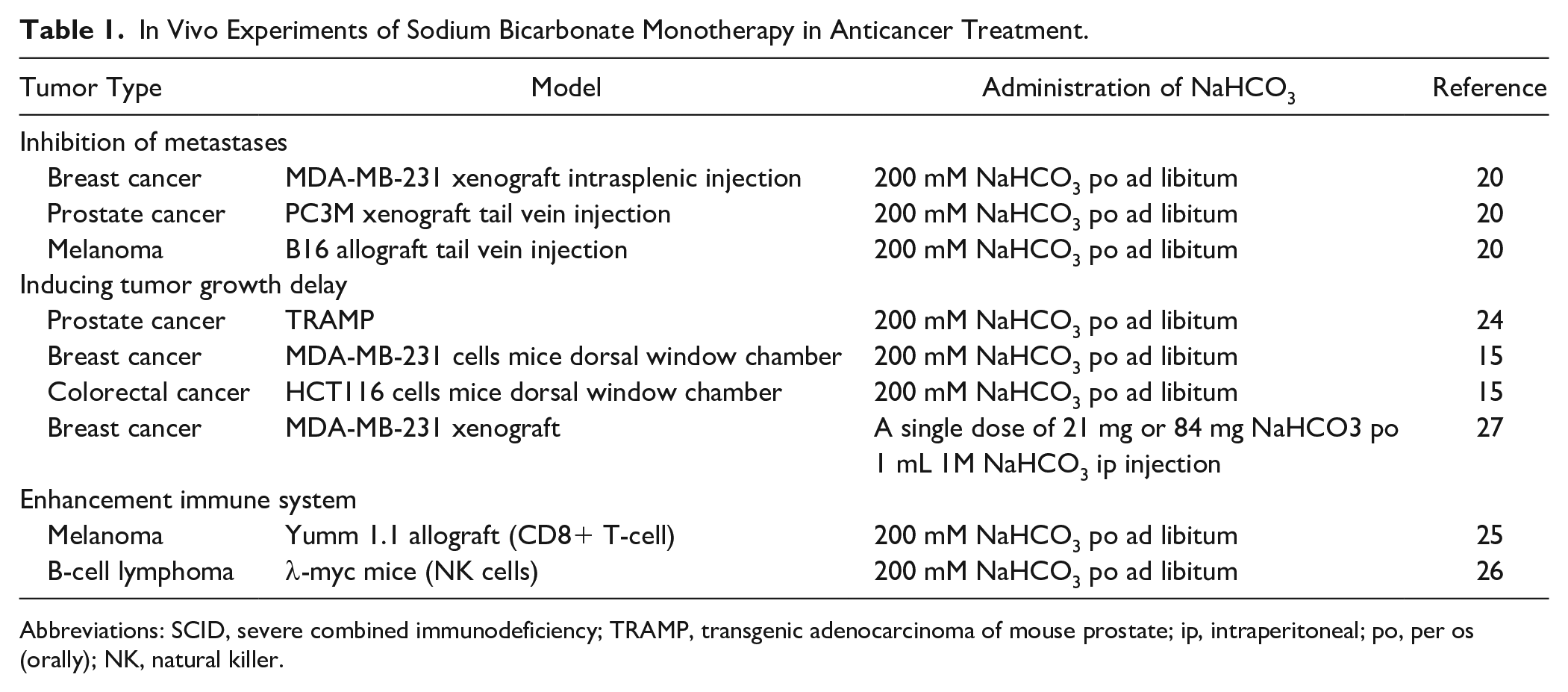
Abbreviations: SCID, severe combined immunodeficiency; TRAMP, transgenic adenocarcinoma of mouse prostate; ip, intraperitoneal; po, per os (orally); NK, natural killer.
Sodium bicarbonate reduces the formation of spontaneous metastases and the rate of lymph node involvement in mouse models of metastatic breast cancer. However, the data did not reveal an effect on the number of circulating tumor cells. 20 Based on experiments employing the transgenic adenocarcinoma of mouse prostate (TRAMP) model, the administration of 200 mM bicarbonate to 4-week-old TRAMP mice (weaning at 3 weeks) effectively perturbs the in situ evolution of cancer to a microinvasive disease. 24 In the C57BL/6 mice bearing syngeneic Yumm 1.1 melanoma, sodium bicarbonate significantly controls tumor growth and improves CD8+ T-cell infiltration. 25 Natural killer (NK) cell activity is also increased in a B-cell lymphoma mouse model following the systemic administration of a buffer therapy. 26
Regarding the clinical evidence presented in the published literatures, apart from TILA-TACE, a study by Silva and colleagues, members of Gatenby and Gilles groups,
28
included the following statement: we include the experience of a 79-year-old man with widely metastatic renal cancer at the Moffitt Cancer Center. After failing first-line treatment, he discontinued conventional therapy and began a self-administered course of vitamins, supplements, and 60 g of bicarbonate mixed in water daily. As of this submission, he has remained well with stable tumor for 10 months.
We must emphasize that baking soda alone without any other anticancer therapies is only effective for some cancer cell lines with less aggressiveness, such as breast cancer MDA-MB-231 cell line and prostate cancer PC3M cell line,15,20,24 while mice bearing tumors with more aggressive phenotypes, like B16 melanoma and Panc02 pancreatic cancer, died of a substantial tumor burden after a short time. 20 Moreover, the above are the results from preclinical studies, and there are insufficient clinical evidences to support that routine anticancer therapy could be replaced with drinking water containing baking soda.
Methods for Using Sodium Bicarbonate as a Cancer Treatment
Here, a question arises of how to use sodium bicarbonate as a cancer treatment in the clinic. The acidic microenvironment can not only promote carcinogenesis and development but also have a negative impact on various antitumor agents, such as weak-base chemotherapeutic drugs,29-32 some drugs targeting specific molecules,33,34 and immunotherapeutic drugs.35,36 Therefore, sodium bicarbonate could be used as an adjuvant therapy to enhance the efficacy of conventional treatments. Several in vivo experiments have assessed whether sodium bicarbonate cooperates with traditional anticancer therapies (summarized in Table 2)25,29,30,33,34
In Vivo Experiments of Combination Sodium Bicarbonate With Other Anticancer Therapies.

Abbreviations: ip, intraperitoneal; po, per os (orally); iv, intravenous; VEGFR2, vascular endothelial growth factor rectptor-2; mTORC1, mechanistic target of rapamycin complex-1; CTLA-4, cytolytic T lymphocyte-associated antigen-4; PD-1, programmed death-1.
SCID (severe combined immunodeficient) mice with MCF-7 human breast cancer xenografts were administered bicarbonate-supplemented water to drink at the same time they received doxorubicin. Surprisingly, extracellular alkalization induced a 2- to 3-fold increase in the efficacy of doxorubicin. 29 However, while sodium bicarbonate increases the uptake of weak-base drugs through elevating the pHe, it greatly reduces the efficacy of some weak acidic chemotherapeutics, such as chlorambucil.37,38 Thus, it is not wise to combine baking soda with acidic agents.
In the aforementioned animal experiments, researchers delivered sodium bicarbonate through the drinking water at a concentration of 200 mM NaHCO3 as a substitute for ordinary drinking water. Some researchers are concerned that the chronic administration of sodium bicarbonate may cause hypernatremia and other metabolic disorders. The authors tested the effectiveness and practicability of acute alkalization, via an intraperitoneal injection and gavage. The anticancer effect of sodium bicarbonate was not influenced by the mode of drug delivery.27,30
What is the proper use of baking soda as an auxiliary medication in the clinic? Taking oral administration as an example, the first consideration is an appropriate dose of sodium bicarbonate. In animal experiments, a mouse with average weight of 23 g drinks 4.2 mL 200 mM (16.8 g/L) sodium bicarbonate, which is equal to an intake of 3 g/kg. 39 For a 70 kg human, the consumption of 210 g of sodium bicarbonate per day is undoubtedly impractical for popularization. In consideration of tolerance, a modified dose of sodium bicarbonate is necessary. A phase 1 clinical trial (NCT02531919) launched by Robey started in August 2015, and was completed in April 2016. This study intended to explore the practicability and tolerance of 0.5 g/kg/day sodium bicarbonate administered for a short-term (10 days) or a long-term (90 days) period. The results have not yet been published. The optimal dose of sodium bicarbonate for humans is still in dispute. Moreover, during the administration of the medication, both urine and blood pH must be monitored to prevent health hazards, such as renal complications and indigestion.
In addition to systemic administration, a local application of sodium bicarbonate is also, a great choice. Intratumor injections, such as TILA-TACE, are quite more difficult to perform compared with oral delivery. But from another perspective, these routes accurately target the tumor microenvironment and are less likely to change the systemic pH. Furthermore, sodium bicarbonate may increase doxorubicin uptake, which may be the crux of the whole procedure. Analogously, we wonder whether sodium bicarbonate could be combined with hyperthermal intraperitoneal chemotherapy to treat peritoneal metastases, particularly using alkalescent chemotherapeutic agents.
Discussion
Buffer therapy, or targeting the tumor acidity through alkalization, has been a widespread anticancer therapy. 40 In addition to baking soda, researchers have found several other buffering agents to manipulate the tumor pHe, including Tris-base, 41 2-imidazole-1-yl-3-ethoxycarbonylpropionic acid, 42 and free base lysine. 43 Similar to sodium bicarbonate, these agents have been confirmed to inhibit tumor progression in the preclinical studies.41-43 Apart from neutralization of acidity, suppression of H+ ion discharge can also elevate the tumor pHe. Thus, the inhibitor of the proton pump, such as omeprazole or esomeprazole, which potently hamper the export of H+ from the tumor cells to the extracellular space, could be used for anticancer treatment. 44 According to the results of a phase III clinical trial, an intermittent high dose of esomeprazole enhances the effects of docetaxel-cisplatin on metastatic breast cancer in patients, without additional toxicity. 45 A retrospective study suggested that omeprazole exerts a synergetic effect with chemoradiotherapy and significantly decreases the recurrence of rectal cancer. 46
No matter what kind of agents, monitoring the tumor pHe value is the key to the translation of buffering therapy from bench to bedside. There are various imaging technologies available for mapping tumor pH in vivo.47-49 Among them, magnetic resonance imaging-chemical exchange saturation transfer with iopamidol has been proved as a noninvasive imaging protocol for assessing tumor acidosis with good sensitivity. 50
As mentioned above, H+ ions, CO2 as well as lactate are produced during tumor metabolism. Some scientists have supposed that lactate also contributes to tumor progression. First, lactate enables to facilitate the survival of cancer cells under hypoxic conditions via inducing metabolic symbiosis. 51 Second, it has also been documented to stimulate angiogenesis by activating some signaling pathways, such as the VEGF/VEGFR2 (vascular endothelial growth factor/VEGF receptor 2) 18 and NF-κB/interleukin-8 pathways, 52 providing the fertile soil for tumor growth and metastases.18,53-55 Last but not least, lactate exerts inhibitory effects on the immune system to achieve “immune escape,” including T lymphocytes,56,57 monocytes, 53 macrophages, 58 dendritic cells,59,60 and NK cells.61,62 Based on the pro-tumor influences of lactate, glycolysis inhibitors, such as dichloroacetate63-65 as well as lactate transport inhibitors, like monocarboxylate transporter 1 (MCT1) and MCT4,55,66,67 may have a more substantial effect on cancer cells than sodium bicarbonate. Actually, the clinical studies of these 2 kinds of agents are not going well. Inhibiting glycolysis or lactate transport could lead to severe adverse events, because these processes are also crucial for some immune cells and other normal cells.58,68,69
The preclinical studies exploring the anti-cancer effects of sodium bicarbonate have begun as early as the 1990s, but the translation from bench to bedside is quite tardy. That is why the results of TILA-TACE, 6 a small-scale pilot study, caused a great sensation in China, and suggested a wide application foreground of sodium bicarbonate in cancer treatment. We propose that the research design of this clinical trial is worth some deep thinking. First, the trial used a unique mode to deliver sodium bicarbonate. Next, it took advantage of the coordinated effects of sodium bicarbonate and doxorubicin. Above all, this study gained a positive result largely due to its distinctive methods of evaluation, visible tumor residues (VTRs). VTRs are rarely used in traditional clinical research, the common endpoints of which are recurrence rate and overall survival. The investigators proposed that lower VTRs and better local control are independent prognostic factors for patient survival. Thus, even without overall survival results from the randomized clinical trial, they concluded that bicarbonate remarkably enhanced the anticancer activity of TACE.
Conclusions
The distinctive metabolic mode of solid tumors leads to acidity in the tumor microenvironment, which results in the activation of multiple factors contributing to tumor development. The most direct method to conquer the acidity is neutralization. Several in vivo experiments have revealed potential anticancer effects of sodium bicarbonate alone or in combination with other therapies. The use of TILA-TACE has confirmed that local application potentially represents an ideal administration method, and the combination of sodium bicarbonate with other anticancer therapies might be more effective. However, a large-scale clinical trial is necessary to test and verify this hypothesis and we hope it will be confirmed.
Footnotes
Author Contributions
MYY collected data and was a major contributor in writing the original draft. XZ contributed to the conception of this review and revised the manuscript. YY gave final approval of the version and acquired funding. All authors read and approved the final manuscript.
Declaration of Conflicting Interests
The author(s) declared no potential conflicts of interest with respect to the research, authorship, and/or publication of this article.
Funding
The author(s) disclosed receipt of the following financial support for the research, authorship, and/or publication of this article: This work was supported by grants from National Key R&D Program of China (Grant No: 2017YFC0908200).
