



Abstract
Keywords
Introduction
According to the Global Burden of Diseases, 1 neoplasms changed from the third to the second position from 1990 to 2016 in term of the number of deaths and from fifth to third in disability-adjusted life years (DALYs). Nonetheless, over the past 2 decades, there was a reduction in the mortality rate among some cancer patients. 2 This growing group of survivors suffers a reduction in quality of life because of comorbidities, and many could die because of treatment-associated side effects. 3 Thus, new integrative practices are being applied in the treatment of the comorbidities related to cancer. Accordingly, complementary and alternative medicine (CAM) therapies are being used by approximately one-third of cancer patients. 4 Furthermore, patients have shown the desire to receive CAM therapies or are receiving them. However, these patients rarely communicate this information to their primary care physicians. 5 Thus, the patients’ interest in CAM could reflect the necessity to cover some aspects not covered by common practice, such as coping with the disease and fear of death. 6 Therefore, the development of analysis using an evidence-based approach longitudinally and historically could aid scientists and health care providers to not only provide evidence-based practice but also help guide studies that could be built on the model of existing scientific support for the future. 7
The use of scientometrics can facilitate the analysis of the integrative and complementary oncology (ICO) research field.8-10 Some notable publications have analyzed the CAM field. Danell and Danell 11 examined the evolution of scientific production in academic journals from 1966 to 2007. Fu et al 12 analyzed the document types and the geographical and institutional distribution of the authorship from 1980 to 2009. Tam et al 13 identified the most frequently cited articles published in the journals indexed in the Integrative and Complementary Medicine Web of Science (WoS) subject category. Wieland et al 14 analyzed the Cochrane Complementary Medicine Field specialized register for controlled trials from a bibliometric and content perspective. Moral-Munoz et al 15 described the thematic evolution of CAM in the Integrative and Complementary Medicine WoS subject category. Zyoud et al 16 analyzed the scientific production of the Arab world in CAM. Huang et al 17 performed an analysis of the literature of traditional Chinese medicine in PubMed.
Furthermore, several articles related to scientific production in cancer were published. Ugolini et al 18 analyzed the scientific output in cancer rehabilitation. Hack et al 19 conducted a citation analysis of Canadian psycho-oncology and supportive care. Thonon et al 20 explained the trends and evolution of French cancer research. Powell et al 21 evaluated the 100 most influential articles in gastric cancer. Singh et al 22 mapped the breast cancer research in India. Foley et al 23 performed an analysis of the 100 most cited articles in esophageal and junctional cancer. Bras et al 24 conducted a scientometric study of the oncology research produced by Portugal in the late 20th century. However, a detailed scientific analysis of the ICO research using bibliometrics and science mapping has yet to be undertaken.
Based on this background, this article offers an overview of the status of research in the ICO field. Through the results obtained, the reader can identify who, where, and what is being researched worldwide. The main aim of this article is to analyze the publication trends and collaboration networks and to identify the main topics of ICO research field using the documents published in the Integrative and Complementary Medicine category of the WoS database from 1976 to 2017 for Science Mapping Analysis (SMA).
Material and Methods
Sample
The set of documents was obtained from the list of journals included into the Integrative and Complementary Medicine category of the Journal Citation Report (JCR) 2016 through the WoS database to perform the proposed bibliometric analysis. The WoS database was used to identify the core of documents that compound the research topic since it was suggested to index the most relevant documents of the different research areas. Furthermore, this database is employed as the primary criterion in academic decisions.25,26 The terms referred to cancer were selected from the Medical Subject Heading (MeSH): neoplasm, tumor, neoplasia, and cancer. Then, the following search strategy was employed:

This query retrieved 8406 documents (7597 articles and 809 reviews) from 1976 to 2017. Citation counts up to February 2018 were also included.
Production Trends
All the articles referring to ICO in the period 1976-2017 were assessed according to the following criteria: journals, institutions, and countries. In addition, leading to further comprehension of global trends, these analyses were performed by dividing the whole period into 3 different subperiods 27 : (a) preliminary development, (b) fast development, and (c) Consolidated development. This division is based on the visual representation of the field production over time. The first subperiod is established until the year when the number of publications starts to increase. The second subperiod is established from the end of the first subperiod until the last year before a decrease in production. The last subperiod is considered from the end of the second subperiod until the last year studied. Moreover, it is important to highlight that each document was considered by all authors’ institutions and countries, not the first or corresponding author only.
Furthermore, the Relative Priority Index (RPI)28,29 was applied to analyze the relative production of a country taking into account the world publications. The RPI is defined as

where
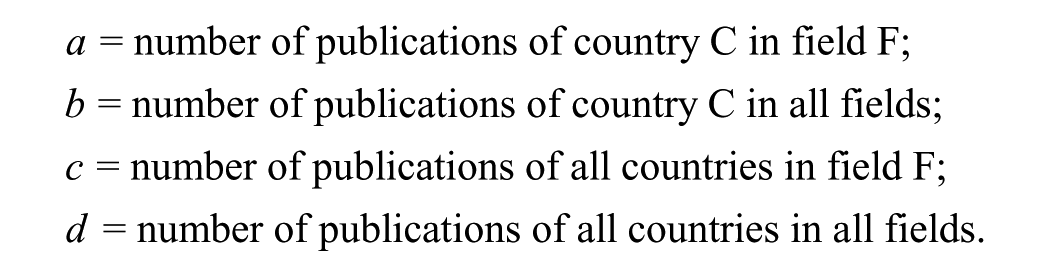
RPI = 100 shows that the research priority of a country is average compared with the remaining countries. If RPI > 100, the priority is higher than the average; if RPI < 100, priority is lower than the average.
To complete the trend analysis, a stacked bar graph with the documents published by the top 10 countries in each quartile ranking of the WoS (based on 2016 impact factor) was built. It is important to highlight that documents published in 2017 were not included in this analysis.
Collaboration Analysis
The VOSviewer software 30 was used to obtain information about the collaboration among countries and produce a map representing the countries coauthorship. In other words, countries are connected based on the number of publications they have authored together. 31 The bibliographic data of the sample were analyzed using the full counting method, which implies that the overall weight of a publication is equal to the number of authors of the publication. 32 We use the full counting method following the criteria of its best understanding. All the authors as well as the affiliations that they declare in the article are taken into account for the analysis. In this network, each node represents a country. A shorter distance between 2 nodes means a stronger relationship. The locations of the nodes are determined using the visualization of similarities (VOS) technique. 33 By default, VOSviewer also assigns the nodes to clusters, which are sets of closely related nodes. In this work, the node size depends on the number of documents that each country has coproduced, and the color reflects the received citations. A minimum of 20 documents was established to be represented. VOSviewer provides different types of representations but the overlay visualization where the color of a node indicates a particular property of the node, was selected. 31 In this case, the color is related to the number of received citations.
Research Topic Identification
The method 34 and software SciMAT 35 were used to perform the topic identification. A deduplicating process was applied to improve the data quality (the authors’ keywords and the WoS keywords plus were used as the unit of analysis). Words representing the same concept were grouped. Furthermore, some meaningless keywords, such as stop words or words with general meaning were removed (eg, disease, outcomes, or system).
Next, 3 phases established by SciMAT were employed to analyze the main topics 36 :
Research Theme Detection. A normalized bibliometric co-word network of keyword co-occurrence is first built 37 using the equivalence index 38 as a similarity measure. Then, clustering of keywords into topics/themes using simple centers algorithm 39 is detected. This keyword clustering corresponds to centers of interest and/or research problems that are the object of significant interest among researchers.
Low-Dimensional Space Layout of Research Themes. A spatial layout of research themes is achieved by plotting each research theme using a 2-dimensional strategic diagram based on their centrality (degree of interaction of the research theme with other research themes) and density (internal strength of a research theme) rank values. 38 Once the research themes are mapped into a 2-dimensional space, they can be classified into 4 groups35,40: (a) Motor: Themes appearing in the upper-right quadrant are classified as motor themes and are considered to be well developed and essential for the structuring of a research field; (b) Basic and transversal: Themes appearing in the lower-right quadrant are classified as basic and transversal and are considered to be relevant for a research field but are not yet developed; (c) Emerging or declining: Themes that appear in the lower-left quadrant are classified as emerging or declining and are considered to be weakly or marginally developed; and (d) Highly developed and isolated: Themes that appear in the upper-left quadrant are categorized as highly developed and isolated and are considered to be well developed but of marginal importance for the field. In this spatial representation, topics are visualized as spheres, in which volume is proportional to the number of documents associated with each one. The number of citations associated with each topic is also depicted in brackets.
Performance Analysis. The relative contribution of the research themes and thematic areas to the whole research field is measured quantitatively and qualitatively. The most prominent, productive and highest-impact subfields may be identified. The following bibliometric indicators are applied to the different detected themes and thematic areas to achieve this task: number of published documents, number of received citations, and h-index.41,42
Furthermore, a stacked bar graph was built to show the relative interest of the top 10 countries on the different topics detected. In this graph, the size of the colored bars is related to the relative interest on the theme; the number inside the bar corresponds to the total documents published in a theme by a country. Thus, the different research interest of the analyzed countries is easily recognizable.
Results
Production and Leading Actors
As previously mentioned, the study was performed with a collection of 8406 documents from 1976 to 2017. The distribution is shown in Figure 1, which is described as an exponential growth according to the number of documents published. The divisions established according to the distribution will be used in the remainder of the trends analysis. On the other hand, it is interesting to highlight the maximum production peak, reaching almost 10 000 documents in 2016.
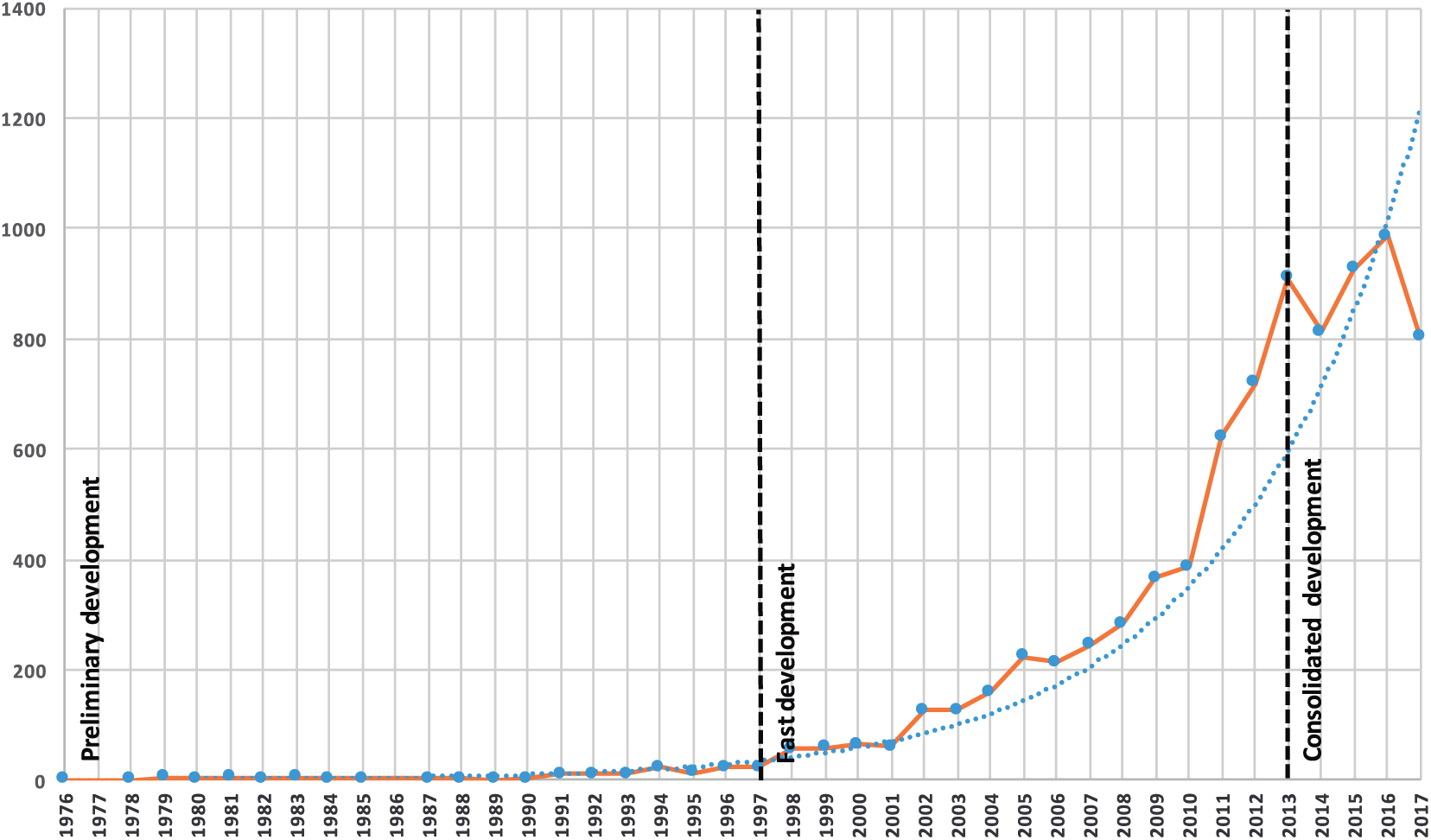
Distribution and evolution of documents on Integrative and Complementary Oncology research in Web of Science (WoS) database; dots indicate the number of documents in each year, and the dashed line establishes the different periods.
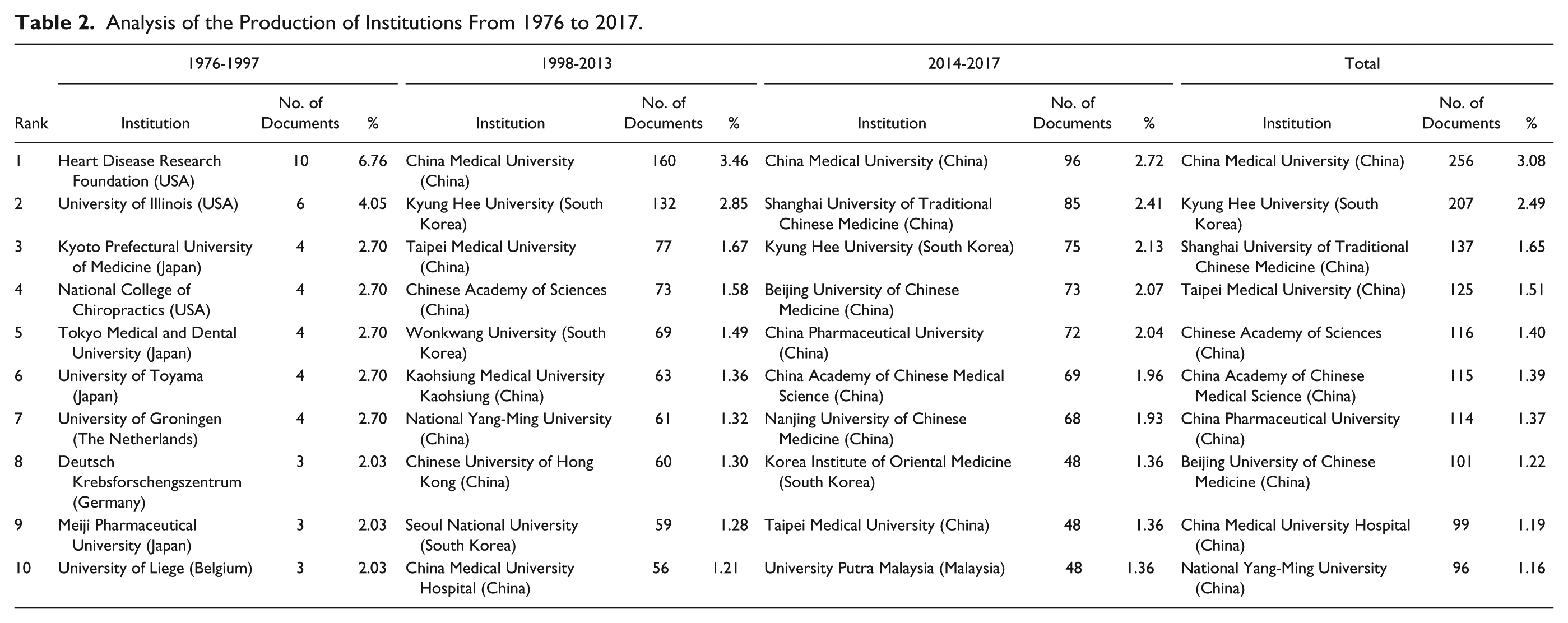
Furthermore, to discover the leading scientific producers in ICO field, several tables were obtained to show the most productive journals, institutions, and countries (Tables 1, 2, and 3, respectively).
Analysis of the Production of the Top 10 Journals From 1976 to 2017.

Abbreviation: N/A, not applicable.
Analysis of the Production of Institutions From 1976 to 2017.
Analysis of the Production of Countries From 1976 to 2017.

In view of the information provided in Table 1, the leading journal is the Journal of Ethnopharmacology. If we look at the different periods, it seems to have a clear predominance in the fast development and whole period. Nevertheless, it is important to highlight that there were fewer indexed journals in the preliminary development period compared with the remaining periods. Therefore, the Journal of Ethnopharmacology could be considered as a “classical journal” that leads the ICO field in conjunction with Planta Medica, Phytomedicine, and the American Journal of Chinese Medicine. It is also remarkable that approximately 50% of the documents published in the fast development period are concentrated in three different journals: the Journal of Ethnopharmacology, Evidence-Based Complementary and Alternative Medicine, and Planta Medica. Evidence-Based Complementary and Alternative Medicine leads the consolidated period followed by the BMC Complementary and Alternative Medicine and the Journal of Ethnopharmacology. In this way, it is interesting to highlight the growing production of the BMC Complementary and Alternative Medicine, which moves from seventh-ranked in the second period to second-ranked in the third period and fourth-ranked in the overall rank.
Analyzing the leading institutions that produce research in ICO field (Table 2), the primacy of the China Medical University (China) is evident. It is first-ranked in the fast and consolidated development periods and is also the leader in the total ranking. It does not appear in the preliminary development period, but this finding is likely due to the reduced number of journals indexed in WoS in that period.
On the other hand, in the preliminary development period, 2 institutions could be highlighted as preliminary producers: the Heart Disease Research Foundation (USA) and the University of Illinois (USA). Furthermore, in the fast development period, the primary production is concentrated in the China Medical University (China) and the Kyung Hee University (South Korea). Finally, as the consolidated development period comes into play, the Shanghai University of Traditional Chinese Medicine (China) is second-ranked. However, in the total ranking, it is the third-ranked and preceded by the Kyung Hee University (South Korea) and the China Medical University (China). At a glance, the ICO research production, with the exception of the preliminary development period, is dominated by Asian institutions, specifically by China and South Korea. Only the University Putra Malaysia (Malaysia) among the other Asian countries has been able to position itself among the 10 institutions most productive in the last period.
When the country level is analyzed (Table 3), the Unites States appears as the second-ranked with 16.99% of the total production. China is the leader with approximately 1000 more documents (28.30% of the total). South Korea follows with 11.38% of the total. This ranking is also maintained in the fast and consolidated development periods. As a general perception, although Asian countries dominate the production, the presence of some European (Germany and England), South American (Brazil), Oceania (Australia), and North American (Canada) countries is remarkable. Furthermore, as shown in Figure 2, the countries with the highest RPI are Malaysia, Taiwan, and South Korea. Nonetheless, it is notable that China has a higher RPI than the United States, so this finding confirms not only higher production but also higher relative interest.

Relative Priority Index of the top 10 countries; the values obtained by each country are presented at the edges.
Figure 3 shows a stacked bar graph with the documents published by the top 10 countries in each quartile ranking of the WoS. According to the results, India is the country with a higher percentage of Q1 (greater than 60%) followed by Brazil (60%), Malaysia, and South Korea (almost 60%). China has approximately 80% of its production in Q1 and Q2, representing approximately 40% in each group. In contrast, the United States has a higher proportion of documents published in Q2 than in Q1.

Documents published by the top 10 countries in each quartile ranking of the Web of Science (WoS).
Collaboration
The scientific collaboration relationships among the leading producers’ countries from 1976 to 2017 are shown in Figure 4. Primary production is concentrated in China, the United States, and South Korea, and a close collaboration is maintained among these. Nonetheless, based on the map, the citations received are not directly related to the number of publications. At a glance, the United States and Japan received a higher number of citations than China, South Korea, or Taiwan. Conversely, Belgium, Israel, and Scotland, with a lower number of documents, received more cites.

Country collaborations in the integrative and complementary oncology (ICO) research field; the size of the spheres is related to the number of documents, and the color reflects the received citations.
Topics
As previously mentioned, a strategic diagram (Figure 5) was obtained, showing 5 major themes, including apoptosis, breast cancer, oxidative stress, chemotherapy, and nuclear factor-Kappa-B (NF-Kappa-B), that reflect the principal topics of the set of documents that compounds the ICO research field. A more in-depth analysis will be performed in the discussion section.

Strategic diagram of the main topics detected in integrative and complementary oncology (ICO) for the period 1976-2017; the size of the spheres is related to the number of documents.
In Figure 6, a stacked bar graph is shown representing the relative interest of the top 10 and the remaining countries on the 17 themes detected in the strategic diagram.

Production of the top 10 countries in each of the 17 themes detected.
Discussion
In this bibliometric study, the results of publication on the topic of ICO indexed in WoS from 1976 to 2017 are presented. According to the obtained results, some aspects related to the ICO research field should be noted.
First, Journal of Ethnopharmacology is the predominant journal during the entire period. It could be considered as a “classical journal” within the ICO and CAM fields. 12 It is the journal that contributes the most relevant articles to the development of the ICO field followed by the Journal of Alternative and Complementary Medicine, Complementary Therapies in Medicine, and Integrative Cancer Therapies. These findings contrast with the overall ranking based on the number of documents (Table 1), where the Journal of Alternative and Complementary Medicine is eighth-ranked, Integrative Cancer Therapies is sixth-ranked, and Complementary Therapies in Medicine does not even appear in the top 10. Nonetheless, it must be noted that the articles of each journal started indexing in different years: Journal of Ethnopharmacology in 1997, Journal of Alternative and Complementary Medicine in 2000, Complementary Therapies in Medicine in 2002, and Integrative Cancer Therapies in 2008. Therefore, the most important articles are not always published in the most productive journals, and the considerable growth of Integrative Cancer Therapies is noteworthy.
A similar trend occurs with the analysis of countries. While the most productive countries are China, the United States, and South Korea, as represented in the collaboration map (Figure 4), these countries do not receive more citations. It is remarkable that the United States received more cites than China with approximately 1000 fewer documents. This finding also contrasts with the findings shown in Figure 3, where the United States has a reduced percentage of documents in Q1 proportionally. China has approximately 10% more documents in this quartile. Nonetheless, the Chinese production indexed in WoS has mainly accumulated since 2000s, 12 so these findings have to be taking with caution.
Furthermore, considering the map, the countries receiving more citations according to their production are Belgium, Israel, and Scotland. Thus, there is not a direct relation between publication and citations. This situation was previously addressed in the literature.12,43 Furthermore, it is interesting to highlight that China and the United States do not obtain the highest RPI. Malaysia, Taiwan, and South Korea have the highest RPI. These countries make a higher effort in research in this topic. It is interesting to highlight the collaboration of the USA with Asian countries, specifically with China, South Korea, and Japan. Non-Asiatic countries are closer to these countries.
Additionally, by looking at the main topics detected in Figure 5 and the relative contribution of each country to each topic in Figure 6, several observations can be made. Regarding major themes, the theme Apoptosis is composed of several relevant articles44,45 related to the study of the effect of different medicinal plants in the destruction process of damaged cells, such as tumor cells. Although China has more documents published in this theme, Malaysia has a higher relative effort. Taking into account the theme Oxidative Stress, which is related to free radicals and antioxidant defenses (main actors in inflammatory processes), some important papers comprise its core.46,47 China has are documents published in this topic, but Japan has the highest relative interest since it has a higher percentage of documents published in this topic. Furthermore, the theme of Breast Cancer is composed of several relevant articles48-52 mainly focused on the treatment of the cancer-related symptoms, highly researched also in the literature. 53 This finding is entirely in concordance with the social and economic repercussion of the breast cancer condition, 54 since it ranks second (15.4%) among cancer deaths after lung cancer in the developed nations. England has the highest relative interest in this theme. Nonetheless, the United States is the leading producer. According to Boon et al, 55 greater than 80% of women with breast cancer report the use of CAM therapies. Regarding the theme NF-Kappa-B, it involves the anti-inflammatory process and adequate control of DNA transcription. Consequently, regarding cellular responses to different stimuli, this topic is also relevant to the ICO field. Regarding the interest of the countries in this theme, South Korea has a higher relative interest, and China is the leading producer. Two of the articles identified as relevant56,57 constitute this theme and are related to the use of medicinal plants to mediate in the inflammatory reaction. Overall, although the theme does not appear in the strategic diagram, the majority of the topics are related to herbal medicine. This finding supports previous findings in which the dominance of herbal medicine in CAM research field was stated. 15 In addition, 2 different studies within the theme Chemotherapy58,59 analyze the benefits and uses of the CAM therapies in the chemotherapy intervention, such as acupuncture, mind-body interventions, and medicinal plants. In this theme, China is the leading producer, and England has the highest relative interest. Finally, from the themes classified as emerging or declining, it is important to underline the themes of Acupuncture and Colorectal Cancer. Several meta-analyses were published in the recent literature addressing the benefits of the use of acupuncture in cancer-related symptoms.60,61 Moreover, different meta-analyses were also published about CAM and colorectal cancer.62,63 The presence of these meta-analyses denotes the scientific support of some CAM therapies through the highest level of the evidence pyramid. 64 Finally, concerning the research interests of the top 10 countries, China is the leading producer and the country with the highest relative interest in Colorectal Cancer. Moreover, although China is the leading producer in the Acupuncture theme, England has the highest relative interest.
Given that all the analyzed aspects have been reported, an overall perspective of the research field is needed. The therapies related to the ICO research field are strongly related to traditional Oriental medicine, and this issue is notable given the high presence of Asian countries and institutions investing resources and time in this field. Furthermore, the research is focused on 2 of the most important types of cancer: breast and colorectal cancers. Among all the CAM therapies, acupuncture seems to be attracting the scientific attention. It is noteworthy that the first document that describes and organizes the system of diagnosis and treatment dates from approximately 100
Moreover, there is a large thematic area related to the effect of the CAM therapies on the cellular processes that occur in tumor growth or removal. Specifically, scientific attention given to inflammation processes, the effect of chemotherapy that promotes several cellular changes, and the physiological mechanisms to fight against the tumor are remarkable. Finally, although in our study the theme Quality of Life appears as an isolated theme, it is logical to think that in the future, research in this topic will increase due to the growing number of cancer survivors. 2
Considering the different issues previously discussed, a better understanding of the social and cognitive structure of the ICO research field allows us to understand the development of the field itself as well as identify its main historical actors and other research foci. In this sense, these results could help the administrative authorities to better plan funding allocations, taking into account those consolidated actors and emerging topics. In addition, the identification of the collaboration networks, leading countries, and institutions can support several academic decisions, facilitating the identification of potential new collaborations and promoting synergistic scientific activities in different regions of the world. In the end, this study provides an evidence-based framework in which the different actors of scientific dissemination can make decisions and promote new research lines.
Although the present study provides exciting findings, some limitations have to be addressed. First, the use of WoS limits the analysis to the perspective of the documents indexed in this database. Furthermore, document selection was based on the Integrative and Complementary Medicine WoS category, and some papers could be indexed in other categories. Conversely, a systematic approach using the most relevant bibliometric procedures was applied, obtaining an overview of the evolution of the ICO research field.
Conclusion
In recent years, the quantity of CAM therapies users has increased given that these research topics are attracting the interest of the research community. Therefore, it is important to identify the leading producers of the knowledge in this field and themes that are the focus of the attention. The field is led by China from a country perspective and China Medical University on an institutional level. Nevertheless, although the primary scientific producer in ICO is China, which also has a higher percentage of documents published in Q1, the United States receives a higher quantity of citations. In contrast, Malaysia, Taiwan, and South Korea make a higher effort in research in this topic. The primary topics attracting the attention are apoptosis, breast cancer, oxidative stress, chemotherapy, and NF-Kappa-B. These results provide potentially relevant information to help understand the past, present, and future of the ICO field. This study proposes an evidence-based framework on which to base future research lines and academic decisions.
Footnotes
Declaration of Conflicting Interests
The author(s) declared no potential conflicts of interest with respect to the research, authorship, and/or publication of this article.
Funding
The author(s) disclosed receipt of the following financial support for the research, authorship, and/or publication of this article: The authors want to thank the support of FEDER funds (TIN2016-75850-R) and University of Cádiz project (PR2017-038).
