



Abstract
Previous studies have shown that soybean fermentation products can act as cancer chemoprevention or therapeutic agents. In this study, the anticancer activities of a fermentation product of soybean, black bean, and green bean mixture (BN999) were investigated. We found that BN999 inhibited the growth of human breast cancer AU565 cells and prostate adenocarcinoma PC-3 cells but not that of normal human cells. BN999 induced apoptosis in various human cancer cells but not in normal human cells. BN999 treatment of AU565 cancer cells resulted in activation of calpain and caspase-8, -9, and -3, suggesting that BN999 induces apoptosis via receptor-, mitochondria-, and endoplasmic reticulum–mediated pathways. Finally, we showed that BN999 inhibited the growth of mouse CT-26 colon cancer xenografts in syngenic BALB/c mice without causing obvious side effects. Together, these data suggest that BN999 has potential to be used as a cancer chemoprevention or therapeutic agent.
Introduction
Previous epidemiological studies have shown that increased intake of soy or soy-based products can reduce the risk of cancers, including breast, prostate, and colon cancers, in Asian countries. 1 Moreover, Asian people who migrate to the Western countries or adopt the Western diets (which contain less soy) are reported to have higher mortality rate of breast and prostate cancers. 2 These studies suggest that the bioactive ingredients of soybean may act as chemoprevention agents. Indeed, the major components of soybean, including isoflavones, phytosterols, soy phytates, protease inhibitors, and saponins, have been shown to have anticancer activities. 3 Furthermore, soy fermentation products or soy extracts have been reported to be able to act as cancer chemoprevention agents.4,5
Isoflavones (such as genistein and daidzein) have been shown to have various anticancer activities, including inhibition of proliferation and induction of apoptosis of cancer cells. 1 Isoflavones are naturally occurring compounds that are produced almost exclusively in leguminous plants. Among these legumes, soybean, black bean, and green bean have been shown to contain abundant amount of isoflavones,3,6,7 suggesting that these beans may be used as cancer chemoprevention food supplements. Indeed, ingredients from soybean, black bean, and green bean have been shown to have cancer chemopreventive activities.3,8-10
Apoptosis is a well-regulated process and is essential for animal development and tissue homeostasis. Apoptosis can be triggered by the extrinsic, receptor-mediated, or intrinsic, mitochondria-mediated signaling pathways, which are activated by caspase-8 and caspase-9, respectively. 11 Caspase-8 is activated when it is recruited to a death-inducing signaling complex that is formed on ligand-induced oligomerization of Fas or tumor necrosis factor receptor. In contrast, caspase-9 is activated when cytochrome c is released into cytoplasm where it forms an apoptosome with adenosine triphosphate, Apaf-1, and procaspase-9. 12 The activation of caspase-8 and -9 can then lead to activation of downstream effector caspases, including caspase-3, -6, and -7. In addition to the above 2 apoptotic pathways, many studies indicated that endoplasmic reticulum–mediated signaling pathway is also involved in apoptotic execution. Endoplasmic reticulum stress causes an increase in intracellular calcium level, which in turn causes the activation of calpain/caspase-12/caspase-3 cascades, leading to apoptosis. 6 A variety of signals, such as those induced by ultraviolet, ionizing radiation, anticancer drugs, and growth factor deprivation, can trigger an apoptotic response. It is believed that apoptosis contributes to the antitumor activity of most chemotherapeutic drugs. 13
BN999 is a fermentation product of soybean (Glycine max (L) Merr), black bean [black soybean, Glycine max (L) Merr], and green bean (Vigna radiata (L) Wilczek) mixture. Since soybean fermentation products and ingredients of soybean, black bean, and green bean have been reported to have anticancer activities,4,8,10 we tested whether BN999 had antitumor activities. Our data indicated that BN999 could specifically induce apoptosis in various human cancer cells and inhibit the in vivo tumor growth in a mouse xenograft tumor model, suggesting that BN999 is a potential anticancer nutritional supplement.
Materials and Methods
Cell Culture
The human breast cancer cell line, AU565, the human cervical carcinoma cell line, C-33A, the human lung carcinoma cell line, H1299, the human nasopharyngeal carcinoma cell line, NPC-TW04, the human gastric adenocarcinoma cell line, AGS, the human osteosarcoma cell line, U-2OS, and the mouse colon carcinoma cell line, CT-26, were routinely grown in Dulbecco’s modified Eagle medium (DMEM, GIBCO BRL Life Technologies, Grand Island, NY) supplemented with 10% fetal bovine serum (FBS) in 5% CO2. The human prostate adenocarcinoma cell line, PC-3, was cultured in RPMI-1640 medium (GIBCO BRL Life Technologies, Grand Island, NY) supplemented with 10% FBS in 5% CO2. Primary human umbilical vein endothelial cells (HUVEC) were isolated from umbilical cord as described 14 and maintained in medium 199 (GIBCO BRL Life Technologies, Grand, Island, NY) supplemented with 20% FBS, 30 µg/mL endothelial cell growth supplement (Upstate Biotechnology, Lake Placid, NY), 15 µg/mL heparin (Leo Pharmaceutical Product, Ballerup, Denmark), and 1 mM pyruvate in 5% CO2. Human gingival fibroblast (GF) cells were isolated from gingival tissue as described 15 and cultured in DMEM containing 10% FBS in 5% CO2.
BN999
BN999, a fermentation product of soybean, black bean, and green bean mixture, was provided by AKC Nutraceuticals Inc (Burnaby, British Columbia, Canada). The microorganisms used in the fermentation process included Lactobacillus paracasei and Saccharomyces cerevisiae. The nutrient broth used in fermentation was prepared by mixing organic beans (mainly soybean, black bean, and green bean) with distilled water, followed by grinding, and heat sterilizing (at 100°C). The microorganisms were inoculated into the mixed bean nutrient broth (at 1.08 × 10⁸ colony forming units/mL) and incubated for 150 hours. On completion of the incubation period, the final fermented broth was heat sterilized, filtered, concentrated, and spray dried. The resulting pathogen-free powders were then packaged into capsules.
Preparation of BN999 for Experimental Usage
For in vitro experiments, the BN999 extracts was prepared as follows: 300 mg BN999 powder was dissolved in 2 mL dimethyl sulfoxide (DMSO), shaken at room temperature for 3 days, and then centrifuged at 10 000 rpm for 5 minutes to remove insoluble debris. The brown supernatant was stored at 4°C before use. For animal experiments, BN999 solution (at concentration of 30 mg/mL) was prepared by dissolving BN999 powder in water. The BN999 water solution was given orally to the mice without centrifugation.
Cell Growth Inhibition Assay
Cells were seeded at 5000 cells/well in 96-well cell culture plates and incubated overnight. For dose–response assays, cells were fed with fresh media containing solvent DMSO (0.5%) or various concentrations of BN999. Seventy-two hours later, cell viability was measured by 3-(4,5-dimethyl-thiazol-2-yl) 2,5-diphenyl tetrazolium bromide (MTT; Sigma-Aldrich, St Louis, MO) assay. The MTT assay was performed as follows. Cells were incubated with 0.4 mg/mL MTT at 37°C for 3 hours. Cells were then dissolved in DMSO at 37°C for 5 minutes and the spectrophotometric absorbance of the samples was determined by using an ELISA reader (Biotek, Winooski, VT) at 550 nm. The OD (optical density) 550 values obtained at 0 µg/mL of BN999 (used as control) were set as 100% and the OD 550 values obtained at other concentrations of BN999 were compared with control. For time-course experiments, cells were incubated in fresh medium containing either solvent DMSO (0.5%) or 750 µg/mL BN999 and were incubated for different times as indicated. The amounts of viable cells at different time points were determined by the MTT assay and expressed as OD 550 values.
Flow Cytometric Apoptotic Assay, Determination of Caspase-3, -8, and -9 Activities, and Western Blot Analysis
The flow cytometric apoptotic assay was performed as described previously. 16 Apoptotic cells were shown as a subdiploid (sub-G1) peak. Caspase-3, -8, and -9 activities were determined using fluorimetric caspase activity assay as described. 17 Western blot analysis was performed as described previously. 18
Determination of Intracellular Ca2+ Concentrations
AU565 cells were treated with solvent DMSO (0.5%) for 2 hours or 750 µg/mL BN999 for 1 or 2 hours. Thirty minutes before harvesting, cells were treated with 2 µM fluo-3-AM (Calbiochem, Bad Soden, Germany) to detect intracellular Ca2+ levels. The cells were then washed with phosphate-buffered saline (PBS), resuspended in PBS, and the intracellular Ca2+ levels were determined by flow cytometry with FL1 channel.
Determination of Calpain Activities
Calpain activity was assayed using Suc-Leu-Leu-Val-Tyr-AMC as fluorogenic substrate. AU565 cells were treated with solvent DMSO (0.5%) for 12 hours or 750 µg/mL BN999 for 6 or 12 hours, harvested, washed with PBS, resuspended in 50 µL of chilled cell lysis buffer (10 mM HEPES pH 7.4, 1% Triton X-100, 145 mM NaCl, 10% glycerol, and 1 mM Na3VO4), and incubated on ice for 30 minutes. Cell lysates were cleared by centrifugation and the protein concentration of the supernatants was determined. Fifty micrograms of total protein was assayed for calpain activity in 100 µL reaction buffer (10 mM HEPES pH 7.4 and 145 mM NaCl) containing 100 µM Suc-Leu-Leu-Val-Tyr-AMC. The protease reaction was allowed to proceed for 1 hour at 37°C. Under these conditions, calpain activity is proportional to the release of AMC from the substrate. Fluorescence from AMC was monitored with the fluorometer Spectra Max Gemini XS (Molecular Devices, Sunnyvale, CA) using 380 nm excitation and 460 nm emission wavelengths.
Mouse CT-26 Colon Cancer Xenograft Model
All animal experiments in this study were performed following the Guidelines for Animal Experiments in National Taiwan University and were approved by the Institutional Animal Care and Use Committee of College of Medicine, National Taiwan University (IACUC Approval No: 20100025). Female BALB/c mice (6-8 weeks old) were purchased from the Laboratory Animal Center at the College of Medicine, National Taiwan University and given food and water ad libitum. Starting from 1 week before tumor cell implantation, the mice were fed orally with either BN999 or water (200 µL, twice a day; the dose of BN999 used is about 0.65 g/d/kg). On day 8 of treatment, both flanks of the mice were subcutaneously injected with CT-26 colon cancer cells (5 × 10⁴, suspended in 100 µL of PBS), and the mice were treated with BN999 or water in a similar protocol as described above till the end of the experiment. The mouse body weight and tumor size were measured at different time points following tumor implantation. The tumor volume was calculated according to the following formula: ½(length × width2).
Statistical Analysis
Data were expressed as the mean ± standard error. The significance of the difference between groups was evaluated with the Student’s t test, and P < .05 was considered significant.
Results
Effect of BN999 on Cell Growth and Apoptosis
The effect of BN999 on the growth of human breast cancer AU565 cells, human prostate adenocarcinoma PC-3 cells, human HUVEC, and human GF cells was analyzed by MTT assay. These cells were treated with different doses of BN999 for 72 hours. As shown in Figure 1A, left panel, BN999 inhibited the growth of AU565 and PC-3 cancer cells in a dose-dependent manner. The concentration required for 50% inhibition of growth of AU565 and PC-3 cells (ID50) was 480.4 and 596.8 µg/mL, respectively. In contrast, the growth of normal HUVEC and normal GF cells was only marginally affected by BN999 treatment (Figure 1A, right panel). The AU565, PC-3, HUVEC, and GF cells were incubated with 750 µg/mL BN999 for various lengths of time. As shown in Figure 1B, whereas the growth rate of AU565 and PC-3 cancer cells was inhibited by BN999, that of normal HUVEC and GF cells was only slightly affected by BN999.

Inhibition of cancer cell growth and induction of cancer cell apoptosis by BN999. (A) Dose-dependent effect of BN999 on AU565 and PC-3 cancer cells (left panel) and normal human HUVEC and GF cells (right panel). Cells were cultured in media containing solvent DMSO (0.5%) or various concentrations of BN999 for 72 hours. Cell survival was determined by the MTT assay and expressed as a percentage of the control (DMSO-treated group). Values represent means ± SE, n = 5. *P < .05; **P < .001 versus DMSO-treated group. (B) Time-dependent growth-inhibitory effect of BN999 on AU565 and PC-3 cancer cells (left panel) and normal human HUVEC and GF cells (right panel). Cells were cultured in media containing solvent DMSO (0.5%) or 750 µg/mL BN999 for 24, 48, and 72 hours. Cell growth was determined by the MTT assay. Values represent means ± SE, n = 6. *P < .05; **P < .001, comparison between DMSO-treated and BN999-treated groups at the specific time point. (C) Dose-dependent apoptotic effect of BN999 on AU565, PC-3, HUVEC, and GF cells. Cells were cultured in media containing either solvent DMSO (0.5%) or various concentrations of BN999 for 72 hours. The percentages of sub-G1 cells were assessed by flow cytometric analysis of DNA content. Values represent means ± SE, n = 3. *P < .05; **P < .001 versus DMSO-treated group
It is possible that BN999 inhibited the growth rate of AU565 and PC-3 cancer cells through induction of apoptosis. We thus tested whether BN999 could induce apoptosis in AU565 and PC-3 cells by performing sub-G1 DNA content analysis using flow cytometry. AU565 and PC-3 cells were treated with 500 or 750 µg/mL of BN999 for 72 hours. The cells were then harvested and subjected to sub-G1 DNA content analysis. In sub-G1 DNA content analysis, cells with sub-G1 DNA contents were scored as apoptotic. As shown in Figure 1C, in both AU565 and PC-3 cells, BN999 dose-dependently increased the percentage of cells with sub-G1 DNA content, indicating that BN999 can induce apoptosis in these cancer cells. In contrast, in normal HUVEC and GF cells, BN999 did not induce apoptosis even at a concentration of 1000 µg/mL (Figure 1C). Together, these data indicate that BN999 can specifically induce apoptosis in human cancer cells but not in normal human cells. Next we tested whether BN999 could induce apoptosis in other types of cancer cells. By using sub-G1 DNA content analyses, we found that BN999 could dose-dependently induce apoptosis in human cervical carcinoma C-33A cells, human lung carcinoma H1299 cells, human nasopharyngeal carcinoma NPC-TW04 cells, human gastric adenocarcinoma AGS cells, human osteosarcoma U-2OS cells and mouse colon carcinoma CT-26 cells (Figure 2). Therefore, BN999 can induce apoptosis in a broad spectrum of cancer cells.

Dose-dependent apoptotic effect of BN999 on C-33A, H1299, NPC-TW04, AGS, U-2OS, and CT-26 cancer cells. Cells were cultured in media containing either solvent DMSO (0.5%) or various concentrations of BN999 for 72 hours. The percentages of sub-G1 cells were assessed by flow cytometric analysis of DNA content. Values represent means ± SE, *P < .05; **P < .001 versus DMSO-treated group
Modulation of Apoptosis-Regulatory Molecules by BN999
Caspases play important roles in induction of apoptosis, and caspase-3 is a key executioner of apoptosis mediated by various apoptotic stimuli. To investigate whether caspase-3 was involved in the BN999-induced apoptosis, we measured caspase-3 activity using a fluorimetric caspase activity assay. As shown in Figure 3A, caspase-3 was significantly activated in BN999-treated AU565 cancer cells. Caspase-3 activation in BN999-treated AU565 cells was confirmed by the cleavage of its substrate poly(ADP-ribose)polymerase (PARP; Figure 3B). Caspase-3 is known to be activated by caspase-8, caspase-9, and calcium-calpain cascades. To study which of these pathways was involved in BN999-induced caspase-3 activation, the activities of caspase-8, caspase-9, and calpain were analyzed in BN999-treated AU565 cancer cells. As shown in Figure 3A, the activities of caspase-8 and caspse-9 were activated in BN999-treated AU565 cells. BN999 could also increase the intracellular level of calcium in AU565 cells (Figure 3C). As a result, the activity of calpain was activated by BN999 in AU565 cells (Figure 3D). Together, these data indicate that BN999 can induce the activation of caspase-8, caspse-9, and calpain, which in turn causes the activation of caspase-3, leading to apoptosis of cancer cells.
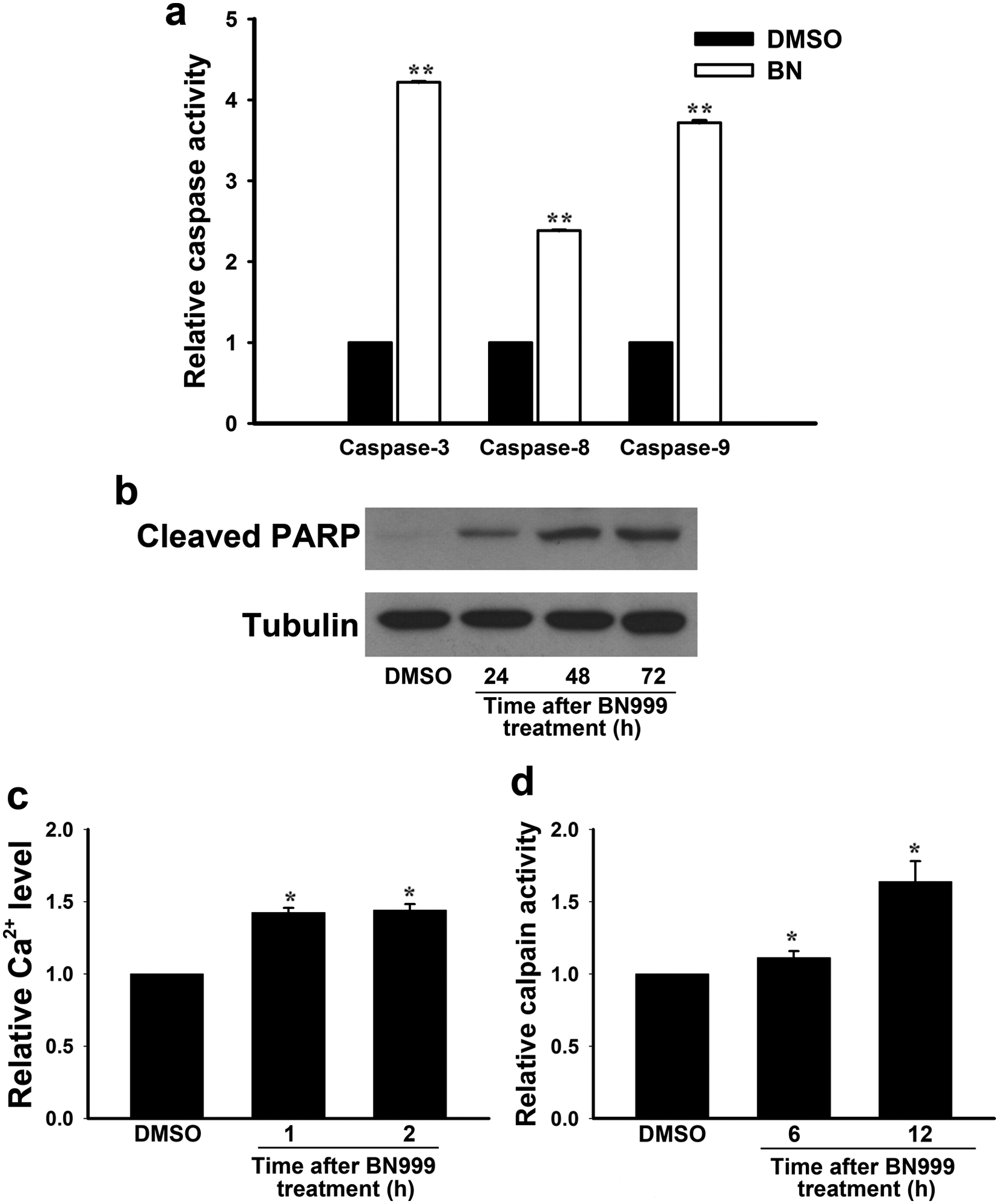
(A) Activation of caspase-3, -8, and -9 in AU565 cells by BN999. AU565 cells were treated with solvent DMSO (0.5%) or 750 µg/mL BN999 for 24 hours. Caspase activities were determined using fluorimetric caspase activity assay. Relative caspase activity was obtained by comparing the caspase activity in cells treated with BN999 with that in cells treated with DMSO. Values represent means ± SE, n = 2. **P < .005 versus DMSO-treated group. (B) Caspase substrate PARP was cleaved in BN999-treated AU565 cells. Cells were treated with solvent DMSO (0.5%) for 72 hours or 750 µg/mL BN999 for 24, 48, or 72 hours. After treatment, cell lysates were prepared and immunoblotted with antibody against cleaved PARP fragment. (C) Effect of BN999 on intracellular level of Ca2+ in AU565 cells. AU565 cells were treated with DMSO (0.5%) for 2 hours or 750 µg/mL BN999 for 1 or 2 hours, and intracellular Ca2+ levels were determined. The Ca2+ level in DMSO-treated group was set as 1. Values represent means ± SE, n = 2. *P < .05 versus DMSO-treated group. (D) Activation of calpain in AU565 cells by BN999. AU565 cells were treated with DMSO (0.5%) for 12 hours or 750 µg/mL BN999 for 6 or 12 hours, and the calpain activities were determined. The calpain activity in DMSO-treated group was set as 1. Values represent means ± SE, n = 3. *P < .05 versus DMSO-treated group
BN999 Inhibits the Growth of Mouse CT-26 Colon Cancer Xenografts in Syngenic BALB/c Mice
It is believed that apoptosis contributes to the antitumor activity of most antitumor agents. Since BN999 could induce apoptosis in mouse colon carcinoma CT-26 cells (Figure 2), we thus used mouse CT-26 tumor model to test the antitumor activity of BN999. Female BALB/c mice were orally fed with either BN999 (at a dose of ~0.65 g/d/kg) or water throughout the experimental duration. On day 8 of BN999 treatment, CT-26 cancer cells were injected subcutaneously into both flanks of mice. The mouse body weight and tumor volume were measured at different time points following tumor implantation. BN999 did not cause body weight loss (Figure 4A) or other side effects, such as hair loss and lethargy during the experimental period. The growth of tumors was slower in BN999-treated mice than in water-treated mice (Figure 4B). At day 21 after tumor cell implantation, whereas the average tumor volume of BN999-treated mice was 0.3 ± 0.03 cm3, that of water-treated mice was 0.5 ± 0.04 cm3. Together, these data indicate that BN999 can inhibit tumor growth and may be used as a cancer chemoprevention agent.

BN999 inhibits the growth of mouse CT-26 cancer xenografts in syngenic BALB/c mice. The effect of BN999 on body weight (A) and tumor growth (B) in BALB/c mice subcutaneously inoculated with mouse CT-26 colon cancer cells. For body weight data, values represent means ± SE, n = 6 mice per group. For tumor volume data, values represent means ± SE, n = 12 tumors per group, *P < .05; **P < .001 versus water-treated group
Discussion
Many studies have shown that soybean fermentation products can inhibit cancer cell growth, induce apoptosis of cancer cells, and inhibit tumor growth in mice.3-5 However, the anticancer activity of fermentation products produced from mixture of soybean and other leguminous beans is not known. Here we show that BN999, a fermentation product of mixed leguminous beans, has potent anticancer activities in vitro and in vivo. To our knowledge, this is the first report showing that fermentation products of mixed beans may be used in cancer prevention or therapy. BN999 is a fermentation product produced from mixture of soybean, black bean, and green bean. Among these beans, soybean is known to contain isoflavones, phytosterols, soy phytates, protease inhibitors, lignans, and saponins that have been reported to have anticancer activities.1,3 The components of black bean, including isoflavones, phenolic acids, anthocyanins, and flavanols, and the components of green bean, including isoflavones and protease inhibitor mungoin, have also been shown to have anticancer activities.8-10 These anticancer ingredients together with the bioactive compounds produced during the fermentation process may contribute to the antitumor activities of BN999. It is possible that BN999, which contains more anticancer ingredients derived from black bean and green bean, has stronger antitumor activity than fermentation products made from soybean alone. Experiments aiming to compare the anticancer activities of BN999 with other soy fermentation products are in progress.
One of the most important anticancer ingredients found in soybean, black bean, and green bean is a family of related compounds called isoflavones. Isoflavones, which have phytoestrogenic activity, may act as estrogen receptor agonists or antagonists and have been shown to reduce the risk of breast cancers. In this study, we demonstrated that BN999, which contains abundant isoflavones, could inhibit the growth and induce apoptosis of human breast AU565 cancer cells. Since the AU565 cell line lacks estrogen receptors, the inhibitory effect of BN999 on AU565 breast cancer cells may not be attributed to the phytoestrogenic properties of BN999. Isoflavones, such as genistein, daidzein, and glycitein, possess multiple biological and biochemical functions that may be related to their anticancer activities. 1 In general, isoflavones present in soybean, black bean, and green bean mostly as glucoside conjugates, such as genistin, daidzin, and glycitin (supplementary table at http://ict.sagepub.com/supplemental), which are not absorbed across enterocytes. 19 These glycosylated isoflavones can be converted to isoflavone aglycones (such as genistein, daidzein, and glycitein, which can be absorbed via small intestine) by mammalian or microbial β-glucosidase. 20 Fermentation of soybean, black bean, and green bean by microorganisms thus can increase the bioavailability of isoflavones in these beans. 21 BN999 is a fermentation product of soybean, black bean, and green bean mixture using Lactobacillus paracasei and Saccharomyces cerevisiae. High-performance liquid chromatographic analysis of BN999 indicates that BN999 contains much higher isoflavone aglycones (such as genistein, daidzein, and glycitein) than glycosylated isoflavones (supplementary table at http://ict.sagepub.com/supplemental). Therefore, BN999 should be more efficient than extracts from soybean, black bean, and green bean mixture for cancer prevention or therapy.
BN999 was more effective in inducing cancer cell apoptosis than the commercial isoflavone product containing higher amount of isoflavones (supplementary figure at http://ict.sagepub.com/supplemental). This might be because of the possibility that BN999 contains other apoptosis-inducing ingredients such as phytosterols, saponins, phytates, anthocyanins, and chemicals formed during fermentation, which could act additively or synergistically with isoflavones.9,22 That BN999 may contain various apoptosis-inducing ingredients is reflected by the fact that BN999 can induce apoptosis through different apoptotic pathways including the receptor-, mitochondria-, and endoplasmic reticulum–mediated pathways (Figure 3). Different cancer cells are known to have mutations that disable distinct apoptotic pathways. This is the reason why disparate tumors may respond differentially to specific chemotherapeutic drugs and tumors that are sensitive to certain drugs may otherwise be resistant to other drugs. Therefore, combination chemotherapy that targets several apoptotic pathways simultaneously would overcome the problem of chemoresistance. 13 BN999, which contains various anticancer ingredients from fermented soybean, black bean, and green bean, was shown here to induce apoptosis via at least 3 apoptotic pathways (Figure 3) and induce apoptosis in a broad spectrum of human cancer cell lines (Figure 2). This “chemotherapy cocktail” should be superior to conventional chemotherapeutic drugs because it can evade and overcome the chemoresistance mechanisms that have befallen many conventional chemotherapeutic approaches.
We have found that BN999 at a dose of ~0.65 g/d/kg can significantly inhibit CT-26 tumor growth without causing body weight loss in mice (Figure 4A). To further investigate the safety of BN999 in mice, the 28-day feeding toxicity test was conducted (data not shown). BN999 at doses of 1.25, 2.5, and 5g/d/kg caused no significant changes in body weight, food consumption, and clinical chemistry or hematology parameters (including the weight of internal organs, the blood cells and platelet counts, the level of cholesterol, triglyceride, creatinine phosphokinase, lactate dehydrogenase, blood urea nitrogen, and albumin). Histological examination in all BN999-treated mice revealed no inflammatory or pathological changes in spleen, kidney, heart, lung, and gastrointestinal tract when compared with control mice. The dose levels of 1.25, 2.5, and 5 g/d/kg used in this toxicity study were much higher than the dose (~0.65 g/d/kg) used in the CT-26 tumor inhibition study (Figure 4). We believe that the tumor-inhibitory effect of BN999 would be more prominent if higher dosages were used.
Conclusion
The present study demonstrates that BN999 can inhibit the growth of human cancer cells but not that of normal human cells. BN999 induces apoptosis in a variety of human cancer cell lines but not in normal human cells. BN999 treatment of AU565 cancer cells resulted in activation of calpain and caspase-8, -9, and -3, suggesting that BN999 induces apoptosis via receptor-, mitochondria-, and endoplasmic reticulum–mediated pathways. Moreover, BN999, which was delivered orally 1 week before tumor implantation, could exert antitumor effects without causing side effects in mice. Together these data suggest that BN999 has potential to be used as a cancer chemoprevention agent.
Footnotes

Declaration of Conflicting Interests
The authors declared no potential conflicts of interest with respect to the research, authorship, and/or publication of this article.
Funding
The authors received no financial support for the research, authorship, and/or publication of this article.