



Abstract
This study used a questionnaire to examine how academic staff members in Greece and Cyprus feel about the changes in undergraduate medical education during the COVID-19 pandemic. In general, e-learning was not considered an adequate way of teaching and was less enjoyable. Participants aged 31-40 years experienced more (P = .001), while staff in higher academic ranks less difficulty (P < .001) in adjustment. There was a small increase in workload, which was higher among respondents researching into COVID-19 (P = .001). During the pandemic, daily screen use >6 h was increased from 28.8% to 57.5%. The majority (74.2%) stated that scientific and educational training opportunities were not affected by the pandemic. In conclusion, the pandemic has induced important changes in undergraduate medical education. This new condition was considered adequate but not pleasant, with younger faculty members being more burdened.
The 2020 to 2021 lockdown due to the corona virus infectious disease (COVID-19) pandemic has had important impacts on many aspects of life, work and medical education.1,2 In universities, physical presence was prohibited in all forms and was replaced by e-learning. 2 The aim of our study was to examine the effects of this change on undergraduate medical education in Greece and in Cyprus, as based on views and attitudes of the faculty members from three Medical Schools in these two countries.
Methods
This study was conducted among faculty members of three Medical Schools (two in Greece and one in Cyprus) between the middle of the winter semester 2020 to 2021 and the spring semester 2020 to 2021: Medical School of Democritus University of Thrace (DUTH), located in Alexandroupolis, Greece; Medical School of the National and Kapodistrian University of Athens (NKUA), Athens, Greece; and Medical and Dentistry School of European University of Cyprus (EUC), Nicosia, Cyprus.
Participants
Faculty members of these Medical Schools were the target population. The only inclusion criterion was current position as a faculty/teaching member with an active institutional email address. No exclusion criteria were applied. Overall, 109 faculty members from DUTH, 497 from NKUA and 133 from EUC were invited to participate.
Study Design
In a cross-sectional design, an email was sent to the faculty members of each institution, based on the official list at each institution‘s webpage. The email included an introductory note explaining the aim of the study, along with the procedure and the expected results. Assurance of the anonymity of the study was emphasised. The email included the link to an online questionnaire, which was developed by members of the research team using the GoogleForms® platform (Google LLC, MountainView, CA).
Questionnaire
The questionnaire consisted of 31 items, in most of which answers were on a Likert scale ranging from 1 to 10. Questions were first tested with a pilot questionnaire answered by 10 faculty members of DUTH. The final version of the questionnaire was modified based on their comments and suggestions. Reliability analysis in the pilot study showed an acceptable value for Cronbach‘s alpha (0.624). In the pilot study, no personal data were collected. These 10 professors were invited to participate again in the final study. The questionnaire was then distributed to the three universities. In DUTH and NKUA, the online questionnaire was provided in Greek language, whereas in the European University of Cyprus it was provided both in Greek and in English. Four days after the first e-mail, a reminder of the invitation was sent to all faculty members.
Statistical Analysis
Statistical analysis was performed with the SPSS 26.0 statistical programme (IBM Corp. Released 2019. IBM SPSS Statistics for Windows, Version 26.0. Armonk, NY: IBM Corp). Descriptive statistics were used. Normality of data was checked with Kolmogorov-Smirnov test, and appropriate analyses (parametric or non- parametric, according to the normality of distribution) were applied. Mean scores in different subgroups were compared by one-way ANOVA. Qualitative variables were compared by chi-square test. Significance was defined at 5% (two-tailed P < .05).
Results
General Characteristics
Completion rate was 99.63%. Specifically, out of the 269 responses initially received, only one was rejected, because this questionnaire was not completely answered, especially in the parts that were crucial for statistical analyses. Response rates according to the Institution were: Democritus University of Thrace 59.63% (n = 65), National and Kapodistrian University of Athens 33.6% (n = 167), and European University of Cyprus 27.07% (n = 36) (Table 1). The majority of responders were male (65.5%), married (81.3%) and aged between 51 and 60 years (45.5%).
General Characteristics of Participants.
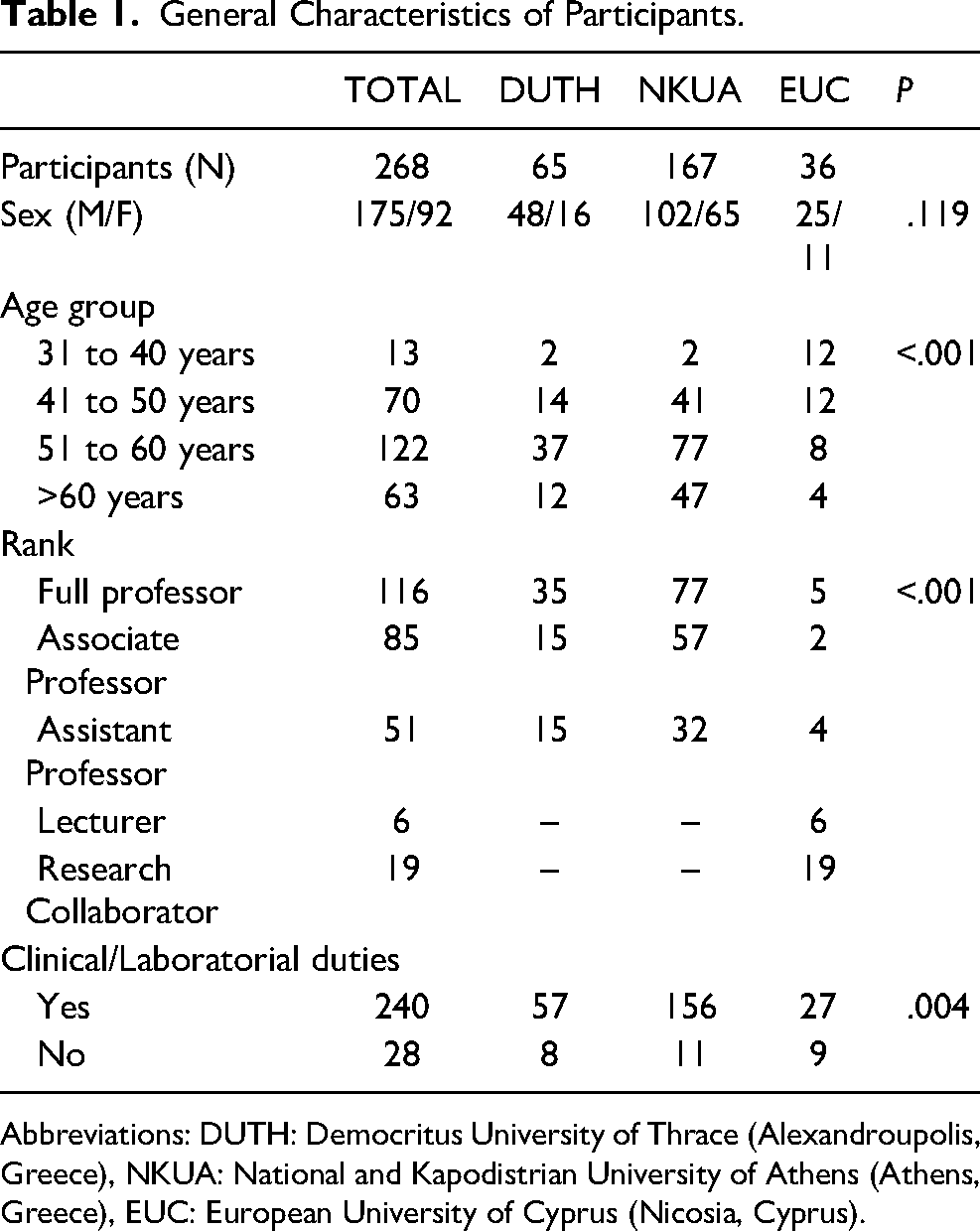
Abbreviations: DUTH: Democritus University of Thrace (Alexandroupolis, Greece), NKUA: National and Kapodistrian University of Athens (Athens, Greece), EUC: European University of Cyprus (Nicosia, Cyprus).
Tutorial Duties and Research During the COVID-19 Pandemic
The questionnaire assessed personal experience with teaching. Its results are summarised in Table 2. In general, it was noted that e-learning was helpful for the lectures (mean: 6.76 ± 2.55). Adjustment to the new educational process was easy (mean: 7.87 ± 2.1) Participants aged 31 to 40 experienced difficulties in adapting to e-learning (5.85 ± 2.97 vs. 8.19 ± 1.91 among those aged 51-60, P = .001).
Teaching Experience.
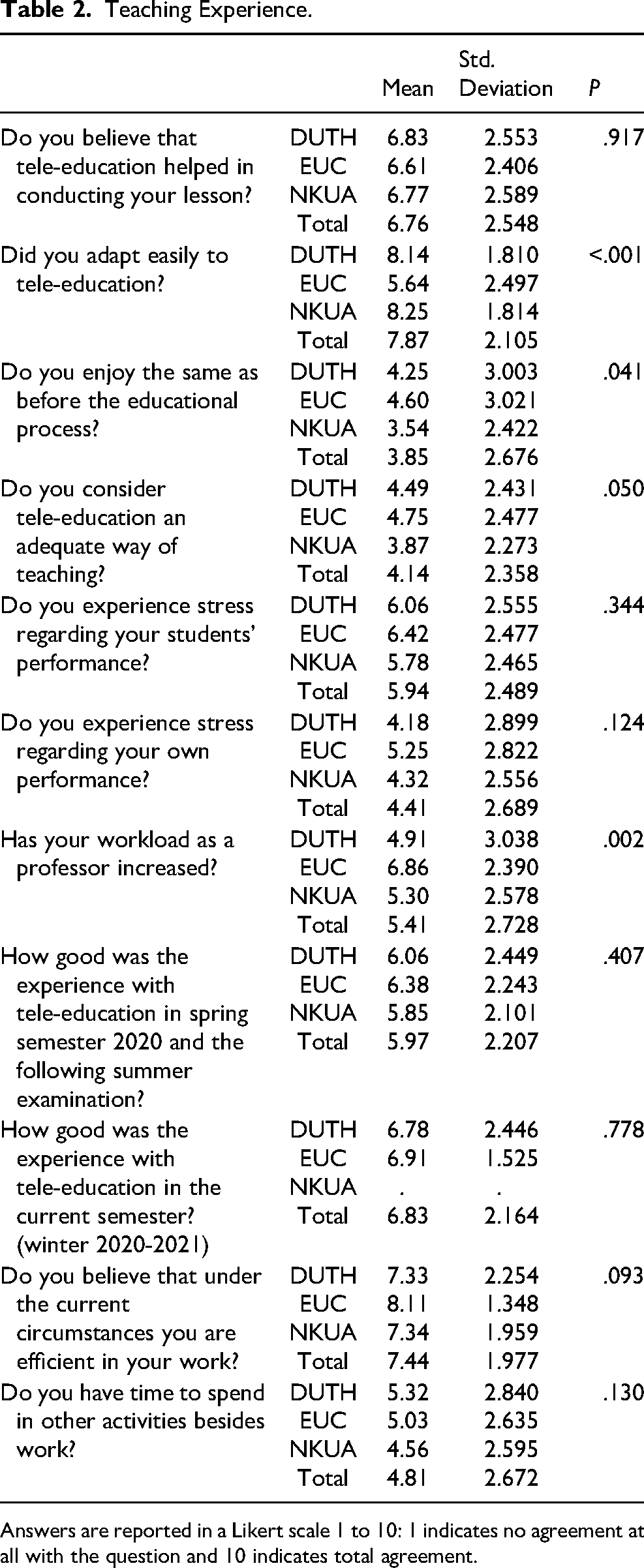
Answers are reported in a Likert scale 1 to 10: 1 indicates no agreement at all with the question and 10 indicates total agreement.
The comparison between academic ranks showed that lecturers and research associates (two junior academic ranks existing only in EUC) experienced significant difficulties adapting to the new teaching circumstances: research associates 5.53 ± 2.8, lecturers 5.83 ± 1.72, assistant professors 7.9 ± 2.02, associate professors 8.0 ± 2.0 and full professors 8.25 ± 1.81 (P < .001).
In general, e-learning was not considered an adequate way of teaching (4.14 ± 2.36). As age increased this mode of learning was considered less in a statistically significant way (P = .036), namely: 5.77 ± 3 in those 31 to 40 years, 4.37 ± 2.3 in those 41 to 50 years, 4.01 ± 2.31 in those 51 to 60 years, and 3.81 ± 2.27 in those >60 years. Moreover, responders did not enjoy the educational process as much as before the pandemic (level of enjoyment in the total sample: 3.85 ± 2.68). Enjoyment scores, although low, were significantly (P = .041) higher among responders from EUC (4.60 ± 3) in comparison to Universities from Greece (DUTH: 4.25 ± 3; NKUA: 3.54 ± 2.42).
A small increase in workload was also reported (5.41 ± 2.73); comparison between academic ranks was as follows: research associates and external collaborators (Cyprus only) reported an increase of 7.17 ± 2.36, lecturers (Cyprus only) 7 ± 2.28, assistant professors (Greece and Cyprus) 4.86 ± 2.73, associate professors (Greece and Cyprus) 5.36 ± 2.54, and full professors (Greece and Cyprus) 5.3 ± 2.83. Of note, respondents who had focused their research on COVID-19 related topics reported a significant increase in their daily workload (P = .001). Finally, time devoted to other activities was reduced (4.81 ± 2.67). However, time use and efficacy was relatively high (7.44 ± 1.98).
Regarding the positivity of the whole experience, results were moderate during the spring semester 2020 when measures were applied for the first time (positive experience: 5.97 ± 2.2), but progressively improved during the following semesters. Specifically, responses from DUTH and EUC showed higher scores during the winter semester 2020 to 2021 (positive experience: 6.83 ± 2.16). Similar results were found in answers of participants from the NKUA (positive experience: 6.46 ± 2.2), while for the spring semester of 2021, mean value of answers in the question of positivity of their experience was 6.74 ± 2.23. When asked about their intention to change the examination methods in the future, 46 responders from DUTH and EUC combined (total: 45.5%) and 44 responders (26.3%) from NKUA answered affirmatively.
An increase in time of using digital screens was observed. Before the pandemic, 43.1% reported daily use <3 h, while during the pandemic this was decreased to 11.7%. At the same time, >6 h of daily screen use was reported by 28.8% before the pandemic versus 57.5% of the participants during the pandemic.
Regarding their personal scientific and educational training opportunities, 74.2% of respondents stated that they were not affected by the pandemic, while 41.9% mentioned an increase in the overall educational opportunities. Additionally, 59% of participants have incorporated topics related to COVID-19 in their research. This was more prevalent among full professors (64.7%) and assistant professors (70.6%) and less so among other ranks (P = .003).
Generally, females exhibited higher scores (Table 3). They considered that e-learning facilitated medical education (females 7.22 ± 2.35 vs. males: 6.5 ± 2.61, P = .028). Enjoyment of the procedure (females 4.55 ± 2.65 vs. males 3.46 ± 2.61, P = .001) and increase in workload (female 5.99 ± 2.45 vs. male 5.09 ± 2.82, P = .011) were higher among females. Especially during the winter semester of 2020 to 2021, female faculty members in DUTH and EUC, reported better experience with e-learning (females 8.04 ± 1.4 vs. males 6.35 ± 2.22, P < .001).
Comparison of Answers Between Males and Females.
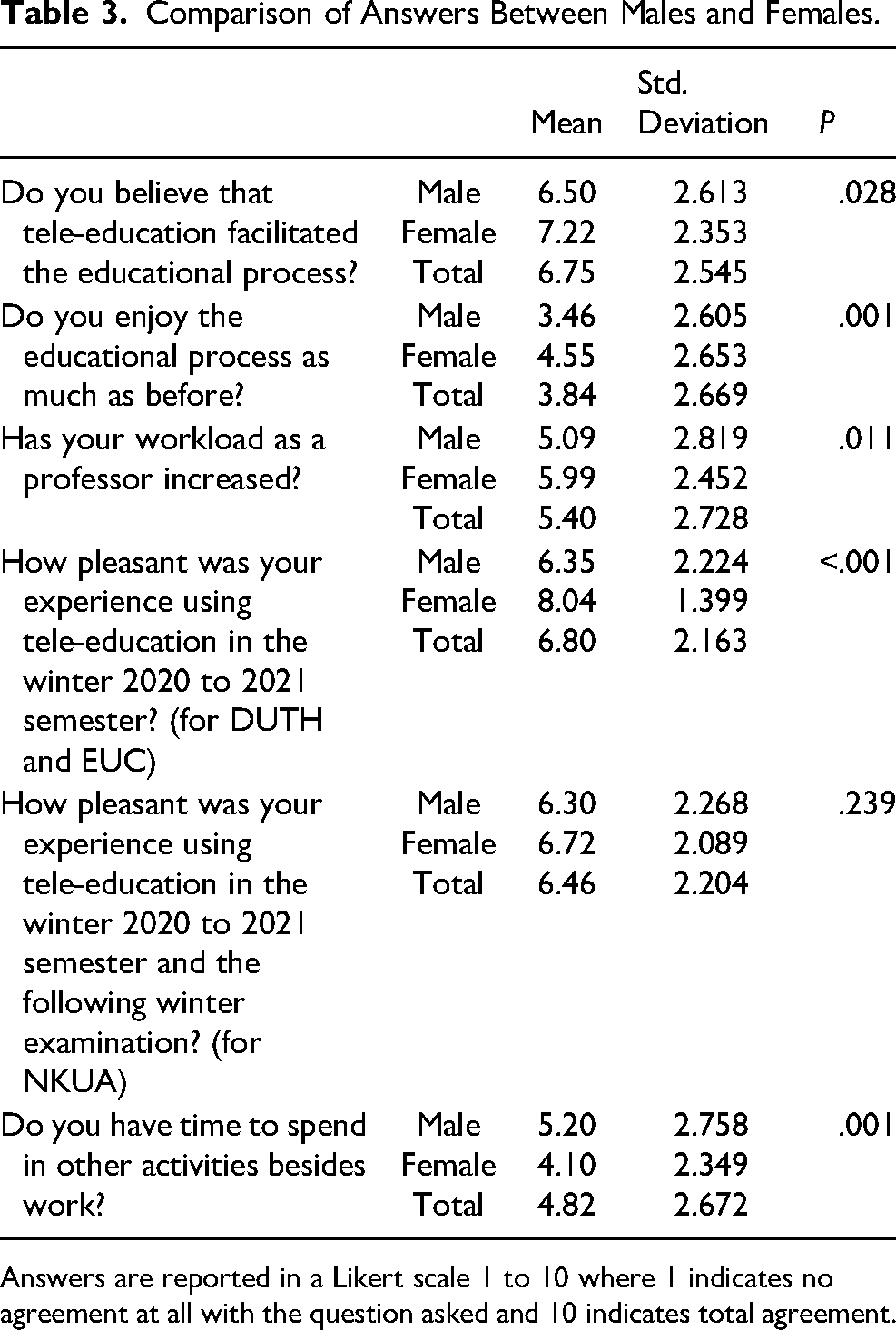
Answers are reported in a Likert scale 1 to 10 where 1 indicates no agreement at all with the question asked and 10 indicates total agreement.
Discussion
The present study among medical faculty members in Greece and Cyprus has shown that adjustment to the new e-learning was relatively easy. E-learning was considered a useful but not adequate tool for lectures. The whole experience was not as enjoyable as before the pandemic, but it progressively improved from spring semester 2020 to the winter semester 2020 to 2021. In addition, an increase in workload was noted both in the tutorial and the clinical/laboratory duties of staff, leaving limited time to invest in other activities.
So far, literature on e-learning for undergraduate medical education during the COVID-19 pandemic has reported contradictory findings among academic staff members. Some academics faced difficulties with the new technologies 3 and preferred working on site rather than remotely. 4 They also mentioned that staff interactions are better when working on site3,4 and that they missed face-to-face contact with students when teaching online.5,6 Other disadvantages of e-learning include its cost, the inability of assessing clinical/laboratory skills, 2 difficulty in preparing for classes and the lack of interaction or understanding between students and professors. Thus, most academic staff members have expressed their preference to return to lectures with physical presence after the pandemic, 6 while others have preferred continuing e-learning even after the pandemic.7,8 Of note, some of the latter praised the flexibility of e-learning in delivering lectures and in involving students in their classes.5,9 Moreover, an improvement in the quality of lectures has been reported. 7 Interestingly, in our study an increase in personal scientific and educational training was revealed, mainly due to the overwhelming number of online conferences and webinars, in accordance with other reports.10,11
In our study, relatively increased workload was reported in all medical faculties. This may be due to additional effort needed for the preparation of appropriate material for the new type of online lectures, probably because of copyright and personal information concerns. 8 Such increased workload may, generally, reduce pursuing of other activities and increase stress, 12 but this was not confirmed in our study. Of note, previous works have also reported increase in workload, among academic staff members13,14. Moreover, among medical professionals involved in the treatment of COVID-19 patients, burnout has been also reported in several countries.15-17
An interesting finding of our study was that females were generally more positive towards distant learning and the new working conditions. They enjoyed the teaching process more, even though their duties were more increased, as compared with males. A similar difference in workload between sexes has previously been reported: females were significantly more affected on both personal and professional level, due to increased work-related obligations and caregiving responsibilities, intensified by the pandemic. 12
Certainly, there are limitations in the current study, such as its cross-sectional design, which does not allow us to explore causal relationships. Secondly, our sample size, though larger than that of previous similar works, is small and is based on 3 universities only. Thus, larger studies including staff members from more universities are highly welcome. Finally, our questionnaire included only closed-ended questions, which provide limited insight into exact viewpoints. However, this was preferred because it permits easy data analysis.
Despite these limitations, this is the first enquiry into the views of academic staff members from medical schools in our two countries. Indeed, our study provides valuable information about the current situation, helping us gain some insight about measures that should be taken in potential future global crises. Theoretically, should e-learning continue, undergraduate medical students would have more spare time, and this could be used to familiarise them with principles of medical writing early enough,18-21 but this remains to be verified.
In conclusion, the pandemic has induced important changes in undergraduate medical education. This new condition was considered adequate but not pleasant, with younger faculty members being more burdened. Hence, a plan to support academic staff members both mentally and physically merits careful consideration.
Footnotes
Declaration of Conflicting Interests
The author(s) declared no potential conflicts of interest with respect to the research, authorship, and/or publication of this article.
Funding
The author(s) received no financial support for the research, authorship and/or publication of this article.
Ethical Approval
The ethics committee of each institution provided approval of the study. (DUTH: #DUTH/EHDE/37237/337-02.03.2021; NKUA: #504/19.04.2021; EUC: #EEBK-EP-2021.01.38
