



Abstract
The purpose of this study was to conduct a systematic meta-review with the goal of documenting the landscape of measures of classroom management in the school-based literature. Our systematic search for systematic reviews and extraction of primary studies in the classroom management research yielded 73 studies for inclusion that captured 76 different classroom management measures. We present an inclusive repository of measures from the field. Results revealed high levels of variability in aspects of both scales and observational measures across a range of domains assessed. We discuss our descriptive analysis of the landscape of classroom management measures and provide implications for future work.
High-quality classroom management practices are an essential set of skills for teachers to acquire. High-quality classroom management can be characterized by positive and proactive schedules, supports, and strategies that promote effective teaching and instruction as well as student motivation, engagement, and success (Sprick et al., 2021). Effective classroom management requires teachers to be continuously sensitive to students’ needs within the context of the classroom environment, respond to student disruptions and distractions in proactive ways that promote and maintain a discipline order in the class, and, at the same time, consider students’ social-emotional development (Cunningham et al., 2023). These supports promote instructional time and student engagement via adjusting the classroom environment, building high-quality teacher–student relationships, and managing student behaviors, among other pathways (Chow et al., 2020). Indeed, studies show that classroom management practices characterized by positive behavior supports can build a high-quality, warm, and positive classroom environment for students, maximize instructional time, and improve student–teacher relationships and academic outcomes (Chow et al., 2021; Mitchell & Bradshaw, 2013).
Given the strength of the connection between classroom management and outcomes for both teachers and students, researchers, stakeholders, and policy makers have devoted significant time and funds to assessing the dimensions and quality of classroom management approaches. However, a wide range of classroom management assessments exist. This review fills a need in the field to collate and analyze the landscape of approaches for assessing classroom management practices across these domains, provide considerations for selecting classroom management assessments, and discuss areas for future work.
Classroom Management and Student Outcomes
A teacher’s approach to classroom management influences students’ engagement and academic achievement. The rate of using evidence-based classroom management strategies relates to students’ classroom engagement; teachers who use fewer evidence-based classroom management strategies have lower student engagement rates during instructional time (Gage et al., 2018). Similarly, Larson et al. (2021) found the use of positive behavior support increased students’ active class engagement. Dijk et al. (2019) found a significant indirect effect between classroom management and students’ math achievement via behavior management. Effective classroom management is also linked to students’ interest in learning different subjects (Kunter et al., 2007). This suggests teachers who use effective classroom management strategies can motivate student learning and learning motivation can lead to improved academic achievement (e.g., Adeyemo, 2012; Nisar et al., 2019). In contrast, teachers with poor classroom management skills are more likely to create a less organized classroom structure and emotionally supportive environment, which may lead to more conflict and misbehavior (Chow et al., 2020; Varghese et al., 2019). It is not surprising that teachers who are observed to use lower quality classroom management strategies also report high levels of stress, which may contribute to continued cycles of negative teacher–student interactions (Jennings & Greenberg, 2009).
Effective classroom management methods also affect students’ social and emotional outcomes. The classroom setting is not only a place for students to learn academic knowledge but also a place for students to interact with one another and build social-emotional skills. A focused environment with clear social and behavioral expectations provides a secure setting under which students can learn to manage their own emotions, to navigate conflict, and to have social and emotional success across varying peer/social settings (S. M. Jones & Bouffard, 2013). Through effective classroom management strategies, teachers can support students in developing social-emotional skills, listening attentively, managing behaviors, and regulating emotions. To illustrate, Korpershoek et al. (2016) conducted a meta-analysis and found a small but significant effect of classroom management strategies on student social-emotional outcomes. Similarly, Morris and colleagues (2013) found that classroom management strategies improved students’ competence in attention and inhibitory control. Furthermore, by using classroom management strategies, teachers also help students to set moral standards (Nucci, 2006).
It is important to note that a range of definitions of classroom management exist in the literature. These can include a breadth of skills and practices that teachers employ to engage and maintain organizational classroom structures, student attention and on task behaviors, and promote productive learning opportunities. We operationally define classroom management as “the actions teachers take to create an environment that supports and facilitates both academic and social-emotional learning” (Evertson & Weinstein, 2006). This operationalization is purposely broad to maximize the inclusivity of our review to encompass the full scope of strategies that teachers may employ to maintain classroom structures and promote learning. This operationalization is consistent with theoretical frameworks which conceptualize classroom management as an overarching domain comprising a broad range of subordinate aspects (Marder et al., 2023); we focus on four underlying components that are drawn from a conceptual framework about the structure and nature of relationships and organizational features in the classroom (e.g., Hamre & Pianta, 2007). These components include teachers’ efforts to manage instructional time, student behaviors, teacher–student relationships, and organizational features of the classroom (e.g., expectations, rules, routines); each (a) are connected to academic and social-emotional student outcomes; (b) are core elements in most teaching quality frameworks (e.g., Hamre & Pianta, 2010; Klieme et al., 2009) and used daily in teachers’ classroom management practice; and (c) are areas teachers identify as needs for support. Each component is posited to measure a distinct aspect of classroom management that, together or alone, may be responsible for promoting an environment that supports and facilitates both academic and social-emotional learning. Understanding the extent these components are measured in the literature will improve our understanding about measurement selection and areas for future work.
Classroom Management Measures
Classroom management research has increased over the past several decades, resulting in a variety of approaches to assess the features and qualities of classroom management strategies. Modalities of assessment include (but are not limited to) observational assessments, teacher self-reports via surveys and interviews, checklists, informal observational notes, video-based self-reflection and reporting, and coach or principal reports on teacher performance (Bracken & Fischel, 2006; Reddy et al., 2013). Although observational assessments are considered the gold standard for objective measures of classroom management, they are time consuming and costly. Thus, researchers have called for practical, brief, easy, acceptable, and reliable measures that can be employed in classroom settings (e.g., self-report measures; Sutherland et al., 2013). However, it is not clear how many classroom management assessments currently exist, the modality of each, and the dimensions assessed. Thus, when making measurement choices, researchers may default to relying on previous experiences with a measure, highly publicized or cited measures, or create their own measures tailored to specific practices of interest. The field needs a summary assessment of the classroom management measures currently available that can support measurement choices that are based on a comprehensive assessment of measurement features.
This review will provide the field with a comprehensive dataset of classroom management measures used in the school-based literature, to provide a summary evaluation and descriptors of these assessments. Although there have been numerous syntheses of intervention research of both group and single-case designs (e.g., Bowman-Perrott et al., 2016; Chaffee et al., 2017; Kaya & Selvitopu, 2019; Korest & Carlson, 2021; Korpershoek et al., 2016; Long et al., 2019; Maggin et al., 2017), the extent that these reviews capture and evaluate assessments of classroom management over and above implementing an intervention is unknown. This review specifically aims to synthesize this research base with the intention of identifying and reviewing measures or assessments of classroom management. This review aims to collate and analyze the landscape of approaches that have been used to assess classroom management in school-based research to inform decision making in the context of intervention research, evaluation, and practice.
Method
Literature Search
For the purposes of this study, we included systematic reviews and meta-analyses published within the past 10 years (2012–present). Given the nature of the systematic review process, it is likely the data (i.e., primary studies within systematic reviews) will include many studies prior to the review publication date and additional substantive search terms to capture the full scope of classroom management studies. To identify systematic reviews of the literature, we searched the Academic Search Complete, ERIC, and PsycINFO electronic databases for all document types using the following search strategy: “classroom management” AND “meta-analysis” OR “systematic review” OR “literature review” OR “meta analysis” OR “meta-synthesis” OR “meta synthesis” and retrieved 151 returns. We conducted this search on May 13, 2022. After removing duplicates, we retained 118 documents for further review. We then conducted title and abstract screening and retained 22 documents for full-text review; 12 reviews remained for primary study extraction.
We extracted all primary studies included in the final set of 12 systematic reviews to serve as our sample for this meta-review of classroom management measures. As such, we compiled a reference list of all included articles from all reviews, resulting in an initial corpus of 307 primary studies. After removing duplicates and articles that could not be located across the databases of four institutions from this comprehensive list, 263 primary studies remained, and we downloaded full-text versions of each study for full-text screening.
Inclusion Criteria
To be included in our study as a systematic review from which we extracted primary studies, documents had to (a) be systematic reviews, including meta-analyses, and (b) include classroom management as a primary construct of interest. At this stage, we searched for the term “classroom management” and included all relevant reviews. We defined “primary construct” as a main variable of analysis including classroom management intervention efficacy and correlational analyses of classroom management’s relation to other constructs (e.g., burnout, self-efficacy, student achievement). The study purpose had to clearly indicate that the review was assessing the importance of classroom management in either of these contexts. Examples of studies that would have been excluded were case studies or policy analyses that focused on classroom management as an important construct but used course taking or licensure as a proxy.
To be included in our study as a primary study, documents had to (a) include participants in preschool through 12th grade and (b) include a measure of teacher classroom management. Of the 263 primary studies, 83 met our inclusion criteria and we included them in full coding. From this set, we identified 10 additional studies that did not meet our criteria (e.g., were child only focused measures). Our final sample included 73 studies which had 76 different measures of classroom management (see Figure S1). During the coding phase (see Study Coding), we further operationalized “classroom management,” in the context of measures in a primary study by organizing the measures by assigning one or more of the following descriptors to each measure: (a) teachers’ instructional management, (b) student behavior management, (c) teacher–student interactions or relationships, (d) classroom organization and/or structure, or (e) other.
Training and Reliability
To index reliability of our screening process, we independently reviewed the downloaded sample of 118 reviews after deduplication. We then compared screening and resolved any discrepancies and were in 100% agreement to produce the full-text review sample of 22 documents. We then reviewed the remaining documents which yielded a set of 13 agreed-upon reviews for primary study extraction; we later excluded one review because it was in higher education (and not K–12), resulting in a final set of 12 reviews.
We trained a team of coders by reading written descriptions of the inclusion criteria, discussing criteria, and reviewing questions related to the screening criteria. Coders independently reviewed their assigned articles and indicated if those articles met the criteria. We had discussions about any articles that a coder was unsure of. After all coders had completed their screening, the first and second authors reviewed a portion of the articles to check agreement with screening criteria. After resolving discrepancies and any disagreements, we excluded 32 articles from the corpus due to not being conducted in a preK–12 setting, 69 for not having any measure of classroom management, and 79 for having only child-focused measures. During the data restructure to prepare for full study and measure level coding, we excluded four studies for child-focused measures related to classroom management (e.g., student behavior). This resulted in 79 studies that we coded for full study information and measure level details.
As with study screening, we trained coders prior to full-text coding. Coders reviewed the coding manual, discussed any questions related to coding, and practiced coding a few articles prior to group discussion. During meetings, we further clarified definitions, reviewed examples and non-examples, and discussed any discrepancies or concerns. Coders then independently coded their remaining articles or measures. We held meetings as needed to ensure coders were comfortable and confident in their coding. We then independently verified a minimum of 25% of the codes for each measure type (observation, survey/scale, other) and corrected any discrepancies identified; agreement across variables was high (>90%). During this process, we identified three additional studies as including student behavior–focused measures instead of teacher-focused measures, and two studies as duplicates. This resulted in excluding six additional studies from our study corpus. As such, our final study corpus included 73 studies.
Study Coding
We coded all articles screened into the review for general study aspects, including country, grade band (preschool, elementary, secondary), measure name, and study. These features were coded to provide an overall description of the measure. We coded individual measures following full-text coding to capture measure-specific information to better understand the variability of the measures of classroom management. This information included (a) whether the measure was previously developed or developed for the specific study; (b) whether the measure was an observational measure, survey measure, or another type of measure; (c) whether the focal population was the teacher or both students and teachers; (d) whether the measure was a single domain or multiple domains; and (e) what domains of classroom management each measure assessed. These codes were chosen to evaluate whether the reported reliability information was only reported for past samples or for the present study sample, to assess common methodological approaches to measuring classroom management, to gauge whose perspectives were more or less represented, to get sense of the scope of each measure, and to assess the extent to which existing measures mapped onto the previous theoretical framework and organization of classroom management domains.
To code the domains, two authors independently reviewed all the studies’ definitions of the measures (Supplementary Tables) and categorized them to four broad domains (pulled from a previous theoretical framework of classroom management; Hamre & Pianta, 2007): teachers’ efforts to manage instructional time, student behaviors, teacher–student relationships, and organizational features of the classroom (e.g., expectations, rules, routines). Upon review of the measures, an “other” category emerged that consisted of measures that assessed constructs such as teacher’s perceptions of their classroom management practices or affective constructs such as teaching self-efficacy. This construct was not represented in the previous framework; as such we chose to add an additional coding domain to describe the study measures.
We coded measure-specific information based on the measure type. For observations, we coded (a) whether the study was previously published, (b) the number of observations per teacher, (c) the length of each observation, (d) the type of sampling used in the observation, and (e) what prior reliability was if previously published, (f) overall reliability (i.e., internal consistency) in the current study, and (g) subscale reliability in the current study if applicable. For survey and scale measures, we coded (a) whether the measure was previously published, (b) whether it was a full survey/scale or subscale of a larger scale, (c) the number of items, (d) the number of subscales (if it was a full survey/scale), (e) the type of rating, (f) prior reliability (i.e., internal consistency), (g) whether the authors conducted an exploratory factor analysis (EFA) or confirmatory factor analysis (CFA), (h) overall measure reliability, and (i) subscale reliability if applicable.
Results
The purpose of this review was to document a comprehensive dataset of classroom management measures used in the school-based literature and discuss its implications for the field. Most articles included a single measure of classroom management (72%), with two measures included in 24% of articles, and 4% of articles included three or more measures (see Tables 1 and 2 for summary-level descriptive data). Broadly, the measures included in the studies were either observations or surveys/scales.
Overview of the Characteristics of Included Measures.
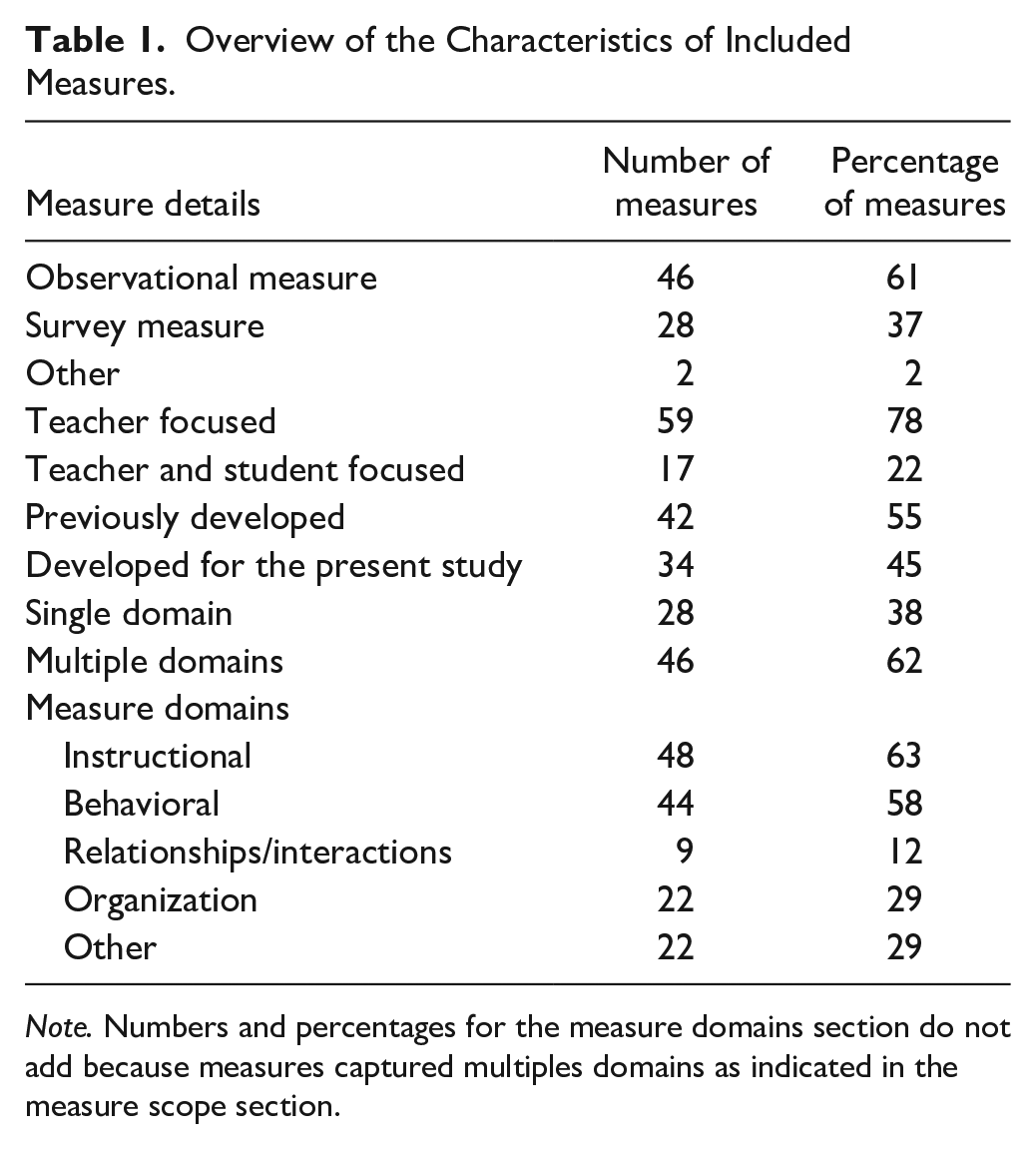
Note. Numbers and percentages for the measure domains section do not add because measures captured multiples domains as indicated in the measure scope section.
Included Studies With Corresponding Measures of Classroom Management.
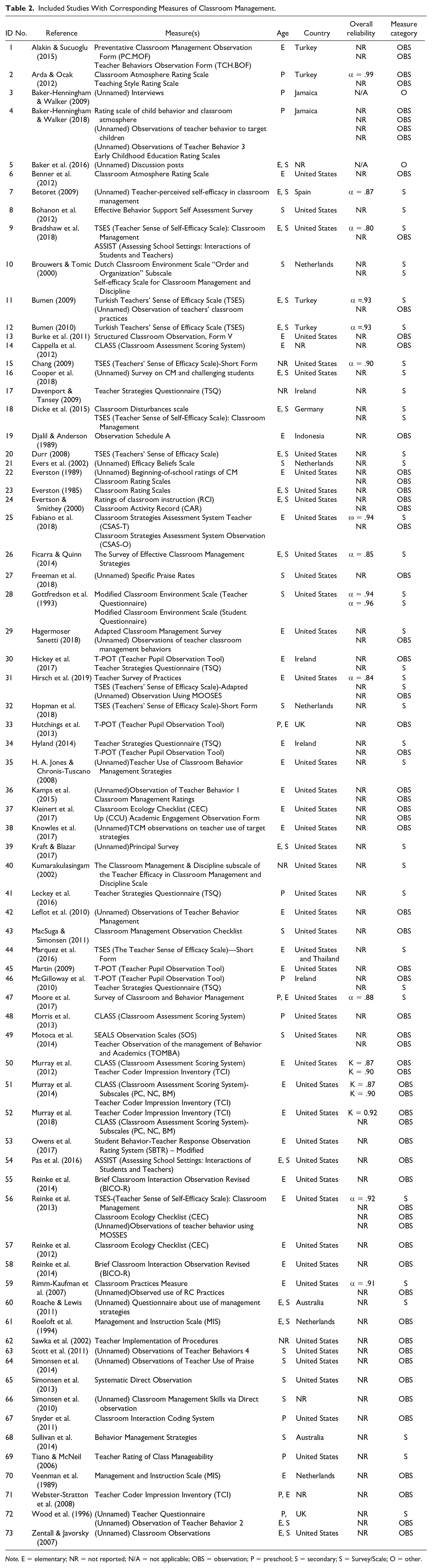
Note. E = elementary; NR = not reported; N/A = not applicable; OBS = observation; P = preschool; S = secondary; S = Survey/Scale; O = other.
In the observations category, we identified 46 unique observational measures used in 50 studies (29 published, 17 unpublished). The measures had an average number of six observations (min = 1, max = 56), and an average length of 43 min (min = 5, max = 180), suggesting a wide range of time cost across the corpus. In terms of data collection, 24 used time sampling procedures, 19 used summative ratings, two combined the two approaches, and one did not report the method. In terms of reliability and validity, 31% of studies using previously published measures reported prior reliability and validity. Only 9% reported overall reliability information for their study sample, and 17% of studies reported subscale or component reliability information (see Table S1 in the online supplemental materials for observational measures details).
In the surveys and scales category, we identified 28 measures that were used across 33 studies (21 published, seven unpublished, 10 modified/adapted). The scale measures had an average of 22 items (min = 1, max = 64) and an average of 2.5 subscales (min = 0, max = 6) again suggesting a range of time costs across measures. Of the 28 measures, 22 were surveys, four were subscales of existing scales, and two did not report. The majority were teacher/self-report measures, though one study included teacher and student reports, and another used a principal survey. For previously published measures, 43% reported prior internal consistency. Overall, 35% of studies reported overall internal consistency for the current sample and 50% of studies reported subscale reliability, both exceeding observational measures. See Tables S2 and S3 in the online supplemental materials for included survey and scale measures descriptive information and operational definitions.
In terms of classroom management domains, 28 of the measures assessed a single domain. Five measured teacher instructional delivery, three measured classroom organization, one measured teacher behavior/behavior management, and none individually measured teacher–student interactions or relationships. Of these 28 single-domain measures, 19 classified as “other.” Although a coding domain of “other” was not derived from the previous framework, this domain was created upon review of the measures (described above); these measures primarily assessed constructs such as teacher’s perceptions of their classroom management practices or affective constructs such as teaching self-efficacy. Measures coded in this category were primarily teacher report via interview or survey methods. Forty-six measures assessed multiple domains: of this subset nearly all measured teacher behavior/behavior management (n = 43) or teacher instructional delivery (n = 43). Classroom organization was captured in 19 of these measures, and student–teacher relationships or interactions were measured in nine of the multiple-domain assessments. Interestingly, only 10 of these measures assessed all domains (except for “other”) and these measures tended to be collected via observations (see Table 1 and Table S3 for details).
In terms of reliability, most studies did not report internal consistency for the current sample or reported acceptable levels of internal consistency. We considered it acceptable when the measure, or 50% of subscales, had Cronbach’s alphas above .7, Kappas above .8, or Omegas above .7 (Green & Yang, 2015). For previously published observation measures, all either met our acceptability cutoff (35%) or did not report sample reliability (68%). No study that developed observations reported sample reliability. For surveys and scales, 50% not reporting sample reliability and most meeting the acceptability cutoff. For study-developed survey measures, 30% did not report sample reliability.
Discussion
The purpose of this study is to conduct a systematic meta-review, with the goal of documenting the landscape of measures of classroom management in the school-based literature. Our results center on a compilation of measures that researchers have used to assess classroom management, and our discussion focuses on some patterns that emerge when examining the full body of measures as well as patterns in the group of observational measures and the group of survey and scale measures used in the literature. We view the primary contribution of this study is this collective list of measures that will allow researchers to have a more exhaustive list of options to select from, as well as avail researchers with options related to resources and time. For example, researchers can efficiently read through the operational definitions of measures to narrow down a list of measures that are aligned with their purpose and intent of their individual study’s classroom management construct and intent.
From this study, researchers can measure classroom management across a range of domains and via a range of modalities. This variety offers researchers flexibility in measurement choice which may be dictated partly by study time, costs, personnel, and agreements between researchers and school partners. This work provides researchers the ability to select from a library of measures that have the potential to be well aligned across sample characteristics and research questions in this area, as well as measures that may be more distal to better understand generalized or transfer effects. In addition, many measures were used in the context of classroom management practices that are evidence-based because they were developed as part of classroom management or related intervention studies. This collection of measures will continue to be useful for future intervention studies that aim to measure different aspects or the collective construct of classroom management.
This review also documents several areas of need in the measurement of classroom management. As is evident in our final list of included measures and corresponding definitions, there are a broad range of constructs captured in the umbrella term of “classroom management.” Given that we collated these measures from studies included in systematic reviews of the classroom management literature, it is important to consider the variability in constructs that are synthesized in the original reviews. When interpreting results of individual studies as well as systematic reviews, it is unlikely that authors, measures, and definitions are referring to (and reflecting) the same construct, teacher behavior, or contextual elements. Varying definitions of classroom management or focal practices may be part of the reason for the wide range of practices assessed under each measure. This range points to an important area for future work; a consistent definition of the construct of classroom management may centralize the approaches and quality of measurement, and in turn, consistent measurement may improve our ability to make comparisons across samples and interventions.
As expected, most studies were conducted in the United States. It was somewhat surprising given the substantial amount of school-based, teacher-focused research that has been conducted in Europe and other countries around the world. This may be due, in part, to how individual studies operationally define the construct of classroom management. We relied on previously conducted reviews that each conducted their own systematic reviews of the literature for the present review’s data. It is possible that there are other ways to describe and label classroom management that may be represented more in different countries and cultures.
Studies primarily included either observational assessments or teacher reports of classroom management. Future studies could include both assessment methods to make comparisons between teacher perceptions of their management practices and objective assessments of these practices—both of which are important and differentially predictive of child outcomes. Future work could probe surveys and observational measures of classroom management that can be aligned to assess the extent to which these reporters overlap or intentionally develop measures that are designed to assess different constructs (perceptions vs. behavior). This may be important to be able to determine which measures are sensitive to change and under which instructional and intervention contexts.
It is also important to consider how to balance considerations of cost (time cost, labor cost, disruption of class schedules) and measure depth (capturing many aspects of classroom management) as they relate to reliability. In some instances, a short, simple, highly reliable measure that captures one aspect of classroom management may be well aligned with the goals of a project, while in other instances, more comprehensive, time-intensive observational measures may be better aligned. Aligning the purpose of the measure (e.g., to evaluate the impacts of an intervention, to screen or quickly assess teacher skills, to comprehensively index the current state of a classroom environment) with the intended domains and resources available is an important consideration at the design stage of studies.
The sheer variability of the measures was challenging to synthesize. Classroom management research may benefit from a consolidation of measures to be able to understand the mechanisms through which teacher behavior more precisely can positively change student outcomes. Having more consistency and reliability in the outcome measures, which will include substantial measurement and validation work, will allow researchers to have more confidence that intervention effects are due to intervention components and changes in teacher behavior if the outcome measures were more reliable and consistent across studies. A future, targeted review could apply a more stringent criterion for inclusion based on measure quality. Amid this variation, we provide recommendations based on our findings.
Recommendations
We recommend reporting the reliability of the measure given the current sample. This adds transparency and allows others to accurately assess whether the measure may be appropriate for their sample. Many studies that used well-known measures did not report either the prior reliability or the current sample reliability. This makes interpreting their results challenging, because it is unclear whether the measure performed as well, better, or poorer than previous studies, including the original norming sample of the measure. Research can be challenging, and many factors may contribute to variation in reliability. Although ideally measures will present high levels of reliability, reporting the reliability of each measure in each sample can provide important context for appropriately interpreting study results. One possible way to improve the science in this area is by using factor analysis methods when using a newly developed or modified version of a previously published survey or scale. We found one study that used a revised version of the Teacher Sense of Efficacy Scale-short form, reported both prior and current sample reliability and conducted a CFA to confirm that the revised sales were operating as expected (see Chang, 2009). We suggest reporting clear and transparent information on how the measure was used, including the number and length observations, and if they used a full scale or selected subscales. This will be essential for interpretations, informing future studies, and transparency and replication.
From a resource perspective, authors should consider measures aligned with project constraints in terms of cost (e.g., time, financial cost). In some fields, observational measures may be the gold standard. However, project constraints may dictate that a less costly survey measure be used. We recommend choosing a measure that is aligned with the focus of your project or intervention. As shown in this review, measures can focus on a single aspect of classroom management or numerous aspects. Carefully selecting a measure in which the definition and constructs of classroom management are aligned with project goals is critical.
Limitations
Our purpose was to provide a compendium of classroom management measures in the research literature, and we note several limitations that should be considered to contextualize our results. First, the literature we synthesized favors studies written and published in English, centers the research on English-speaking countries, and it is possible that the systematic reviews that we drew our study sample from might have also excluded non-English studies in their review process. Individual studies and corresponding measures collected rely on search procedures of included reviews. Another point related to the individual reviews that needs to be thought through carefully when interpreting our findings is that the included studies of this review rely heavily on the purposes of the 12 reviews we sampled from. For example, review of intervention effects is not going to include descriptive studies; it is possible that there are several measures missing that were used in descriptive studies that did not meet inclusion criteria for the original reviews.
We also note that these measures represent a wide range of levels of detail in reporting, which somewhat hinder our confidence in summary recommendations overall. Specific to reliability, we focused on internal consistency coefficients, and for observational measures, we did not synthesize the extent to which studies evaluated interobserver agreement, which will be important in work focused on the specific aspects of observational measure reliability. This limits the current review in terms of making quality-based recommendations of observational measures of classroom management beyond the data we report from each individual study.
Conclusion
This review supplies the field with a summary of the measures used in the classroom management literature, explores variation within measures, and provides summary-level recommendations. Given that observational assessments have been considered the gold standard for objective measures of classroom management, it is not surprising that most measures reviewed were observational. Future studies should analyze the interobserver agreement properties of the observational measures to speak more substantively to their reliability. Future studies should also consider the role of other variables that are known to affect reliability of observations such as observer qualifications, training procedures, and the conditions under which the observations were conducted. There was also wide use of surveys and scales providing researchers with a range of practical, brief, easy, acceptable, and reliable measures that can be employed in classroom settings (e.g., self-report).
Broadly, the measures in this review indexed teachers and teacher behavior with some measures including student–teacher interactions and child behavior. Future studies should consider carefully how measures of classroom management account for and integrate contextual factors as well as individual differences of teacher and students and the classroom ecology. As a field, we should move beyond only assessing how much or how well a teacher delivers a practice and consider other factors such as student responsiveness to teachers’ attempts to deliver a practice, the importance of mulitple dimensions of classroom context, and the general dyadic and interactive nature of classroom relationships (Chow et al., 2020). Although the racial-ethnic sample composition was not a focus of this review, future work should prospectively examine the role of different racial classroom compositions, students with disabilities, and emergent bilinguals in determining how classroom management assessment can promote inclusive measurement practices and intervention development.
There has been a long and influential history of research that focuses on assessing or improving classroom management in school settings. However, the ways in which studies operationalize and measure classroom management remain heterogeneous. We have documented a comprehensive set of measures drawn from systematic reviews of the classroom management research literature to aid researchers in understanding, planning, and implementing studies moving forward. Future studies should critically consider how the type of measure and the scope of the measure definition may influence assessment or the interpretation of intervention effects.
Supplemental Material
sj-docx-1-aei-10.1177_15345084231208671 – Supplemental material for A Systematic Meta-Review of Measures of Classroom Management in School Settings
Supplemental material, sj-docx-1-aei-10.1177_15345084231208671 for A Systematic Meta-Review of Measures of Classroom Management in School Settings by Jason C. Chow, Robin Sayers, Yang Fu, Kristen L. Granger, Shannon McCullough, Corinne Kingsbery and Ashley Morse in Assessment for Effective Intervention
Supplemental Material
sj-docx-2-aei-10.1177_15345084231208671 – Supplemental material for A Systematic Meta-Review of Measures of Classroom Management in School Settings
Supplemental material, sj-docx-2-aei-10.1177_15345084231208671 for A Systematic Meta-Review of Measures of Classroom Management in School Settings by Jason C. Chow, Robin Sayers, Yang Fu, Kristen L. Granger, Shannon McCullough, Corinne Kingsbery and Ashley Morse in Assessment for Effective Intervention
Supplemental Material
sj-docx-3-aei-10.1177_15345084231208671 – Supplemental material for A Systematic Meta-Review of Measures of Classroom Management in School Settings
Supplemental material, sj-docx-3-aei-10.1177_15345084231208671 for A Systematic Meta-Review of Measures of Classroom Management in School Settings by Jason C. Chow, Robin Sayers, Yang Fu, Kristen L. Granger, Shannon McCullough, Corinne Kingsbery and Ashley Morse in Assessment for Effective Intervention
Supplemental Material
sj-docx-4-aei-10.1177_15345084231208671 – Supplemental material for A Systematic Meta-Review of Measures of Classroom Management in School Settings
Supplemental material, sj-docx-4-aei-10.1177_15345084231208671 for A Systematic Meta-Review of Measures of Classroom Management in School Settings by Jason C. Chow, Robin Sayers, Yang Fu, Kristen L. Granger, Shannon McCullough, Corinne Kingsbery and Ashley Morse in Assessment for Effective Intervention
Footnotes
Authors Note
Jason C. Chow is now affiliated with Vanderbilt University, Nashville, TN, USA.
Robin Sayers is now affiliated with WestEd, California, USA.
Declaration of Conflicting Interests
The author(s) declared no potential conflicts of interest with respect to the research, authorship, and/or publication of this article.
Funding
The author(s) received no financial support for the research, authorship, and/or publication of this article.

References
Supplementary Material
Please find the following supplemental material available below.
For Open Access articles published under a Creative Commons License, all supplemental material carries the same license as the article it is associated with.
For non-Open Access articles published, all supplemental material carries a non-exclusive license, and permission requests for re-use of supplemental material or any part of supplemental material shall be sent directly to the copyright owner as specified in the copyright notice associated with the article.
