



Abstract
Play and peer interactions are crucial for children’s socioemotional development and growth. However, children with special needs, disabilities, and developmental delays may not participate in play with peers as much as typically developing children. Reliable and valid assessment information of children’s social behavior is necessary to design programs that support the socioemotional development of young children with and without special needs. The Teacher Impression Scale (TIS) is a behavioral rating scale based on systematic observations of children’s social behaviors in play. The study aimed to examine the internal structure evidence and the reliability of the Swedish version of the TIS. A sample of 46 preschool teachers used the TIS to rate the social behavior of 92 children. Teachers observed children with special education needs (SEN) and typically developing children (TD) during a 2-week time to assess the children’s social interactions in different play situations. The results showed that the Swedish version of the TIS, the TIS-S, is reliable and can help teachers to identify the need of support for children in play and social interaction in inclusive preschool environments. Furthermore, the instrument could also be useful for identifying special educational strategies aimed at strengthening the social interaction between children.
For young children with special educational needs enrolled in inclusive settings, social integration through interactions and play with peers is a challenge (Chen et al., 2019; Guralnick, 1999). Programs that promote and support such social integration need to be based on reliable, valid, and feasible assessments of children’s social and play skills (Cambra & Silvestre, 2003). In Sweden, the Teacher Impressions Scale (TIS) developed in the United States (McConnell & Odom, 1999) has been translated and adapted to provide just such information about social play skills of children enrolled in inclusive, comprehensive preschool programs, which are common educational settings for children with disabilities in Sweden (Lundqvist et al., 2015). The purpose of this study is to examine the reliability and validity of the Swedish adaptation of the TIS.
Inclusion of children with special educational needs in education settings with their typically developing peers is a human right supported by both the United Nations Convention for the Rights of Persons with Disability (United Nations General Assembly, 2007) and the UN Convention on the Rights of the Child (United Nations General Assembly, 1989). However, successful inclusion extends beyond simply access to inclusive settings. In the United States, the joint statement by the Council for Exceptional Children Division for Early Childhood (DEC) and National Association for the Education of Young Children (2009) specifies that indicators of successful inclusion are the engagement and social integration of the children with special educational needs into the typical peer group. The Swedish Education Act and the Curriculum for the Preschool (Curriculum for the Preschool Lpfö 18, 2018; SFS 2010:800) stipulates that education in the preschool should promote the development and learning of all pupils, and a lifelong desire to learn. It should take into account the different conditions and needs of children and be adapted to all children in the preschool. To have an opportunity to develop as far as possible according to the objectives of the education, all children regardless of conditions should be given the guidance and stimulation they need for their learning and personal development. In Swedish preschools, children should receive special support when they need it, even if they do not have a disability diagnosis. For this reason, we adopt the broader concept of special educational needs (SEN), which in our context covers both children with a recognized developmental disability and children who show delays and are the reason of concern but have not been formally assessed. The students’ participation and engagement play a central role in students’ learning and development. However, previous research (Allodi, Lundqvist, et al., 2019; Almqvist et al., 2018; Granlund & Lillvist, 2015) and national evaluations show that students with special educational needs/disabilities risk experience significant shortcomings, due to the lack of inclusive quality in many educational settings (Swedish National Agency for Special Needs Education and Schools, 2020).
Accordingly, placement of children with special educational needs in inclusive preschools does not ensure that they will become socially integrated and fully participating members of the peer group. One criterion for the success of inclusion is the social acceptance of the child with special educational needs as a full member of the peer group. While acceptance into the social peer group naturally occurs for most typically developing children, some children with SENs have limited social and play skills (Odom et al., 2006). A study conducted by Chen et al. (2019) to examine patterns of social interaction between preschool children with and without disabilities in the context of play showed that children with disabilities formed looser play networks but had similar conflict networks when compared to their typically developing peers. The researcher also found that typically developing children were more likely to be situated at the center of classroom play networks, while children with disabilities were more likely to be marginalized and isolated (Chen et al., 2019). A large body of research (Justice et al., 2014; Odom, 2019; Watkins et al., 2015) shows that social interaction between children with disabilities and typically developing children has several benefits for children with special needs who have difficulties engaging in interpersonal communications. Play activities are vital in preschool settings and are crucial for the positive development of all children, but particularly for children with SEN. In interactive play, typically developing peers interact and help children with special needs with new communication and social skills within natural environments, and this situation is considered to stimulate the social engagement of children with disabilities (Odom et al., 1999).
Identifying children who have difficulties in engaging in social play with peers requires reliable and valid assessment information (Brown et al., 2002). Such information is necessary for designing intervention or instructional programs that would promote social inclusion. In early childhood education, the assessment of young children’s social behavior has a long history. Since the classic research by Parten in the 1930s (Parten, 1932), researchers have used direct observation methodology to assess young children’s social play (Odom & Ogawa, 1992). Such quantitative observational systems have operational definitions of social behaviors, and the observer records the frequency of the behavior(s) or the number of time intervals in which a social specific behavior occurs (Sam et al., 2015). The systems require the observer obtain a specific level of inter-observer agreement (IOA) with another observer before collecting data and checks on IOA during observations in classrooms. The advantage of this approach is that they focus on specific behaviors in context and can provide very accurate information (Nock & Kurtz, 2005). A disadvantage is that they often require extensive and time-consuming training for observers to achieve acceptable levels of IOA, which is a limitation for practitioners (Chafouleas et al., 2021). Alternatively, practitioners may turn to teacher rating scales, such as the Social Skills Improvement System Rating Scale (Gresham & Elliott, 2008). The advantage of such scales is that they often have evidence of high reliability and validity and may be used with minimal training. However, they depend on retrospective, subjective judgments of children’s abilities, gathered over undefined time periods and they tend to generate standard or norm-referenced scores that have limited use for planning interventions or instruction (Denham et al., 2014; Halle & Darling-Churchill, 2016).
An observer impression scale (OIS) combines the advantages of both direct observation and rating scales. The rater (e.g., a teacher) observes for a defined period or periods of time and specified context (e.g., social playtime), and completes a rating after an observational period, which may be relatively brief (e.g., 5–10 minutes). To gather representative samples of a child’s behavior, observations may occur on several different days or activities. A primary advantage of OISs is that they focus the rater’s attention on the behavior of the child being observed. As a rating scale, they do require psychometric evidence of reliability and validity. To assess the peer-related social competence of preschool children with special educational needs, McConnell and Odom (1999) developed an OIS for teachers (i.e., Observer Rating of Social Interaction renamed as Teacher Impression Scale) to assess the peer-related social competence of preschool children with special educational needs and their peers. They collected ratings for 222 preschool children with special education needs and typically developing peers and found the scale to have internal structure evidence (i.e., OIS loaded on the first component of the analysis). The scale was also used in a subsequent treatment comparison study and demonstrated sensitivity to treatment effects (i.e., significant differences between groups).
Since the initial development of TIS, the instrument has been used internationally. To serve as an outcome measure for a randomized clinical trial of a social skills intervention with Polish preschoolers, Szumski et al. (2016) translated and adapted the measure. The participants were children with disabilities, children with less-developed social skills (without disabilities), and typically developing children. They observed changes in children’s social skills after participation in the “Play Time/Social Time” (PT/ST; Odom et al., 1997) program. Szumski et al. (2016) found positive effects of the program with a large effect size. The results of this study show that the program is especially effective in developing the social skills of children with disabilities and with less-developed social skills. They also found that the reliability of the TIS was high. In a second study, Szumski and colleagues (2019) compared the effectiveness of two programs, that is, “Play Time/Social Time” (PT/ST) and “I Can Problem Solve” (ICPS) for developing social skills and theory of mind in preschoolers with autism spectrum disorder (ASD). The participants consisted of 52 children and the experiment took place in a classroom setting. They found that both programs were effective in developing social skills. However, the PT/ST program was more effective than ICPS in developing interaction skills. They also found that the reliability of TIS was high. Similarly, in Sweden, Gladh et al. (2022) translated and conducted a pilot study aimed to examine the social validity of the Swedish version of TIS. In this study, the participants consisted of 16 teachers in different preschool settings. They found strong evidence of internal consistency as well as social validity. The teachers reported that TIS-S was suitable for recognizing individual children’s need for support in interactions with peers.
The provision of tailored support to children with SEN is a recommended practice that if provided could benefit inclusive settings. The planning of these provisions and interventions may require systematic assessments of various features of the learning environment and reliable indicators of children’s development, with applications and procedures that are feasible and not perceived as too time-consuming by the staff. TIS is an instrument that is based upon naturalistic structured observations of children’s social interaction in play. The instrument is intended to be used by the teachers in their classroom, to observe free play activities to identify children that may need support in social interactions, as well as peers that may function well as peer-mediators, that is, play partners and role models in play situations. The items should also be able to differentiate samples of children with SEN from typically developing children (discriminant validity). In addition, if fluctuations in its scorings over time do not occur in “treatment as usual” conditions, the instrument could be employed to evaluate the effect of interventions (Krauss & Chen, 2004).
Against this backdrop, investigated the potential usefulness of TIS as a tool that can be used by the teacher without any specific training for the assessment of children’s social skills in inclusive preschools in Sweden. Furthermore, the tool may allow the teacher to detect the individual children’s need for social support. However, an instrument employed to identify children who may need support should be reliable and valid so that its measurements are sufficiently accurate and stable over time.
The purpose of the study is to extend the psychometric evaluation of the Swedish version of the TIS. The specific research questions are as follows:
Method
Participants
The participants in the present study consisted of 92 children ages 3 to 5 years attending Swedish preschools and 46 preschool teachers from different municipalities in Sweden. The teachers had no specific training in special education but usually conducted the development assessment together with the special educators. Each participating teacher selected one child they considered to have SEN (focus child) in social play with peers and one child they considered typically developing TD (matched child) for the observations with TIS-S. In the preschools that participated in this study, group sizes of children varied from 14 to 26. In total, 92 children (i.e., focus children = 46; matched children = 46) were observed by teachers for approximately 5 minutes three to four times over 2 weeks in play situations with peers on several different occasions.
The Instrument
The TIS is a behavior rating scale based on systematic observations of children’s social interactions and behaviors in play situations. TIS was originally developed for evaluating the play behavior of children taking part in the “Play Time/Social Time” program (PT/ST, Odom et al., 1997), but it can also be used independently from that program. The “PT/ST” intervention program aims to improve the social skills of preschool children with SEN, as well as to reinforce interactions between children ages 3 and 5 with and without disabilities through peer-mediated learning in play. PT/ST has been evaluated in the United States (Odom et al., 1999) and replicated in Europe (e.g., Szumski et al., 2016).
The TIS consists of 16 statements that are rated on a five-point Likert-type scale with the response option ranging from 1 = the child does not display the given behavior to 5 = the child often displays the given behavior (see Table 1). The statements have strength-based formulations, as they describe positive social behaviors that the children typically show when they are engaged in natural play situations with peers.
Item Means and Standard Deviations for the Focus Children (FC) and for the Matched Children (MC).
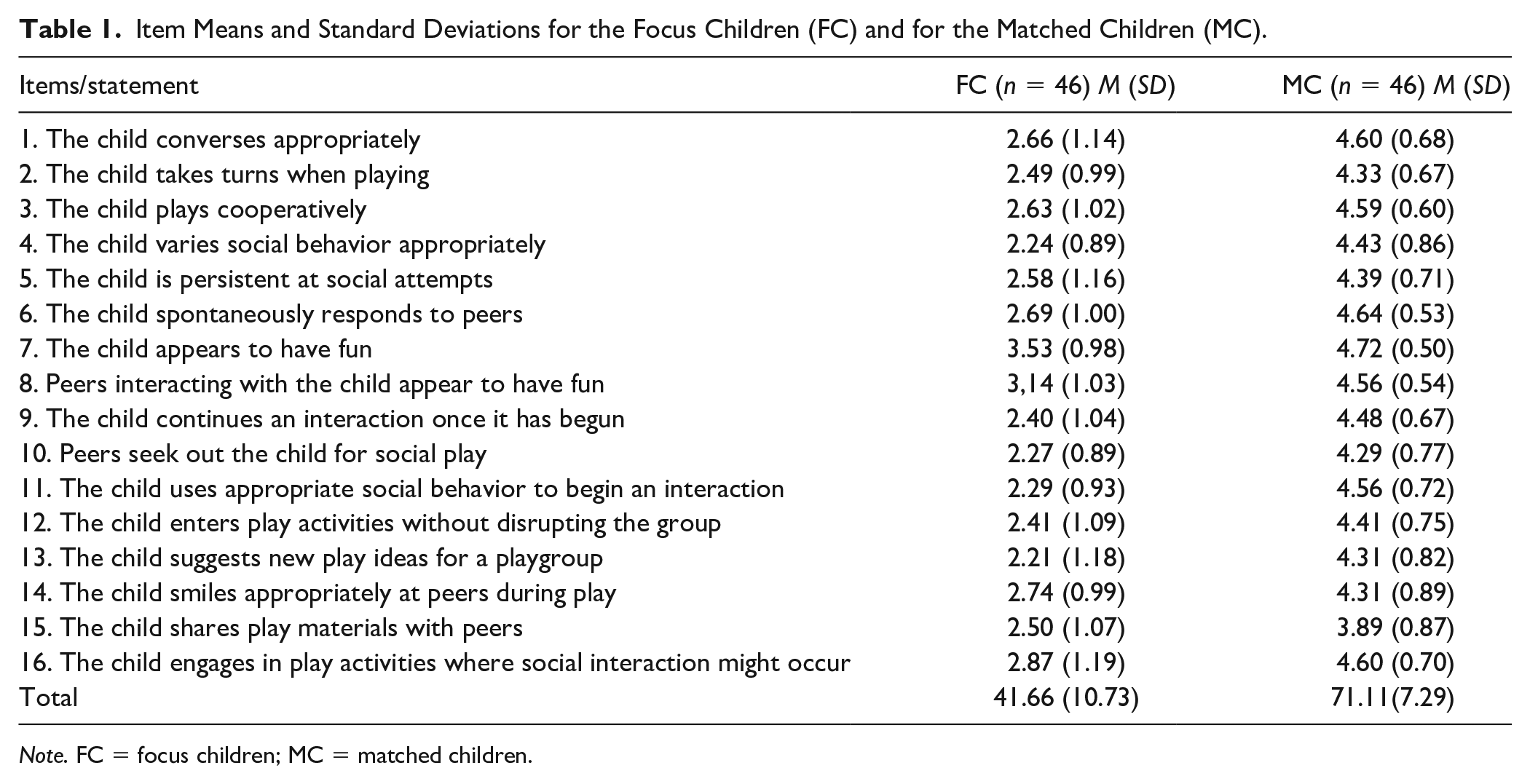
Note. FC = focus children; MC = matched children.
Development of the Swedish version of the Teacher Impression Scale (TIS-S)
An authorized translator translated the PT/ST manual and the TIS items. The second and third authors of this study, fluent in Swedish as well as in English, revised the manual translation and adapted the items to the current educational context. They have 20 to 40 years of experience in special education teaching as well as research. The fourth author of this study, who developed the original TIS, validated the instrument.
The items’ formulation and the contents’ face validity were discussed with a group of experienced early childhood education teachers attending a SEN training at the university. TIS as an observation tool and the applicability of its procedures were tested in four case studies in 2016 (Siljehag & Allodi, 2017) and successively employed by 16 teachers in different preschool settings (Gladh et al., 2022), demonstrating satisfactory social validity. The item contents were evaluated positively and deemed as possible to observe in natural settings with the suggested procedures. During the previous adaptation process, one teacher asked for an explanation of a word (appropriate/adekvat) that is not very common in the Swedish language, and a side note providing a definition was added for this reason.
Procedure
Students in the special education program at the local university found inclusive preschools for the study. In Sweden, most of the preschools are inclusive since they enroll children with both SEN and typically developing children. The recruitment of the participants in some cases has been conducted by sending emails directly to the preschool teachers, and in some cases to the head of the preschool who then forwarded the participation request to their employees (i.e., preschool teachers). Data were collected at the beginning of spring through autumn of 2018. The preschools and preschool teachers recruited for the study were instructed to select two children, one with SEN and one TD, for observation and assessment of the children’s social interaction in different play situations. Instructions on how to perform the observations were provided to the teachers.
Each participant observed one child with SEN or a child for whom they had concerns regarding the participation in the play and interaction, which henceforth will be called “focus child who” and one child had been perceived to have the ability to participate in play and social interaction, called the “matched peer.” The teacher observed a child for 5 minutes three to four times during indoor free play activities (e.g., toys, doll and character play, blocks, jigsaw puzzle, animals, cars) and completed the TIS-S after the four observations (they completed one TIS-S rating for the first week of observations and another for the second week of observations for each child). The teacher was also asked to consider if there are circumstances that may have influenced the child’s behavior.
During the observations, the teachers focused on various play-and-interaction patterns between children in accordance with the items in TIS-S and thereafter filled in the form. The forms for week 1 were collected directly at the end of the week. After a time-lapse of 1 week, the teacher repeated the same procedure and again observed the same two children. Initially, the participants consisted of 53 teachers but five of them dropped out for various reasons. One of the participants misunderstood the instruction to administrate the observation individually and conducted the observation together with a colleague. Therefore, this participant was excluded from the study. Another one misinterpreted the instructions and did not complete observations correctly. As a result, the remaining 46 participants were included in this study. Altogether, 184 TIS-S forms were collected as both paper-pencil forms as well as electronically by 46 preschool teachers, which the teachers sent in through email. However, data were missing for four children regarding the second observation week (two for focus children and two for matched children), resulting in a total of 180-collected TIS-S that were included in the analysis. For observation week 1, there were 46 TIS-S for focus children and 46 TIS-S for matched children included in the analysis. For the second observation week, there were 44 TIS-S for focus children and 44 TIS-S for matched children included in the analysis. In total, 92 TIS-S were collected during the first observation week and 88 TIS-S during the second observation week (see Figure 1). The time-lapse of 1 week between the administrations of the two observation tasks was considered sufficiently large to avoid an effect from memory, and at the same time, not too long, to avoid a possible effect of maturation. The determination followed methodological recommendations of test–retest procedures as well as based on researchers’ judgment (Krauss & Chen, 2004).
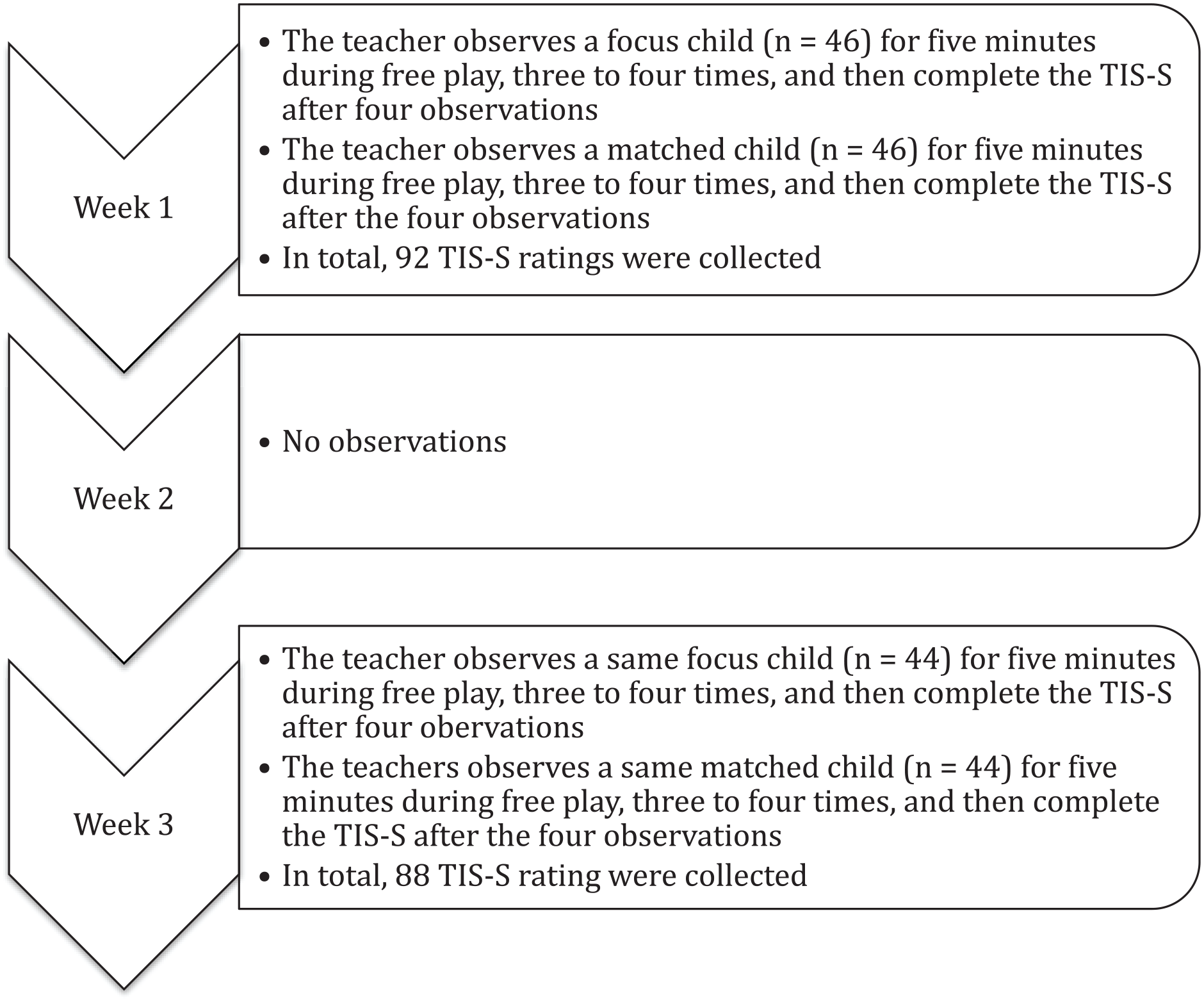
Data collection process for teacher observations of the focus child and matched typical child.
Ethical Considerations
This study is a part of the project Play and Interaction for All Children in Inclusive Preschool Environments. The Regional Ethical Review Board in Stockholm approved the project, Diary number: 2016/1368-31/5 with updated Diary number: 2018732-31.
Data Analysis
Statistical analyses were performed using IBM SPSS statistics version 26. The internal consistency of the TIS-S for this sample was ascertained by calculating Cronbach’s alpha. The stability of the test over time was measured through test–retest reliability, that is, the stability of the children’s scores on the assessment (TIS-S) over two time points (Krauss & Chen, 2004). The Pearson correlation coefficient and intraclass correlation coefficient (ICC) were used for test–retest analysis (two-way mixed effects, absolute agreement, single rater/measurement). Based on the 95% confidence interval of the ICC estimate, values less than 0.5 are indicative of poor, between 0.5 and 0.75 moderate, between 0.75 and 0.9 good, and greater than 0.90 excellent reliability (Koo & Li, 2016). Criterion-related validity was examined through analysis of differences between groups, that is, the focus and matched children (Boateng et al., 2018), and the evidence based on internal structure of TIS-S was examined through Principal Components Analysis (PCA).
Results
Descriptive Statistics
Scale total mean score and standard deviation for all children (N = 92) and all ratings of TIS-S was M = 56.48; SD = 17.30. The total mean scores were also calculated for two groups separately (i.e., focus and matched children, respectively). The total mean score and standard deviation for focus children (n = 46) was M = 41.66; SD = 10.73. Lowest mean score M = 2.21; SD = 1.18 for focus children was regarding item 13, the child suggests new play ideas for a playgroup. The total mean score for matched children (n = 46) was M = 71.11; SD = 7.29. The lowest mean score M = 3.89; SD = 0.87 regarding matched children was item 15, which stated that the child shares play materials with peers. For both groups, item 7, which stated that the child appears to have fun displayed the highest mean score, where focus children had M = 3.53; SD = 0.98 and matched children M = 4.72; SD = 0.50, respectively (see Table 1).
Internal Consistency
The internal consistency of the TIS-S for this sample was assessed using Cronbach’s alpha coefficient and item-total correlations. The result showed that the scale was highly reliable. The Cronbach’s alpha for all children (N = 92) was α = 0.97, p < 0.001, which indicated a high degree of internal consistency. Average ICC = 0.97–0.98 with a 95% CI between 0.85–0.86 and 0.93–0.94 across groups, p < 0.001.
Internal consistency was also calculated separately for the focus and matched children. Cronbach’s alpha for focus children regarding the first administration of TIS-S as well as the second administration was high (α = 0.90 and α = 0.90, respectively, p < 0.001). Cronbach’s alpha for both observation ratings together (i.e., administration 1 and administration 2) regarding focus children was also high (α = 0.90; p < 0.001). The internal consistency for the two observations separately regarding matched children remained high also (α = 0.90 and α = 0.91, respectively; p < 0.001). Cronbach’s alpha for both observation ratings together regarding matched children was also high (α = 0.90; p < 0.001).
Test–Retest Reliability
The stability of the test over time through test–retest analysis was conducted for two assessments, that is, teachers’ ratings of TIS-S during the first week and second ratings of TIS-S 1 week later. Initially, two test–retests were conducted for each group separately (i.e., focus and matched children) and then a test–retest for the whole sample rather than focus and matched children separately was conducted, which gave the same results. Therefore, the combined analysis for the whole sample will be presented. The analysis showed a high level of test–retest reliability. Children’s scores were highly correlated between test–retest; the Pearson’s correlation coefficient was r = 0.94, p < 0.001; and ICC = 0.94 with 95 % CI = 0.83 to 0.97.
Criterion-Related Validity
A univariate analysis of variance (ANOVA) analysis was performed to investigate if there were significant differences between the focus and matched children’s ratings. The independent variable was the groups of children (i.e., focus and matched children) and the dependent variable was a total score of each TIS-S. The assumption of the homogeneity of variance was tested and satisfied based on Levene’s F-test. The result showed that there was a significant difference among the groups, F (1,179) = 464.02; p < 0.001, η2 = 0.72. The difference between the mean of the focus children’s ratings (M = 41.66; SD = 10.73) and matched children (M = 71.11; SD = 7.29) was significant. The results showed a large effect size (Cohen’s d = 3.21).
Evidence Based on Internal Structure
A Principal Components Analysis (PCA) was performed to test the construct stability of the item structure of the TIS-S. A Kaiser-Meyer-Olkin (KMO) Measure of Sampling Adequacy indicated that factor analysis was appropriate for the observed variables. KMO = 0.96, above the commonly recommended value of 0.6, and greater than 0.8, which is considered good. Bartlett’s test of sphericity was significant, χ2(120) = 3076.04; p < 0.001. A PCA on the 16 items extracted one component with eigenvalue > 1 (eigenvalue = 11.52) that explains 72% of the variance. It demonstrates that the instrument is measuring one construct, as hypothesized, confirming the results of a previous trial (Gladh et al., 2022). Furthermore, the results of each item loaded on the principal component analysis showed that the loadings were high. A range of loadings was from the lowest value 0.74 to the highest value 0.93 (see Table 2). Loadings above 0.7 are considered excellent and below 0.32 poor (Comrey & Lee, 1992; Tabachnick & Fidell, 2013).
Item Loaded on the Principal Component Analysis (PCA).
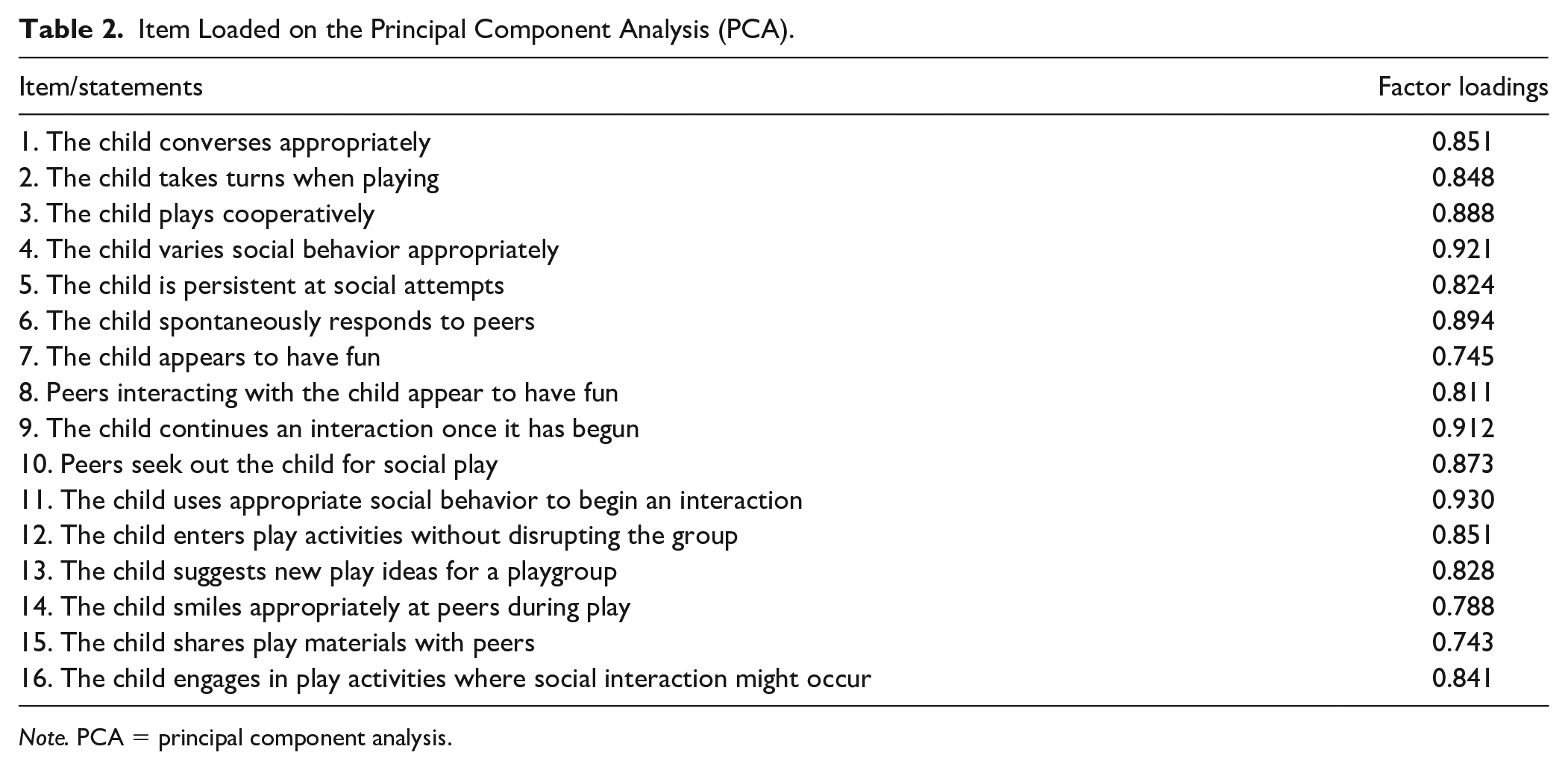
Note. PCA = principal component analysis.
Discussion
The purpose of this study was to evaluate the psychometric features of the Swedish version of the TIS. The results of this study showed strong evidence of reliability (i.e., internal consistency and stability over time) of the whole instrument as well as the criterion and evidence based on internal structure, which is in line with findings from previous research (Gladh et al., 2022; Szumski et al., 2016, 2019). The observations across the short time lapse of 3 weeks were stable and showed a high level of test–retest reliability, which is also in line with findings from previous research (e.g., Szumski et al., 2016). The results of this study further showed that TIS-S scorings effectively differentiate children with SEN and TD children, which has also been found in previous research conducted in Europe (e.g., Gladh et al., 2022; Szumski et al., 2016, 2019).
The results of this study indicate that TIS can help to identify children’s need for support in play and social interaction in inclusive preschool settings. Preschool teachers can use the instrument without extensive training. Thus, it might become easier for the teacher to identify the children’s strengths and weaknesses and then support them in play at an early stage. Furthermore, results indicate that all items in the instrument are positively formulated, in the sense that they describe children’s normally occurring social behaviors and strengths. The formulations do not evoke difficulties and do not induce the teachers to observe shortcomings; on the contrary, the teachers are made aware of which behaviors could be encouraged and thus occur more often among children in social play situations. Other rating instruments that are available internationally to assess preschool children’s social skills and play behavior may focus on measuring pathologies and behavior problems. When we decided to adopt the TIS, we considered various alternatives and our evaluation was that those kinds of observation checklists (with the description of difficulties) might fill a function within rehabilitation services. However, teachers in the Swedish context would not easily accept these kind of assessment tools.
Furthermore, the results of this study showed that regardless of group, the children seemed to have fun. This information is valuable in the sense it gives us an idea of the child’s wellbeing. The TIS might help the teacher to identify how the children are doing. However, item 15, the child shares play materials with peers, scored low regardless of the groups The identification of these shortcomings might aid the teacher in the process of promoting stronger sharing and cooperation skills. The children in the matched group were rated comparatively higher than the children in the focus group. A conclusion we can draw from these findings is that with the help of a user-friendly, valid, and reliable observation instrument such as TIS, one might be able to identify the need for interventions or prevention.
Strength-based instruments such as TIS “offer the early childhood practitioner the opportunity to focus decisions more positively on ways that support and maximize child and family’s strengths” (Epstein & Synhorst, 2008, p. 860). For this reason, its content could also be useful for suggesting strategies aimed at strengthening social competence and play between children. Strength-based formulations had higher acceptability among Danish teachers than deficit-based instruments, in a recent comparison (Sjö et al., 2021). The reception of the teachers and their willingness to use the observation instrument TIS may be related to its strength-based characteristics.
Furthermore, worth highlighting is that teachers in Swedish preschools are not using other similar assessment instruments, that we are aware of. However, teachers might utilize tools used for the assessment of learning environments such as the Early Childhood Environment Rating Scale (ECERS; Harms et al., 2020), but such tools have a broader or different scope. For this reason, other tools are not directly comparable with TIS-S.
This study has limitations. The sample was a convenience sample and may not be representative of a broader population of children and teachers. All preschools were located in a metropolitan area in Sweden and the results may not be generalized to other Swedish regions. Although the preschools were situated in areas with various socio-economic contexts, data on children’s demographics were still not collected. For this reason, there is a lack of background information on the children, which could have been useful for deeper analysis. A further limitation might be teachers’ selection of the children they observed. The teachers’ expectations that one child was social and the other was not might lead to measurement bias (i.e., that a teacher possibly will overrate or underrate the children’s behaviors). Thus, this can have an impact on the validity of the measurements. However, it would be difficult for an outside participant who does not know the children as well as the teachers to select a child with SEN and a socially skilled child. The TIS-S is not supposed to be used by an independent observer but by teachers in educational settings, hence the conditions of this study were similar to those that would arise in practice if practitioners in preschools adopt the instrument.
In this study, inter-rater agreement at the item level was not assessed. The TIS is a rating scale based on observations and differs from a time-based, discrete categorical observational system that generates frequencies of behavior or percentages of intervals in which a behavior occurs. For the latter systems, detailed measurement of the inter-observer agreement is more important, and one may argue that internal consistency and intraclass correlations (ICCs) are a more applicable measure of scale reliability for the TIS. Regardless, future research should assess TIS-S inter-rater agreement to supplement other reliability findings.
Currently, the TIS-S is being used as an outcome variable in a multiple case study of the PT/ST program, and in an ongoing trial in a community situated in the northern region of Sweden. In these studies, the validity of the teachers’ assessments will be further examined through analyses of video-recorded play interactions focusing on the behaviors that are targeted in the peer-mediated interventions (Allodi, Siljehag, et al., 2019). The teachers in this study were not involved in the interventions.
In conclusion, the results support evidence of reliability and validity of the instrument. Teachers were able to utilize the measure reliably with minimal training. The TIS-S can provide information about the social play skills of children enrolled in inclusive, comprehensive preschool programs, which are common educational settings for children with disabilities in Sweden. Furthermore, the tool may allow the teacher to detect the individual child’s need for social support. The findings suggest that the TIS-S could be used for identifying children’s social and peer engagement skills in early childhood settings in the Swedish context, and for planning appropriate interventions.
Footnotes
Declaration of Conflicting Interests
The author(s) declared no potential conflicts of interest with respect to the research, authorship, and/or publication of this article.
Funding
The author(s) received no financial support for the research, authorship, and/or publication of this article.
