




Abstract
Recent challenges have made the jobs of leaders increasingly complex. A different skillset that includes Emotional Intelligence (EQ) might be required for leaders to not only persevere but also thrive amid today’s challenges. While a range of studies have examined the relationship between EQ and leadership, there have been few recent efforts to review them comprehensively and systematically. With empirical research evolving quickly and the rising popularity of EQ among Human Resource Development (HRD) professionals, there is a need to synthesize past research findings. To address this issue, we systematically reviewed 101 empirical studies published between 1990 and 2021 that investigated the relationship between leader EQ and leader outcomes in terms of leadership styles and behaviors, well-being, and performance. Our findings indicate that leader EQ is positively associated with a range of outcomes beneficial to the leader. These outcomes include not only concepts closely linked to EQ, such as relational leadership styles, but also more task-related outcomes, such as leader effectiveness. While our results do not allow for establishing causal relations, they do suggest that the benefits of EQ might be more far-reaching than previously assumed. Our findings need to be considered in the context of an ongoing debate about the distinctiveness of the EQ concept, valid measurements, and a call for increased inclusion of a potential dark side of EQ. We conclude our review by outlining practical implications for HRD professionals and key directions to further advance this domain of research.
Introduction
Leading others is one of the most important responsibilities in organizations (Yukl & Gardner, 2020). While leader roles have always been demanding, the past years have presented unparalleled challenges on a global scale for today’s leaders (Wittmer & Hopkins, 2022). That is, the world still wrestles with the consequences of the COVID-19 pandemic, rising mental health challenges (Kohls et al., 2023), and advances in technology that have far-reaching consequences on how and where we work (Del Giudice et al., 2023). This calls for a deeper insight into what is needed for leaders to lead themselves and others through these uncertain times and how HRD professionals can best support them.
One of the abilities that has been closely linked with successful leadership is Emotional Intelligence (EQ; Dasborough et al., 2022; Harms & Credé, 2010). EQ refers to people’s ability to recognize and deal with their own and others’ emotions (Salovey & Mayer, 1990). It has been posited to help leaders with “solving complex problems, planning how to use their time effectively, adapting their behavior to the situation, and managing crises” (Yukl & Gardner, 2020, p. 209)—a considerable enumeration of key leadership responsibilities. Over the past decades, a growing body of academic literature highlighted the relationship between EQ and some of these key aspects of leadership (e.g., Drigas et al., 2023; Tan et al., 2022).
As leadership is characterized as an “emotion-laden process, both from a leader and a follower perspective” (George, 2000, p. 1046), over the past decades, there has been a shift from a static view that focuses on the isolated effects of leadership to approaches that take a broader view, considering emotions, thoughts and cognitions, which are important for leaders’ subsequent actions (Dinh et al., 2014). This is emphasized by the development of theories such as empathetic leadership (Kock et al., 2019), servant leadership (Zhang et al., 2023), or emotional leadership (Humphrey, 2002). The increased focus on emotions in leadership research concurred with significant empirical and conceptual developments in the EQ literature over the past three decades. EQ developed into an important construct to measure the emotional abilities and traits of leaders (Pekaar et al., 2020a). This is important for both researchers and practitioners, as empirical evidence indicates that leaders’ EQ can, to some extent, be developed (Mattingly & Kraiger, 2019). While considerable empirical attention has been paid to the outcomes of leader EQ for employees, it is equally important to investigate the relationship between leader EQ and outcomes for the leaders themselves. Stress and leadership appear to be inextricably linked (Harms et al., 2017), and it can be observed that faced with a multitude of challenges in a demanding role, an increasing number of leaders are feeling burnt out (Klinghoffer & Kirkpatrick-Husk, 2023). Research shows that stressors trigger affective-motivational responses in leaders—some of them resulting in decreased performance through increased strain (Courtright et al., 2014). Given that EQ can buffer against these effects, it is worth looking at associated leader outcomes, as leaders who experience a state of emotional exhaustion may not be able to perform in their leadership role (D’Souza et al., 2023).
Creating a systematic review of studies investigating the relationship between leader EQ and leader outcomes is important for several reasons. First, growing evidence suggests that leader EQ is associated with a wide range of positive and constructive outcomes (e.g., Cabral et al., 2020; Dartey-Baah et al., 2020; Fianko et al., 2020). This led to increased interest in the field of HRD (e.g., Miao et al., 2020), where research on emotions is now considered an emergent subject area (Shirmohammadi et al., 2021). Given the growing empirical evidence and interest in the field, it is important to provide a systematic overview of the empirically tested relationships to better understand what is known and unknown in the research domain, draw meaningful conclusions from the existing body of research and help with identifying research gaps (Paul & Barari, 2022). However, no review to date has taken a holistic, interdisciplinary approach to examine the relationship between leader EQ and outcomes at the leader level. Second, the need for a systematic literature review stems from the current fragmentation within EQ research. There is a lack of coherence concerning construct, framework, definition, and measurement (Dasborough et al., 2022), which makes it even more difficult to interpret and compare existing empirical research findings. Our overall goal is to offer a systematic literature review that provides a structured representation of the existing research body, along with recommendations for future research and implications for practitioners.
With this systematic literature review, we make the following contributions. First, we provide a systematic analysis of empirical research linking EQ and leadership. Despite the ongoing discussions on EQ in both practice and academia (Pekaar et al., 2020a), only a small number of studies focused on the integration or systematization of research on EQ and leadership. Given that synthesizing past research findings is one of the most important tasks for advancing a field of research (Batistič et al., 2017), we conducted a comprehensive systematic review that includes also the recent empirical findings. Previous reviews have primarily focused on EQ in relation to specific leadership approaches (e.g., transformational leadership; Kim & Kim, 2017), leadership outcomes (e.g., leader effectiveness; Tan et al., 2022), specific institutions (e.g., schools; Gómez-Leal et al., 2022), research designs (e.g., intervention studies; Kotsou et al., 2018), research domains (e.g., human resource development (Farnia & Nafukho, 2016), or definitions and models (McCleskey, 2014). In the current review, we included all leadership approaches, leader outcomes, sectors, and types of empirical research, rather than restricting the focus to specific areas. Given the fragmentation of EQ and leadership research, this inclusive approach is important for fostering cross-fertilization between ongoing debates across different disciplines (Paul & Barari, 2022).
Second, by focusing on leader outcomes of leader EQ, we enhance researchers’ and practitioners’ understanding of the benefits and potential drawbacks for individuals in leadership roles, as well as for HRD professionals involved in assessing and developing current and future leaders. Focusing on leader outcomes is important, as leaders play a critical role in the success of any organization. Leaders who are unable to regulate their emotions are more likely to face difficulties managing stress (George, 2000), which can hinder their ability to perform effectively in their roles. Given that research indicates that EQ can be developed to some extent (Mattingly & Kraiger, 2019), a comprehensive overview of its benefits and potential drawbacks can help HR professionals in designing targeted leadership development interventions. To date, the relationship between leader EQ and key outcomes, such as leader’s work engagement, remains inconsistent, with studies indicating conflicting results (e.g., Alotaibi et al., 2020; Liu & Cho, 2018). It is now essential to consolidate these findings, enabling future researchers to better target their efforts toward addressing unresolved questions and bridging existing gaps (Paul & Barari, 2022).
Emotional Intelligence and Leader Outcomes
The notion of EQ dates back thousands of years in philosophical thinking and decades of research in psychology (Mayer et al., 2004). One of the first and most influential definitions of EQ emerged in 1990, defining EQ as “the ability to monitor one’s own and others’ feelings and emotions, to discriminate among them and to use this information to guide one’s thinking and actions” (Salovey & Mayer, 1990, p. 189). While academic in its roots, the concept of EQ first became widely known and was taken up by organizational practitioners through Daniel Goleman’s work (Goleman, 1996; Weinberger, 2002). Around the same time, scholars started to increase their focus on emotions in organizations – a topic largely ignored in organizational research up to that point (Fox & Spector, 2002). Since then, there has been an increased interest in the study of affect and emotions in organizations (Ashkanasy & Humphrey, 2011). As a result, a considerable body of research emerged and helped institutionalize the concept. However, until this day, researchers have not yet agreed upon a common definition of the concept (Pekaar et al., 2020b).
Currently, two main streams of EQ research exist, using different measurements to get insight into the construct (Petrides et al., 2007). In one stream, EQ is conceptualized as an ability, and in the other stream, EQ is seen as a trait (Petrides et al., 2007). Ability EQ, also referred to as cognitive-emotional ability (Petrides et al., 2007), builds on the first definition of EQ by Salovey and Mayer in 1990 (O’Connor et al., 2019). It is not only important for managing emotions but also for integrating them into cognitions (Harms & Credé, 2010). Within this stream, EQ is usually measured by performance tests, akin to the tradition in research on intelligence. In contrast, trait EQ, also referred to as emotional self-efficacy (Petrides et al., 2007), is usually measured through self-report questionnaires. The trait-approach positions EQ closer to personality research, considering it as a trait-like construct with innate components (Harms & Credé, 2010). Across these two streams, there is an ongoing debate on the validity of measures, whether EQ is distinct from other constructs related to personality or intelligence (Clarke, 2006), and the strong claims made by some researchers about the benefits of EQ (Antonakis, 2015).
Less debated than the construct itself is the understanding that emotions play a vital role in the leadership process (Ashkanasy & Daus, 2002). Over the past two decades, researchers started to investigate how micro processes, such as perceptions, emotions, and cognitions, and macro processes, such as the social-relational context, affect follower and leader outcomes (Dinh et al., 2014; McCleskey, 2014). Leadership research increasingly focused on approaches and theories that emphasize the relational and emotional nature of the leadership process, such as research on leader-member exchange (Graen & Uhl-Bien, 1995), emotional leadership (Humphrey, 2002), or empathetic leadership (Kock et al., 2019). It can be concluded that despite the ongoing debate about the EQ concept and measurements themselves, interest in understanding the outcomes of EQ remains high, particularly in the leadership domain (Harms & Credé, 2010). This interest is likely to rise even further given the need to better understand leaders’ emotional expressions and their outcomes (Kock et al., 2019). Despite this growing interest (Coronado-Maldonado & Benítez-Márquez, 2023), prior research on the relationship between leader EQ and leader outcomes remains fragmented. With this systematic literature review, we aim to reduce the fragmentation by answering two research questions: (1) What is known about the relationship between leader EQ and outcomes at the leader level? (2) What current gaps, limitations, and opportunities exist in the EQ research?
Method
To answer the research questions, we followed the five-step process proposed by Wolfswinkel et al. (2013) to create a systematic review of the literature. A review was chosen as a suitable method over a meta-analysis, given that the studies included in our research used 35 different ways to measure EQ.
Inclusion/Exclusion Criteria
In Step 1, we defined the criteria for inclusion and exclusion. This systematic literature review focuses on studies that investigate the relationship between leader EQ and leader outcomes, such as leadership style and behavior, well-being, and performance. Articles were included based on the following criteria: (a) they focus on leader EQ (vs. follower EQ), (b) they investigate the relationship between leader EQ and outcomes at leader level, (c) they were published after and including 1990, as this was when the term EQ was defined by Salovey and Mayer (1990) until 2021, (d) they are based on empirical research, (e) they include a clear definition of EQ, (f) they are published in academic peer-reviewed journals, and (g) they are written in English.
Search Strategy
In Step 2, we conducted an online literature search limited to articles that have the terms “emotional intelligence” AND “leader*” OR “manage*” OR “supervisor” AND “workplace OR “organi?ation*” OR “business” in the abstract. The asterisk and question mark were used as wildcards to ensure the inclusion of all word variations and all versions of the English language. The different sets of search terms were combined in the search machines PsycINFO and ABI Inform, now called ProQuest One Business, with the Boolean “AND” and “OR” operators. The databases PsycINFO and ABI/Inform were chosen for two reasons. First, they are two of the databases that were most used in comprehensive systematic literature searches (Harari et al., 2020). Second, multiple databases should be included in a literature search to improve search results and increase the depth of the search (Harari et al., 2020). The database PsycINFO was selected as it provides targeted results in both research constructs-leader EQ and leader outcomes (Harari et al., 2020). It was also used in several other systematic literature reviews on leadership (e.g., Rudolph et al., 2021). ABI Inform, now called ProQuest One Business, was chosen to complement the narrower database PsycINFO due to its stronger business and management focus (Piotrowski & Armstrong, 2005). It has also widely been used in systematic literature reviews on leadership (e.g., Eva et al., 2019). This search resulted in 855 publications in total (PsycINFO = 359; ABI Inform/ProQuest One Business = 496). In the first screening, we excluded 155 articles based on their titles and abstracts. Next, 700 full-text articles were assessed, out of which 599 were excluded. The main reasons for exclusion matched the first two criteria listed above (a = focus on leader EQ and b = focus on leader outcomes). After close examination against the criteria laid out above, in Step 3, we selected 101 articles that remained in scope for this literature review (PsycINFO = 47; ABI Inform/ProQuest One Business = 54). The literature search, selection process, and reasons for excluding articles are depicted in Figure 1. Flowchart of the systematic literature search and selection process.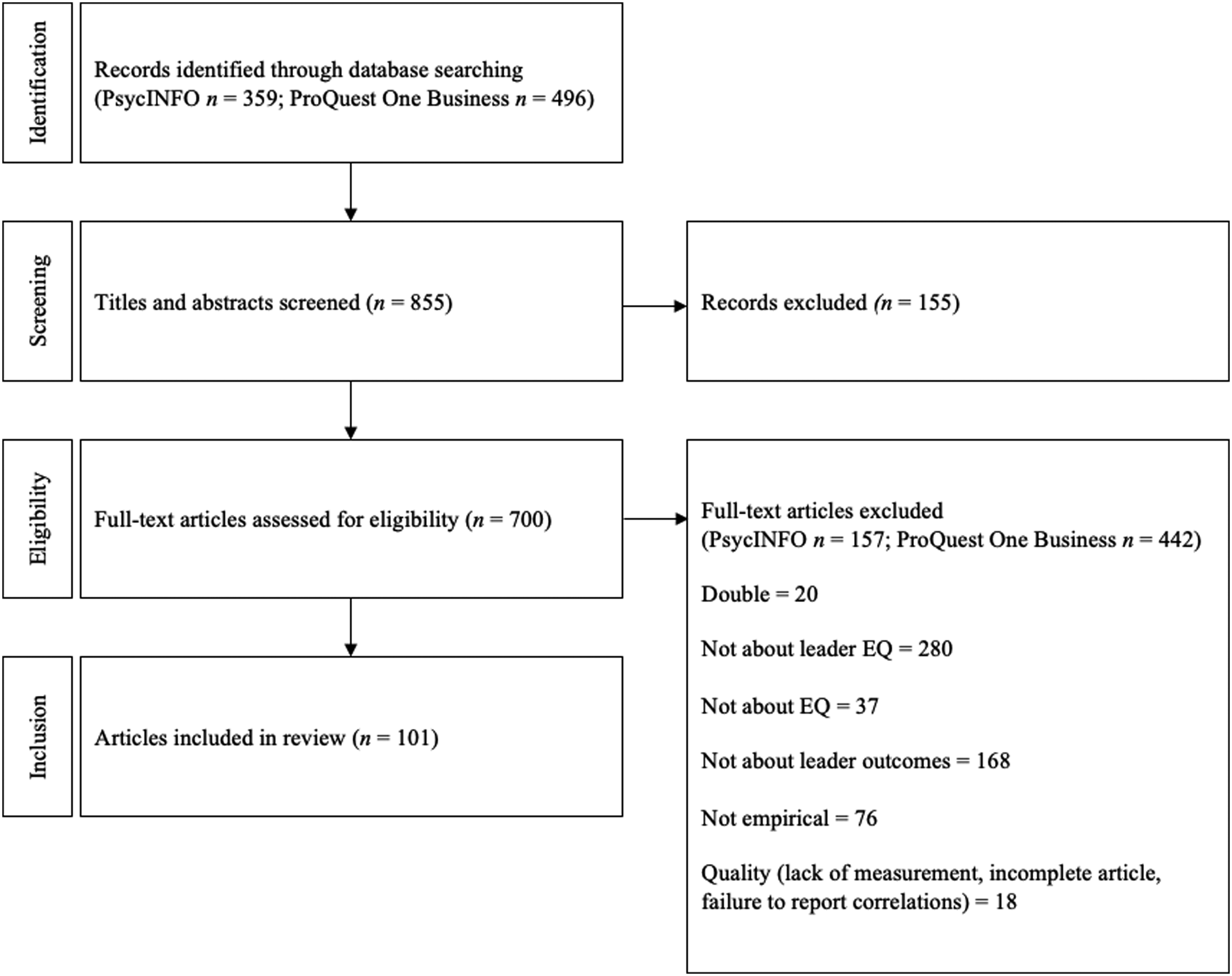
Coding
We then moved to Step 4, analysis of the studies. At this stage, we compiled the individual studies in a file, including essential information such as titles, study authors, databases, and journals to aid the analysis. In a next step, we examined the abstracts and full texts of selected articles and coded them according to specific criteria. We read the individual studies and engaged in open coding to facilitate the identification of patterns in presenting the studies. The studies were jointly coded in a shared file among the three authors of this review. All inconsistencies were discussed, and a solution was reached for all coding decisions. Due to the chosen process, no interrater reliability was calculated (O’Connor & Joffe, 2020).
Characteristics of Research Studies.

Key Findings of Research Studies in Relation to EQ.

Results
Descriptives
A total of 101 studies were included for analysis, published between 1999 and 2021. The studies addressed different leadership levels in different organizations, including leadership positions from a range of hierarchical levels. A range of studies included the employees of the leaders to rate leader EQ (n = 17). The studies investigated a variety of industries including public service and government (n = 9), banking (n = 8), manufacturing (n = 8), healthcare (n = 6), insurance (n = 5), education (n = 4), technology (n = 4), military (n = 3), construction (n = 2), and others. In geographical terms, the largest number of studies in this review were conducted in the Asia-Pacific region (APAC; n = 37), followed by North America (n = 20), Europe (n = 13), Africa (n = 6), and the Middle East (n = 5). A further 19 studies either did not specify or included a range of geographical populations.
Most studies followed a quantitative research methodology (n = 91), while a minority were qualitative studies (n = 1) or used a mixed design (n = 9). The large majority (n = 95) used a cross-sectional design. In terms of measurement, most studies (n = 77) relied on leaders to self-assess their EQ, and a minority (n = 7) only asked other referents (mostly employees), drew on multi-source data (n = 8), used performance tests (n = 7) or combined self-assessment and performance tests (n = 2) to assess leader EQ. An overview of all studies can be found in Tables 1 and 2. The results regarding specific leader outcomes are organized into three categories: Leadership Styles and Behaviors, Well-being, and Performance.
Leader Outcomes
Leadership Styles and Behaviors
To start with, most studies focused on how EQ is related to various leadership behaviors and/or styles (n = 52). While the overall picture seems to be that of a positive association between EQ and the respective behavior and/or style, a few negative and non-significant associations give rise to a more mixed picture.
Transformational Leadership Style
Of all the leadership styles, transformational leadership (TFL) emerged as the predominant focus of investigation (n = 29). Most of the studies indicate that EQ is positively and strongly associated with TFL (n = 23), with only a few reporting mixed results (n = 4) or non-significant relationships (n = 3). For example, Sshaaban (2018), Hur et al. (2011), and Rahman et al. (2012) found that EQ correlates positively with all dimensions of TFL. In the studies that report a positive correlation, a variety of eleven measurement tools has been used with all but two using a questionnaire rather than an assessment-based performance test that measures the leader’s EQ ability through a series of questions and scenarios. A small number of studies (n = 6) included others (mostly employees) for the assessment of leader EQ. Taken together, this suggests that there is a strong case for a relationship between EQ and TFL, given that this relationship was established across different measurement tools.
A small number of studies (e.g., Brown et al., 2006; Weinberger, 2009) did not report a correlation between EQ and TFL. Mixed results come, for example, from Tang et al. (2010), who found different correlations based on whether the research population was based in Taiwan or the US, and from Crowne et al. (2017), whose results differed across time points. This suggests that culture and time are important factors to consider when seeking to examine and confirm the relationship between EQ and TFL.
While most studies (n = 19) looked at the overall TFL concept, studies that differentiated between the dimensions of TFL (n = 8; i.e., idealized influence, inspirational motivation, intellectual stimulation, individual consideration), suggest largely similar positive patterns. However, to our surprise, we found less empirical support that EQ is related to intellectual stimulation, with a handful of studies finding different results for this dimension (n = 3). While Barling et al. (2000) and Görgens-Ekermans and Roux (2021) did not find any association between EQ and intellectual stimulation, Barbuto and Burbach (2006) reported a positive correlation between EQ and intellectual stimulation when the subscale was assessed by leaders. It can be concluded that while findings on the relationship between EQ and TFL are not completely unequivocal, there is reasonable support to suggest that EQ does indeed have a positive association with TFL and its different subscales.
Leader Member Exchange
Our review also highlighted studies examining EQ and leader-member-exchange (LMX) theory (n = 3). LMX is a relational, dyadic leadership approach that focuses on the quality of the relationship between a leader and their employees (Graen & Uhl-Bien, 1995). Researchers argued that affect is critical for the development of an LMX relationship (Liden et al., 1997; Sears & Holmvall, 2010) as individuals who show affect are more likely to interact in a highly collaborative and supportive relationship. Given the close link between affect and EQ, the relational nature of LMX suggests that EQ might play an important role in helping both, leaders and employees, develop a strong relationship. This seems to be the case, with reviewed studies reporting a positive correlation between EQ and LMX (e.g., Clarke & Mahadi, 2017a).
However, looking at the results in detail reveals a more nuanced picture. While Noorlaila et al. (2011) deliver support for a positive relationship between the two EQ dimensions “use of emotion” and “other’s emotion appraisal” with LMX, Sears and Holmvall (2010) found that a positive relationship with high-quality LMX relationships is observed only when both leaders and their employees exhibit a high level of EQ. These results point to the conclusion that EQ appears to be associated with LMX, but this assessment needs to consider both leader and employee perceptions and levels of EQ.
Transactional Leadership Style
Results for the relationship between EQ and transactional leadership (n = 12) are inconclusive, ranging from positive (n = 5) to not significant (n = 6) or negative (n = 1) associations. A number of studies report positive results between EQ and transactional leadership as an overarching concept (n = 2), while others only found this for the sub-dimension “contingent reward” (n = 3). For example, Downey et al. (2006) did not find a correlation between EQ and transactional leadership but identified a positive association between specific EQ dimensions and contingent reward, a subdimension of transactional leadership. Along similar lines, Gardner and Stough (2002) found a positive correlation with contingent reward, but not with transactional leadership overall. Studies by Wu et al. (2006) and Potter et al. (2018), for example, show a positive correlation between EQ and specific dimensions of transactional leadership. Therefore, while findings deliver a mixed picture with regards to the relationship between EQ and transactional leadership, they do point to the conclusion that EQ might not only be associated with relationship-oriented leadership styles, but also with the ones that are more task-oriented in nature. It appears that EQ plays a role in adopting various leadership styles and behaviors, even those that are not inherently emotional.
Laissez-Faire Leadership Style
Bass and Avolio (1990) describe the laissez-faire leadership style as characterized by being indecisive and uninvolved. For laissez-faire leadership (n = 6), the reviewed studies paint a mixed picture. Half of the studies (n = 3) found no significant relationship with EQ, while the other half noted a negative correlation between different dimensions of EQ and laissez-faire leadership—in other words, the higher the EQ, the less likely it was for a leader to adopt a laissez-faire leadership style.
Servant Leadership Style
Servant leadership is a leadership approach that focuses on developing relationships with employees and puts their needs and development at the core (Greenleaf, 1998). By prioritizing people-oriented qualities such as humility and empathy, there are theoretical reasons to suggest that EQ would be positively related to servant leadership. At first glance, two of the reviewed studies found positive correlations between both constructs. However, looking at those studies (Barbuto et al., 2014; Roark & Beuthin, 2014) in detail reveals a less unequivocal picture. Similar to the LMX findings, outcomes from both studies suggest that perceptions of both leaders and employees need to be considered when looking at the association between EQ and the servant leader approach.
Other Leadership Styles
EQ is also positively correlated with leadership styles that appear less frequently in the reviewed literature (n = 3). This includes findings that leaders with higher levels of EQ tend to offer support before applying performance pressure, what the authors call the “before” style (Li et al., 2016). EQ also appears to be connected to an entrepreneurial leadership style, which involves taking more risks and being more innovative than other styles (Naudé et al., 2014; Taliadorou & Pashiardis, 2015).
Leadership Behaviors
Our review of the literature also highlighted particular leadership behaviors that are associated with EQ and cannot directly be placed under the header of specific styles (n = 13). This distinction is important, as, according to Yukl (2012), behaviors represent the fundamental unit to categorize leadership. Among these are a host of leader prosocial behaviors, including organizational citizenship behavior, altruistic behavior, and drive and integrity, all of which are positively associated with EQ (Carmeli, 2003; Jain, 2012; Rosete & Ciarrochi, 2005; Singh & Dubey, 2015). In the only qualitative study included in this review, Clarke (2010) found through interviews with project managers that emotional awareness influences decision-making behaviors, particularly those related to the quality of relationships in their projects. At the same time, several studies indicate that EQ might also be negatively related to leaders displaying counterproductive work behaviors, such as withdrawal intentions (Carmeli, 2003), leader turnover intention (Dong et al., 2014), a lack of regard for others by using sarcasm or sharing critical remarks (Loi et al., 2021), and self-indulgent or destructive behaviors (Trong Tuan, 2013). A small number of studies (n = 4) also suggest that EQ is related to leaders’ commitment, which includes career commitment (Sultana et al., 2016) as well as organizational commitment (e.g., Mahanta & Goswami, 2020). Leaders’ commitment to objectively disclosing financial information, as measured by Salehi et al. (2017), however, does not appear to be connected to EQ.
Skills and Abilities
Aside from styles and behaviors, the reviewed studies also mention EQ’s positive association (either for the overall concept or specific EQ dimensions) with other skills and abilities that are needed to successfully perform core leadership responsibilities, such as project management (Livesey, 2017), knowledge sharing (Luu, 2014), decision-making quality and styles (Alzoubi & Aziz, 2021; Basu, 2016; Istianingsih et al., 2020), networking (Naudé et al., 2014), problem-solving and concern for quality (Rahim & Minors, 2003), fostering innovation capacity (Puerta et al., 2021), change management (Dhingra & Punia, 2016), ethical judgement (Angelidis & Ibrahim, 2011; Mahanta & Goswami, 2020), conflict management (Chen et al., 2019) and possessing political skills (Semadar et al., 2006; Taliadorou & Pashiardis, 2015). Studies also suggest a positive relationship between EQ and overall leadership capacity (Sánchez et al., 2020), leadership potential (Higgs & Aitken, 2003), the probability of becoming a leader (Siegling et al., 2014), career progression (Dulewicz & Higgs, 2003) and a range of managerial competencies that span from goal setting to motivating others and people development (Mikolajczak et al., 2012). Leaders with high levels of EQ also appear to possess more cultural intelligence, as indicated by different studies (n = 4), such as Jyoti and Kour (2017) or Sharma and Singh (2021).
All these results suggest that EQ is associated with a wide range of leader outcomes that are shaping a leader’s approach to leadership with regards to the styles and behaviors they adopt.
Well-Being
Leader well-being was investigated in 16 studies. Overall, EQ was positively linked to happiness and meaning in life (Higgs & Dulewicz, 2014) and to a reduction in negative health symptoms and stress (Slaski & Cartwright, 2002). Three studies found support for a positive association between EQ and self-efficacy, which can be seen as a main contributor to well-being (Bandura, 1994). Leaders with high EQ also appear to experience higher psychological empowerment (Alotaibi et al., 2020) and secure attachment at work (Neustadt et al., 2011).
There is mixed, limited evidence (n = 2) for a relationship between EQ and work engagement, with one study indicating a positive correlation (Liu & Cho, 2018) and the other not finding a significant relationship (Alotaibi et al., 2020). A potential explanation for the variation in results could be due to cultural differences as both studies take place in different contexts. A few studies (n = 2) reported a negative relationship between EQ and burnout (Holliday et al., 2017; Srivastava et al., 2019).
EQ also appears to be linked directly to a leader’s emotions. Loi et al. (2021) found that EQ is positively associated with positive affect and negatively associated with negative affect. Linked to this, results by Singh (2004) yielded a positive association between EQ and a leader’s ability to express emotions. Leaders with high EQ also seem to be able to solve work-family conflict in a better and more effective way (Carmeli, 2003).
Also, there appear to be important findings with regard to EQ and relationships with others, as indicated above. Leaders with higher EQ show more mutual respect for the capabilities of others (Clarke & Mahadi, 2017b), which reinforces the importance of EQ for many aspects of relationships. Also, it turns out that one key element of EQ, empathy, is positively associated with experiencing trust (Yu et al., 2021). The authors did, however, not find a relationship between overall EQ and trust, which might indicate that empathy is one of the essential factors in this connection. An investigation of the relation between EQ and quality of coaching between the leader and employee shows a similar pattern, connecting empathy with the quality of the coaching relationship as perceived by the employees (Gregory & Levy, 2011).
Taken together, these results suggest that EQ is linked to well-being in two important ways. First, evidence points to the fact that EQ is connected to beneficial health outcomes for leaders (e.g., Carmeli, 2003; Higgs & Dulewicz, 2014). Second, as well-being has been linked to other key outcomes for leaders (e.g., performance; engagement), it is likely that EQ indirectly also has a positive influence on other outcomes.
Performance
A range of studies investigated the relationship between EQ and leader performance (n = 27). It is important to note that the definitions of performance varied greatly throughout these studies, which might explain some differences in outcomes. Most studies found a positive association between EQ and performance (n = 23), the majority examining the relation between EQ and leader effectiveness (n = 11). For example, Aslam et al. (2016), Dartey-Baah et al. (2020), and Hur et al. (2011) found that EQ positively correlates with leader effectiveness. Three studies did not establish a relationship between EQ and performance. Weinberger (2009) assessed leader effectiveness through employee perceptions and found no correlation between EQ and several aspects of leader effectiveness. Peer-rated evaluations of EQ and leadership effectiveness, as conducted by Koh and O’Higgins (2018), on the other hand, indicate that there is a positive relationship between EQ and leader effectiveness also when EQ is not self-assessed.
Another big cluster of studies investigated the association between EQ and the leader’s job performance (n = 12). Most studies examining EQ and the leader’s job performance found a positive correlation (n = 11; e.g., Cavazotte et al. (2012); Istianingsih et al. (2020); Rahman et al. (2013)). The only study in this cluster that did not establish a relationship between EQ and job performance (Baczyńska & Thornton, 2017) used a study design that may have prompted leaders to draw more on other types of intelligence than EQ, thereby leaving leaders less likely to display EQ in the first place.
Finally, a small number of studies (n = 2) looked at financial performance, as a proxy of leader performance. Boyatzis (2006) found a positive relationship between EQ and financial performance in terms of client revenue and gross margin for consulting partners. This is in line with Stein et al. (2009), whose results indicated that empathy is positively associated with company profit and the likelihood for leaders to perceive business challenges as easy, especially those relating to interpersonal issues. Overall, it can be noted that research findings strongly suggest that EQ makes leaders more effective in their role.
Discussion
In this systematic literature review, we investigated two research questions to better understand the relationship between EQ and leader outcomes. With the first research question of this paper, we aimed to explore the existing knowledge regarding the relationship between leader EQ and outcomes at the leader level. Our findings indicate that leader EQ is related to various leadership styles and behaviors (e.g., transformational style), well-being outcomes (e.g., happiness and meaning in life), and performance-related outcomes (e.g., leader effectiveness). Although we anticipated that EQ would be primarily associated with relational leadership concepts, our review indicates that, in general, EQ is also positively correlated with task-oriented leadership constructs. These include transactional leadership and task-focused leadership skills and abilities, such as problem-solving. One explanation is that even in more task-oriented processes, the ability to process and regulate emotions enhances a leader’s effectiveness (Humphrey, 2002). Emotion precedes or accompanies cognition, creating an interconnection between the two (Dickmann & Stanford-Blair, 2002). In line with this, research has shown that empathy is crucial for the cognitive and behavioral processes that underlie leader emergence (Wolff et al., 2002). Additionally, cognitive skills, such as problem-solving, are supported by perspective-taking, a skill closely tied to the EQ construct (Wolff et al., 2002). Considering the interplay between cognition and emotion, it is plausible that EQ is not only linked to relational leadership outcomes but also to more task-oriented outcomes (Humphrey, 2002).
Our second research question sought to identify the existing gaps, limitations, and opportunities in the EQ research. The most significant gap is the absence of a common definition and measurement of EQ, which limits the comparability of study results. In the following section, we elaborate on this gap and propose directions for future research.
Future Research
The 101 studies included in this review used 35 different ways to measure EQ. While some studies relied on trait-based measurements (e.g., Istianingsih et al., 2020; Mikolajczak et al., 2012; Sshaaban, 2018), others adopted ability-based approaches (e.g., Dong et al., 2014; Føllesdal & Hagtvet, 2013; Kerr et al., 2006). This heterogeneity regarding the variety of tools used to measure leader EQ needs to be considered when aiming to compare the results of the different studies. For future research, we recommend that scholars focus on validating the uniqueness and reliability of tools designed to define and measure the concept EQ.
The heterogeneity in tools to measure EQ reflects a broader issue, which is the absence of a valid, agreed-upon conceptualization of EQ (Pekaar et al., 2020b). Several studies revealed an overlap between EQ and other existing constructs (Davies et al., 1998), most notably dimensions of personality (van der Linden et al., 2017), general intelligence (Schulte et al., 2004), and social intelligence (Crowne, 2009). Therefore, more research is needed to reach conceptual clarity on how EQ is differentiated from other related constructs (Cherniss, 2010).
There is evidence pointing towards the fact that in general EQ is trainable, as becomes evident from a meta-analysis by Mattingly and Kraiger (2019). Given the maturity stage of the EQ concept, it is now time to arrive at definitive answers to what extent and how leader EQ can best be developed so that the efforts of both researchers and practitioners can be better directed. For HRD professionals specializing in leadership development, it is important gain a deeper understanding of the most effective methods for helping leaders enhance their skill in this area (Zeidner et al., 2002). This also includes guiding HRD practitioners toward the most effective interventions and understanding how to best apply them within the leadership context (Thory, 2013). For future research, this means that it would be worthwhile to use intervention studies and longitudinal research designs, to better understand the (targeted) development of EQ over time (Hur et al., 2011).
Further, while there seem to be many positive associations between EQ and beneficial leader outcomes, future research might also investigate whether EQ might have a “dark side”, as several studies suggest (e.g., Austin et al., 2007; Davis & Nichols, 2016; Lubbadeh, 2020). For example, a solid understanding of others’ emotions, might also lead some leaders to engage in unethical behavior and follow Machiavellian strategies to reach their own goals. This argument is corroborated by the observation that leaders with higher EQ also perceive themselves as better able to manipulate others (Hyde & Grieve, 2014). While in many organizations EQ tends to be seen as an inherently good quality, HRD professionals would benefit from better understanding the context and intrapersonal factors that are likely to lead an individual to apply EQ skills to their own advantage. For future directions, we therefore recommend that more research focuses on the potential negative effects of EQ to better understand the mechanisms and boundary conditions of the dark side of EQ.
Practical Implications
Gaining insight into how leader EQ is related to leader outcomes is important as leaders find themselves in a challenging role where they need to navigate through a changing and complex environment (Klinghoffer & Kirkpatrick-Husk, 2023). It is therefore crucial for HRD professionals to understand how they can design targeted interventions to help leaders succeed in their role. By outlining the relationships between leader EQ and selected leadership outcomes, this review offers recommendations for both HRD professionals and leaders.
First, our results suggest that leaders with high EQ can influence a range of outcomes related to leadership styles and behaviors, leader well-being, and leader performance. Therefore, it is advisable for organizations to consider a leader’s EQ during both the hiring process and promotion cycles – not only because of the impact leaders have on others, but also because of the impact on themselves (Görgens-Ekermans & Roux, 2021). This can, for example, be done through psychometric testing as part of the hiring or promotion process. There is a wide variety of instruments practitioners can choose from (Bru-Luna et al., 2021), some of them freely accessible and others associated with a fee. It is advised that those individuals applying for the (new) leadership position receive a de-brief session in which they are walked through the results of their test. It goes without saying that the whole process needs to be designed and implemented following local law to ensure that all necessary conditions are met when using an EQ tool to assess and develop leaders.
Second, given that selected studies suggest that EQ is developable (Mattingly & Kraiger, 2019) and considering the myriads of positive outcomes for leaders with high levels of EQ, HRD professionals should gather the Executive Team’s support for investing in interventions aimed at increasing leaders’ EQ. This will not only be beneficial for the leaders themselves, but, as other reviews pointed out, also for employees, teams, and the organization (Farnia & Nafukho, 2016; Gómez-Leal et al., 2022; Kim & Kim, 2017). There are different options for how leader EQ can be developed in leaders. The most common intervention is to offer training in EQ, which consists of elements such as lectures, role plays, group discussions, work in tandems, self-exploration through diaries or self-directed learning, such as individual readings (Mattingly & Kraiger, 2019; Nelis et al., 2009). Specifically, research found that an active approach that engages the participants tends to be more effective than a passive one that consists largely of lectures (Mattingly & Kraiger, 2019). Training can be organized and facilitated in-house by the HR department, designed in collaboration with an external provider, or purchased off-the-shelf from an external provider. Alternatively, leaders can attend Emotional Intelligence courses, taught by academic institutions, such as a program from Harvard University’s Division of Continuing Education or private training companies. Additionally, offering 1:1 coaching for leaders can help increase leaders’ emotional intelligence (Boyatzis, 2007; Eilert, 2023). Coaching can either be carried out as a stand-alone intervention or in combination with training. In contrast to training, it allows for a more targeted focus on the individual’s strengths and development areas related to EQ.
Third, next to investing in training and coaching interventions aimed specifically at increasing EQ, it is recommended that the development of EQ is integrated in the curriculum of existing leadership development programs (Boyatzis, 2018; Shuck & Herd, 2012). Given the diverse leadership populations across the studies included in this review, the results suggest that the relationships between leader EQ and leader outcomes are applicable across various industries and cultures. It is therefore advisable for HRD professionals in international organizations to consider integrating EQ into existing international talent and development programs. For example, a leadership workshop could include a reflection exercise to build awareness of their emotional journey. Further, communication training could include an exercise to help leaders engage in active listening that goes beyond the level of what is being said (the content) to how it is said (the emotions).
Limitations
This review has several limitations. One limitation is that the diversity of leaders in the studies makes it difficult to draw out specific leader recommendations that apply to different leadership positions, in line with the idea that leadership is a multilevel phenomenon (Batistič et al., 2017). Future research would benefit from clearly defining and differentiating different leadership levels, such as leadership levels below the Executive Board. Matched with other key parameters, such as industry, size of organization, and department, this will allow researchers and practitioners to draw conclusions on the type of leadership position and create targeted development interventions.
Another limitation lies in the search terms used. While we aimed to consider all key terms to identify studies relevant to the research questions, there is a small risk that the selection of search terms did not capture all relevant articles and that there are additional components that might not have been considered. For example, including components of EQ, such as emotional management (Salovey & Mayer, 1990), or related constructs, such as empathy (Depow et al., 2021), could help ensure that further relevant studies are included in future reviews.
In addition, the review is limited by its database selection, publication bias, and focus on articles published in English, which means that there might be empirical studies that went unaccounted for in our review. Further, the focus on empirical articles, a choice we made for the benefit of quality, may have led to the exclusion of potentially relevant research on leader EQ. Future research might benefit from including other commonly used databases, such as Google Scholar and ProQuest Dissertations and Theses (Harari et al., 2020), to ensure an even better coverage of relevant articles – empirical and non-empirical.
Moreover, in our analysis, mediators and moderators that were part of the empirical studies were not included as such in this review. Instead, we analyzed the correlations and/or other means of bivariate associations between EQ and these variables. In addition, most of the included studies in scope were cross-sectional and therefore less suitable for establishing mediating mechanisms. This means that we cannot draw conclusions regarding the mechanisms behind and contingencies of reported correlations. Future research would therefore benefit from also coding for mediators and moderators, possibly with a focus on one category of leader outcomes, to ensure the feasibility and timeliness of the review.
Conclusion
To conclude, our goal with this review was to provide a systematic overview and propose a future research agenda on the relationship between leader EQ and outcomes at the leader level. It became clear that there is strong empirical support for a positive relationship between leader EQ and many beneficial outcomes. While it was expected that EQ would be associated with relational concepts of leadership (Opengart & Bierema, 2015), our review suggests that in general, EQ is also positively related to more task-oriented leadership constructs such as transactional leadership, and task-focused leadership skills and abilities, such as problem-solving. To reduce existing fragmentation in the field, future research will need to make considerable progress in establishing EQ as a clear and distinct concept with valid measurements. Future research should also explore the most effective ways to develop leader EQ, while addressing the potential negative aspects of EQ, rather than focusing solely on its positive impact. EQ could, after all, have a threshold where Aristotle’s practical wisdom needs to be applied, which posits that more of a virtue is not always better than less (Schwartz & Sharpe, 2006).
Footnotes
Declaration of Conflicting Interests
The author(s) declared no potential conflicts of interest with respect to the research, authorship, and/or publication of this article.
Funding
The author(s) received no financial support for the research, authorship, and/or publication of this article.
