




Abstract
Informal field-based learning (IFBL)—a subset of work-related learning that is informal, intentional, and self-directed—is a developmental process in which motivational, behavioral, and cognitive mechanisms interact. Despite the consensus on the role of cognitive processing in learning, research on informal learning is dominated by a behavioral focus on learning activities, while the cognitive perspective remains sidelined. In the Self-regulated Informal Learning Cycle we introduce here, we use metacognitive and memory system lenses to zoom into the (meta-)cognitive IFBL processes, considering intention as a motivational starting point of the learning process. Specifically, we draw on self-determination theory, achievement goal theory, memory concepts, and self-regulated learning models. Our cycle distinguishes five phases—preparation, action, encoding and consolidation, performance, and self-appraisal—and elaborates on IFBL processes at the intentional, behavioral, cognitive, and metacognitive level. Theoretical implications for human resource development, including the often-neglected role of time in IFBL, are discussed.
Keywords
Introduction
In our rapidly evolving society, organizations and their human resource development departments place employees’ continuous work-related learning at the top of their strategic agenda, because it has a profound impact on organizational success (Cerasoli et al., 2018; Tannenbaum & Wolfson, 2022). Work-related learning refers to all learning that an employee undertakes related to their current job in order to develop their knowledge, skills, abilities, and other characteristics (KSAOs; Jacobs & Park, 2009; Kraiger & Ford, 2021; Kyndt & Baert, 2013; Poell, 2013). However, most work-related learning does not take place in formal training courses, but informally, embedded in work processes (Cerasoli et al., 2018; Jeong et al., 2018). Different types of informal learning can be distinguished based on three dimensions, namely, formality (formal/informal), intentionality (intentional/incidental), and directedness (self/other; Wolfson et al., 2018). Informal field-based learning (IFBL) is considered to be an intentional subset of informal learning (Tannenbaum & Wolfson, 2022) that refers to “engaging in intentional, self-directed behavior aimed at learning new, work-oriented, and organizationally valued content outside of a formal learning program” (Wolfson et al., 2018, p. 16). The current paper is going to focus on this specific type of informal learning.
There is consensus that while a learning process involves behavioral learning activities, subsequent cognitive processing must take place for KSAO development (e.g., Baddeley et al., 2020; National Academies of Sciences, Engineering, and Medicine [NASEM], 2018). Although both the cognitive and behavioral perspectives are generally recognized in IFBL research, both perspectives can be combined or one perspective can be dominant, depending on the model or framework. Many IFBL models adopt a dominant behavioral perspective when focusing on the undertaking of learning activities such as experimenting with new methods and solutions, seeking feedback, and debriefing (Decius et al., 2019; Tannenbaum et al., 2010; Tannenbaum & Wolfson, 2022). These models pay less attention to the role of cognition, for example, during cognitive memory processing of information and experience gained through learning activities, on the one hand, and during metacognitive self-appraisal of prior learning, on the other.
Cognitive processing takes different shapes and occurs in different types of memory systems, leading to different kinds of KSAO development or performance (NASEM, 2018). Therefore, we cannot fully reveal the mechanisms underlying IFBL unless we consider the different memory systems involved. However, previous IFBL models do not take into account memory processing; nor do they consider that KSAOs can be either conscious and accessible or unconscious and inaccessible to the learner. Even an intentional and conscious learning activity as defined in IFBL can result in an unconscious learning outcome such as tacit knowledge (e.g., Hadjimichael & Tsoukas, 2019).
Furthermore, metacognitive reflection on the learning process is essential for improving the effectiveness and efficiency of informal learning (e.g., to increase IFBL’s appropriateness; Tannenbaum & Wolfson, 2022). By considering metacognitive strategies, as is common in models of self-regulated learning (Panadero, 2017; Sitzmann & Ely, 2011), we can explain learners’ intentions to re-run an informal learning cycle and improvement loops in the IFBL process. This allows us to formulate recommendations on how to support IFBL that are related to the entire learning cycle the learner runs through, from motivation to behavioral activity, cognitive processing, and metacognitive reflection.
In this article, we argue that to fully understand IFBL, both a behavioral and a cognitive perspective are needed to fully unpack the IFBL process. Therefore, we introduce the Self-regulated Informal Learning Cycle (SILC) model, which assumes the complementarity of these two perspectives. We highlight the cognitive processes in informal learning, adopting two theoretical lenses: a metacognitive perspective and a memory system perspective. Our SILC model makes several contributions to the IFBL literature.
First, we zoom in on the cognitive processing of learning experiences. Taking a memory system perspective and distinguishing between semantic, episodic, and procedural memory (Baddeley et al., 2020; Squire, 2004), we hypothesize how KSAOs and ultimately performance can emerge from behavioral informal learning activities. While informal learning research usually looks at the “big picture” without considering the underlying processes in detail, memory research focuses on cognitive characteristics without taking the work-related context into account. We therefore combine both strands of research to provide more clarity on the steps taken in IFBL, without neglecting the broader context in which learning is taking place.
Second, we consider the mechanisms by which informal learning processes can be re-run through after achieving KSAOs or a job performance. We draw on self-determination theory (e.g., Deci et al., 2017) and achievement goal theory (e.g., Senko et al., 2011) to distinguish stimuli from intentions, and to divide intentions into learning intentions and action-oriented coping intentions. Building on Zimmerman and Moylan’s (2009) model of self-regulated learning, we use a metacognitive lens to argue how one learning cycle might lead to another.
Third, we identify a rarely considered question in informal learning research: How much time passes while a learner goes through an informal learning cycle? Previous cyclical models, such as that of Marsick and Watkins (1990), provided a useful overview of the entire informal learning process, but did not explicitly pay attention to time and sequences. The SILC model, in contrast, provides a conceptual framework for IFBL scholars to examine the distinct components of the learning process and the time spent on these by the learner. To this end, we draw on the framework of self-regulated learning phases presented by Panadero (2017), adopting its preparation phase, performance phase, and self-appraisal phase. Building on prior IFBL research (e.g., Tannenbaum & Wolfson, 2022), we add a (behavioral) action phase; building on memory research, we add a (cognitive) encoding and consolidation phase, in which information is mentally processed and stored as representations of learning experiences. We thus expand the IFBL research by incorporating elements from pedagogy and educational psychology on self-regulated learning and elements from cognition research and cognitive psychology on memory systems.
Our model provides researchers in the field of human resource development with a starting point for empirically studying the IFBL cycle, taking into account the behavioral and (meta-)cognitive processes of informal workplace learning. In considering the intentions that trigger informal learning activities, the model also takes a motivational perspective. By combining these theoretical perspectives, the SILC adopts a holistic approach that might lead to highlighting blind spots as well as potential interactions between motivation, behavior, and cognition to be explored in future research.
Theoretical Background
Informal Field-based Learning: Considering Multiple Perspectives
In the following, we describe how informal learning research has so far considered the behavioral, motivational, and cognitive perspectives on informal learning. Work-related learning is often characterized by distinguishing between dimensions along which types of learning activities can be positioned (Tannenbaum & Wolfson, 2022). Examples of such dimensions are intentionality (intentional/incidental), directedness (self/others), and formality (formal/informal; Wolfson et al., 2018). Types of learning activities are distinguished based on these dimensions. Regarding intentionality, Eraut (2000) has distinguished between deliberate and implicit learning, while concerning the dimension of directedness, research has distinguished between learning from oneself and learning from others (e.g., Crans et al., 2021; Decius & Hein, 2024; Noe et al., 2013). With regard to formality, formal learning refers to all designed learning that takes place in a defined context that provides structures in terms of learning support, learning time, and learning objectives (Kyndt & Baert, 2013). Examples of these formal learning activities are trainings, seminars, and workshops, often leading to formal recognition, such as diplomas or certificates. In contrast, informal learning is initiated and controlled by the learner and does not usually lead to certification (Decius et al., 2019).
Furthermore, by bringing the three dimensions together, Wolfson et al. (2018) have distinguished between different types of informal learning. One type is field-based learning which is intentional, self-directed, and informal. According to a synthesis of 21 definitions, IFBL has nine characteristics (Decius, 2020, p. 34): IFBL (1) is not formally or institutionally organized, (2) has little structure, (3) occurs in everyday work processes and situations, (4) is directed and controlled by the learner, (5) is not pedagogically supported, (6) involves learning from experiences and actions as well as reflection, (7) is a conscious or intentional process, (8) often has an action or problem solving as its goal, (9) is often embedded in a social context.
Just as with other types of learning, explanations of IFBL have been grounded in learning theories. These learning theories have often taken a dominant behavioral perspective. For example, Kolb’s experiential learning cycle (Kayes et al., 2005; Kolb, 1984), the model of informal and incidental learning (Marsick & Watkins, 1990; Watkins et al., 2018), and the dynamic model of informal learning (Tannenbaum et al., 2010) all include several learning behaviors, such as going through a work-related experience, reflecting on one’s own actions, theorizing, and experimenting. Furthermore, these learning theories have in common that they recognize the important role of reflection on experiences, whether by receiving feedback or not, which is crucial for learning from experiences.
In addition, the models by Marsick and Watkins (1990) and Tannenbaum et al. (2010) also take a motivational perspective. These models recognize the role of motivation as an important starting point for learning. Learning intentions are seen as triggers for undergoing learning experiences or undertaking actions. The octagon model of informal workplace learning (Decius et al., 2019) distinguishes intrinsic and extrinsic learning intentions, that is, learning sparked by interest and enjoyment, and learning sparked by external incentives such as compensation or praise.
However, these models pay hardly any attention to the cognitive processes underlying IFBL. In parallel with the learning cycle of Kolb (1984), Eraut (2000) was one of the first taking a more cognitive perspective in his model of tacit knowledge, specifically, a memory structure perspective, by distinguishing between episodic memory (what Kolb called reflection 1 ) and semantic memory (what Kolb called abstraction). Experience is the starting point, but it leads to learning in episodic and semantic memory, rather than reflection and abstraction, as Kolb called it. Eraut also introduced implicit learning, in which concrete experiences are directly translated into performance via episodic memory. In other words, no explicit connection is made with the meaning structures in semantic memory. Similarly, implicit learning was described by Horvath et al. (1996) as “the direct influence of event knowledge in episodic memory on behavior—influence that is not mediated by the generalized knowledge representations in semantic memory” (p. 8). In order to go beyond the previous cognitive perspective on IFBL, we will next take a look at the cognitive memory processes involved in learning.
Memory System Research: Adopting a Cognitive Perspective
Information can be stored in the mind for a few seconds in short-term or working memory, or for a longer period in long-term memory. Even though short-term memory plays an important role in solving complex tasks, long-term memory is particularly important for learning (NASEM, 2018). Long-term memory can be divided into declarative (or explicit) memory and non-declarative (or implicit) memory (Baddeley et al., 2020; Squire, 2004). Experimental research (Xie et al., 2019) has shown that these two memory systems can interfere when performing different learning tasks whose meaning is not related (i.e., a word-list learning task for declarative memory and an action learning task for non-declarative memory). However, if the meaning of the tasks is associated, the interference effect vanishes. If, in addition to semantic association, the sequence of the learning content also matches, a beneficial effect on learning even occurs.
Tulving’s (1972) distinction between semantic memory and episodic memory is a classic approach to declarative memory, even though both systems are related and partly overlap in neuronal activities (Irish & Vatansever, 2020; Rubin, 2022). Semantic memory stores general, abstract knowledge about concepts, facts, and meanings (e.g., the names of different countries’ capitals or the meanings of words) that is independent of personal experience. Personal experience is stored in episodic memory, which contains representations of specific events (e.g., a birthday party or a drastic experience in the past) and is therefore temporally and contextually bound.
The main system of non-declarative memory is procedural memory (NASEM, 2018; Squire, 2004). Procedural memory stores knowledge about skills, routines and action sequences that can be recalled automatically and often unconsciously (e.g., motor skills such as riding a bicycle or playing a musical instrument). Despite the distinction between declarative and non-declarative memory systems, procedural, semantic and episodic memory are associated and interact in learning processes (Baddeley et al., 2020; Humphreys et al., 1989).
Research on Self-regulated Learning: Adopting a Metacognitive Perspective
Self-regulated learning can be defined as the “modulation of affective, cognitive, and behavioral processes throughout a learning experience to reach a desired level of achievement” (Sitzmann & Ely, 2011, p. 421). Self-regulation is triggered by goal setting and striving and leads learners to systematically activate and maintain their internal learning resources (i.e., cognitions, motivations, behaviors, and affects) to achieve their goals (Schunk & Greene, 2018). Learners thus control themselves during the learning process: They set goals (e.g., to acquire a particular competency), motivate themselves to begin the learning process (e.g., by making clear how personally important this competency is to them), monitor goal achievement (e.g., by checking off goals on a mental or physical checklist), and regulate their thoughts, feelings, and behavior to avoid distractions (e.g., by changing the learning location when environmental noise occurs). In this process, self-regulation is not linear, but rather a dynamic and cyclical process that involves feedback loops, both internal loops through self-monitoring and external loops through feedback from the task or from others (Schunk & Greene, 2018). Goal attainment can lead to setting new goals.
Self-regulated learning has been predominantly studied in formal contexts such as school and higher education (Endedijk & Cuyvers, 2022; Sitzmann & Ely, 2011). Empirical evidence suggests that self-regulated learning is similar in work contexts, although learning is more driven by the task and performance demands and has limited opportunities for systematic self-reflection (Margaryan et al., 2013). In this sense, the concept of self-directed learning has been introduced into adult education and human resource development literature (e.g., Knowles, 1975). Although both self-regulated and self-directed learning are conceptualized in a similar way, self-directed learning pays more attention to the learner’s ability to design the learning environment, and thus the concept takes a broader macro perspective, while self-regulated learning focuses more on the learner’s cognition and takes a micro perspective (Saks & Leijen, 2014; see Bell, 2017, for an overview of prompting, guiding, and cultivating strategies for supporting self-directed learning in the workplace).
There are numerous models of self-regulated learning that emphasize either cognitive, motivational, or emotional processes (Endedijk & Cuyvers, 2022; Panadero, 2017). The most widely received model according to Panadero’s (2017) citation analysis is that of Zimmerman (2000; Zimmerman & Moylan, 2009). This cyclical phase model has also been applied in the work context (Schmitz & Wiese, 2006). According to the extended version of this model (Zimmerman & Moylan, 2009), learners go through three phases: forethought, performance, and self-reflection. In the following, we present the three phases based on Zimmerman and Moylan (2009), with a focus on the self-reflection phase, because the underlying processes in that phase play an important role for the cognitive perspective that we take on IFBL.
In the forethought phase, the learner analyzes the task, which is reflected in goal setting and strategic planning. The learner also activates self-motivational beliefs (e.g., self-efficacy or goal orientation). The performance phase includes self-control and self-observation. In self-control, for example, the learner follows task strategies and uses self-instruction or pays attention to time management. Self-observation, for instance, involves metacognitive monitoring (i.e., the mental tracking of the learning process, learning outcomes, and learning effectiveness).
The final self-reflection phase consists of self-judgment and self-reaction. According to Zimmerman and Moylan (2009), one of the core processes of self-judgment is self-evaluation: the learner compares their own performance to a standard, such as meeting all task requirements, to previous levels of their own performance, or to the performance of others through social comparison. Another core process of self-judgment is causal attribution, which considers whether the learning outcome achieved is attributable to the learner’s own ability, effort, or use of learning strategies, and whether the learner considers these factors to be alterable and controllable. The self-reaction component includes the core processes of self-satisfaction and adaptive/defensive decisions. Self-satisfaction refers to affective and cognitive reactions to the learner’s self-judgments (Zimmerman & Moylan, 2009), such as satisfaction or anxiety. Adaptive decisions (e.g., setting new learning goals) involve the learner’s willingness to repeat the learning cycle with the same or adapted learning strategies as needed; defensive decisions (e.g., procrastination) refer to the avoidance of further learning efforts to prevent disappointment and negative affect in the future. Depending on the outcome of the self-reflection phase—based on self-judgment and self-reaction—the learner will tend to view the learning cycle as: a) successful and completed; b) successful or unsuccessful, but worth continuing; or c) unsuccessful, but also not worth continuing.
The Self-Regulated Informal Learning Cycle (SILC)
In the following, we provide an overview of the five SILC phases that characterize the work-related informal learning process, combining motivational, behavioral, and (meta-)cognitive perspectives (see Figure 1). Our model draws on motivational theories such as self-determination theory (e.g., Deci et al., 2017) and achievement goal theory (e.g., Senko et al., 2011), memory systems concepts (e.g., Baddeley et al., 2020), and self-regulated learning research (Panadero, 2017; Zimmerman & Moylan, 2009). Using self-regulation, metacognition, and memory system mechanisms as conceptual lenses, we aim to further unpack the IFBL process in order to complement the dominant behavioral perspective on informal learning activities (e.g., Decius et al., 2019; Tannenbaum & Wolfson, 2022) with more nuanced motivational and (meta-)cognitive perspectives. The self-regulated informal learning cycle (SILC).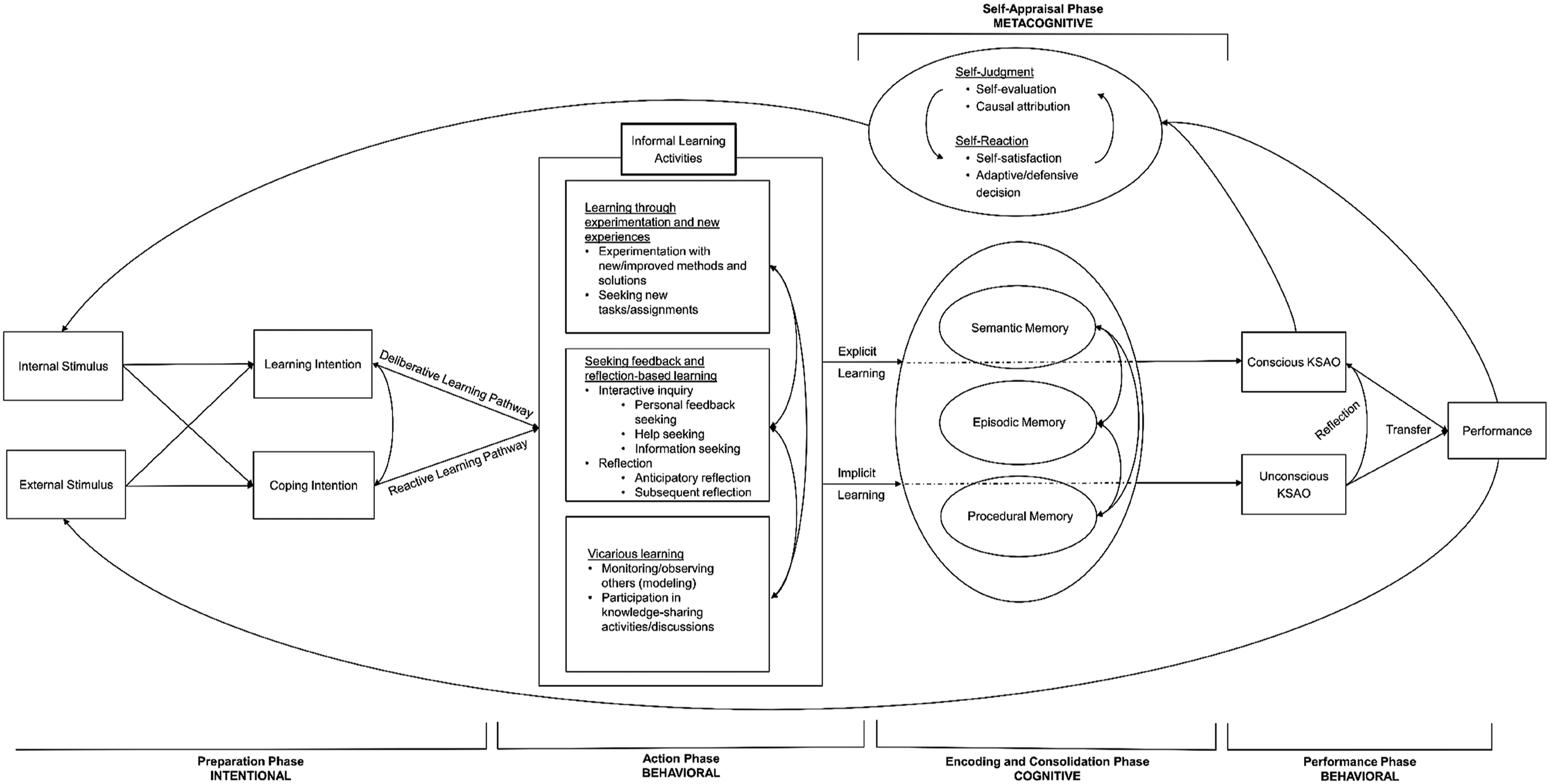
In the preparatory phase, an internal or external stimulus prompts the learner to form an intention. This intention can be specifically focused on learning, or on coping with a problem or challenging situation. In the action phase, the intention leads to informal learning activities, which include learning through experimentation and new experiences, seeking feedback and reflection-based learning, as well as vicarious learning. Representing these learning experiences in the memory system via explicit or implicit learning pathways leads to integrating new information into existing memory structures during the encoding and consolidation phase. All memory systems can yield conscious as well as unconscious KSAOs; however, in line with Eraut (2000, 2004), we argue that semantic and episodic memory tend to shape conscious KSAO development, while procedural memory tends to shape unconscious KSAO development. Reflection processes can make the learner aware of unconscious KSAOs. The performance phase involves applying these KSAOs via transfer of learning, for instance, to new tasks. External feedback on performance or the learning process can act as an external stimulus, initiating the learning cycle anew. Alternatively, metacognitive evaluation in the self-appraisal phase can serve as a new internal stimulus, also triggering a new informal learning cycle. In the next section, we introduce the five phases in detail and outline the underlying learning mechanisms.
Preparation Phase
In the preparation phase, a stimulus triggers the learning process. This stimulus can be internal or external (e.g., Marsick & Volpe, 1999). An internal stimulus is a learning trigger that emanates from the learner relatively independent of external influences, such as a desire to learn more about a work-related topic. An external stimulus is a learning trigger that comes from the work environment, including social interactions with colleagues, supervisors, or costumers, for instance, a job requirement that the employee cannot fulfill without learning. In both cases, a new challenge or an emerging problem in the work process is often what increases the employee’s interest in learning and constitutes a starting point for the learning process.
The internal or external stimulus triggers an intention. Panadero (2017) noted that learning research had distinguished between learning intention and coping intention (e.g., Boekaerts, 1996). This is in line with self-determination theory, which identifies two motivational orientations: autonomous and controlled motivation (Deci et al., 2017). Autonomous motivation, which can be tied to a learning intention, is driven by intrinsic reasons (e.g., learning for enjoyment of the content) or at least internalized reasons (e.g., learning because one attributes importance or value to the learning content, identifies with it, or sees it as an integral part of one’s role identity). Controlled motivation, which can be tied to a coping intention, is driven by extrinsic reasons (e.g., learning in anticipation of external rewards or to avoid punishment) or introjected reasons (e.g., learning in order to feel pride or to avoid negative feelings such as shame or guilt).
Depending on the intention, the learner pursues different achievement goals. Achievement goal theory distinguishes between mastery goals and performance goals, a classic distinction (e.g., Senko et al., 2011). In the case of a learning intention, learners pursue a mastery goal; that is, they strive to increase their understanding or develop personally (see also the “intrinsic learning intention” component in the octagon model of informal workplace learning; Decius et al., 2019). In the case of a coping intention, learners pursue a performance goal; that is, they want to appear competent and solve a possible problem at work effectively or efficiently (see also the “extrinsic learning intention” component in the octagon model). Employees who carry out IFBL activities are usually aware of the fact that they are developing themselves further, but the focus is not on learning, but on problem solving (Decius & Decius, 2022).
Learning intentions and coping intentions make employees follow different learning pathways. Eraut (2000) distinguished between the deliberate and reactive pathways of work-related learning. The deliberate learning pathway is characterized by “engagement in decision-making, problem-solving, [and] planned informal learning”; the reactive learning pathway comprises “incidental noting of facts, opinions, impressions, ideas; [and] recognition of learning opportunities” (Eraut, 2000, p. 116). We argue that with learning intentions, learners follow the deliberate pathway because they have a clear and conscious objective of personal development. With coping intentions, on the other hand, learners respond to job circumstances and follow the reactive pathway. Here, learning is not geared towards mastery and competence, but takes place as a (consciously perceived) by-product of the problem-solving process.
However, both types of learning intentions and the resulting learning pathways can interact, as individuals can pursue several goals at the same time (Senko et al., 2011). If an employee has both a mastery goal and a performance goal for a specific issue at work, a cue from the environment could decide which of the goals is more salient in that situation. Under subjectively perceived time pressure, for example, they might tend to focus on the performance goal and build up a coping intention, whereas in a relaxed setting they might prioritize the mastery goal and build up a learning intention. Another example of the interaction of learning intentions is the emergent learning strategy: Learners already have a learning intention in mind, but wait until a suitable learning opportunity arises; then, they respond by following the reactive path and starting the learning process (Decius & Decius, 2022; Eraut, 2000).
Action Phase
IFBL learning activities take place in the action phase. Three types of activity can be distinguished (Tannenbaum & Wolfson, 2022; Wolfson et al., 2018): learning through experimentation and new experiences, seeking feedback and reflection-based learning, and vicarious learning.
The first learning activity, learning through experimentation and new experiences, can be divided into two parts: experimentation with new/improved methods and solutions, and seeking new tasks/assignments. The first part involves learners trying out their own ideas and applying new solution strategies. Through trial and error, they attempt to find innovative or improved approaches by completing tasks differently than usual (Decius et al., 2019; Tannenbaum & Wolfson, 2022). In the second part, learners look for new tasks, accept challenging assignments and seek out new work situations in order to develop and grow (Tannenbaum & Wolfson, 2022; Wolfson et al., 2018). These activities differ in their focus on learning and problem solving from constructs such as job crafting, that is, proactively shaping the boundaries of the job or workplace, which however has been shown to be a predictor of IFBL (Decius et al., 2023).
Personal experience during the learning process is important for learning by doing, practicing skills, and receiving direct responses from the functioning or non-functioning of a task. If employees were to learn solely vicariously and without first-hand experience, for example, through observation and verbal instructions, they might tend to mistakenly view themselves as fully prepared and make incorrect attributions about the task that people with relevant experience would avoid (Tannenbaum et al., 2010).
The second learning activity of the action phase, seeking feedback and reflection-based learning, also includes two parts: interactive inquiry (Anseel et al., 2013) and reflection. With regard to interactive inquiry, we adopt the typology of Froehlich et al. (2014), who, based on Bamberger (2009), distinguished between (personal) feedback seeking, help seeking, and information seeking. Personal feedback seeking refers to proactively seeking evaluations of oneself and one’s own work; help seeking refers to proactively seeking advice to solve a specific work-related problem; and information seeking refers to obtaining knowledge for purposes other than evaluation and problem solving, such as participation in work meetings (Froehlich et al., 2019). In all three feedback types of interactive inquiry, employees can actively seek advice from experts and obtain direct feedback on their work performance (Tannenbaum & Wolfson, 2022; Wolfson et al., 2018).
The second part, reflection, can be divided into two reflective activities according to the octagon model of informal workplace learning (Decius et al., 2019), which go back to Schön (1983): anticipatory and subsequent reflection. Anticipatory reflection takes place before performing a task, as when the learner plans the sequence of steps that are important for completing the task or prepares the workplace. Subsequent reflection takes place after the task has been completed. The learner reviews work experiences, thinks about improvement options and possibly discusses them with colleagues (Tannenbaum & Wolfson, 2022). It is important for employees to seek feedback in the learning process and reflect on their performance, as they may otherwise misjudge work situations and their learning progress, and overestimate or underestimate their understanding and competence development, which can lead to mistakes or a loss of confidence in their capabilities (Tannenbaum et al., 2010).
The third learning activity of the action phase, vicarious learning, also includes two parts: monitoring/observing others (modeling) and participation in knowledge-sharing activities/discussions. Monitoring/observing others or observational learning is based on social cognitive theory (e.g., Bandura, 2005) and refers to the conscious and intentional watching of others’ actions. Individuals learn by observing the behavior of a model and its consequences from their social environment. Self-efficacy plays a facilitating role here, because an individual can only perform the observed behavior effectively if they are confident about doing so. Modeling can apply both to positive behaviors to be copied and to negative behaviors to be avoided. Anseel et al. (2013) also regard monitoring others as a feedback-seeking strategy. In fact, empirical evidence has shown that in some target groups, such as students in higher education, learning from models and vicarious feedback together form a superordinate factor (Decius, Dannowsky, & Schaper, 2024). In target groups with manual tasks such as blue-collar workers, however, both factors are only slightly related and form distinct factors (Decius et al., 2019).
Participation in knowledge-sharing activities/discussions involves an employee talking to their colleagues about work, sharing tips and tricks, or asking others to demonstrate how they complete a task (Decius et al., 2019; Tannenbaum & Wolfson, 2022; Wolfson et al., 2018). As knowledge sharing is a set of behaviors involving the exchange of information or support for others (Connelly & Kelloway, 2003), these processes are based on mutual assistance. According to social exchange theory (e.g., Cropanzano & Mitchell, 2005), employees may be inclined to share their knowledge with colleagues if they also receive helpful advice in return. This illustrates that the learning activities mentioned in the SILC are embedded in social and organizational processes.
Moreover, analogous to the fact that resources at work do not exist individually but travel in packs or caravans (Hobfoll et al., 2018), different learning activities can form learning caravans (i.e., sequences of consecutive learning activities, such as experimentation, feedback, and reflection). An employee could, for instance, try out a new solution, obtain feedback from colleagues and then reflect on this feedback. Tannenbaum et al. (2010) assumed that the learning process is particularly effective if the learning activities cover experience, feedback, and reflection. Indeed, empirical research has shown that team feedback only leads to an increase in performance if it is followed by shared reflection on the feedback (Gabelica et al., 2014).
In arguing for learning caravans, we also hypothesize that the learning activities of the three types of activity mentioned as occurring in the action phase can influence each other. Our rationale for this is that these learning activities are partially fed by the same learning sources, such as learning from oneself, from others, and from non-interpersonal sources, as well as from the Internet and new media (Kortsch et al., 2019; Noe et al., 2013). Both obtaining feedback and vicarious learning are usually based on exchanges with other individuals, although, other sources such as machines can also provide feedback and offer opportunities for monitoring. Both experimentation and reflection are based on the employee themselves as a source of learning (Decius & Hein, 2024), although they can also use non-interpersonal learning materials (e.g., reflection sheets).
Encoding and Consolidation Phase
A representation of the learning experience that occurs during the action phase is stored in memory by encoding and consolidation. During encoding, new information provided by informal learning activities such as experimentation, feedback, and reflection, as well as vicarious learning, is converted into a form that the mind can process and store (Baddeley et al., 2020). Subsequently, consolidation takes place, in which new information is stabilized and transferred to long-term memory (Lane et al., 2015). In this process, pieces of information are integrated into existing memory traces (Baddeley, 2013; NASEM, 2018).
The three separate but interacting long-term memory systems of semantic, episodic, and procedural memory are particularly relevant for learning (Baddeley et al., 2020; NASEM, 2018). The different memory systems can simultaneously store different memory content during a learning activity. Furthermore, stored memory content can be retrieved from one memory system during a learning activity to support the processing and storage of new memory content in another memory system (Lane et al., 2015; NASEM, 2018). We present three examples of the interaction between two different memory systems in the following.
Semantic memory, which stores facts and meanings, can interact during learning with episodic memory, which stores personal events and experiences. A new employee, for instance, watches a safety training video together with colleagues. The employee not only learns relevant facts about safety procedures, but also implicitly recognizes the level of importance safety has in the organization through the reactions of their colleagues.
Semantic memory can also interact with procedural memory, which stores more unconscious skills and routines that cannot be directly verbalized. An apprentice, for example, learns how to assemble components. In doing so, they gain the necessary product knowledge to be stored in semantic memory, such as properties of the physical material, but they also acquire the dexterity required for assembly, which is stored as a skill in procedural memory.
Finally, episodic memory and procedural memory can also work together. For example, an employee who implements new software trains a routine to be stored in the procedural memory by repeating various steps when calling up software submenus. Retrieving frustrating experiences stored in the episodic memory from implementing similar software at their previous employer supports the employee’s learning process.
Through this process of retrieval, encoded and consolidated memory content can be made available to the learner again during the learning process. However, no exact copies of the included mental representation are retrieved; instead, a reconstruction of the stored memory content takes place (NASEM, 2018; Roediger III & Abel, 2022). Retrieval can thus initiate a new consolidation process, as in the example of the employee mentioned above, who uses their software implementation experience from episodic memory while storing new memory content in procedural memory.
The mental processing of information acquired in the action phase through informal learning activities leads to the development of KSAOs (Tannenbaum & Wolfson, 2022; Wolfson et al., 2018). Not all KSAOs are consciously available to the learner. They can also be implicit, such as tacit knowledge that is difficult to express in language (e.g., Hadjimichael & Tsoukas, 2019; Sternberg et al., 2018). We therefore distinguish explicit and implicit learning pathways in the SILC at the intersection between the action phase and the encoding/consolidation phase. Typical examples of unconscious KSAOs are automated action patterns, such as when learning to drive a car, which may also have been partially conscious during the learning phase before becoming internalized (Eraut, 2000). However, reflection processes can make unconscious KSAOs partially conscious, for example, when internalized skills are explicated to share them with others. (Dienes & Perner, 1999; Hadjimichael & Tsoukas, 2019).
Based on the memory functions mentioned above, we argue that semantic and episodic memory, which are referred to as explicit memory systems (Baddeley et al., 2020), contribute in particular to conscious KSAOs, while procedural memory, referred to as implicit memory, contributes in particular to unconscious KSAOs. However, the distinction between conscious and unconscious KSAOs is not always clear-cut, as they are often acquired equally when engaging in a learning activity. For instance, by interacting with colleagues during the onboarding process, a new employee learns facts about structures and work processes that are conscious, largely unconscious skills such as spatial orientation in the company building or the operation of systems and machines, and partly conscious norms and rules of conduct of the organization.
Performance Phase
In the performance phase, KSAO development leads to performance. KSAOs are considered learning outcomes and performance prerequisites (Buller & McEvoy, 2012; Kraiger et al., 1993). Increased knowledge, for instance, enables the employee to solve a work-related problem. Performance involves various aspects. While traditionally work performance was defined as the proficiency with which an employee fulfilled the tasks in their job description, performance was later defined more specifically and constructs such as citizenship performance, contextual performance, adaptive performance and proactivity were introduced (Griffin et al., 2007). For the SILC, we define performance broadly as the result of applying enhanced or newly acquired KSAOs at work (i.e., transfer of KSAOs to a new challenge or task; Mehner et al., 2024). For employees, for whom work performance is reflected not only by the quality of a product or service, but also at least partly by learning progress (e.g., apprentices), work performance can also be learning performance. Both consciously and unconsciously acquired KSAOs enable the employee to perform via learning transfer, and both often interact while performing (NASEM, 2018). When operating a machine, for instance, an employee can retrieve and use newly learned and then automated action routines from procedural memory, but at the same time also consciously draws on existing experiences and factual knowledge from episodic and semantic memory to achieve optimal work performance.
Performance can lead to a new external stimulus that makes the learner run through the SILC again. One such stimulus can be feedback on their performance (Hagemann & Decius, 2024; Mandouit & Hattie, 2023). However, feedback can address not only the result of the action (i.e., performance feedback), but also the process of learning or achievement (i.e., process feedback; Gabelica et al., 2012). Colleagues or supervisors, for example, can provide feedback to the employee on how well they performed or how efficient their process was and whether or how improvements could be made. Feedback can also come from a machine or computer system, or result automatically from the task if the employee immediately sees whether a product is working properly or is malfunctioning. However, the traditional assumption that feedback primarily helps to correct errors (Guthrie, 1971) is considered outdated according to experimental findings, as feedback can also reinforce originally correct responses (Smith & Kimball, 2010).
Self-Appraisal Phase
The self-appraisal phase follows the performance phase. The learner reflects on their learning process based on their KSAO development and the performance achieved. However, metacognitive reflection on KSAO development is only possible if the learner is aware of their KSAOs (see NASEM, 2018; Sitzmann & Ely, 2011). An employee can, for instance, compare their knowledge of a software system with a desired state common in the company. If the employee has previously used the software rather intuitively, conscious reflection on their strengths and weaknesses (e. g., by using a checklist or a test of software knowledge) can make their KSAOs consciously accessible.
However, a more typical starting point for the self-appraisal phase is the work performance at the end of the learning process, for instance, the quality of the solution to an initial problem that triggered the learning process. Concerning the assessment of the subjective quality of the learning process, we refer to the self-regulated learning model of Zimmerman and Moylan (2009), which distinguishes the two interacting components of cognitive assessment (i.e., self-judgment) and affective/emotional assessment (i.e., self-reaction) of learning.
Self-judgment consists of self-evaluation and causal attribution (Zimmerman & Moylan, 2009). In self-evaluation, the employee compares their performance with a standard, namely, their own previous performance levels, performance levels of other persons, or whether they completed all critical components of the task (Zimmerman, 2000). The result of this metacognitive process can then be a new internal stimulus, for instance, when the learner perceives an improvement in performance as a result of the learning process undertaken, but evaluates the learning outcome as still insufficient.
Causal attribution refers to whether the employee attributes the achieved performance to their own ability and effort or to external factors. If an employee experiences the learning process leading up to performance as controllable, this should maintain or even increase their motivation— if, in contrast, the employee attributes failures to uncontrollable factors such as lack of talent or ability, negative motivational effects can be expected (Schunk, 2007; Zimmerman & Moylan, 2009). In the former case, the metacognitive process can provide an internal stimulus to start a new learning cycle based on the positive learning experience.
As a result of self-judgment, affective self-reactions occur, which are crucial for determining whether a new internal learning stimulus emerges from self-judgment. Self-reaction includes self-(dis)satisfaction and adaptive/defensive decisions. If an employee concludes through self-judgment that they are (dis)satisfied with the learning outcome, the likelihood of entering a new learning cycle increases (Bandura, 1989; Carver & Scheier, 1990; Zimmerman & Moylan, 2009). Both satisfaction and dissatisfaction are often accompanied by a decision to adjust one’s level of competence and engage in another learning cycle (i.e., adaptive decision; Zimmerman, 2000). However, when the employee is dissatisfied with their learning process, they may also avoid further learning efforts (i.e., defensive decision; e.g., procrastination, task avoidance; Zimmerman, 2000). Alternatively, the employee is fully satisfied with the learning outcome and feels that further learning is unnecessary. In both cases, the occurrence of a new internal stimulus would be unlikely; the learning process would come to an end.
However, there may also be a feedback loop between self-judgment and self-reaction. The affective result of the evaluation process can stimulate a new self-evaluation or change the causal attributions. This means that the metacognitive cycle can be run through several times, independently of the entire SILC, before an internal stimulus arises or does not.
The Role of Time in the SILC
Although it is recognized that time availability is an important resource for IFBL (Decius et al., 2021; Tannenbaum & Wolfson, 2022; Van der Klink et al., 2014; Wolfson et al., 2018), the informal learning research has largely neglected the role of time in modeling informal learning cycles (Decius, 2024). The models of Marsick and Watkins (1990), Tannenbaum et al. (2010), and Decius et al. (2019), for example, made no claims about how long it takes to complete an informal learning cycle. We therefore present three conceivable scenarios that consider different time spans when completing the SILC: a short-term, a medium-term, and a long-term scenario.
The short-term scenario considers a learning cycle as a matter of seconds. A learner’s brain can execute the formation of a learning or coping intention, as well as the cognitive processing of learning content in memory and metacognitive reflection, in a short period of time (e.g., NASEM, 2018). For the entire learning cycle to take only a few seconds, the learning activity in the action phase must also be completed quickly. This can be the case when reflecting on a task, trying out a single parameter such as inserting a number into a mathematical formula, or picking up single pieces of information from non-interpersonal sources such as books. Social interactions in informal learning, on the other hand, typically require more time (Crans et al., 2023; Tannenbaum & Wolfson, 2022).
In the medium-term scenario, we consider the learning process at a higher level, where the cycle can last several minutes. Following an internal or external stimulus, the formation of an intention may occur with a time delay (Eraut, 2000). An employee might perceive the problem of a production machine running erratically. This perception could be an external stimulus that elicits a coping intention to solve the problem through a learning action. However, it is likely that the employee does not form the intention immediately after noticing the problem; perhaps they ignore the problem first to avoid interrupting their usual routine of operating the machine. In addition, the learning activity often does not follow immediately after the intention is formed. Again, the employee can delay the learning process, as not all required learning resources are always immediately available (Tannenbaum & Wolfson, 2022), choosing an emergent learning strategy (Decius & Decius, 2022; Eraut, 2000). The employee might need to get a tool or find a helpful colleague before starting to analyze the problem more deeply.
In the long-term scenario, a SILC run could take several hours or even days. From this perspective, interruptions in the learning process and recovery periods between learning cycles play a key role; these occur in IFBL processes that are driven by the work environment and those that are self-directed; Federman, 2019; Zhang et al., 2022). For instance, an employee can learn something in the morning through their own trial-and-error approach and complete the learning process, including the self-appraisal phase. In the afternoon, the employee can go through another learning cycle on the same learning topic, where they get feedback from experienced colleagues on the results of their own trial-and-error experience from the morning. In the evening or the next morning, they undergo another learning cycle focusing on task reflection based on the feedback they have received. On the other hand, the employee can go through the learning cycle to performance in one run, but then a longer time can elapse before the self-appraisal phase.
As time is a limited and therefore precious resource, not only in working life, understanding the role of time in IFBL can help to support different SILC processes efficiently. The fact that all three scenarios are likely to occur, depending on learners, jobs, learning tasks, and situations (Tannenbaum & Wolfson, 2022), highlights the need for research on the role of time in informal learning. Open questions in this regard are, for instance, whether different cognitive processes are involved in the three scenarios mentioned, or whether longer runs of the SILC, compared to shorter runs, place a stronger emphasis on semantic, episodic, or procedural memory. Furthermore, it could be that only certain phases of the entire IFBL cycle, such as the formation of an intention in the preparation phase or the metacognitive reflection in the self-appraisal phase, require more or less time, while other components, such as the IFBL activities in the action phase, show less temporal variance regardless of the scenario. We strongly advocate the use of intensive longitudinal research designs, laboratory and field experiments, and a combination of observations, surveys, and objective measures to address these blind spots in the IFBL research.
Discussion
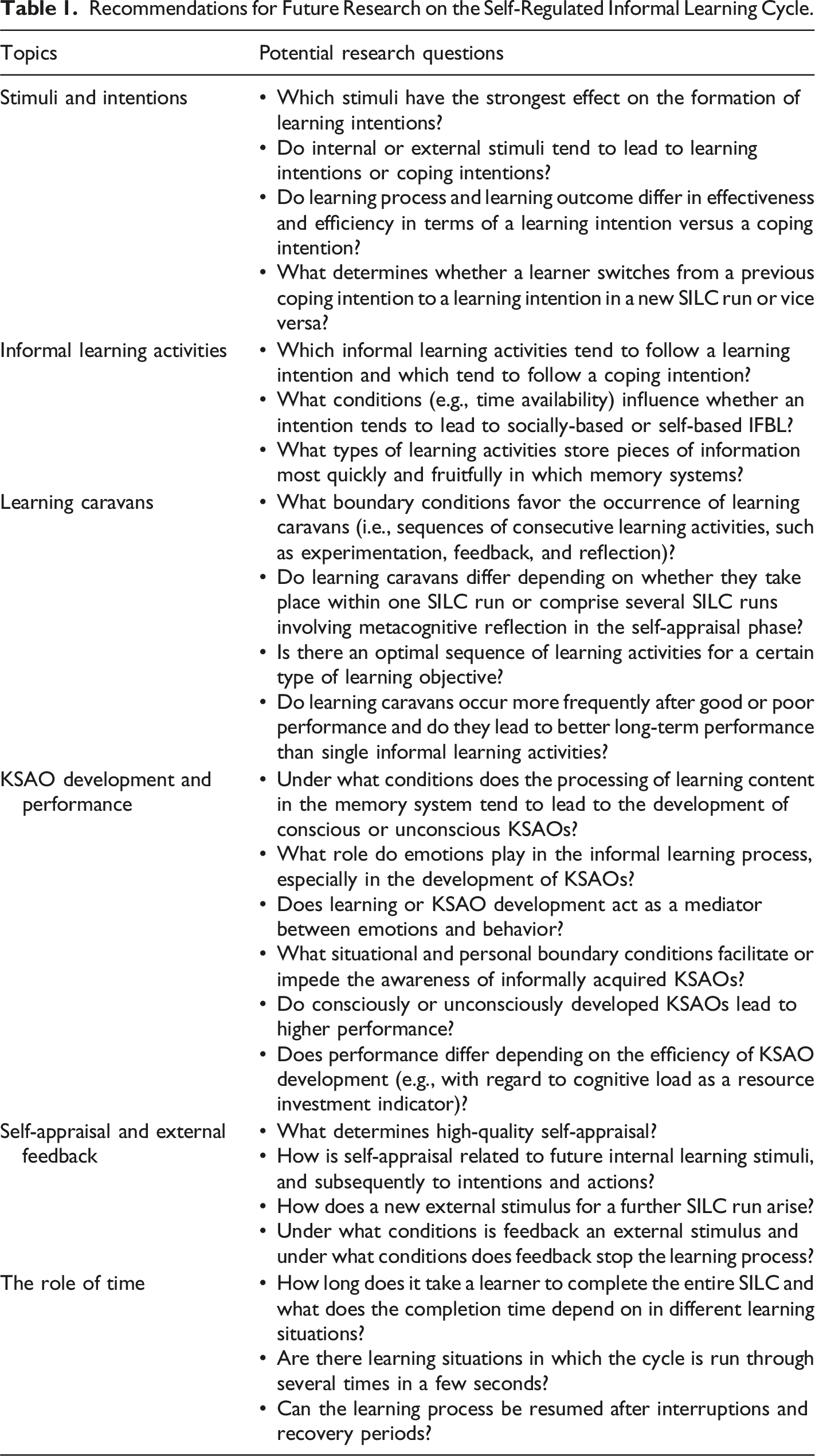
Recommendations for Future Research on the Self-Regulated Informal Learning Cycle.
Limitations, Implications from the SILC, and Future Research Directions
We see the SILC model as a starting point for further research to continue empirical investigation of the cognitive perspective on IFBL. In the following, we discuss limitations of the model and explain how researchers can address them to advance IFBL research. We also present implications from the SILC model for research and practice; in particular, how the SILC can make stakeholders aware of the fact that the informal learning process consists of motivation, behavior, cognition, as well as metacognition, and thus requires a holistic approach. We organize our discussions according to three transitions central to our model: from motivation to behavior, from behavior to cognition, and from cognition (via performance) to metacognition. However, prior to that, we would like to make three general remarks on the limited perspective we take on informal learning by focusing on IFBL, on potential overlaps between informal and self-regulated learning, and on the role of the broader context that is outside the scope of the SILC model.
First, it should be noted that the SILC model focuses on informal field-based learning only. IFBL is just a subset of informal learning, characterized by intentionality and self-directedness (Wolfson et al., 2018). We thus omit non-intentional, incidental learning (e.g., Watkins & Marsick, 1992), which the SILC makes no claim to explain. The reason for this focus is that we aim to map the metacognitive reflection process in informal learning, which is a conscious and self-directed process. Although it is possible that the SILC mechanism applies to other types of informal learning as well, such as social informal learning (Crans et al., 2021), we do not claim that the SILC explains these other types of informal learning. However, the SILC offers starting points for integrating various (more or less intentional and purposeful) perspectives on informal learning, as we take into account deliberative and reactive learning pathways, explicit and implicit learning, as well as conscious and unconscious KSAOs.
Second, in developing the SILC, we drew on mechanisms of self-regulated learning. We agree with researchers who have emphasized the strong conceptual and empirical relationship between informal and self-regulated learning (e.g., Kittel & Seufert, 2023), which are both intentional and self-directed (Wolfson et al., 2018). However, they are considered distinct forms of learning (see Decius, 2020; Decius, Knappstein, & Klug, 2024). Meta-analyses have shown different predictors for both forms of learning (Cerasoli et al., 2018; Sitzmann & Ely, 2011), and they also show different associations with outcome variables such as employability (Decius, Knappstein, & Klug, 2024).
Third, the SILC model aims to unravel the how and why behind IFBL as a phenomenon, taking both a behavioral and a cognitive perspective. The aim was not to map person- and context-related conditions that might foster or hinder IFBL. Some conceptual models (e.g., Tannenbaum et al., 2010; Tannenbaum & Wolfson, 2022) and various review studies (e.g., Jeong et al., 2018; Kyndt & Baert, 2013) have been published on antecedents of informal workplace learning, including IFBL, which give a more complete picture of how personal and situational characteristics might hinder or hamper the IFBL process discussed in this article.
Combining Motivational and Behavioral Perspectives
In combining motivational and behavioral perspectives in the SILC, we discuss the link between intentions and IFBL activities, the effectiveness of the learning pathways, and the distinction between internal and external stimuli.
As we consider intentional IFBL in the SILC, the intention in the preparation phase leads to explicit learning activities in the action phase. Nevertheless, we agree with Eraut (2004) that intentional learning from experience always includes implicit processes, and that the awareness of explicit learning does not prevent implicit learning from taking place at the same time. We also assume that both learning and coping intentions can be linked with any subsequent informal learning activity. An employee can, for instance, obtain feedback from a colleague regardless of whether they primarily want to learn and develop or want to solve a problem. Based on an observable learning activity, we cannot therefore deduce the intention that led to this activity. Nevertheless, there could be learning activities that are more frequently linked with coping intentions and learning activities that are more frequently linked with learning intentions. In coping situations, for example, employees might prefer socially-based informal learning, which may promise faster insights through direct inquiry with colleagues, while with a pronounced learning focus, they might tend to experiment with their own solutions through self-based informal learning (Decius & Hein, 2024). Future research could investigate these assumptions to unpack the complex mechanisms operating between intentions and the undertaking of learning activities, which is necessary to derive practical implications for IFBL enhancement.
The SILC makes no claims about the effectiveness of the learning pathways in the model, as addressed in the review by Poell et al. (2018). However, there might be differences in effectiveness and learning outcomes depending on whether the learner has a learning intention and takes the deliberate pathway or a coping intention and takes the reactive pathway. Results from achievement goal research have shown that an individual with a performance goal (i.e., focusing on task fulfillment rather than personal development, comparable to a coping intention) tends to consider distinct units of information in the learning process separately, as well as preferring high learning speed and immediate recall of what has been learned (NASEM, 2018). However, this can impair long-term learning success. On the other hand, pursuing a mastery goal (i.e., focusing on personal development rather than task fulfillment, comparable to a learning intention) can support long-term learning success (Crouzevialle & Butera, 2013). This suggests that the deliberate pathway tends to represent deep learning and the reactive pathway tends to represent superficial learning (Kirby et al., 2003): Deep learning involves more in-depth processing of learning, such as connecting ideas and concepts and relating new knowledge to previous knowledge. Surface learning, in contrast, skips this additional processing, such as by implementing the first-best solution or using methods that have been successful in the past (Froehlich et al., 2014). A similar distinction was made by Perkins et al. (2013) between development stance and completion stance. Regarding IFBL, however, the relationships between achievement goals and IFBL are rather complex and ambiguous (Decius & Hein, 2024). Further research is needed to investigate, for instance, how effective and efficient the learning process and the learning outcome are with a learning intention versus a coping intention, and the role of time regarding SILC completion, from stimulus to performance and self-appraisal.
The SILC distinguishes between internal and external stimuli. This is a rough classification, but to our knowledge there is no established typology of learning stimuli—future research could further differentiate the stimuli. The frequency and intensity of perceived internal learning stimuli may depend on employee predispositions, such as curiosity or the ability to recognize learning opportunities (i.e., self-directed learning orientation), which are considered IFBL antecedents (Cerasoli et al., 2018; Decius et al., 2021; Gijbels et al., 2012). Whether an employee perceives a job requirement or challenge as an external stimulus may also depend on the relative difference between their abilities and the abilities required to perform the task (Decius*/Schilbach* & Graßmann, 2024; *shared first authorship). The same objective requirement could be stimulating for a rather experienced employee, whereas it could be overchallenging for a novice and underchallenging for an expert, and therefore not stimulating in either case. Further research is needed on what stimuli have the strongest effects on learning intentions and whether they are internal or external stimuli.
Combining Behavioral and Cognitive Perspectives
In combining behavioral and cognitive perspectives in the SILC, we discuss the concept of learning caravans, the complexity of memory processes, and the development of conscious and unconscious KSAOs.
Following Tannenbaum et al. (2010), we have argued for the existence of learning caravans when, for example, feedback, reflection, or experimentation trigger each other and are sequenced. It is still unclear under what conditions such a learning caravan may occur in the action phase within a SILC run without a metacognitive phase involved, and under which conditions a learning caravan comprises several SILC runs, in which a learner engages in different learning activities in each associated action phase. Future research could investigate whether there is an optimal sequence of learning activities for certain types of learning objectives in multiple SILC runs. At the team level, there is evidence that feedback improves performance only if it is followed by reflection (Gabelica et al., 2014). For individual learners, however, it may also be conceivable, depending on the learning situation, to first reflect on their task themselves and then obtain feedback. Whether this will result in more learning and better performance, and whether learning caravans are more likely to occur with good or poor performance, could be investigated experimentally—preferably with objective performance measures, as previous IFBL research has almost exclusively used self-assessments of performance (Cerasoli et al., 2018). Future findings on informal learning caravans can help managers provide guidance on situationally appropriate support for IFBL while still considering formal learning activities such as training (Blume et al., 2024).
The neuronal memory processes involved in informal learning are complex and, despite intensive research, have not yet been fully untangled (Baddeley et al., 2020; NASEM, 2018). In the SILC, we present these processes in a simplified way by only referring to the interaction of the memory systems when considering IFBL. However, we would like to note that during retrieval from memory information is re-encoded, whereby memories can be altered, supplemented, or distorted (Baddeley et al., 2020; NASEM, 2018; Roediger III & Abel, 2022). Strictly speaking, this can be regarded as a new learning process. In addition, (re)consolidation of what has been learned also takes place increasingly during phases of sleep (Diekelmann & Born, 2010; Walker & Stickgold, 2006). This suggests that future research on the time course of IFBL may need to consider what happens during sleep after a learning experience.
We have argued that the three memory systems contribute to the development of conscious and unconscious KSAOs, to varying degrees, the latter of which may take on the role of tacit knowledge (Hadjimichael & Tsoukas, 2019). Future research could investigate what boundary conditions could be responsible for any within-person differences in varying situations or over time. A personal experience, for instance, such as a controversial discussion with a colleague, which is primarily processed in episodic memory, could lead to the development of conscious knowledge about operational processes in another department, if the discussion is about organizational processes. However, if the discussion involves private topics, the learner might primarily store unconscious knowledge about attitudes and norms. Affective events theory, which states that events or situations in the workplace can trigger emotions that influence employee behavior and performance, could provide a conceptual framework here (Weiss & Cropanzano, 1996). Learning, or more specifically KSAO development, could be a mediator between emotions and behavior.
Combining Cognitive and Metacognitive Perspectives
In combining cognitive and metacognitive perspectives in the SILC, we discuss reflection on KSAOs to become aware of unconscious KSAOs, the role of feedback as an external stimulus for a further SILC run, and how metacognitive self-appraisal can create a new internal stimulus.
Despite the research on tacit knowledge, little is known about what situational and personal boundary conditions facilitate or hinder the awareness of informally acquired unconscious KSAOs (Hadjimichael & Tsoukas, 2019). The learner must use cognitive and presumably also temporal resources to become aware of the KSAOs through reflection, which—arguing from resource approaches such as the job demands-resources model (Bakker & Demerouti, 2017) or conservation of resources theory (Hobfoll et al., 2018)—they would only do if this is beneficial to them, as a futile investment of resources can lead to stress. Cognitive load theory (Sweller, 2010) could provide a conceptual framework for investigation to determine what processes of KSAO awareness are linked to what type and extent of cognitive load. Considering empirical findings on curvilinear relationships between workload and learning (van Ruysseveldt & van Dijke, 2011), a medium level of cognitive load could be optimal for KSAO development. In addition, research could examine whether there are differences in performance based on learning transfer of consciously versus unconsciously developed KSAOs. Regarding KSAO awareness, employees may promote their metacognitive reflection through developing a positive reflection mindset as part of a growth mindset (Rogers et al., 2023) to increase the effectiveness of their learning with each run of the SILC. Supervisors and human resources departments can support them in this by designing IFBL-promoting work conditions such as a positive learning climate, opportunities for proactive work behaviors, slack (i.e., resources such as time) for learning, or formal organizational practices such as IFBL recognition (Abel et al., 2016; Blume et al., 2024; Cerasoli et al., 2018; Decius et al., 2023; Parker, 2017; Tannenbaum & Wolfson, 2022).
Feedback can also be a new external stimulus for another SILC run. However, whether feedback leads to a new run or brings the learning process to a halt, despite not achieving desired performance, could depend on the employee’s feedback orientation, self-reflection tendency and competence, as well as on the task type and the work environment (Crans et al., 2021; Froehlich et al., 2019). Feedback availability (Anseel et al., 2013) could also influence the choice of the (new) learning activity. For instance, a learning demand, such as the need to learn about digital access to a highly company-specific software system, might be more easily addressed by a quick question to an experienced colleague rather than by a lengthy search of documents on the company’s intranet. However, a rather timid employee might still prefer the intranet search.
Future research could also investigate what mechanisms are particularly important for high-quality self-appraisal in IFBL. One research question could be whether self-judgment and self-reaction always inevitably occur together (see Zimmerman & Moylan, 2009), or whether learners can also react purely cognitively, for example, by attributing certain causes to the learning process without having an affective reaction such as (dis)satisfaction follow. Supervisors who are guided by the SILC to understand these metacognitive IFBL processes can assist their employees in maintaining their motivation to learn even when negative affective reactions occur, by openly addressing these situations and modeling a positive error culture (Wolfson & Tannenbaum, 2022). Furthermore, the question arises whether this affective reaction is already a new internal stimulus itself, or merely an antecedent of an internal stimulus, and whether mediators additionally explain the association between self-appraisal and stimulus. The self-appraisal phase is also likely to have an impact on future SILC runs. Through metacognition, a learner who initially pursued a coping intention could subsequently pursue a learning intention because they are more interested in the learning content or have internalized it more strongly (Deci et al., 2017). Future research could also examine the extent to which metacognitive processes influence the formation of learning caravans, such as those described above.
Conclusion
The SILC provides a holistic perspective on the process of informal field-based learning. By incorporating elements from memory research in the encoding and consolidation phase of the model and elements from self-regulated learning research in the preparatory and self-appraisal phases, we enrich the literature on IFBL process models with the previously largely neglected cognitive perspective. We also incorporate motivational theories to fine-tune intention as a starting point for IFBL. Human resource development researchers are provided with a theoretical framework for more in-depth empirical investigation of IFBL’s underlying mechanisms. Our model integrates different strands of research on IFBL. However, the proposed research agenda reveals that the links between different perspectives on IFBL should be explored further. We therefore encourage future research to test the model empirically and to refine the individual process stages based on evidence, in order to better understand the entire informal learning process and to make it more effective for learners and organizations in the future. Human resource developers who want to support their employees in their IFBL should keep in mind to consistently consider motivation, behavior, cognition, and metacognition in order not to overlook any important stages in the IFBL process.
